
21 11 2017 1 Good Governance Social Sustainability
21 -11 -2017 | 1 Good Governance, Social Sustainability, and Human Rights Obligations of Business Actors Prof. Dr. Aurelia Colombi Ciacchi University of Groningen (NL)
21 -11 -2017 | 2 GOOD GOVERNANCE DISCUSSIONS Academic discussions on good governance in several disciplines, including: 1. Political economy 2. International relations 3. Political science 4. Administration studies 5. Law
21 -11 -2017 | 3 THE BIRTH OF THE MODERN GOOD GOVERNANCE DISCOURSE After the Cold War, World Bank and IMF “retraced what happened in the 1980 s and concluded that their structural adjustment programmes in developing countries had failed because of institutional weakness, especially in Africa” Good governance requirements introduced as borrowing conditions. (Wouter & Ryngaert, ‘Good Governance: Lessons from International Organisations’, in: Curtin & Wessel (eds), Good Governance and the European Union, Intersentia 2005)
21 -11 -2017 | 4 POLITICAL ECONOMY: WORLD BANK WB 1989: term “good governance” first used WB 1992: governance = “the manner in which power is exercised in the management of a country’s economic and social resources for development” WB Six good governance indicators: 1. Voice and Accountability 2. Political Stability and Absence of Violence 3. Government Effectiveness 4. Regulatory Quality 5. Rule of Law 6. Control of Corruption
21 -11 -2017 | 5 WORLD BANK INDICATORS 1, 3, 4 1. Voice and Accountability = the extent to which citizens are able to participate in selecting their government 3. Government Effectiveness = the quality of public services and their independence of political bargaining; the quality of policy formulation and implementation; the credibility of government commitment to such policies 4. Regulatory Quality = the consistency in formulation and implementation of policies that promote private sector development
21 -11 -2017 | 6 BUT DOES THE WORLD BANK ITSELF COMPLY WITH ITS OWN GOOD GOVERNANCE STANDARDS? Lottie Lane 2018: “While the World Bank appears to adopt definitions and criteria for good governance within countries wishing to receive funding from the institution, it in practice sometimes neglects to consider the standards as being applicable to its own operations, particularly in the context of international human rights”.
21 -11 -2017 | 7 WB’s DOING BUSINESS REPORTS Since 2004 annual World Bank Doing Business reports measuring the business friendliness of regulations in more than 100 countries Methodology: US economists (La Porta et al. 1997 -2008) Comparative assessment of business friendliness of national regulatory instruments through indicators “numerical comparative law” (Siems 2004) Heavy pro-US bias Heavy neo-liberal bias
21 -11 -2017 | 8 UNITED NATIONS: PRINCIPLES OF GOOD GOVERNANCE 1. Equity 2. Participation 3. Pluralism 4. Transparency 5. Accountability 6. Rule of law 7. Effective and efficient public administration
21 -11 -2017 | 9 EUROPEAN UNION: FIRST USES OF GOOD GOVERNANCE CONCEPT 28 Nov 1991 Council Resolution on human rights, democracy and development: “…human rights and democracy form part of a larger set of requirements in order to achieve balanced and sustainable development”… “In this context, account should be taken of the issue of good governance”. “For the EU, good governance belongs to the same political category as human rights, democratic principles and the rule of law” (Wouter & Ryngaert 2005)
21 -11 -2017 | 10 EUROPEAN GOVERNANCE: A WHITE PAPER - COM(2001)428 5 principles of good governance: 1. Openness – ”work in a more open manner”, “actively communicate”, use accessible language 2. Participation – “The quality, relevance and effectiveness of EU policies depend on ensuring wide participation throughout the policy chain…” 3. Accountability – “Each of the EU institutions must explain and take responsibility for what it does in Europe”
21 -11 -2017 | 11 EUROPEAN GOVERNANCE: A WHITE PAPER (continued) 4. Effectiveness – “Policies must be effective and timely, delivering what is needed on the basis of clear objectives, an evaluation of future impact and, where available, of past experience. Effectiveness also depends on implementing EU policies in a proportionate manner and on taking decisions at the most appropriate level” 5. Coherence – “Policies and action must be coherent and easily understood”… “ensure a consistent approach within a complex system”
21 -11 -2017 | 12 POLITICAL SCIENCE - Gisselquist 2012 7 core components of good governance: 1. Democracy and representation 2. Human rights 3. Rule of law 4. Efficient and effective public management 5. Transparency and accountability 6. Developmental objectives 7. “a varying range of particular political and economic policies, programmes, and institutions (e. g. elections, a legislature, a free press…) that are conducive to the previous six components”
21 -11 -2017 | 13 HAZENBERG 2018 Jilles Hazenberg, The Good Governance of Transnational Private Relationships for a Sustainable Society, 2018 Jilles Hazenberg, ‘Good Governance Contested’, in: Holzhacker, Wittek & Woltjer (eds), Decentralization and Governance in Indonesia, Springer 2015, p. 31 -52 Social sustainability: goal of good governance Social sustainability interpreted with reference to basic human rights
21 -11 -2017 | 14 WHAT ARE HUMAN RIGHTS? I. Natural law approach: basic human rights (life, bodily integrity, liberty, property. . . ) are inherent to every human being. They pre-exist to laws. Laws merely acknowledge them. See eg Locke, Two Treatises on Government 1689. II. Positive law approach: all rights are created by laws. Human rights only exist insofar as provided by laws, either national laws or international documents (UDHR, ECHR, etc). My position: a combination of both approaches natural core + legal boundaries of a right.
21 -11 -2017 | 15 LEGAL SOURCES OF HUMAN RIGHTS I. National law: eg 1215 Magna Carta; 1776 American Declaration of Independence, 1789 French Déclaration des droits de l’homme e du citoyen; UK Human Rights Act 1998 II. International law: eg UDHR 1948; ECHR 1950; International Covenant on Economic, Social and Cultural Rights 1966 III. Regional (supranational) law: eg African Charter on Human and Peoples’ Rights 1981; Charter of Fundamental Rights of the EU 2000; ASEAN Human Rights Declaration 2012
21 -11 -2017 | 16 HUMAN RIGHTS: THREE GENERATIONS I. Civil and political rights – some of which already acknowledged in the Magna Carta, the American Declaration of Independence, and the French Déclaration des droits de l’homme e du citoyen. UN: International Covenant on Civil and Political Rights 1966 (binding) II. UN: International Covenant on Economic, Social and Cultural Rights 1966 (binding); further binding international treaties III. Collective (or solidarity) rights – eg right to development; right to healthy environment
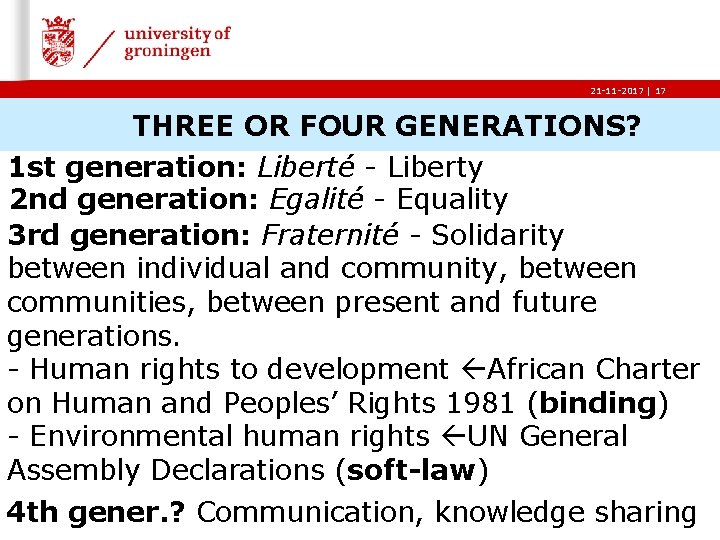
21 -11 -2017 | 17 THREE OR FOUR GENERATIONS? 1 st generation: Liberté - Liberty 2 nd generation: Egalité - Equality 3 rd generation: Fraternité - Solidarity between individual and community, between communities, between present and future generations. - Human rights to development African Charter on Human and Peoples’ Rights 1981 (binding) - Environmental human rights UN General Assembly Declarations (soft-law) 4 th gener. ? Communication, knowledge sharing
21 -11 -2017 | 18 HUMAN RIGHTS: LEGAL EFFECTS Generations of human rights = purely descriptive – historical, not legal categories. Completely independent of its categorization as a 1 st, 2 nd, 3 rd or 4 th generation right, the legal effects / legal obligations created by each human right depend on the binding force of the specific law or Treaty acknowledging that right. The actual scope of protection of a human right is also determined by court decisions.
21 -11 -2017 | 19 HUMAN RIGHTS OBLIGATIONS (1) Negative h. r. obligations: eg obligation not to kill, not to injury, not to intrude into one’s privacy, not to restrict one’s freedom of expression or freedom of religion, not to discriminate, etc. Positive h. r. obligations: eg obligation to provide health care, clean water, education, workers’ safety & welfare, pension schemes, etc. BUT: The protection of one and the same human right might require both negative and positive action (religious freedom, non-discrimination…)
21 -11 -2017 | 20 HUMAN RIGHTS OBLIGATIONS (2) I. Obligations to respect h. r. : obligations to refrain from taking any action that would infringe the enjoyment of a h. r. (eg prohibition to publish details on Naomi Campbell’s drugs addiction) II. Obligations to protect h. r. : obligations to prevent, investigate and punish infringements of human rights III. Obligations to fulfil h. r. : obligations to facilitate and provide human rights. Eg provision of essential services: water, health care, etc.
21 -11 -2017 | 21 HUMAN RIGHTS OF BUSINESSES? YES. Some human rights can be held by a collective entity such as a business firm: Assembly, association – Art. 20 UDHR, Art. 11 ECHR Property - Art. 17 UDHR, Art. 1 1 st Prot. ECHR Privacy, home, correspondence - Art. 12 UDHR, Art. 8 ECHR Fair trial - Art. 10 UDHR, Art. 6 ECHR Effective remedy before national authority – Art. 13 ECHR Freed. to conduct a business? Art. 16 CFREU
21 -11 -2017 | 22 HUMAN RIGHTS OBLIGATIONS OF BUSINESS ACTORS? With “business actors” here I mean private, i. e. non-state businesses and business persons. Private actors = all individuals and collective entities other than public authorities. Traditional understanding of human rights: they create obligations for the state, that is for public authorities. International treaties + decisions of European Court of Human Rights: only binding for states.
21 -11 -2017 | 23 WE LIVE IN THE ERA OF PRIVATE POWERS! I believe that the traditional state-centric understanding of human rights no longer fits the contemporary world, dominated by private powers. Human rights were conceived in the Enlightenment era (17 th-18 th century) as natural rights to be protected FROM the state and BY the state. Multinational corporations today are much more powerful than states!
21 -11 -2017 | 24 MULTINATIONAL CORPORATIONS: BOTH VIOLATORS AND FOSTERERS OF HUMAN RIGHTS Google, Facebook, the press, TV etc. can intrude in one’s privacy, freedom of expression, freedom of information more than public authorities. But they also can protect these rights from interferences of third parties. Energy multinationals, car producers, tobacco producers interfere with the right to health and the right to a clean and healthy environment. But they give work and welfare life and health.
21 -11 -2017 | 25 HUMAN RIGHTS & BUSINESS ACTORS: NATIONAL LEVEL Academic research on fundamental/human rights and non-state actors: longer tradition, more publications for what concerns the national than the international level. Some fundamental (human) rights of workers enshrined in national Constitutions (France, Germany, Italy) are directly binding also for private parties. Creative role of courts and academics direct / indirect horizontal effect of fundamental rights
21 -11 -2017 | 26 HUMAN RIGHTS & BUSINESS ACTORS: INTERNATIONAL LEVEL (1) “OECD Guidelines for Multinational Enterprises – Recommendations for responsible business conduct in a global context” (1976 -2011) = Soft law (not legally binding). Required adhering States to establish a National Contact Point (NCP) = mediation and conciliation platform for helping to resolve cases of non-compliance with the Guidelines Since 2011 the number of NCP cases dealing with human rights has increased dramatically!
21 -11 -2017 | 27 HUMAN RIGHTS & BUSINESS ACTORS: INTERNATIONAL LEVEL (2) 2011 UN Guiding Principles on Business and Human Rights (drafted by Ruggie + endorsed by the Human Rights Council): soft law 2014 UN Human Rights Council Resolution 26/9 intergovernmental working group established “to elaborate an internationally legally binding instrument to regulate (…) the activities of transnational corporations and other business enterprises”. Future Treaty on business and human rights?
21 -11 -2017 | 28 BUSINESS AND HUMAN RIGHTS: OHCHR The Office of the UN High Commissioner for Human Rights (OHCHR) has a mandate to: • Lead the business and human rights agenda within the UN system • Develop guidance and training relating to the dissemination and implementation of the UN Guiding Principles on B & HR - provide advice, tools and guidance - support capacity building on B&HR to all stakeholders at the national level - provide technical support to HR mechanisms
21 -11 -2017 | 29 B & HR: OHCHR (continued) • The Accountability and Remedy Project - major project conducted by OHCHR since 2014 - Aimed at enhancing accountability and access to remedy in case of business involvement in serious human rights abuse • UN Working Group on Business and Human Rights = 5 independent experts - supported and advised by OHCHR - guides the work of the Forum on B & HR - publishes reports
21 -11 -2017 | 30 UN FORUM ON BUSINESS AND HUMAN RIGHTS Inspiration: UN Guiding Principles on Business and Human Rights 2011 Organizing entity: UN Working Group on Business and Human Rights 2012 -2019: 1 st -8 th Annual Forum on Business and Human Rights (Geneva) 25 -27 November 2019
21 -11 -2017 | 31 I DID NOT DO THE RESEARCH ALONE… Jilles Hazenberg, The Good Governance of Transnational Private Relationships for a Sustainable Society, 2018 Jilles Hazenberg, ‘Good Governance Contested’, in: Holzhacker, Wittek & Woltjer (eds), Decentralization and Governance in Indonesia, Springer 2015, p. 31 -52 Lottie Lane, The Horizontal Effect of International Human Rights Law: Towards a Comparative Law and (Multi-Level) Governance Approach, 2018
- Slides: 31