
21 04 2009 Namwater Desalination Plant Mile 6
- Slides: 23
21 -04 -2009 Namwater Desalination Plant: Mile 6 (Swakopmund) EIA: Water & Wastewater Management Philip de Souza
Specialist Study Components… • • • Literature review and interactions Brief consideration of water and groundwater environments Technology review Water use Wastewater treatment and associated discharges/disposal Stormwater impacts Preliminary water balance Identification of any opportunities for improving integrated water management/promoting water conservation North/South scenarios NO significant impact on the water & wastewater management study
Legislative Aspects… • Water Resources Management Act (Act 24 of 2004) – – • • • Part VIII – Licence To Abstract And Use Water Part XI – Water Pollution Control Draft Pollution Control and Waste Management Bill (1999) Taking water from a water resource (e. g. from the sea) Storing water on-site (e. g. in a reservoir) Discharging waste or water containing waste into a water resource through a pipe, canal, sewer or other conduit (e. g. brine disposal to the sea, wash water disposal to sea, spillages of chemicals/oil? ) Disposing of waste in a manner, which may be detrimental on the water resource (e. g. disposal of solid waste, oil, chemicals with subsequent pollution of groundwater resources)
Potential Impacts… • Water use – Construction (earthworks, etc) – Operations (drinking-water, process water, etc) • Wastewater discharge – Domestic wastewater – Process wastewaters (concentrated brine, wash waters) – Contaminated stormwater (poor housekeeping – spillages) – Sludge handling/disposal
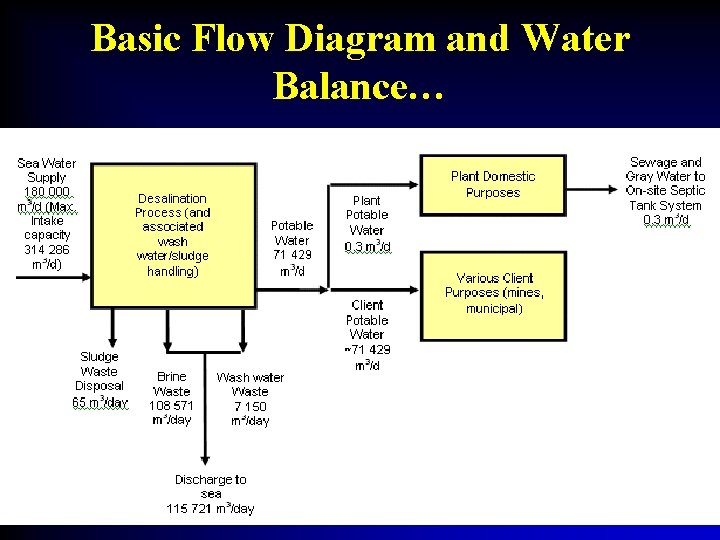
Basic Flow Diagram and Water Balance…
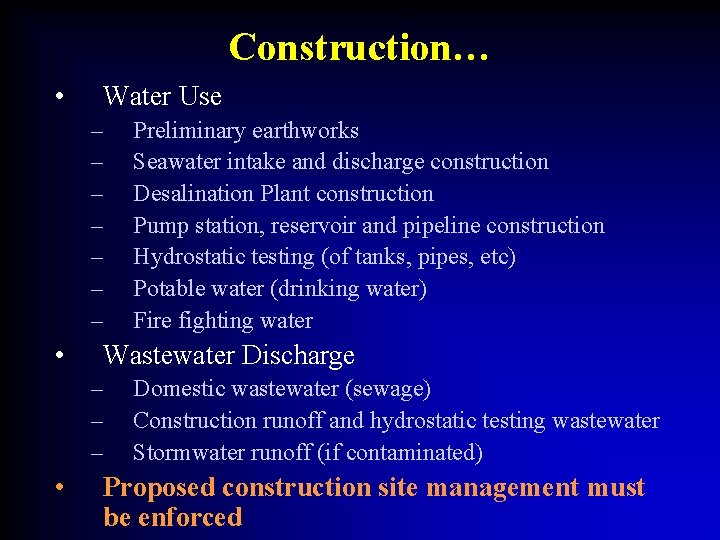
Construction… • Water Use – – – – • Wastewater Discharge – – – • Preliminary earthworks Seawater intake and discharge construction Desalination Plant construction Pump station, reservoir and pipeline construction Hydrostatic testing (of tanks, pipes, etc) Potable water (drinking water) Fire fighting water Domestic wastewater (sewage) Construction runoff and hydrostatic testing wastewater Stormwater runoff (if contaminated) Proposed construction site management must be enforced
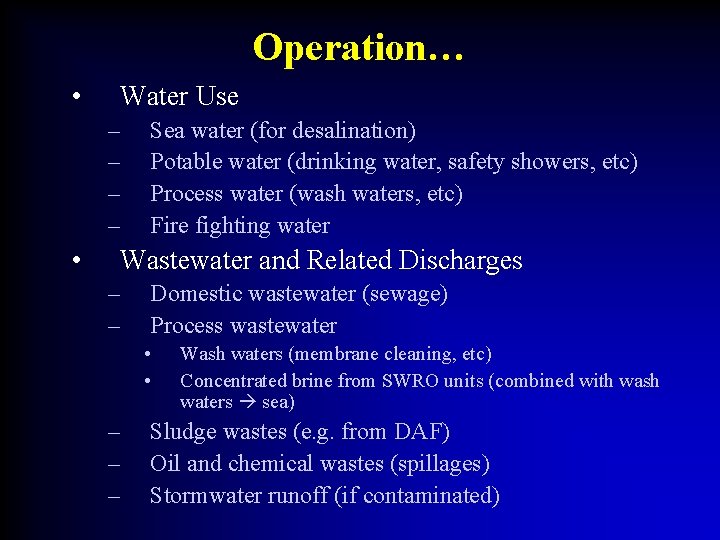
Operation… • Water Use – – • Sea water (for desalination) Potable water (drinking water, safety showers, etc) Process water (wash waters, etc) Fire fighting water Wastewater and Related Discharges – – Domestic wastewater (sewage) Process wastewater • • – – – Wash waters (membrane cleaning, etc) Concentrated brine from SWRO units (combined with wash waters sea) Sludge wastes (e. g. from DAF) Oil and chemical wastes (spillages) Stormwater runoff (if contaminated)
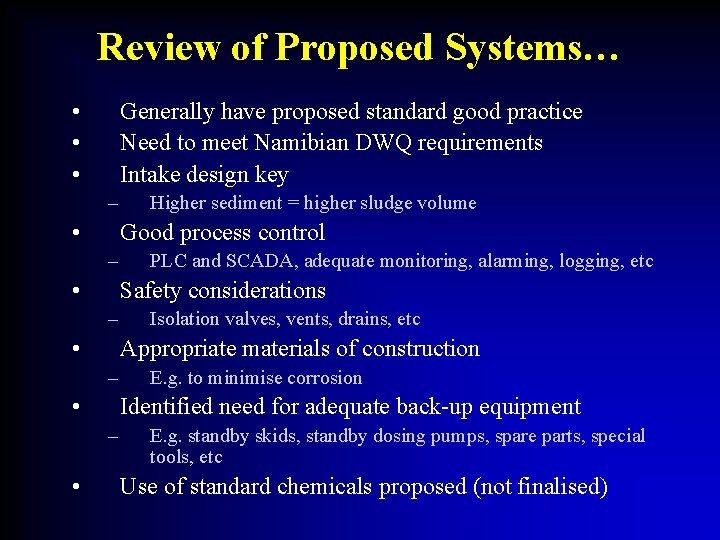
Review of Proposed Systems… • • • Generally have proposed standard good practice Need to meet Namibian DWQ requirements Intake design key – • Good process control – • PLC and SCADA, adequate monitoring, alarming, logging, etc Safety considerations – • Isolation valves, vents, drains, etc Appropriate materials of construction – • E. g. to minimise corrosion Identified need for adequate back-up equipment – • Higher sediment = higher sludge volume E. g. standby skids, standby dosing pumps, spare parts, special tools, etc Use of standard chemicals proposed (not finalised)
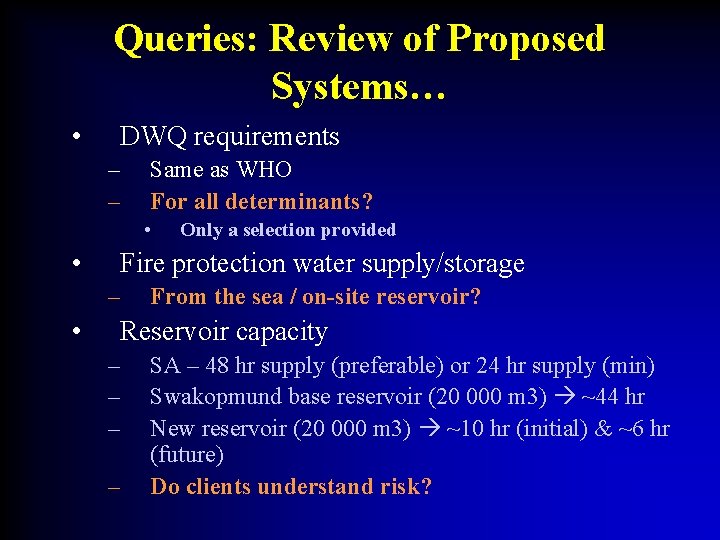
Queries: Review of Proposed Systems… • DWQ requirements – – Same as WHO For all determinants? • • Fire protection water supply/storage – • Only a selection provided From the sea / on-site reservoir? Reservoir capacity – – SA – 48 hr supply (preferable) or 24 hr supply (min) Swakopmund base reservoir (20 000 m 3) ~44 hr New reservoir (20 000 m 3) ~10 hr (initial) & ~6 hr (future) Do clients understand risk?
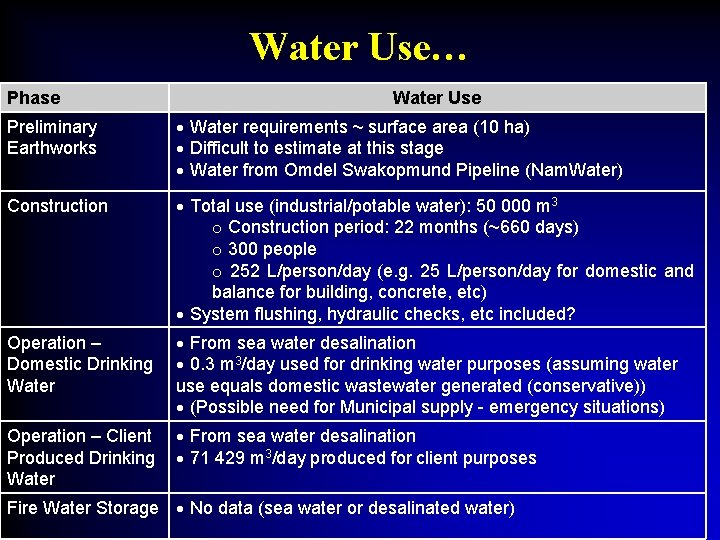
Water Use… Phase Water Use Preliminary Earthworks Water requirements ~ surface area (10 ha) Difficult to estimate at this stage Water from Omdel Swakopmund Pipeline (Nam. Water) Construction Total use (industrial/potable water): 50 000 m 3 o Construction period: 22 months (~660 days) o 300 people o 252 L/person/day (e. g. 25 L/person/day for domestic and balance for building, concrete, etc) System flushing, hydraulic checks, etc included? Operation – Domestic Drinking Water From sea water desalination 0. 3 m 3/day used for drinking water purposes (assuming water use equals domestic wastewater generated (conservative)) (Possible need for Municipal supply - emergency situations) Operation – Client Produced Drinking Water From sea water desalination 71 429 m 3/day produced for client purposes Fire Water Storage No data (sea water or desalinated water)
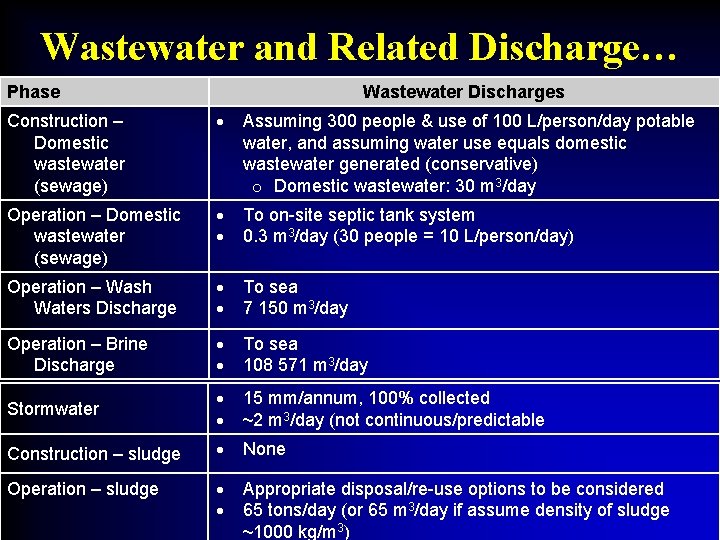
Wastewater and Related Discharge… Phase Wastewater Discharges Construction – Domestic wastewater (sewage) Assuming 300 people & use of 100 L/person/day potable water, and assuming water use equals domestic wastewater generated (conservative) o Domestic wastewater: 30 m 3/day Operation – Domestic wastewater (sewage) To on-site septic tank system 0. 3 m 3/day (30 people = 10 L/person/day) Operation – Wash Waters Discharge To sea 7 150 m 3/day Operation – Brine Discharge To sea 108 571 m 3/day Stormwater 15 mm/annum, 100% collected ~2 m 3/day (not continuous/predictable Construction – sludge None Operation – sludge Appropriate disposal/re-use options to be considered 65 tons/day (or 65 m 3/day if assume density of sludge ~1000 kg/m 3)
Domestic Wastewater (Sewage)… • Construction – – • On-site sanitation for 300 persons (porta-loos) Collection by honeysucker? (frequency? ) To municipal wastewater treatment works? Agreements? Operation – – 30 persons Septic tank system • – – Capacity? French drain system or collection by honeysucker? (frequency? ) Agreements?
Brine Discharge… • Options – – – Regulated discharge to the marine environment Discharge to municipal sewers (volumes, quality) Disposal via evaporation ponds (area, cost) Concentration of brine via evaporator / concentrator / crystallization treatment steps (cost, brine further concentrated) Zero Effluent Discharge facility (cost) • Discharge to sea • Wash waters co-disposal Dependant on Marine Discharges Impact Study findings
Stormwater Management… • Swakopmund area rainfall – < 15 mm/annum very low rainfall – Storm events are unlikely • Air emissions from the Nam. Water Desalination Plant no impact on stormwater quality (electricity generated off-site) • BUT how do we handle – Stormwater? – Wastewaters generated on-site from nonprocess activities that could pollute stormwater? • E. g. washing of vehicles, chemical or oil spillages
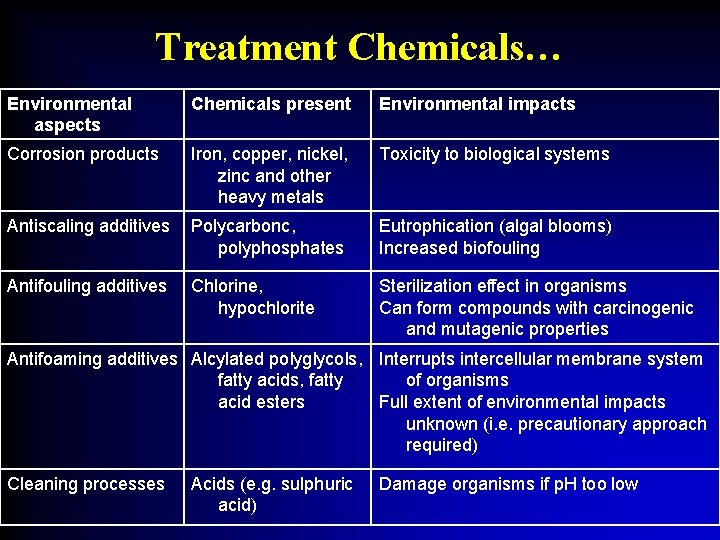
Treatment Chemicals… Environmental aspects Chemicals present Environmental impacts Corrosion products Iron, copper, nickel, zinc and other heavy metals Toxicity to biological systems Antiscaling additives Polycarbonc, polyphosphates Eutrophication (algal blooms) Increased biofouling Antifouling additives Chlorine, hypochlorite Sterilization effect in organisms Can form compounds with carcinogenic and mutagenic properties Antifoaming additives Alcylated polyglycols, Interrupts intercellular membrane system fatty acids, fatty of organisms acid esters Full extent of environmental impacts unknown (i. e. precautionary approach required) Cleaning processes Acids (e. g. sulphuric acid) Damage organisms if p. H too low
Chemical/Oil Waste Management… • “Construction” chemicals – cleaning/lubrication – • • Water treatment chemicals Lab chemicals for DWQ analysis Oils/fuels (e. g. diesel for generators) Spillage management structures? – • Secure buildings, impervious areas, containment dikes, bunded areas Spillage management protocol/plan – – • PVC glue, acetone, grease, lubricating oils Immediate spill response and cleanup measures Sorbent and other materials availability Empty chemical containers hazardous?
Sludge Handling/Management… • Sludge utilization: – – Nutrients Metals Odours (nuisance conditions, public attention) Pathogens • Sludge classification (e. g. agriculture): – Microbiological class (i. e. faecal coliforms, helminth ova) – Stability class (i. e. stability of the sludge) – Pollutant class (i. e. analysis of 8 potentially toxic metals and elements: arsenic, cadmium, chromium, copper, lead, mercury, nickel and zinc)
Sludge Handling/Management… • • • Sludge concentration % dry solids Estimated 65 tons dry matter/day Assume density of sludge = density of water Sludge concentration = 20% solids Water = 80% or 260 tons water/day Components – – – Ferric hydroxide (coagulation) Suspended solids (sea water) Polymer (coagulant aid) Grit (backwashing of calcite beds) Calcium hydroxide?
Sludge Handling/Management… • • General waste (e. g. domestic waste, builders rubble) Hazardous waste (need a Hazardous Waste landfill) – – Bleaching powder, Calcium hypochlorite, Cyanuric chloride, Dichloroisocyanuric acid salts, EDTA, Ferric chloride, Ferrous chloride, Potassium permanganate, Sodium fluorosilicate, Sodium hypochlorite, Sodium phosphate tribasic, Trichloroisocyanuric acid mg/L and mass per area per time period
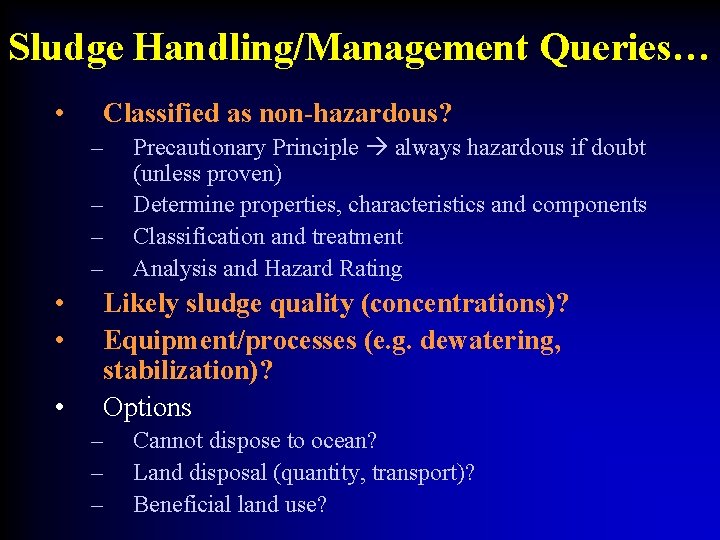
Sludge Handling/Management Queries… • Classified as non-hazardous? – – • • • Precautionary Principle always hazardous if doubt (unless proven) Determine properties, characteristics and components Classification and treatment Analysis and Hazard Rating Likely sludge quality (concentrations)? Equipment/processes (e. g. dewatering, stabilization)? Options – – – Cannot dispose to ocean? Land disposal (quantity, transport)? Beneficial land use?
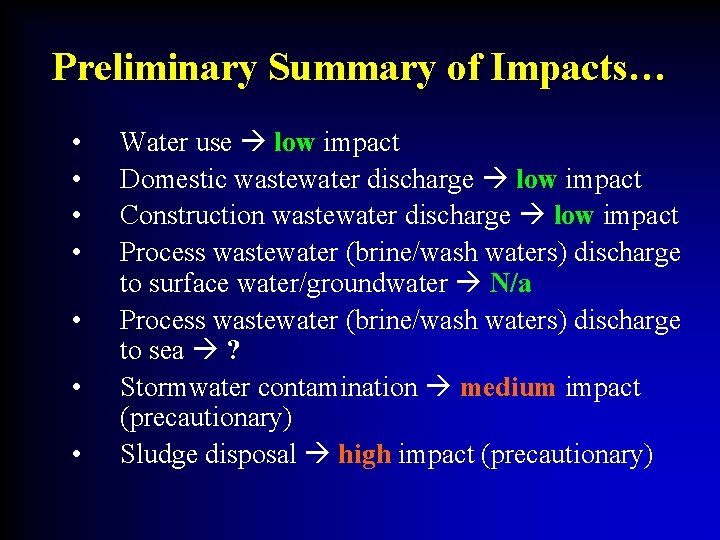
Preliminary Summary of Impacts… • • Water use low impact Domestic wastewater discharge low impact Construction wastewater discharge low impact Process wastewater (brine/wash waters) discharge to surface water/groundwater N/a Process wastewater (brine/wash waters) discharge to sea ? Stormwater contamination medium impact (precautionary) Sludge disposal high impact (precautionary)
Preliminary Conclusions… • Main queries/concerns – Desired drinking-water quality? – Stormwater management? – Spillages management? – Sludge handling/management? – Fire protection water supply storage? – Reservoir capacity?