
2021 Shelter Homelessness Legislation Presentation July 1 2021
- Slides: 12
2021 Shelter & Homelessness Legislation Presentation July 1, 2021 Ariel Nelson, League of Oregon Cities (LOC)
HB 2006 – Emergency Shelter Siting Governor Brown signed HB 2006 into law on Wednesday, May 12, which passed the Legislature with strong bipartisan support. The new law takes effect immediately and requires local governments to approve an application for an emergency shelter regardless of state or local land use laws, if the application meets specific approval criteria outlined in the bill Not a land use decision • Removes state requirements for mailed notice, public hearing, or solicitation of public comment on an application • • No requirement for a city to make a decision within a particular period of time Decisions under HB 2006 may not be appealed to the Land Use Board of Appeals but may be appealed using the writ of review process provided under ORS 34. 010 – 34. 100 Effective Dates • The siting authority in HB 2006 sunsets on July 1, 2022, but shelters approved under the bill may remain in operation after the sunset. Should a shelter cease to operate, the regular land use regulations would apply again. • Applicants must submit applications between May 12, 2021 and June 30, 2022 to qualify under HB 2006 – Implementation Examples • City of Eugene • Applicant submits a letter with supporting evidence demonstrating how the proposed Emergency Shelter meets the criteria listed in HB 2006 • City of Bend • Applicant completes an application developed by the city
HB 2006 – Shelter Requirements • • Includes sleeping and restroom facilities Complies with applicable building codes Is located within an urban growth boundary or in a rural residential zone Will not result in a new building that is sited within an area designated under a statewide land use planning goal relating to natural disasters and hazards (e. g. flood plains or mapped environmental health hazards) unless the development complies with regulations directly related to the hazard Has adequate transportation access to commercial and medical services; and Will not pose any unreasonable risk to public health or safety. Must be operated by: • • A local government; or An organization with at least two years’ experience operating an emergency shelter using best practices that is: • • A housing authority A religious corporation A public benefit corporation whose charitable purpose includes the support of homeless individuals and that has been recognized as exempt from income tax under section 501(a) of the Internal Revenue Code on or before January 1, 2018; or A nonprofit corporation partnering with any of those entities.
HB 2006 – Permissive Shelter Provisions • An emergency shelter may provide on-site and at no cost: • • Showering and bathing facilities Personal property storage Laundry Food service Recreation areas for children and pets Case management services, or Any other services incidental to the shelter • An emergency shelter may include youth shelters, veterans' shelters, winter or warming shelters, day shelters and family violence shelter homes. • An emergency shelter may provide additional transitional housing services at a fee of not more than $300/month. HB 2006 – Vehicle Camping • • • Any political subdivision may allow any public or private entity to allow overnight camping by homeless individuals living in vehicles on the property of the entity. A political subdivision may impose reasonable conditions upon offering camping space under this section, including establishing a maximum number of vehicles allowed. Entities providing camping spaces under this section must also provide access to sanitary facilities, including toilet, handwashing and trash disposal facilities.
HB 3261 – Hotel/Motel Conversion • Signed into law on Thursday, May 6, and now in effect. This new law requires local governments to allow the conversion of hotels and motels into an emergency shelter or affordable housing, regardless of state or local land use laws, if the application meets specific approval criteria. The measure only applies to hotel or motel properties in areas: • • Within an urban growth boundary; Outside heavy industrial zones; With adequate transportation access to commercial and medical services; and Not within an area designated for a statewide land use planning goal relating to natural disasters or hazards, including flood plains or mapped environmental health hazards, unless the converted use complies with regulations directly related to the disasters or hazards. • Not a land use decision • Cities may still require the converted use to comply with building codes, occupancy limits, and reasonable siting and design standards so long as the standards do not, individually or cumulatively, prohibit the conversion through unreasonable costs or delay. • HB 3261 applies to hotel and motel conversions or applications for conversions submitted on or after January 1, 2021.
HB 3115 – Local Homeless Ordinances Signed into law on June 23, HB 3115 is the product of a workgroup between the League of Oregon Cities (LOC) and the Oregon Law Center (OLC) as well as individual cities and counties. The workgroup spent many hours crafting a concept that recognizes a key principle from the recent Martin v. City of Boise federal court decision. • Requires that any city or county law regulating the acts of sitting, lying, sleeping or keeping warm and dry outside on public property must be “objectively reasonable” based on the totality of the circumstances as applied to all stakeholders, including persons experiencing homelessness. • Preserves the ability of cities to manage public spaces effectively for the benefit of the entire community • Provides clarity and transparency for communities and people experiencing homelessness • Recognizes that what is objectively reasonable will look different in different communities. • Delayed implementation date of July 1, 2023 , to allow local governments time to review and update ordinances and support intentional community conversations. The LOC and OLC will partner to provide guidance to cities. Emergency clause to allow jurisdictions to begin immediately the development of ordinances in order to meet the July 2023 compliance deadline.
HB 3124 – Campsite Removal Procedures • Signed into law June 23 and now in effect • Extends requirement for law enforcement to provide written notice before removing homeless individuals from an established camping site from 24 hours to 72 hours. • Requires jurisdictions to store unclaimed personal property in a facility located in the same community as the camping site from which it was removed. • Preserves notice exceptions when: • There are grounds for law enforcement officials to believe that illegal activities other than camping are occurring at an established camping site; • In the event of an exceptional emergency at an established camping site, including, but not limited to, possible site contamination by hazardous materials, a public health emergency or other immediate danger to human life or safety.
HB 2100 – Modernizing Oregon’s Homeless System • Modernizes Oregon’s homeless system by clarifying Oregon Housing and Community Services’ (OHCS) role and responsibilities in administering federal and state funding to address Oregon’s homeless crisis • Requires OHCS to consult with a range of stakeholders to ensure equitable services for all, and clarifies that eligible grantees must demonstrate culturally responsive services to best serve the needs of diverse populations, including Oregon’s Black, Indigenous and communities of color • Establishes a Task Force on Homelessness and Racial Disparities to address racial disparities in the provision of and access to homeless services programs across the state
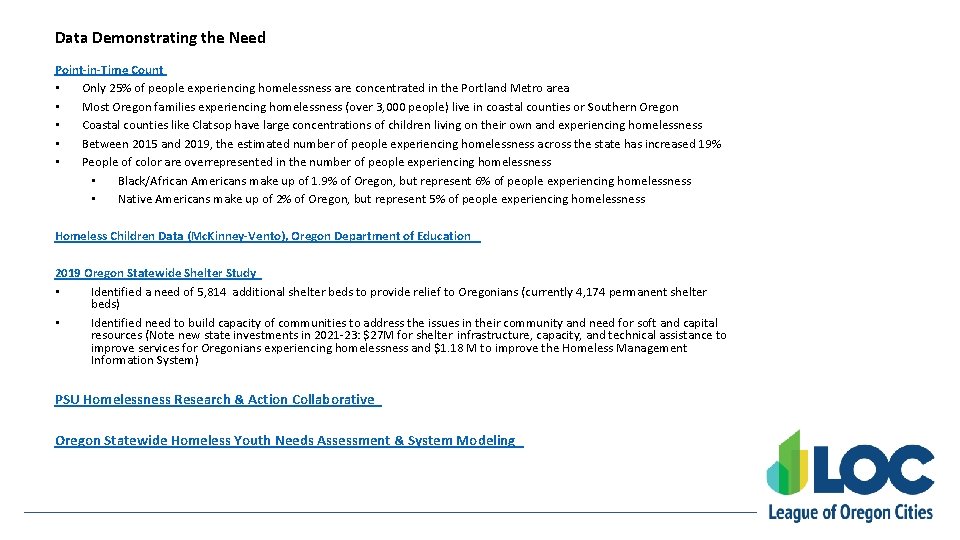
Data Demonstrating the Need Point-in-Time Count • Only 25% of people experiencing homelessness are concentrated in the Portland Metro area • Most Oregon families experiencing homelessness (over 3, 000 people) live in coastal counties or Southern Oregon • Coastal counties like Clatsop have large concentrations of children living on their own and experiencing homelessness • Between 2015 and 2019, the estimated number of people experiencing homelessness across the state has increased 19% • People of color are overrepresented in the number of people experiencing homelessness • Black/African Americans make up of 1. 9% of Oregon, but represent 6% of people experiencing homelessness • Native Americans make up of 2% of Oregon, but represent 5% of people experiencing homelessness Homeless Children Data (Mc. Kinney-Vento), Oregon Department of Education 2019 Oregon Statewide Shelter Study • Identified a need of 5, 814 additional shelter beds to provide relief to Oregonians (currently 4, 174 permanent shelter beds) • Identified need to build capacity of communities to address the issues in their community and need for soft and capital resources (Note new state investments in 2021 -23: $27 M for shelter infrastructure, capacity, and technical assistance to improve services for Oregonians experiencing homelessness and $1. 18 M to improve the Homeless Management Information System) PSU Homelessness Research & Action Collaborative Oregon Statewide Homeless Youth Needs Assessment & System Modeling
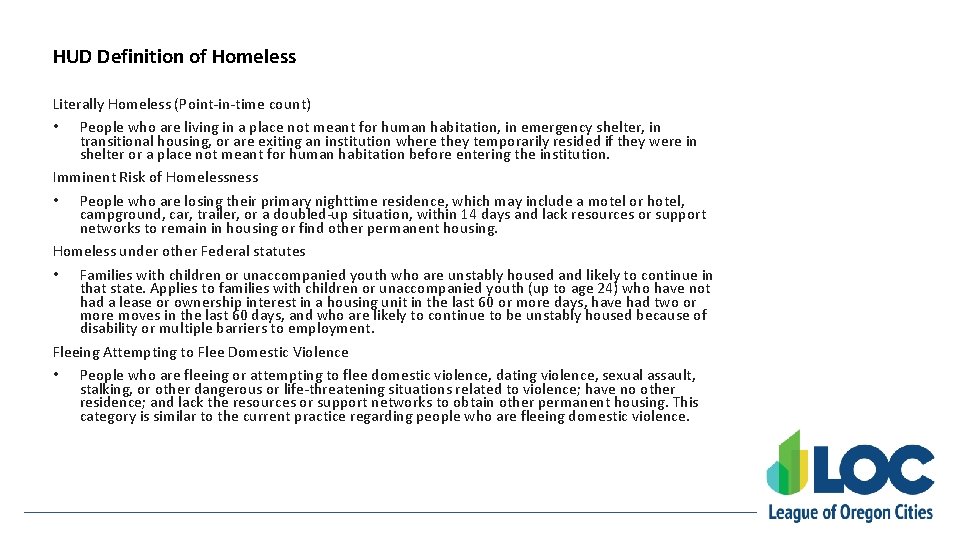
HUD Definition of Homeless Literally Homeless (Point-in-time count) • People who are living in a place not meant for human habitation, in emergency shelter, in transitional housing, or are exiting an institution where they temporarily resided if they were in shelter or a place not meant for human habitation before entering the institution. Imminent Risk of Homelessness • People who are losing their primary nighttime residence, which may include a motel or hotel, campground, car, trailer, or a doubled-up situation, within 14 days and lack resources or support networks to remain in housing or find other permanent housing. Homeless under other Federal statutes • Families with children or unaccompanied youth who are unstably housed and likely to continue in that state. Applies to families with children or unaccompanied youth (up to age 24) who have not had a lease or ownership interest in a housing unit in the last 60 or more days, have had two or more moves in the last 60 days, and who are likely to continue to be unstably housed because of disability or multiple barriers to employment. Fleeing Attempting to Flee Domestic Violence • People who are fleeing or attempting to flee domestic violence, dating violence, sexual assault, stalking, or other dangerous or life-threatening situations related to violence; have no other residence; and lack the resources or support networks to obtain other permanent housing. This category is similar to the current practice regarding people who are fleeing domestic violence.
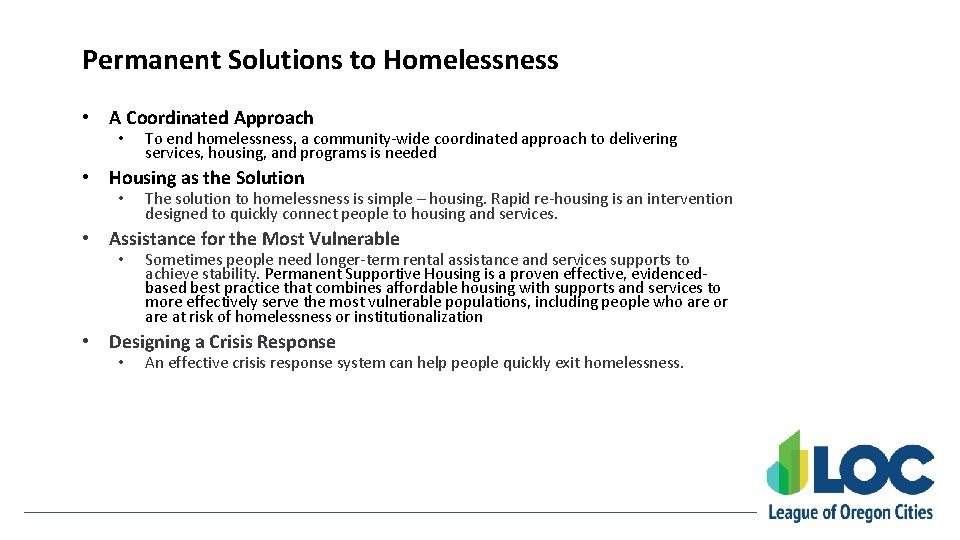
Permanent Solutions to Homelessness • A Coordinated Approach • To end homelessness, a community-wide coordinated approach to delivering services, housing, and programs is needed • Housing as the Solution • The solution to homelessness is simple – housing. Rapid re-housing is an intervention designed to quickly connect people to housing and services. • Assistance for the Most Vulnerable • Sometimes people need longer-term rental assistance and services supports to achieve stability. Permanent Supportive Housing is a proven effective, evidencedbased best practice that combines affordable housing with supports and services to more effectively serve the most vulnerable populations, including people who are or are at risk of homelessness or institutionalization • Designing a Crisis Response • An effective crisis response system can help people quickly exit homelessness.
Additional Resources • Oregon Housing and Community Services 2021 Legislative Highlights • Fair Housing Council of Oregon • National Alliance to End Homelessness – Solutions • United States Interagency Council on Homelessness (USICH) – Tools for Action • Corporation for Supportive Housing – Supportive Housing 101