
2021 REVISED RECOVERY CURRICULUM AND ASSESSMENT PLANS MATHEMATICS

- Slides: 23
2021 REVISED RECOVERY CURRICULUM AND ASSESSMENT PLANS MATHEMATICS GRADE: R - 3 IMPLEMENTATION: May 2021
PRESENTATION OUTLINE 1. Purpose 2. Curriculum • • • Principles Overview Error Analysis Annual Teaching Plan 2021 T 2 Diagnostic Programme of Assessment (POA) 3. Conclusion
1. PURPOSE To mediate the: • Amendments of the trimmed and re-organised 2021 Annual Teaching Plan including School Based Assessment for Mathematics, Grade 1 -3 for implementation in July 2021 as stipulated in Circular S 13 of 2021 -Curriculum Recovery. • To ensure that meaningful teaching continues during the remaining teaching time as per the school calendar for TERM 2. • To assist teachers with guided pacing and sequencing of curriculum content and assessment.
1. PURPOSE… • To enable teachers to cover the core skills and knowledge in each grade within the available time. • To assist teachers with planning for the different forms of assessment. • To ensure learners are adequately prepared for the subsequent year/s in terms of skills, knowledge, attitudes and values.
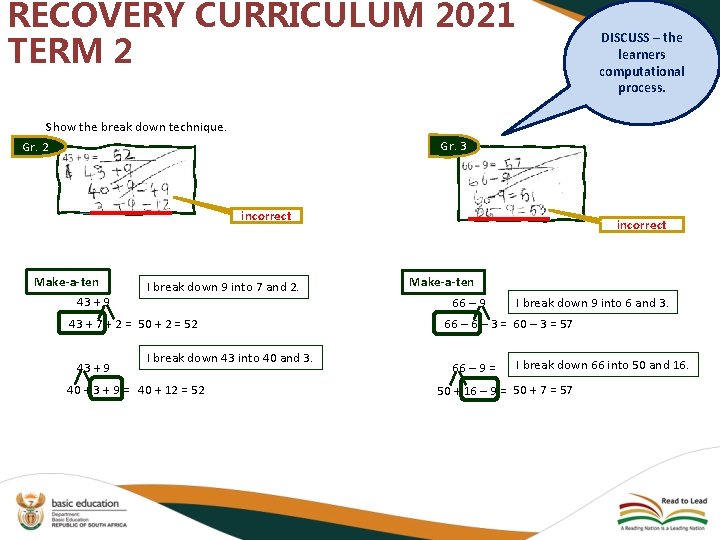
RECOVERY CURRICULUM 2021 TERM 2 Show the break down technique. Gr. 2 Gr. 3 incorrect Make-a-ten 43 + 9 I break down 9 into 7 and 2. 43 + 7 + 2 = 50 + 2 = 52 43 + 9 I break down 43 into 40 and 3. 40 + 3 + 9 = 40 + 12 = 52 DISCUSS – the learners computational process. incorrect Make-a-ten 66 – 9 I break down 9 into 6 and 3. 66 – 3 = 60 – 3 = 57 66 – 9 = I break down 66 into 50 and 16. 50 + 16 – 9 = 50 + 7 = 57
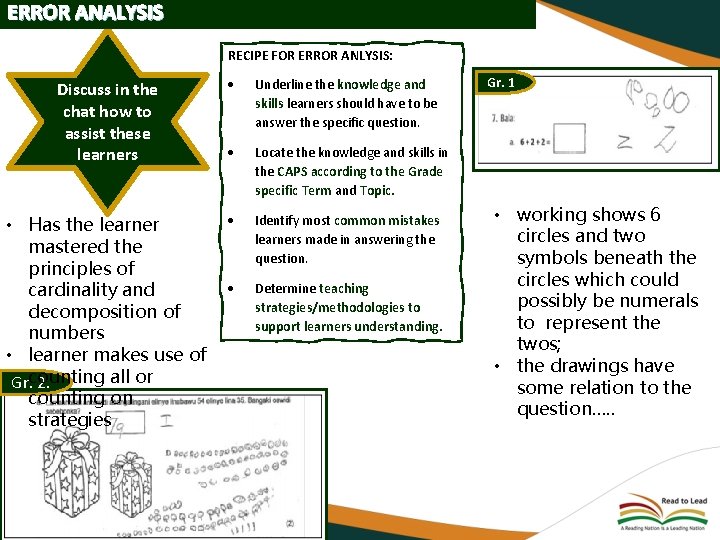
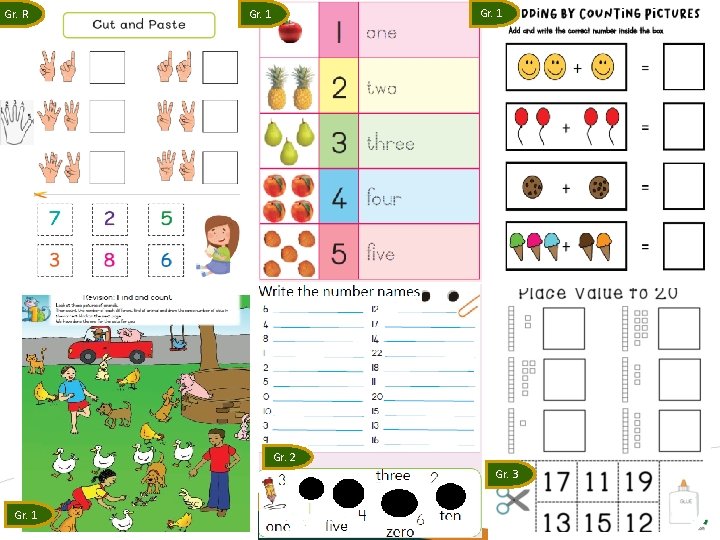
ERROR ANALYSIS RECIPE FOR ERROR ANLYSIS: Discuss in the chat how to assist these learners Underline the knowledge and skills learners should have to be answer the specific question. Locate the knowledge and skills in the CAPS according to the Grade specific Term and Topic. • Has the learner mastered the principles of cardinality and decomposition of numbers • learner makes use of all or Gr. counting 2. counting on strategies Identify most common mistakes learners made in answering the question. Determine teaching strategies/methodologies to support learners understanding. Gr. 1 • working shows 6 circles and two symbols beneath the circles which could possibly be numerals to represent the twos; • the drawings have some relation to the question…. .
2. PRINCIPLES • For the 2021 -2023 period, the DBE is committed to: • providing carefully planned curriculum guidelines which are CAPS compliant – and aims to ensure that all the core concepts, knowledge and skills are covered.
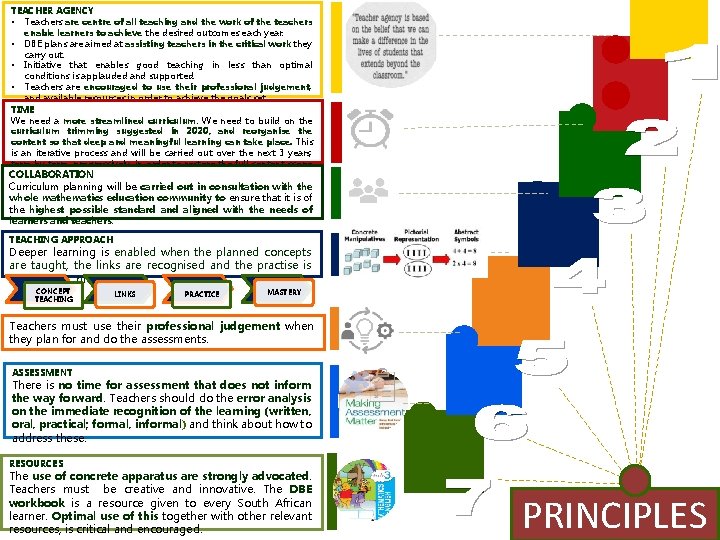
TEACHER AGENCY • Teachers are centre of all teaching and the work of the teachers enable learners to achieve the desired outcomes each year. • DBE plans are aimed at assisting teachers in the critical work they carry out. • Initiative that enables good teaching in less than optimal conditions is applauded and supported. • Teachers are encouraged to use their professional judgement, and available resources in order to achieve the goals set. TIME We need a more streamlined curriculum. We need to build on the curriculum trimming suggested in 2020, and reorganise the content so that deep and meaningful learning can take place. This is an iterative process and will be carried out over the next 3 years, term by term, progressively, in order to restore the full content scope by the end of 2023. COLLABORATION Curriculum planning will be carried out in consultation with the whole mathematics education community to ensure that it is of the highest possible standard and aligned with the needs of learners and teachers. TEACHING APPROACH Deeper learning is enabled when the planned concepts are taught, the links are recognised and the practise is enabled for mastery. CONCEPT TEACHING LINKS PRACTICE MASTERY Teachers must use their professional judgement when they plan for and do the assessments. ASSESSMENT There is no time for assessment that does not inform the way forward. Teachers should do the error analysis on the immediate recognition of the learning (written, oral, practical; formal, informal) and think about how to address these. RESOURCES The use of concrete apparatus are strongly advocated. Teachers must be creative and innovative. The DBE workbook is a resource given to every South African learner. Optimal use of this together with other relevant resources, is critical and encouraged. PRINCIPLES
Gr. R Gr. 1 Gr. 2 Gr. 3 Gr. 1
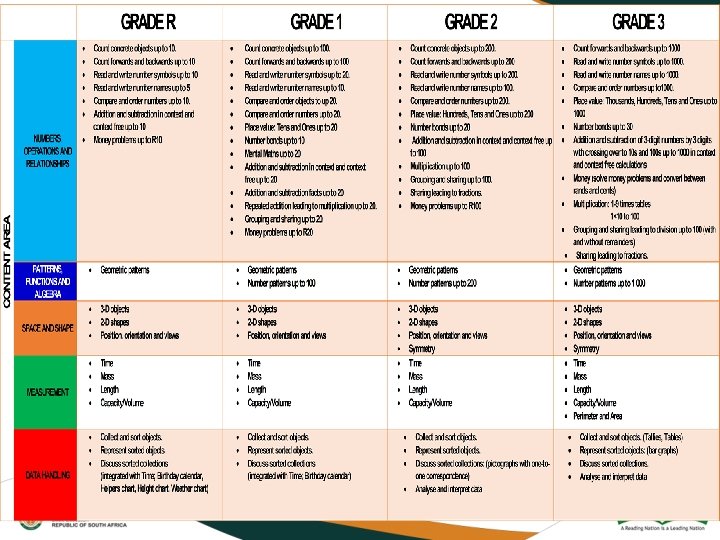
THE PHASE OVERVIEW The Content Overview shows the Grade R to 3 Content Areas as follows: • specification of concepts (skills and knowledge) • progression of concepts (skills and knowledge) • maps grade specific, concepts (skills and knowledge) to be recovered and acquired in Grade R to 3.
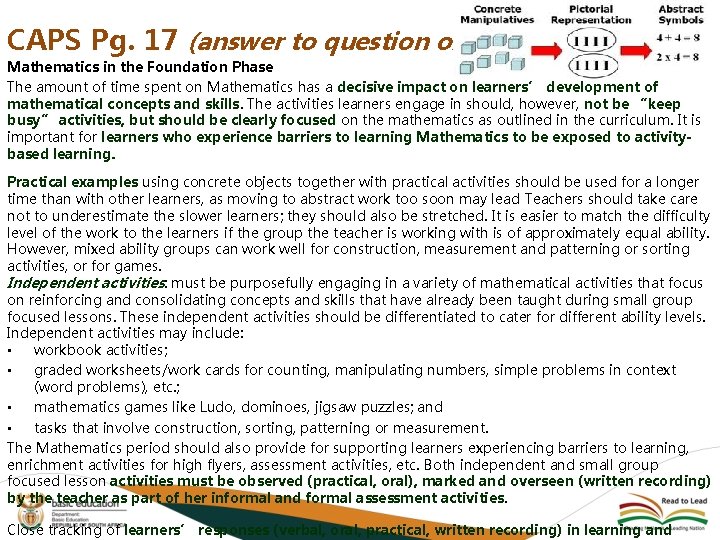
CAPS Pg. 17 (answer to question on the chat) Mathematics in the Foundation Phase The amount of time spent on Mathematics has a decisive impact on learners’ development of mathematical concepts and skills. The activities learners engage in should, however, not be “keep busy” activities, but should be clearly focused on the mathematics as outlined in the curriculum. It is important for learners who experience barriers to learning Mathematics to be exposed to activitybased learning. Practical examples using concrete objects together with practical activities should be used for a longer time than with other learners, as moving to abstract work too soon may lead Teachers should take care not to underestimate the slower learners; they should also be stretched. It is easier to match the difficulty level of the work to the learners if the group the teacher is working with is of approximately equal ability. However, mixed ability groups can work well for construction, measurement and patterning or sorting activities, or for games. Independent activities: must be purposefully engaging in a variety of mathematical activities that focus on reinforcing and consolidating concepts and skills that have already been taught during small group focused lessons. These independent activities should be differentiated to cater for different ability levels. Independent activities may include: • workbook activities; • graded worksheets/work cards for counting, manipulating numbers, simple problems in context (word problems), etc. ; • mathematics games like Ludo, dominoes, jigsaw puzzles; and • tasks that involve construction, sorting, patterning or measurement. The Mathematics period should also provide for supporting learners experiencing barriers to learning, enrichment activities for high flyers, assessment activities, etc. Both independent and small group focused lesson activities must be observed (practical, oral), marked and overseen (written recording) by the teacher as part of her informal and formal assessment activities. Close tracking of learners’ responses (verbal, oral, practical, written recording) in learning and
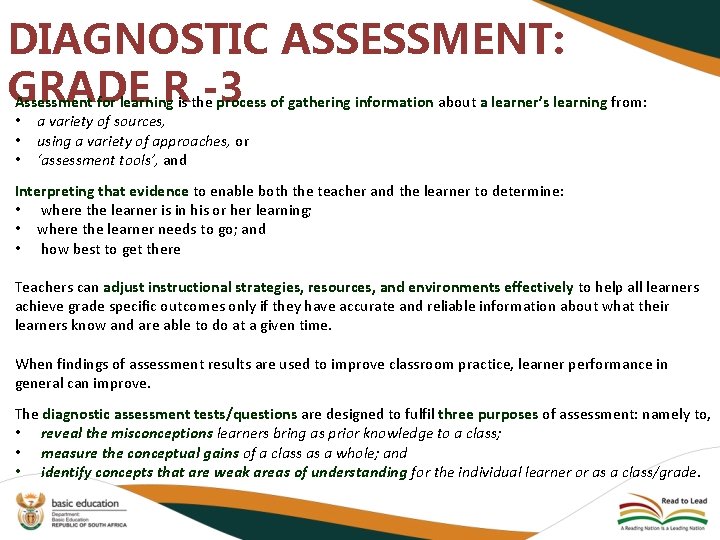
DIAGNOSTIC ASSESSMENT: GRADE R -3 Assessment for learning is the process of gathering information about a learner’s learning from: • a variety of sources, • using a variety of approaches, or • ‘assessment tools’, and Interpreting that evidence to enable both the teacher and the learner to determine: • where the learner is in his or her learning; • where the learner needs to go; and • how best to get there Teachers can adjust instructional strategies, resources, and environments effectively to help all learners achieve grade specific outcomes only if they have accurate and reliable information about what their learners know and are able to do at a given time. When findings of assessment results are used to improve classroom practice, learner performance in general can improve. The diagnostic assessment tests/questions are designed to fulfil three purposes of assessment: namely to, • reveal the misconceptions learners bring as prior knowledge to a class; • measure the conceptual gains of a class as a whole; and • identify concepts that are weak areas of understanding for the individual learner or as a class/grade.
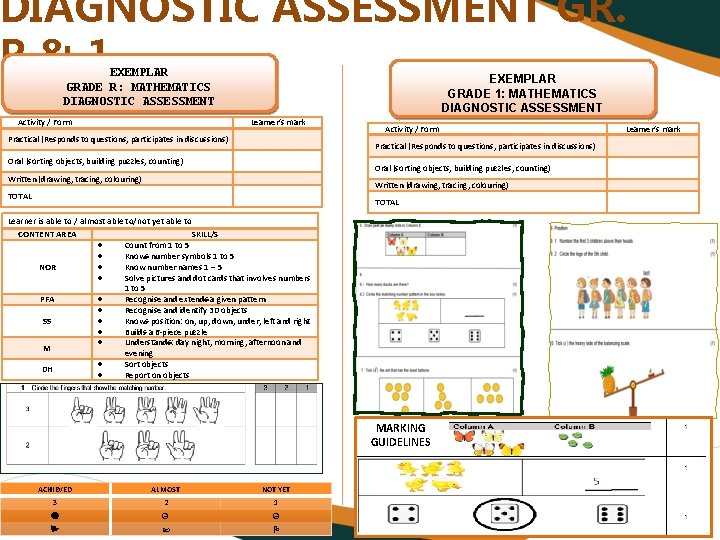
DIAGNOSTIC ASSESSMENT GR. R&1 EXEMPLAR GRADE R: MATHEMATICS DIAGNOSTIC ASSESSMENT EXEMPLAR GRADE 1: MATHEMATICS DIAGNOSTIC ASSESSMENT Learner’s mark Activity / Form Practical (Responds to questions, participates in discussions) Oral (sorting objects, building puzzles, counting) Written (drawing, tracing, colouring) TOTAL Learner is able to / almost able to/not yet able to CONTENT AREA SKILL/S Count from 1 to 5 Knows number symbols 1 to 5 NOR Know number names 1 – 5 Solve pictures and dot cards that involves numbers 1 to 5 PFA Recognise and extends a given pattern Recognise and identify 3 D objects SS Knows position: on, up, down, under, left and right Builds a 6 -piece puzzle Understands: day night, morning, afternoon and M evening Sort objects DH Report on objects MARKING GUIDELINES ACHIEVED ALMOST 3 2 NOT YET 1 Learner’s mark
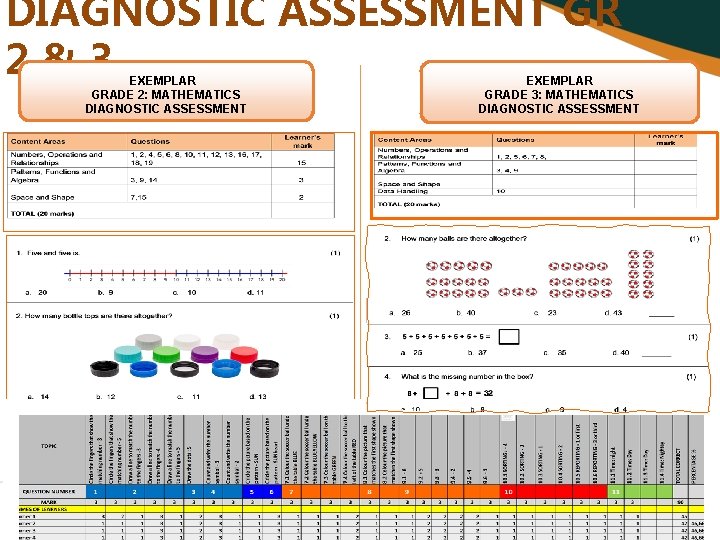
DIAGNOSTIC ASSESSMENT GR 2&3 EXEMPLAR GRADE 2: MATHEMATICS DIAGNOSTIC ASSESSMENT EXEMPLAR GRADE 3: MATHEMATICS DIAGNOSTIC ASSESSMENT
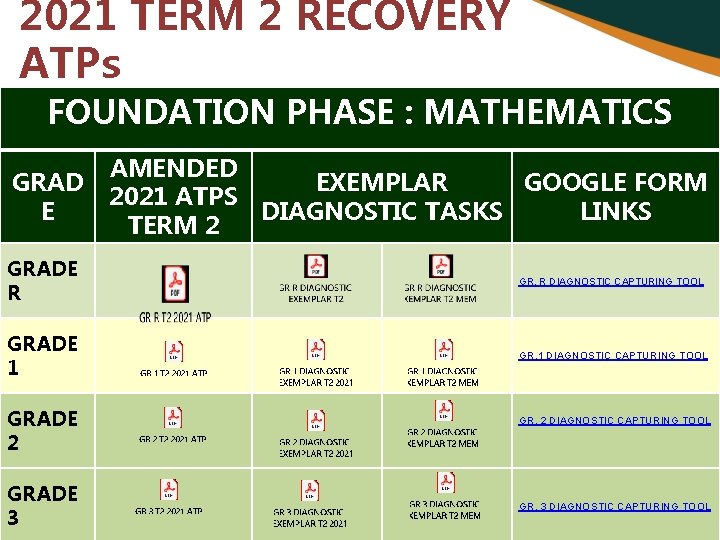
2021 TERM 2 RECOVERY ATPs FOUNDATION PHASE : MATHEMATICS GRAD E AMENDED EXEMPLAR GOOGLE FORM 2021 ATPS DIAGNOSTIC TASKS LINKS TERM 2 GRADE R GR. R DIAGNOSTIC CAPTURING TOOL GRADE 1 GR. 1 DIAGNOSTIC CAPTURING TOOL GRADE 2 GRADE 3 GR. 2 DIAGNOSTIC CAPTURING TOOL GR. 3 DIAGNOSTIC CAPTURING TOOL
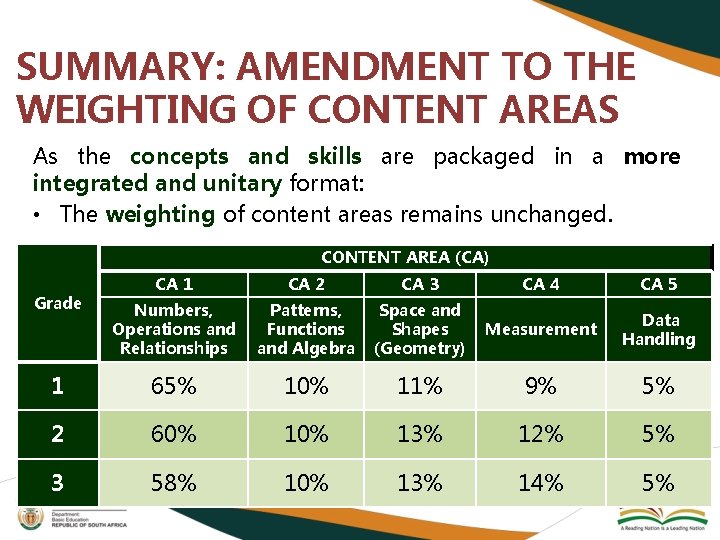
SUMMARY: AMENDMENT TO THE WEIGHTING OF CONTENT AREAS As the concepts and skills are packaged in a more integrated and unitary format: • The weighting of content areas remains unchanged. CONTENT AREA (CA) CA 1 CA 2 CA 3 CA 4 CA 5 Numbers, Operations and Relationships Patterns, Functions and Algebra Space and Shapes (Geometry) Measurement Data Handling 1 65% 10% 11% 9% 5% 2 60% 13% 12% 5% 3 58% 10% 13% 14% 5% Grade
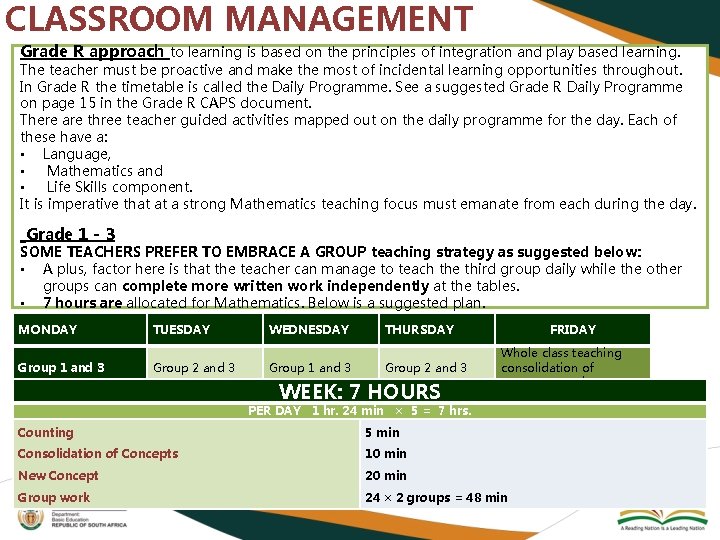
CLASSROOM MANAGEMENT Grade R approach to learning is based on the principles of integration and play based learning. The teacher must be proactive and make the most of incidental learning opportunities throughout. In Grade R the timetable is called the Daily Programme. See a suggested Grade R Daily Programme on page 15 in the Grade R CAPS document. There are three teacher guided activities mapped out on the daily programme for the day. Each of these have a: • Language, • Mathematics and • Life Skills component. It is imperative that at a strong Mathematics teaching focus must emanate from each during the day. Grade 1 - 3 SOME TEACHERS PREFER TO EMBRACE A GROUP teaching strategy as suggested below: • A plus, factor here is that the teacher can manage to teach the third group daily while the other groups can complete more written work independently at the tables. • 7 hours are allocated for Mathematics. Below is a suggested plan. MONDAY TUESDAY WEDNESDAY THURSDAY Group 1 and 3 Group 2 and 3 WEEK: 7 HOURS FRIDAY Whole class teaching consolidation of concepts taught. PER DAY 1 hr. 24 min × 5 = 7 hrs. Counting 5 min Consolidation of Concepts 10 min New Concept 20 min Group work 24 × 2 groups = 48 min
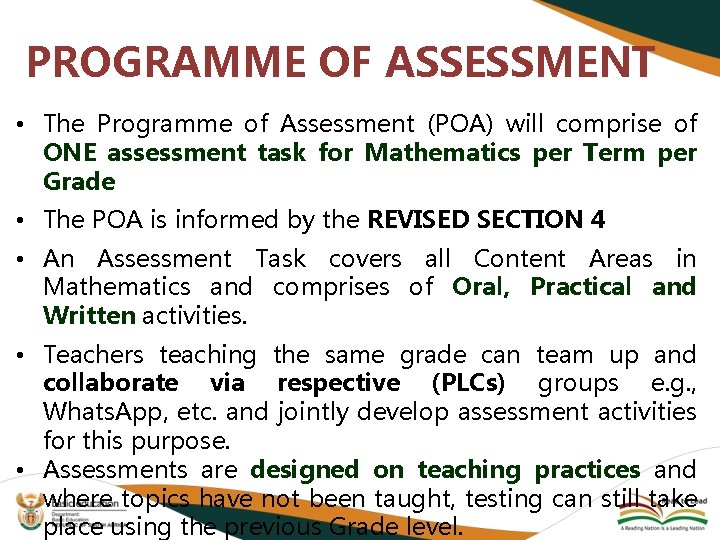
PROGRAMME OF ASSESSMENT • The Programme of Assessment (POA) will comprise of ONE assessment task for Mathematics per Term per Grade • The POA is informed by the REVISED SECTION 4 • An Assessment Task covers all Content Areas in Mathematics and comprises of Oral, Practical and Written activities. • Teachers teaching the same grade can team up and collaborate via respective (PLCs) groups e. g. , Whats. App, etc. and jointly develop assessment activities for this purpose. • Assessments are designed on teaching practices and where topics have not been taught, testing can still take place using the previous Grade level.
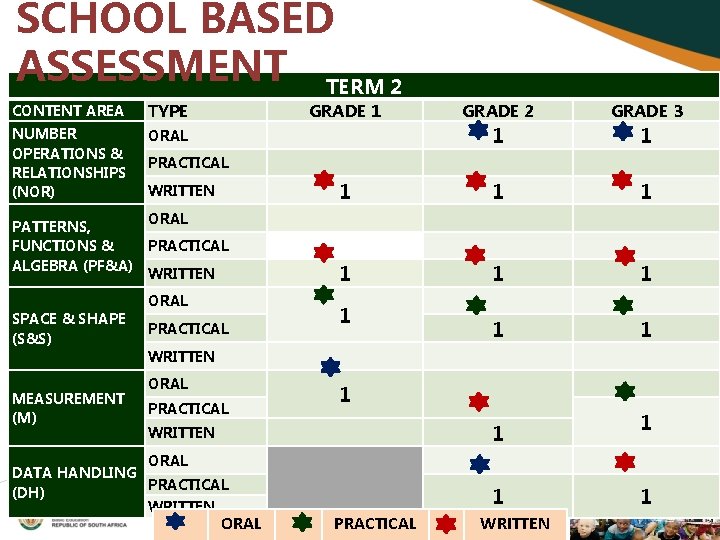
SCHOOL BASED ASSESSMENT TERM 2 CONTENT AREA TYPE NUMBER OPERATIONS & RELATIONSHIPS (NOR) ORAL PATTERNS, FUNCTIONS & ALGEBRA (PF&A) SPACE & SHAPE (S&S) MEASUREMENT (M) GRADE 1 GRADE 2 GRADE 3 1 1 1 1 1 PRACTICAL WRITTEN ORAL PRACTICAL 1 1 WRITTEN ORAL DATA HANDLING PRACTICAL (DH) WRITTEN ORAL 1 PRACTICAL WRITTEN 1 1
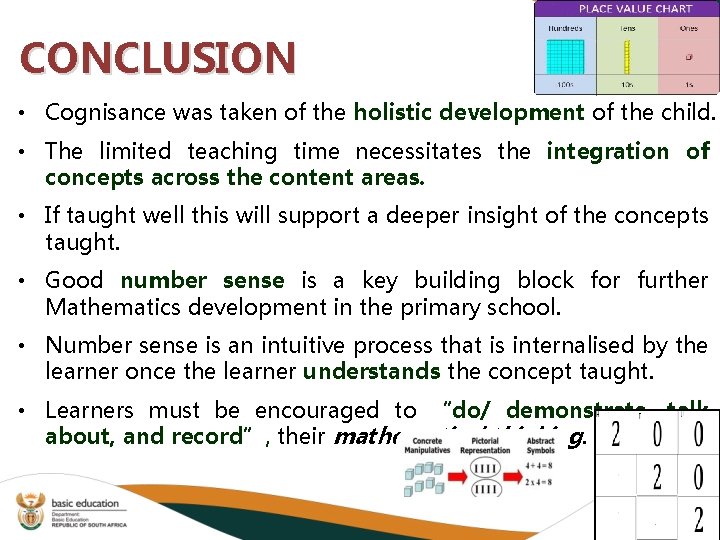
CONCLUSION • Cognisance was taken of the holistic development of the child. • The limited teaching time necessitates the integration of concepts across the content areas. • If taught well this will support a deeper insight of the concepts taught. • Good number sense is a key building block for further Mathematics development in the primary school. • Number sense is an intuitive process that is internalised by the learner once the learner understands the concept taught. • Learners must be encouraged to “do/ demonstrate, talk about, and record”, their mathematical thinking.
CONTACT DETAILS NAME: Elspeth Khembo DIRECTOR: MST, Curriculum Innovation and E-Learning Department of Basic Education : 012 357 4267 : Khembo. E@dbe. gov. za