
2021 Electric TD Benchmarking Data Collection Guide March
2021 Electric T&D Benchmarking Data Collection Guide March 2021 Updated versions of the Guidelines and recordings from the webinars are available at our website. www. 1 qconsulting. com : : Benchmarking Community : : Data Entry Gateway 1
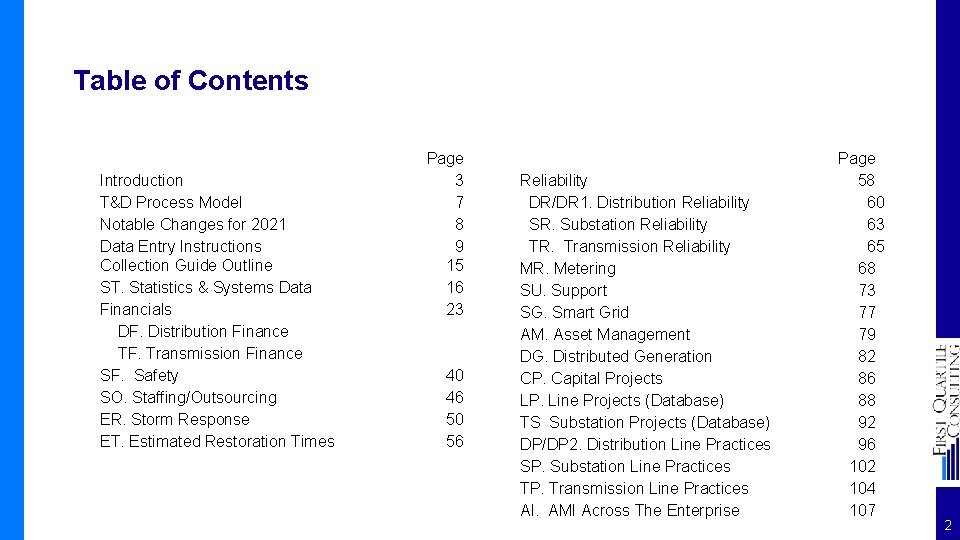
Table of Contents Introduction T&D Process Model Notable Changes for 2021 Data Entry Instructions Collection Guide Outline ST. Statistics & Systems Data Financials DF. Distribution Finance TF. Transmission Finance SF. Safety SO. Staffing/Outsourcing ER. Storm Response ET. Estimated Restoration Times Page 3 7 8 9 15 16 23 40 46 50 56 Reliability DR/DR 1. Distribution Reliability SR. Substation Reliability TR. Transmission Reliability MR. Metering SU. Support SG. Smart Grid AM. Asset Management DG. Distributed Generation CP. Capital Projects LP. Line Projects (Database) TS Substation Projects (Database) DP/DP 2. Distribution Line Practices SP. Substation Line Practices TP. Transmission Line Practices AI. AMI Across The Enterprise Page 58 60 63 65 68 73 77 79 82 86 88 92 96 102 104 107 2
Introduction ◆ The purpose of this Data Collection Guide is to provide guidance and direction in how to complete the detailed questionnaire for the T&D benchmark study. It gives instructions regarding the types of answers expected, as well as errors to avoid. This Guide has been described as the “rules” for providing data. ◆ It provides the underlying process models around which the various sections of the questionnaire are organized, to help in understanding the purpose of some of the questions. ◆ The appropriate costs to include, and those to exclude, are highlighted so that each member utility can provide accurate data that readily supports comparisons. ◆ Some key definitions are provided throughout the document. ◆ A comprehensive set of definitions is available in a separate Glossary, also available through links in the individual sections of the Questionnaire. 3
Guidance On Collecting Financial and Staffing Data ◆ It’s important to have everyone who is collecting Financial and Staffing Data communicate so that these items align. § Be sure that labor costs include any staff reported. § Be sure to complete the sections on outsourcing § Be sure that activities/volumes match with the costs reported and vice versa. ◆ It’s helpful to have everyone collecting financial and staffing data review each of the functional sections so that they know what activities are included or excluded. ◆ Work with your Data Steward if you have questions about definitions that can’t be answered here or via the Glossary ◆ Attend our scheduled Data Collection Webinars! 4
Guidance on Text Responses, Practices and Initiatives ◆ Questions that ask for text responses: § Be brief and succinct – so that the reader will not need to read through an extensive volume of material to understand the message § Make your responses anonymous: don't mention your company name or other company identifying information (e. g. . city or state names) in your replies § Avoid use of jargon, acronyms, organizational references, etc. , that people outside your company may not understand § For open-ended questions, be complete enough to answer all aspects of the question ◆ Questions that ask about “practices” or “initiatives”; for our purposes: § Practices are current activities, programs or processes that have been in place for more than 2 years and have been determined to be effective. We mostly ask about practices that have proven successful in accomplishing a specific goal. § Initiatives are new activities, programs or processes that have been enacted recently (within the past 1 to 2 years) with the goal of improvement. These may not have been in place long enough for you to assess their success, but we are still interested in learning what you are doing to try to improve. 5
Guidance on “Zeros” versus “Blanks” and Allocation Questions ◆ Entering Zero (0) vs. leaving data entry fields blank; for our purposes: § Zero means that your data collection effort has determined that the correct value for your company is, in fact, zero. Therefore, we will include your company with a 0. 0 value on the reports and in our calculations of mean and quartile values for the community. § Blank means that your company’s value is unknown or you did not collect data to respond to the question. Therefore, we will not include your company on our reports nor in our calculations of mean and quartile values for the community. ◆ Allocation questions: § In some areas of the survey, we ask that a number collected in one question be allocated across subcategories in a subsequent question, either numerically or as a percentage of the total in the first question. § In most cases, it is intended that the allocations across the listed subcategories total to the number in the first question (or 100%, if % allocations are requested). Please keep this in mind as you develop your data to be entered into the survey. We have built in some automatic edit calculations to catch under- or over allocation errors at the time of data entry. 6
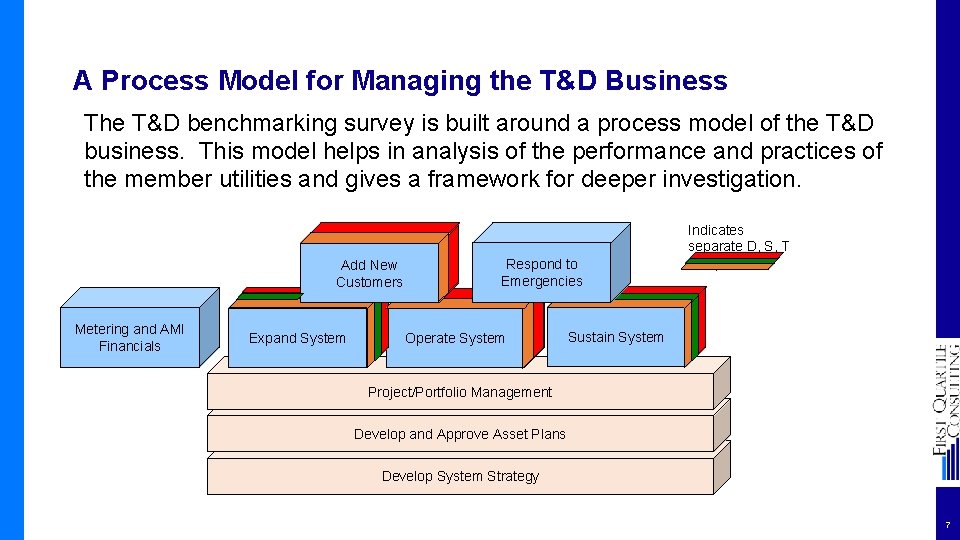
A Process Model for Managing the T&D Business The T&D benchmarking survey is built around a process model of the T&D business. This model helps in analysis of the performance and practices of the member utilities and gives a framework for deeper investigation. Add New Customers Metering and AMI Financials Expand System Respond to Emergencies Operate System Indicates separate D, S, T components Sustain System Project/Portfolio Management Develop and Approve Asset Plans Develop System Strategy 7
Revised Sections for 2021 ◆ We have reorganized several sections and groups of questions for 2021. § If you participate in both T&D and CS, the CS group have already received these. Each company only needs to complete this one (shown below). § If you are T&D only, you’ll complete these are part of the T&D survey. ◆ Revised Sections § Metering (MR): We revised the original Meter Reading section from Customer Service to include all meter-related questions, such as those originally from Asset Management and Smart Grid, in addition to the original meter reading questions. § Estimated Restoration Times (ET): This is a separate tab this year so that we can use in both surveys. § AMI Across the Organization (AI): A section aimed at gathering AMI financial and organizational information. 8
New Sections for 2021 ◆ These are new tabs in pre-existing questionnaires. § Distribution New Business (DP 2): Contains questions that get at the labor and cost associated with different types of new business installations. § Distribution Reliability by Service Territory (DR 2): These questions only need to be completed by companies with one (or possibly two) major metro areas in an otherwise less densely-populated service territory. We are asking for a breakout of the reliability statistics for metros and all others. ◆ There are 2 returning sections on projects. § Lines Projects (LP): asking for line projects to support our Community database § Substation Projects (TS): asking for substation projects to support our Community database 9
Data Entry Instructions There are detailed instructions included on the first tab of every data entry file. 10
Questionnaire ◆ The questionnaire now contains 10 years of historical data. You’ll be able to hide those columns if you like. ◆ None of the 10 years of historical data should be locked. Let us know if you encounter a locked cell in that area. ◆ We have pre-populated some questions where the data is unlikely to have changed from last year. § These cells are colored purple § Please review the answer and change it if necessary. ◆ Where was this question last year? § Column AP in each questionnaire provides the question number (and therefore section location) for that question in last years survey. If it has “NEW”, then this is a new question for 2021. ◆ Qlik. Sense will be connecting directly to your data entry files. This means… § We will have real-time access to your data. All we need to do is store your incoming questionnaire data entry file on our server and Qlik. Sense will process your data on the next batch run. § Late submissions will be easier to deal with. 11
Working With Historical Data In The Questionnaire ◆ Trends and historical data will be pulled directly from your data entry file. ◆ You can make changes to your historical data that will immediately be reflected in profiles. § There are implications to the ease with which historical data can be changed. 1. You’ll probably want to have some controls internally so that you know what data changes are made or so that you can decide the “past is the past” 2. If companies update their data, that will impact means/quartiles for past years. This has been happening for years. Mostly we don’t see huge swings, just small shifts. ◆ If you wish to track whether historical data has been edited, you can turn on track changes using the Tools menu, Track Changes, Highlight Changes, check “Track changes while editing”. § Note: This option is not available if you use MS Office 365 and an on-line spreadsheet. If you download the spreadsheet and work with it off-line then the option is available. 12
Data Steward Graphs In The Questionnaire ◆ Data Steward graphs previously produced after you submitted data to 1 QC are now embedded in the Data Entry file. This feature was used last year. § That means you can view the data trends as you’re entering data. (see next slide) § Once you submit your questionnaire data entry file, you and your Data Steward can review those graphs to identify any problems. 13
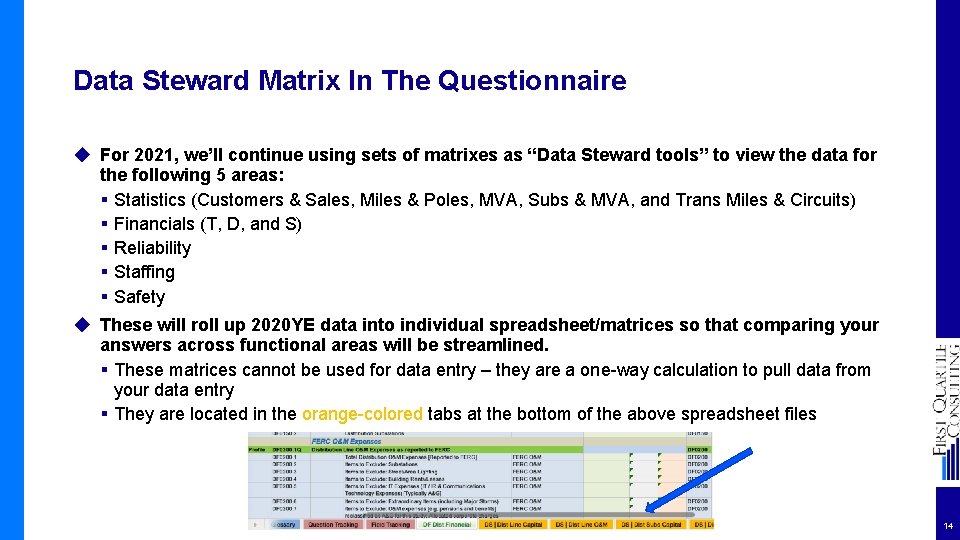
Data Steward Matrix In The Questionnaire ◆ For 2021, we’ll continue using sets of matrixes as “Data Steward tools” to view the data for the following 5 areas: § Statistics (Customers & Sales, Miles & Poles, MVA, Subs & MVA, and Trans Miles & Circuits) § Financials (T, D, and S) § Reliability § Staffing § Safety ◆ These will roll up 2020 YE data into individual spreadsheet/matrices so that comparing your answers across functional areas will be streamlined. § These matrices cannot be used for data entry – they are a one-way calculation to pull data from your data entry § They are located in the orange-colored tabs at the bottom of the above spreadsheet files 14
Questionnaire Files – Behind the Scenes Do’s and Don’ts ◆ We’ve noticed a few times where a company takes last year’s questionnaire, adds a column for the current year and assumes that all is good. § Given the many changes we have recently incorporated behind the scenes, attempting to do what is described above will mean we don’t get your data. ◆ It remains very important not to change the tab names within the questionnaire. ◆ File names should not be changed. We can see that they’ve been changed when we receive them and change them back, but please help us to avoid rework. ◆ Share. Point will still be available for those that like to use our server for data entry. § It is still very important to let Debi Cook and/or your Data Steward know that the files are ready for use. § We do not check Share. Point to see what files have been updated. § You need to “submit” your files just like everyone else at each deadline. 15
Data Collection Guide Outline ◆ The purpose of this Data Collection Guide is to describe the “rules” for providing data. The organization is as follows: ST Statistics SU Support DF Distribution Financial SG Smart Grid TF Transmission Financial AM Asset Management SF Safety DG Distributed Generation SO Staffing & Outsourcing CP Capital Projects ER Storm Response LP Line Projects DR Distribution Reliability TS Substation Projects SR Substation Reliability DP Distribution Line Practices TR SP Substation Practices TP Transmission Line Practices AI AMI Across the Organization Transmission Reliability MR Metering 16
Statistics 17
Statistics ◆ The Statistics section is used to gather demographic information used to normalize the data • System configuration • Numbers of system components • Age of parts of the system 18
Statistics ◆ This section collects the following types of information: § T&D system demographic data such as end of year customer counts, service territory size, miles of line, numbers of structures, etc § Age profile data for major equipment components § Data quantifying how much customer and system growth occurred over the past year § Major software packages used for key T&D information systems (e. g. , OMS, WMS) ◆ Uses of the collected information: § Some of the end-of-year data is used to normalize the cost, reliability and staffing data that is collected elsewhere in the questionnaire § Other data is used in unit cost calculations or statistical analyses of results to better understand the inherent advantages and limitations of circumstances facing each utility. 19
Transmission Versus Distribution ◆ For purposes of this survey, we define distribution to be a voltage level of 44 k. V and below. § The distinction is somewhat arbitrary, but picks a point between 69 k. V, which is generally considered a transmission (or at least sub-transmission) level, and 21 k. V, which would generally be considered distribution. § In some cases, it may be unrealistic for utilities to redefine all of their internal statistics, cost and reliability reporting on the basis of these definitions. In such case, we accept data collected based on a utility’s self-determined definitions. However, a utility that has very different definitions and performance results may want to take the time to restate their data to better compare their performance. Distribution Voltage Classes (Phase to Phase) 5 k. V class (>1 k. V, <=9 k. V) 15 k. V class (>9 k. V, <=15 k. V) 25 k. V class (>15 k. V to <=26 k. V) 35 k. V class (>26 k. V to <=36 k. V) 44 k. V class (>36 k. V to <=44 k. V) Transmission classes >=45 k. V (Phase to Phase) <69 k. V class (>=45 k. V <69 k. V) 69 k. V class (>=69 k. V <100 k. V) 100 k. V class (>=100 k. V <200 k. V) 200 k. V Class (>=200 k. V <300 k. V) 300 k. V Class (>=300 k. V <400 k. V) 400 k. V and above 20
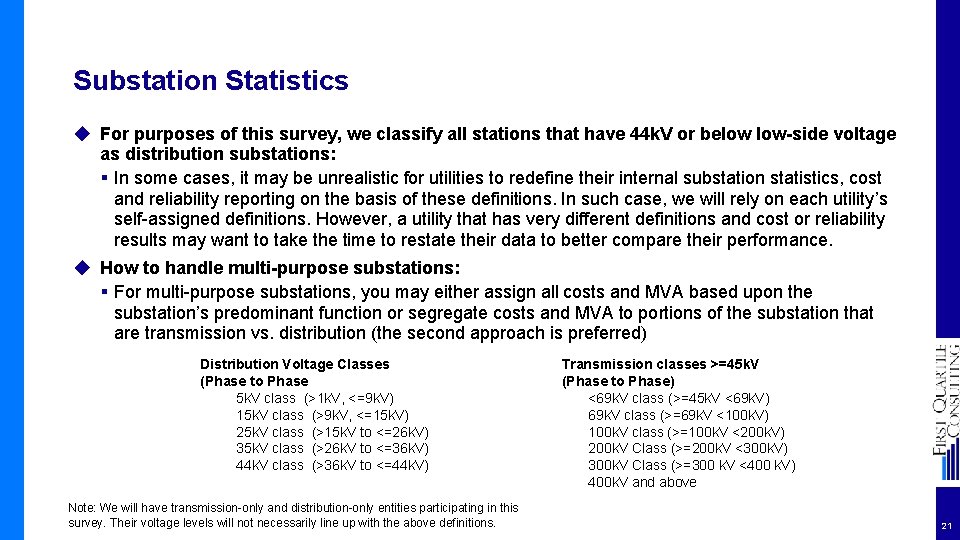
Substation Statistics ◆ For purposes of this survey, we classify all stations that have 44 k. V or below low-side voltage as distribution substations: § In some cases, it may be unrealistic for utilities to redefine their internal substation statistics, cost and reliability reporting on the basis of these definitions. In such case, we will rely on each utility’s self-assigned definitions. However, a utility that has very different definitions and cost or reliability results may want to take the time to restate their data to better compare their performance. ◆ How to handle multi-purpose substations: § For multi-purpose substations, you may either assign all costs and MVA based upon the substation’s predominant function or segregate costs and MVA to portions of the substation that are transmission vs. distribution (the second approach is preferred) Distribution Voltage Classes (Phase to Phase 5 k. V class (>1 k. V, <=9 k. V) 15 k. V class (>9 k. V, <=15 k. V) 25 k. V class (>15 k. V to <=26 k. V) 35 k. V class (>26 k. V to <=36 k. V) 44 k. V class (>36 k. V to <=44 k. V) Note: We will have transmission-only and distribution-only entities participating in this survey. Their voltage levels will not necessarily line up with the above definitions. Transmission classes >=45 k. V (Phase to Phase) <69 k. V class (>=45 k. V <69 k. V) 69 k. V class (>=69 k. V <100 k. V) 100 k. V class (>=100 k. V <200 k. V) 200 k. V Class (>=200 k. V <300 k. V) 300 k. V Class (>=300 k. V <400 k. V) 400 k. V and above 21
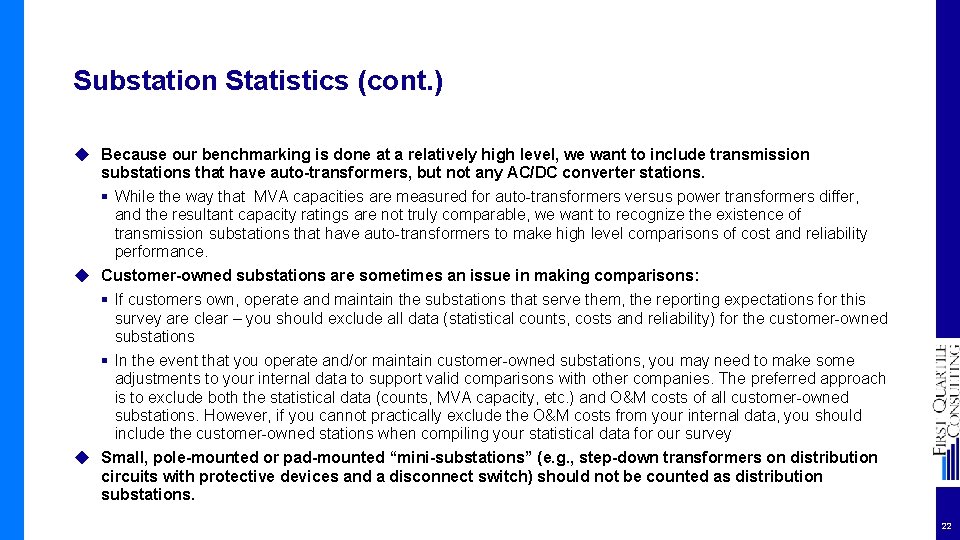
Substation Statistics (cont. ) ◆ Because our benchmarking is done at a relatively high level, we want to include transmission substations that have auto-transformers, but not any AC/DC converter stations. § While the way that MVA capacities are measured for auto-transformers versus power transformers differ, and the resultant capacity ratings are not truly comparable, we want to recognize the existence of transmission substations that have auto-transformers to make high level comparisons of cost and reliability performance. ◆ Customer-owned substations are sometimes an issue in making comparisons: § If customers own, operate and maintain the substations that serve them, the reporting expectations for this survey are clear – you should exclude all data (statistical counts, costs and reliability) for the customer-owned substations § In the event that you operate and/or maintain customer-owned substations, you may need to make some adjustments to your internal data to support valid comparisons with other companies. The preferred approach is to exclude both the statistical data (counts, MVA capacity, etc. ) and O&M costs of all customer-owned substations. However, if you cannot practically exclude the O&M costs from your internal data, you should include the customer-owned stations when compiling your statistical data for our survey ◆ Small, pole-mounted or pad-mounted “mini-substations” (e. g. , step-down transformers on distribution circuits with protective devices and a disconnect switch) should not be counted as distribution substations. 22
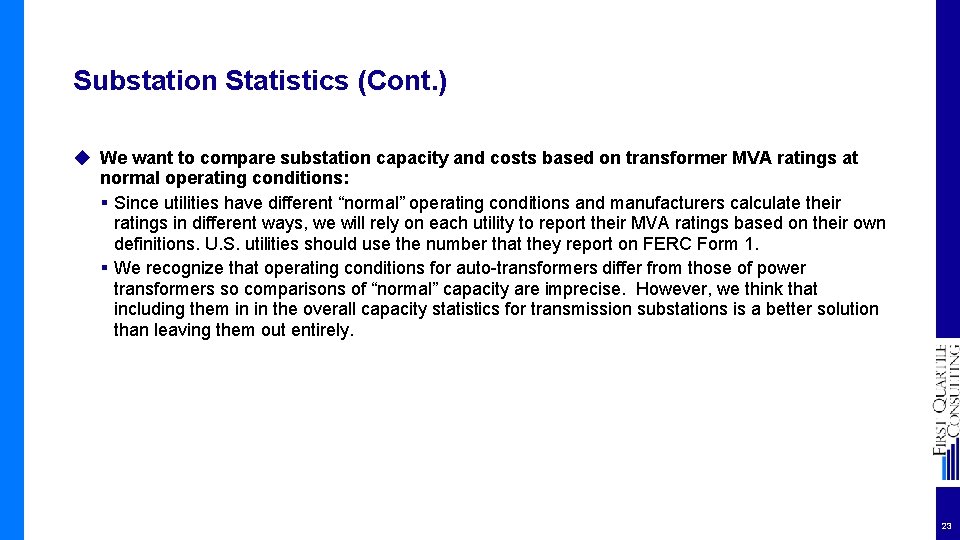
Substation Statistics (Cont. ) ◆ We want to compare substation capacity and costs based on transformer MVA ratings at normal operating conditions: § Since utilities have different “normal” operating conditions and manufacturers calculate their ratings in different ways, we will rely on each utility to report their MVA ratings based on their own definitions. U. S. utilities should use the number that they report on FERC Form 1. § We recognize that operating conditions for auto-transformers differ from those of power transformers so comparisons of “normal” capacity are imprecise. However, we think that including them in in the overall capacity statistics for transmission substations is a better solution than leaving them out entirely. 23
Financials 24
Financial Sections ◆ The Financial sections of the questionnaire (Sections DF and TF) ask for the Capital and O&M costs of running the business, separated between Distribution Lines, Distribution Substations, Transmission Lines and Transmission Substations ◆ We use two cost reporting models: § FERC: The overall cost model is based on the FERC system of accounts, with a number of adjustments designed to make the cost reporting more consistent between the companies. Specific questions within the questionnaire ask for the data reported in a group of FERC accounts, and then subsequent questions ask for the information required to make the desired adjustments. § Activity-Based: The guiding principle of the activity cost model is to capture the expenditures associated with the year in which they were made, regardless of when they were actually reported to FERC. The activities also are more aligned with typical budgetary categories, such as New Business (capital) and Vegetation Management (O&M). While budget categories differ among utilities, we have developed a set of budget categories that most companies have been able to use. ◆ The Financial section also covers assets, depreciation and Construction Work In Progress (CWIP) 25
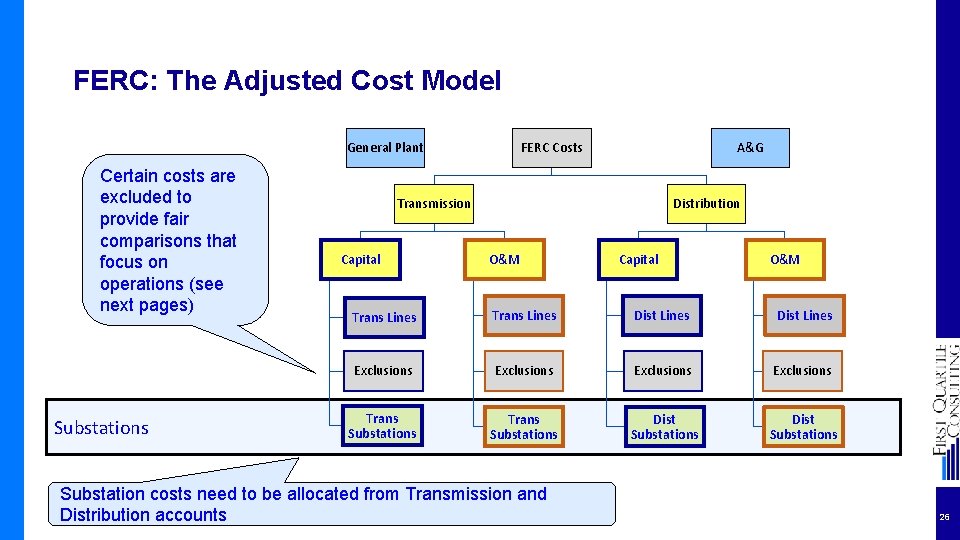
FERC: The Adjusted Cost Model General Plant Certain costs are excluded to provide fair comparisons that focus on operations (see next pages) Substations FERC Costs A&G Transmission Capital Distribution O&M Capital O&M Trans Lines Dist Lines Exclusions Trans Substations Dist Substations Substation costs need to be allocated from Transmission and Distribution accounts 26
FERC Cost Exclusions: General ◆ The goal of the exclusions is to provide a fairer comparison of T&D operational performance, by excluding certain costs which are included in FERC reporting that are not under the control of T&D management. § A&G Costs: exclude costs typically reported as A&G (e. g. pensions and benefits) from your FERC O&M data. Also exclude any corporate A&G overheads that may be charged to your FERC O&M § General Plant Costs: exclude costs typically reported as General Plant (e. g. IT/Communications infrastructure, capital cost of buildings) from your FERC Capital data. § Land Acquisition Costs and Building Rents/Leases: Land acquisition costs should be excluded from your FERC Capital data because they vary greatly by region and also can occur at very different points in time, based upon land policies. Building rents/leases should also be excluded from FERC O&M data for similar reasons § Extraordinary Items Including Major Storm Events: You should exclude the costs of any very large, unforeseen event or transaction for which the total O&M or total Capital spending exceeded 10% of your company’s annual T&D O&M or Capital spending. • Note: For major storm events, some utilities use an “insurance reserve” account. The restoration expenses for major storms are charged to the reserve account and are not reported as O&M expenses. If you had a major storm event and your company uses such an account, you do not need to make any adjustment to your FERC O&M data. However, you should still adjust your FERC capital data to remove any capital expenditures for major storm events that exceeded the 10% of annual budget threshold. 27
FERC Cost Exclusions: Specific ◆ Distribution § Exclude all street lighting capital and O&M costs. There is a large variation in what street lighting exists in utility service territories and what percent is owned and operated by the utility versus other entities (e. g. , municipalities) ◆ Substation § Exclude any O&M expenses for which you are reimbursed, such as substation maintenance work performed for customer-owned substations. ◆ Transmission § Exclude wheeling expenses: Our transmission cost metrics are geared to operational performance of the infrastructure. So, while an argument could be made that wheeling is a substitute for system ownership, it may also be simply an economic arrangement to purchase incremental or low-cost power. § Exclude Regional Transmission Operator fees: These costs vary between regions and many utilities don’t even incur these costs, so they should be excluded. 28
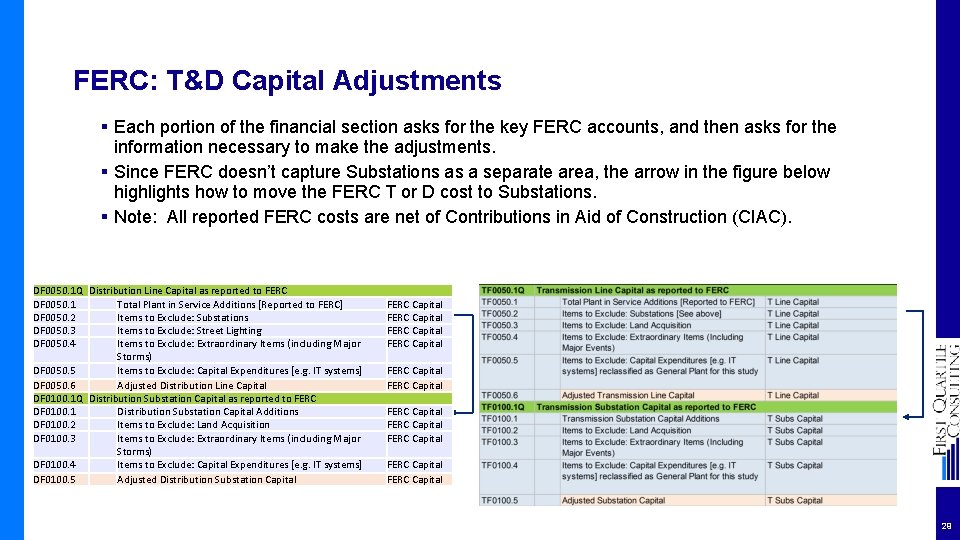
FERC: T&D Capital Adjustments § Each portion of the financial section asks for the key FERC accounts, and then asks for the information necessary to make the adjustments. § Since FERC doesn’t capture Substations as a separate area, the arrow in the figure below highlights how to move the FERC T or D cost to Substations. § Note: All reported FERC costs are net of Contributions in Aid of Construction (CIAC). DF 0050. 1 Q Distribution Line Capital as reported to FERC DF 0050. 1 Total Plant in Service Additions [Reported to FERC] DF 0050. 2 Items to Exclude: Substations DF 0050. 3 Items to Exclude: Street Lighting DF 0050. 4 Items to Exclude: Extraordinary Items (including Major Storms) DF 0050. 5 Items to Exclude: Capital Expenditures [e. g. IT systems] DF 0050. 6 Adjusted Distribution Line Capital DF 0100. 1 Q Distribution Substation Capital as reported to FERC DF 0100. 1 Distribution Substation Capital Additions DF 0100. 2 Items to Exclude: Land Acquisition DF 0100. 3 Items to Exclude: Extraordinary Items (including Major Storms) DF 0100. 4 Items to Exclude: Capital Expenditures [e. g. IT systems] DF 0100. 5 Adjusted Distribution Substation Capital FERC Capital FERC Capital FERC Capital 29
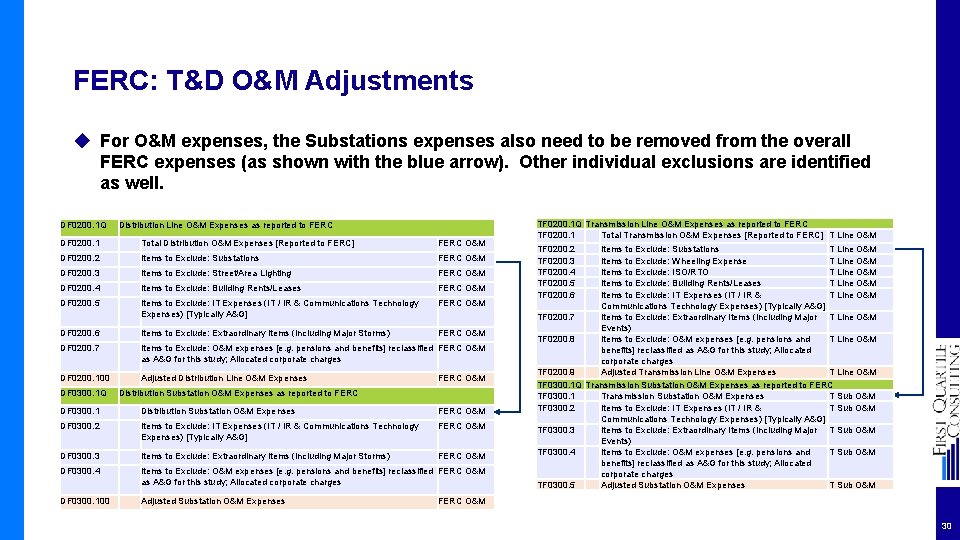
FERC: T&D O&M Adjustments ◆ For O&M expenses, the Substations expenses also need to be removed from the overall FERC expenses (as shown with the blue arrow). Other individual exclusions are identified as well. DF 0200. 1 Q Distribution Line O&M Expenses as reported to FERC DF 0200. 1 Total Distribution O&M Expenses [Reported to FERC] FERC O&M DF 0200. 2 Items to Exclude: Substations FERC O&M DF 0200. 3 Items to Exclude: Street/Area Lighting FERC O&M DF 0200. 4 Items to Exclude: Building Rents/Leases FERC O&M DF 0200. 5 Items to Exclude: IT Expenses (IT / IR & Communications Technology Expenses) [Typically A&G] FERC O&M DF 0200. 6 Items to Exclude: Extraordinary Items (including Major Storms) FERC O&M DF 0200. 7 Items to Exclude: O&M expenses [e. g. pensions and benefits] reclassified FERC O&M as A&G for this study; Allocated corporate charges DF 0200. 100 Adjusted Distribution Line O&M Expenses DF 0300. 1 Q FERC O&M Distribution Substation O&M Expenses as reported to FERC DF 0300. 1 Distribution Substation O&M Expenses FERC O&M DF 0300. 2 Items to Exclude: IT Expenses (IT / IR & Communications Technology Expenses) [Typically A&G] FERC O&M DF 0300. 3 Items to Exclude: Extraordinary Items (including Major Storms) FERC O&M DF 0300. 4 Items to Exclude: O&M expenses [e. g. pensions and benefits] reclassified FERC O&M as A&G for this study; Allocated corporate charges DF 0300. 100 Adjusted Substation O&M Expenses TF 0200. 1 Q Transmission Line O&M Expenses as reported to FERC TF 0200. 1 Total Transmission O&M Expenses [Reported to FERC] T Line O&M TF 0200. 2 TF 0200. 3 TF 0200. 4 TF 0200. 5 TF 0200. 6 Items to Exclude: Substations T Line O&M Items to Exclude: Wheeling Expense T Line O&M Items to Exclude: ISO/RTO T Line O&M Items to Exclude: Building Rents/Leases T Line O&M Items to Exclude: IT Expenses (IT / IR & T Line O&M Communications Technology Expenses) [Typically A&G] TF 0200. 7 Items to Exclude: Extraordinary Items (Including Major T Line O&M Events) TF 0200. 8 Items to Exclude: O&M expenses [e. g. pensions and T Line O&M benefits] reclassified as A&G for this study; Allocated corporate charges TF 0200. 9 Adjusted Transmission Line O&M Expenses T Line O&M TF 0300. 1 Q Transmission Substation O&M Expenses as reported to FERC TF 0300. 1 Transmission Substation O&M Expenses T Sub O&M TF 0300. 2 Items to Exclude: IT Expenses (IT / IR & T Sub O&M Communications Technology Expenses) [Typically A&G] TF 0300. 3 Items to Exclude: Extraordinary Items (Including Major T Sub O&M Events) TF 0300. 4 Items to Exclude: O&M expenses [e. g. pensions and T Sub O&M benefits] reclassified as A&G for this study; Allocated corporate charges TF 0300. 5 Adjusted Substation O&M Expenses T Sub O&M FERC O&M 30
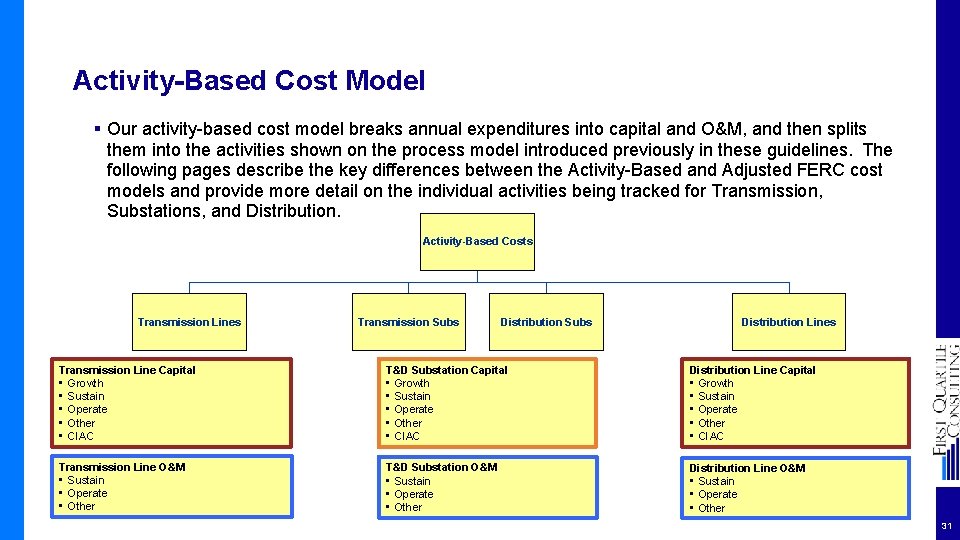
Activity-Based Cost Model § Our activity-based cost model breaks annual expenditures into capital and O&M, and then splits them into the activities shown on the process model introduced previously in these guidelines. The following pages describe the key differences between the Activity-Based and Adjusted FERC cost models and provide more detail on the individual activities being tracked for Transmission, Substations, and Distribution. Activity-Based Costs Transmission Lines Transmission Subs Distribution Lines Transmission Line Capital • Growth • Sustain • Operate • Other • CIAC T&D Substation Capital • Growth • Sustain • Operate • Other • CIAC Distribution Line Capital • Growth • Sustain • Operate • Other • CIAC Transmission Line O&M • Sustain • Operate • Other T&D Substation O&M • Sustain • Operate • Other Distribution Line O&M • Sustain • Operate • Other 31
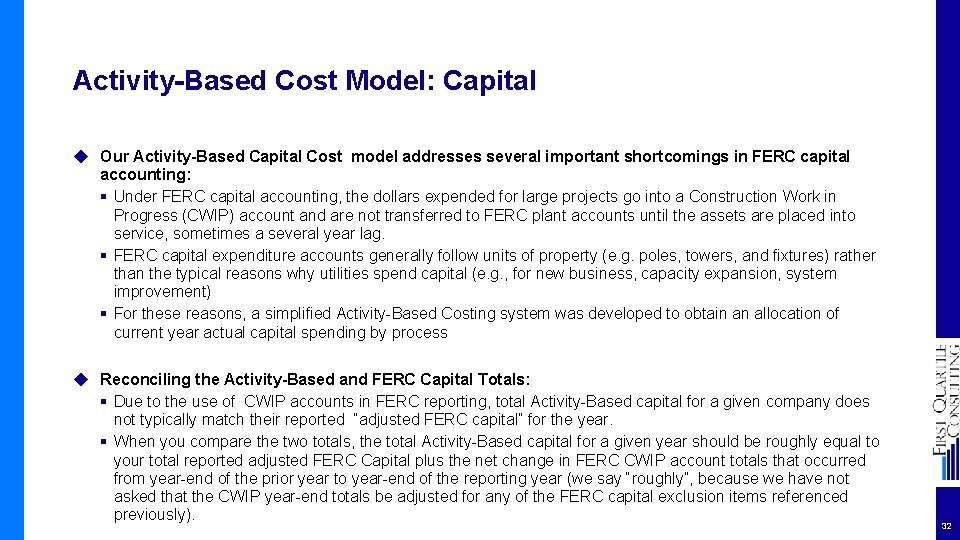
Activity-Based Cost Model: Capital ◆ Our Activity-Based Capital Cost model addresses several important shortcomings in FERC capital accounting: § Under FERC capital accounting, the dollars expended for large projects go into a Construction Work in Progress (CWIP) account and are not transferred to FERC plant accounts until the assets are placed into service, sometimes a several year lag. § FERC capital expenditure accounts generally follow units of property (e. g. poles, towers, and fixtures) rather than the typical reasons why utilities spend capital (e. g. , for new business, capacity expansion, system improvement) § For these reasons, a simplified Activity-Based Costing system was developed to obtain an allocation of current year actual capital spending by process ◆ Reconciling the Activity-Based and FERC Capital Totals: § Due to the use of CWIP accounts in FERC reporting, total Activity-Based capital for a given company does not typically match their reported “adjusted FERC capital” for the year. § When you compare the two totals, the total Activity-Based capital for a given year should be roughly equal to your total reported adjusted FERC Capital plus the net change in FERC CWIP account totals that occurred from year-end of the prior year to year-end of the reporting year (we say “roughly”, because we have not asked that the CWIP year-end totals be adjusted for any of the FERC capital exclusion items referenced previously). 32
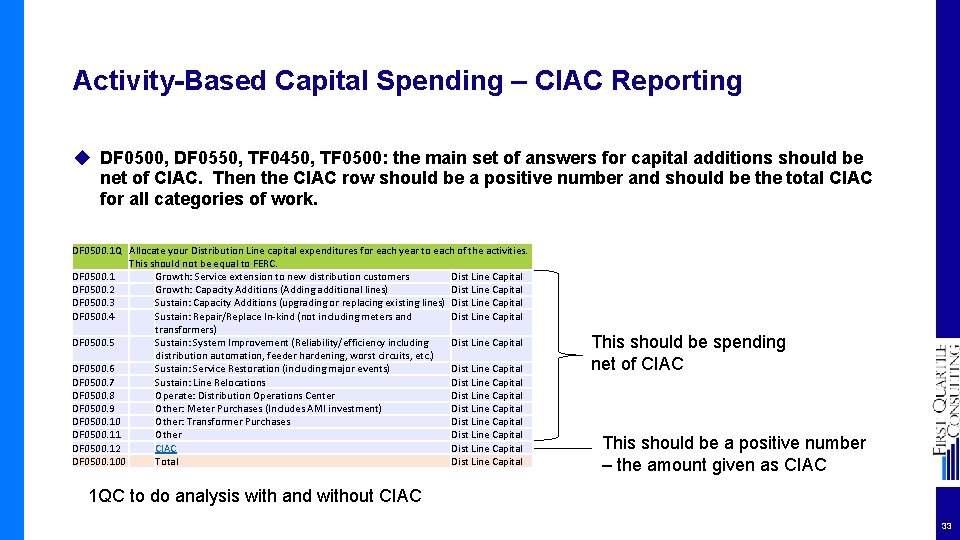
Activity-Based Capital Spending – CIAC Reporting ◆ DF 0500, DF 0550, TF 0450, TF 0500: the main set of answers for capital additions should be net of CIAC. Then the CIAC row should be a positive number and should be the total CIAC for all categories of work. DF 0500. 1 Q Allocate your Distribution Line capital expenditures for each year to each of the activities. This should not be equal to FERC. DF 0500. 1 Growth: Service extension to new distribution customers Dist Line Capital DF 0500. 2 Growth: Capacity Additions (Adding additional lines) Dist Line Capital DF 0500. 3 Sustain: Capacity Additions (upgrading or replacing existing lines) Dist Line Capital DF 0500. 4 Sustain: Repair/Replace In-kind (not including meters and Dist Line Capital transformers) DF 0500. 5 Sustain: System Improvement (Reliability/efficiency including Dist Line Capital distribution automation, feeder hardening, worst circuits, etc. ) DF 0500. 6 Sustain: Service Restoration (including major events) Dist Line Capital DF 0500. 7 Sustain: Line Relocations Dist Line Capital DF 0500. 8 Operate: Distribution Operations Center Dist Line Capital DF 0500. 9 Other: Meter Purchases (Includes AMI investment) Dist Line Capital DF 0500. 10 Other: Transformer Purchases Dist Line Capital DF 0500. 11 Other Dist Line Capital DF 0500. 12 CIAC Dist Line Capital DF 0500. 100 Total Dist Line Capital This should be spending net of CIAC This should be a positive number – the amount given as CIAC 1 QC to do analysis with and without CIAC 33
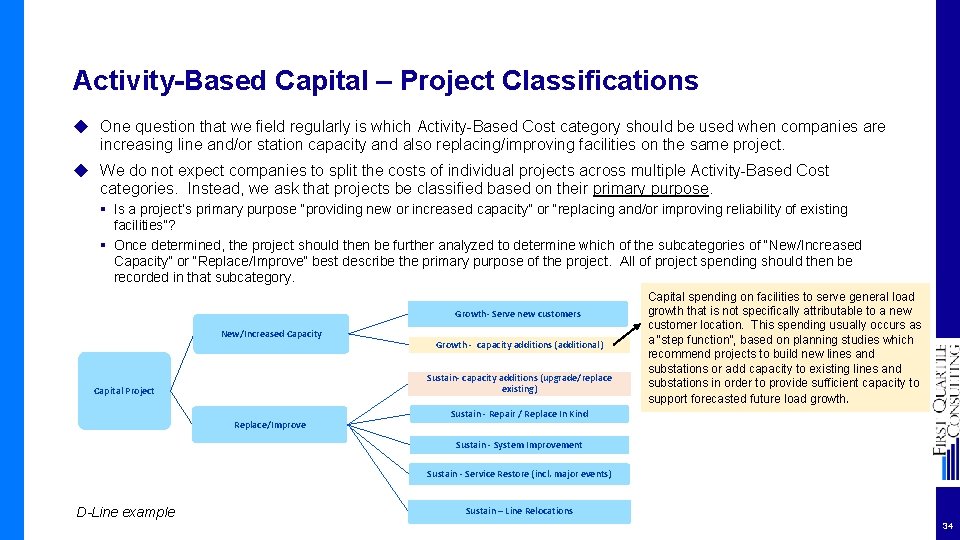
Activity-Based Capital – Project Classifications ◆ One question that we field regularly is which Activity-Based Cost category should be used when companies are increasing line and/or station capacity and also replacing/improving facilities on the same project. ◆ We do not expect companies to split the costs of individual projects across multiple Activity-Based Cost categories. Instead, we ask that projects be classified based on their primary purpose. § Is a project’s primary purpose “providing new or increased capacity” or “replacing and/or improving reliability of existing facilities”? § Once determined, the project should then be further analyzed to determine which of the subcategories of “New/Increased Capacity” or “Replace/Improve” best describe the primary purpose of the project. All of project spending should then be recorded in that subcategory. Growth- Serve new customers New/Increased Capacity Growth - capacity additions (additional) Sustain- capacity additions (upgrade/replace existing) Capital Project Replace/Improve Capital spending on facilities to serve general load growth that is not specifically attributable to a new customer location. This spending usually occurs as a “step function”, based on planning studies which recommend projects to build new lines and substations or add capacity to existing lines and substations in order to provide sufficient capacity to support forecasted future load growth. Sustain - Repair / Replace In Kind Sustain - System Improvement Sustain - Service Restore (incl. major events) D-Line example Sustain – Line Relocations 34
Activity-Based Cost Model: O&M ◆ While FERC O&M accounts tend to be more activity-oriented, they still do have some limitations for inter-utility benchmarking: § FERC O&M accounts do not segregate the costs of some important work processes such as vegetation management and service restoration § Therefore, our Activity-Based O&M Cost Model asks companies to segregate total adjusted FERC O&M costs into key process areas ◆ Reconciliation of Activity-Based and FERC O&M Totals § Your total reported Activity-Based O&M expenses should always match the total of what you reported as “Adjusted FERC O&M” 35
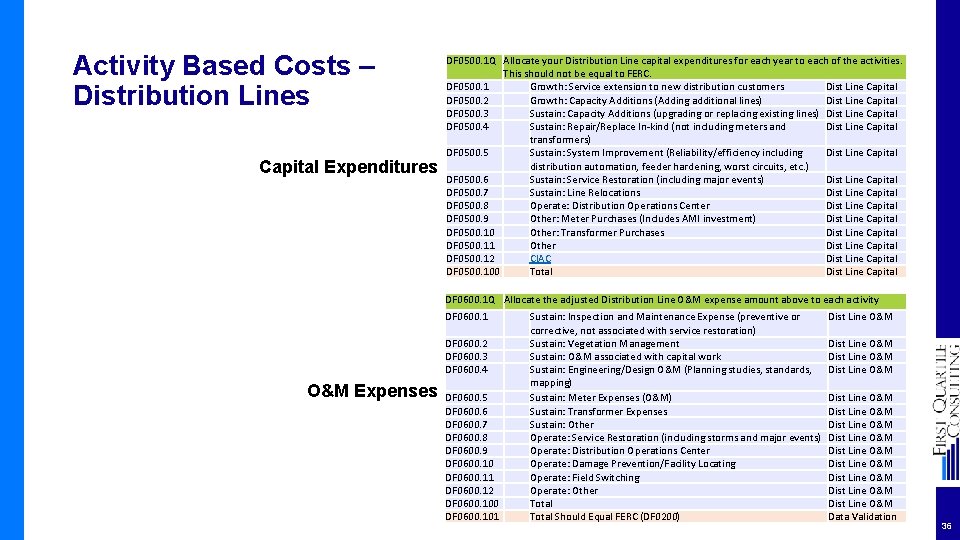
Activity Based Costs – Distribution Lines Capital Expenditures DF 0500. 1 Q Allocate your Distribution Line capital expenditures for each year to each of the activities. This should not be equal to FERC. DF 0500. 1 Growth: Service extension to new distribution customers Dist Line Capital DF 0500. 2 Growth: Capacity Additions (Adding additional lines) Dist Line Capital DF 0500. 3 Sustain: Capacity Additions (upgrading or replacing existing lines) Dist Line Capital DF 0500. 4 Sustain: Repair/Replace In-kind (not including meters and Dist Line Capital transformers) DF 0500. 5 Sustain: System Improvement (Reliability/efficiency including Dist Line Capital distribution automation, feeder hardening, worst circuits, etc. ) DF 0500. 6 Sustain: Service Restoration (including major events) Dist Line Capital DF 0500. 7 Sustain: Line Relocations Dist Line Capital DF 0500. 8 Operate: Distribution Operations Center Dist Line Capital DF 0500. 9 Other: Meter Purchases (Includes AMI investment) Dist Line Capital DF 0500. 10 Other: Transformer Purchases Dist Line Capital DF 0500. 11 Other Dist Line Capital DF 0500. 12 CIAC Dist Line Capital DF 0500. 100 Total Dist Line Capital DF 0600. 1 Q Allocate the adjusted Distribution Line O&M expense amount above to each activity DF 0600. 1 DF 0600. 2 DF 0600. 3 DF 0600. 4 O&M Expenses DF 0600. 5 DF 0600. 6 DF 0600. 7 DF 0600. 8 DF 0600. 9 DF 0600. 10 DF 0600. 11 DF 0600. 12 DF 0600. 100 DF 0600. 101 Sustain: Inspection and Maintenance Expense (preventive or corrective, not associated with service restoration) Sustain: Vegetation Management Sustain: O&M associated with capital work Sustain: Engineering/Design O&M (Planning studies, standards, mapping) Sustain: Meter Expenses (O&M) Sustain: Transformer Expenses Sustain: Other Operate: Service Restoration (including storms and major events) Operate: Distribution Operations Center Operate: Damage Prevention/Facility Locating Operate: Field Switching Operate: Other Total Should Equal FERC (DF 0200) Dist Line O&M Dist Line O&M Dist Line O&M Dist Line O&M Data Validation 36
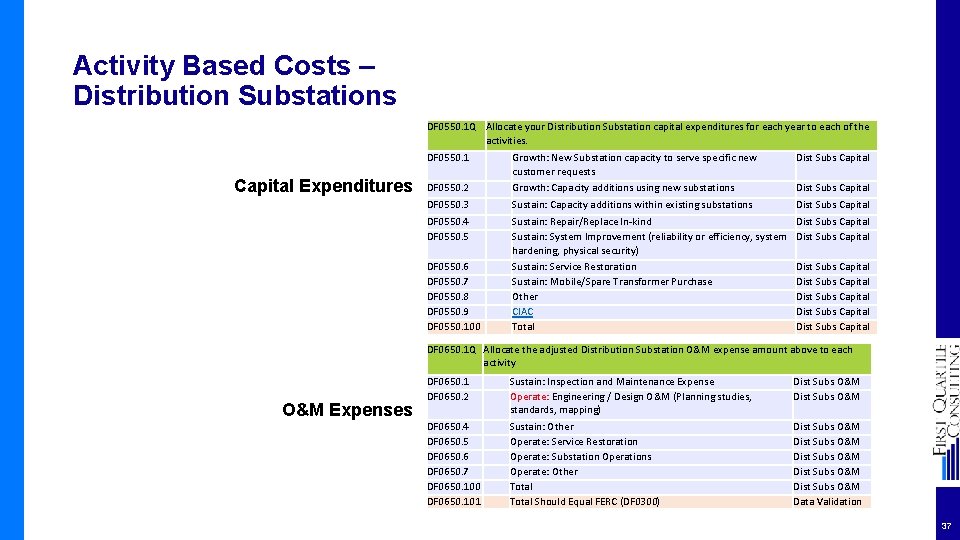
Activity Based Costs – Distribution Substations DF 0550. 1 Q Allocate your Distribution Substation capital expenditures for each year to each of the activities. Capital Expenditures DF 0550. 1 Growth: New Substation capacity to serve specific new customer requests Dist Subs Capital DF 0550. 2 Growth: Capacity additions using new substations Dist Subs Capital DF 0550. 3 Sustain: Capacity additions within existing substations Dist Subs Capital DF 0550. 4 DF 0550. 5 Sustain: Repair/Replace In-kind Dist Subs Capital Sustain: System Improvement (reliability or efficiency, system Dist Subs Capital hardening, physical security) DF 0550. 6 DF 0550. 7 DF 0550. 8 DF 0550. 9 DF 0550. 100 Sustain: Service Restoration Sustain: Mobile/Spare Transformer Purchase Other CIAC Total Dist Subs Capital Dist Subs Capital DF 0650. 1 Q Allocate the adjusted Distribution Substation O&M expense amount above to each activity O&M Expenses DF 0650. 1 DF 0650. 2 Sustain: Inspection and Maintenance Expense Operate: Engineering / Design O&M (Planning studies, standards, mapping) Dist Subs O&M DF 0650. 4 DF 0650. 5 DF 0650. 6 DF 0650. 7 DF 0650. 100 DF 0650. 101 Sustain: Other Operate: Service Restoration Operate: Substation Operations Operate: Other Total Should Equal FERC (DF 0300) Dist Subs O&M Dist Subs O&M Data Validation 37
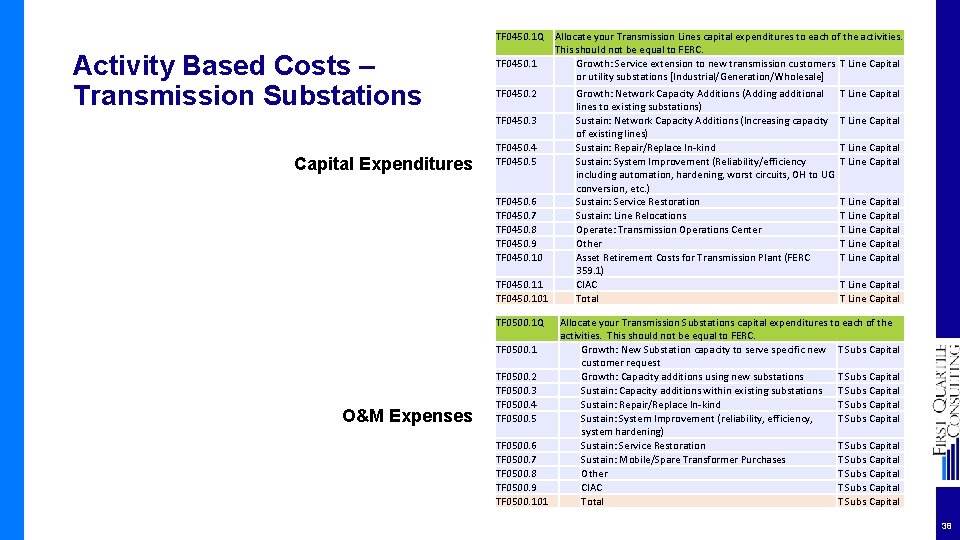
Activity Based Costs – Transmission Substations TF 0450. 1 Q Allocate your Transmission Lines capital expenditures to each of the activities. This should not be equal to FERC. TF 0450. 1 Growth: Service extension to new transmission customers T Line Capital or utility substations [Industrial/Generation/Wholesale] TF 0450. 2 TF 0450. 3 Capital Expenditures TF 0450. 4 TF 0450. 5 TF 0450. 6 TF 0450. 7 TF 0450. 8 TF 0450. 9 TF 0450. 10 TF 0450. 11 TF 0450. 101 TF 0500. 1 Q TF 0500. 1 O&M Expenses TF 0500. 2 TF 0500. 3 TF 0500. 4 TF 0500. 5 TF 0500. 6 TF 0500. 7 TF 0500. 8 TF 0500. 9 TF 0500. 101 Growth: Network Capacity Additions (Adding additional lines to existing substations) Sustain: Network Capacity Additions (Increasing capacity of existing lines) Sustain: Repair/Replace In-kind Sustain: System Improvement (Reliability/efficiency including automation, hardening, worst circuits, OH to UG conversion, etc. ) Sustain: Service Restoration Sustain: Line Relocations Operate: Transmission Operations Center Other Asset Retirement Costs for Transmission Plant (FERC 359. 1) CIAC Total T Line Capital T Line Capital T Line Capital Allocate your Transmission Substations capital expenditures to each of the activities. This should not be equal to FERC. Growth: New Substation capacity to serve specific new T Subs Capital customer request Growth: Capacity additions using new substations T Subs Capital Sustain: Capacity additions within existing substations T Subs Capital Sustain: Repair/Replace In-kind T Subs Capital Sustain: System Improvement (reliability, efficiency, T Subs Capital system hardening) Sustain: Service Restoration T Subs Capital Sustain: Mobile/Spare Transformer Purchases T Subs Capital Other T Subs Capital CIAC T Subs Capital Total T Subs Capital 38
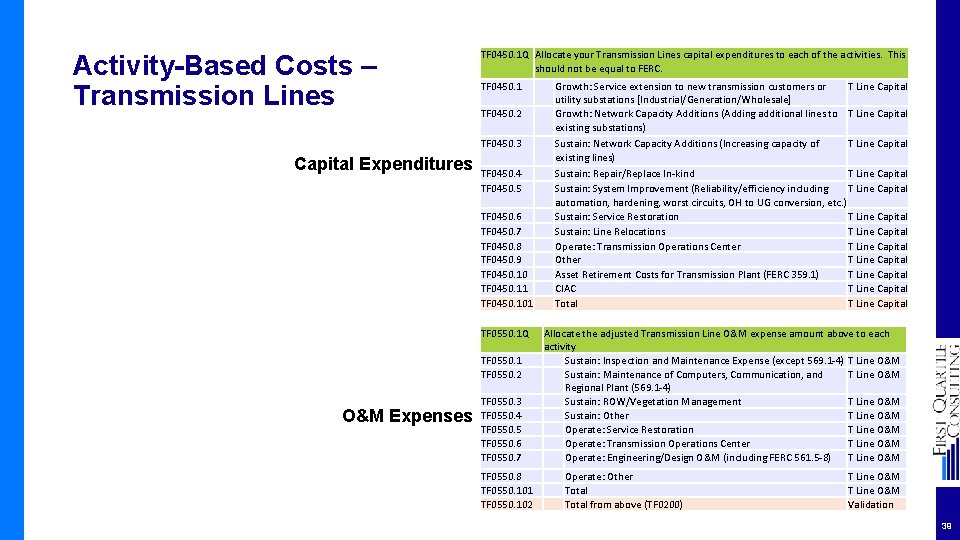
Activity-Based Costs – Transmission Lines Capital Expenditures TF 0450. 1 Q Allocate your Transmission Lines capital expenditures to each of the activities. This should not be equal to FERC. TF 0450. 1 TF 0450. 2 TF 0450. 3 Sustain: Network Capacity Additions (Increasing capacity of existing lines) TF 0450. 4 TF 0450. 5 Sustain: Repair/Replace In-kind T Line Capital Sustain: System Improvement (Reliability/efficiency including T Line Capital automation, hardening, worst circuits, OH to UG conversion, etc. ) Sustain: Service Restoration T Line Capital Sustain: Line Relocations T Line Capital Operate: Transmission Operations Center T Line Capital Other T Line Capital Asset Retirement Costs for Transmission Plant (FERC 359. 1) T Line Capital CIAC T Line Capital Total T Line Capital TF 0450. 6 TF 0450. 7 TF 0450. 8 TF 0450. 9 TF 0450. 10 TF 0450. 11 TF 0450. 101 TF 0550. 1 Q TF 0550. 1 TF 0550. 2 O&M Expenses Growth: Service extension to new transmission customers or T Line Capital utility substations [Industrial/Generation/Wholesale] Growth: Network Capacity Additions (Adding additional lines to T Line Capital existing substations) TF 0550. 3 TF 0550. 4 TF 0550. 5 TF 0550. 6 TF 0550. 7 TF 0550. 8 TF 0550. 101 TF 0550. 102 T Line Capital Allocate the adjusted Transmission Line O&M expense amount above to each activity Sustain: Inspection and Maintenance Expense (except 569. 1 -4) T Line O&M Sustain: Maintenance of Computers, Communication, and T Line O&M Regional Plant (569. 1 -4) Sustain: ROW/Vegetation Management T Line O&M Sustain: Other T Line O&M Operate: Service Restoration T Line O&M Operate: Transmission Operations Center T Line O&M Operate: Engineering/Design O&M (including FERC 561. 5 -8) T Line O&M Operate: Other Total from above (TF 0200) T Line O&M Validation 39
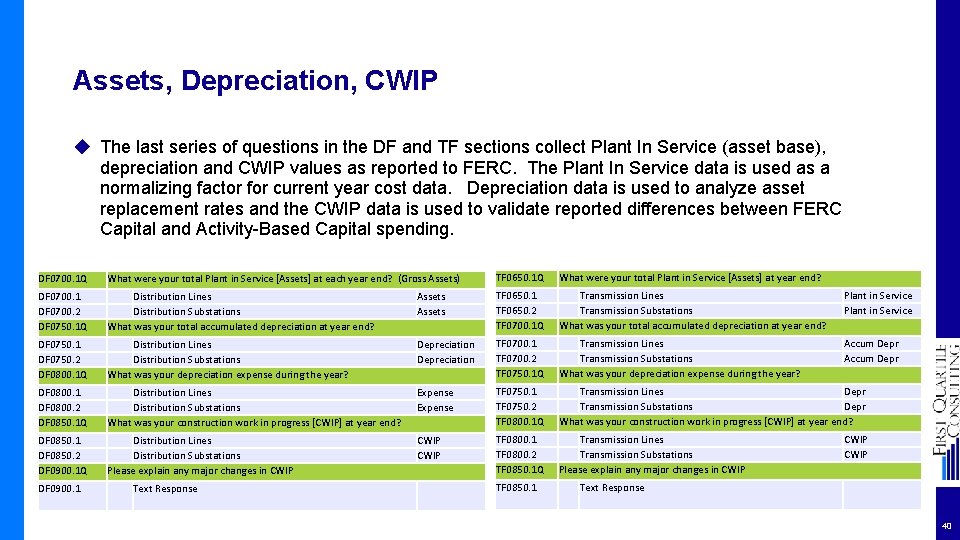
Assets, Depreciation, CWIP ◆ The last series of questions in the DF and TF sections collect Plant In Service (asset base), depreciation and CWIP values as reported to FERC. The Plant In Service data is used as a normalizing factor for current year cost data. Depreciation data is used to analyze asset replacement rates and the CWIP data is used to validate reported differences between FERC Capital and Activity-Based Capital spending. DF 0700. 1 Q What were your total Plant in Service [Assets] at each year end? (Gross Assets) TF 0650. 1 Q What were your total Plant in Service [Assets] at year end? DF 0700. 1 DF 0700. 2 DF 0750. 1 Q Distribution Lines Distribution Substations What was your total accumulated depreciation at year end? Assets TF 0650. 1 TF 0650. 2 TF 0700. 1 Q Transmission Lines Transmission Substations What was your total accumulated depreciation at year end? Plant in Service DF 0750. 1 DF 0750. 2 DF 0800. 1 Q Distribution Lines Distribution Substations What was your depreciation expense during the year? Depreciation TF 0700. 1 TF 0700. 2 TF 0750. 1 Q Transmission Lines Transmission Substations What was your depreciation expense during the year? Accum Depr DF 0800. 1 DF 0800. 2 DF 0850. 1 Q Distribution Lines Distribution Substations What was your construction work in progress [CWIP] at year end? Expense TF 0750. 1 TF 0750. 2 TF 0800. 1 Q Transmission Lines Depr Transmission Substations Depr What was your construction work in progress [CWIP] at year end? DF 0850. 1 DF 0850. 2 DF 0900. 1 Q Distribution Lines Distribution Substations Please explain any major changes in CWIP TF 0800. 1 TF 0800. 2 TF 0850. 1 Q Transmission Lines Transmission Substations Please explain any major changes in CWIP DF 0900. 1 Text Response TF 0850. 1 CWIP Text Response 40
Safety 41
Safety ◆ The purpose of this section is to capture safety performance measures and understand the practices that drive good performance or influence poor performance. ◆ What’s included or excluded… § All T&D field and office occupations should be included in the safety stats (all company employees counted in the Staffing section). § Meter Readers and Field Service staff should not be included in the safety stats. ◆ For 2021 we are asking you to provide both “all-in”- everything reported to OSHA, including Recordable COVID-related Injury/Illnesses, and then the COVID-related data separately (see next few pages). We are asking this in Total, then similar breakouts for Distribution and Subs and Transmission ◆ Sections include: § Safety Metrics § Motor Vehicle Safety Initiatives and Practices § Leadership and Organizational Structure § Leading Indicators § Awards/Recognition § Incident Reporting, Investigation and Follow-Up § Wellness, Formal Safety Observations, Communications, Public Safety 42
Safety Reporting ◆ The employee injury statistics come directly from OSHA definitions (see www. OSHA. gov) ◆ Motor vehicle accident data are also requested (total counts and segregated counts for preventable and high-risk accidents) along with miles driven ◆ However, there are some safety reporting differences among companies which should be recognized when analyzing comparative data: § Vehicle accident data – Some utilities do not collect data on preventable and/or high-risk accidents, so they only report the total counts. § Vehicle accident data – We want companies to include personal vehicles when used for company business. Some companies are not able to do that. § Employee injury data -There are some differences in how utilities administer limited (or light) duty work, which will not be resolved as part of this benchmarking. 43
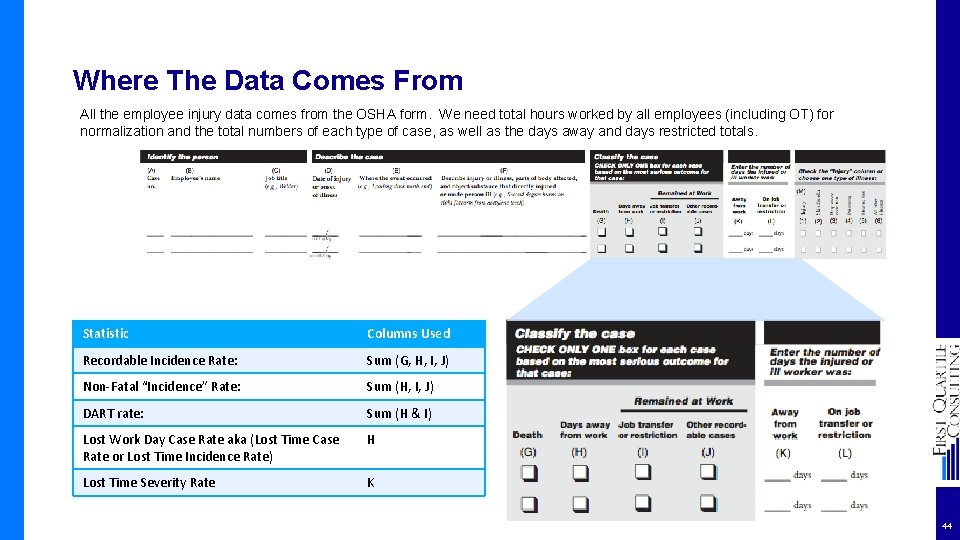
Where The Data Comes From All the employee injury data comes from the OSHA form. We need total hours worked by all employees (including OT) for normalization and the total numbers of each type of case, as well as the days away and days restricted totals. Statistic Columns Used Recordable Incidence Rate: Sum (G, H, I, J) Non-Fatal “Incidence” Rate: Sum (H, I, J) DART rate: Sum (H & I) Lost Work Day Case Rate aka (Lost Time Case Rate or Lost Time Incidence Rate) H Lost Time Severity Rate K 44
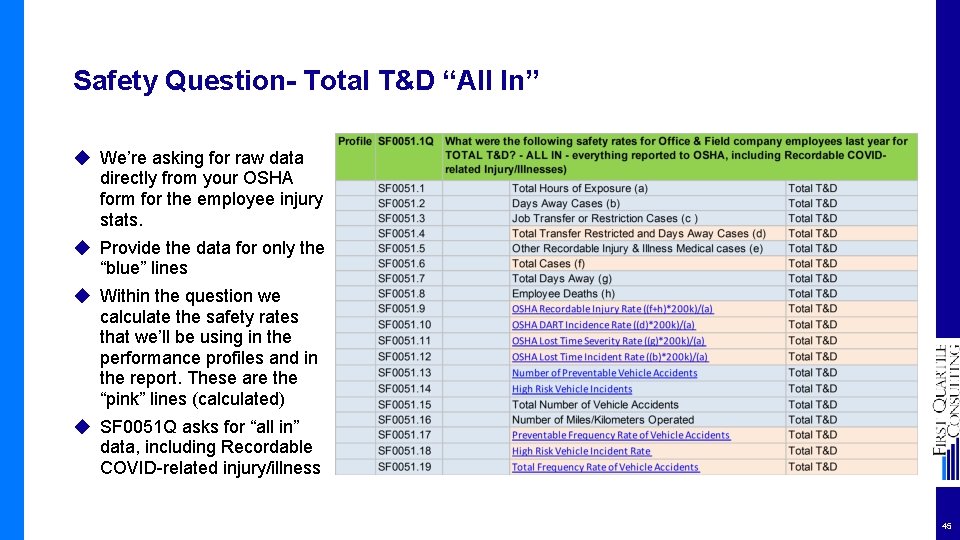
Safety Question- Total T&D “All In” ◆ We’re asking for raw data directly from your OSHA form for the employee injury stats. ◆ Provide the data for only the “blue” lines ◆ Within the question we calculate the safety rates that we’ll be using in the performance profiles and in the report. These are the “pink” lines (calculated) ◆ SF 0051 Q asks for “all in” data, including Recordable COVID-related injury/illness 45
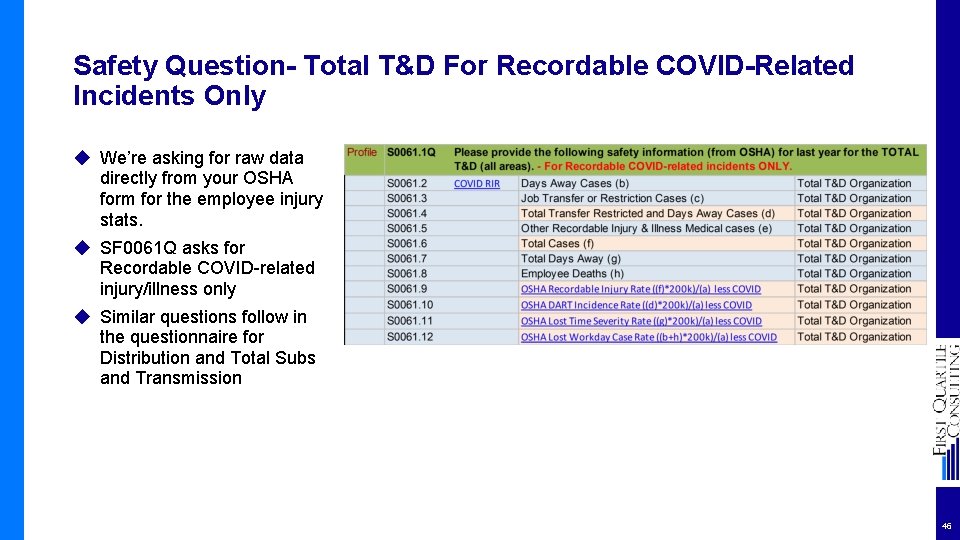
Safety Question- Total T&D For Recordable COVID-Related Incidents Only ◆ We’re asking for raw data directly from your OSHA form for the employee injury stats. ◆ SF 0061 Q asks for Recordable COVID-related injury/illness only ◆ Similar questions follow in the questionnaire for Distribution and Total Subs and Transmission 46
Staffing & Outsourcing 47
Staffing & Outsourcing ◆ Purpose… § To gather staffing data grouped by functional area and by Distribution, Substations, and Transmission in the form of FTEs (Full Time Equivalents) § To collect supporting data that can be helpful in understanding staffing such as overtime, wage rates, and contracting/outsourcing § To understand several practices in the areas of employee engagement, training, recruiting, and mentoring ◆ Questions in this section address the following: § Wage rates § Staff Counts (Distribution Lines, Substations, Transmission) § Staffing Practices • Overtime • Demographics § Outsourcing § Training 48
Staffing ◆ Staffing FTEs: § Count all company employees assigned full time to a function, including direct labor, supervision, administrative support and technical support § Also count contract employees who work in company offices and/or on company facilities and who are directly supervised by company employees (see Glossary definition for “Contract FTE”) § Add in partial counts for part-time employees (seasonal employees or employees who work less than 40 hours per week) and for full-time employees who split their time across different functions • When calculating FTE value use 2080 hours per year as the denominator. • When counting FTEs we don’t expect companies to get total number of employee hours and divide that by 2080. We do expect companies to look at changes in head count throughout the year and use that information to adjust final (or year-end) headcount to get an estimate of actual FTEs. So, a person working fulltime for ½ of the year is only ½ of an FTE. A person working 20 hours per week for the full year is also ½ of an FTE. 49
Outsourcing ◆ We would like to get an accurate estimate of the amount of outsourcing you are doing in addition to your regular Direct and Contract Labor ◆ Outsourcing % are based on “the amount of work that is outsourced” ◆ There should be a relationship to the amount of “contract services” spending you are incurring in the areas covered. ◆ Contract Services: The estimated percentage of the total direct labor work for a specific functional area that was performed by a turn-key Contract Service, rather than by company employees or contractor FTEs supervised by company employees. You may use different methods to estimate this outsourcing percentage such as % of total labor hours, % of total miles built, etc. ◆ If you do not outsource work in an area, please enter “ 0” so that we know you have none versus you did not answer the question 50
Storm Response 51
Storm Response ◆ To better understand storm responses, this section collects the following storm statistics: § In the Summary Storm Data section, for storm events that were experienced last year (2020) where the cumulative number of sustained customer interruptions during the event exceeded 1% of your total customer base. • Count of storm events by size range • Average Storm CAIDI for events in each size range § For Major and Catastrophic Storms, more detailed information on individual storms experienced last year which fell into either the "Major" (>10% to 20% of total customers interrupted) or "Catastrophic" (>20% of customers interrupted) size categories. • Please identify these storms by answering questions ER 0200 through ER 0300 for the two largest storm events that your company experienced last year where total sustained customer interruptions exceeded 10% of your customer base. ◆ In addition, we ask several questions about company storm damage models, storm response operations, changes in weather and processes, ERTs, wildfire mitigation and mutual assistance 52
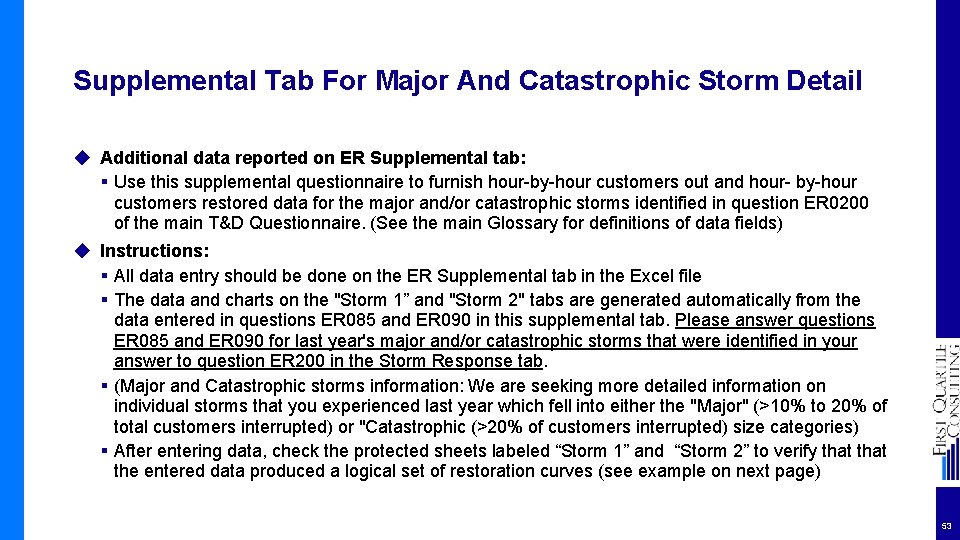
Supplemental Tab For Major And Catastrophic Storm Detail ◆ Additional data reported on ER Supplemental tab: § Use this supplemental questionnaire to furnish hour-by-hour customers out and hour- by-hour customers restored data for the major and/or catastrophic storms identified in question ER 0200 of the main T&D Questionnaire. (See the main Glossary for definitions of data fields) ◆ Instructions: § All data entry should be done on the ER Supplemental tab in the Excel file § The data and charts on the "Storm 1” and "Storm 2" tabs are generated automatically from the data entered in questions ER 085 and ER 090 in this supplemental tab. Please answer questions ER 085 and ER 090 for last year's major and/or catastrophic storms that were identified in your answer to question ER 200 in the Storm Response tab. § (Major and Catastrophic storms information: We are seeking more detailed information on individual storms that you experienced last year which fell into either the "Major" (>10% to 20% of total customers interrupted) or "Catastrophic (>20% of customers interrupted) size categories) § After entering data, check the protected sheets labeled “Storm 1” and “Storm 2” to verify that the entered data produced a logical set of restoration curves (see example on next page) 53
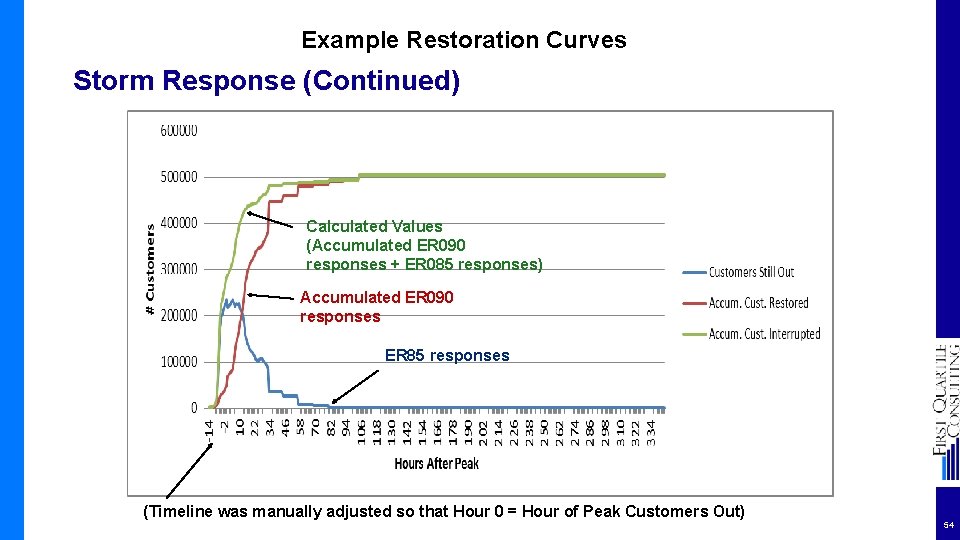
Example Restoration Curves Storm Response (Continued) Calculated Values (Accumulated ER 090 responses + ER 085 responses) Accumulated ER 090 responses ER 85 responses (Timeline was manually adjusted so that Hour 0 = Hour of Peak Customers Out) 54
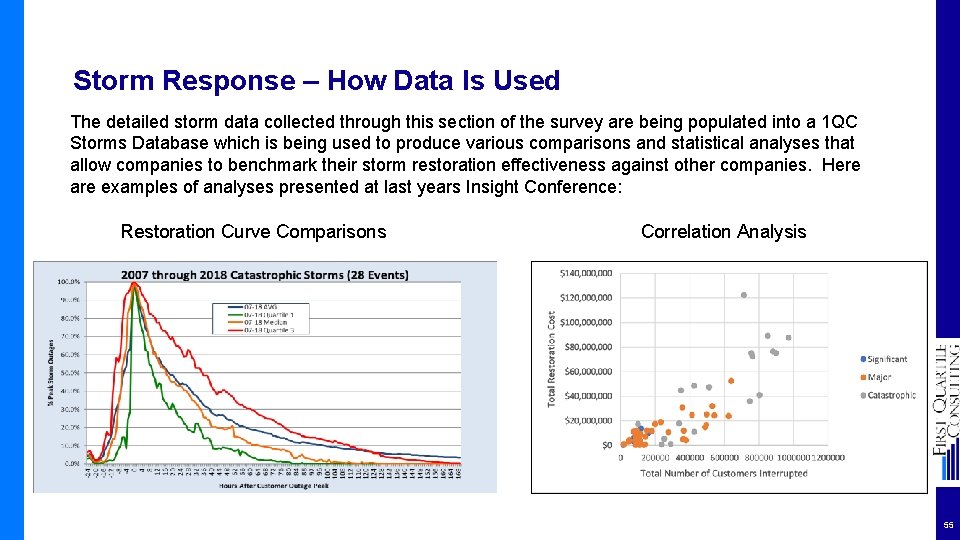
Storm Response – How Data Is Used The detailed storm data collected through this section of the survey are being populated into a 1 QC Storms Database which is being used to produce various comparisons and statistical analyses that allow companies to benchmark their storm restoration effectiveness against other companies. Here are examples of analyses presented at last years Insight Conference: Restoration Curve Comparisons Correlation Analysis 55
Functions That May Find This Information Helpful and Potential Uses for the Data ◆ Storm and Outage Response Planners, Resource Planning functions may find this database useful ◆ Uses of data and related analysis include: § Restoration Curves – useful for evaluating performance § Correlations – useful for estimating restoration times and costs § Track progress to set improvement targets § Regulatory defense of your performance § Development and refining of storm damage models 56
Estimated Restoration Time 57
Topic Areas for ERTs ◆ The section of the survey aggregates all the ERT questions into one section and addresses the following topics: § What data is provided and calculated § When are ERTs provided § Blue Sky Outages § ERT definition and accuracy § Accuracy goals § Channels for communication 58
Reliability Distribution, Substation, and Transmission 59
Response Formatting For Reliability: Zero vs. Blank For all the reliability sections, we do want you to report zeros where you experienced no outages. ◆ Distribution: For distribution if you are completing outage cause questions DR 0300, DR 0350, DR 0400, DR 0450 and did not experience outages by one of the causes, you should enter a zero. Other questions where zero may be appropriate are DR 0650 (sustained interruptions), DR 0800 (durations), and DR 0950 (major event days) ◆ Substations: For questions SR 0100 through SR 0250, if you experienced no failures, mis-operations or outages by a specific cause, enter zero. ◆ Transmission: For the outage questions, only report zeros for voltage levels that you have. So, if you had no outages caused by vandalism, you would still only enter zeros for the voltage levels that you have. If you have no 600 k. V, leave that blank. 60
Distribution Reliability ◆ We look to identify the reliability levels, measurement practices, and initiatives underway to improve distribution reliability. ◆ The perspective is from the end-user, so interruptions from Distribution, Transmission, Substation, and Generation are included. ◆ This year we are asking several questions related to measurement of Public Safety Shut. Offs of due to fire, storm-related events ◆ Blue Sky Day Trouble Call Response § We ask about staffing allocated to first response to customer trouble calls and the average time it takes to dispatch, travel to site and complete repairs/restoration on “blue sky days” (days when less than 1% of customers are out and no significant storms are expected) 6
Distribution Reliability Statistics ◆ The various distribution customer reliability statistics that we collect in this section are defined in IEEE Standard 1366. The latest edition of that standard (IEEE 1366 -2012) can be purchased for download at: http: //standards. ieee. org/findstds/standard/1366 -2012. html ◆ Some of the key reporting issues addressed by the IEEE standard include: § Outage duration to be considered a sustained interruption § Definition of a major event (2. 5 Beta Method) ◆ Utilities vary in exactly how they apply the IEEE standard and there are some differences among utilities on data collection system parameters that are not resolved in the standard such as: § Step restoration reporting § Level of reporting (e. g. , are single service outages included) § Accuracy of reported restoration times ◆ In addition to all of the IEEE 1366 -defined reliability statistics, we calculate and compare “mileage normalized” customer interruptions and customer interruption durations. 62
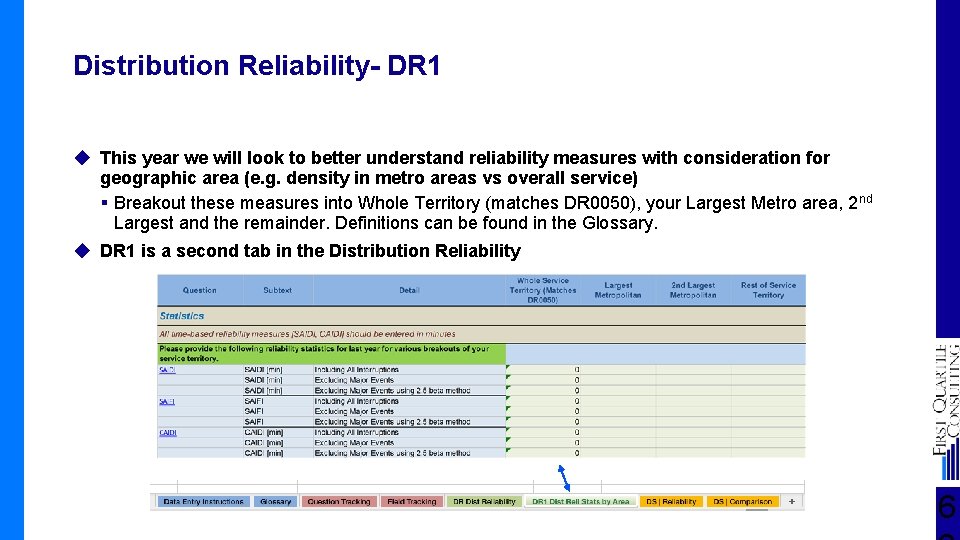
Distribution Reliability- DR 1 ◆ This year we will look to better understand reliability measures with consideration for geographic area (e. g. density in metro areas vs overall service) § Breakout these measures into Whole Territory (matches DR 0050), your Largest Metro area, 2 nd Largest and the remainder. Definitions can be found in the Glossary. ◆ DR 1 is a second tab in the Distribution Reliability 6
Substation Reliability ◆ We collect data to isolate the contributions of substation outages on distribution end-use customer reliability (SAIDI and SAIFI). The interest here is on just those customer interruptions that were due to problems originating “within the substation fence”. An example to clarify this distinction follows: § A cable failure outside of the substation occurs and the protecting feeder breaker fails to trip due to a relay mis-operation. As a result, the back-up device trips out the substation transformer which causes an interruption to the original faulted cable circuit as well as 3 additional circuits fed from the same transformer. The outage of the circuit with the original cable failure is not counted in “substation” statistics (its cause is “distribution equipment failure”) but the outage of the other 3 circuits is counted in “substation” since they occurred as a result of the relay mis-operation. ◆ We collect data on substation power transformer failures ◆ We also ask for data on the “percent mis-operation rate” for relays as defined in a document from IEEE/PSRC Working Group 13. The definition is included in our Glossary. ◆ We also collect data to isolate the impact of substation outages on the TADS transmission line reliability statistics 64
Substation Reliability (continued) ◆ See the Distribution Reliability section guidelines for a description of how we collect aggregate data to measure the impact of substation outages on customer (distribution enduse) reliability. In this section, we ask that the substation contributions to customer reliability (SAIDI and SAIFI) be further split by more detailed outage cause codes. § We recognize that our transmission-only participants may not collect Distribution customer interruption data. If this is true for your company, then leave the questions in this section related to substation contributions to SAIDI and SAIFI blank. ◆ See the Transmission Reliability section guidelines for a description of how we collect raw data to measure the impact of substation outages on the TADS transmission line availability measures. We look at the impact of substation outages on all transmission lines (voltages of 45 k. V and higher), even though the NERC TADS reporting requirement applies only to transmission components 100 k. V and higher. ◆ Risk Quantification § In the case of condition-based or predictive maintenance, a key issue is what happens in the case of equipment failure, so we have several question on measurements. We ask you to focus your answers to these questions on the impacts to larger commercial and industrial customers 65
Transmission Reliability ◆ We gather Transmission reliability data in detail by voltage and outage cause code, including: § Momentary and sustained outages § Delivery point outages § Both before and after exclusion days ◆ Areas surveyed in this section: § Initiatives and practices for improving reliability § Top internal metrics used § Transmission reliability measures (before and after exclusions) § Exclusion days § Planned outages 66
Transmission Line Reliability (continued) ◆ We primarily use the NERC TADS reporting framework to benchmark transmission reliability. The TADS framework measures the frequency and durations of all transmission component outages, irrespective of whether those component outages had any impact on customers. ◆ We collect raw data on the outage counts and durations, split by voltage class and outage cause code. We have aligned our outage cause code breakdown and definitions with the NERC TADS definitions, which can be found in the following document that is available for free download: § NERC | Transmission Availability Data System Definitions | August 1, 2014 http: //www. nerc. com/pa/RAPA/tads/Documents/2015_TADS_Appendix_7. pdf ◆ Note: for the purposes of our program, we have made a few minor adjustments to the NERC definitions which are reflected in our Glossary document 67
Transmission Line Reliability (continued) ◆ In addition to the aforementioned small differences in the application of outage cause codes, our benchmarking program differs from the NERC TADS reporting in the following respects: § We track reliability performance of just AC transmission circuits (not DC) § We track the performance of all AC transmission circuits (45 k. V and higher voltages), even though NERC only requires TADS reporting for 100 k. V and higher voltage facilities § We focus only on “automatic” outages, sustained and momentary, as defined in TADS (no collection of planned outage data) § In addition to calculating the standard TADS transmission line reliability measures, we collect data on delivery point outages and calculate and report “mileage normalized” statistics for both circuit and delivery point outages (counts and durations) § We collect aggregate T-SAIDI and T-SAIFI statistics, based on company definitions ◆ Practice Questions § We ask a few practice questions including one that asks about reliability improvement initiatives. Please take the time to provide concise and complete answers 68
Metering New Section 69
Metering- New Section ◆ This year we have consolidated all questions regarding meter data and demographics into one section and are calling it Metering. This includes questions that were in our traditional Meter Reading Section of the Customer Service survey, as well as those that resided in this T&D survey. ◆ We will be using this same survey section for both CS and T&D programs. ◆ Our reasoning was to create one central location for all questions, as well as to capture information about Meter Reading, AMI application, systems and related demographics. ◆ We are asking companies participating in both surveys to collaborate among counterparts to provide us one set answers. Only one Metering section should be returned to us. ◆ T&D participants should submit the Metering section for all data collection deadlines. 70
Subject Areas for Metering ◆ Volumes ◆ Service Levels § Read Rates § Meter Reading Errors ◆ AMI (features and reads) ◆ Smart Meters/AMI Technology ◆ Age of System ◆ Systems 71
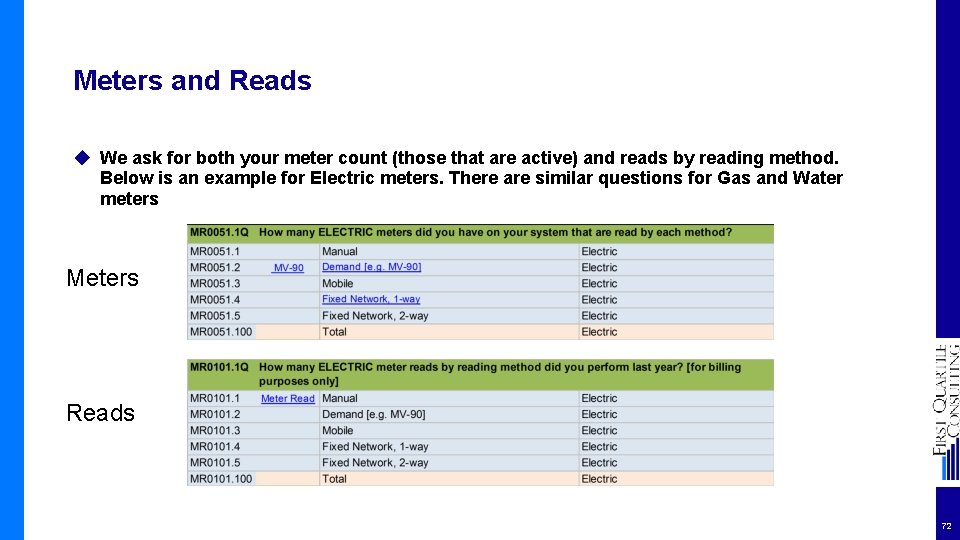
Meters and Reads ◆ We ask for both your meter count (those that are active) and reads by reading method. Below is an example for Electric meters. There are similar questions for Gas and Water meters Meters Reads 72
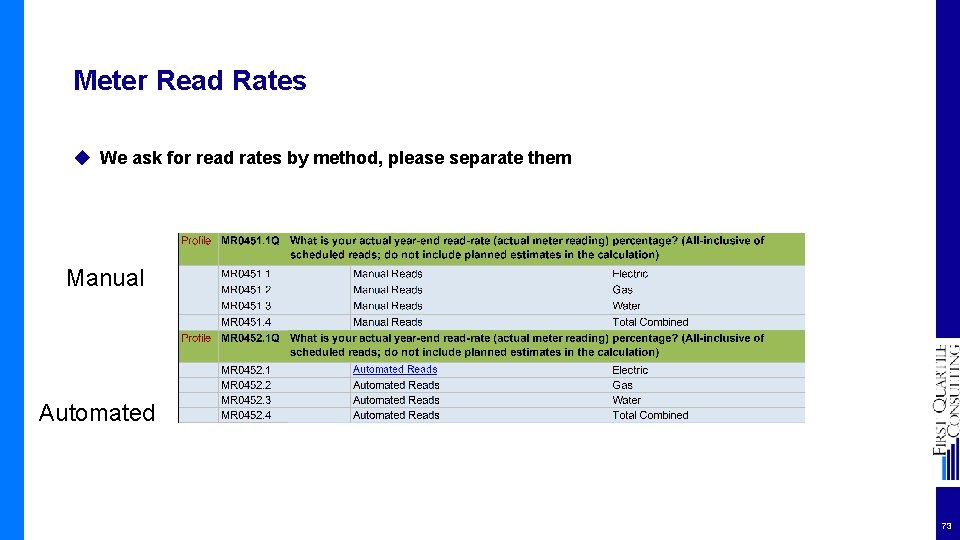
Meter Read Rates ◆ We ask for read rates by method, please separate them Manual Automated 73
Support 74
Support ◆ In this section we gather data on several key areas of T&D Support • Inventory • Fleet • Meter Shop ◆ Included in the survey this year is a further understanding of Inventory and Warehousing: § Inventory Measures and Management • Inventory values, turns, fill and loading rates, and purchasing fill rate • Questions on inventory aggregation and optimizing tools § Distribution, Warehousing and Materials In the Field • Number of facilities, their staffing and 3 rd party services • Vendor delivery to job sites • Measurement Practices for ordering and reordering primary construction and maintenance materials ◆ Included in the Fleet section: • Number of vehicles • Cost benchmarks • Own versus lease • Alternative fuel vehicles 75
Inventory ◆ For inventory values, provide the portion of the value reported in FERC Account 154, "Plant Materials and Operating Supplies", FERC Form 1, Page 110, line 48, column C, allocated by function ◆ We ask for Normal Inventory (Omitting storm stock, spares, power transformers, regulators, reclosers from inventory value) ◆ Definitions for Distribution Centers/Warehouses, Satelites /Service Centers, and 3 rd Party Managed sites are provided in the Glossary 76
Fleet ◆ We have just selected a few key measures for Fleet. This section is not intended to cover the entire fleet operations area. For instance, we are only looking at motorized vehicles. ◆ Focused on O&M (mostly maintenance) of vehicles, not purchase costs. ◆ Vehicle counts should include both company-owned and leased vehicles assigned to T&D employees. Do not include vehicles assigned to anyone who is not included in your T&D staffing count in the Staffing section. ◆ Several groups of people or activities are not included in our T&D survey. Since we exclude these, adjustments to the number of vehicles reported should be made to match the fleet to the activities and people that ARE included in the survey. ◆ Activities/people excluded: § Meter Reading § Storeroom/Warehouse § Street Light Maintenance § Environmental 77
Smart Grid 78
Smart Grid ◆ Our objective is to understand what companies are doing with regard to T&D Smart Grid and Automation § Status of technology implementation/pilots § Support for new automation being applied (resources, skills, expertise) § Initiatives underway in Distribution, Substation, and Transmission ◆ What’s included … § Distribution Automation / Smart Grid Technology § Battery Maintenance and Replacement (new this year) § Substation Automation § Transmission Automation 79
Asset Management 80
Asset Management ◆ The Asset Management section focuses on replacement activities for assets ◆ Questions included address § Service life and age of components § Assets replaced in the past 5 years or planned for replacement in the next 5 years § Last year’s spending allocations for replacement programs ◆ Sections include the following § Asset Management Approach (including health indices ) § Distribution Lines § Substation § Transmission Lines 81
Asset Management Practice Investigation – Service Life and Replacement Capital ◆ This year we ask several additional questions aimed at understanding the service life, replacement rates, future enhancements in the following areas across T, D, and S § Expected service life and average § Percent of components replaced in the last 5 years? (include all actual component replacements for all reasons, regardless of whether they were paid for as O&M or as capital) § Percent planned to be replaced in the next 5 years 82
Distributed Generation 83
Distributed Generation ◆ This section of the T&D survey collects the following baseline information about distributed generation (DG) technology which is connected to the electric distribution systems of companies in our T&D community: § Inventory of all utility-connected DG sites (utility owned and non-utility owned DG) § Owner versus utility responsibilities for various types of non-utility owned DG sites § DG-related regulations, rates and fees § Net Metering § Utility operational activities to support DG § Financial impacts of DG on utility electric T&D networks ◆ The data is being collected to develop an understanding of the similarities and differences in DG penetration and impact across our T&D community 84
Distributed Generation- Key Definitions ◆ Distributed Generation (a. k. a. , “DG”) § Small scale power generation units (generally in the range of 1 KW to 10 MW) which are connected to the electric distribution system rather than to the transmission network. These distributed generation units are commonly owned by electric utility customers or other private entities rather than by the utility that has the franchise to provide electric distribution service to a community. Distributed generation units may use either “renewable” energy sources (see definition below) or more traditional non-renewable energy sources such as diesel oil or gas. ◆ Renewable Energy Sources (a. k. a. , “Renewables”) § Energy sources that are naturally replenished on a human time scale such as sunlight, wind, rain, tides, waves, geothermal heat, biomass, etc. Power generation units that use renewable energy sources may be connected to electric grids at either the transmission or distribution level. 85
Distributed Generation – Key Definitions (continued) ◆ Distributed Generation Site § A residential home, commercial establishment or industrial production facility with some type of distributed power generation (generally in the range of 1 KW to 10 MW capacity) that is connected to the utility electric distribution system ◆ Distributed Generation Site Capacity: § The aggregate nameplate AC generating capacity of the generator(s) at a DG site in megawatts. For non-utility owned DG sites, use the capacity that is stated in the generation interconnection agreement with the utility. Note: For inverter-based DC generating systems, the DC nameplate rating of the generating systems should be converted to an AC nameplate rating. Typically this is accomplished by multiplying the DC rating by a factor of 0. 77, to account for DC to AC conversion efficiency. 86
Capital Projects 87
Capital Projects – Purpose & Structure ◆ This section captures information about how the capital portfolio is developed, and how the projects are managed and executed. ◆ Capital Projects covers a range of capital portfolio management aspects from ranking/selection of projects to put into the portfolio for the year through the management and execution of the individual projects ◆ Question in this section address the following: § Workplan Development- Project Identification § Project/Program Planning § Project Control & Monitoring § Workplan Execution- Portfolio Management § Current Budget Projections (capital budget projections for the next 3 years) 88
Line Projects (Database) 89
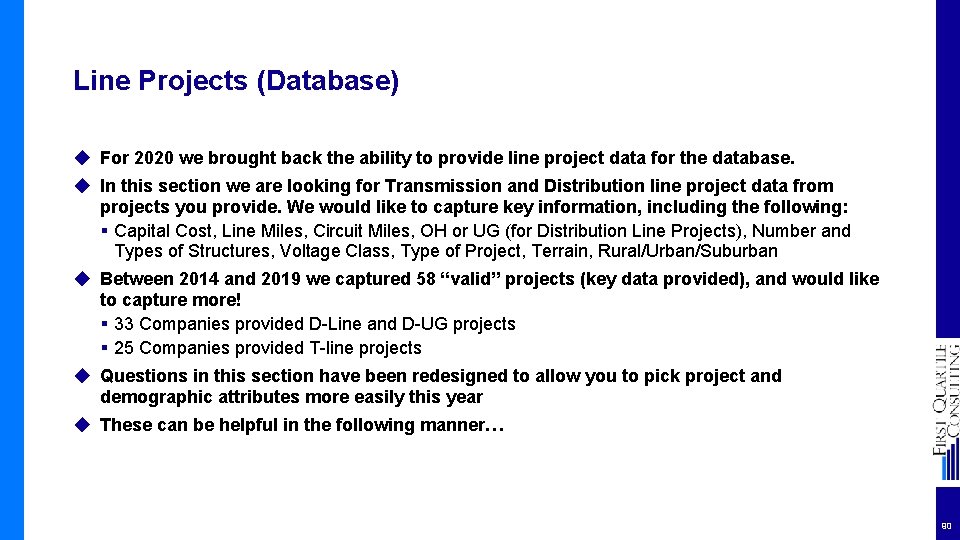
Line Projects (Database) ◆ For 2020 we brought back the ability to provide line project data for the database. ◆ In this section we are looking for Transmission and Distribution line project data from projects you provide. We would like to capture key information, including the following: § Capital Cost, Line Miles, Circuit Miles, OH or UG (for Distribution Line Projects), Number and Types of Structures, Voltage Class, Type of Project, Terrain, Rural/Urban/Suburban ◆ Between 2014 and 2019 we captured 58 “valid” projects (key data provided), and would like to capture more! § 33 Companies provided D-Line and D-UG projects § 25 Companies provided T-line projects ◆ Questions in this section have been redesigned to allow you to pick project and demographic attributes more easily this year ◆ These can be helpful in the following manner… 90
Functions That May Find This Information Helpful and Potential Uses for the Data ◆ Project Managers, Asset Managers, Capital Planning functions could find use here ◆ Could produce project cost correlations and bar charts – useful for project cost estimating. ◆ Line Projects § Cost vs. Line Miles, Cost vs. Circuit Miles, Cost vs. # Structures § Projects Sorted and Grouped in Various Ways 91
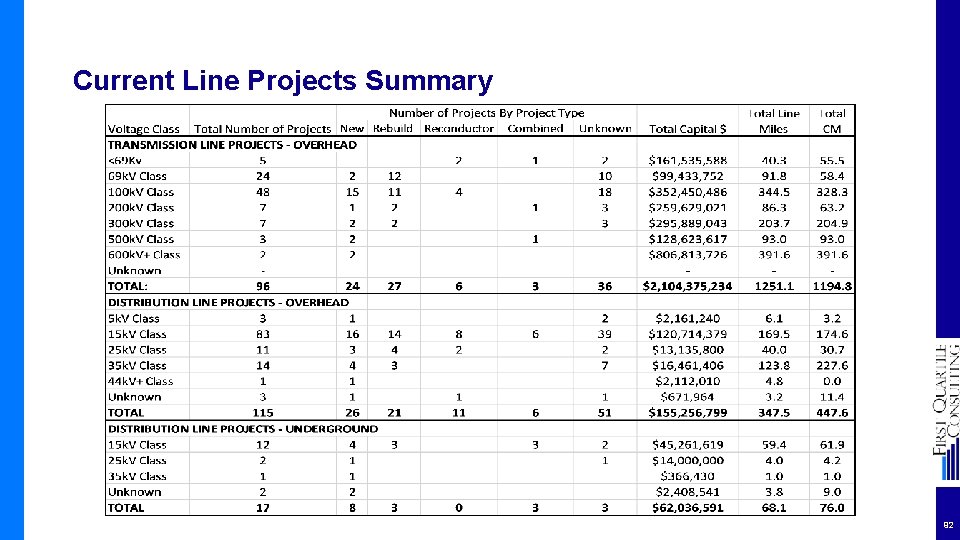
Current Line Projects Summary 92
Substation Projects (Database) 93
Substation Projects (Database) ◆ For 2020 we brought back the ability to provide substation project data for the database. ◆ In this section we are looking for Transmission and Distribution Substation project data from projects you provide. We would like to capture key information, including the following: § Capital Cost, Installed MVA, Number of Transformers, Number of Breakers, Number of Line Terminations, High Side Voltage, Low Side Voltage, Type of Project, Rural/Urban/Suburban ◆ Between 2014 and 2019 we captured 24 “valid” projects (key data provided), and would like to capture more! ◆ Questions in this section have been redesigned to allow you to pick project and demographic attributes more easily this year ◆ These can be helpful in the following manner… 94
Functions That May Find This Information Helpful and Potential Uses for the Data ◆ Project Managers, Asset Managers, Capital Planning functions could find use here ◆ Could produce project cost correlations and bar charts – useful for project cost estimating. ◆ Substation Projects § Cost vs. MVA, Cost vs. # Transformers, Cost vs. # Breakers § Projects Sorted and Grouped in Various Ways 95
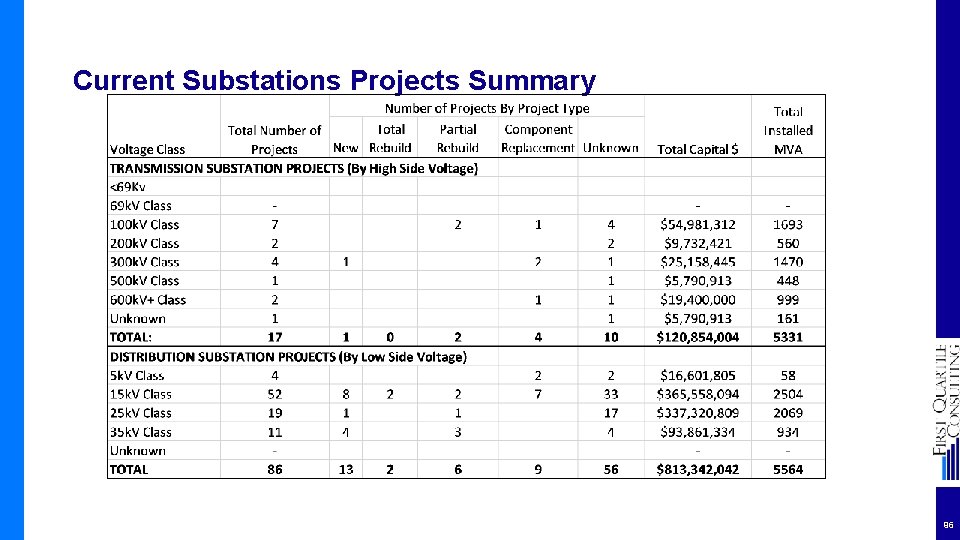
Current Substations Projects Summary 96
Distribution Practices 97
Distribution Line Practices ◆ This section is organized around the following topics : § Distribution Line Planning/Engineering/Design § New Business Service Connections § Line Maintenance § Field Maintenance Scheduling and Performance § Distribution Line Inspection Programs* § Vegetation Management: Trim cycles, contracting methods, and storm/climate-related changes (new) § Distribution System Operations § Poles/ Management* § Thermography* ◆ There is an additional tab this year in this section/file, DP 2 - New Business* * See next slides for details 98
Distribution Line Practices Investigation – Inspection Programs ◆ This year we have again asked several additional questions aimed at understanding inspection programs, including those specifically for switches… § Inspection Basis: Component-Based § Inspection Basis: Critical Circuits § Inspection Basis: Worst Performing Circuits § Switch Inspection Programs 99
Distribution Line Practices Investigation – Poles ◆ This year we have asked several additional questions aimed at understanding the pole management demographics and process in the following areas… § Wood Pole Inspection Process § Pole Replacement or Refurbishment § Wood Pole Recycling § Pole Attachments 100
Distribution Line Practices Investigation – Thermography ◆ This year we have asked several questions aimed at understanding company practices on the use of thermography inspections to determine the status and condition of underground cables …. § Performed by company crews or contractors? § Average daily work volume per crew § Inspection scheduling and dispatching methods § Pole Attachments 101
Distribution Line Practices Investigation – New Business (DP 2) ◆ A separate tab in the questionnaire, DP 2 has been added to address New Business ◆ In order to compare work practices and spending we've developed 4 scenarios that describe work performed. Please answer the questions about each of the following scenarios regarding the work being done: § Scenario 1: 100 A, 240/120 V service from existing overhead transformer, 75 ft [23 m], overhead to a service mast. § Scenario 2: 200 A, 240/120 V service, set new pole and transformer in an existing- single phase primary, service 100 ft [30 m], underground to a meter base. § Scenario 3: 200 A, 240/120 V service, run 200 ft underground primary from existing overhead to new pad mount transformer, run 75 ft [23 m] service to meter base § Scenario 4: 200 k. W demand, 120/208 V service, set riser pole in existing overhead line, run primary 200 ft [60 m] to a new pad mount transformer, three phase service 50 ft [15 m] underground. 102
Substation Practices 103
Substation Practices ◆ This section is organized around the following topics : § Planning/Engineering/ Design § Substation Contractor Crew Management – productivity measurement and improvement § Mobiles and Spares § Maintenance– Improvement initiatives underway, the degree of crew specialization. Also work management systems, inspections, uses of different approaches for equipment maintenance (time based, condition based, etc. ) § Risk Mitigation § Ground Clearing 104
Transmission Practices 105
Transmission Line Practices ◆ This section is organized around the following topics: § Planning, Engineering and Design § Inspection and Analysis Technologies § Patrol & Inspection § Maintenance § Vegetation Management Activity § Insulator Replacement* § Wood Pole/Structure Replacement* § Operations Center (TOC) § Transmission Protection Approaches* § Fire Mitigation ◆ *Note: This year we are undertaking several practice investigations into specific transmission line replacement practices for insulators and wood pole/structures (see next slides for details) 106
Transmission Line Practices Investigation – Replacement For 2020 we have asked a limited number of additional questions aimed at understanding the replacement practices for wood poles/structures and insulators … ◆ Transmission Wood Pole/Structure Replacement § # replaced § Components replaced § Replacement under ”live” conditions § Contracting ◆ Insulator Replacement § # replaced § Replacement under ”live” conditions § Wash cycle and duration of cycle 107
AMI Across the Enterprise: Financial and Organizational 108
AMI Areas Covered ◆ Costs (O&M) ◆ Organizational Location ◆ Staffing ◆ Technology of AMI meters (e. g. PLC, RF Mesh etc. ) 109
Who Should Participate ◆ Companies with greater than 30% of their meters installed using automated meter technology. This includes reading, remote connect and disconnect functions. § We’ll run comparisons of the data for companies greater than 80% and less than 80%. § We want anyone with AMI to answer these questions so that we have the greatest volume of data and so that companies that are in the process of converting meters can begin collecting data in the new format. ◆ We want capability of 2 -way communication, but you don’t have to be able to remotely disconnect, or you may have decided not to use full functionality etc. ◆ If your automation requires van drive-by to capture a read, or just the ability to read meters, do not complete. This section will be provided both in the CS and T&D surveys. We’re looking for one response from each company. Please coordinate internally to get complete data. It will operate on the Customer Service schedule. 110
Baseline Assumptions ◆ Could this include costs that may have already been captured in CS or T&D studies? § Yes, this is a stand-alone financial study. ◆ Are the costs of any purchased AMI meters included? § No, we do not capture capital costs. This is an O&M study only. ◆ What do AMI back office (AMI IT) systems include? § All newly introduced systems to support the AMI system that is installed and its operation. ◆ What is included in data analytics? § Data analytics are those that manipulate the raw data from the measurement ‘function’ to provide insights to the business. It doesn’t include any further manipulation of the data at the functional level. 111
AMI Costs that are not included ◆ What's not included: § Capitalized costs § Corporate Overheads and Adders (e. g. P&B costs) § Costs of the users of AMI management reporting (if someone/some group is simply a user of output reports, e. g. does not gather, manipulate, conduct data analytics, or perform work on AMIrelated assets using reports) 112
Activity Template for AMI ◆ To resolve the financial challenge, we built a financial matrix for capturing all costs related to advanced meters. (We are not trying to relate this back to FERC. ) ◆ For the 2021 Survey, we want to continue to gather information from our benchmarking community on the core and support areas for advanced meters. This means: § Identifying the core areas that are involved with advanced meters. § Defining the activities related to advanced meters. § Capturing financial and staffing data related to those areas. 113
AMI Enterprise Financial Model § Based on the development of an initial model and input from our Community in 2018, First Quartile built an enterprise financial model that looks to capture AMI O&M costs in the following 7 functional areas of activity: 1. Measurement of Usage / Customer & Interface 2. Monitor Systems Communications 3. Maintain & Upgrade Meter 4. Maintain Communications Network (Field Design) 5. Data Analytics 6. Back Office Systems NOTE: For each of these areas we are looking for on-going (post- AMI implementation) O&M costs. • We are not including pilot or transition-to-AMI costs in this survey. • Capital costs are not included. 114
AMI Enterprise Financial Model Definitions (1) 1. Measurement of Usage / Customer & Interface § Collection of interval data, capture of the meter read for billing, managing related AMI outputs, providing data (but not reports or reporting) to billing systems, and any design of or enhancement of data collection performance (or growth/expansion) for customers or company interfaces. All costs are O&M costs 2. Monitor System Communications § Monitoring and backhaul of the AMI systems communications network. This would include any network/ communications systems upgrades that are O&M in nature 3. Maintain & Upgrade Meter § Maintenance and upgrade of AMI meter and its components on the customer side of the weather head. Includes the meter and associated elements such as the maintenance/ replacement of batteries, range extenders. Testing and implementation of meter firmware/software/program upgrades is also included here in these costs. 115
AMI Enterprise Financial Model Definitions (2) 4. Maintain Communications Network (Field Design) § Identifying and/or replacing poor/inadequate performing communications network assets (both in and out of field) on the company side of the weather head. Includes the cost of design for communications network asset performance and growth. 5. Data Analytics § Various AMI-related data analytics, including analysis for power quality, revenue protection, outage, and system asset loading. Cost could typically include labor associated with conducting such analysis but may also include contactors, or 3 rd party analytic support/analysis services. 6. Back Office Systems § Technology for AMI, including data acquisition, storage, data analysis systems and tools, data collection and Meter Data Management (MDM) system testing and maintenance. All costs are O&M costs. 116
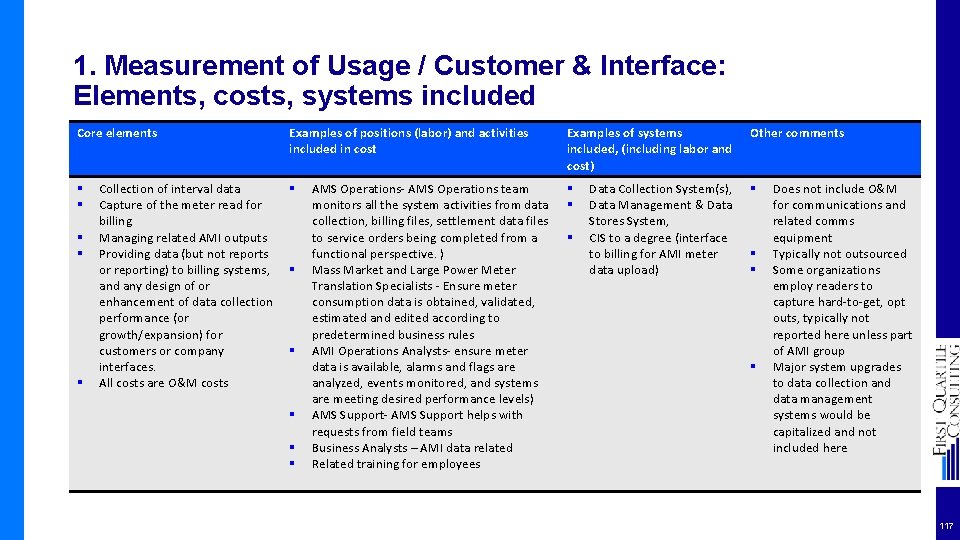
1. Measurement of Usage / Customer & Interface: Elements, costs, systems included Core elements § § § Collection of interval data Capture of the meter read for billing Managing related AMI outputs Providing data (but not reports or reporting) to billing systems, and any design of or enhancement of data collection performance (or growth/expansion) for customers or company interfaces. All costs are O&M costs Examples of positions (labor) and activities included in cost § § § AMS Operations- AMS Operations team monitors all the system activities from data collection, billing files, settlement data files to service orders being completed from a functional perspective. ) Mass Market and Large Power Meter Translation Specialists - Ensure meter consumption data is obtained, validated, estimated and edited according to predetermined business rules AMI Operations Analysts- ensure meter data is available, alarms and flags are analyzed, events monitored, and systems are meeting desired performance levels) AMS Support- AMS Support helps with requests from field teams Business Analysts – AMI data related Related training for employees Examples of systems included, (including labor and cost) § § § Data Collection System(s), Data Management & Data Stores System, CIS to a degree (interface to billing for AMI meter data upload) Other comments § § Does not include O&M for communications and related comms equipment Typically not outsourced Some organizations employ readers to capture hard-to-get, opt outs, typically not reported here unless part of AMI group Major system upgrades to data collection and data management systems would be capitalized and not included here 117
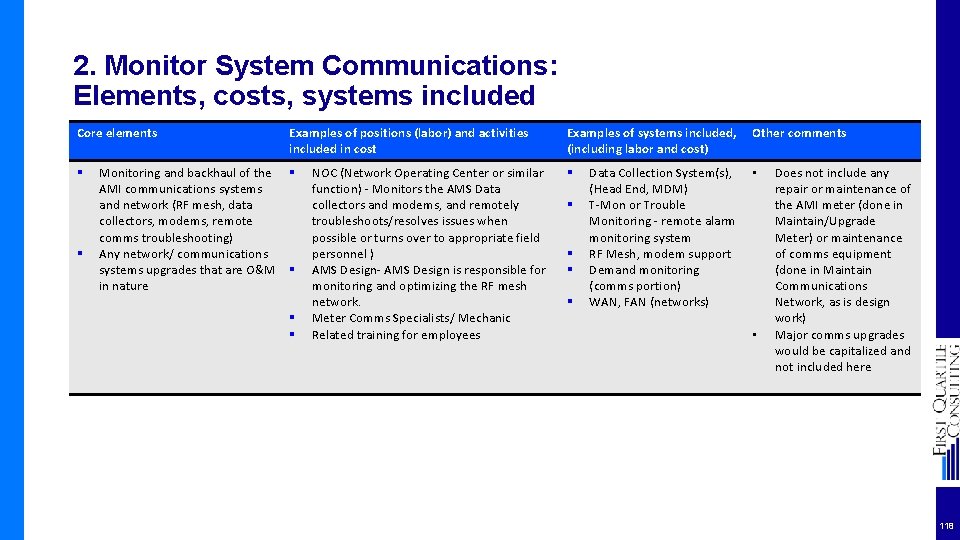
2. Monitor System Communications: Elements, costs, systems included Core elements § § Monitoring and backhaul of the AMI communications systems and network (RF mesh, data collectors, modems, remote comms troubleshooting) Any network/ communications systems upgrades that are O&M in nature Examples of positions (labor) and activities included in cost § § NOC (Network Operating Center or similar function) - Monitors the AMS Data collectors and modems, and remotely troubleshoots/resolves issues when possible or turns over to appropriate field personnel ) AMS Design- AMS Design is responsible for monitoring and optimizing the RF mesh network. Meter Comms Specialists/ Mechanic Related training for employees Examples of systems included, (including labor and cost) § § § Data Collection System(s), (Head End, MDM) T-Mon or Trouble Monitoring - remote alarm monitoring system RF Mesh, modem support Demand monitoring (comms portion) WAN, FAN (networks) Other comments • • Does not include any repair or maintenance of the AMI meter (done in Maintain/Upgrade Meter) or maintenance of comms equipment (done in Maintain Communications Network, as is design work) Major comms upgrades would be capitalized and not included here 118
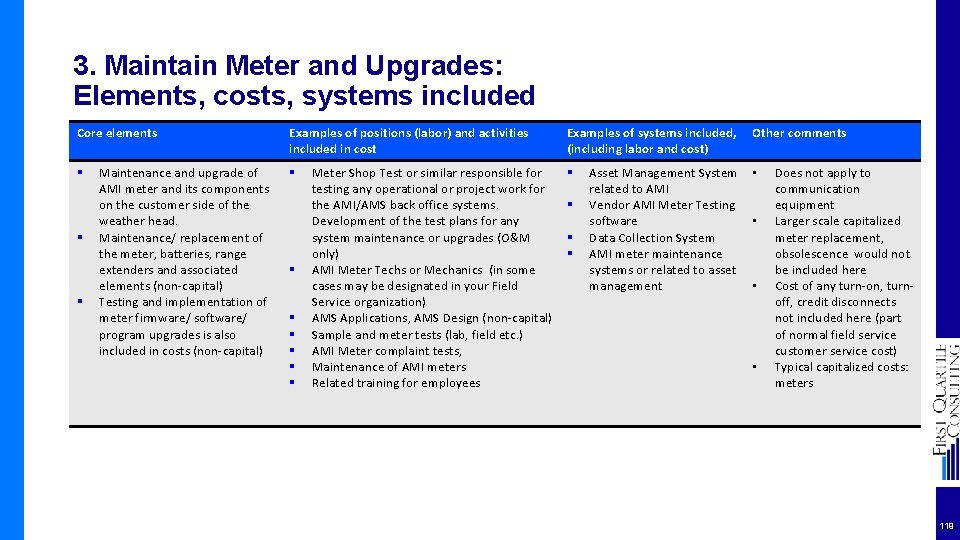
3. Maintain Meter and Upgrades: Elements, costs, systems included Core elements § § § Maintenance and upgrade of AMI meter and its components on the customer side of the weather head. Maintenance/ replacement of the meter, batteries, range extenders and associated elements (non-capital) Testing and implementation of meter firmware/ software/ program upgrades is also included in costs (non-capital) Examples of positions (labor) and activities included in cost § § § § Meter Shop Test or similar responsible for testing any operational or project work for the AMI/AMS back office systems. Development of the test plans for any system maintenance or upgrades (O&M only) AMI Meter Techs or Mechanics (in some cases may be designated in your Field Service organization) AMS Applications, AMS Design (non-capital) Sample and meter tests (lab, field etc. ) AMI Meter complaint tests, Maintenance of AMI meters Related training for employees Examples of systems included, (including labor and cost) § § Asset Management System related to AMI Vendor AMI Meter Testing software Data Collection System AMI meter maintenance systems or related to asset management Other comments • • Does not apply to communication equipment Larger scale capitalized meter replacement, obsolescence would not be included here Cost of any turn-on, turnoff, credit disconnects not included here (part of normal field service customer service cost) Typical capitalized costs: meters 119
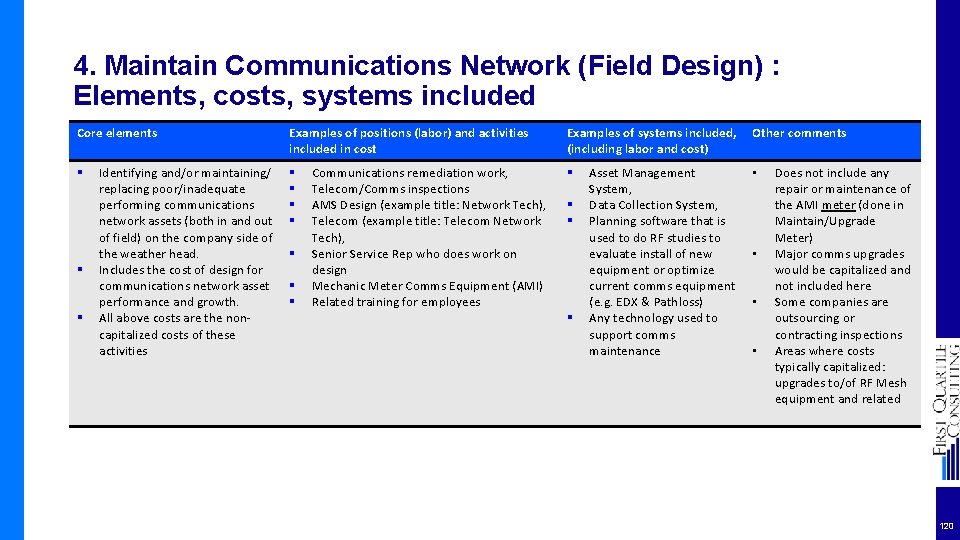
4. Maintain Communications Network (Field Design) : Elements, costs, systems included Core elements § § § Identifying and/or maintaining/ replacing poor/inadequate performing communications network assets (both in and out of field) on the company side of the weather head. Includes the cost of design for communications network asset performance and growth. All above costs are the noncapitalized costs of these activities Examples of positions (labor) and activities included in cost § § § § Communications remediation work, Telecom/Comms inspections AMS Design (example title: Network Tech), Telecom (example title: Telecom Network Tech), Senior Service Rep who does work on design Mechanic Meter Comms Equipment (AMI) Related training for employees Examples of systems included, (including labor and cost) § § Asset Management System, Data Collection System, Planning software that is used to do RF studies to evaluate install of new equipment or optimize current comms equipment (e. g. EDX & Pathloss) Any technology used to support comms maintenance Other comments • • Does not include any repair or maintenance of the AMI meter (done in Maintain/Upgrade Meter) Major comms upgrades would be capitalized and not included here Some companies are outsourcing or contracting inspections Areas where costs typically capitalized: upgrades to/of RF Mesh equipment and related 120
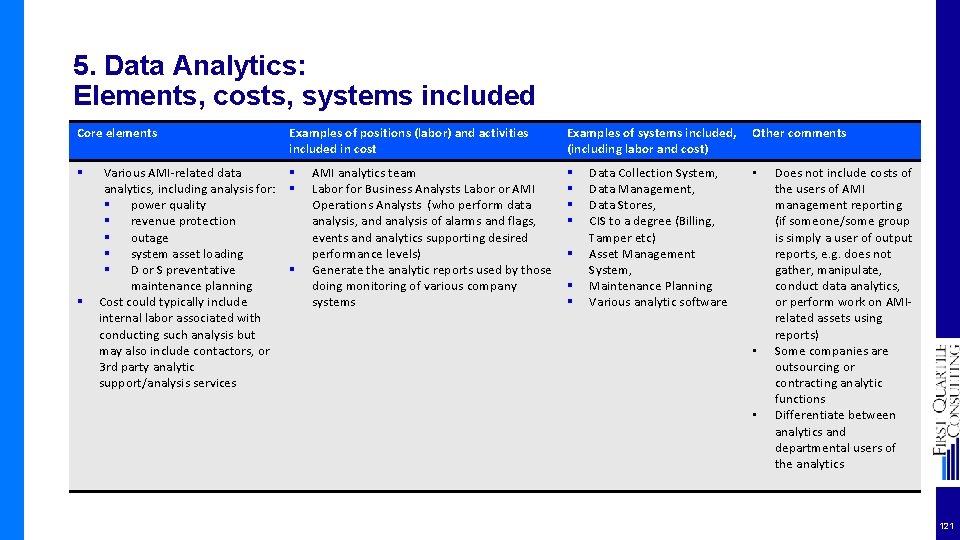
5. Data Analytics: Elements, costs, systems included Core elements § § Various AMI-related data analytics, including analysis for: § power quality § revenue protection § outage § system asset loading § D or S preventative maintenance planning Cost could typically include internal labor associated with conducting such analysis but may also include contactors, or 3 rd party analytic support/analysis services Examples of positions (labor) and activities included in cost § § § AMI analytics team Labor for Business Analysts Labor or AMI Operations Analysts (who perform data analysis, and analysis of alarms and flags, events and analytics supporting desired performance levels) Generate the analytic reports used by those doing monitoring of various company systems Examples of systems included, (including labor and cost) § § § § Data Collection System, Data Management, Data Stores, CIS to a degree (Billing, Tamper etc) Asset Management System, Maintenance Planning Various analytic software Other comments • • • Does not include costs of the users of AMI management reporting (if someone/some group is simply a user of output reports, e. g. does not gather, manipulate, conduct data analytics, or perform work on AMIrelated assets using reports) Some companies are outsourcing or contracting analytic functions Differentiate between analytics and departmental users of the analytics 121
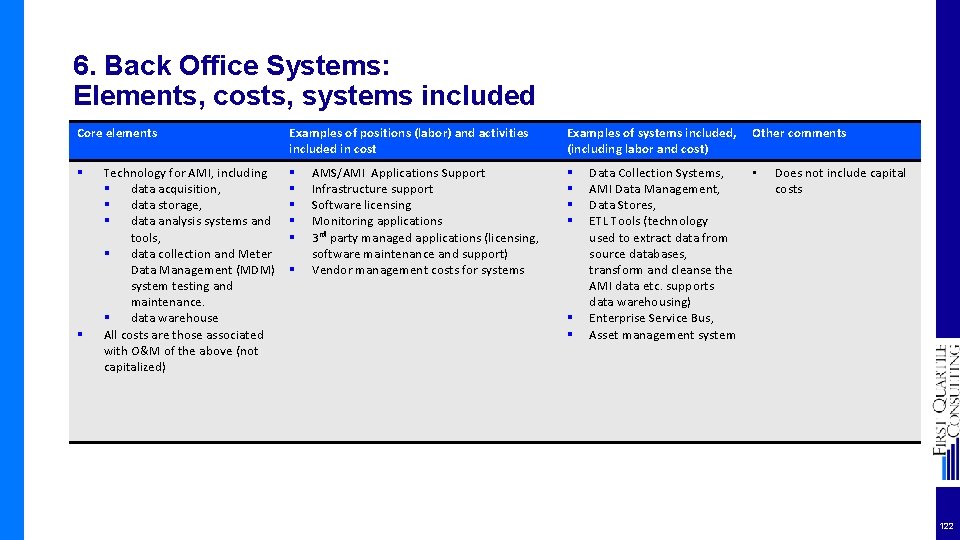
6. Back Office Systems: Elements, costs, systems included Core elements § § Technology for AMI, including § data acquisition, § data storage, § data analysis systems and tools, § data collection and Meter Data Management (MDM) system testing and maintenance. § data warehouse All costs are those associated with O&M of the above (not capitalized) Examples of positions (labor) and activities included in cost § § § AMS/AMI Applications Support Infrastructure support Software licensing Monitoring applications 3 rd party managed applications (licensing, software maintenance and support) Vendor management costs for systems Examples of systems included, (including labor and cost) § § § Data Collection Systems, AMI Data Management, Data Stores, ETL Tools (technology used to extract data from source databases, transform and cleanse the AMI data etc. supports data warehousing) Enterprise Service Bus, Asset management system Other comments • Does not include capital costs 122
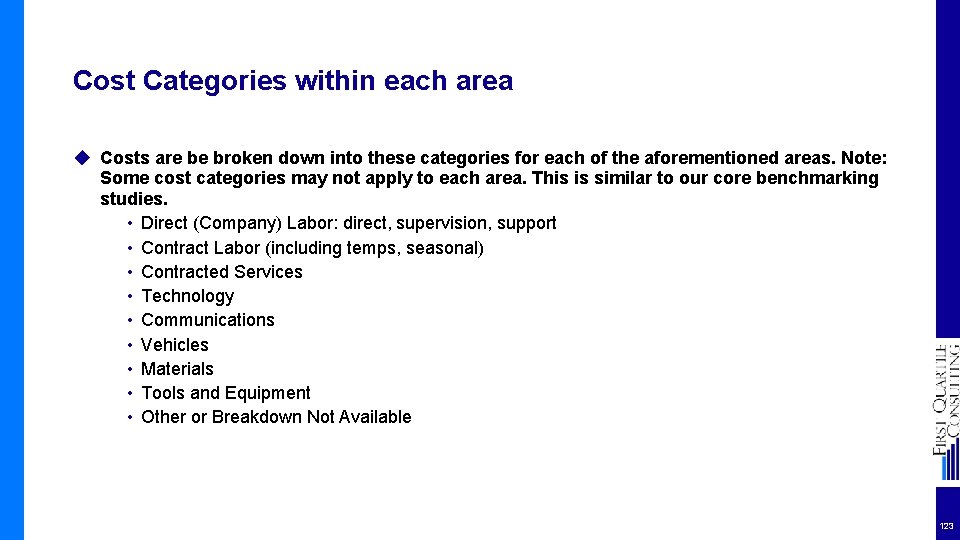
Cost Categories within each area ◆ Costs are be broken down into these categories for each of the aforementioned areas. Note: Some cost categories may not apply to each area. This is similar to our core benchmarking studies. • Direct (Company) Labor: direct, supervision, support • Contract Labor (including temps, seasonal) • Contracted Services • Technology • Communications • Vehicles • Materials • Tools and Equipment • Other or Breakdown Not Available 123
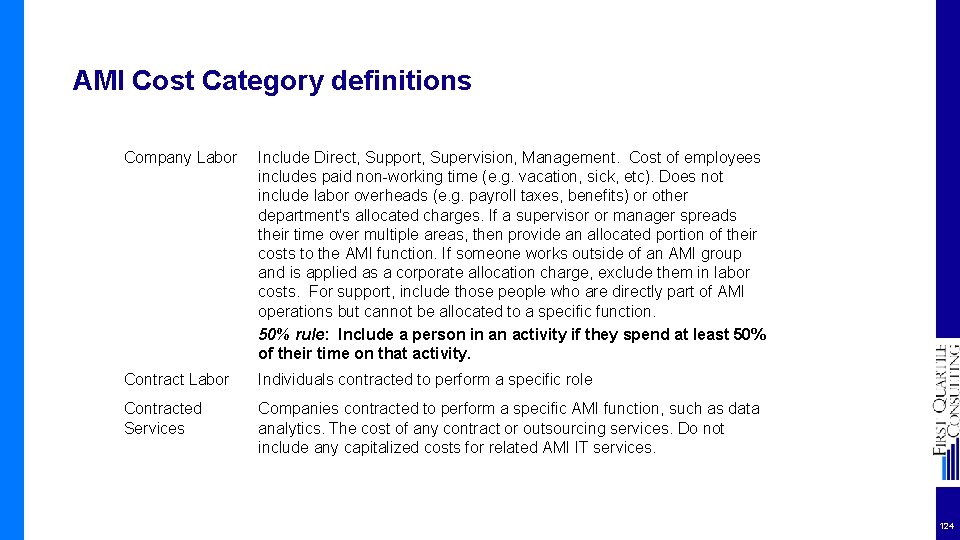
AMI Cost Category definitions Company Labor Include Direct, Support, Supervision, Management. Cost of employees includes paid non-working time (e. g. vacation, sick, etc). Does not include labor overheads (e. g. payroll taxes, benefits) or other department's allocated charges. If a supervisor or manager spreads their time over multiple areas, then provide an allocated portion of their costs to the AMI function. If someone works outside of an AMI group and is applied as a corporate allocation charge, exclude them in labor costs. For support, include those people who are directly part of AMI operations but cannot be allocated to a specific function. 50% rule: Include a person in an activity if they spend at least 50% of their time on that activity. Contract Labor Individuals contracted to perform a specific role Contracted Services Companies contracted to perform a specific AMI function, such as data analytics. The cost of any contract or outsourcing services. Do not include any capitalized costs for related AMI IT services. 124
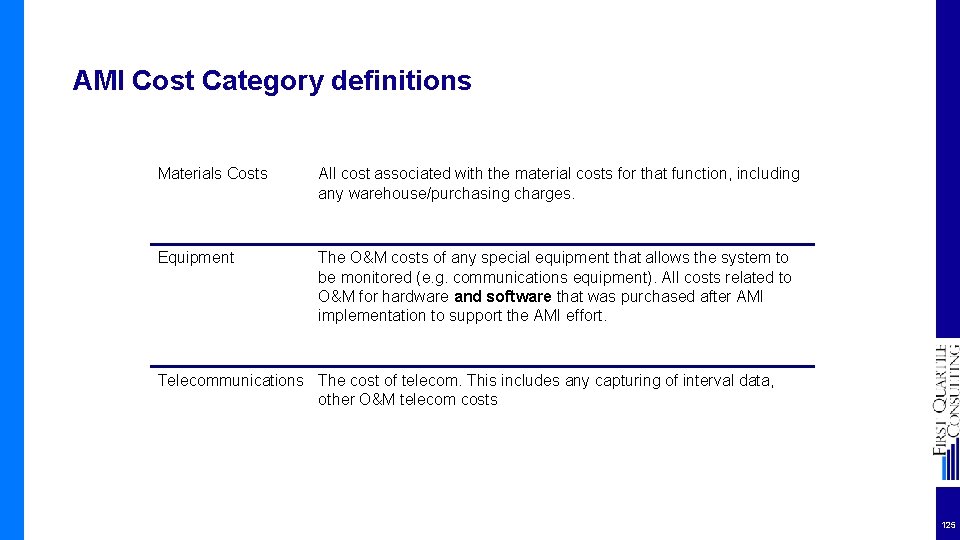
AMI Cost Category definitions Materials Costs All cost associated with the material costs for that function, including any warehouse/purchasing charges. Equipment The O&M costs of any special equipment that allows the system to be monitored (e. g. communications equipment). All costs related to O&M for hardware and software that was purchased after AMI implementation to support the AMI effort. Telecommunications The cost of telecom. This includes any capturing of interval data, other O&M telecom costs 125
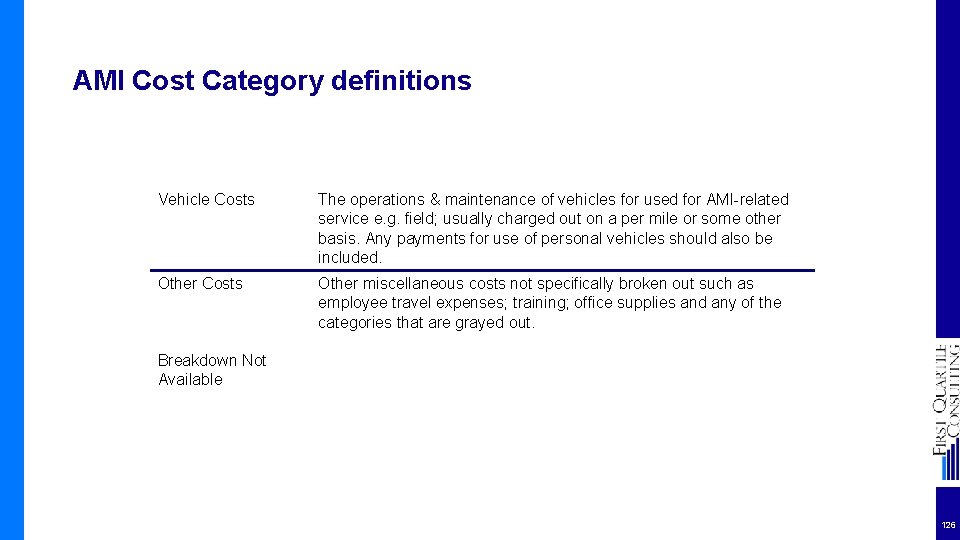
AMI Cost Category definitions Vehicle Costs The operations & maintenance of vehicles for used for AMI-related service e. g. field; usually charged out on a per mile or some other basis. Any payments for use of personal vehicles should also be included. Other Costs Other miscellaneous costs not specifically broken out such as employee travel expenses; training; office supplies and any of the categories that are grayed out. Breakdown Not Available 126
Thank You for Your Input and Participation! Your 1 QC Team: Ken Buckstaff Ken. Buckstaff@1 QConsulting. com 310 -922 -0783 Gene Dimitrov Gene. Dimitrov@1 QConsulting. com 301 -535 -0590 Debi Cook Debi. Cook@1 QConsulting. com 760 -272 -7277 Rob Earle Rob. Earle@1 QConsulting. com 315 -944 -7610 Dave Carter Dave. Carter@1 QConsulting. com 414 -881 -8641 About 1 QC First Quartile Consulting is a utility-focused consultancy providing a full range of consulting services including continuous process improvement, change management, benchmarking and more. You can count on a proven process that assesses and optimizes your resources, processes, leadership management and technology to align your business needs with your customer’s needs. Visit us at www. 1 stquartileconsulting. com | Follow our updates on Linked. In 127
- Slides: 127