
2021 2022 FAFSA Training Presentation 1 Presentation Authors


- Slides: 53
2021 -2022 FAFSA Training Presentation 1`
Presentation Authors �Mark Kantrowitz �Co-author of Filing the FAFSA �Author of How to Appeal for More College Financial Aid �Helped develop FAFSA on the Web �David Levy �Served as Director of Financial Aid at many of the nation’s leading colleges �Co-author of Filing the FAFSA 2
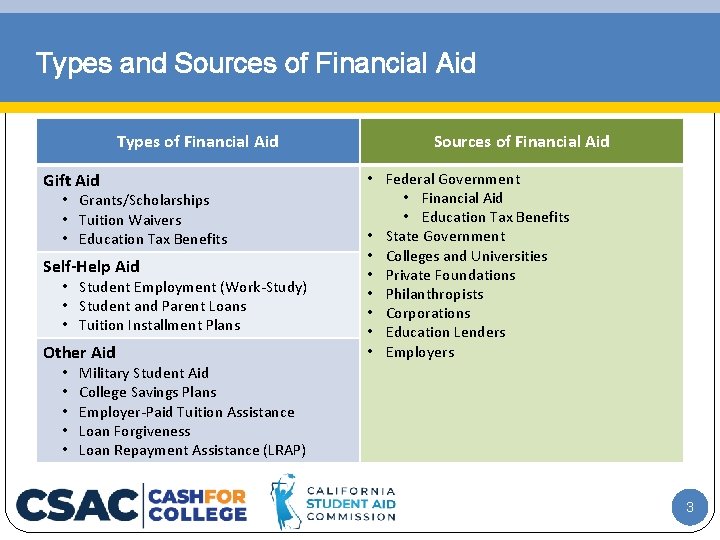
Types and Sources of Financial Aid Types of Financial Aid Gift Aid • Grants/Scholarships • Tuition Waivers • Education Tax Benefits Self-Help Aid • Student Employment (Work-Study) • Student and Parent Loans • Tuition Installment Plans Other Aid • • • Sources of Financial Aid • Federal Government • Financial Aid • Education Tax Benefits • State Government • Colleges and Universities • Private Foundations • Philanthropists • Corporations • Education Lenders • Employers Military Student Aid College Savings Plans Employer-Paid Tuition Assistance Loan Forgiveness Loan Repayment Assistance (LRAP) 3
How Students Apply for Need-Based Aid �File the Free Application for Federal Student Aid (FAFSA) �Get FSA IDs at fsaid. ed. gov to sign the FAFSA electronically �File the FAFSA online at fafsa. ed. gov �The FAFSA is based on the income and assets of the student and parents, as well as household size and number of children in college �File the FAFSA by March 2, 2021 to qualify for the Cal Grant 4
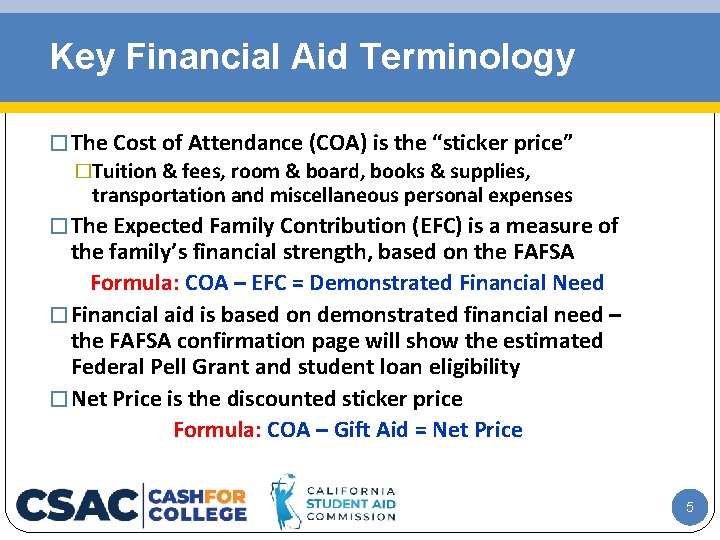
Key Financial Aid Terminology � The Cost of Attendance (COA) is the “sticker price” �Tuition & fees, room & board, books & supplies, transportation and miscellaneous personal expenses � The Expected Family Contribution (EFC) is a measure of the family’s financial strength, based on the FAFSA Formula: COA – EFC = Demonstrated Financial Need � Financial aid is based on demonstrated financial need – the FAFSA confirmation page will show the estimated Federal Pell Grant and student loan eligibility � Net Price is the discounted sticker price Formula: COA – Gift Aid = Net Price 5
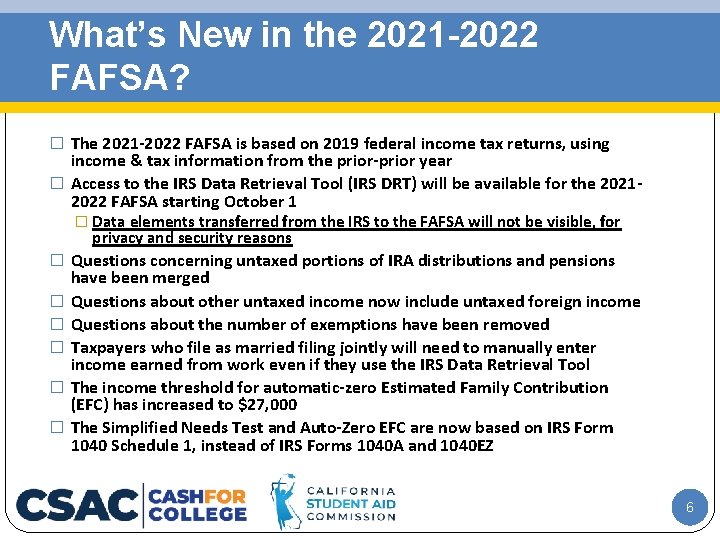
What’s New in the 2021 -2022 FAFSA? � The 2021 -2022 FAFSA is based on 2019 federal income tax returns, using income & tax information from the prior-prior year � Access to the IRS Data Retrieval Tool (IRS DRT) will be available for the 20212022 FAFSA starting October 1 � Data elements transferred from the IRS to the FAFSA will not be visible, for privacy and security reasons � Questions concerning untaxed portions of IRA distributions and pensions � � � have been merged Questions about other untaxed income now include untaxed foreign income Questions about the number of exemptions have been removed Taxpayers who file as married filing jointly will need to manually enter income earned from work even if they use the IRS Data Retrieval Tool The income threshold for automatic-zero Estimated Family Contribution (EFC) has increased to $27, 000 The Simplified Needs Test and Auto-Zero EFC are now based on IRS Form 1040 Schedule 1, instead of IRS Forms 1040 A and 1040 EZ 6
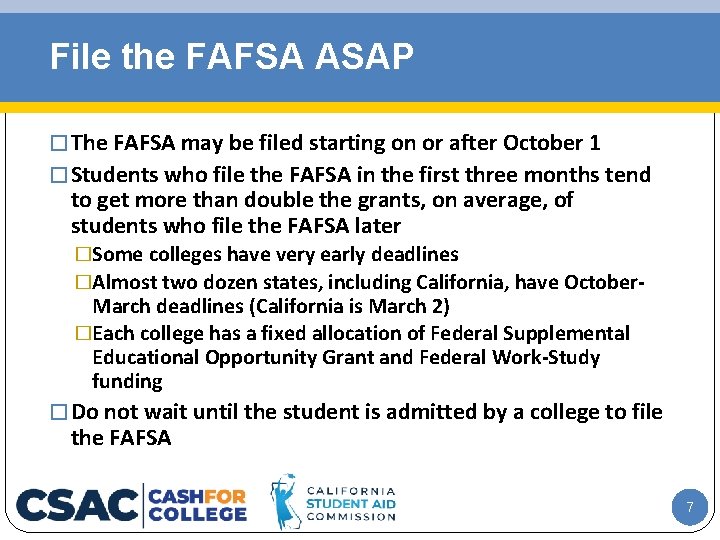
File the FAFSA ASAP � The FAFSA may be filed starting on or after October 1 � Students who file the FAFSA in the first three months tend to get more than double the grants, on average, of students who file the FAFSA later �Some colleges have very early deadlines �Almost two dozen states, including California, have October- March deadlines (California is March 2) �Each college has a fixed allocation of Federal Supplemental Educational Opportunity Grant and Federal Work-Study funding � Do not wait until the student is admitted by a college to file the FAFSA 7
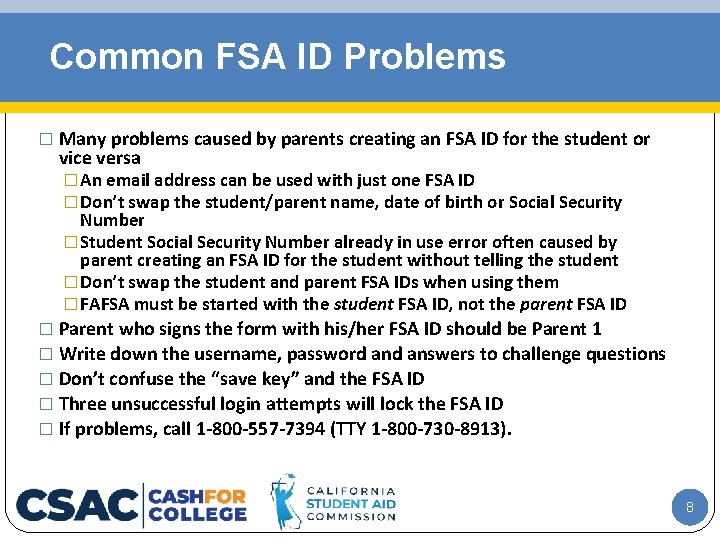
Common FSA ID Problems � Many problems caused by parents creating an FSA ID for the student or vice versa � An email address can be used with just one FSA ID � Don’t swap the student/parent name, date of birth or Social Security Number � Student Social Security Number already in use error often caused by parent creating an FSA ID for the student without telling the student � Don’t swap the student and parent FSA IDs when using them � FAFSA must be started with the student FSA ID, not the parent FSA ID � Parent who signs the form with his/her FSA ID should be Parent 1 � Write down the username, password answers to challenge questions � Don’t confuse the “save key” and the FSA ID � Three unsuccessful login attempts will lock the FSA ID � If problems, call 1 -800 -557 -7394 (TTY 1 -800 -730 -8913). 8
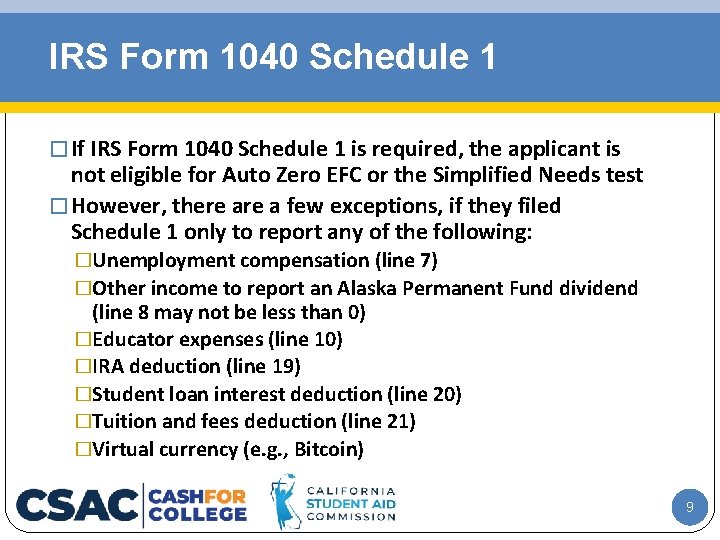
IRS Form 1040 Schedule 1 � If IRS Form 1040 Schedule 1 is required, the applicant is not eligible for Auto Zero EFC or the Simplified Needs test � However, there a few exceptions, if they filed Schedule 1 only to report any of the following: �Unemployment compensation (line 7) �Other income to report an Alaska Permanent Fund dividend (line 8 may not be less than 0) �Educator expenses (line 10) �IRA deduction (line 19) �Student loan interest deduction (line 20) �Tuition and fees deduction (line 21) �Virtual currency (e. g. , Bitcoin) 9
Section 1 STUDENT DEMOGRAPHICS
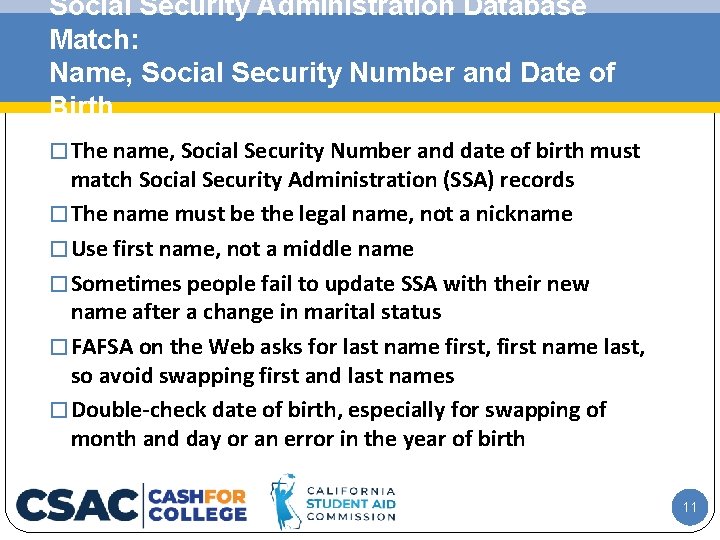
Social Security Administration Database Match: Name, Social Security Number and Date of Birth � The name, Social Security Number and date of birth must match Social Security Administration (SSA) records � The name must be the legal name, not a nickname � Use first name, not a middle name � Sometimes people fail to update SSA with their new name after a change in marital status � FAFSA on the Web asks for last name first, first name last, so avoid swapping first and last names � Double-check date of birth, especially for swapping of month and day or an error in the year of birth 11
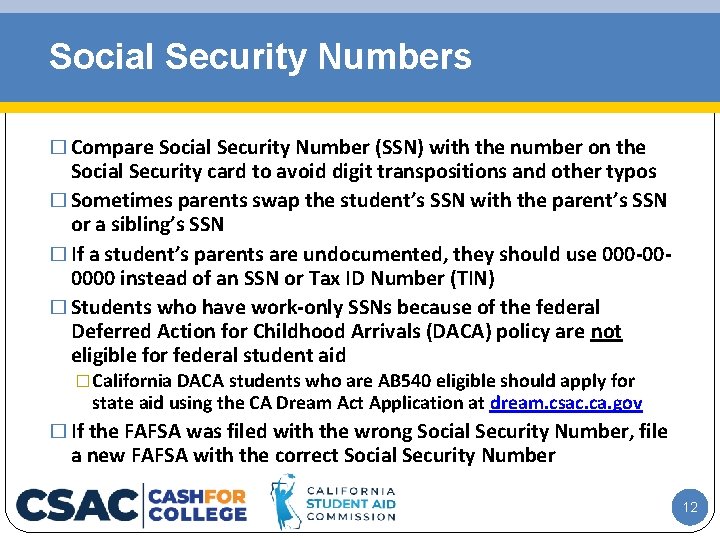
Social Security Numbers � Compare Social Security Number (SSN) with the number on the Social Security card to avoid digit transpositions and other typos � Sometimes parents swap the student’s SSN with the parent’s SSN or a sibling’s SSN � If a student’s parents are undocumented, they should use 000 -000000 instead of an SSN or Tax ID Number (TIN) � Students who have work-only SSNs because of the federal Deferred Action for Childhood Arrivals (DACA) policy are not eligible for federal student aid �California DACA students who are AB 540 eligible should apply for state aid using the CA Dream Act Application at dream. csac. ca. gov � If the FAFSA was filed with the wrong Social Security Number, file a new FAFSA with the correct Social Security Number 12
Student Gender �Students should answer the question about their gender (male, female) based on their gender at birth, even if it has subsequently changed �Gender at birth is listed on the student’s birth certificate �Gender at birth is used to trigger the Selective Service requirements �If a student was born male, the student must register with Selective Service between ages 18 and 25 (inclusive) to be eligible for federal and/or state student financial aid 13
Email and Postal Addresses �Provide email and postal mail addresses and telephone numbers that will remain active through the end of the admission and financial aid application periods �Do not use the student’s school email or postal mailing addresses �Use 00000 as the zip code foreign addresses �These addresses are used by schools, state agencies and the U. S. Department of Education to contact the applicant and to confirm FAFSA data 14
State Residency � In all states, a student who is a U. S. citizen or permanent resident is considered to be a resident of a state if he or she has lived in the state for at least five years � Many states base determinations of state residency on a shorter period of time, typically one year prior to enrollment � Some states have exceptions for children of active duty members of the U. S. Armed Forces � If the student has resided in the state for fewer than five years, the student will be asked to provide the date he or she became a resident of the state � If the student is a dependent student, the student’s state of legal residence is based on the state in which the custodial parents live 15
Legal Parents � Legal parents include biological or adoptive parents �Including same-sex parents �Including unmarried parents living together � Legal parents also include a parent who is listed as a parent on the student’s birth certificate � A stepparent is considered to be a parent only if he or she is married to the student’s custodial parent as of the date the FAFSA is filed or has adopted the student � Legal parents do not include guardians or foster parents �Students in a court-ordered legal guardianship or foster care considered to be independent students � Legal parents do not include grandparents, aunts, uncles, siblings or cousins unless they have legally adopted the student 16
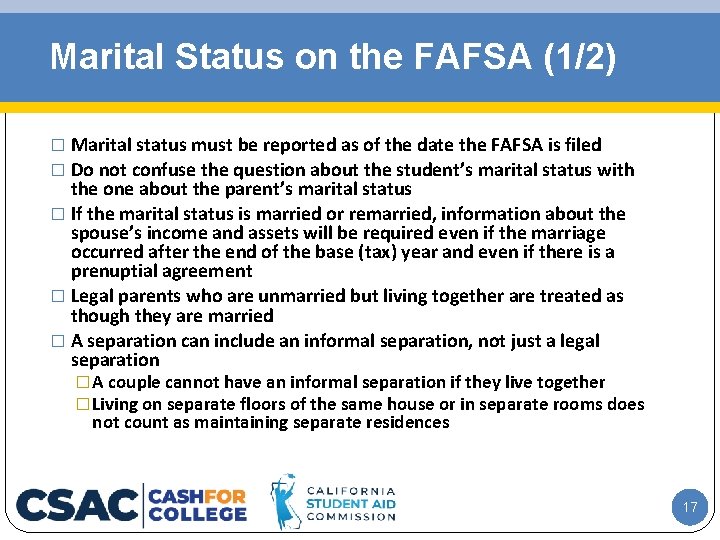
Marital Status on the FAFSA (1/2) � Marital status must be reported as of the date the FAFSA is filed � Do not confuse the question about the student’s marital status with the one about the parent’s marital status � If the marital status is married or remarried, information about the spouse’s income and assets will be required even if the marriage occurred after the end of the base (tax) year and even if there is a prenuptial agreement � Legal parents who are unmarried but living together are treated as though they are married � A separation can include an informal separation, not just a legal separation � A couple cannot have an informal separation if they live together � Living on separate floors of the same house or in separate rooms does not count as maintaining separate residences 17
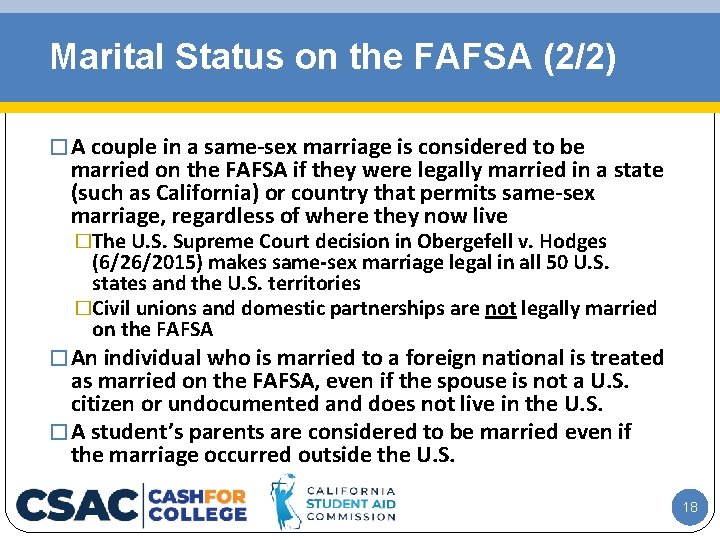
Marital Status on the FAFSA (2/2) � A couple in a same-sex marriage is considered to be married on the FAFSA if they were legally married in a state (such as California) or country that permits same-sex marriage, regardless of where they now live �The U. S. Supreme Court decision in Obergefell v. Hodges (6/26/2015) makes same-sex marriage legal in all 50 U. S. states and the U. S. territories �Civil unions and domestic partnerships are not legally married on the FAFSA � An individual who is married to a foreign national is treated as married on the FAFSA, even if the spouse is not a U. S. citizen or undocumented and does not live in the U. S. � A student’s parents are considered to be married even if the marriage occurred outside the U. S. 18
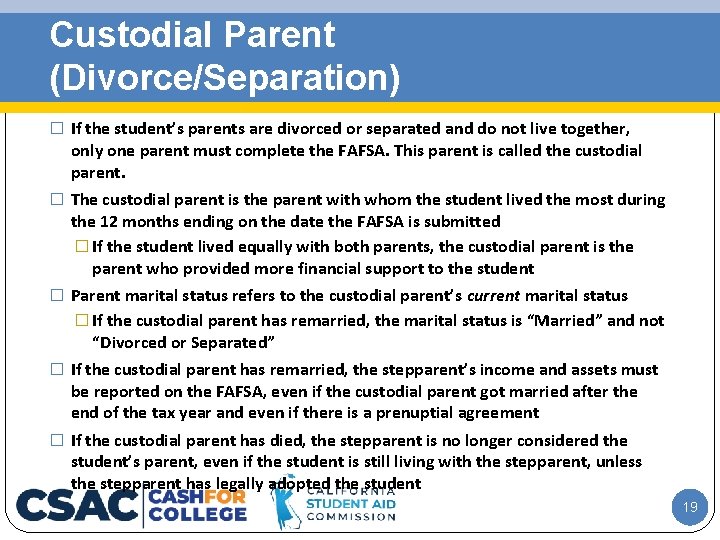
Custodial Parent (Divorce/Separation) � If the student’s parents are divorced or separated and do not live together, only one parent must complete the FAFSA. This parent is called the custodial parent. � The custodial parent is the parent with whom the student lived the most during the 12 months ending on the date the FAFSA is submitted � If the student lived equally with both parents, the custodial parent is the parent who provided more financial support to the student � Parent marital status refers to the custodial parent’s current marital status � If the custodial parent has remarried, the marital status is “Married” and not “Divorced or Separated” � If the custodial parent has remarried, the stepparent’s income and assets must be reported on the FAFSA, even if the custodial parent got married after the end of the tax year and even if there is a prenuptial agreement � If the custodial parent has died, the stepparent is no longer considered the student’s parent, even if the student is still living with the stepparent, unless the stepparent has legally adopted the student 19
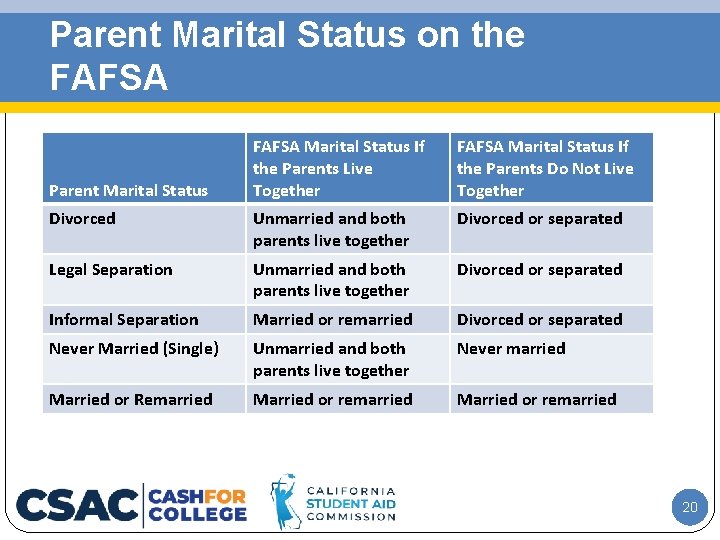
Parent Marital Status on the FAFSA Marital Status If the Parents Live Together FAFSA Marital Status If the Parents Do Not Live Together Divorced Unmarried and both parents live together Divorced or separated Legal Separation Unmarried and both parents live together Divorced or separated Informal Separation Married or remarried Divorced or separated Never Married (Single) Unmarried and both parents live together Never married Married or Remarried Married or remarried Parent Marital Status 20
Changes in Marital Status � Report marital status as of the date the FAFSA is submitted �Do not anticipate a future change in marital status �A couple who are engaged to be married are not considered to be married �Do not report marital status as of the end of the base year if it has changed since then � The FAFSA cannot be updated to reflect a mid-year change in the student’s marital status except in rare circumstances � A college financial aid administrator may require the student to update his or her marital status “to address an inequity or to more accurately reflect the applicant’s ability to pay” �Examples include changes in marital status due to death of a spouse, divorce or separation due to domestic violence or an incarcerated or incapacitated spouse 21
Reporting of Alimony on the FAFSA �The Tax Cuts and Jobs Act of 2017 changed the reporting of alimony paid and received effective starting in 2019 �Alimony paid will no longer be deducted from the payer’s adjusted gross income (AGI) �Alimony received will no longer be included in the recipient’s AGI �Alimony received is not reported in untaxed income �This change means that the recipient of alimony payments will have lower income on the FAFSA, while the payer will have higher income 22
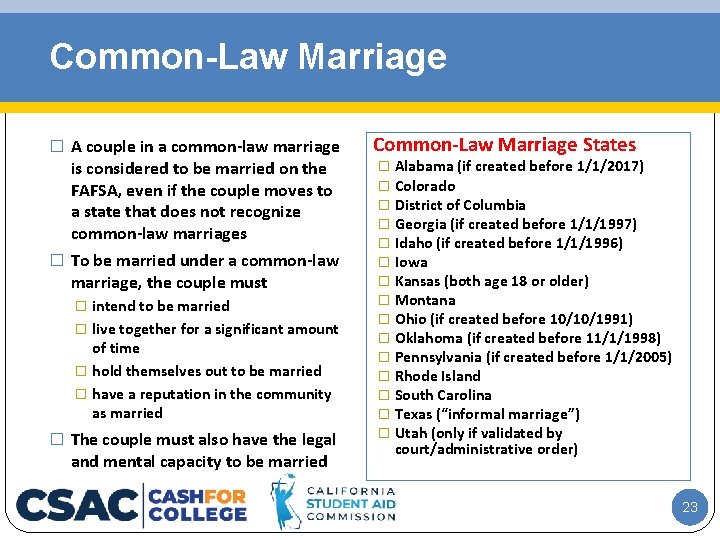
Common-Law Marriage � A couple in a common-law marriage is considered to be married on the FAFSA, even if the couple moves to a state that does not recognize common-law marriages � To be married under a common-law marriage, the couple must � intend to be married � live together for a significant amount of time � hold themselves out to be married � have a reputation in the community as married � The couple must also have the legal and mental capacity to be married Common-Law Marriage States � Alabama (if created before 1/1/2017) � Colorado � District of Columbia � Georgia (if created before 1/1/1997) � Idaho (if created before 1/1/1996) � Iowa � Kansas (both age 18 or older) � Montana � Ohio (if created before 10/10/1991) � Oklahoma (if created before 11/1/1998) � Pennsylvania (if created before 1/1/2005) � Rhode Island � South Carolina � Texas (“informal marriage”) � Utah (only if validated by court/administrative order) 23
Citizenship Status � A student who is a U. S. citizen or permanent resident is eligible for federal and state student aid even if the student’s parents are undocumented � Eligible non-citizens include students who: � Have a status as a refuge, asylum granted, parolee, T visa holder, Cuban- Haitian Entrant, victim of human trafficking or Battered Immigrants. Qualified Aliens and their children � Are residents of the Republic of Palau (PW), the Republic of the Marshall Islands (MH), or the Federated States of Micronesia (FM) � Are Canadian-born Native Americans under the terms of the Jay Treaty � Students who are eligible non-citizens should provide their 8 or 9 - digit Alien Registration Number (ARN), prefixing an 8 -digit ARN with a zero � The student’s status as a U. S. citizen will be confirmed by a database match with SSA. Status as eligible non-citizen will be confirmed by a database match with Department of Homeland Security (DHS). 24
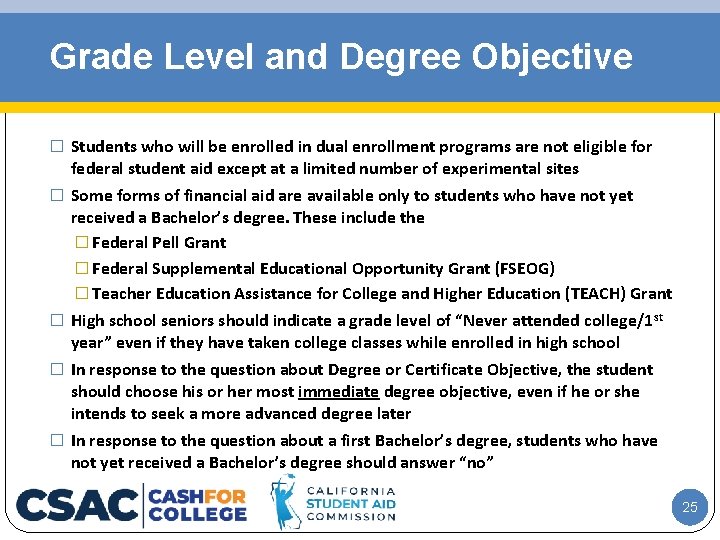
Grade Level and Degree Objective � Students who will be enrolled in dual enrollment programs are not eligible for federal student aid except at a limited number of experimental sites � Some forms of financial aid are available only to students who have not yet received a Bachelor’s degree. These include the � Federal Pell Grant � Federal Supplemental Educational Opportunity Grant (FSEOG) � Teacher Education Assistance for College and Higher Education (TEACH) Grant � High school seniors should indicate a grade level of “Never attended college/1 st year” even if they have taken college classes while enrolled in high school � In response to the question about Degree or Certificate Objective, the student should choose his or her most immediate degree objective, even if he or she intends to seek a more advanced degree later � In response to the question about a first Bachelor’s degree, students who have not yet received a Bachelor’s degree should answer “no” 25
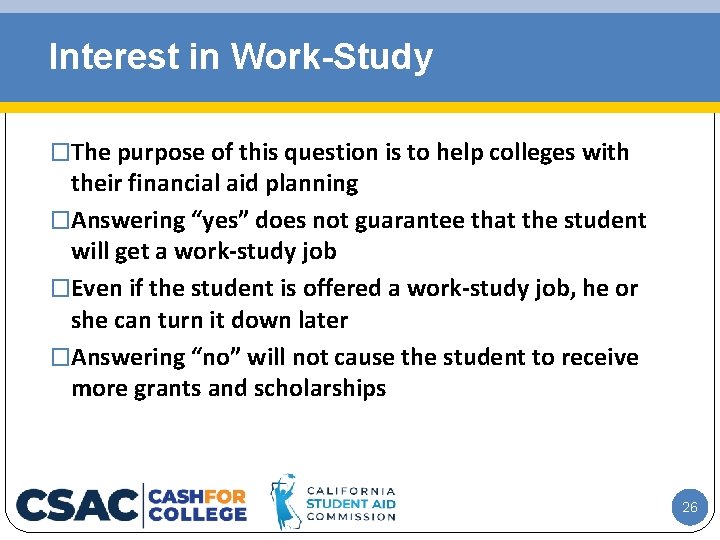
Interest in Work-Study �The purpose of this question is to help colleges with their financial aid planning �Answering “yes” does not guarantee that the student will get a work-study job �Even if the student is offered a work-study job, he or she can turn it down later �Answering “no” will not cause the student to receive more grants and scholarships 26
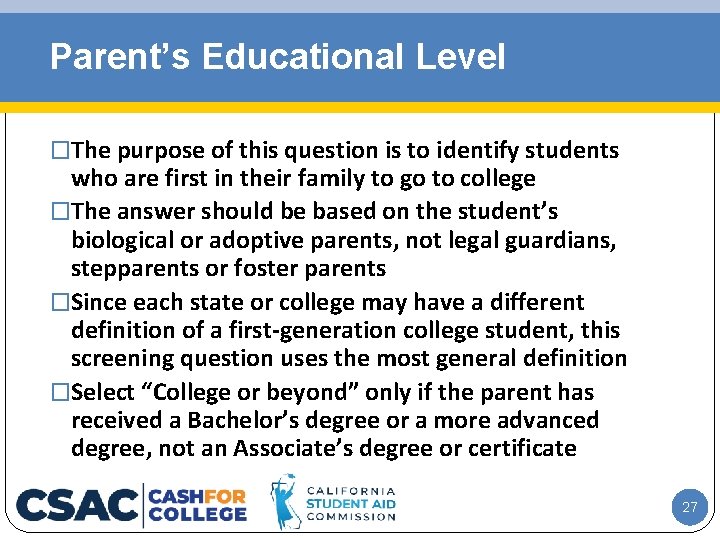
Parent’s Educational Level �The purpose of this question is to identify students who are first in their family to go to college �The answer should be based on the student’s biological or adoptive parents, not legal guardians, stepparents or foster parents �Since each state or college may have a different definition of a first-generation college student, this screening question uses the most general definition �Select “College or beyond” only if the parent has received a Bachelor’s degree or a more advanced degree, not an Associate’s degree or certificate 27
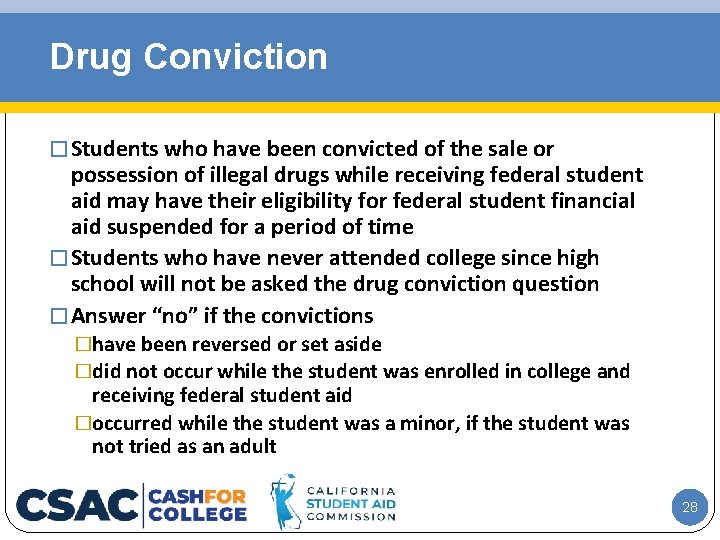
Drug Conviction � Students who have been convicted of the sale or possession of illegal drugs while receiving federal student aid may have their eligibility for federal student financial aid suspended for a period of time � Students who have never attended college since high school will not be asked the drug conviction question � Answer “no” if the convictions �have been reversed or set aside �did not occur while the student was enrolled in college and receiving federal student aid �occurred while the student was a minor, if the student was not tried as an adult 28
Case Study � The student’s parents are divorced, so only one parent completes the FAFSA � The mother claims the student as an exemption on her federal income tax return in odd years and the father claims the student in even years � The student lived with the mother 183 days and the father 182 days in the last 12 months, so the mother completes the FAFSA � The mother remarries, so the stepparent’s information must be reported on the FAFSA � The mother dies, so the biological father must now complete the FAFSA, even though the student still lives with the stepparent, because the stepparent did not legally adopt the student 29
Section 2 SCHOOL SELECTION
Order of Colleges on the FAFSA � The U. S. Department of Education no longer shares the list of all colleges on the FAFSA with the colleges � The list of colleges is still shared with state grant agencies, such as the California Student Aid Commission, so list an instate public college first to be considered for state grants � Then list the colleges with the earliest financial aid deadlines � Up to 10 colleges can be listed on the FAFSA at a time � To list more than 10 colleges, wait until the Student Aid Report (SAR) arrives, then login to fafsa. ed. gov with the student or parent’s FSA ID to delete the old colleges and add new colleges � When looking for a college’s Federal School Code, be careful about colleges with the same name in different states 31
Section 3 STUDENT DEPENDENCY STATUS
Dependency Status � Dependent students are required to report parent information on the FAFSA � Students who answer “yes” to any of the 13 dependency status questions are considered to be independent, otherwise they are dependent � A student is considered to be dependent even if � The student is financially self-sufficient � The student does not live with his or her parents � The student is not claimed as an exemption on the parent’s federal income tax returns � The parents refuse to complete the FAFSA, participate in verification, pay for college or live in a foreign country Criteria for Independent Student Status � � � Age 24 as of December 31 of the award year Married Graduate student Has children who receive more than half their support from the student Has other dependents who live with the student and receive more than half support from the student Active duty member of the U. S. Armed Forces for purposes other than training Veteran After reaching age 13 was an orphan, in foster care or a ward of the court Court-ordered emancipated minor prior to reaching the age of majority Court-ordered legal guardianship Unaccompanied youth who is homeless or self-supporting and at risk of homelessness College FAAs can grant a dependency override in unusual circumstances 33
Dependency Override � Without parental information on the FAFSA, the most a dependent student can receive is unsubsidized Federal Direct Stafford loans, unless the financial aid administrator performs a dependency override � A dependency override changes a student’s dependency status from dependent to independent � Dependency overrides are rare, often involving an involuntary dissolution of the family � Incarceration or institutionalization of both parents � An abusive home environment � Abandonment � Parent whereabouts unknown � Death of the custodial parent � The college financial aid administrator will need documentation to support the need for a dependency override 34
Case Study � A student’s parents disown the student because of the student’s boyfriend/girlfriend and cut off all ties to the student �Common reasons include the race, religion or sexual orientation of the boyfriend/girlfriend �Some college financial aid administrators will perform a dependency override, if the student documents a hostile home environment; some will not �Otherwise, the most aid the student can get is unsubsidized Federal Stafford loans � If the student marries his/her boyfriend/girlfriend, the student will become independent because of the marriage �If the student’s spouse dies, the student reverts to dependent student status 35
Section 4 PARENT DEMOGRAPHICS and FINANCES
Household Size � Household size is not necessarily the same as the number of dependents claimed on federal income tax returns � The student should always be included in household size, even if the student does not or will not live with his or her parents, along with � The student’s spouse (if the student is married) and the student’s children (including stepchildren) and other dependents � If the student is dependent, the student’s parents (including a stepparent), the parents’ other children and the parents’ other dependents � Do not count a parent who is not living in the household due to death, separation or divorce � To be counted in household size � Children, stepchildren and other dependents must receive more than half support from the student/parents, as applicable, and continue to receive more than half support until the end of the award year � Children and stepchildren do not need to live with the student/parents, but other dependents must live with the student/parents, as applicable � Child support paid is reported on the FAFSA if, and only if, the child is not reported in household size (i. e. , the parent provides less than half support) 37
Number in College �Increasing the number in college can have a big impact on eligibility for need-based financial aid �The student is always counted in the number in college, even if the student will be enrolled less than half-time �Parents are not counted in the number in college �Other family members who are included in household size may be counted in the number in college if they are enrolled at least half-time in a program that leads to a college degree or certificate 38
IRS Data Retrieval Tool � The IRS Data Retrieval Tool will transfer income and tax information from federal income tax returns into the FAFSA � Not only does this simplify the FAFSA, but it also reduces the likelihood that the FAFSA will be selected for verification, saving time and hassle � Most families will have filed federal income tax returns before the October 1 start date for the FAFSA Who can’t use the IRS DRT? � Address on FAFSA (FSA ID) does not match � � � � address on federal income tax return Tax return filed too recently (< 3 weeks electronic, < 11 weeks paper) Change in marital status since the end of the tax year Taxpayers who file as Head of Household or Married Filing Separately Parents who file the FAFSA as “Unmarried and both legal parents living together” Taxpayers who file a Puerto Rican or foreign income tax return instead of or in addition to a federal income tax return Parents who do not have a Social Security Number Victims of identity theft until the problem is resolved 39
Recent Changes to IRS Data Retrieval Tool � The IRS Data Retrieval Tool has new security enhancements that encrypt the data transferred from the IRS to the FAFSA � The transferred data will not be visible and instead will be marked as “Transferred from the IRS” � Students and parents will no longer be able to make corrections directly, but instead will need to ask the college financial aid office to make corrections � If there is an IRA rollover or return of contributions, the FAFSA will ask whether it is a rollover or not � Taxpayers who file as married filing jointly may need to provide information about income earned from work, such as W-2 and 1099 forms � Taxpayers who filed amended federal income tax returns may now use the IRS Data Retrieval Tool, but may have to provide a copy of the amended tax return to the college financial aid office 40
IRS Tax Transcripts � Applicants who do not use the IRS Data Retrieval Tool or who change a transferred figure will have to get an IRS Tax Return Transcript if selected for verification (not an IRS Tax Account Transcript) � Due to security concerns, taxpayers who get an online transcript will need to prove their identity, which can be challenging for some taxpayers � Cell phone number registered to the taxpayer AND a credit card, auto loan or mortgage in taxpayer’s name � If a married taxpayer files a joint return, only the taxpayer listed first on the joint return can get a tax return transcript using the IRS web site � Tax transcripts are mailed only to the address on the tax return � The IRS will no longer send tax transcripts by fax or to third party addresses � If the taxpayer has moved, file IRS Form 8822 to change the taxpayer’s address, then wait a few weeks to request a tax transcript 41
Type of Tax Return Schedule 1 � The question about the type of tax return filed by the taxpayer is now based on whether the taxpayer was required to file Schedule 1, since IRS Forms 1040 A and 1040 EZ no longer exist �There are exceptions for taxpayers who file Schedule 1 only to report unemployment compensation, Alaska Permanent Fund dividends, educator expenses, IRA deductions, or the student loan interest deduction � If a taxpayer’s income exceeds the filing threshold, they are required to file a federal income tax return (Table 1 -1 of IRS Publication 17) � Taxpayers who file a foreign income tax return should use corresponding figures from the foreign income tax return, expressed in U. S. dollars using the currency exchange rates in effect on the date the FAFSA is filed �Currency exchange rates are available on www. federalreserve. gov 42
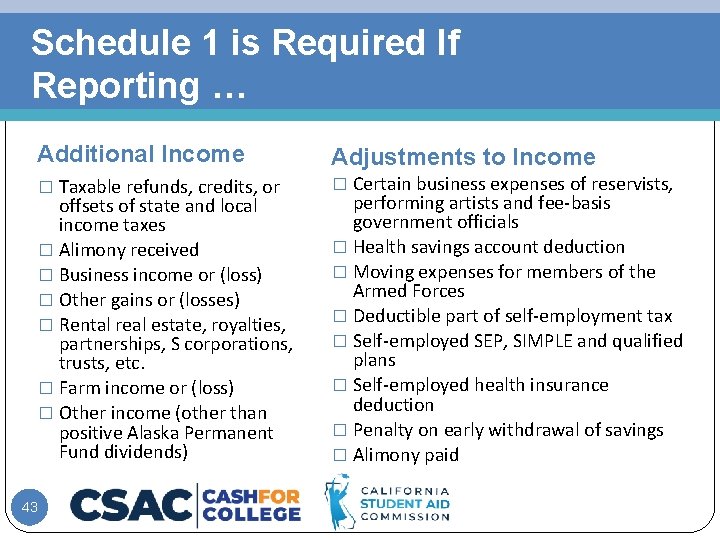
Schedule 1 is Required If Reporting … Additional Income Adjustments to Income � Taxable refunds, credits, or � Certain business expenses of reservists, offsets of state and local income taxes � Alimony received � Business income or (loss) � Other gains or (losses) � Rental real estate, royalties, partnerships, S corporations, trusts, etc. � Farm income or (loss) � Other income (other than positive Alaska Permanent Fund dividends) 43 performing artists and fee-basis government officials � Health savings account deduction � Moving expenses for members of the Armed Forces � Deductible part of self-employment tax � Self-employed SEP, SIMPLE and qualified plans � Self-employed health insurance deduction � Penalty on early withdrawal of savings � Alimony paid
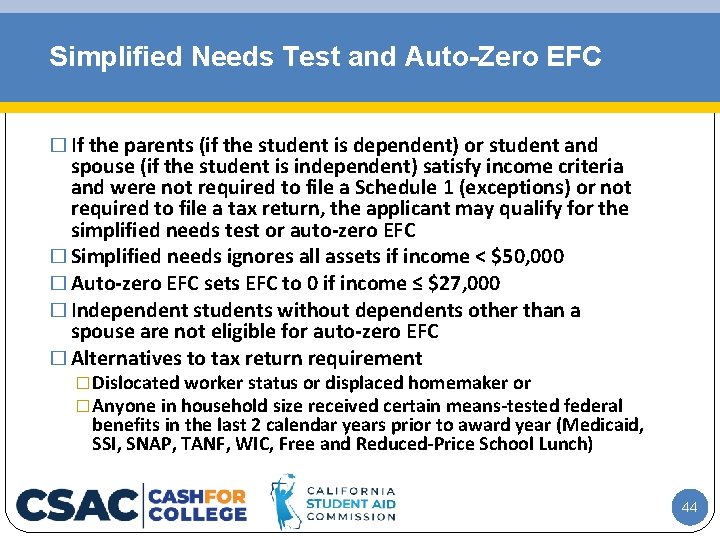
Simplified Needs Test and Auto-Zero EFC � If the parents (if the student is dependent) or student and spouse (if the student is independent) satisfy income criteria and were not required to file a Schedule 1 (exceptions) or not required to file a tax return, the applicant may qualify for the simplified needs test or auto-zero EFC � Simplified needs ignores all assets if income < $50, 000 � Auto-zero EFC sets EFC to 0 if income ≤ $27, 000 � Independent students without dependents other than a spouse are not eligible for auto-zero EFC � Alternatives to tax return requirement �Dislocated worker status or displaced homemaker or �Anyone in household size received certain means-tested federal benefits in the last 2 calendar years prior to award year (Medicaid, SSI, SNAP, TANF, WIC, Free and Reduced-Price School Lunch) 44
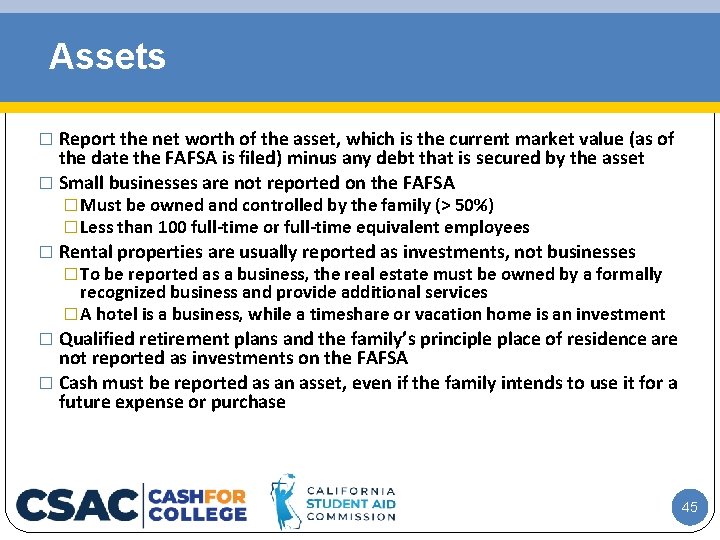
Assets � Report the net worth of the asset, which is the current market value (as of the date the FAFSA is filed) minus any debt that is secured by the asset � Small businesses are not reported on the FAFSA � Must be owned and controlled by the family (> 50%) � Less than 100 full-time or full-time equivalent employees � Rental properties are usually reported as investments, not businesses � To be reported as a business, the real estate must be owned by a formally recognized business and provide additional services � A hotel is a business, while a timeshare or vacation home is an investment � Qualified retirement plans and the family’s principle place of residence are not reported as investments on the FAFSA � Cash must be reported as an asset, even if the family intends to use it for a future expense or purchase 45
Reporting of 529 College Savings Plans � Assets are usually reported based on who owns the asset, as opposed to the beneficiary, with a few exceptions � Custodial 529 plans (owned by a child) and 529 plans owned by the custodial parent are reported as parent investments on the FAFSA, but distributions are ignored �Parent assets have a small impact on aid eligibility � All other 529 plans (e. g. , owned by a grandparent, aunt, uncle or non-custodial parent) are not reported as assets on the FAFSA, but distributions are treated as untaxed income to the student on a subsequent year’s FAFSA �Untaxed income has a big impact on aid eligibility 46
Case Study � A student’s parents have lost their jobs, been furloughed or experienced some other type of income reduction due to the COVID-19 pandemic � The 2021 -2022 FAFSA is based on 2019 income and tax information, which is before the pandemic. What should the student do? � The student and parents should contact the college’s financial aid administrator to ask for a professional judgment review �The financial aid administrator will ask for documentation of the job loss or change in income �The financial aid administrator will also want to know about unemployment benefits and severance pay �The financial aid administrator can make changes to the income figures on the FAFSA to better reflect the family’s ability to pay for college 47
Section 5 STUDENT INFORMATION
Why Does the FAFSA Ask …? � The FAFSA asks for the student’s driver’s license to help prevent identity theft �The student’s driving record does not affect eligibility for financial aid �Do not substitute a conditional use permit or state identification card number � The question about current and former foster youth is used to send information to them about additional financial aid resources that may be available to them � The purpose of the high school question is to help high schools track how many students have filed a FAFSA � The purpose of the parent education level question is to identify students who are first in their family to go to college 49
Special Circumstances � Appeal for more aid if the family is affected by special circumstances � Provide documentation of the special circumstances and their financial impact � Adjustments are more likely if the circumstances were beyond the family’s control � Families can appeal for more aid at any time, even in the middle of the academic year Special Circumstances � � � � Private K-12 tuition Unreimbursed medical and dental expenses Unusually high dependent care costs Change in student or parent income Number of parents enrolled in college at least halftime Homelessness Income from an involuntary foreclosure or bankruptcy liquidation Disability-related expenses End of child support or Social Security benefits Income from a Roth IRA conversion Hardship distributions from retirement plans Natural disasters (wildfires, wind storms, floods, mudslides, tornados, hurricanes) Volatile income that varies from one year to the next, especially if self-employed One-time events that are not reflective of ability to pay during the award year 50
Sources of Free Help with FAFSA � Federal Student Aid Information Center � 1 -800 -4 -FED-AID (1 -800 -433 -3243) or 1 -334 -523 -2691 �If hearing impaired, call TTY 1 -800 -730 -8913 �For FSA ID problems, can also call 1 -800 -557 -7394 �Email Federal. Student. Aid. Customer. Service@ed. gov �fafsa. gov/help. htm � California Cash for College at cash 4 college. csac. ca. gov � National College Access Network (NCAN) at formyourfuture. org � studentaid. ed. gov/sa/fafsa/filling-out 51
Key Telephone Numbers �Social Security Administration (SSA) – ssa. gov 1 -800 -772 -1213 (TTY 1 -800 -325 -0778) �Selective Service System (SSS) – sss. gov 1 -888 -655 -1825 or 1 -847 -6888 �IRS Get a Tax Return Transcript 1 -800 -908 -9946 �Federal Student Aid Information Center (FSAIC) 1 -800 -4 -FED-AID (1 -800 -433 -3243) or 1 -334 -523 -2691 �FSA ID Problems 1 -800 -557 -7394 (TTY 1 -800 -730 -8913)
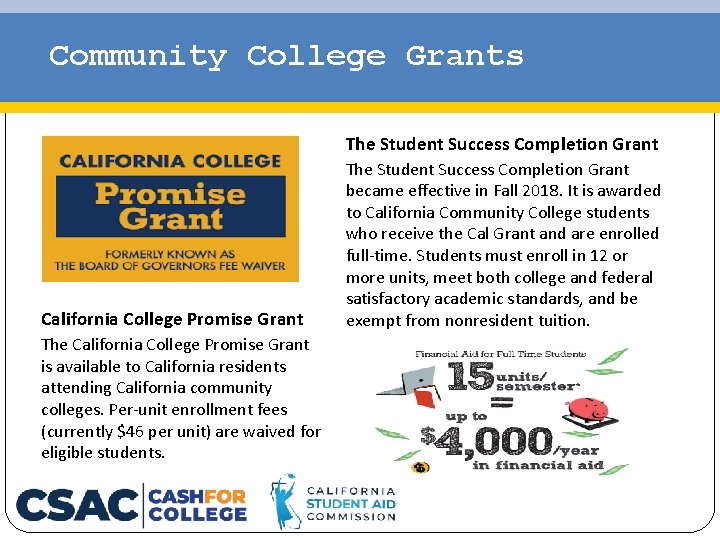
Community College Grants The Student Success Completion Grant California College Promise Grant The California College Promise Grant is available to California residents attending California community colleges. Per-unit enrollment fees (currently $46 per unit) are waived for eligible students. The Student Success Completion Grant became effective in Fall 2018. It is awarded to California Community College students who receive the Cal Grant and are enrolled full-time. Students must enroll in 12 or more units, meet both college and federal satisfactory academic standards, and be exempt from nonresident tuition.