
2020 The Global Foresight Group SARL All rights
© 2020 The Global Foresight Group SARL. All rights reserved. This document may not be reproduced or transmitted in any form or by any means, without prior consent of the author. Content and frameworks not specifically attributed to third parties are the property of The Global Foresight Group and should as such be referenced when used. YMCA, September 2020 © 2020 The Global Foresight Group SARL. All rights reserved.
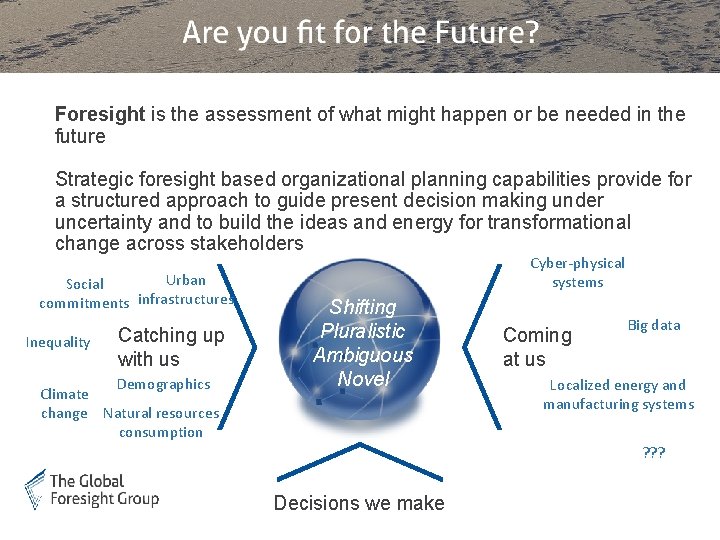
2 Foresight is the assessment of what might happen or be needed in the future Strategic foresight based organizational planning capabilities provide for a structured approach to guide present decision making under uncertainty and to build the ideas and energy for transformational change across stakeholders Urban Social commitments infrastructures Inequality Catching up with us Demographics Climate change Natural resources consumption Cyber-physical systems Shifting Pluralistic Ambiguous Novel Coming at us Big data Localized energy and manufacturing systems ? ? ? Decisions we make
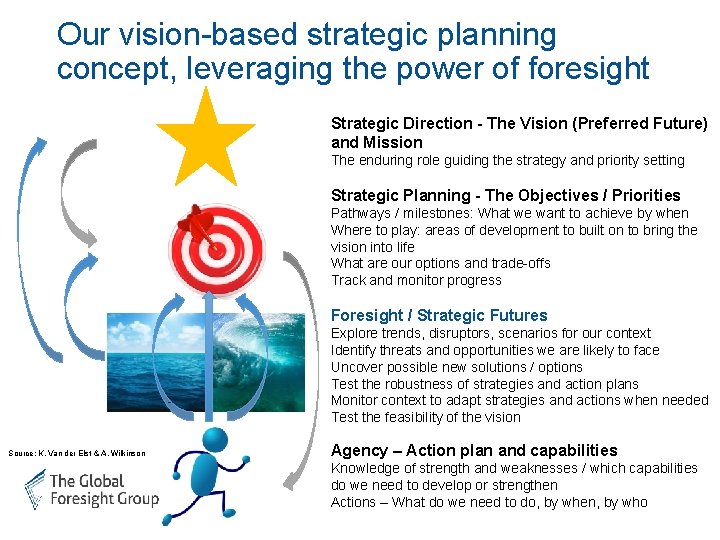
Our vision-based strategic planning concept, leveraging the power of foresight Strategic Direction - The Vision (Preferred Future) and Mission The enduring role guiding the strategy and priority setting Strategic Planning - The Objectives / Priorities Pathways / milestones: What we want to achieve by when Where to play: areas of development to built on to bring the vision into life What are our options and trade-offs Track and monitor progress Foresight / Strategic Futures Explore trends, disruptors, scenarios for our context Identify threats and opportunities we are likely to face Uncover possible new solutions / options Test the robustness of strategies and action plans Monitor context to adapt strategies and actions when needed Test the feasibility of the vision Source: K. Van der Elst & A. Wilkinson Agency – Action plan and capabilities Knowledge of strength and weaknesses / which capabilities do we need to develop or strengthen Actions – What do we need to do, by when, by who
Steps you can follow • Clarify your goals • Explore which scenarios you might face. Scenarios are strategically relevant and structurally different, but plausible, future models of the world. Consider trends and disruptions. • Identify the implications. Under which conditions will we need to operate. What challenges and opportunities (e. g. , , bottlenecks, shortages, emerging needs, emerging capabilities) will we face? Which of your strengths and weaknesses do these scenarios highlight? • Make your planning assumptions explicit and examine their validity. Sort them in those that are credible and should guide your planning/ should be researched further / vulnerable, to be reconsidered. • Review your options, plans, and decisions. What will you do when you arrive in an alternative future? What could you do now that would make you more robust and resilient to possible challenges? • Monitor and adapt. Establish a system to monitor early warning signs, that signal which of your possible futures is actually emerging.
Contact The Global Foresight Group Kristel Van der Elst Kristel. vanderelst@theglobalforesightgroup. com www. theglobalforesightgroup. com
- Slides: 5