
2020 REVISED CURRICULUM AND ASSESSMENT PLANS GRADE 7
- Slides: 41
2020 REVISED CURRICULUM AND ASSESSMENT PLANS GRADE 7: TECHNOLOGY Implementation: June 2020
Presentation Outline 1. Purpose 2. Amendments to the Content Overview for the Phase; 3. Amendments to the Annual Teaching Plan; 4. Amendments School Based Assessment (SBA) 5. Conclusion
1. Purpose • To mediate the amendments of the trimmed and re-organised 2020 Annual Teaching Plan including School Based Assessment for Technology, Grade 7 for implementation in June 2020 as stipulated in Circular S 2 of 2020. • To ensure that meaningful teaching proceeds during the remaining teaching time as per the revised school calendar. • To assist teachers with guided pacing and sequencing of curriculum content and assessment.
1. Purpose (continued) • To enable teachers to cover the essential core content /skills in each grade within the available time. • To assist teachers with planning for the different forms of assessment. • To ensure learners are adequately prepared for the subsequent year/s in terms of content, skills, knowledge, attitudes and values
2. Amendments to the Content Overview for the Phase
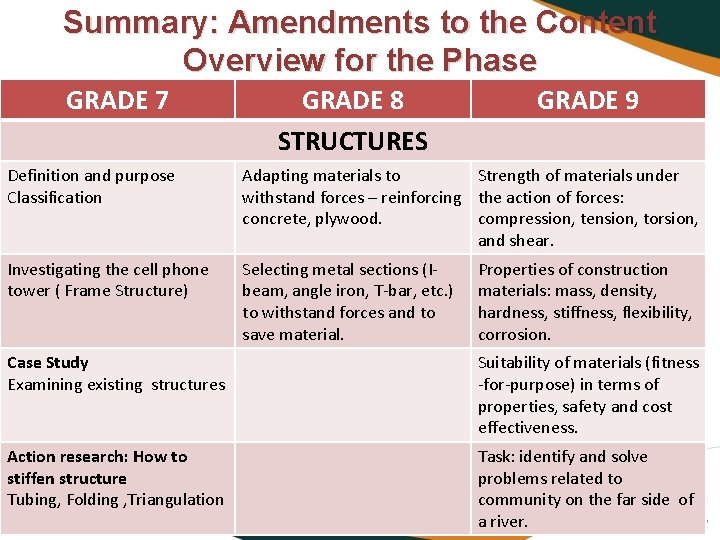
Summary: Amendments to the Content Overview for the Phase GRADE 7 GRADE 8 STRUCTURES GRADE 9 Definition and purpose Classification Adapting materials to Strength of materials under withstand forces – reinforcing the action of forces: concrete, plywood. compression, tension, torsion, and shear. Investigating the cell phone tower ( Frame Structure) Selecting metal sections (Ibeam, angle iron, T-bar, etc. ) to withstand forces and to save material. Properties of construction materials: mass, density, hardness, stiffness, flexibility, corrosion. Case Study Examining existing structures Suitability of materials (fitness -for-purpose) in terms of properties, safety and cost effectiveness. Action research: How to stiffen structure Tubing, Folding , Triangulation Task: identify and solve problems related to community on the far side of a river.
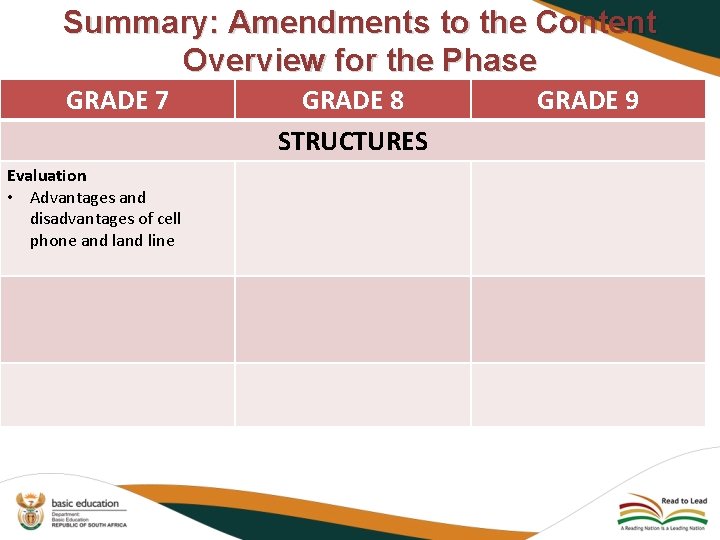
Summary: Amendments to the Content Overview for the Phase GRADE 7 Evaluation • Advantages and disadvantages of cell phone and line GRADE 8 STRUCTURES GRADE 9
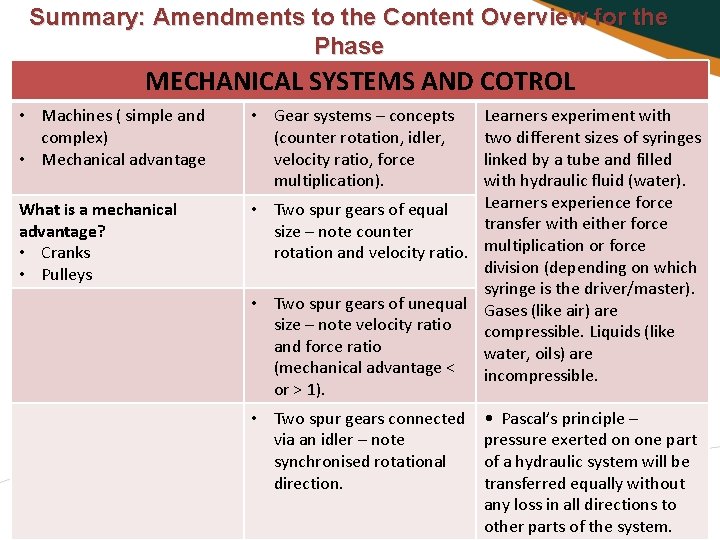
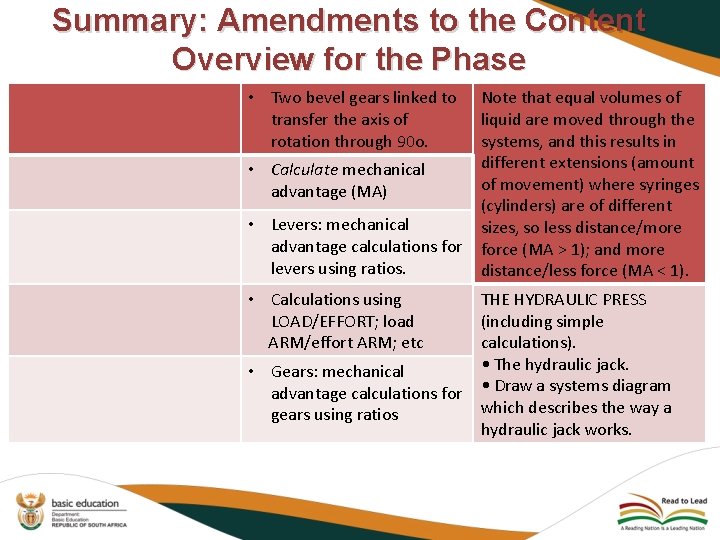
Summary: Amendments to the Content Overview for the Phase MECHANICAL SYSTEMS AND COTROL • Machines ( simple and complex) • Mechanical advantage What is a mechanical advantage? • Cranks • Pulleys • Gear systems – concepts (counter rotation, idler, velocity ratio, force multiplication). Learners experiment with two different sizes of syringes linked by a tube and filled with hydraulic fluid (water). Learners experience force • Two spur gears of equal transfer with either force size – note counter rotation and velocity ratio. multiplication or force division (depending on which syringe is the driver/master). • Two spur gears of unequal Gases (like air) are size – note velocity ratio compressible. Liquids (like and force ratio water, oils) are (mechanical advantage < incompressible. or > 1). • Two spur gears connected via an idler – note synchronised rotational direction. • Pascal’s principle – pressure exerted on one part of a hydraulic system will be transferred equally without any loss in all directions to other parts of the system.
Summary: Amendments to the Content Overview for the Phase • Two bevel gears linked to transfer the axis of rotation through 90 o. • Calculate mechanical advantage (MA) • Levers: mechanical advantage calculations for levers using ratios. • Calculations using LOAD/EFFORT; load ARM/effort ARM; etc • Gears: mechanical advantage calculations for gears using ratios Note that equal volumes of liquid are moved through the systems, and this results in different extensions (amount of movement) where syringes (cylinders) are of different sizes, so less distance/more force (MA > 1); and more distance/less force (MA < 1). THE HYDRAULIC PRESS (including simple calculations). • The hydraulic jack. • Draw a systems diagram which describes the way a hydraulic jack works.
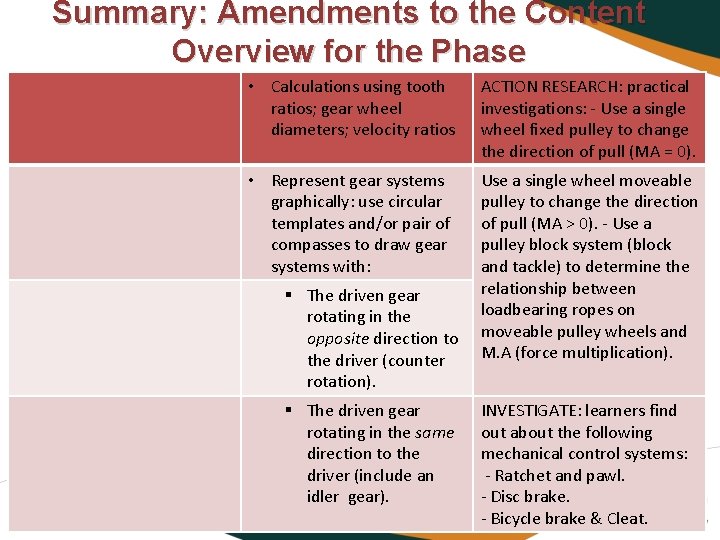
Summary: Amendments to the Content Overview for the Phase • Calculations using tooth ratios; gear wheel diameters; velocity ratios ACTION RESEARCH: practical investigations: - Use a single wheel fixed pulley to change the direction of pull (MA = 0). • Represent gear systems graphically: use circular templates and/or pair of compasses to draw gear systems with: Use a single wheel moveable pulley to change the direction of pull (MA > 0). - Use a pulley block system (block and tackle) to determine the relationship between loadbearing ropes on moveable pulley wheels and M. A (force multiplication). § The driven gear rotating in the opposite direction to the driver (counter rotation). § The driven gear rotating in the same direction to the driver (include an idler gear). INVESTIGATE: learners find out about the following mechanical control systems: - Ratchet and pawl. - Disc brake. - Bicycle brake & Cleat.
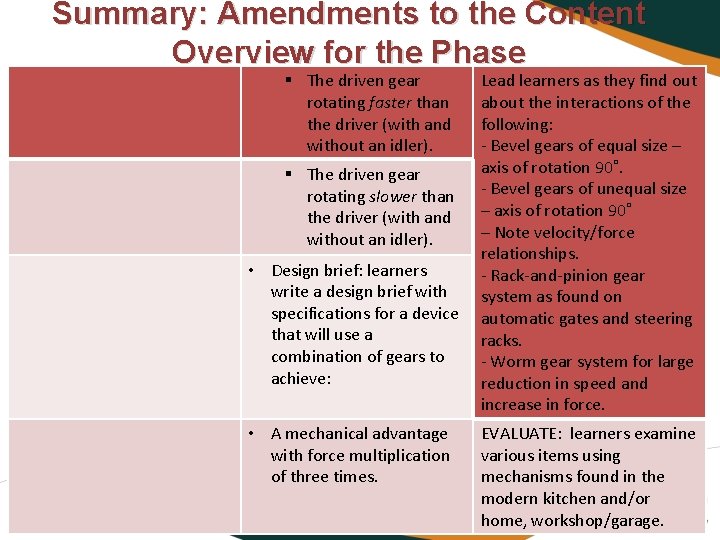
Summary: Amendments to the Content Overview for the Phase § The driven gear rotating faster than the driver (with and without an idler). § The driven gear rotating slower than the driver (with and without an idler). • Design brief: learners write a design brief with specifications for a device that will use a combination of gears to achieve: • A mechanical advantage with force multiplication of three times. Lead learners as they find out about the interactions of the following: - Bevel gears of equal size – axis of rotation 90˚. - Bevel gears of unequal size – axis of rotation 90˚ – Note velocity/force relationships. - Rack-and-pinion gear system as found on automatic gates and steering racks. - Worm gear system for large reduction in speed and increase in force. EVALUATE: learners examine various items using mechanisms found in the modern kitchen and/or home, workshop/garage.
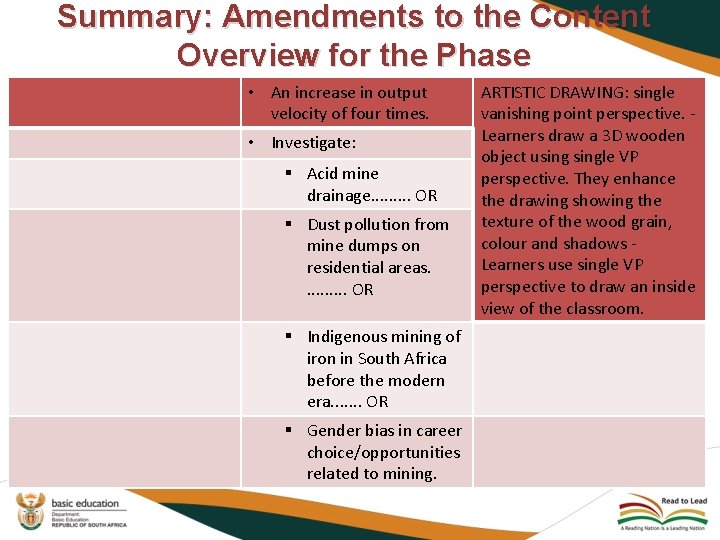
Summary: Amendments to the Content Overview for the Phase • An increase in output velocity of four times. • Investigate: § Acid mine drainage. . OR § Dust pollution from mine dumps on residential areas. . OR § Indigenous mining of iron in South Africa before the modern era. . . . OR § Gender bias in career choice/opportunities related to mining. ARTISTIC DRAWING: single vanishing point perspective. Learners draw a 3 D wooden object usingle VP perspective. They enhance the drawing showing the texture of the wood grain, colour and shadows Learners use single VP perspective to draw an inside view of the classroom.
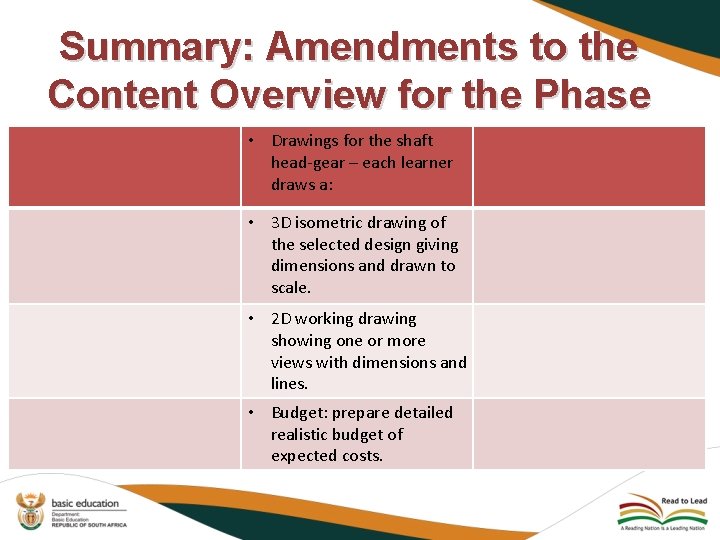
Summary: Amendments to the Content Overview for the Phase • Drawings for the shaft head-gear – each learner draws a: • 3 D isometric drawing of the selected design giving dimensions and drawn to scale. • 2 D working drawing showing one or more views with dimensions and lines. • Budget: prepare detailed realistic budget of expected costs.
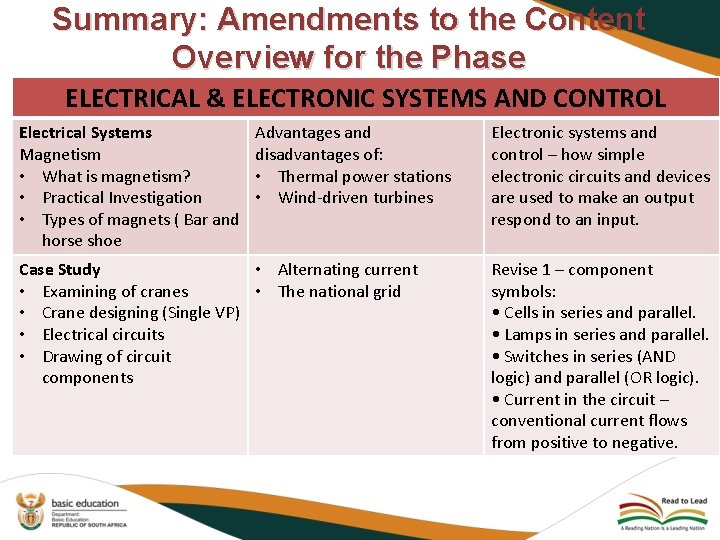
Summary: Amendments to the Content Overview for the Phase ELECTRICAL & ELECTRONIC SYSTEMS AND CONTROL Electrical Systems Magnetism • What is magnetism? • Practical Investigation • Types of magnets ( Bar and horse shoe Advantages and disadvantages of: • Thermal power stations • Wind-driven turbines Case Study • Alternating current • Examining of cranes • The national grid • Crane designing (Single VP) • Electrical circuits • Drawing of circuit components Electronic systems and control – how simple electronic circuits and devices are used to make an output respond to an input. Revise 1 – component symbols: • Cells in series and parallel. • Lamps in series and parallel. • Switches in series (AND logic) and parallel (OR logic). • Current in the circuit – conventional current flows from positive to negative.
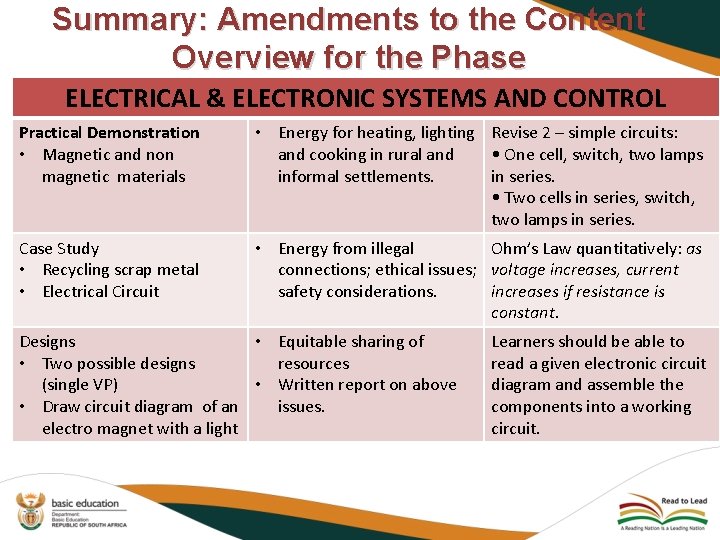
Summary: Amendments to the Content Overview for the Phase ELECTRICAL & ELECTRONIC SYSTEMS AND CONTROL Practical Demonstration • Magnetic and non magnetic materials • Energy for heating, lighting Revise 2 – simple circuits: and cooking in rural and • One cell, switch, two lamps informal settlements. in series. • Two cells in series, switch, two lamps in series. Case Study • Recycling scrap metal • Electrical Circuit • Energy from illegal Ohm’s Law quantitatively: as connections; ethical issues; voltage increases, current safety considerations. increases if resistance is constant. Designs • Equitable sharing of • Two possible designs resources (single VP) • Written report on above • Draw circuit diagram of an issues. electro magnet with a light Learners should be able to read a given electronic circuit diagram and assemble the components into a working circuit.
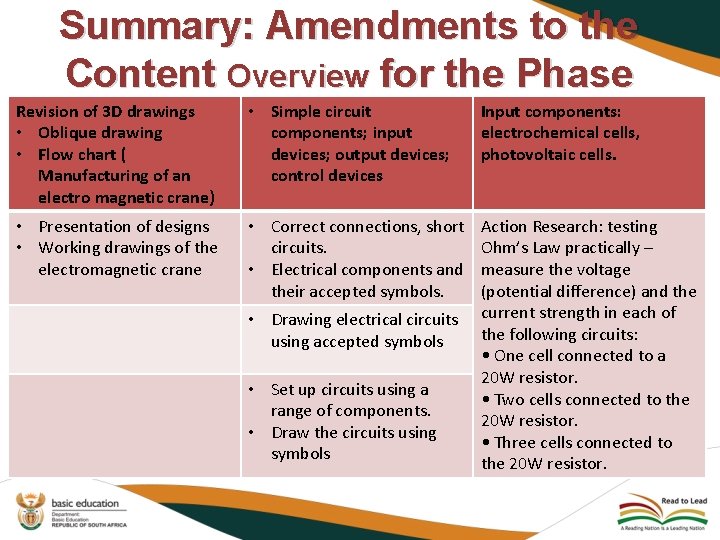
Summary: Amendments to the Content Overview for the Phase Revision of 3 D drawings • Oblique drawing • Flow chart ( Manufacturing of an electro magnetic crane) • Simple circuit components; input devices; output devices; control devices Input components: electrochemical cells, photovoltaic cells. • Presentation of designs • Working drawings of the electromagnetic crane • Correct connections, short circuits. • Electrical components and their accepted symbols. Action Research: testing Ohm’s Law practically – measure the voltage (potential difference) and the current strength in each of the following circuits: • One cell connected to a 20 W resistor. • Two cells connected to the 20 W resistor. • Three cells connected to the 20 W resistor. • Drawing electrical circuits using accepted symbols • Set up circuits using a range of components. • Draw the circuits using symbols
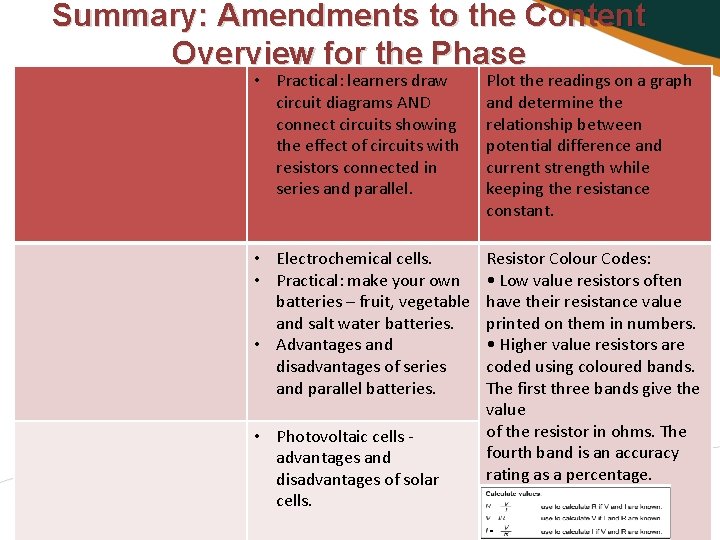
Summary: Amendments to the Content Overview for the Phase • Practical: learners draw circuit diagrams AND connect circuits showing the effect of circuits with resistors connected in series and parallel. Plot the readings on a graph and determine the relationship between potential difference and current strength while keeping the resistance constant. • Electrochemical cells. • Practical: make your own batteries – fruit, vegetable and salt water batteries. • Advantages and disadvantages of series and parallel batteries. Resistor Colour Codes: • Low value resistors often have their resistance value printed on them in numbers. • Higher value resistors are coded using coloured bands. The first three bands give the value of the resistor in ohms. The fourth band is an accuracy rating as a percentage. • Photovoltaic cells advantages and disadvantages of solar cells.
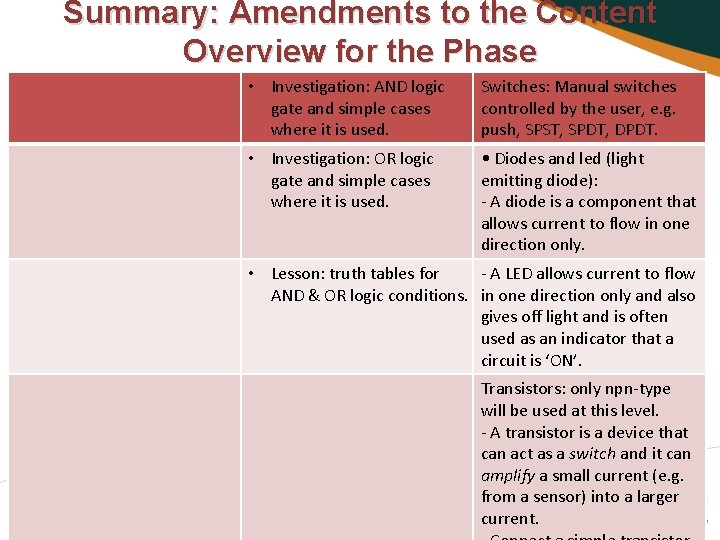
Summary: Amendments to the Content Overview for the Phase • Investigation: AND logic gate and simple cases where it is used. Switches: Manual switches controlled by the user, e. g. push, SPST, SPDT, DPDT. • Investigation: OR logic gate and simple cases where it is used. • Diodes and led (light emitting diode): - A diode is a component that allows current to flow in one direction only. • Lesson: truth tables for - A LED allows current to flow AND & OR logic conditions. in one direction only and also gives off light and is often used as an indicator that a circuit is ‘ON’. Transistors: only npn-type will be used at this level. - A transistor is a device that can act as a switch and it can amplify a small current (e. g. from a sensor) into a larger current.
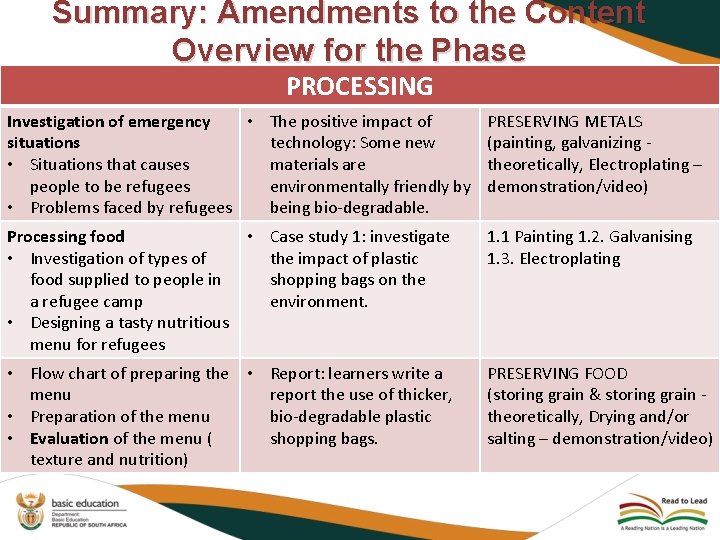
Summary: Amendments to the Content Overview for the Phase PROCESSING Investigation of emergency • The positive impact of situations technology: Some new • Situations that causes materials are people to be refugees environmentally friendly by • Problems faced by refugees being bio-degradable. PRESERVING METALS (painting, galvanizing theoretically, Electroplating – demonstration/video) Processing food • Investigation of types of food supplied to people in a refugee camp • Designing a tasty nutritious menu for refugees 1. 1 Painting 1. 2. Galvanising 1. 3. Electroplating • Case study 1: investigate the impact of plastic shopping bags on the environment. • Flow chart of preparing the • Report: learners write a menu report the use of thicker, • Preparation of the menu bio-degradable plastic • Evaluation of the menu ( shopping bags. texture and nutrition) PRESERVING FOOD (storing grain & storing grain theoretically, Drying and/or salting – demonstration/video)
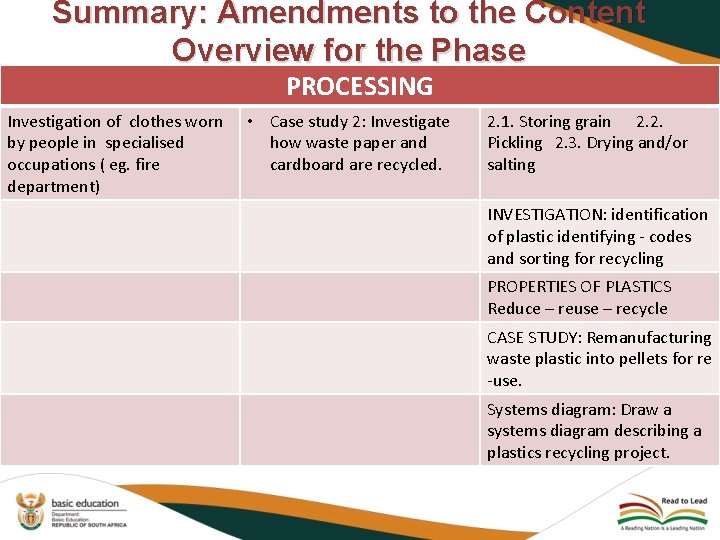
Summary: Amendments to the Content Overview for the Phase PROCESSING Investigation of clothes worn by people in specialised occupations ( eg. fire department) • Case study 2: Investigate how waste paper and cardboard are recycled. 2. 1. Storing grain 2. 2. Pickling 2. 3. Drying and/or salting INVESTIGATION: identification of plastic identifying - codes and sorting for recycling PROPERTIES OF PLASTICS Reduce – reuse – recycle CASE STUDY: Remanufacturing waste plastic into pellets for re -use. Systems diagram: Draw a systems diagram describing a plastics recycling project.
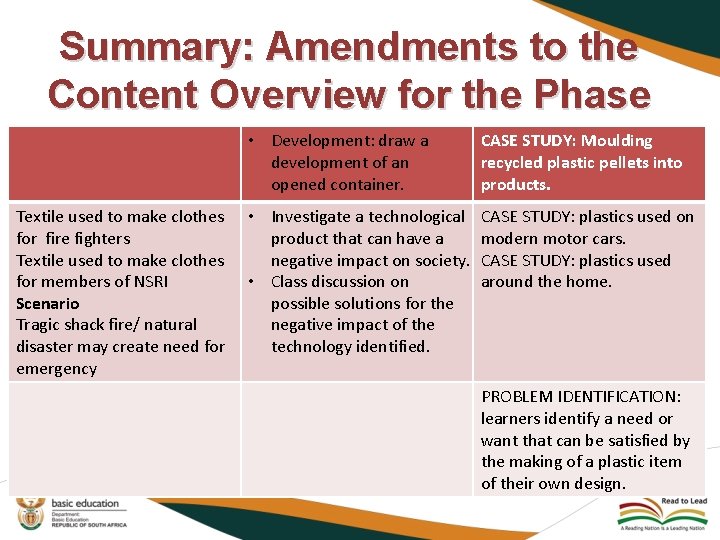
Summary: Amendments to the Content Overview for the Phase Textile used to make clothes for fire fighters Textile used to make clothes for members of NSRI Scenario Tragic shack fire/ natural disaster may create need for emergency • Development: draw a development of an opened container. CASE STUDY: Moulding recycled plastic pellets into products. • Investigate a technological product that can have a negative impact on society. • Class discussion on possible solutions for the negative impact of the technology identified. CASE STUDY: plastics used on modern motor cars. CASE STUDY: plastics used around the home. PROBLEM IDENTIFICATION: learners identify a need or want that can be satisfied by the making of a plastic item of their own design.
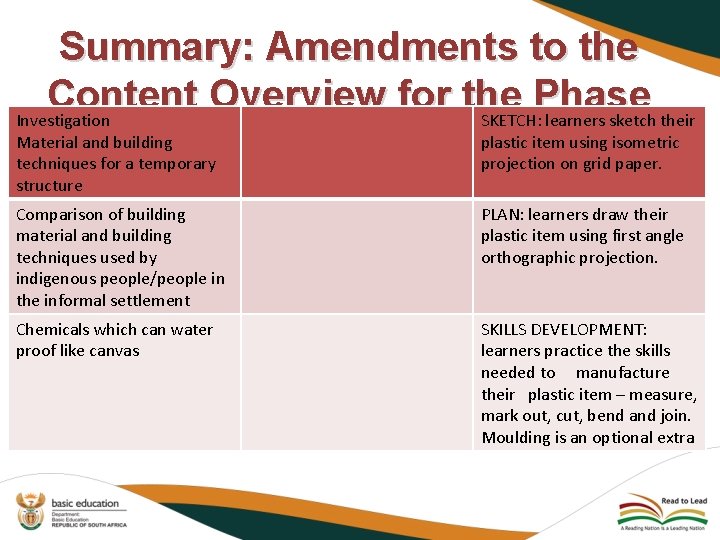
Summary: Amendments to the Content Overview for the Phase Investigation SKETCH: learners sketch their Material and building techniques for a temporary structure plastic item using isometric projection on grid paper. Comparison of building material and building techniques used by indigenous people/people in the informal settlement PLAN: learners draw their plastic item using first angle orthographic projection. Chemicals which can water proof like canvas SKILLS DEVELOPMENT: learners practice the skills needed to manufacture their plastic item – measure, mark out, cut, bend and join. Moulding is an optional extra
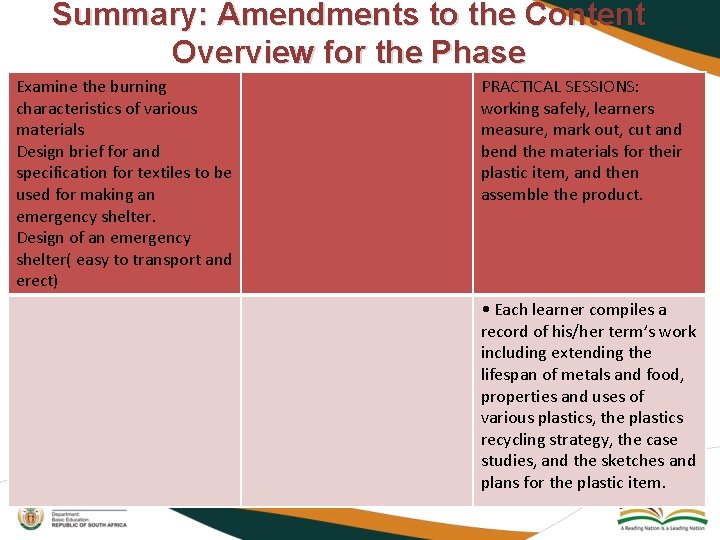
Summary: Amendments to the Content Overview for the Phase Examine the burning characteristics of various materials Design brief for and specification for textiles to be used for making an emergency shelter. Design of an emergency shelter( easy to transport and erect) PRACTICAL SESSIONS: working safely, learners measure, mark out, cut and bend the materials for their plastic item, and then assemble the product. • Each learner compiles a record of his/her term’s work including extending the lifespan of metals and food, properties and uses of various plastics, the plastics recycling strategy, the case studies, and the sketches and plans for the plastic item.
3. Amendments to the Annual Teaching Plan
Grade 7 - Annual Teaching Plan • Annual Teaching Plan • Jaarlikse Onderrigprogram
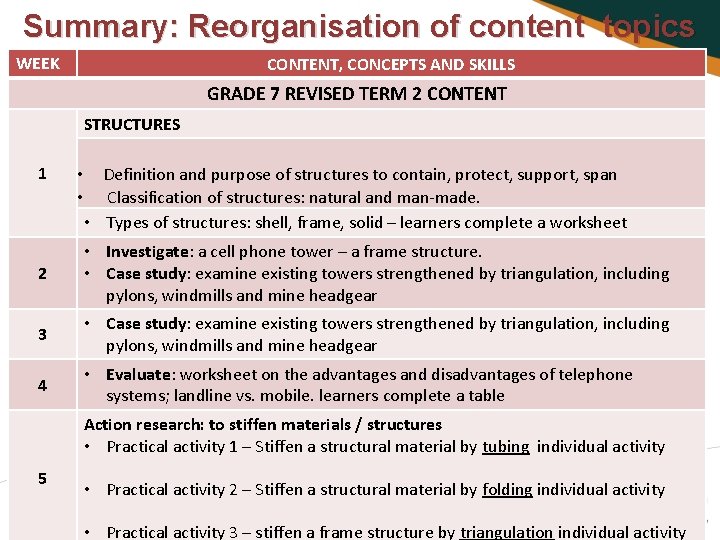
Summary: Reorganisation of content topics WEEK CONTENT, CONCEPTS AND SKILLS GRADE 7 REVISED TERM 2 CONTENT STRUCTURES 1 • • Definition and purpose of structures to contain, protect, support, span Classification of structures: natural and man-made. • Types of structures: shell, frame, solid – learners complete a worksheet 2 • Investigate: a cell phone tower – a frame structure. • Case study: examine existing towers strengthened by triangulation, including pylons, windmills and mine headgear 3 • Case study: examine existing towers strengthened by triangulation, including pylons, windmills and mine headgear 4 • Evaluate: worksheet on the advantages and disadvantages of telephone systems; landline vs. mobile. learners complete a table Action research: to stiffen materials / structures • Practical activity 1 – Stiffen a structural material by tubing individual activity 5 • Practical activity 2 – Stiffen a structural material by folding individual activity • Practical activity 3 – stiffen a frame structure by triangulation individual activity
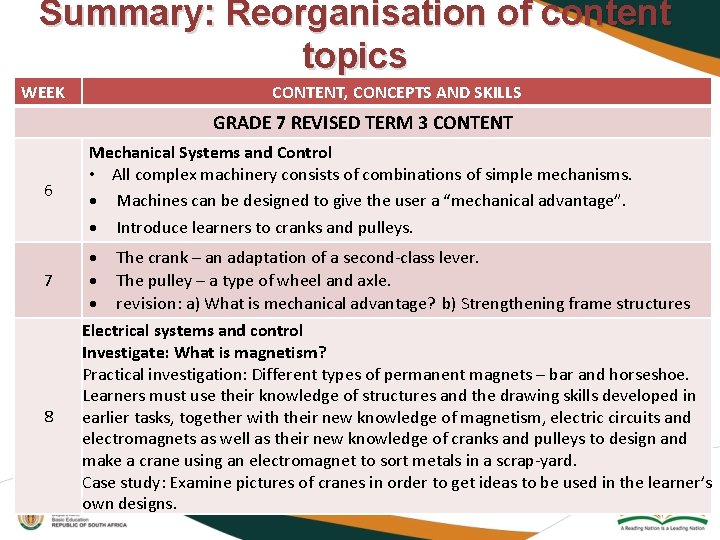
Summary: Reorganisation of content topics WEEK CONTENT, CONCEPTS AND SKILLS GRADE 7 REVISED TERM 3 CONTENT 6 7 8 Mechanical Systems and Control • All complex machinery consists of combinations of simple mechanisms. Machines can be designed to give the user a “mechanical advantage”. Introduce learners to cranks and pulleys. The crank – an adaptation of a second-class lever. The pulley – a type of wheel and axle. revision: a) What is mechanical advantage? b) Strengthening frame structures Electrical systems and control Investigate: What is magnetism? Practical investigation: Different types of permanent magnets – bar and horseshoe. Learners must use their knowledge of structures and the drawing skills developed in earlier tasks, together with their new knowledge of magnetism, electric circuits and electromagnets as well as their new knowledge of cranks and pulleys to design and make a crane using an electromagnet to sort metals in a scrap-yard. Case study: Examine pictures of cranes in order to get ideas to be used in the learner’s own designs.
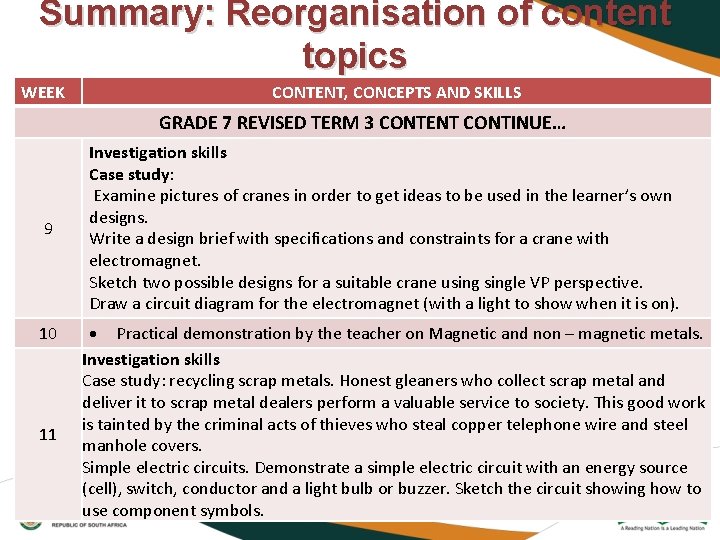
Summary: Reorganisation of content topics WEEK CONTENT, CONCEPTS AND SKILLS GRADE 7 REVISED TERM 3 CONTENT CONTINUE… 9 10 11 Investigation skills Case study: Examine pictures of cranes in order to get ideas to be used in the learner’s own designs. Write a design brief with specifications and constraints for a crane with electromagnet. Sketch two possible designs for a suitable crane usingle VP perspective. Draw a circuit diagram for the electromagnet (with a light to show when it is on). Practical demonstration by the teacher on Magnetic and non – magnetic metals. Investigation skills Case study: recycling scrap metals. Honest gleaners who collect scrap metal and deliver it to scrap metal dealers perform a valuable service to society. This good work is tainted by the criminal acts of thieves who steal copper telephone wire and steel manhole covers. Simple electric circuits. Demonstrate a simple electric circuit with an energy source (cell), switch, conductor and a light bulb or buzzer. Sketch the circuit showing how to use component symbols.
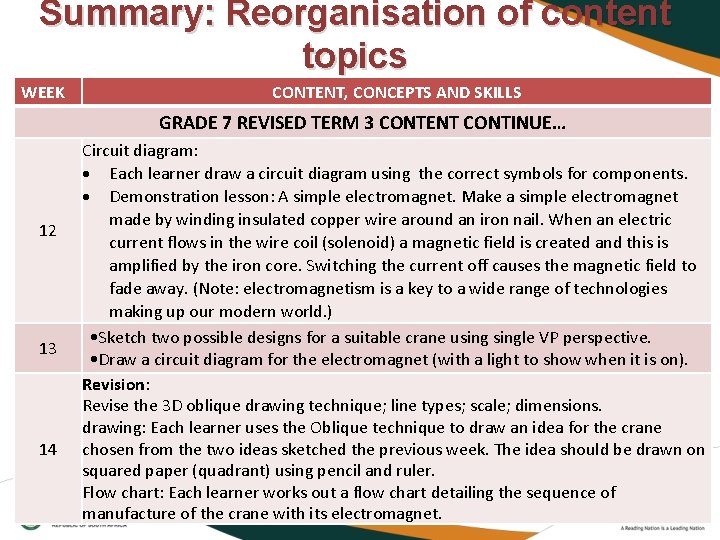
Summary: Reorganisation of content topics WEEK CONTENT, CONCEPTS AND SKILLS GRADE 7 REVISED TERM 3 CONTENT CONTINUE… 12 13 14 Circuit diagram: Each learner draw a circuit diagram using the correct symbols for components. Demonstration lesson: A simple electromagnet. Make a simple electromagnet made by winding insulated copper wire around an iron nail. When an electric current flows in the wire coil (solenoid) a magnetic field is created and this is amplified by the iron core. Switching the current off causes the magnetic field to fade away. (Note: electromagnetism is a key to a wide range of technologies making up our modern world. ) • Sketch two possible designs for a suitable crane usingle VP perspective. • Draw a circuit diagram for the electromagnet (with a light to show when it is on). Revision: Revise the 3 D oblique drawing technique; line types; scale; dimensions. drawing: Each learner uses the Oblique technique to draw an idea for the crane chosen from the two ideas sketched the previous week. The idea should be drawn on squared paper (quadrant) using pencil and ruler. Flow chart: Each learner works out a flow chart detailing the sequence of manufacture of the crane with its electromagnet.
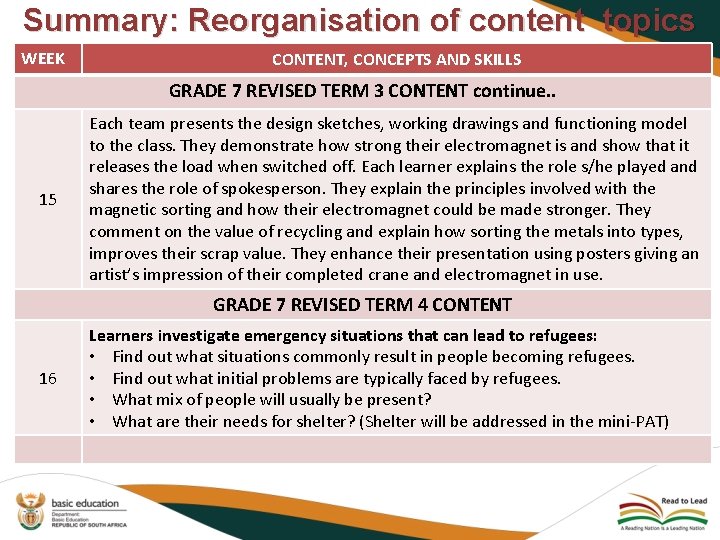
Summary: Reorganisation of content topics WEEK CONTENT, CONCEPTS AND SKILLS GRADE 7 REVISED TERM 3 CONTENT continue. . 15 Each team presents the design sketches, working drawings and functioning model to the class. They demonstrate how strong their electromagnet is and show that it releases the load when switched off. Each learner explains the role s/he played and shares the role of spokesperson. They explain the principles involved with the magnetic sorting and how their electromagnet could be made stronger. They comment on the value of recycling and explain how sorting the metals into types, improves their scrap value. They enhance their presentation using posters giving an artist’s impression of their completed crane and electromagnet in use. GRADE 7 REVISED TERM 4 CONTENT 16 Learners investigate emergency situations that can lead to refugees: • Find out what situations commonly result in people becoming refugees. • Find out what initial problems are typically faced by refugees. • What mix of people will usually be present? • What are their needs for shelter? (Shelter will be addressed in the mini-PAT)
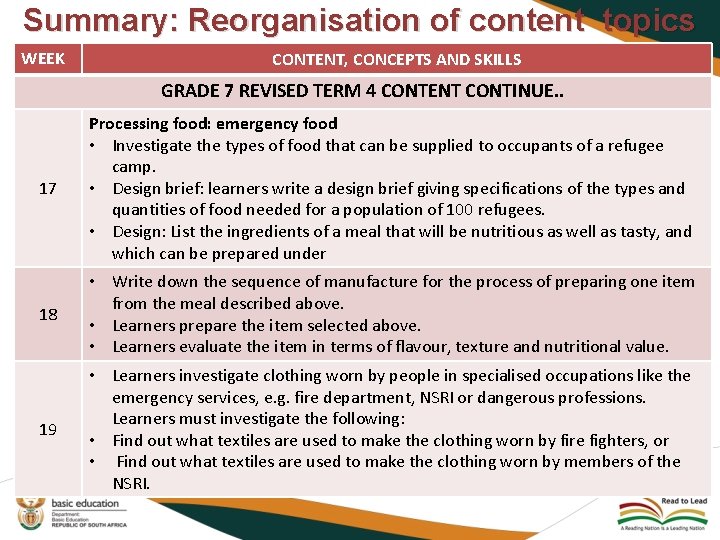
Summary: Reorganisation of content topics WEEK CONTENT, CONCEPTS AND SKILLS GRADE 7 REVISED TERM 4 CONTENT CONTINUE. . 17 Processing food: emergency food • Investigate the types of food that can be supplied to occupants of a refugee camp. • Design brief: learners write a design brief giving specifications of the types and quantities of food needed for a population of 100 refugees. • Design: List the ingredients of a meal that will be nutritious as well as tasty, and which can be prepared under 18 • Write down the sequence of manufacture for the process of preparing one item from the meal described above. • Learners prepare the item selected above. • Learners evaluate the item in terms of flavour, texture and nutritional value. 19 • Learners investigate clothing worn by people in specialised occupations like the emergency services, e. g. fire department, NSRI or dangerous professions. Learners must investigate the following: • Find out what textiles are used to make the clothing worn by fire fighters, or • Find out what textiles are used to make the clothing worn by members of the NSRI.
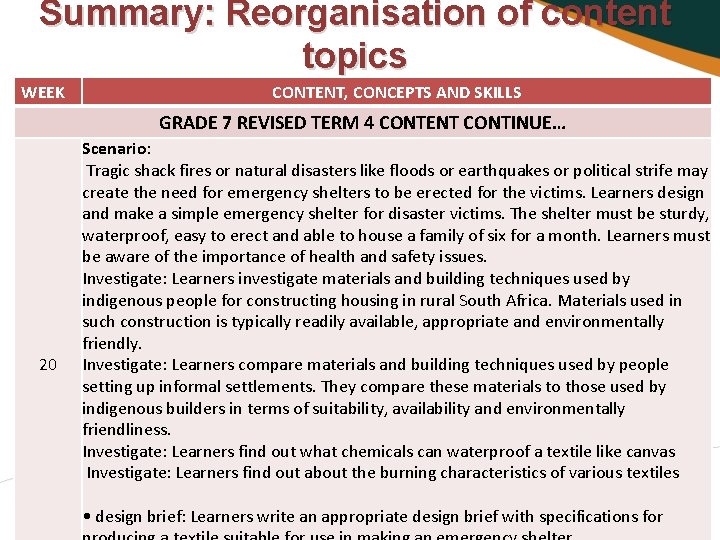
Summary: Reorganisation of content topics WEEK CONTENT, CONCEPTS AND SKILLS GRADE 7 REVISED TERM 4 CONTENT CONTINUE… 20 Scenario: Tragic shack fires or natural disasters like floods or earthquakes or political strife may create the need for emergency shelters to be erected for the victims. Learners design and make a simple emergency shelter for disaster victims. The shelter must be sturdy, waterproof, easy to erect and able to house a family of six for a month. Learners must be aware of the importance of health and safety issues. Investigate: Learners investigate materials and building techniques used by indigenous people for constructing housing in rural South Africa. Materials used in such construction is typically readily available, appropriate and environmentally friendly. Investigate: Learners compare materials and building techniques used by people setting up informal settlements. They compare these materials to those used by indigenous builders in terms of suitability, availability and environmentally friendliness. Investigate: Learners find out what chemicals can waterproof a textile like canvas Investigate: Learners find out about the burning characteristics of various textiles • design brief: Learners write an appropriate design brief with specifications for
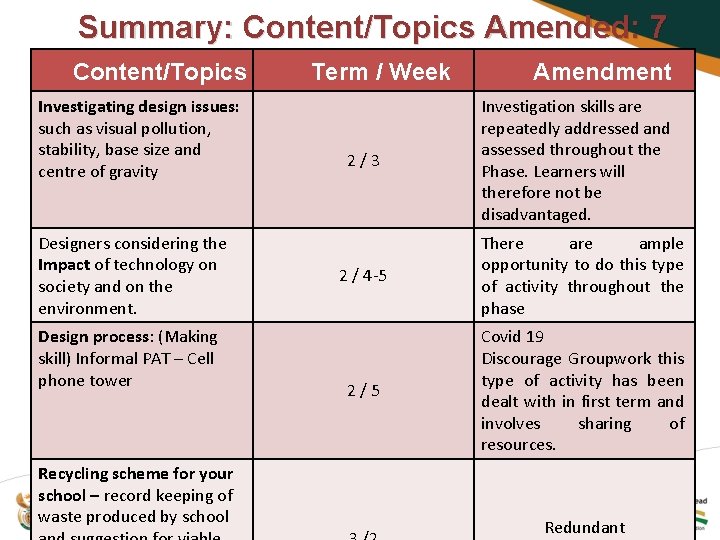
Summary: Content/Topics Amended: 7 Content/Topics Investigating design issues: such as visual pollution, stability, base size and centre of gravity Designers considering the Impact of technology on society and on the environment. Design process: (Making skill) Informal PAT – Cell phone tower Recycling scheme for your school – record keeping of waste produced by school Term / Week 2/3 Amendment Investigation skills are repeatedly addressed and assessed throughout the Phase. Learners will therefore not be disadvantaged. 2 / 4 -5 There ample opportunity to do this type of activity throughout the phase 2/5 Covid 19 Discourage Groupwork this type of activity has been dealt with in first term and involves sharing of resources. Redundant
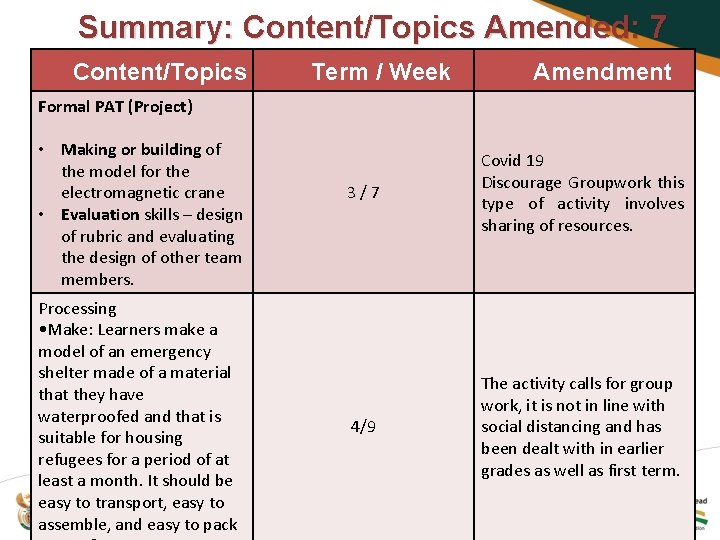
Summary: Content/Topics Amended: 7 Content/Topics Term / Week Amendment Formal PAT (Project) • Making or building of the model for the electromagnetic crane • Evaluation skills – design of rubric and evaluating the design of other team members. Processing • Make: Learners make a model of an emergency shelter made of a material that they have waterproofed and that is suitable for housing refugees for a period of at least a month. It should be easy to transport, easy to assemble, and easy to pack 3/7 Covid 19 Discourage Groupwork this type of activity involves sharing of resources. 4/9 The activity calls for group work, it is not in line with social distancing and has been dealt with in earlier grades as well as first term.
4. Amendments School Based Assessment (SBA)
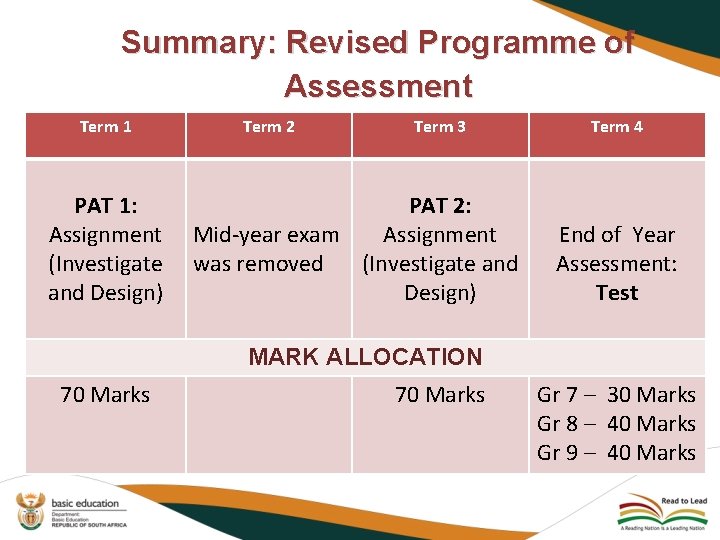
Summary: Revised Programme of Assessment Term 1 PAT 1: Assignment (Investigate and Design) Term 2 Term 3 PAT 2: Mid-year exam Assignment was removed (Investigate and Design) Term 4 End of Year Assessment: Test MARK ALLOCATION 70 Marks Gr 7 – 30 Marks Gr 8 – 40 Marks Gr 9 – 40 Marks
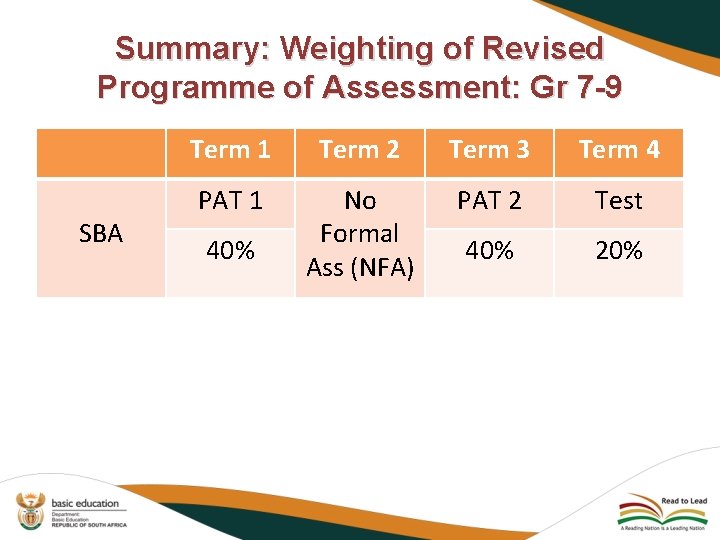
Summary: Weighting of Revised Programme of Assessment: Gr 7 -9 SBA Term 1 Term 2 Term 3 Term 4 PAT 1 No Formal Ass (NFA) PAT 2 Test 40% 20% 40%
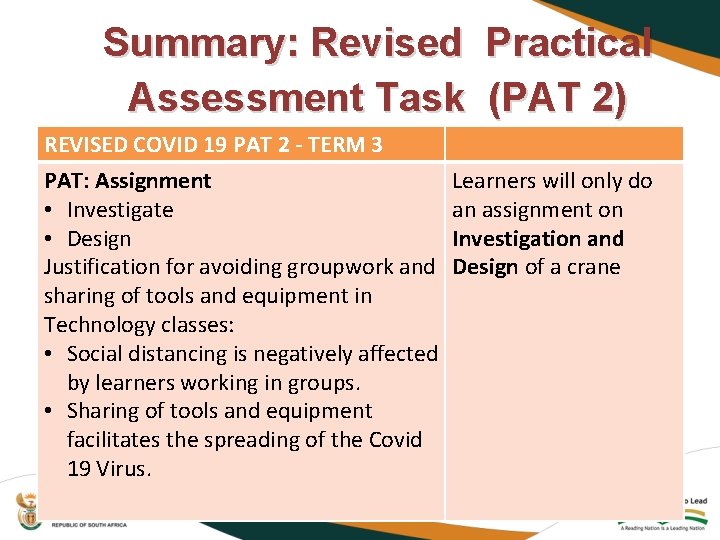
Summary: Revised Practical Assessment Task (PAT 2) REVISED COVID 19 PAT 2 - TERM 3 PAT: Assignment • Investigate • Design Justification for avoiding groupwork and sharing of tools and equipment in Technology classes: • Social distancing is negatively affected by learners working in groups. • Sharing of tools and equipment facilitates the spreading of the Covid 19 Virus. Learners will only do an assignment on Investigation and Design of a crane
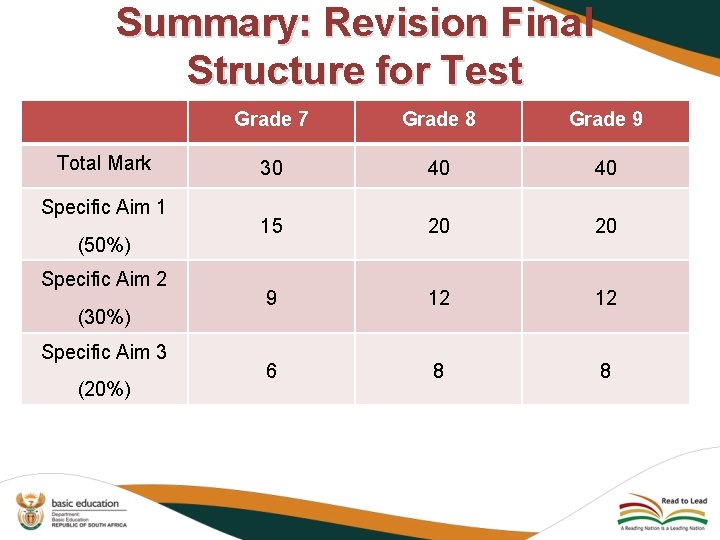
Summary: Revision Final Structure for Test Total Mark Specific Aim 1 (50%) Specific Aim 2 (30%) Specific Aim 3 (20%) Grade 7 Grade 8 Grade 9 30 40 40 15 20 20 9 12 12 6 8 8
4. Conclusion
Contact Details Name: CES: Subjects Department of Basic Education Tel: Email: