
2020 REVISED CURRICULUM AND ASSESSMENT PLANS GEOGRAPHY GRADE
![Summary: Content/Topics Amended Content/Topics Term Amendment The Structure of the Earth [4 HOURS] The](https://slidetodoc.com/presentation_image_h/0b64f539b251dc0bd94ecf09c9e454b6/image-21.jpg "Summary: Content/Topics Amended Content/Topics Term Amendment The Structure of the Earth [4 HOURS] The")
![Summary: Content/Topics Amended Content/Topics Term Amendment Plate Tectonics [4 HOURS] the mechanics of plate](https://slidetodoc.com/presentation_image_h/0b64f539b251dc0bd94ecf09c9e454b6/image-22.jpg "Summary: Content/Topics Amended Content/Topics Term Amendment Plate Tectonics [4 HOURS] the mechanics of plate")
![Summary: Content/Topics Amended Content/Topics Te rm Earthquakes [4 HOURS] the relationship between earthquakes and](https://slidetodoc.com/presentation_image_h/0b64f539b251dc0bd94ecf09c9e454b6/image-23.jpg "Summary: Content/Topics Amended Content/Topics Te rm Earthquakes [4 HOURS] the relationship between earthquakes and")
![Summary: Content/Topics Amended Content/Topics Term Amendment Population Growth [ 4 hours] (Using case studies](https://slidetodoc.com/presentation_image_h/0b64f539b251dc0bd94ecf09c9e454b6/image-24.jpg "Summary: Content/Topics Amended Content/Topics Term Amendment Population Growth [ 4 hours] (Using case studies")
![Summary: Content/Topics Amended Content/Topics Term HIV and AIDS [ 4 hours] HIV infection rates](https://slidetodoc.com/presentation_image_h/0b64f539b251dc0bd94ecf09c9e454b6/image-25.jpg "Summary: Content/Topics Amended Content/Topics Term HIV and AIDS [ 4 hours] HIV infection rates")
![Summary: Content/Topics Amended Content/Topics Water in the World [ 2 hours] different forms of](https://slidetodoc.com/presentation_image_h/0b64f539b251dc0bd94ecf09c9e454b6/image-26.jpg "Summary: Content/Topics Amended Content/Topics Water in the World [ 2 hours] different forms of")
- Slides: 32
2020 REVISED CURRICULUM AND ASSESSMENT PLANS GEOGRAPHY GRADE 10 Implementation: June 2020
Presentation Outline 1. Purpose 2. Amendments to the Content Overview for the Phase; 3. Amendments to the Annual Teaching Plan; 4. Amendments School Based Assessment (SBA) 5. Conclusion
1. Purpose • To mediate the amendments of the trimmed and re-organised 2020 Annual Teaching Plan including School Based Assessment for Geography, Grade 10 for implementation in June 2020 as stipulated in Circular S 2 of 2020. • To ensure that meaningful teaching proceeds during the remaining teaching time as per the revised school calendar. • To assist teachers with guided pacing and sequencing of curriculum content and assessment.
1. Purpose (continued) • To enable teachers to cover the essential core content /skills in each grade within the available time. • To assist teachers with planning for the different forms of assessment. • To ensure learners are adequately prepared for the subsequent year/s in terms of content, skills, knowledge, attitudes and values
2. Amendments to the Content Overview for the Phase
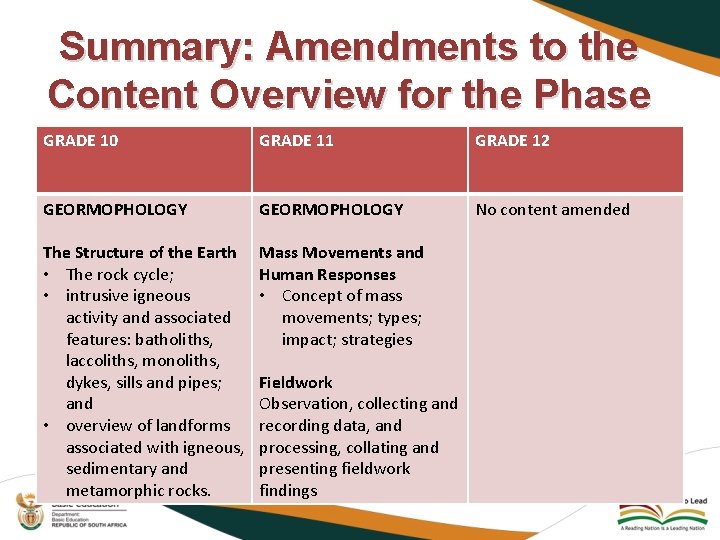
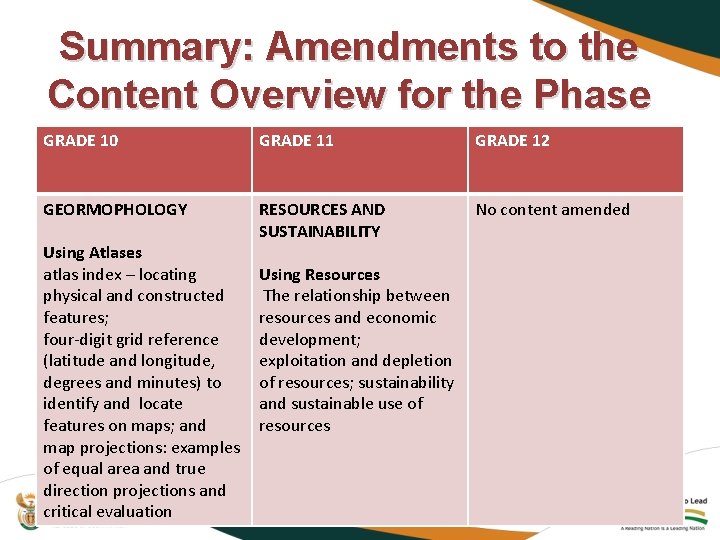
Summary: Amendments to the Content Overview for the Phase GRADE 10 GRADE 11 GRADE 12 GEORMOPHOLOGY No content amended The Structure of the Earth • The rock cycle; • intrusive igneous activity and associated features: batholiths, laccoliths, monoliths, dykes, sills and pipes; and • overview of landforms associated with igneous, sedimentary and metamorphic rocks. Mass Movements and Human Responses • Concept of mass movements; types; impact; strategies Fieldwork Observation, collecting and recording data, and processing, collating and presenting fieldwork findings
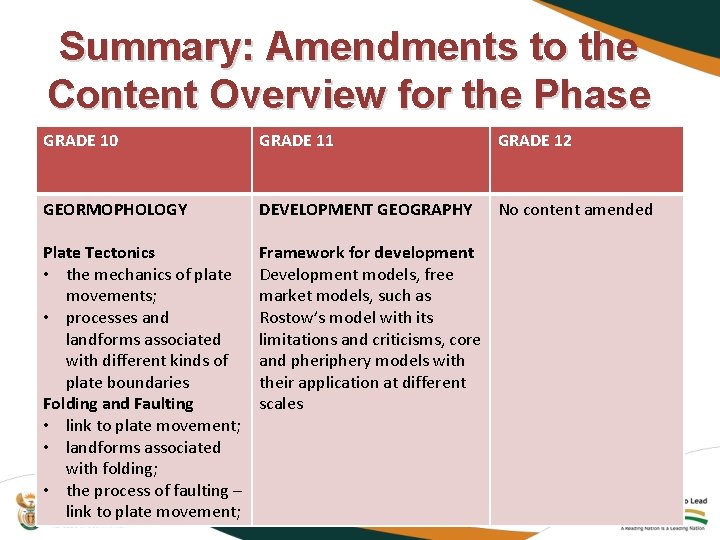
Summary: Amendments to the Content Overview for the Phase GRADE 10 GRADE 11 GRADE 12 GEORMOPHOLOGY DEVELOPMENT GEOGRAPHY No content amended Plate Tectonics • the mechanics of plate movements; • processes and landforms associated with different kinds of plate boundaries Folding and Faulting • link to plate movement; • landforms associated with folding; • the process of faulting – link to plate movement; Framework for development Development models, free market models, such as Rostow’s model with its limitations and criticisms, core and pheriphery models with their application at different scales
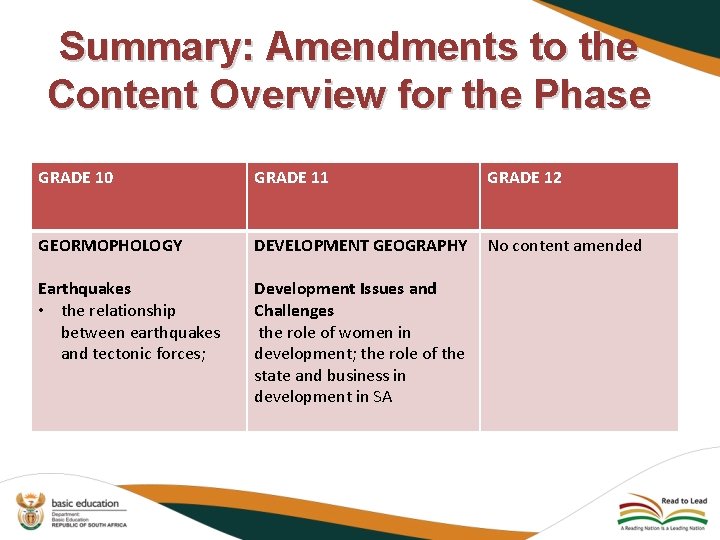
Summary: Amendments to the Content Overview for the Phase GRADE 10 GRADE 11 GRADE 12 GEORMOPHOLOGY DEVELOPMENT GEOGRAPHY No content amended Earthquakes • the relationship between earthquakes and tectonic forces; Development Issues and Challenges the role of women in development; the role of the state and business in development in SA
Summary: Amendments to the Content Overview for the Phase GRADE 10 GRADE 11 GRADE 12 GEORMOPHOLOGY RESOURCES AND SUSTAINABILITY No content amended Using Atlases atlas index – locating physical and constructed features; four-digit grid reference (latitude and longitude, degrees and minutes) to identify and locate features on maps; and map projections: examples of equal area and true direction projections and critical evaluation Using Resources The relationship between resources and economic development; exploitation and depletion of resources; sustainability and sustainable use of resources
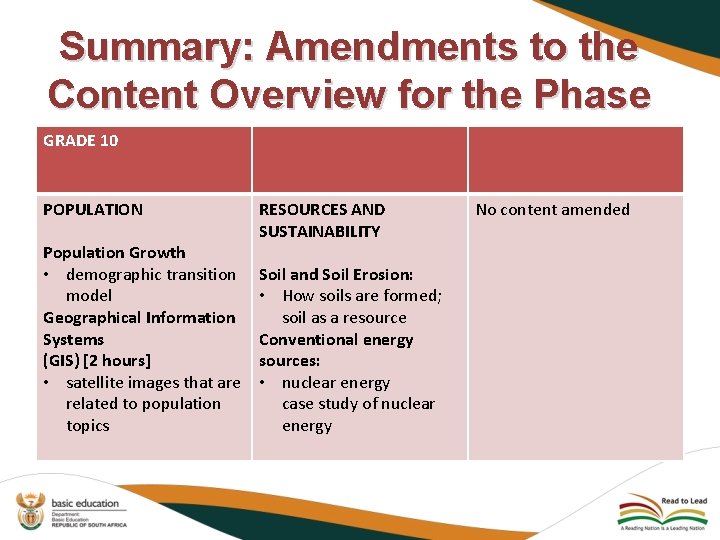
Summary: Amendments to the Content Overview for the Phase GRADE 10 POPULATION Population Growth • demographic transition model Geographical Information Systems (GIS) [2 hours] • satellite images that are related to population topics RESOURCES AND SUSTAINABILITY No content amended Soil and Soil Erosion: • How soils are formed; soil as a resource Conventional energy sources: • nuclear energy case study of nuclear energy
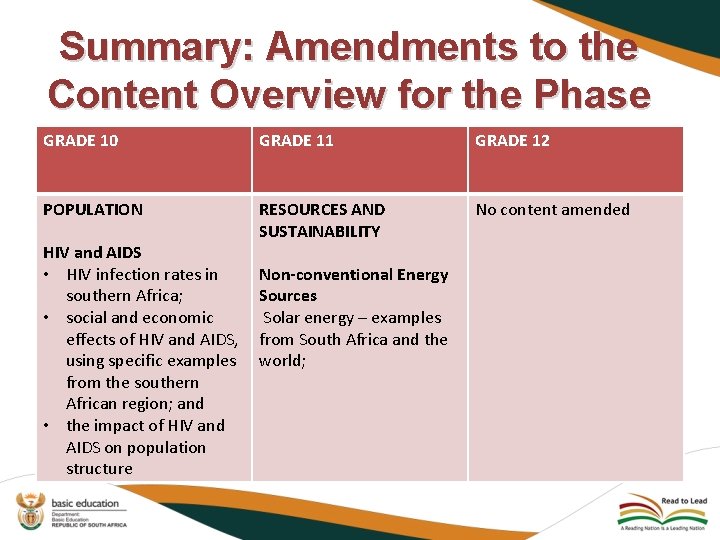
Summary: Amendments to the Content Overview for the Phase GRADE 10 GRADE 11 GRADE 12 POPULATION RESOURCES AND SUSTAINABILITY No content amended HIV and AIDS • HIV infection rates in southern Africa; • social and economic effects of HIV and AIDS, using specific examples from the southern African region; and • the impact of HIV and AIDS on population structure Non-conventional Energy Sources Solar energy – examples from South Africa and the world;
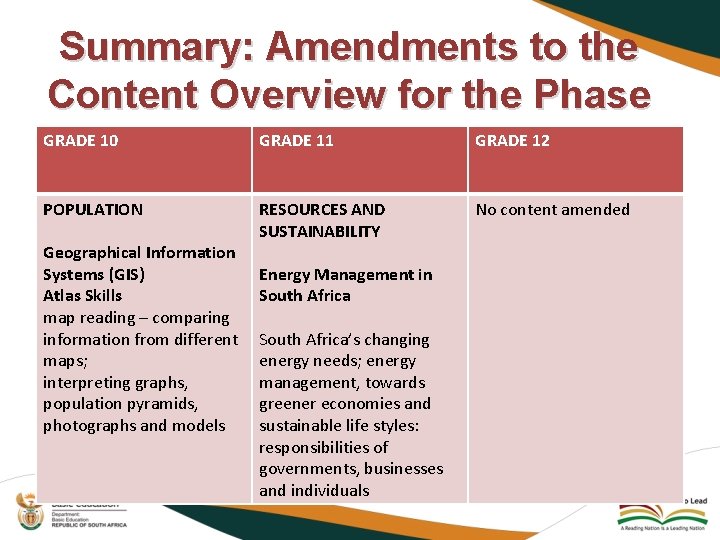
Summary: Amendments to the Content Overview for the Phase GRADE 10 GRADE 11 GRADE 12 POPULATION RESOURCES AND SUSTAINABILITY No content amended Geographical Information Systems (GIS) Atlas Skills map reading – comparing information from different maps; interpreting graphs, population pyramids, photographs and models Energy Management in South Africa’s changing energy needs; energy management, towards greener economies and sustainable life styles: responsibilities of governments, businesses and individuals
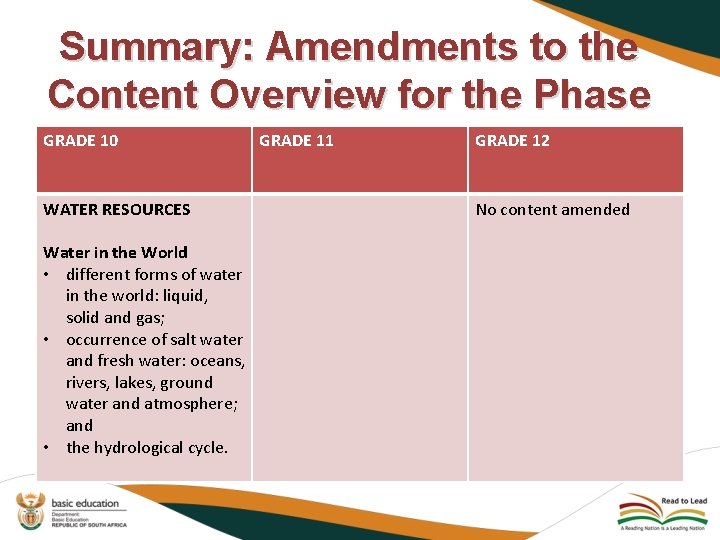
Summary: Amendments to the Content Overview for the Phase GRADE 10 WATER RESOURCES Water in the World • different forms of water in the world: liquid, solid and gas; • occurrence of salt water and fresh water: oceans, rivers, lakes, ground water and atmosphere; and • the hydrological cycle. GRADE 11 GRADE 12 No content amended
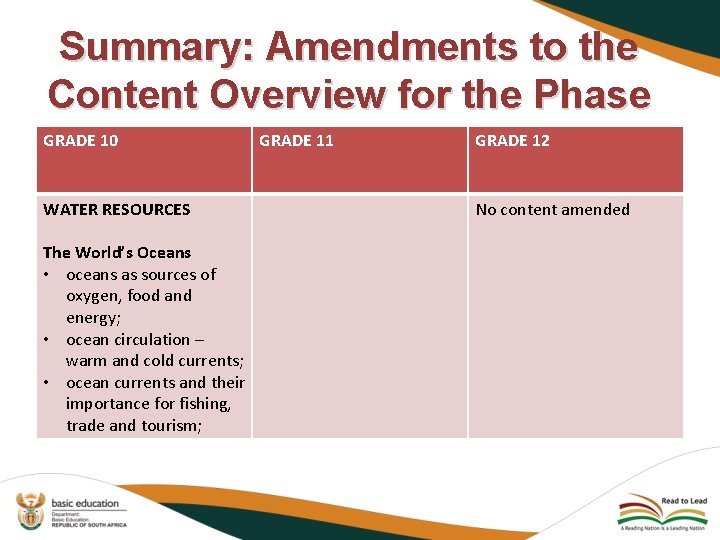
Summary: Amendments to the Content Overview for the Phase GRADE 10 WATER RESOURCES The World’s Oceans • oceans as sources of oxygen, food and energy; • ocean circulation – warm and cold currents; • ocean currents and their importance for fishing, trade and tourism; GRADE 11 GRADE 12 No content amended
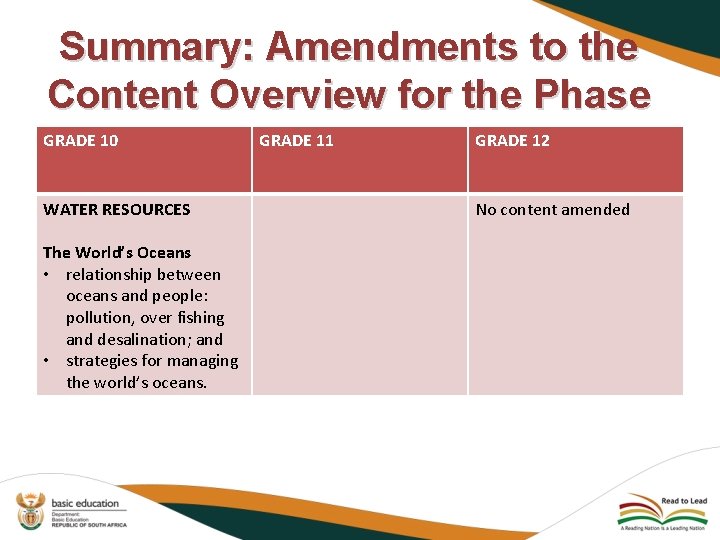
Summary: Amendments to the Content Overview for the Phase GRADE 10 WATER RESOURCES The World’s Oceans • relationship between oceans and people: pollution, over fishing and desalination; and • strategies for managing the world’s oceans. GRADE 11 GRADE 12 No content amended
3. Amendments to the Annual Teaching Plan
Grade 10 Amended ATPs The ATP also highlights how content has been reorganised in the grade • 2020 Post Covid Gr 10 Geography Revised. • 2020 Post Covid Gr 10 Geografie Revised.
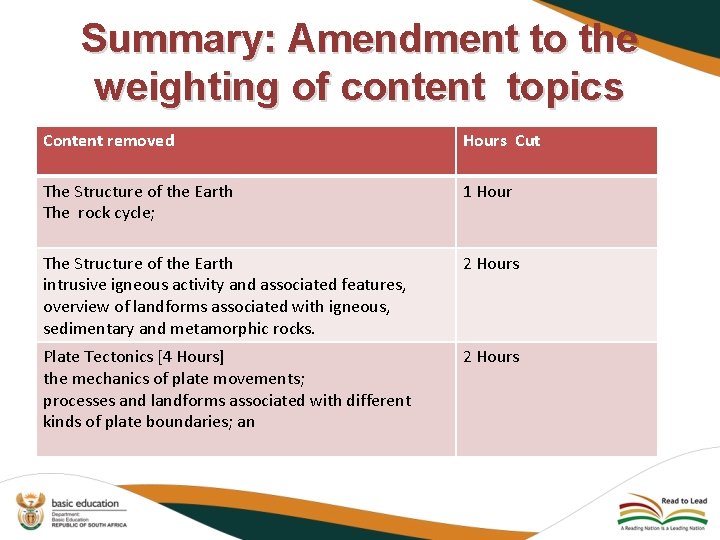
Summary: Amendment to the weighting of content topics Content removed Hours Cut The Structure of the Earth The rock cycle; 1 Hour The Structure of the Earth intrusive igneous activity and associated features, overview of landforms associated with igneous, sedimentary and metamorphic rocks. 2 Hours Plate Tectonics [4 Hours] the mechanics of plate movements; processes and landforms associated with different kinds of plate boundaries; an 2 Hours
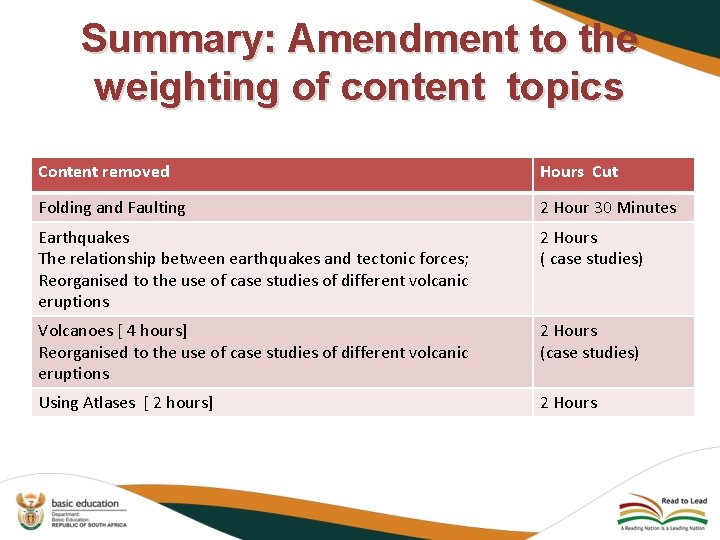
Summary: Amendment to the weighting of content topics Content removed Hours Cut Folding and Faulting 2 Hour 30 Minutes Earthquakes The relationship between earthquakes and tectonic forces; Reorganised to the use of case studies of different volcanic eruptions 2 Hours ( case studies) Volcanoes [ 4 hours] Reorganised to the use of case studies of different volcanic eruptions 2 Hours (case studies) Using Atlases [ 2 hours] 2 Hours
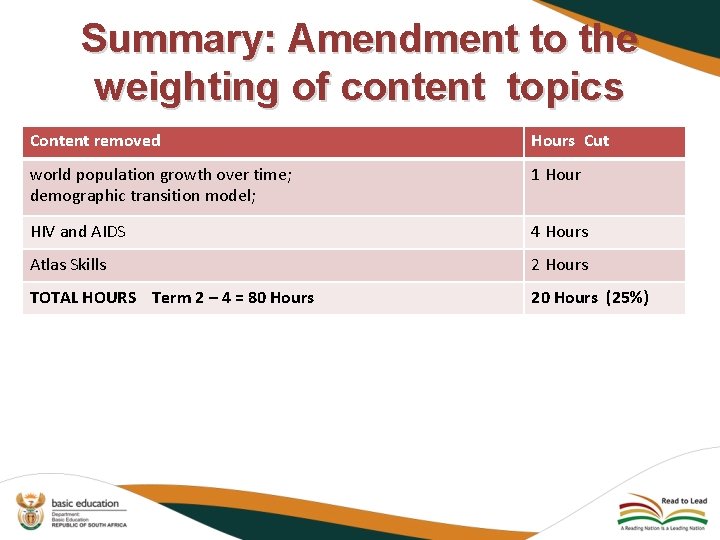
Summary: Amendment to the weighting of content topics Content removed Hours Cut world population growth over time; demographic transition model; 1 Hour HIV and AIDS 4 Hours Atlas Skills 2 Hours TOTAL HOURS Term 2 – 4 = 80 Hours 20 Hours (25%)
Summary: Content/Topics Amended Content/Topics Term Amendment The Structure of the Earth [4 HOURS] The rock cycle; 2 The content has been reduced by removing the rock cycle The Structure of the Earth [2 HOURS] intrusive igneous activity and associated features: batholiths, laccoliths, monoliths, dykes, sills and pipes; and overview of landforms associated with igneous, sedimentary and metamorphic rocks. 2 The content on the Structure of the Earth has been reduced by removing intrusive igneous activity and overview of landforms
Summary: Content/Topics Amended Content/Topics Term Amendment Plate Tectonics [4 HOURS] the mechanics of plate movements; processes and landforms associated with different kinds of plate boundaries; and 2 The content of Plate Tectonics has been reduced by removing mechanisms of plate movements and processes and associated landforms. Folding and Faulting [ 4 HOURS] link to plate movement; landforms associated with folding; the process of faulting – link to plate movement; 2 The content of Folding and Faulting has been reduced by removing links to plate movement, landforms and processes linked to plate movement
Summary: Content/Topics Amended Content/Topics Te rm Earthquakes [4 HOURS] the relationship between earthquakes and tectonic forces; 2 Using Atlases [ 2 hours] atlas index – locating physical and constructed features; four-digit grid reference (latitude and longitude, degrees and minutes) to identify and locate features on maps; and map projections: examples of equal area and true direction projections and critical evaluation 2 Amendment The content of Earthquakes has been reduced by removing relationship between earthquakes and tectonic forces; The topic of Using Atlases has been completely been removed.
Summary: Content/Topics Amended Content/Topics Term Amendment Population Growth [ 4 hours] (Using case studies from around the world is essential) demographic transition model; 2 The content of Population Growth has been reduced by removing demographic transition model Geographical Information Systems (GIS)[ 2 hours] satellite images that are related to population topics. 2 Content on GIS has been reorganized and will be taught in Term 3 as part of Map Skills
Summary: Content/Topics Amended Content/Topics Term HIV and AIDS [ 4 hours] HIV infection rates in southern Africa; social and economic effects of HIV and AIDS, using specific examples from the southern African region; and the impact of HIV and AIDS on population structure 2 GEOGRAPHICAL SKILLS AND TECHNIQUES( applied to above topics) Geographical Information Systems ( GIS) [2 hours] Atlas Skills [ 2 hours] map reading – comparing information from different maps; interpreting graphs, population pyramids, photographs and models 3 Amendment The topic on HIV and AIDS has been completely removed because this content is covered in other learning areas/subjects Content on Skills and techniques has been reorganized and will be taught in Term 3 as part of Map Skills
Summary: Content/Topics Amended Content/Topics Water in the World [ 2 hours] different forms of water in the world: liquid, solid and gas; occurrence of salt water and fresh water: oceans, rivers, lakes, ground water and atmosphere; and the hydrological cycle. The World’s Oceans [2 hours] oceans as sources of oxygen, food and energy; ocean circulation – warm and cold currents; ocean currents and their importance for fishing, trade and tourism; relationship between oceans and people: pollution, over fishing and desalination; and strategies for managing the world’s oceans Term Amendment 4 The topic on Water in the World has been completely removed because this content is covered in other learning areas/subjects 4 The topic on The World’s Oceans has been completely removed because this content is covered in other learning areas/subjects
4. Amendments School Based Assessment (SBA)
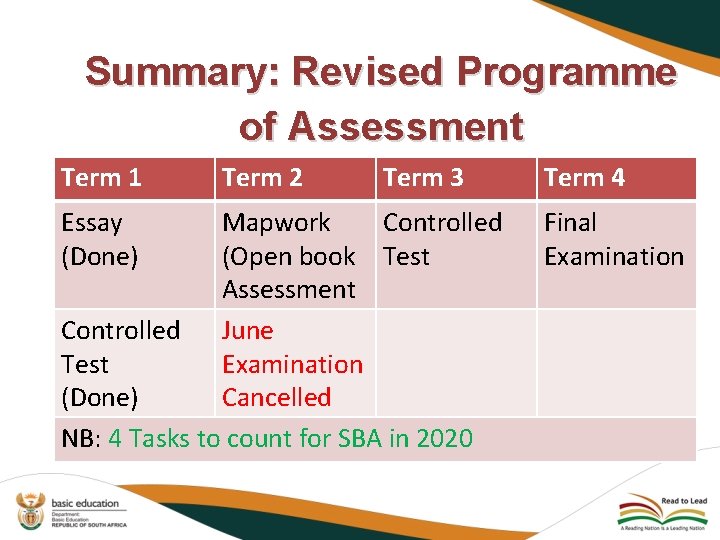
Summary: Revised Programme of Assessment Term 1 Essay (Done) Term 2 Term 3 Mapwork Controlled (Open book Test Assessment Controlled June Test Examination (Done) Cancelled NB: 4 Tasks to count for SBA in 2020 Term 4 Final Examination
Summary: Revision Final Examination Structure • No revision to the final exam structure.
5. Conclusion
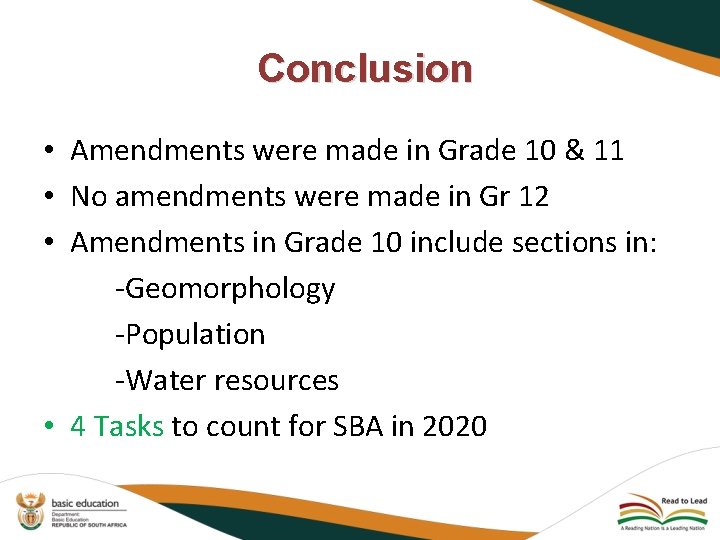
Conclusion • Amendments were made in Grade 10 & 11 • No amendments were made in Gr 12 • Amendments in Grade 10 include sections in: -Geomorphology -Population -Water resources • 4 Tasks to count for SBA in 2020
Contact Details Name: Pule Rakgoathe Subjects: Geography & History Department of Basic Education Tel: 012 357 4185 Email: rakgoathe. p@dbe. gov. za