
2020 International Statistical Genetics Workshop Introduction to Multivariate

- Slides: 45
2020 International Statistical Genetics Workshop Introduction to Multivariate Genetic Analysis PRACTICAL Lucía Colodro Conde, Meike Bartels, Elizabeth Prom-Wormley, and Hermine Maes with thanks to Katrina Grasby, Jose Morosoli, Sarah Medland, and Dorret Boomsma In \workshopFacultylucia2020Wednesdaytwo. ACEvc_practical_2 traits. R
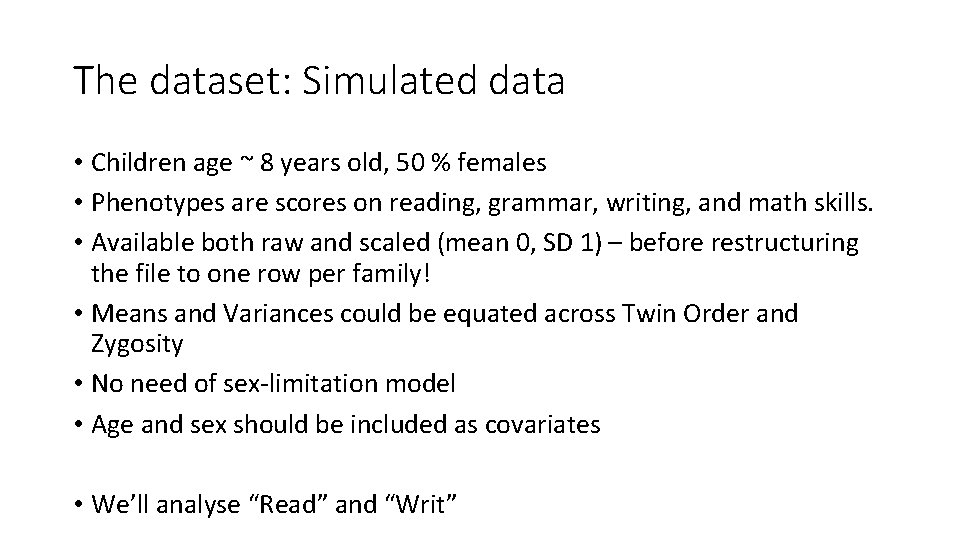
The dataset: Simulated data • Children age ~ 8 years old, 50 % females • Phenotypes are scores on reading, grammar, writing, and math skills. • Available both raw and scaled (mean 0, SD 1) – before restructuring the file to one row per family! • Means and Variances could be equated across Twin Order and Zygosity • No need of sex-limitation model • Age and sex should be included as covariates • We’ll analyse “Read” and “Writ”
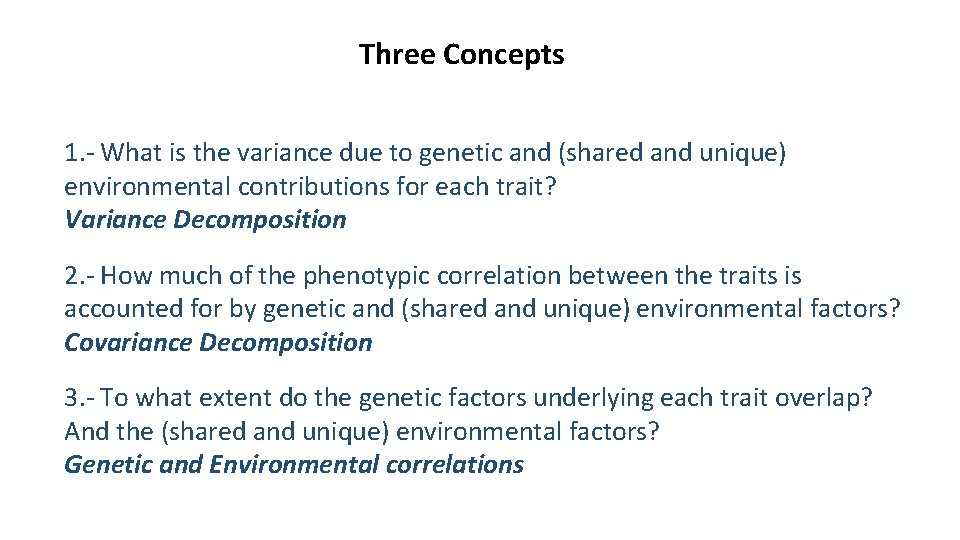
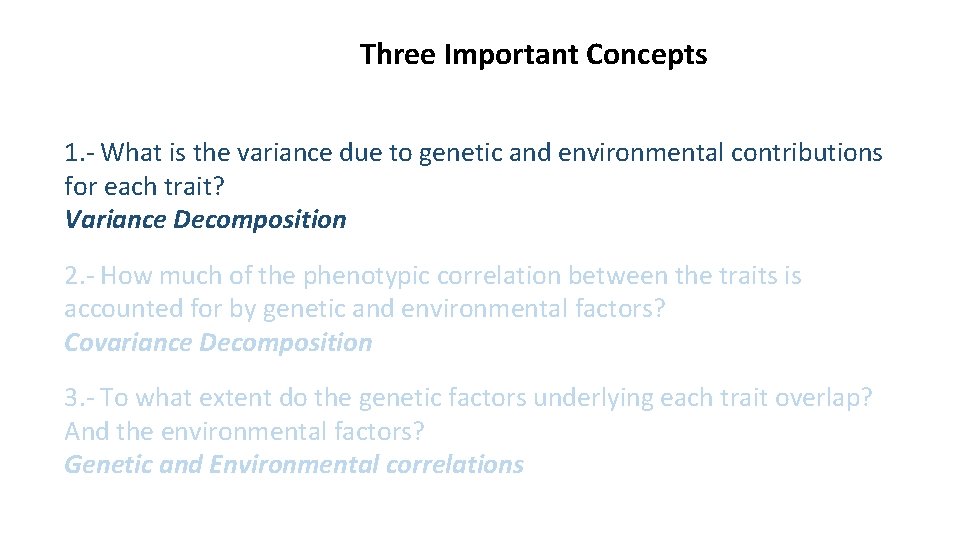
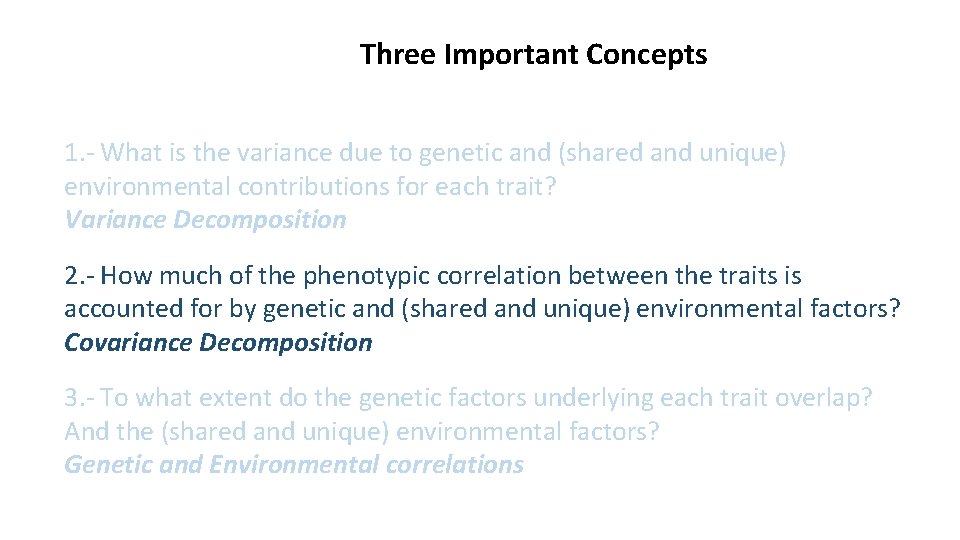
Three Concepts 1. - What is the variance due to genetic and (shared and unique) environmental contributions for each trait? Variance Decomposition 2. - How much of the phenotypic correlation between the traits is accounted for by genetic and (shared and unique) environmental factors? Covariance Decomposition 3. - To what extent do the genetic factors underlying each trait overlap? And the (shared and unique) environmental factors? Genetic and Environmental correlations
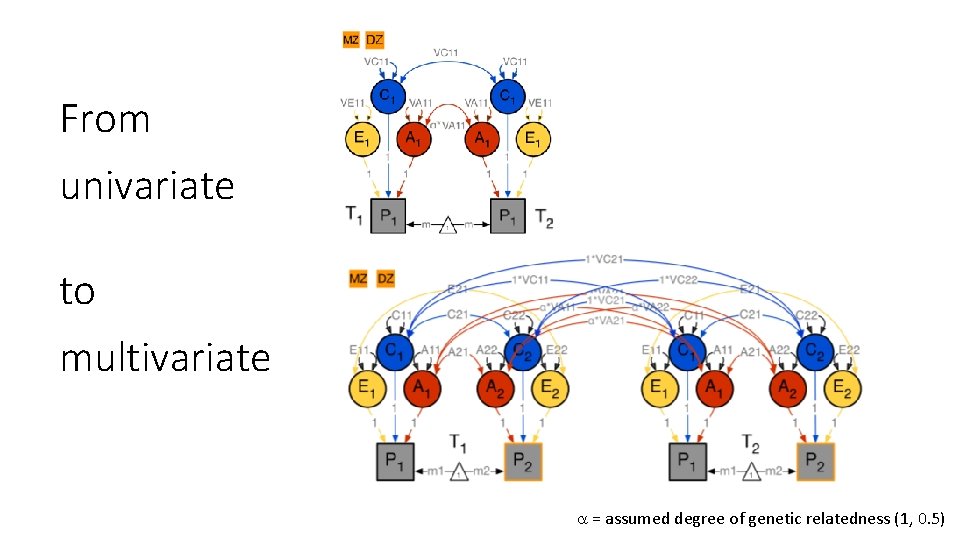
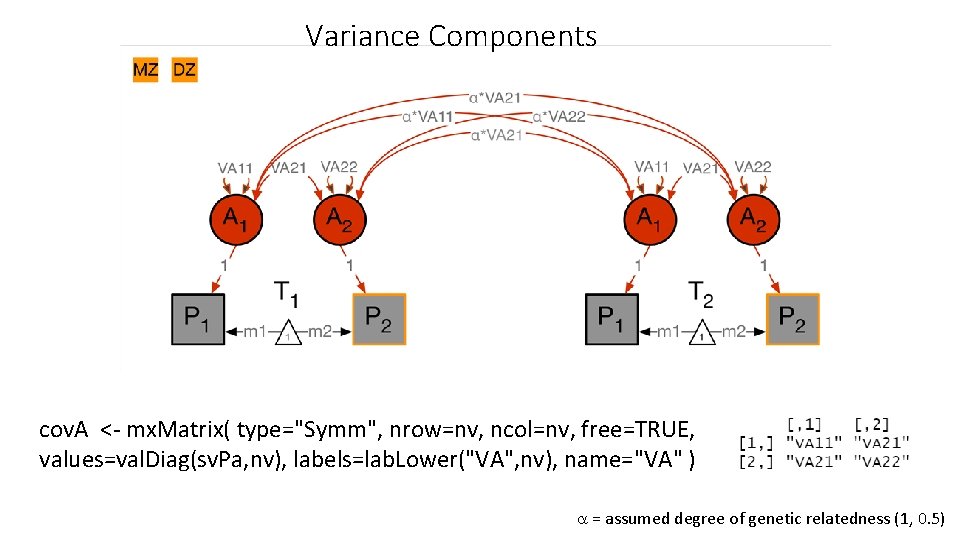
From univariate to multivariate = assumed degree of genetic relatedness (1, 0. 5)
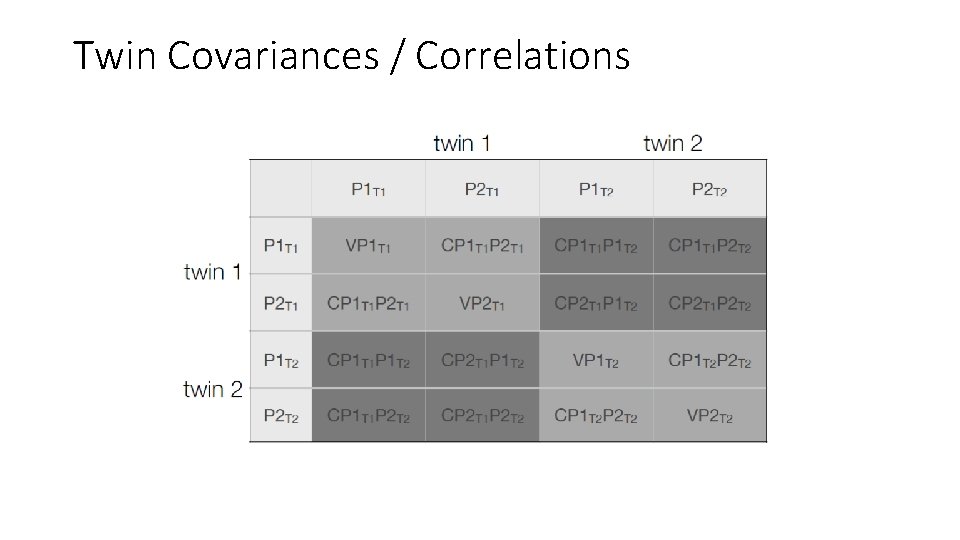
Twin Covariances / Correlations
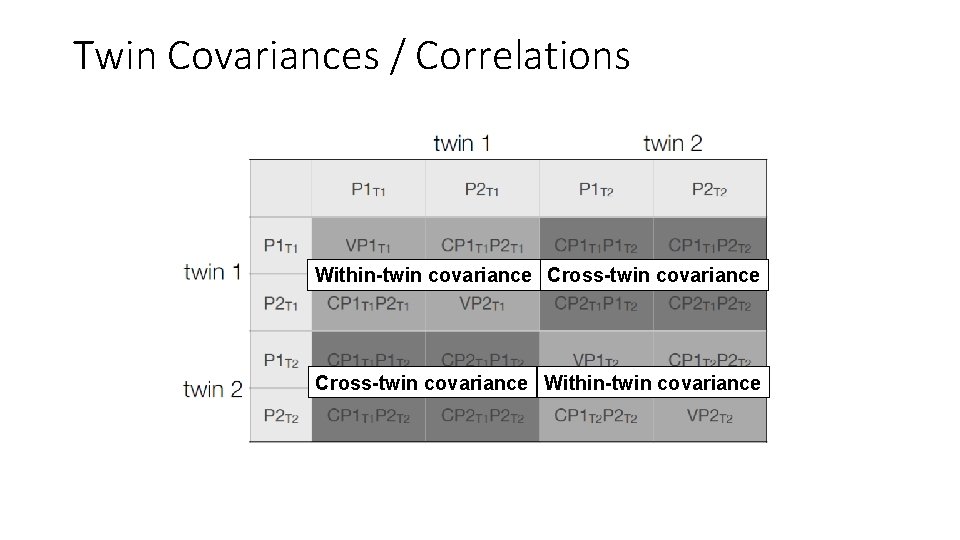
Twin Covariances / Correlations Within-twin covariance Cross-twin covariance Within-twin covariance
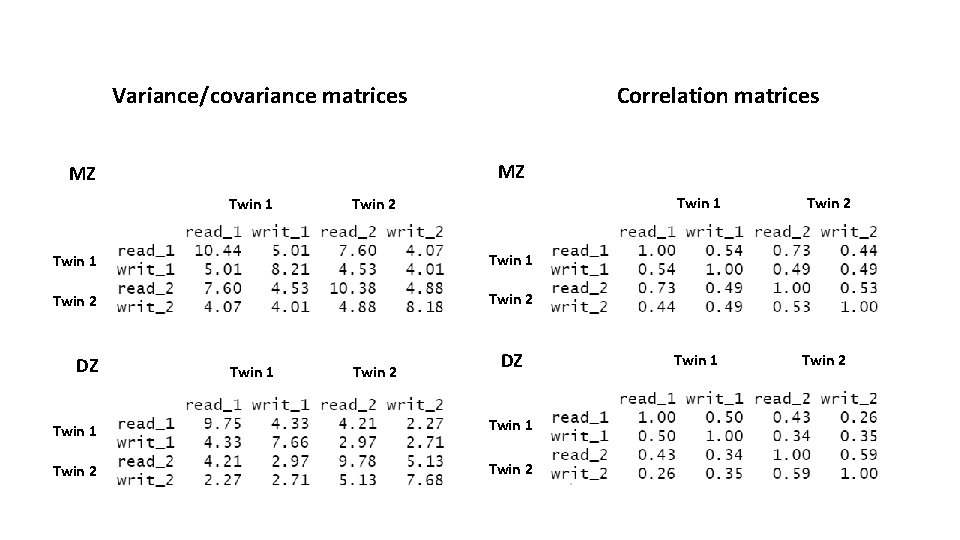
Variance/covariance matrices Correlation matrices MZ MZ Twin 1 Twin 2 DZ Twin 1 Twin 2 Twin 1 Twin 2
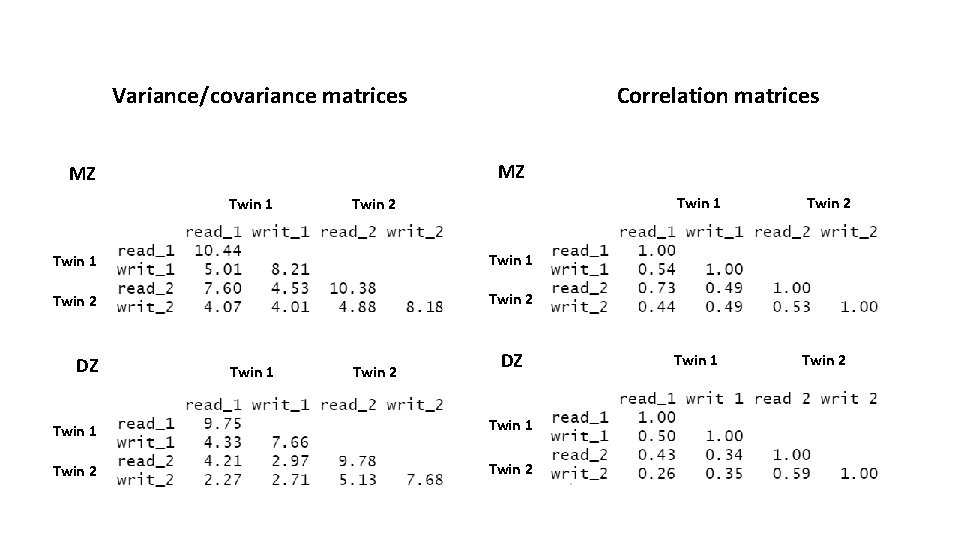
Variance/covariance matrices Correlation matrices MZ MZ Twin 1 Twin 2 DZ Twin 1 Twin 2 Twin 1 Twin 2
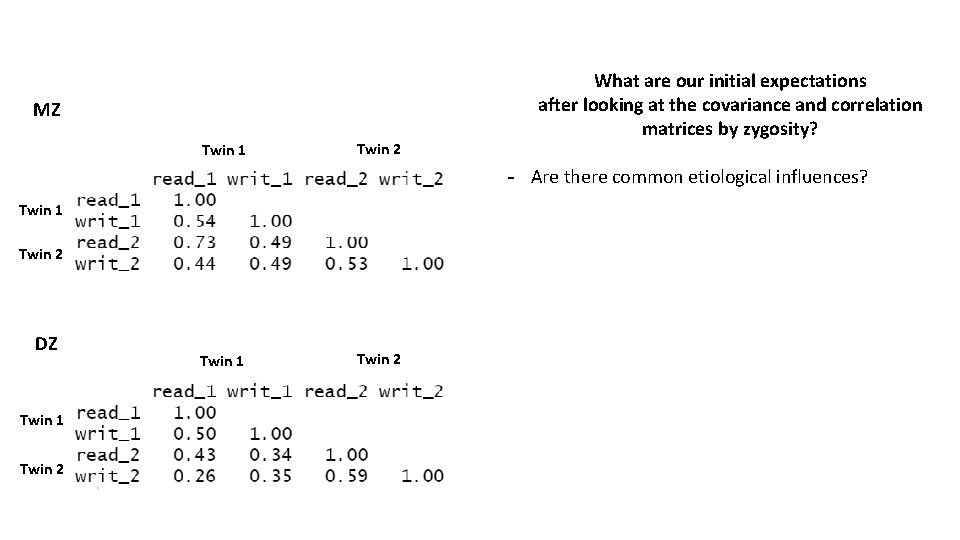
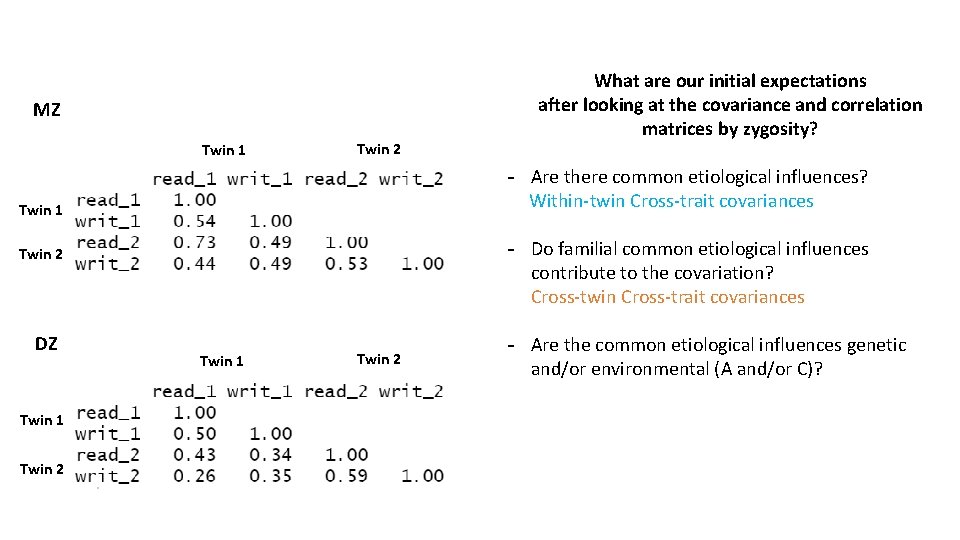
MZ Twin 1 Twin 2 What are our initial expectations after looking at the covariance and correlation matrices by zygosity? - Are there common etiological influences? Twin 1 Twin 2 DZ Twin 1 Twin 2
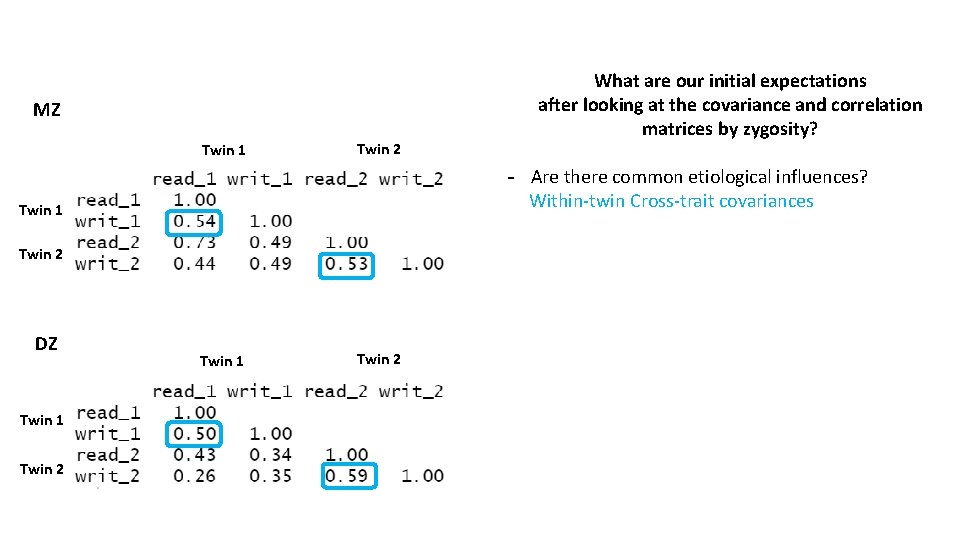
MZ Twin 1 Twin 2 - Are there common etiological influences? Within-twin Cross-trait covariances Twin 1 Twin 2 DZ Twin 1 Twin 2 What are our initial expectations after looking at the covariance and correlation matrices by zygosity? Twin 1 Twin 2
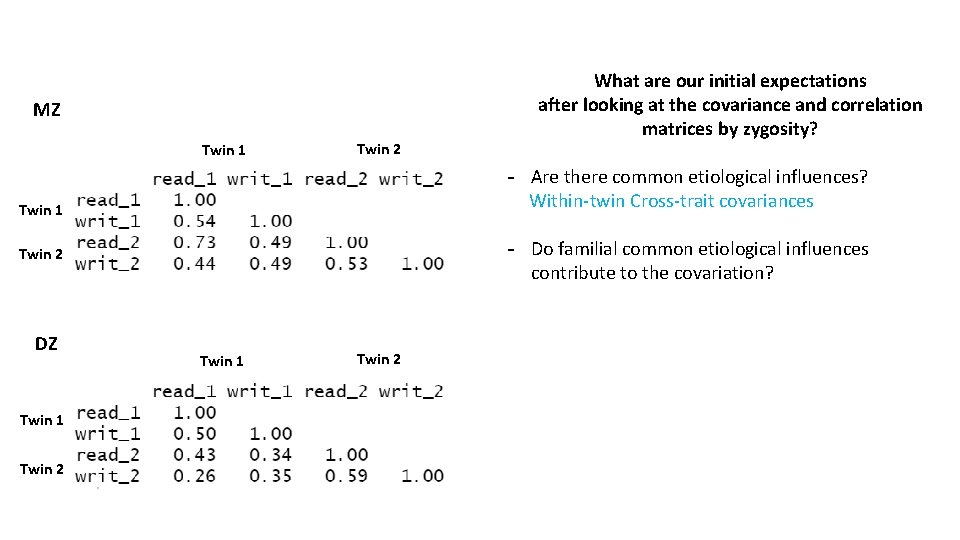
MZ Twin 1 Twin 2 - Are there common etiological influences? Within-twin Cross-trait covariances Twin 1 - Do familial common etiological influences contribute to the covariation? Twin 2 DZ Twin 1 Twin 2 What are our initial expectations after looking at the covariance and correlation matrices by zygosity? Twin 1 Twin 2
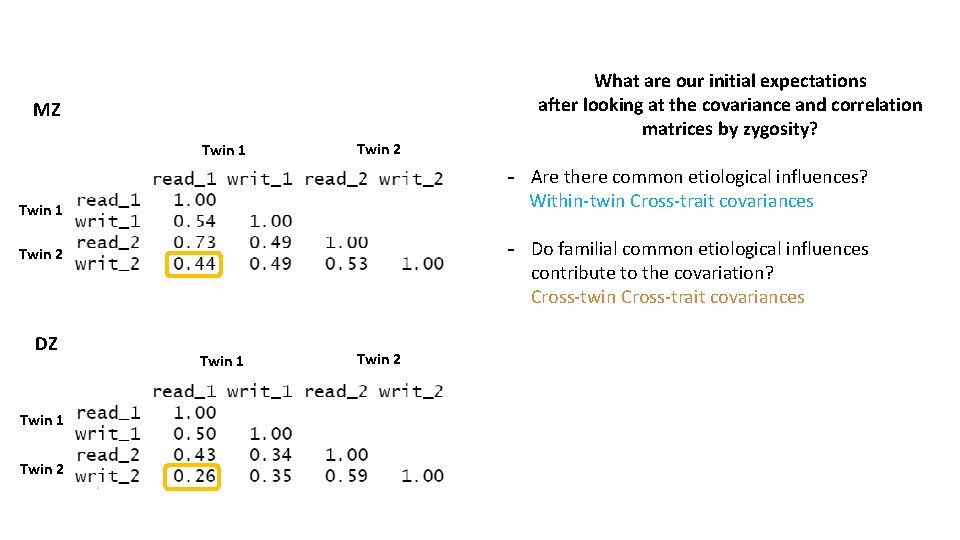
MZ Twin 1 Twin 2 - Are there common etiological influences? Within-twin Cross-trait covariances Twin 1 - Do familial common etiological influences contribute to the covariation? Cross-twin Cross-trait covariances Twin 2 DZ Twin 1 Twin 2 What are our initial expectations after looking at the covariance and correlation matrices by zygosity? Twin 1 Twin 2
MZ Twin 1 Twin 2 - Are there common etiological influences? Within-twin Cross-trait covariances Twin 1 - Do familial common etiological influences contribute to the covariation? Cross-twin Cross-trait covariances Twin 2 DZ Twin 1 Twin 2 What are our initial expectations after looking at the covariance and correlation matrices by zygosity? Twin 1 Twin 2 - Are the common etiological influences genetic and/or environmental (A and/or C)?
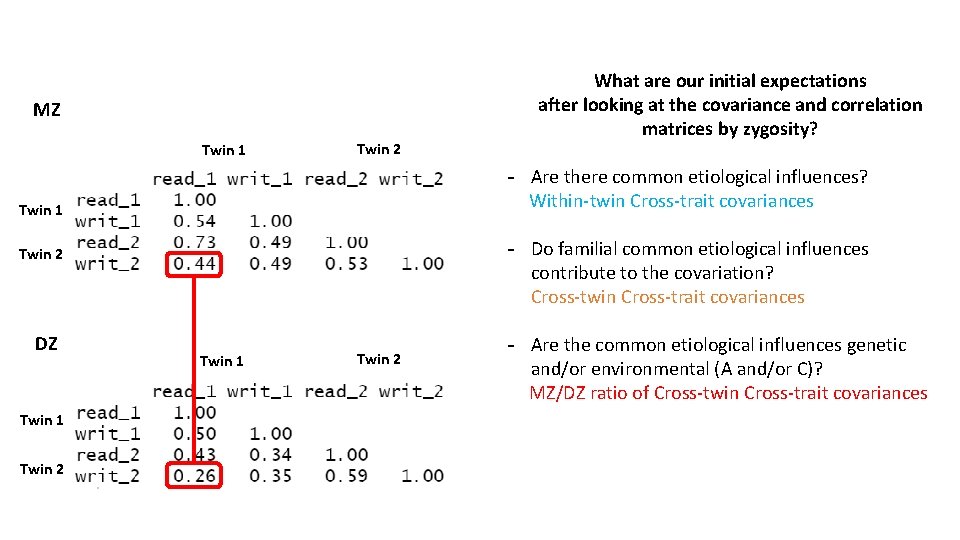
MZ Twin 1 Twin 2 - Are there common etiological influences? Within-twin Cross-trait covariances Twin 1 - Do familial common etiological influences contribute to the covariation? Cross-twin Cross-trait covariances Twin 2 DZ Twin 1 Twin 2 What are our initial expectations after looking at the covariance and correlation matrices by zygosity? Twin 1 Twin 2 - Are the common etiological influences genetic and/or environmental (A and/or C)? MZ/DZ ratio of Cross-twin Cross-trait covariances
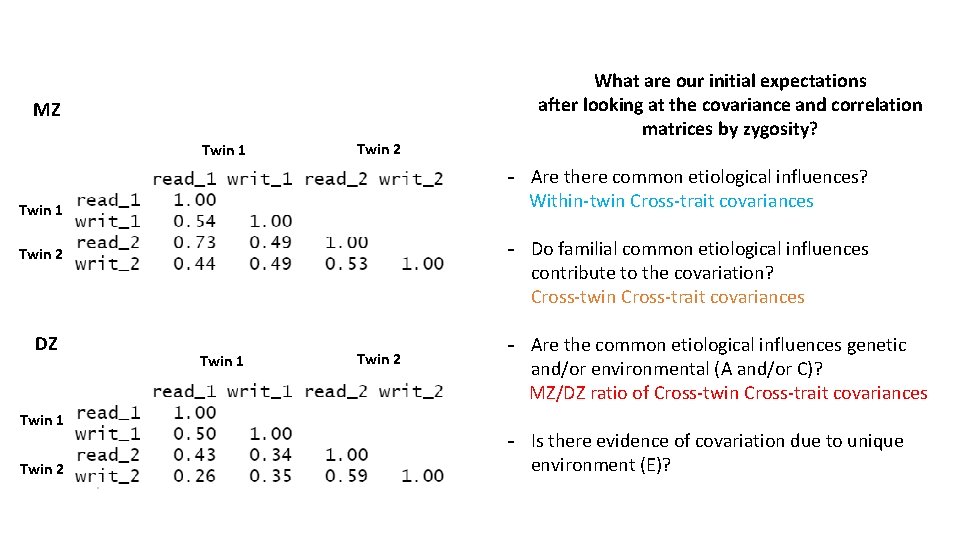
MZ Twin 1 Twin 2 - Are there common etiological influences? Within-twin Cross-trait covariances Twin 1 - Do familial common etiological influences contribute to the covariation? Cross-twin Cross-trait covariances Twin 2 DZ Twin 1 Twin 2 What are our initial expectations after looking at the covariance and correlation matrices by zygosity? Twin 1 Twin 2 - Are the common etiological influences genetic and/or environmental (A and/or C)? MZ/DZ ratio of Cross-twin Cross-trait covariances - Is there evidence of covariation due to unique environment (E)?
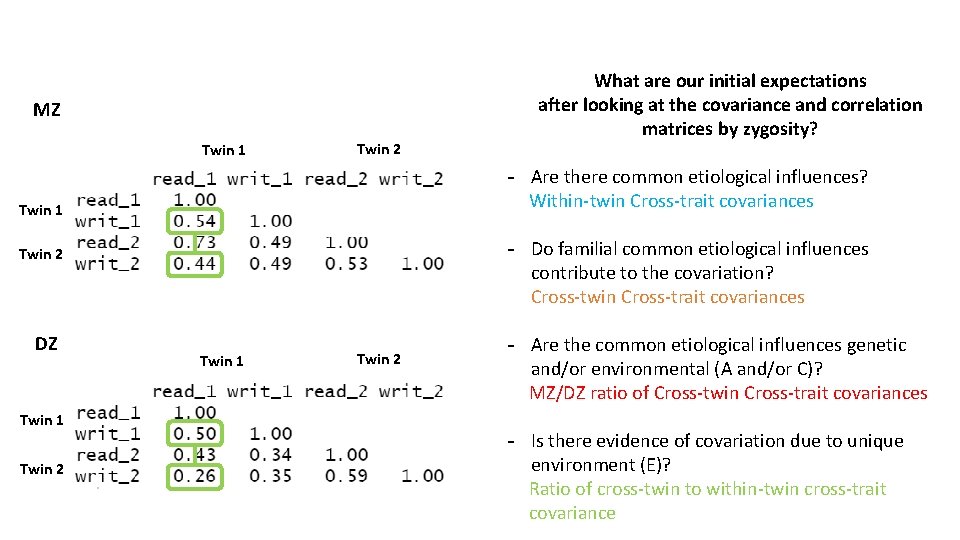
MZ Twin 1 Twin 2 - Are there common etiological influences? Within-twin Cross-trait covariances Twin 1 - Do familial common etiological influences contribute to the covariation? Cross-twin Cross-trait covariances Twin 2 DZ Twin 1 Twin 2 What are our initial expectations after looking at the covariance and correlation matrices by zygosity? Twin 1 Twin 2 - Are the common etiological influences genetic and/or environmental (A and/or C)? MZ/DZ ratio of Cross-twin Cross-trait covariances - Is there evidence of covariation due to unique environment (E)? Ratio of cross-twin to within-twin cross-trait covariance
Variance Components cov. A <- mx. Matrix( type="Symm", nrow=nv, ncol=nv, free=TRUE, values=val. Diag(sv. Pa, nv), labels=lab. Lower("VA", nv), name="VA" ) = assumed degree of genetic relatedness (1, 0. 5)
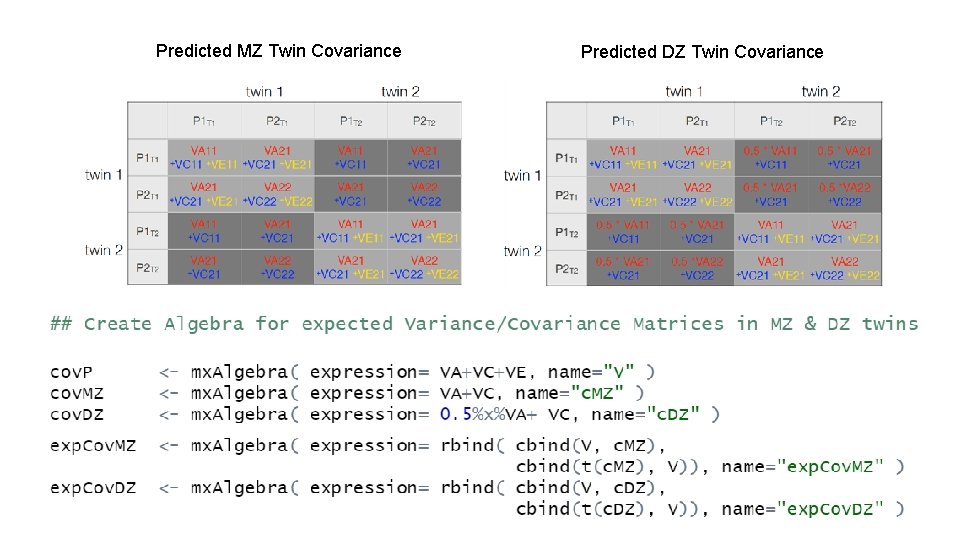
Predicted MZ Twin Covariance Predicted DZ Twin Covariance
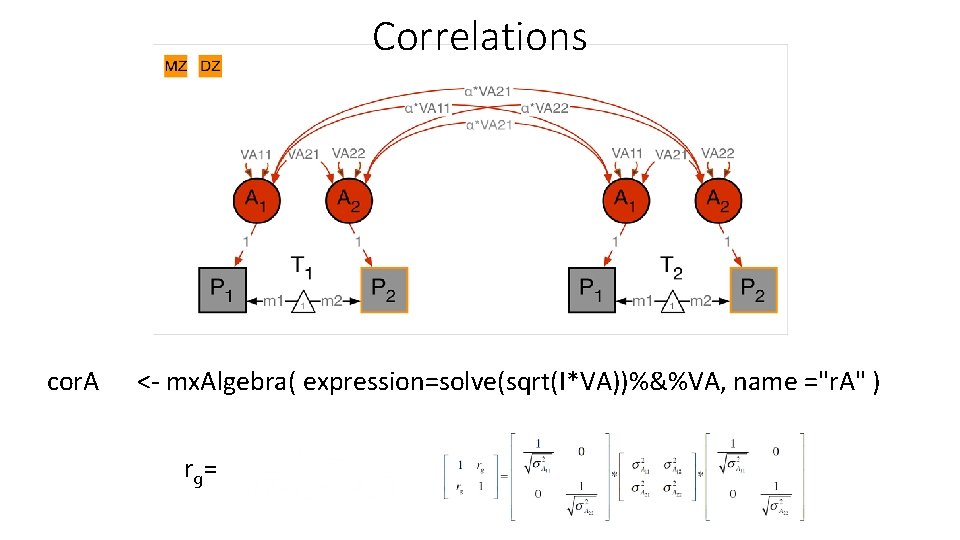
Correlations cor. A <- mx. Algebra( expression=solve(sqrt(I*VA))%&%VA, name ="r. A" ) r g=
Three Important Concepts 1. - What is the variance due to genetic and environmental contributions for each trait? Variance Decomposition 2. - How much of the phenotypic correlation between the traits is accounted for by genetic and environmental factors? Covariance Decomposition 3. - To what extent do the genetic factors underlying each trait overlap? And the environmental factors? Genetic and Environmental correlations
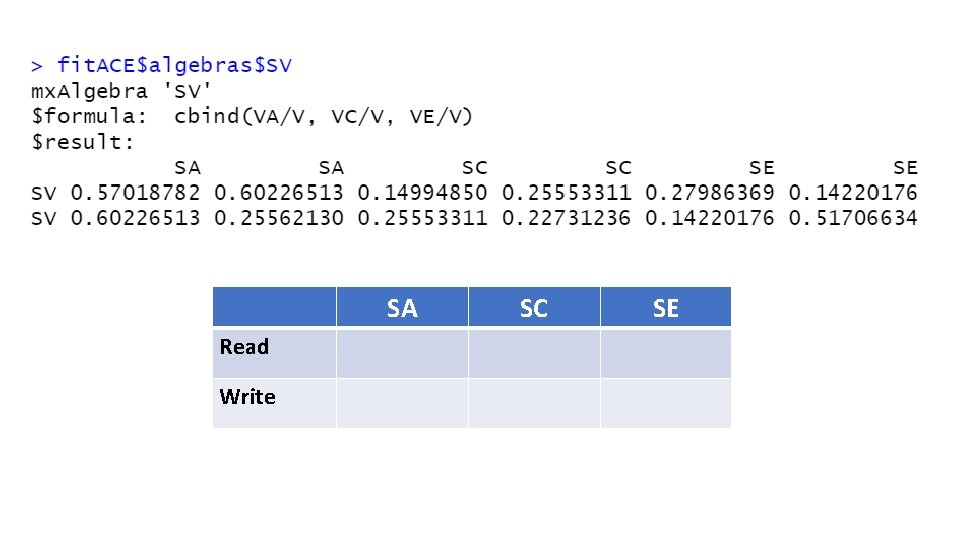
SA Read Write SC SE
SA Read Write SC SE
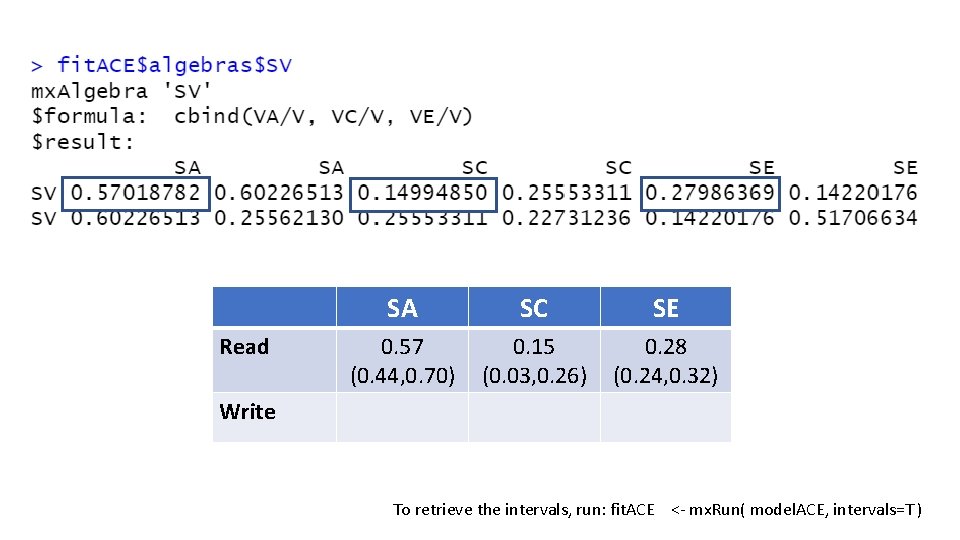
Read SA SC SE 0. 57 (0. 44, 0. 70) 0. 15 (0. 03, 0. 26) 0. 28 (0. 24, 0. 32) Write To retrieve the intervals, run: fit. ACE <- mx. Run( model. ACE, intervals=T )
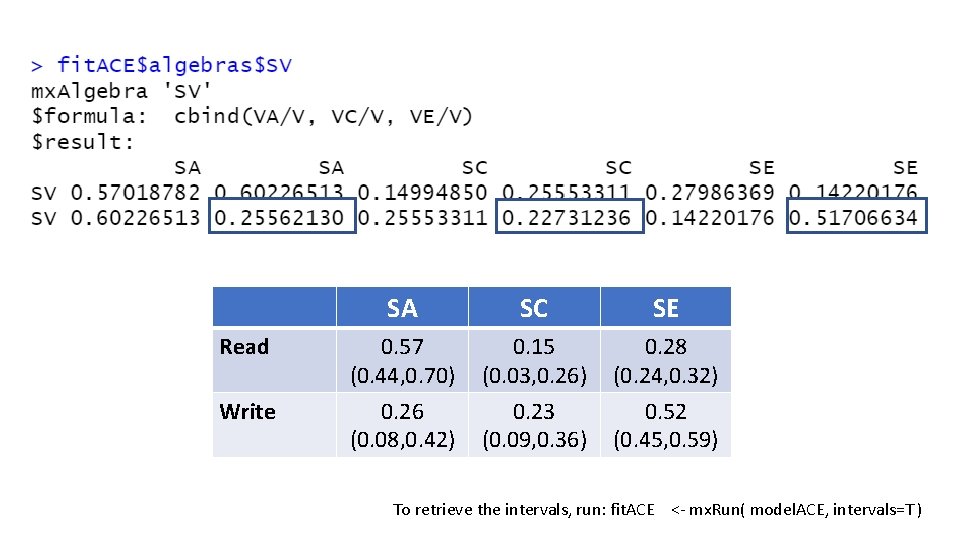
Read Write SA SC SE 0. 57 (0. 44, 0. 70) 0. 26 (0. 08, 0. 42) 0. 15 (0. 03, 0. 26) 0. 23 (0. 09, 0. 36) 0. 28 (0. 24, 0. 32) 0. 52 (0. 45, 0. 59) To retrieve the intervals, run: fit. ACE <- mx. Run( model. ACE, intervals=T )
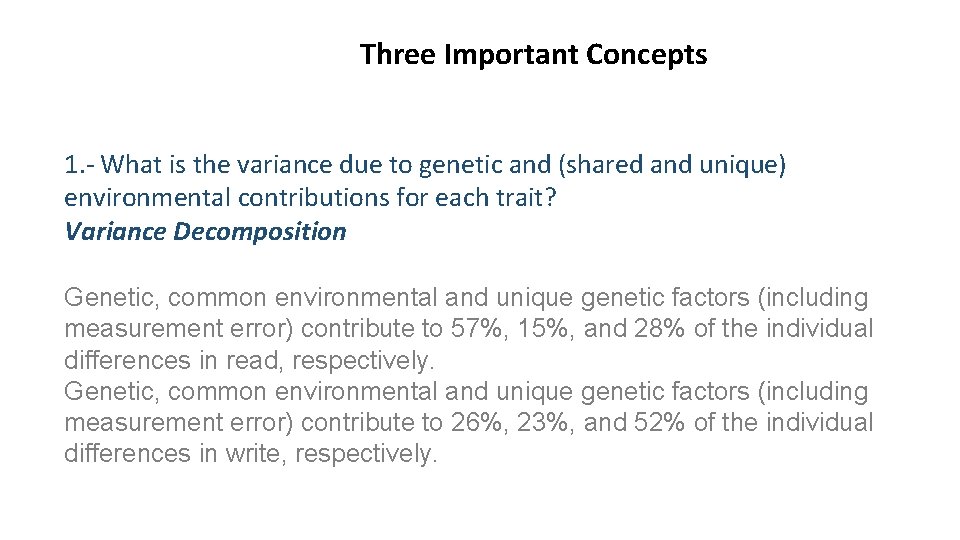
Three Important Concepts 1. - What is the variance due to genetic and (shared and unique) environmental contributions for each trait? Variance Decomposition Genetic, common environmental and unique genetic factors (including measurement error) contribute to 57%, 15%, and 28% of the individual differences in read, respectively. Genetic, common environmental and unique genetic factors (including measurement error) contribute to 26%, 23%, and 52% of the individual differences in write, respectively.
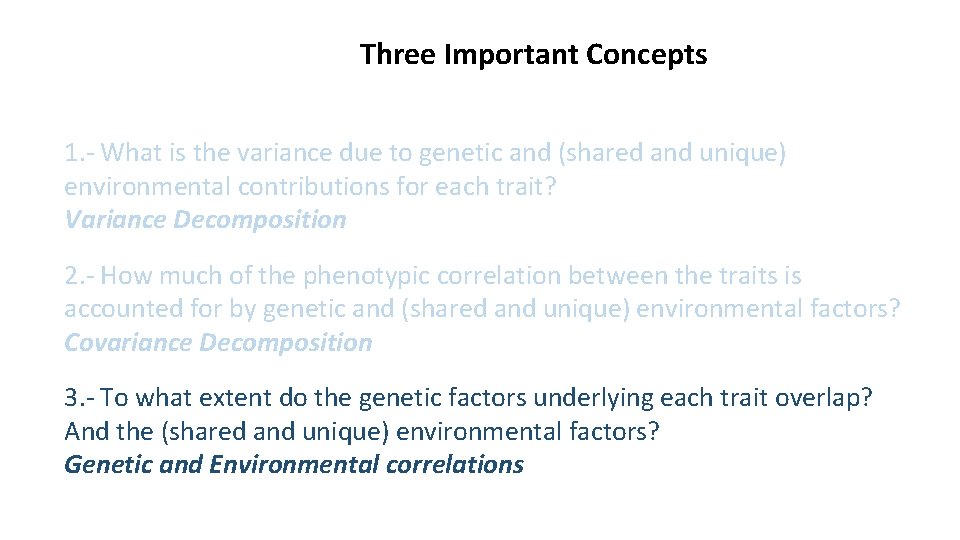
Three Important Concepts 1. - What is the variance due to genetic and (shared and unique) environmental contributions for each trait? Variance Decomposition 2. - How much of the phenotypic correlation between the traits is accounted for by genetic and (shared and unique) environmental factors? Covariance Decomposition 3. - To what extent do the genetic factors underlying each trait overlap? And the (shared and unique) environmental factors? Genetic and Environmental correlations
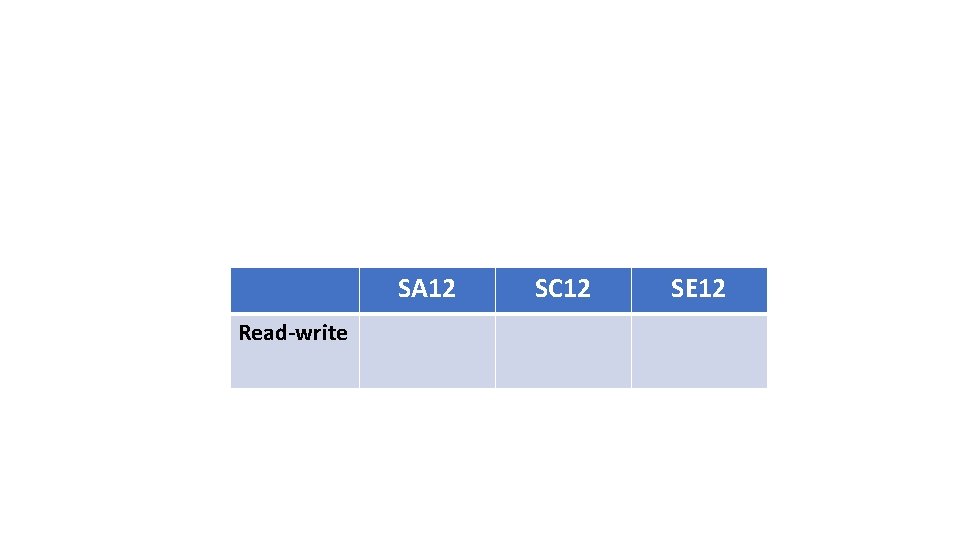
SA 12 Read-write SC 12 SE 12
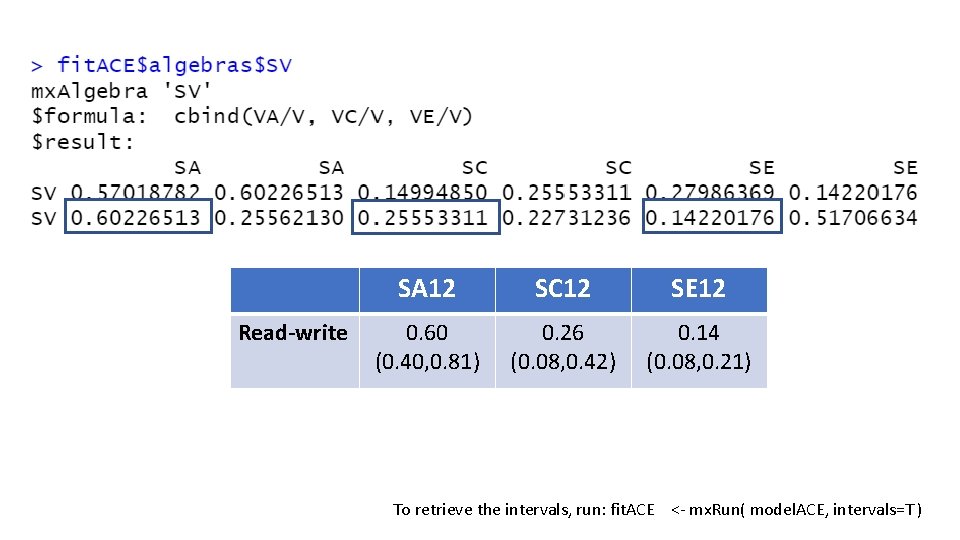
SA 12 SC 12 SE 12 Read-write To retrieve the intervals, run: fit. ACE <- mx. Run( model. ACE, intervals=T )
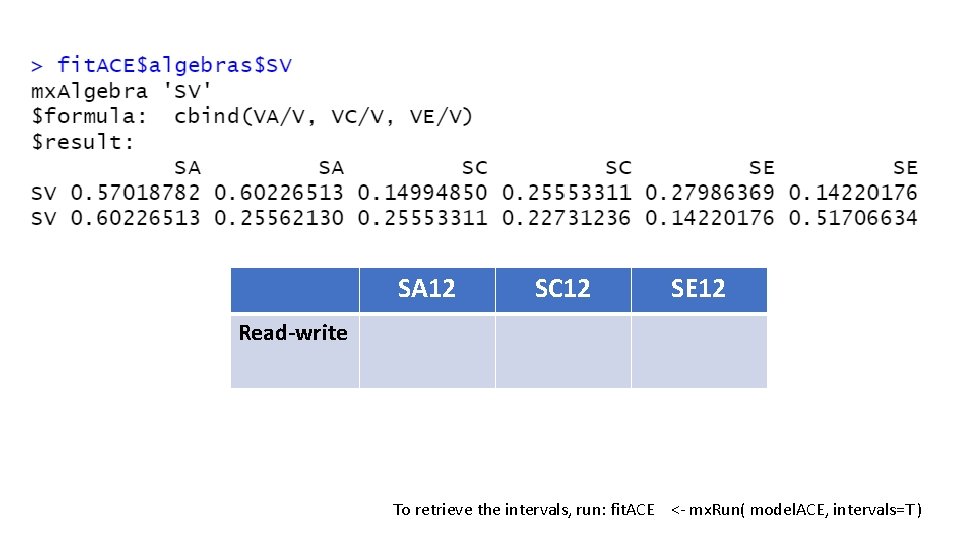
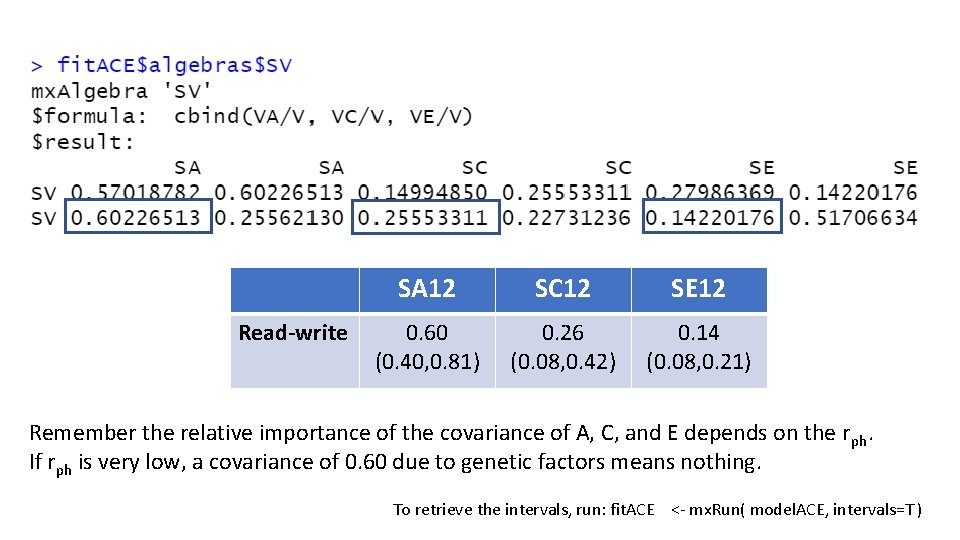
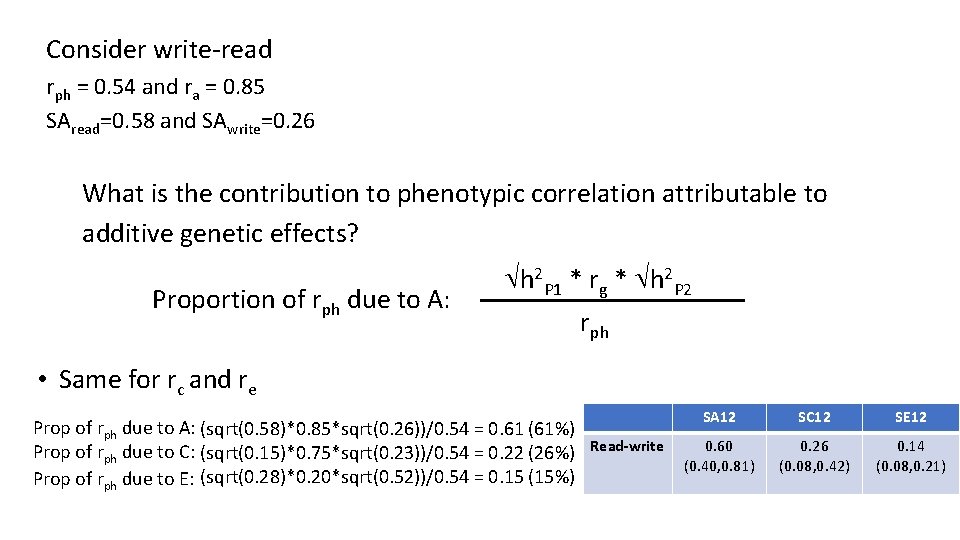
Read-write SA 12 SC 12 SE 12 0. 60 (0. 40, 0. 81) 0. 26 (0. 08, 0. 42) 0. 14 (0. 08, 0. 21) To retrieve the intervals, run: fit. ACE <- mx. Run( model. ACE, intervals=T )
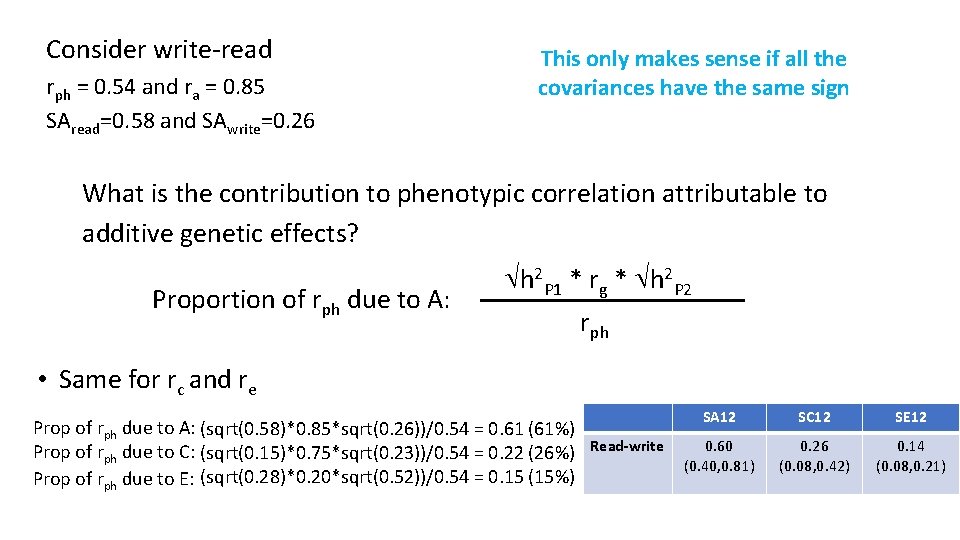
Read-write SA 12 SC 12 SE 12 0. 60 (0. 40, 0. 81) 0. 26 (0. 08, 0. 42) 0. 14 (0. 08, 0. 21) Remember the relative importance of the covariance of A, C, and E depends on the r ph. If rph is very low, a covariance of 0. 60 due to genetic factors means nothing. To retrieve the intervals, run: fit. ACE <- mx. Run( model. ACE, intervals=T )
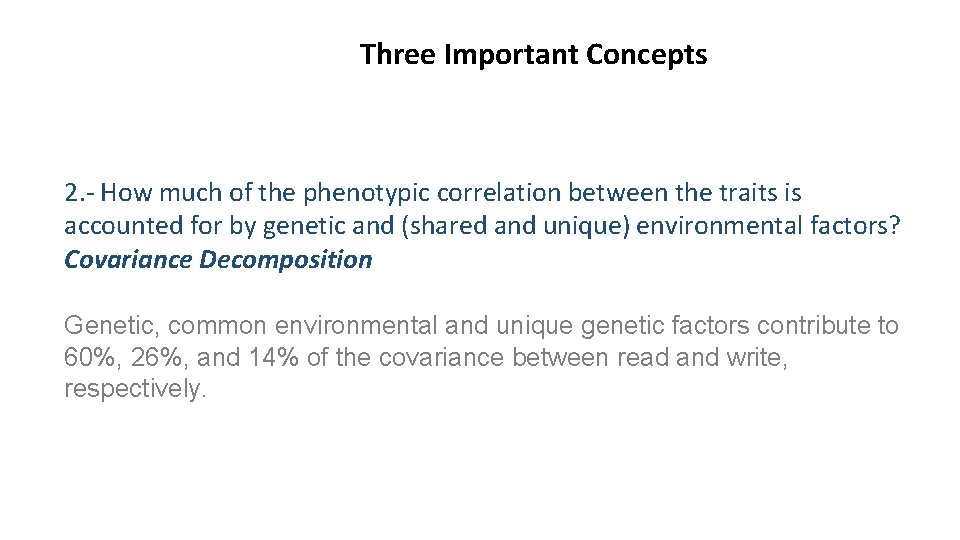
Three Important Concepts 2. - How much of the phenotypic correlation between the traits is accounted for by genetic and (shared and unique) environmental factors? Covariance Decomposition Genetic, common environmental and unique genetic factors contribute to 60%, 26%, and 14% of the covariance between read and write, respectively.
Three Important Concepts 1. - What is the variance due to genetic and (shared and unique) environmental contributions for each trait? Variance Decomposition 2. - How much of the phenotypic correlation between the traits is accounted for by genetic and (shared and unique) environmental factors? Covariance Decomposition 3. - To what extent do the genetic factors underlying each trait overlap? And the (shared and unique) environmental factors? Genetic and Environmental correlations
ra Read-write rc re rph
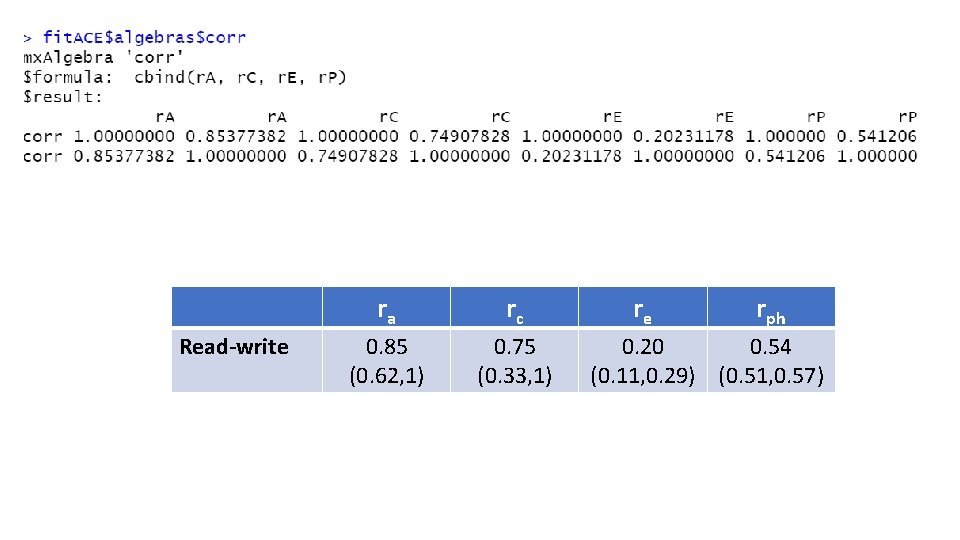
Read-write ra rc 0. 85 (0. 62, 1) 0. 75 (0. 33, 1) re rph 0. 20 0. 54 (0. 11, 0. 29) (0. 51, 0. 57)
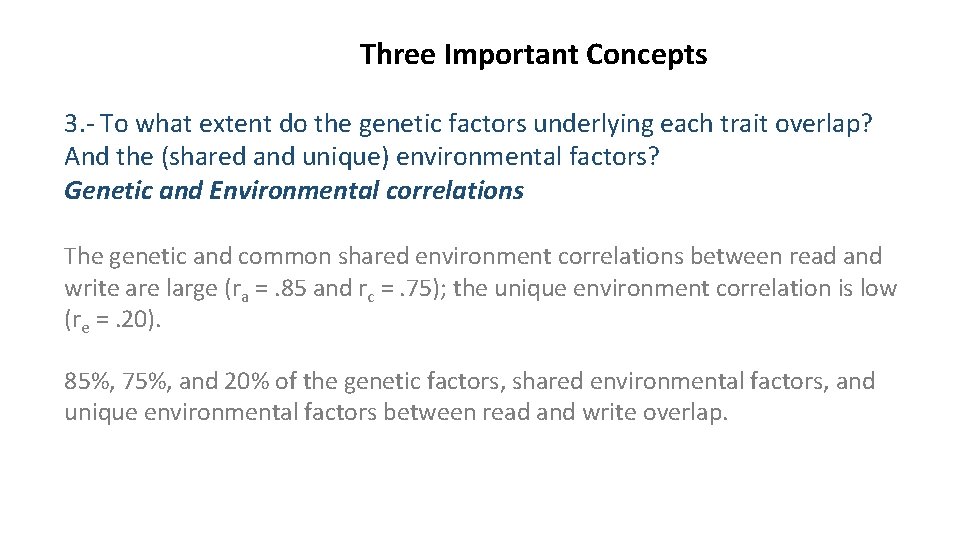
Three Important Concepts 3. - To what extent do the genetic factors underlying each trait overlap? And the (shared and unique) environmental factors? Genetic and Environmental correlations The genetic and common shared environment correlations between read and write are large (ra =. 85 and rc =. 75); the unique environment correlation is low (re =. 20). 85%, 75%, and 20% of the genetic factors, shared environmental factors, and unique environmental factors between read and write overlap.
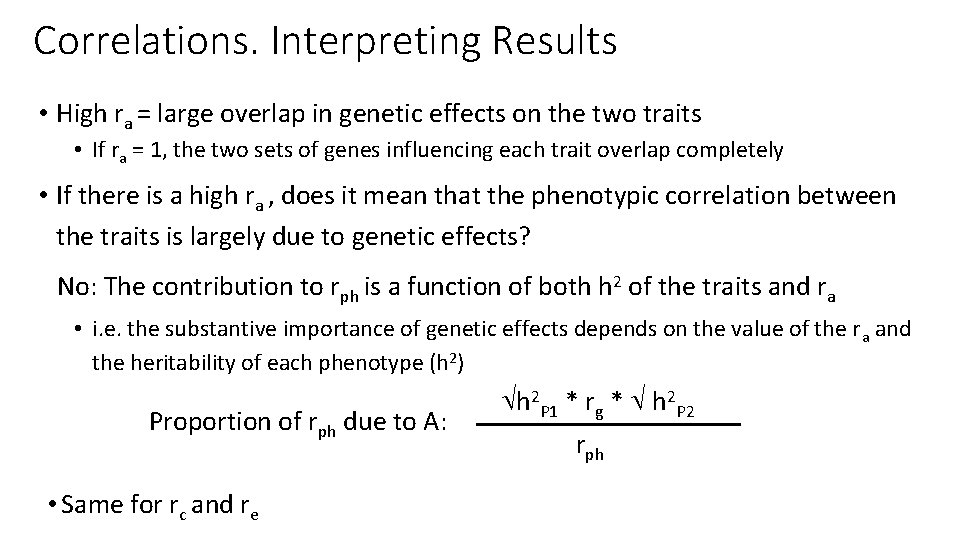
Correlations. Interpreting Results • High ra = large overlap in genetic effects on the two traits • If ra = 1, the two sets of genes influencing each trait overlap completely • If there is a high ra , does it mean that the phenotypic correlation between the traits is largely due to genetic effects? No: The contribution to rph is a function of both h 2 of the traits and ra • i. e. the substantive importance of genetic effects depends on the value of the r a and the heritability of each phenotype (h 2) Proportion of rph due to A: • Same for rc and re h 2 P 1 * rg * h 2 P 2 rph
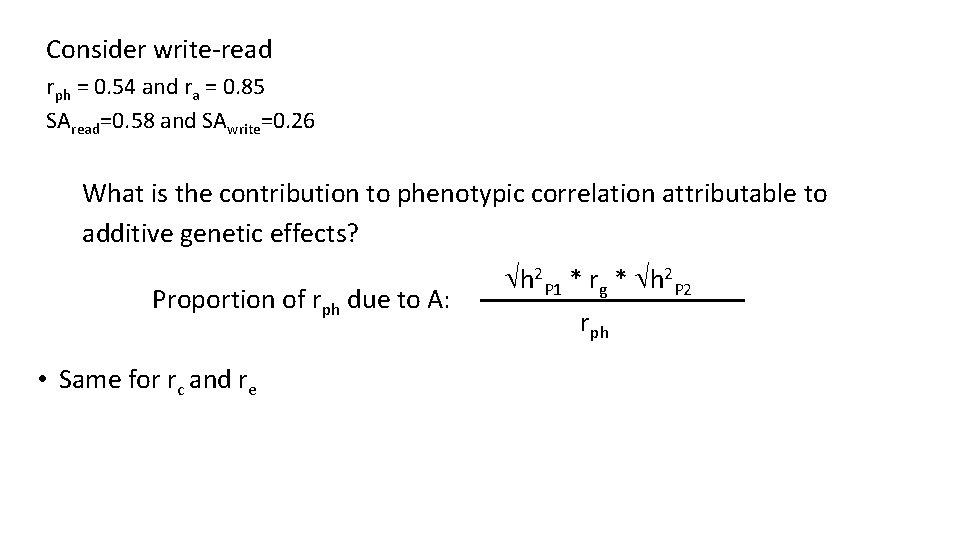
Consider write-read rph = 0. 54 and ra = 0. 85 SAread=0. 58 and SAwrite=0. 26 What is the contribution to phenotypic correlation attributable to additive genetic effects? Proportion of rph due to A: • Same for rc and re h 2 P 1 * rg * h 2 P 2 rph
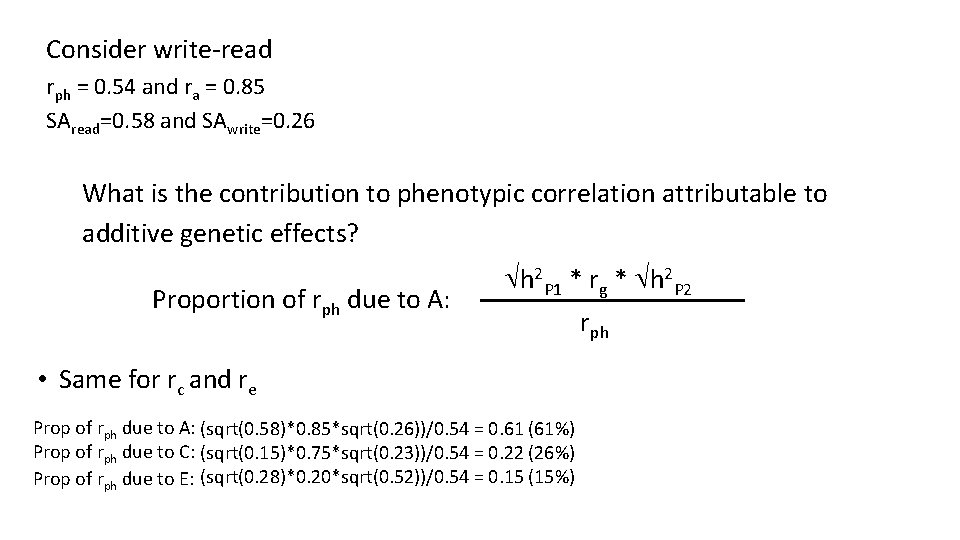
Consider write-read rph = 0. 54 and ra = 0. 85 SAread=0. 58 and SAwrite=0. 26 What is the contribution to phenotypic correlation attributable to additive genetic effects? Proportion of rph due to A: h 2 P 1 * rg * h 2 P 2 • Same for rc and re Prop of rph due to A: (sqrt(0. 58)*0. 85*sqrt(0. 26))/0. 54 = 0. 61 (61%) Prop of rph due to C: (sqrt(0. 15)*0. 75*sqrt(0. 23))/0. 54 = 0. 22 (26%) Prop of rph due to E: (sqrt(0. 28)*0. 20*sqrt(0. 52))/0. 54 = 0. 15 (15%) rph
Consider write-read rph = 0. 54 and ra = 0. 85 SAread=0. 58 and SAwrite=0. 26 What is the contribution to phenotypic correlation attributable to additive genetic effects? Proportion of rph due to A: h 2 P 1 * rg * h 2 P 2 rph • Same for rc and re Prop of rph due to A: (sqrt(0. 58)*0. 85*sqrt(0. 26))/0. 54 = 0. 61 (61%) Prop of rph due to C: (sqrt(0. 15)*0. 75*sqrt(0. 23))/0. 54 = 0. 22 (26%) Prop of rph due to E: (sqrt(0. 28)*0. 20*sqrt(0. 52))/0. 54 = 0. 15 (15%) Read-write SA 12 SC 12 SE 12 0. 60 (0. 40, 0. 81) 0. 26 (0. 08, 0. 42) 0. 14 (0. 08, 0. 21)
Consider write-read rph = 0. 54 and ra = 0. 85 SAread=0. 58 and SAwrite=0. 26 This only makes sense if all the covariances have the same sign What is the contribution to phenotypic correlation attributable to additive genetic effects? Proportion of rph due to A: h 2 P 1 * rg * h 2 P 2 rph • Same for rc and re Prop of rph due to A: (sqrt(0. 58)*0. 85*sqrt(0. 26))/0. 54 = 0. 61 (61%) Prop of rph due to C: (sqrt(0. 15)*0. 75*sqrt(0. 23))/0. 54 = 0. 22 (26%) Prop of rph due to E: (sqrt(0. 28)*0. 20*sqrt(0. 52))/0. 54 = 0. 15 (15%) Read-write SA 12 SC 12 SE 12 0. 60 (0. 40, 0. 81) 0. 26 (0. 08, 0. 42) 0. 14 (0. 08, 0. 21)
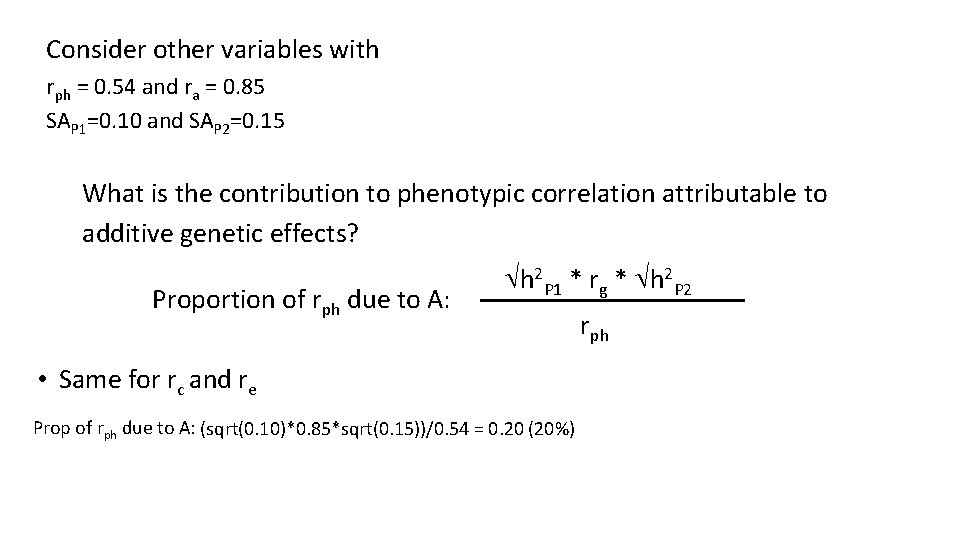
Consider other variables with rph = 0. 54 and ra = 0. 85 SAP 1=0. 10 and SAP 2=0. 15 What is the contribution to phenotypic correlation attributable to additive genetic effects? Proportion of rph due to A: h 2 P 1 * rg * h 2 P 2 • Same for rc and re Prop of rph due to A: (sqrt(0. 10)*0. 85*sqrt(0. 15))/0. 54 = 0. 20 (20%) rph
What’s the best fitting model? • Check submodels
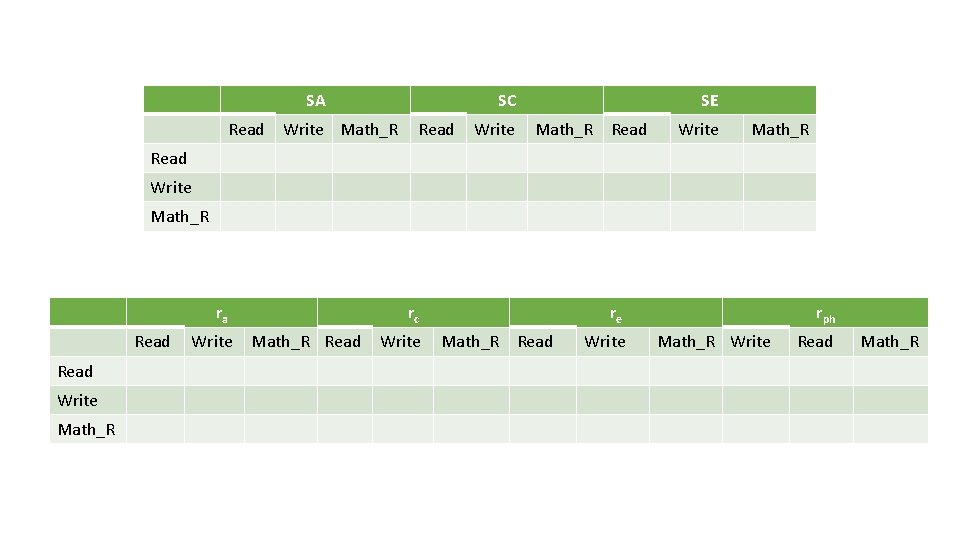
Now let’s add more variables! In \workshopFacultylucia2020Wednesdaytwo. ACEvc_practical_3 traits. R
SA Read SC Write Math_R Read Write SE Math_R Read Write Math_R ra Read Write Math_R Write rc Math_R Read Write re Math_R Read Write rph Math_R Write Read Math_R
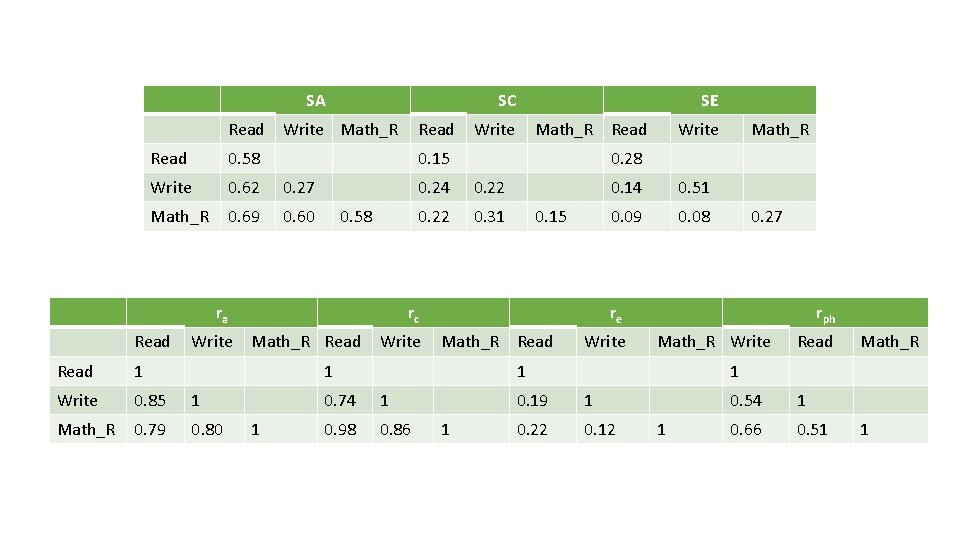
SA Read SC Write Math_R Read 0. 58 Write 0. 62 0. 27 Math_R 0. 69 0. 60 Write Read 1 Write 0. 85 1 Math_R 0. 79 0. 80 Write Math_R Read 0. 15 0. 58 ra Read SE 0. 24 0. 22 0. 31 Write 0. 15 1 0. 14 0. 51 0. 09 0. 08 Math_R Read Write rph Math_R Write 1 1 0. 98 0. 86 0. 27 re 1 0. 74 Math_R 0. 28 rc Math_R Read Write 1 Read Math_R 1 0. 19 1 0. 22 0. 12 1 0. 54 1 0. 66 0. 51 1