
2020 Edition Transceiver Performance for the HF DX
- Slides: 40
2020 Edition Transceiver Performance for the HF - DX Operator Rob Sherwood NCØB RX performance is now so good, TX limitations dominate today. Sherwood Engineering
Don’t focus on just a few transceivers l I started testing receivers in 1976. l Our HF choices today are amazing. l We also have several new challenges. l Let’s look at the issues.
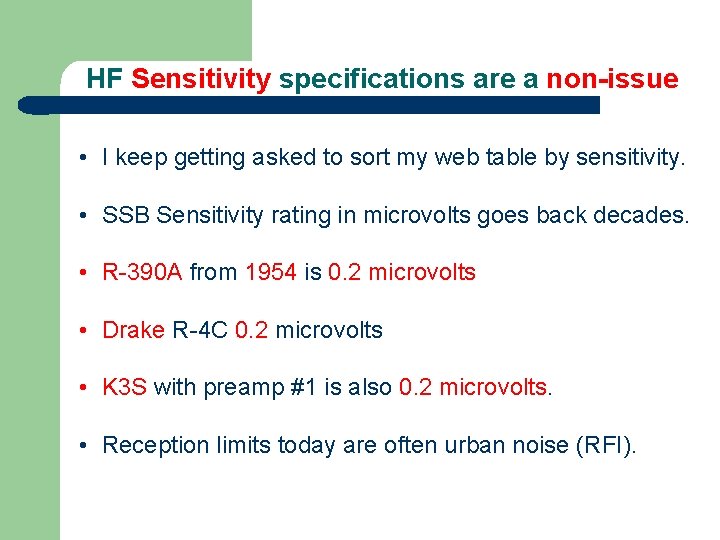
HF Sensitivity specifications are a non-issue • I keep getting asked to sort my web table by sensitivity. • SSB Sensitivity rating in microvolts goes back decades. • R-390 A from 1954 is 0. 2 microvolts • Drake R-4 C 0. 2 microvolts • K 3 S with preamp #1 is also 0. 2 microvolts. • Reception limits today are often urban noise (RFI).
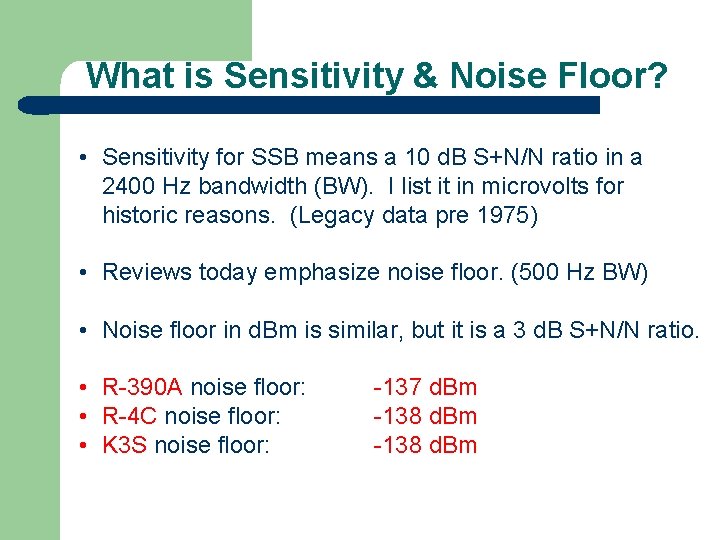
What is Sensitivity & Noise Floor? • Sensitivity for SSB means a 10 d. B S+N/N ratio in a 2400 Hz bandwidth (BW). I list it in microvolts for historic reasons. (Legacy data pre 1975) • Reviews today emphasize noise floor. (500 Hz BW) • Noise floor in d. Bm is similar, but it is a 3 d. B S+N/N ratio. • R-390 A noise floor: • R-4 C noise floor: • K 3 S noise floor: -137 d. Bm -138 d. Bm
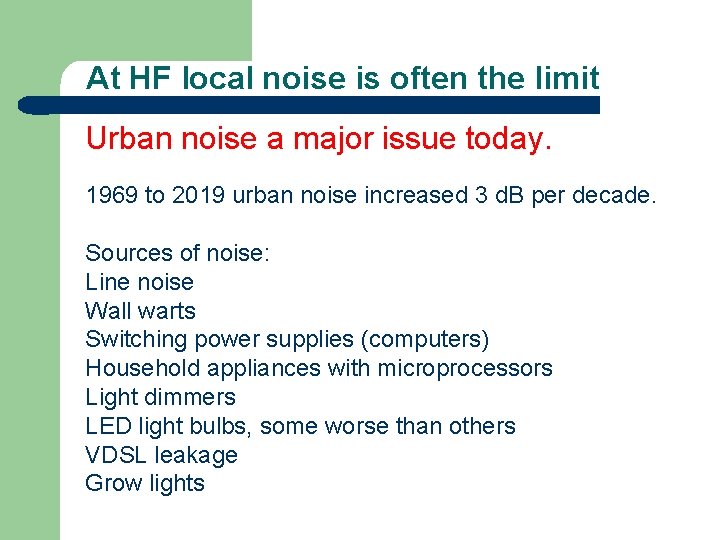
At HF local noise is often the limit Urban noise a major issue today. 1969 to 2019 urban noise increased 3 d. B per decade. Sources of noise: Line noise Wall warts Switching power supplies (computers) Household appliances with microprocessors Light dimmers LED light bulbs, some worse than others VDSL leakage Grow lights
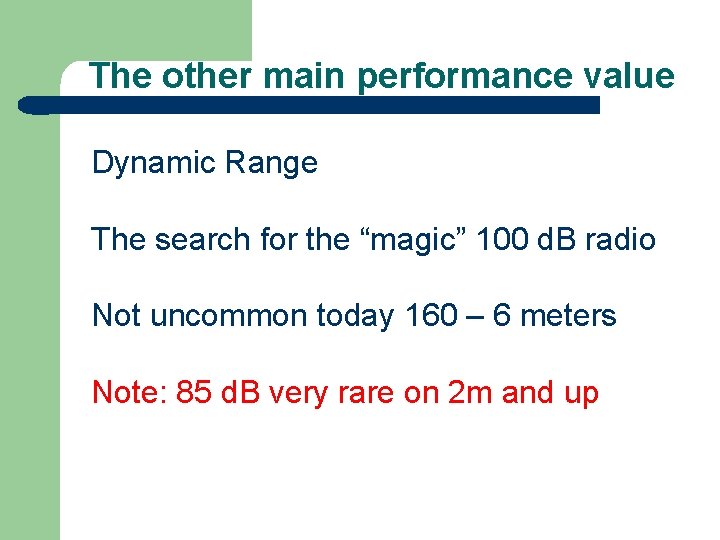
The other main performance value Dynamic Range The search for the “magic” 100 d. B radio Not uncommon today 160 – 6 meters Note: 85 d. B very rare on 2 m and up
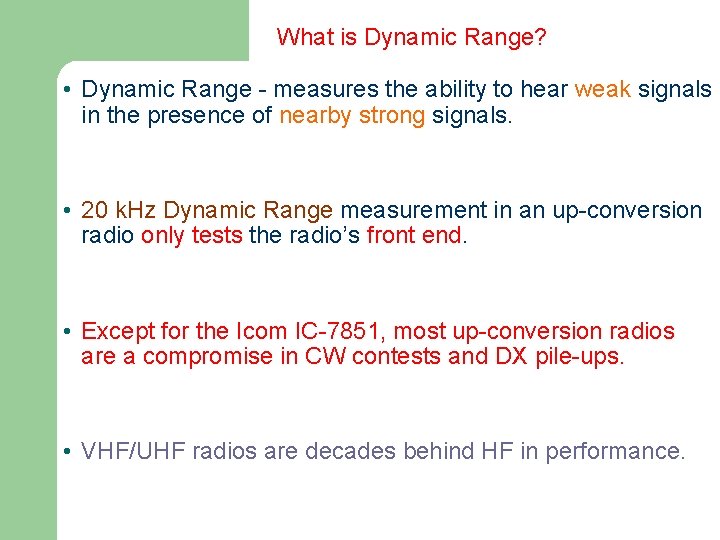
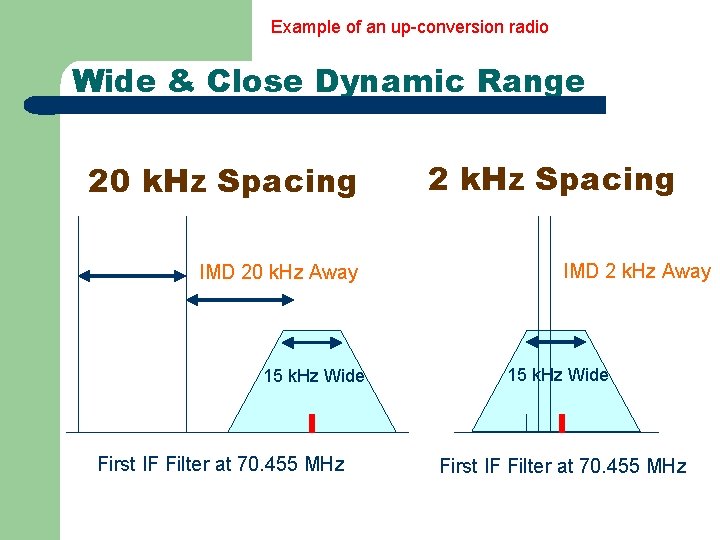
What is Dynamic Range? • Dynamic Range - measures the ability to hear weak signals in the presence of nearby strong signals. • 20 k. Hz Dynamic Range measurement in an up-conversion radio only tests the radio’s front end. • Except for the Icom IC-7851, most up-conversion radios are a compromise in CW contests and DX pile-ups. • VHF/UHF radios are decades behind HF in performance.
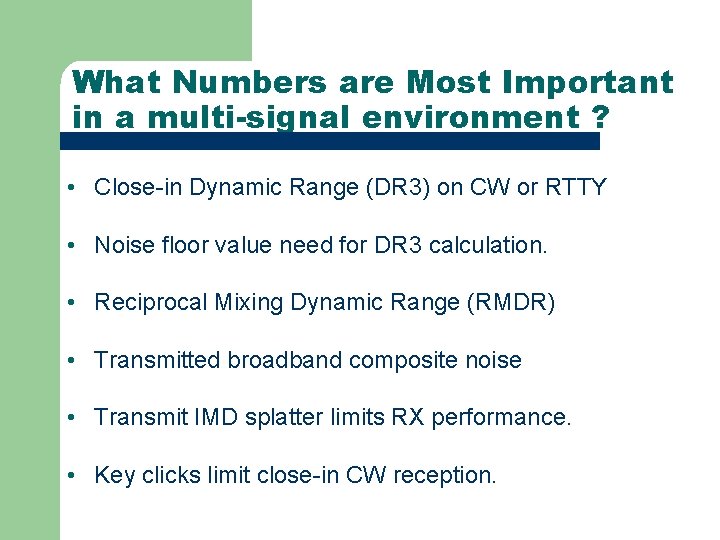
What Numbers are Most Important in a multi-signal environment ? • Close-in Dynamic Range (DR 3) on CW or RTTY • Noise floor value need for DR 3 calculation. • Reciprocal Mixing Dynamic Range (RMDR) • Transmitted broadband composite noise • Transmit IMD splatter limits RX performance. • Key clicks limit close-in CW reception.
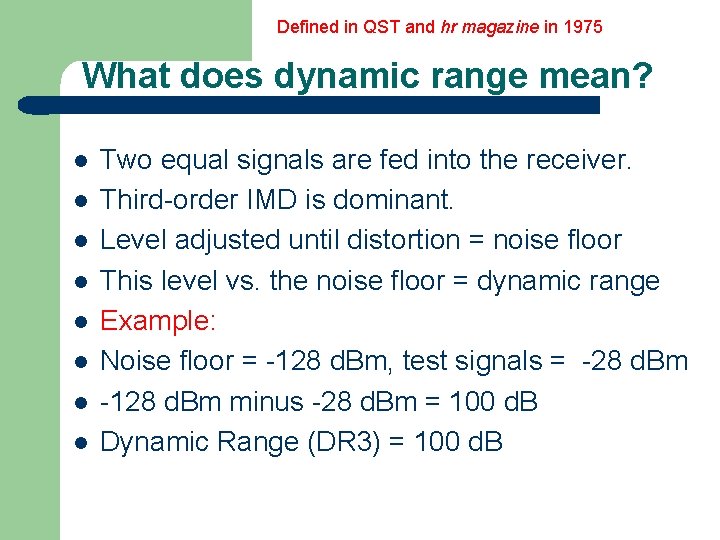
Defined in QST and hr magazine in 1975 What does dynamic range mean? l l l l Two equal signals are fed into the receiver. Third-order IMD is dominant. Level adjusted until distortion = noise floor This level vs. the noise floor = dynamic range Example: Noise floor = -128 d. Bm, test signals = -28 d. Bm -128 d. Bm minus -28 d. Bm = 100 d. B Dynamic Range (DR 3) = 100 d. B
Example of an up-conversion radio Wide & Close Dynamic Range 20 k. Hz Spacing IMD 20 k. Hz Away 15 k. Hz Wide First IF Filter at 70. 455 MHz 2 k. Hz Spacing IMD 2 k. Hz Away 15 k. Hz Wide First IF Filter at 70. 455 MHz
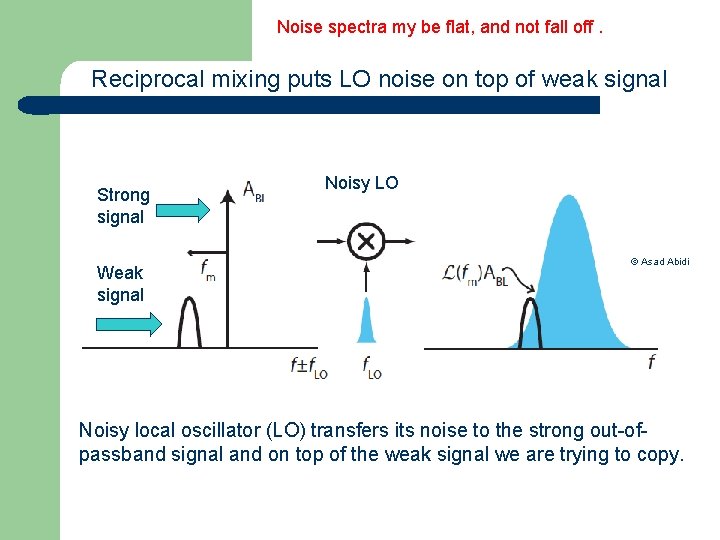
Noise spectra my be flat, and not fall off. Reciprocal mixing puts LO noise on top of weak signal Strong signal Weak signal Noisy LO © Asad Abidi Noisy local oscillator (LO) transfers its noise to the strong out-ofpassband signal and on top of the weak signal we are trying to copy.
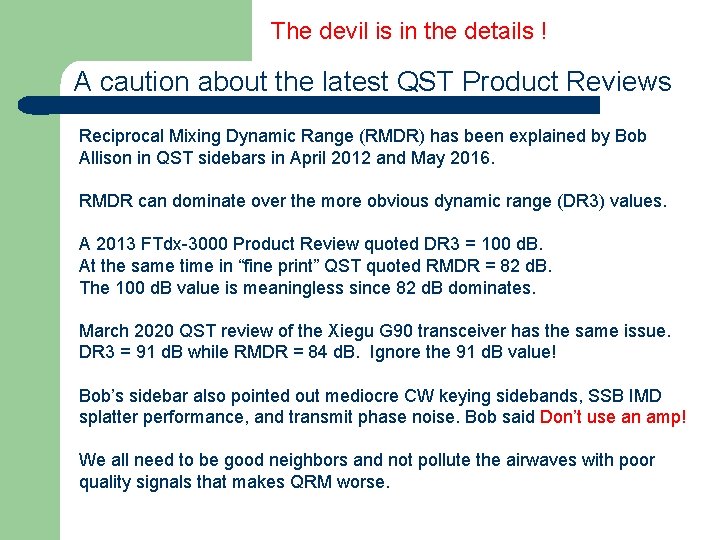
The devil is in the details ! A caution about the latest QST Product Reviews Reciprocal Mixing Dynamic Range (RMDR) has been explained by Bob Allison in QST sidebars in April 2012 and May 2016. RMDR can dominate over the more obvious dynamic range (DR 3) values. A 2013 FTdx-3000 Product Review quoted DR 3 = 100 d. B. At the same time in “fine print” QST quoted RMDR = 82 d. B. The 100 d. B value is meaningless since 82 d. B dominates. March 2020 QST review of the Xiegu G 90 transceiver has the same issue. DR 3 = 91 d. B while RMDR = 84 d. B. Ignore the 91 d. B value! Bob’s sidebar also pointed out mediocre CW keying sidebands, SSB IMD splatter performance, and transmit phase noise. Bob said Don’t use an amp! We all need to be good neighbors and not pollute the airwaves with poor quality signals that makes QRM worse.
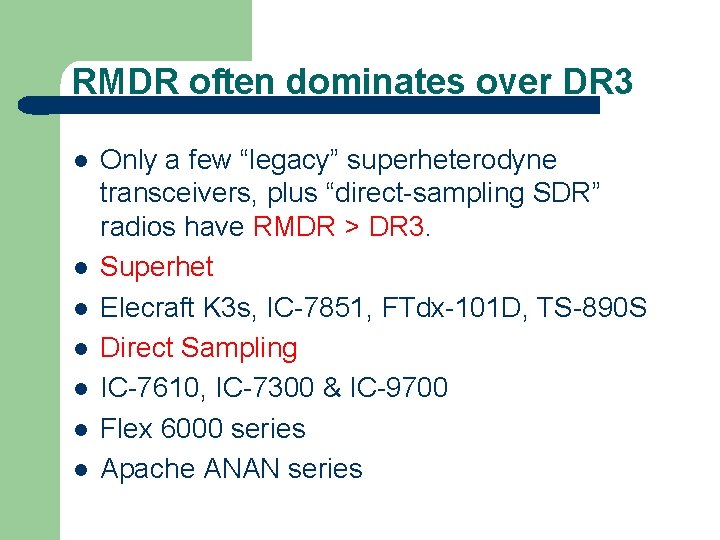
RMDR often dominates over DR 3 l l l l Only a few “legacy” superheterodyne transceivers, plus “direct-sampling SDR” radios have RMDR > DR 3. Superhet Elecraft K 3 s, IC-7851, FTdx-101 D, TS-890 S Direct Sampling IC-7610, IC-7300 & IC-9700 Flex 6000 series Apache ANAN series
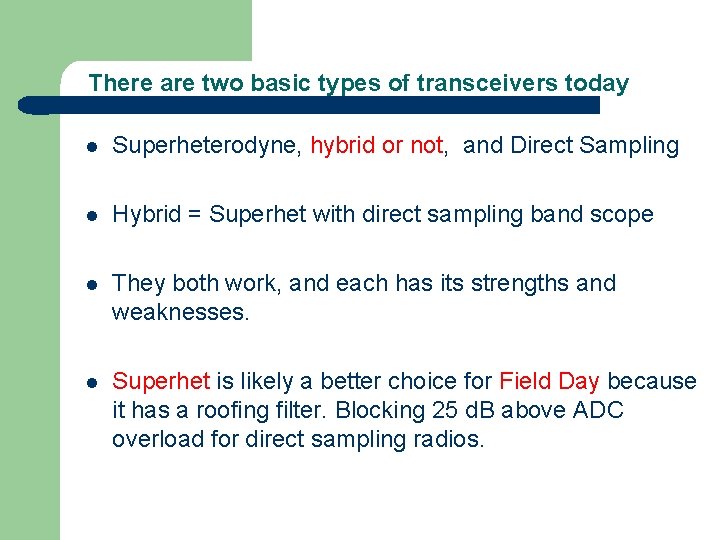
There are two basic types of transceivers today l Superheterodyne, hybrid or not, and Direct Sampling l Hybrid = Superhet with direct sampling band scope l They both work, and each has its strengths and weaknesses. l Superhet is likely a better choice for Field Day because it has a roofing filter. Blocking 25 d. B above ADC overload for direct sampling radios.
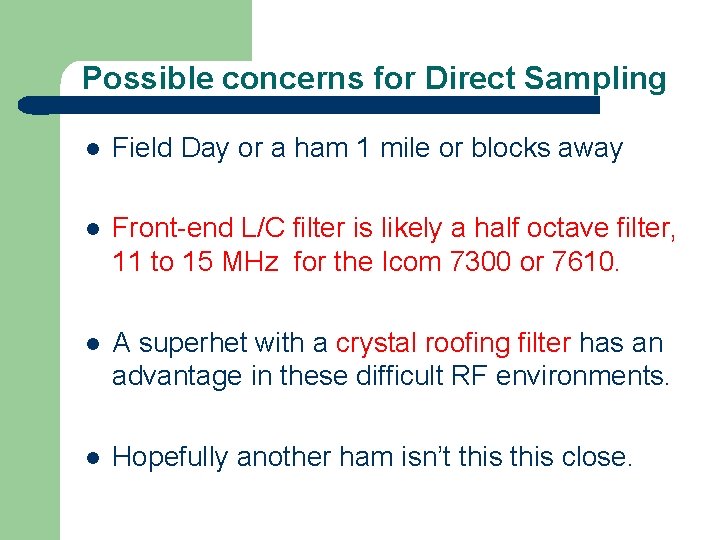
Possible concerns for Direct Sampling l Field Day or a ham 1 mile or blocks away l Front-end L/C filter is likely a half octave filter, 11 to 15 MHz for the Icom 7300 or 7610. l A superhet with a crystal roofing filter has an advantage in these difficult RF environments. l Hopefully another ham isn’t this close.
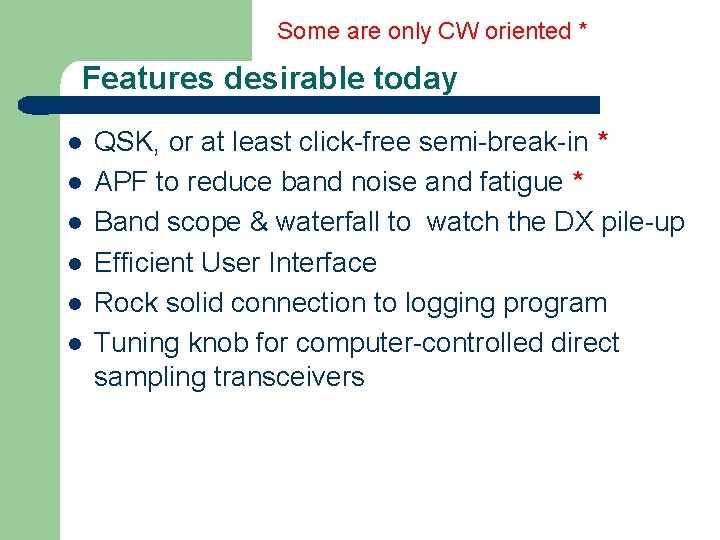
Some are only CW oriented * Features desirable today l l l QSK, or at least click-free semi-break-in * APF to reduce band noise and fatigue * Band scope & waterfall to watch the DX pile-up Efficient User Interface Rock solid connection to logging program Tuning knob for computer-controlled direct sampling transceivers
Time for the numbers l What do performance numbers mean? l Do you need the absolute best numbers? NO ! l You can optimize the performance of whatever transceiver you own. l Lots of transceivers can be perfectly adequate.
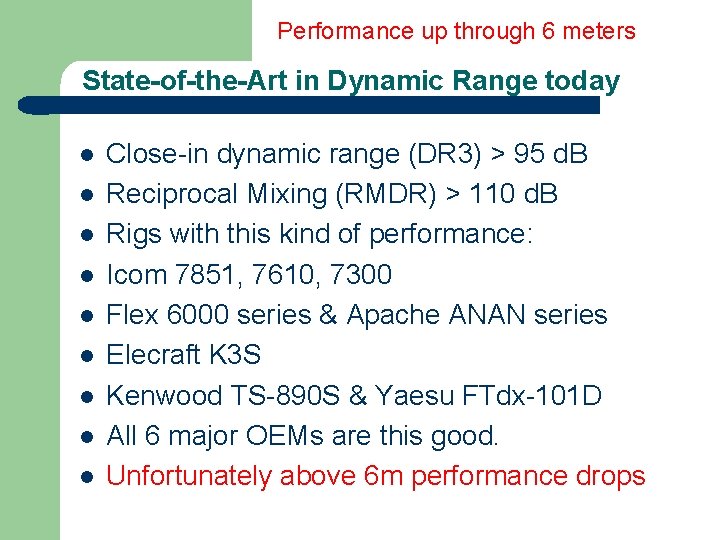
Performance up through 6 meters State-of-the-Art in Dynamic Range today l l l l l Close-in dynamic range (DR 3) > 95 d. B Reciprocal Mixing (RMDR) > 110 d. B Rigs with this kind of performance: Icom 7851, 7610, 7300 Flex 6000 series & Apache ANAN series Elecraft K 3 S Kenwood TS-890 S & Yaesu FTdx-101 D All 6 major OEMs are this good. Unfortunately above 6 m performance drops
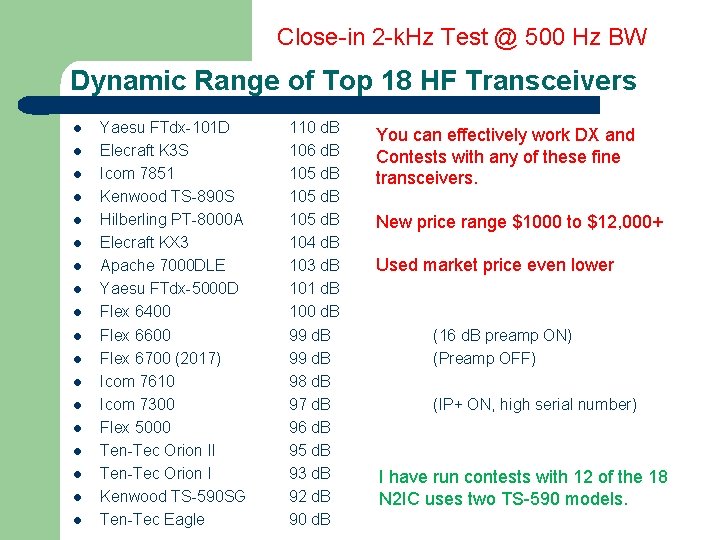
Close-in 2 -k. Hz Test @ 500 Hz BW Dynamic Range of Top 18 HF Transceivers l l l l l Yaesu FTdx-101 D Elecraft K 3 S Icom 7851 Kenwood TS-890 S Hilberling PT-8000 A Elecraft KX 3 Apache 7000 DLE Yaesu FTdx-5000 D Flex 6400 Flex 6600 Flex 6700 (2017) Icom 7610 Icom 7300 Flex 5000 Ten-Tec Orion II Ten-Tec Orion I Kenwood TS-590 SG Ten-Tec Eagle 110 d. B 106 d. B 105 d. B 104 d. B 103 d. B 101 d. B 100 d. B 99 d. B 98 d. B 97 d. B 96 d. B 95 d. B 93 d. B 92 d. B 90 d. B You can effectively work DX and Contests with any of these fine transceivers. New price range $1000 to $12, 000+ Used market price even lower (16 d. B preamp ON) (Preamp OFF) (IP+ ON, high serial number) I have run contests with 12 of the 18 N 2 IC uses two TS-590 models.
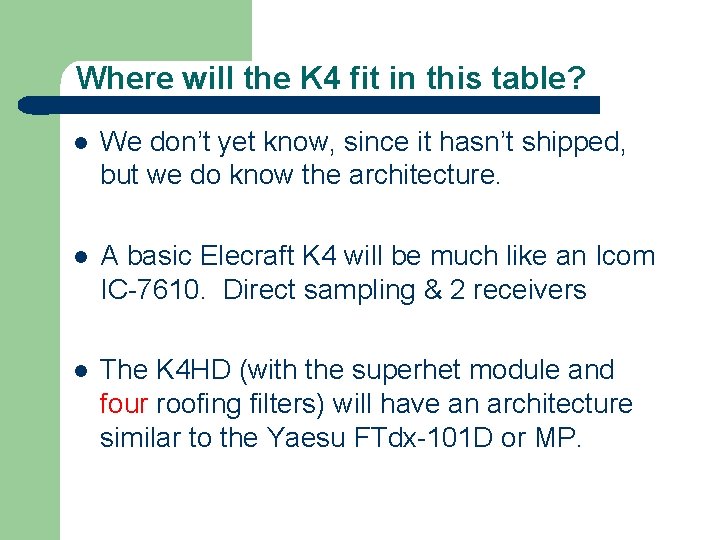
Where will the K 4 fit in this table? l We don’t yet know, since it hasn’t shipped, but we do know the architecture. l A basic Elecraft K 4 will be much like an Icom IC-7610. Direct sampling & 2 receivers l The K 4 HD (with the superhet module and four roofing filters) will have an architecture similar to the Yaesu FTdx-101 D or MP.
New and used price bargains today l A new IC-7300 sells for as little as $899. l A used TS-590 S sells for $600 or less. l I prefer a radio with a built-in band scope but LP-PAN and SDR “dongles” provide viable options.
Pay attention to NET GAIN l The following 10 m and 160 m slides emphasizes using common sense on preamp and attenuator settings. 40 m and below at night, use the attenuator. On 15 m and above, a preamp is useful if you are in a quiet location. Urban noise may make a preamp useless. l A preamp at night on 40 m is crazy! l l l
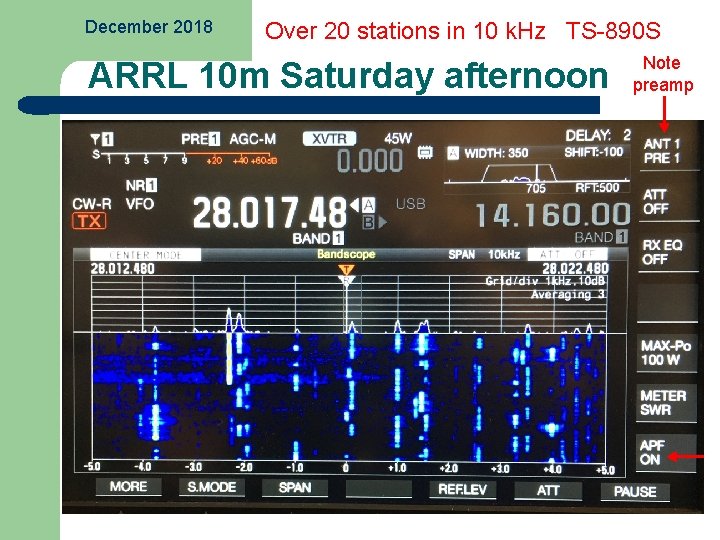
December 2018 Over 20 stations in 10 k. Hz TS-890 S ARRL 10 m Saturday afternoon Note preamp
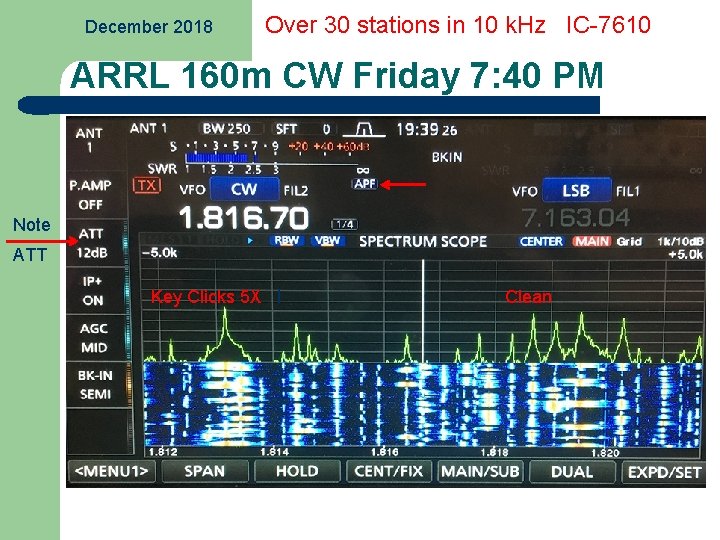
What can else a band scope show? l Not only can we observe a DXpedition running split, the scope and waterfall also show other causes for QRM. l Your receiver filters cannot eliminate inpassband QRM such as Key Clicks, SSB Splatter, or Transmit Composite Noise.
December 2018 Over 30 stations in 10 k. Hz IC-7610 ARRL 160 m CW Friday 7: 40 PM Note ATT Key Clicks 5 X l Clean
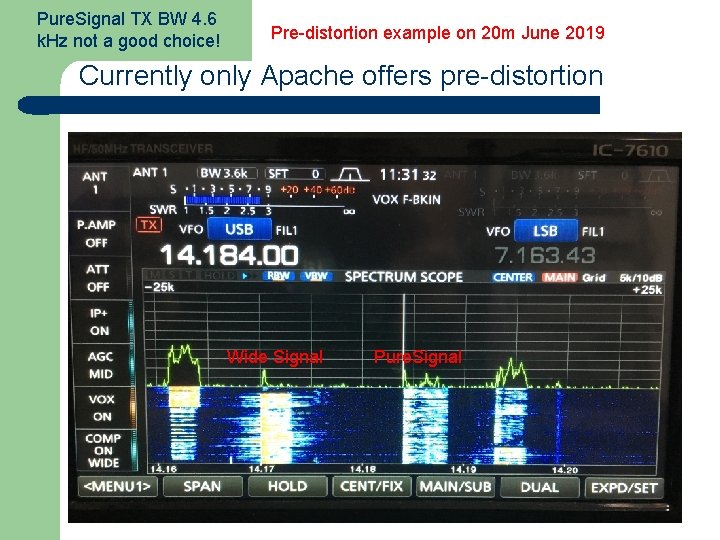
Pure. Signal TX BW 4. 6 k. Hz not a good choice! Pre-distortion example on 20 m June 2019 Currently only Apache offers pre-distortion Wide Signal Pure. Signal
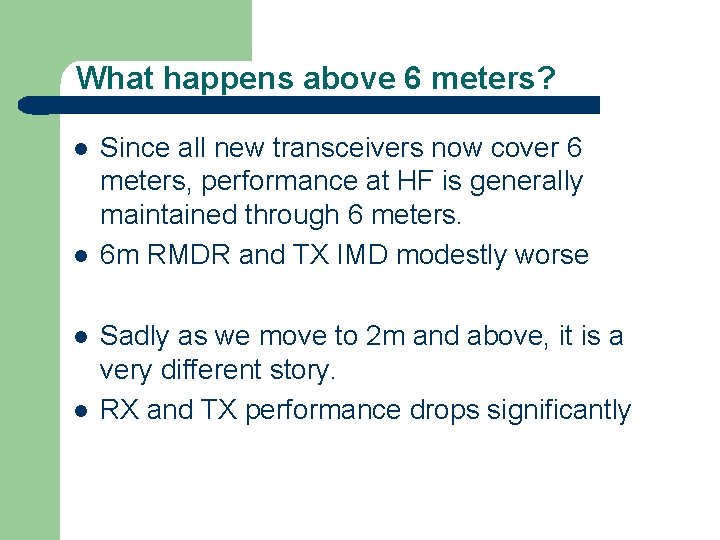
What happens above 6 meters? l l Since all new transceivers now cover 6 meters, performance at HF is generally maintained through 6 meters. 6 m RMDR and TX IMD modestly worse Sadly as we move to 2 m and above, it is a very different story. RX and TX performance drops significantly
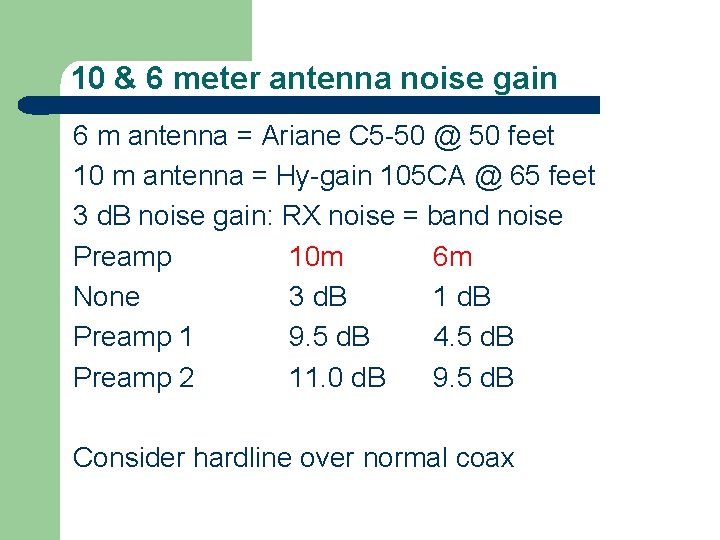
10 & 6 meter antenna noise gain 6 m antenna = Ariane C 5 -50 @ 50 feet 10 m antenna = Hy-gain 105 CA @ 65 feet 3 d. B noise gain: RX noise = band noise Preamp 10 m 6 m None 3 d. B 1 d. B Preamp 1 9. 5 d. B 4. 5 d. B Preamp 2 11. 0 d. B 9. 5 d. B Consider hardline over normal coax
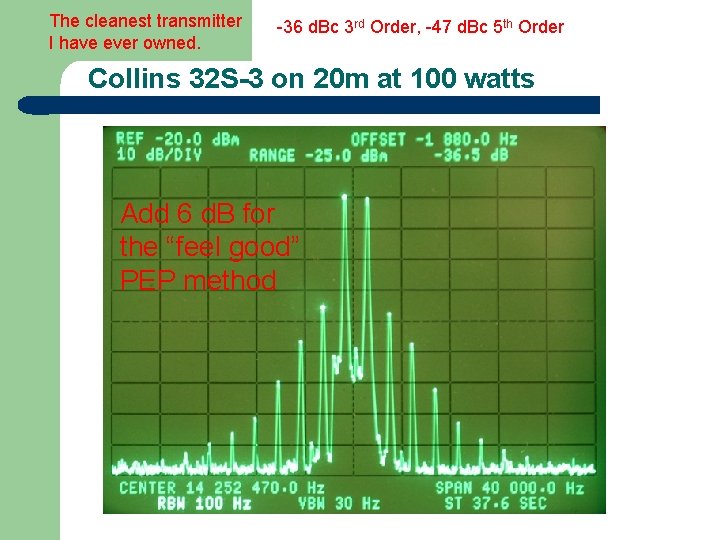
The cleanest transmitter I have ever owned. -36 d. Bc 3 rd Order, -47 d. Bc 5 th Order Collins 32 S-3 on 20 m at 100 watts Add 6 d. B for the “feel good” PEP method
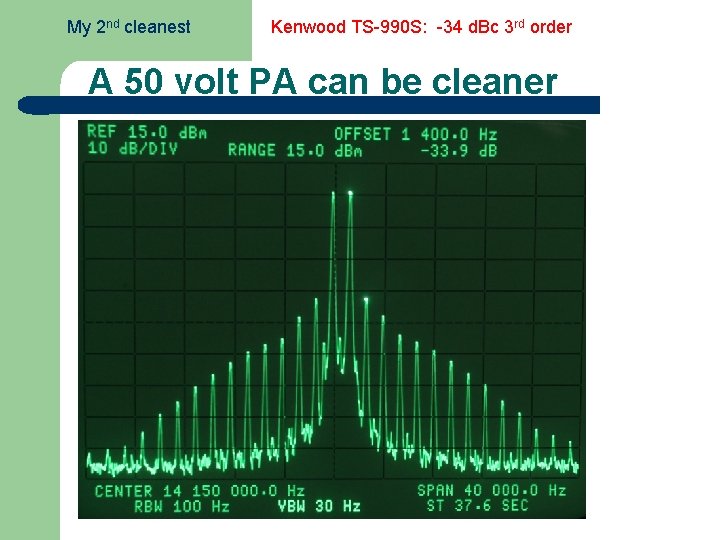
My 2 nd cleanest Kenwood TS-990 S: -34 d. Bc 3 rd order A 50 volt PA can be cleaner
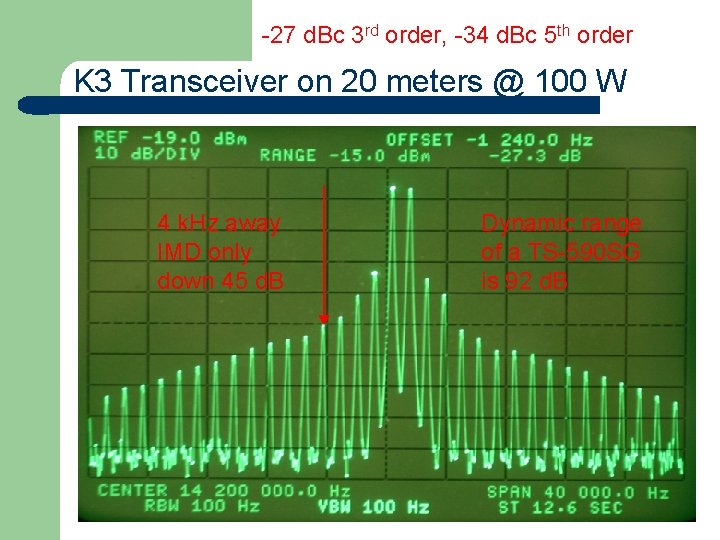
-27 d. Bc 3 rd order, -34 d. Bc 5 th order K 3 Transceiver on 20 meters @ 100 W 4 k. Hz away IMD only down 45 d. B Dynamic range of a TS-590 SG is 92 d. B
SSB vs. CW signal bandwidths SSB splatter can be a significant problem Are you overdriving your amplifier into saturation? I use a -40 d. B sampler and a Tektronix scope full the time. How does CW compare? How close can we work to a strong adjacent CW signal? It often comes down to a menu selection.
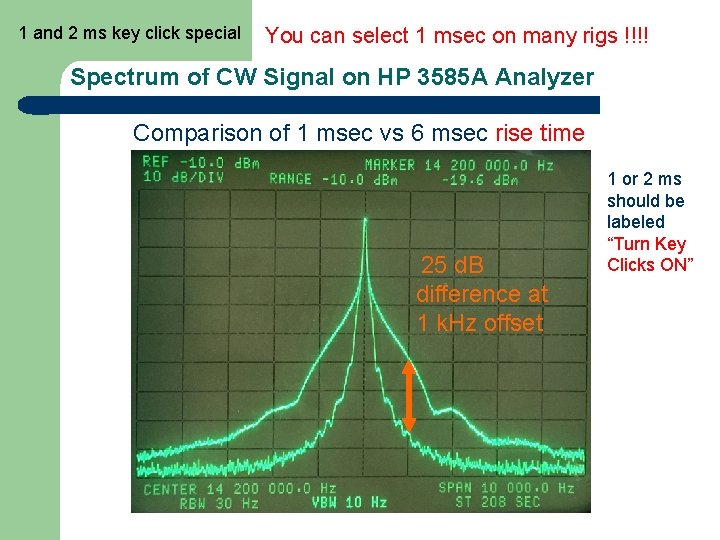
1 and 2 ms key click special You can select 1 msec on many rigs !!!! Spectrum of CW Signal on HP 3585 A Analyzer Comparison of 1 msec vs 6 msec rise time 25 d. B difference at 1 k. Hz offset 1 or 2 ms should be labeled “Turn Key Clicks ON”
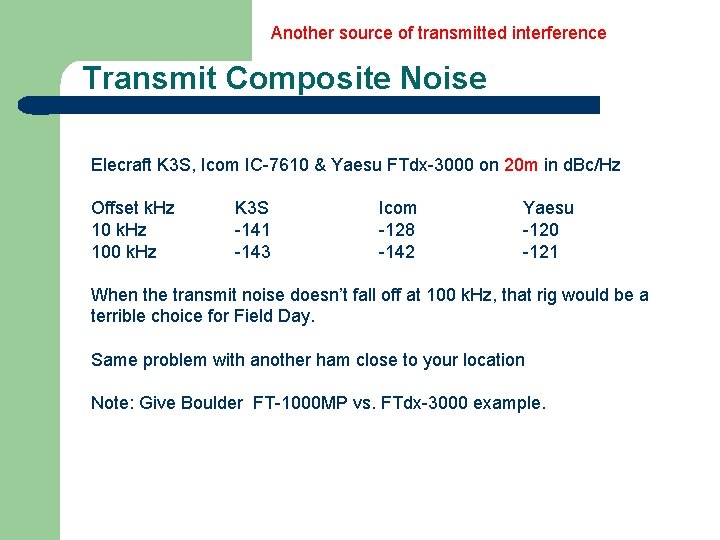
Another source of transmitted interference Transmit Composite Noise Elecraft K 3 S, Icom IC-7610 & Yaesu FTdx-3000 on 20 m in d. Bc/Hz Offset k. Hz 100 k. Hz K 3 S -141 -143 Icom -128 -142 Yaesu -120 -121 When the transmit noise doesn’t fall off at 100 k. Hz, that rig would be a terrible choice for Field Day. Same problem with another ham close to your location Note: Give Boulder FT-1000 MP vs. FTdx-3000 example.
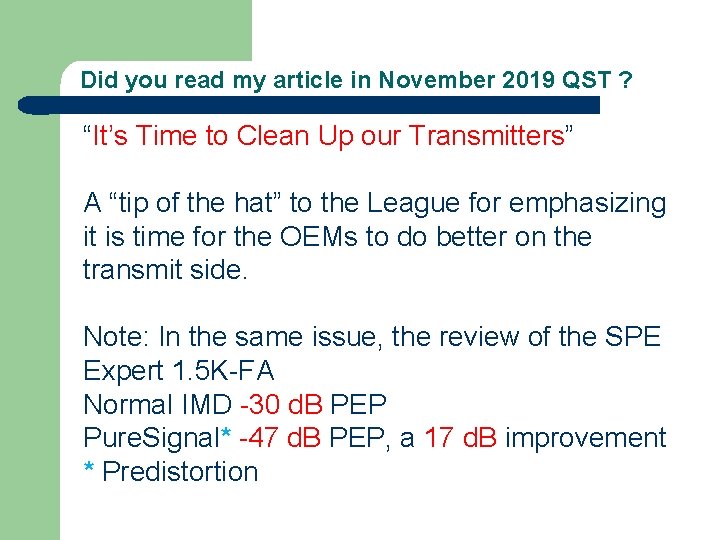
Did you read my article in November 2019 QST ? “It’s Time to Clean Up our Transmitters” A “tip of the hat” to the League for emphasizing it is time for the OEMs to do better on the transmit side. Note: In the same issue, the review of the SPE Expert 1. 5 K-FA Normal IMD -30 d. B PEP Pure. Signal* -47 d. B PEP, a 17 d. B improvement * Predistortion
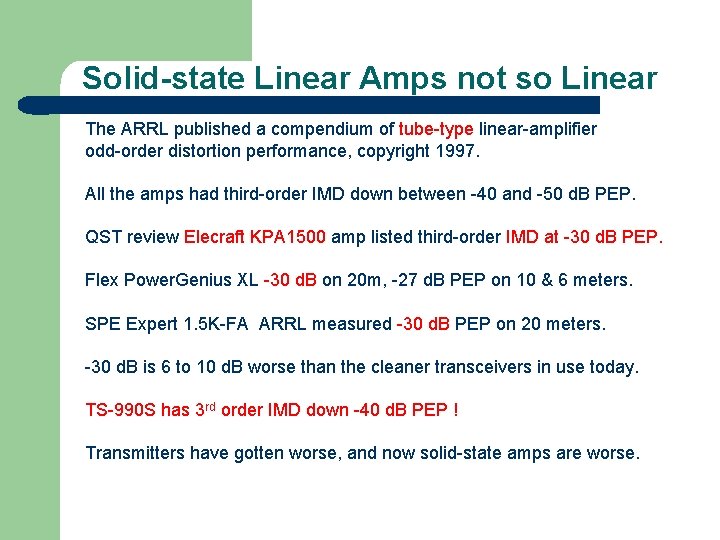
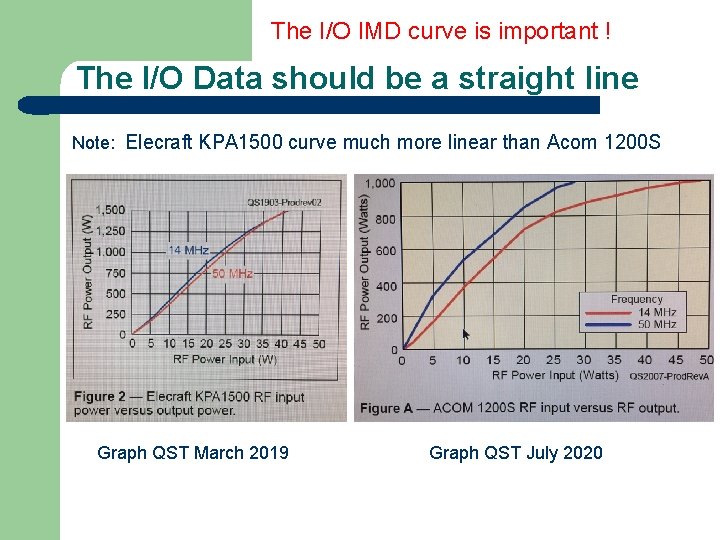
Solid-state Linear Amps not so Linear The ARRL published a compendium of tube-type linear-amplifier odd-order distortion performance, copyright 1997. All the amps had third-order IMD down between -40 and -50 d. B PEP. QST review Elecraft KPA 1500 amp listed third-order IMD at -30 d. B PEP. Flex Power. Genius XL -30 d. B on 20 m, -27 d. B PEP on 10 & 6 meters. SPE Expert 1. 5 K-FA ARRL measured -30 d. B PEP on 20 meters. -30 d. B is 6 to 10 d. B worse than the cleaner transceivers in use today. TS-990 S has 3 rd order IMD down -40 d. B PEP ! Transmitters have gotten worse, and now solid-state amps are worse.
The I/O IMD curve is important ! The I/O Data should be a straight line Note: Elecraft KPA 1500 curve much more linear than Acom 1200 S Graph QST March 2019 Graph QST July 2020
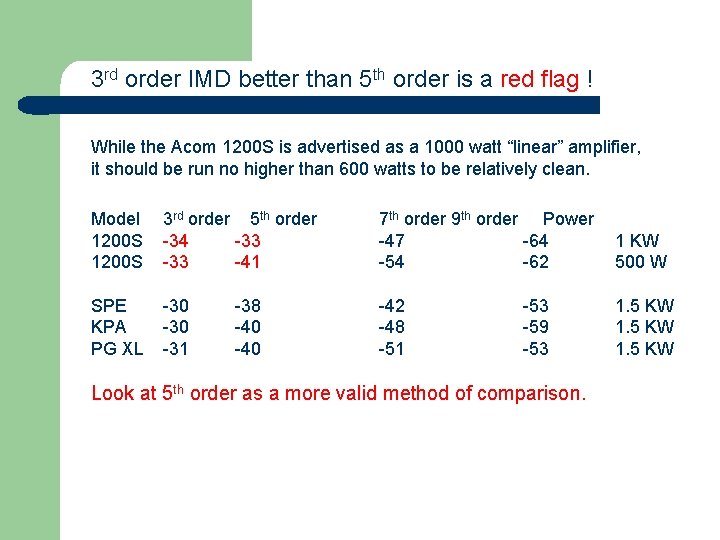
3 rd order IMD better than 5 th order is a red flag ! While the Acom 1200 S is advertised as a 1000 watt “linear” amplifier, it should be run no higher than 600 watts to be relatively clean. Model 1200 S 3 rd order 5 th order -34 -33 -41 7 th order 9 th order Power -47 -64 -54 -62 1 KW 500 W SPE KPA PG XL -30 -31 -42 -48 -51 1. 5 KW -38 -40 -53 -59 -53 Look at 5 th order as a more valid method of comparison.
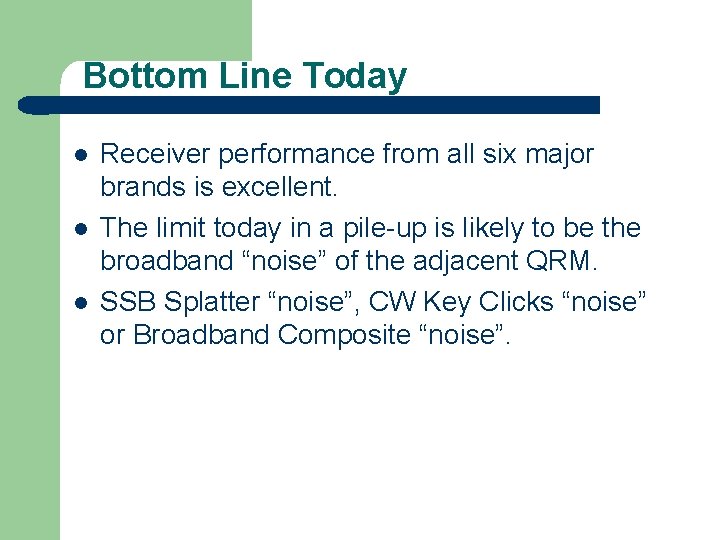
Bottom Line Today l l l Receiver performance from all six major brands is excellent. The limit today in a pile-up is likely to be the broadband “noise” of the adjacent QRM. SSB Splatter “noise”, CW Key Clicks “noise” or Broadband Composite “noise”.
http: //www. NC 0 B. com Sherwood Engineering Videos from past CTU presentations CTU 2013 through 2020 (Select desired year) http: //www. contestuniversity. com/videos Sherwood Shootouts (Contest Comparisons) published by DJ 0 IP http: //www. dj 0 ip. de/sherwood-forest/sherwood-s-shootouts/ Email: rob@nc 0 b. com