
2020 ANNUAL STRATEGIC PLANNING SESSION OMF PHASE II

- Slides: 38
2020 ANNUAL STRATEGIC PLANNING SESSION OMF PHASE II DRAFT WORKSTREAM 5
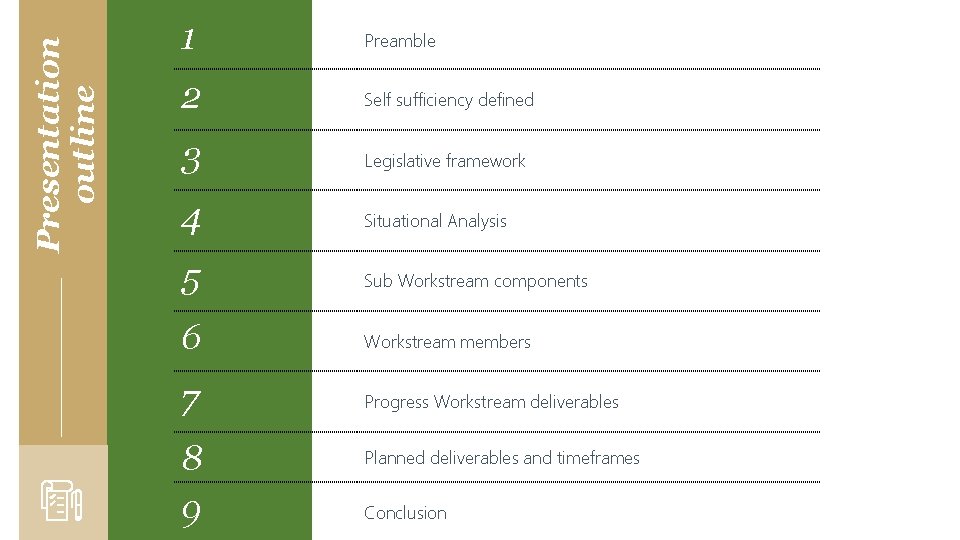
Presentation outline 1 Preamble 2 Self sufficiency defined 3 Legislative framework 4 Situational Analysis 5 Sub Workstream components 6 Workstream members 7 Progress Workstream deliverables 8 9 Planned deliverables and timeframes Conclusion
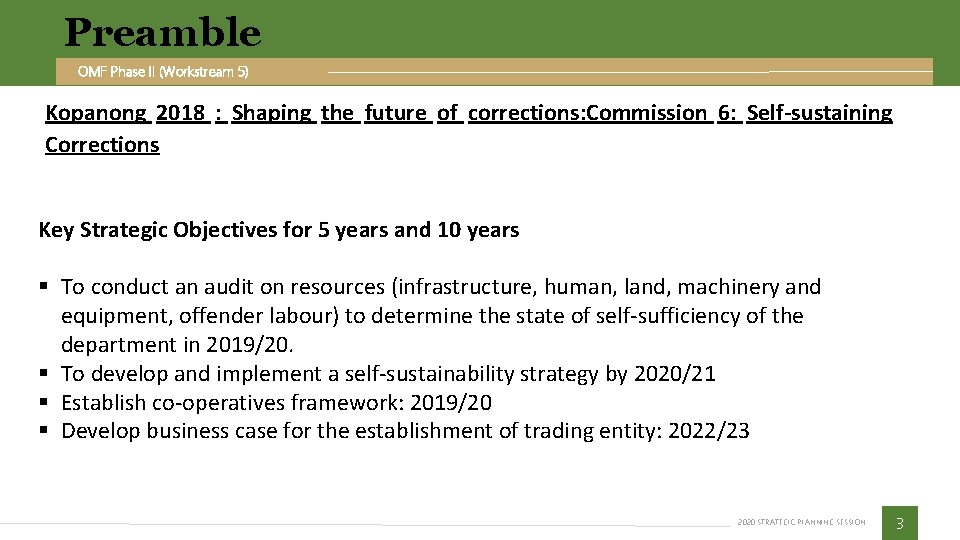
Preamble OMF Phase II (Workstream 5) Kopanong 2018 : Shaping the future of corrections: Commission 6: Self-sustaining Corrections Key Strategic Objectives for 5 years and 10 years § To conduct an audit on resources (infrastructure, human, land, machinery and equipment, offender labour) to determine the state of self-sufficiency of the department in 2019/20. § To develop and implement a self-sustainability strategy by 2020/21 § Establish co-operatives framework: 2019/20 § Develop business case for the establishment of trading entity: 2022/23 2020 STRATEGIC PLANNING SESSION 3
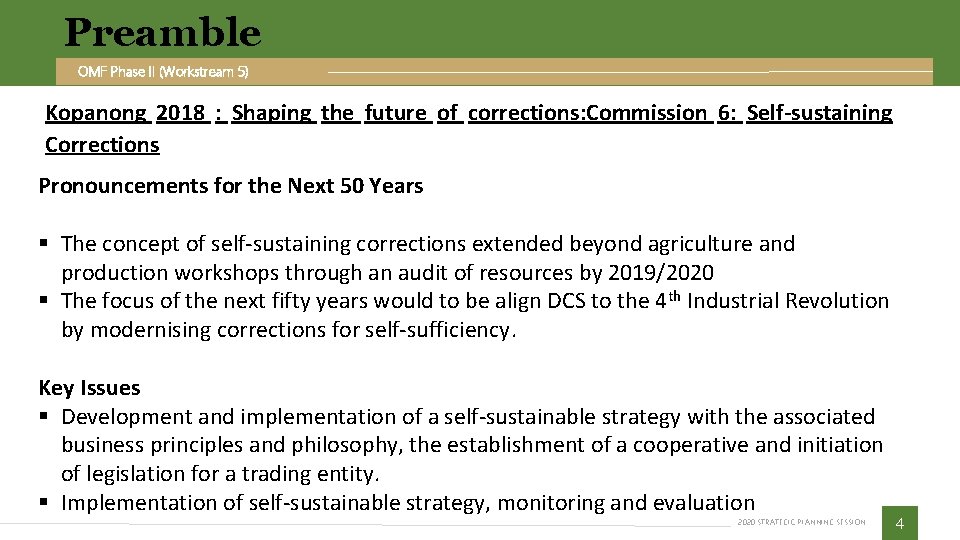
Preamble OMF Phase II (Workstream 5) Kopanong 2018 : Shaping the future of corrections: Commission 6: Self-sustaining Corrections Pronouncements for the Next 50 Years § The concept of self-sustaining corrections extended beyond agriculture and production workshops through an audit of resources by 2019/2020 § The focus of the next fifty years would to be align DCS to the 4 th Industrial Revolution by modernising corrections for self-sufficiency. Key Issues § Development and implementation of a self-sustainable strategy with the associated business principles and philosophy, the establishment of a cooperative and initiation of legislation for a trading entity. § Implementation of self-sustainable strategy, monitoring and evaluation 2020 STRATEGIC PLANNING SESSION 4
Preamble OMF Phase II (Workstream 5) Service Delivery Model recommendations: Self- sufficiency § Opportunities exist to leverage resources to improve self-sufficiency to support and enhance DCS to deliver on its comprehensive mandate 2020 STRATEGIC PLANNING SESSION 5
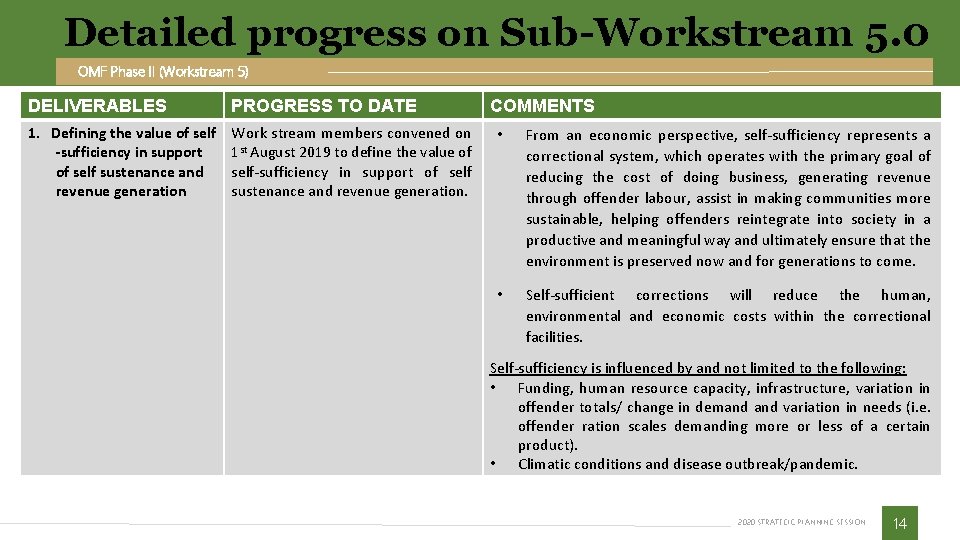
Self sufficiency defined - Workstream 5 OMF Phase II (Workstream 5) • The phrase self-sufficient corrections from an economic perspective represents a correctional system, which operates with the primary goal of reducing the cost of doing business, generating revenue through offender labour, assist in making communities more sustainable, helping offenders reintegrate into society in a productive and meaningful way and ultimately ensure that the environment is preserved now and for generations to come. • Self-sufficient corrections will reduce the human, environmental and economic costs within the correctional facilities. • Production workshops, bakeries and agricultural activities promote the transfer of skills to offenders by complementing skills development programmes and improving their personal and social functioning • Every offender must be given an opportunity for skills training. 2020 STRATEGIC PLANNING SESSION 6
Legislative framework - Workstream 5 OMF Phase II (Workstream 5) Correctional Services Act, Act No. 111 of 1998, as amended: • Section 8(1) stipulates that each inmate must be provided with an adequate diet to promote good health, as prescribed in the regulations. Furthermore, Section 10(1) states that the Department must provide every inmate with clothing and bedding sufficient to meet the requirements of hygiene and climatic conditions. • Section 3(2)(b), states “the department must as far as practicable be self-sufficient and operate according to business principles”. • Section 40(1)(a), states “Sufficient work must as far as is practicable be provided to keep sentenced offenders active for a normal working day and a sentenced offender may be compelled to do such work”. (b) “Such work must as far as is practicable be aimed at providing such offenders with skills in order to be gainfully employed in society on release”. 2020 STRATEGIC PLANNING SESSION 7
Situational Analysis - Workstream 5 OMF Phase II (Workstream 5) • The prevailing financial constraints impact on the price of food items in the open market, with some industries finding it difficult to cope under these constraints, consequently resulting in an increasing unemployment rate, like the case of the poultry industry. • The COVID-19 crisis, which has seen global food chains disrupted, highlights the importance of local food production and consumption. To limit the spread of the COVID-19, governments have taken measures to restrict flows of goods, capital, and labour. • The DCS Service Delivery Model recommends that in order to mitigate the constrained environment, opportunities to improve efficiencies must be considered this includes: Reducing Goods and Services expenditure through driving selfsufficiency exercises; including increasing agriculture, clothing, maintenance and so on from rehabilitation functions. • Self-Sustainability should further utilize production sites within Management Areas to enable service delivery to Districts through strategic partnerships with governmental and non-governmental stakeholders across the Management Areas. • The linkages between food security, health, nutrition, agriculture, and people’s livelihoods are well recognized in addressing malnutrition. • In the longer term, the potential pressure for various countries to increase food reserves could decrease the amount of food pushed into global markets. • Although it is unclear where the current crisis will take the food industry, it is beyond doubt that consumer sentiments will shift even more in favour of sustainable food. 2020 STRATEGIC PLANNING SESSION 8
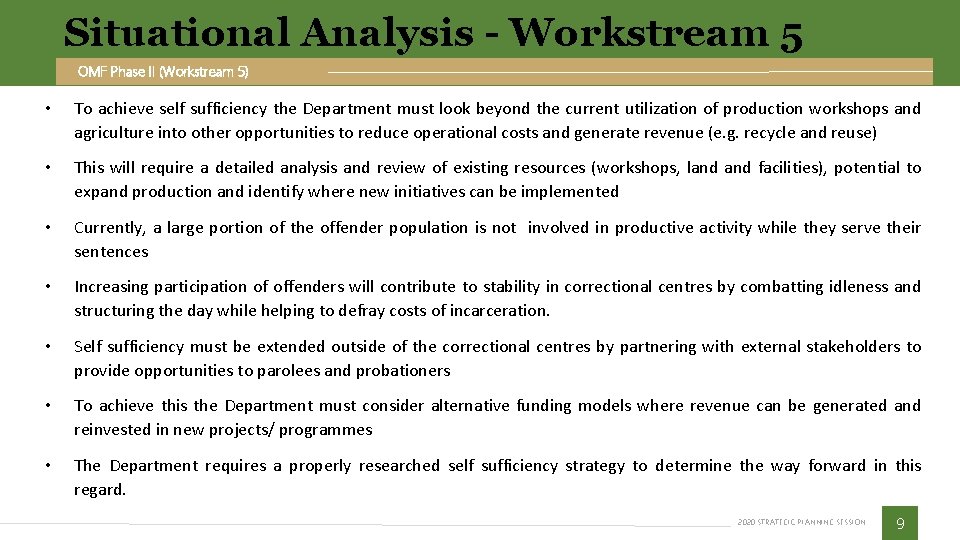
Situational Analysis - Workstream 5 OMF Phase II (Workstream 5) • To achieve self sufficiency the Department must look beyond the current utilization of production workshops and agriculture into other opportunities to reduce operational costs and generate revenue (e. g. recycle and reuse) • This will require a detailed analysis and review of existing resources (workshops, land facilities), potential to expand production and identify where new initiatives can be implemented • Currently, a large portion of the offender population is not involved in productive activity while they serve their sentences • Increasing participation of offenders will contribute to stability in correctional centres by combatting idleness and structuring the day while helping to defray costs of incarceration. • Self sufficiency must be extended outside of the correctional centres by partnering with external stakeholders to provide opportunities to parolees and probationers • To achieve this the Department must consider alternative funding models where revenue can be generated and reinvested in new projects/ programmes • The Department requires a properly researched self sufficiency strategy to determine the way forward in this regard. 2020 STRATEGIC PLANNING SESSION 9
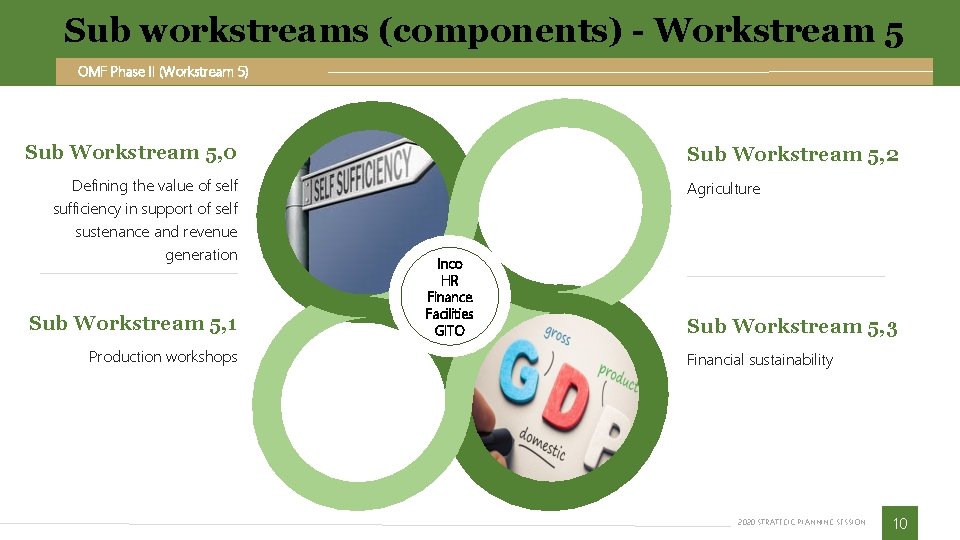
Sub workstreams (components) - Workstream 5 OMF Phase II (Workstream 5) Sub Workstream 5, 0 Defining the value of self sufficiency in support of self sustenance and revenue generation Sub Workstream 5, 1 Production workshops Sub Workstream 5, 2 Agriculture Inco HR Finance Facilities GITO Sub Workstream 5, 3 Financial sustainability 2020 STRATEGIC PLANNING SESSION 10
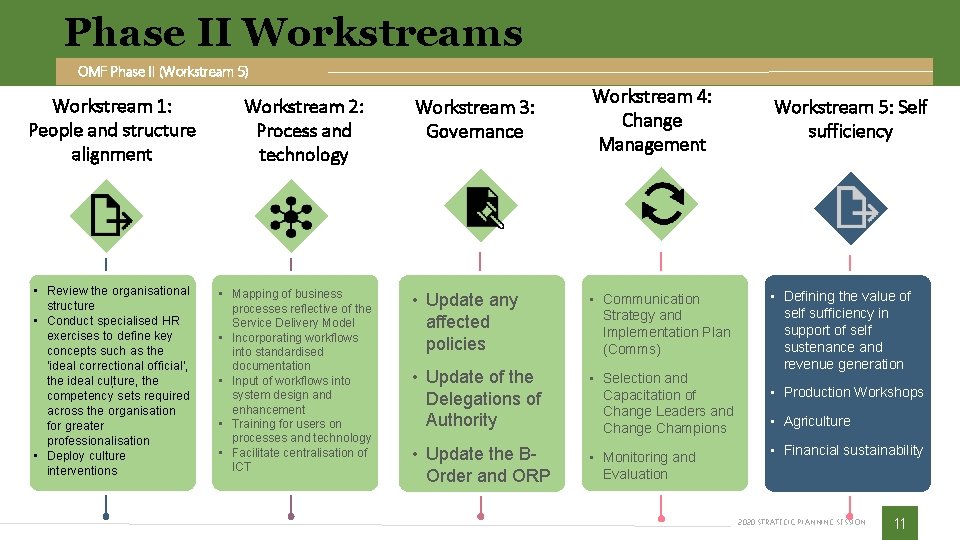
Phase II Workstreams OMF Phase II (Workstream 5) Workstream 1: People and structure alignment • Review the organisational structure • Conduct specialised HR exercises to define key concepts such as the ‘ideal correctional official’, the ideal culture, the. competency sets required across the organisation for greater professionalisation • Deploy culture interventions Workstream 2: Process and technology • Mapping of business processes reflective of the Service Delivery Model • Incorporating workflows into standardised documentation • Input of workflows into system design and enhancement • Training for users on processes and technology • Facilitate centralisation of ICT Workstream 3: Governance Workstream 4: Change Management Workstream 5: Self sufficiency • Update any affected policies • Communication Strategy and Implementation Plan (Comms) • Update of the Delegations of Authority • Selection and Capacitation of Change Leaders and Change Champions • Defining the value of self sufficiency in support of self sustenance and revenue generation • Update the BOrder and ORP • Monitoring and Evaluation • Production Workshops • Agriculture • Financial sustainability 2020 STRATEGIC PLANNING SESSION 11
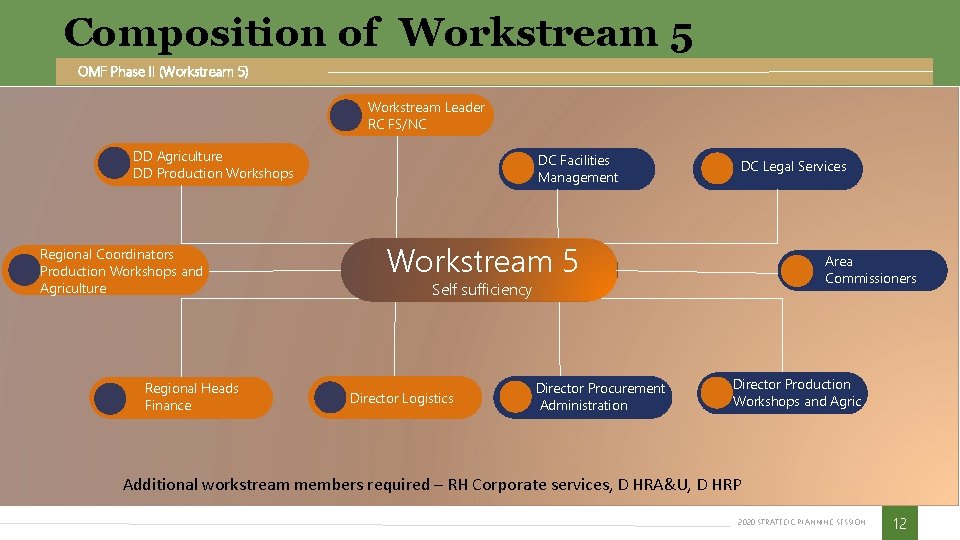
Composition of Workstream 5 OMF Phase II (Workstream 5) Workstream Leader RC FS/NC DD Agriculture DD Production Workshops Regional Coordinators Production Workshops and Agriculture Regional Heads Finance DC Facilities Management DC Legal Services Workstream 5 Area Commissioners Self sufficiency Director Logistics Director Procurement Administration Director Production Workshops and Agric Additional workstream members required – RH Corporate services, D HRA&U, D HRP 2020 STRATEGIC PLANNING SESSION 12
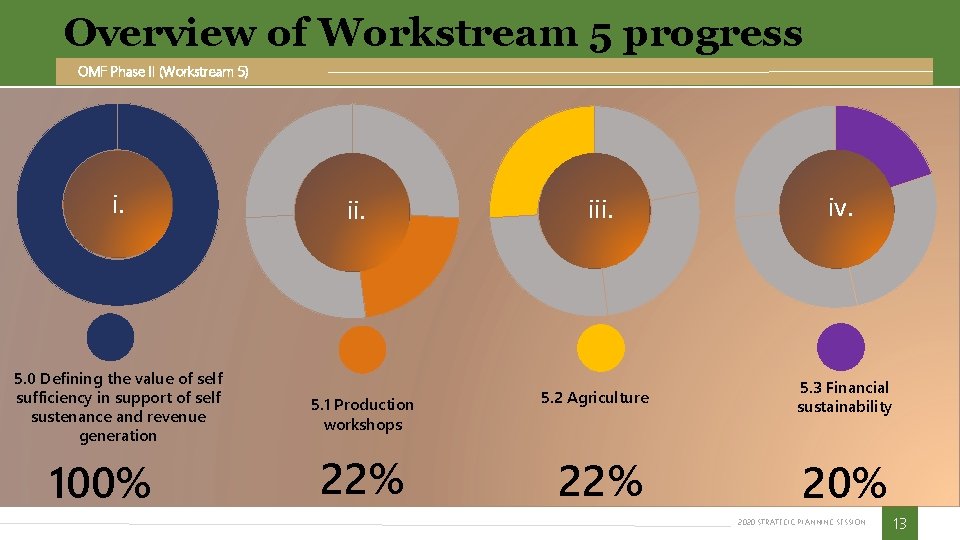
Overview of Workstream 5 progress OMF Phase II (Workstream 5) i. 5. 0 Defining the value of self sufficiency in support of self sustenance and revenue generation 100% ii. 5. 1 Production workshops 22% iii. iv. 5. 2 Agriculture 5. 3 Financial sustainability 22% 2020 STRATEGIC PLANNING SESSION 13
Detailed progress on Sub-Workstream 5. 0 OMF Phase II (Workstream 5) DELIVERABLES PROGRESS TO DATE 1. Defining the value of self -sufficiency in support of self sustenance and revenue generation Work stream members convened on 1 st August 2019 to define the value of self-sufficiency in support of self sustenance and revenue generation. COMMENTS • From an economic perspective, self-sufficiency represents a correctional system, which operates with the primary goal of reducing the cost of doing business, generating revenue through offender labour, assist in making communities more sustainable, helping offenders reintegrate into society in a productive and meaningful way and ultimately ensure that the environment is preserved now and for generations to come. • Self-sufficient corrections will reduce the human, environmental and economic costs within the correctional facilities. Self-sufficiency is influenced by and not limited to the following: • Funding, human resource capacity, infrastructure, variation in offender totals/ change in demand variation in needs (i. e. offender ration scales demanding more or less of a certain product). • Climatic conditions and disease outbreak/pandemic. 2020 STRATEGIC PLANNING SESSION 14
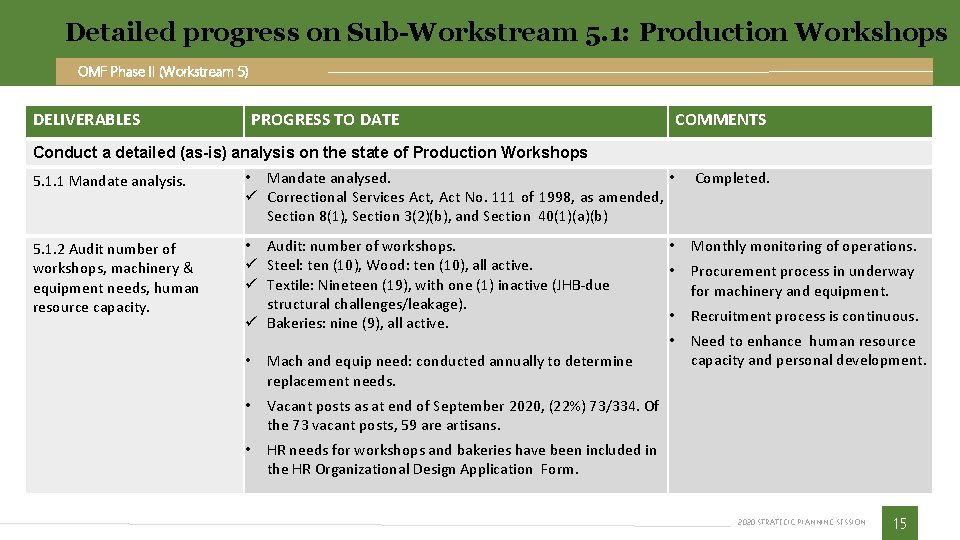
Detailed progress on Sub-Workstream 5. 1: Production Workshops OMF Phase II (Workstream 5) DELIVERABLES PROGRESS TO DATE COMMENTS Conduct a detailed (as-is) analysis on the state of Production Workshops 5. 1. 1 Mandate analysis. • Mandate analysed. • ü Correctional Services Act, Act No. 111 of 1998, as amended, Section 8(1), Section 3(2)(b), and Section 40(1)(a)(b) Completed. 5. 1. 2 Audit number of workshops, machinery & equipment needs, human resource capacity. • Audit: number of workshops. ü Steel: ten (10), Wood: ten (10), all active. ü Textile: Nineteen (19), with one (1) inactive (JHB-due structural challenges/leakage). ü Bakeries: nine (9), all active. • Monthly monitoring of operations. • Procurement process in underway for machinery and equipment. • Recruitment process is continuous. • Need to enhance human resource capacity and personal development. • Mach and equip need: conducted annually to determine replacement needs. • Vacant posts as at end of September 2020, (22%) 73/334. Of the 73 vacant posts, 59 are artisans. • HR needs for workshops and bakeries have been included in the HR Organizational Design Application Form. 2020 STRATEGIC PLANNING SESSION 15
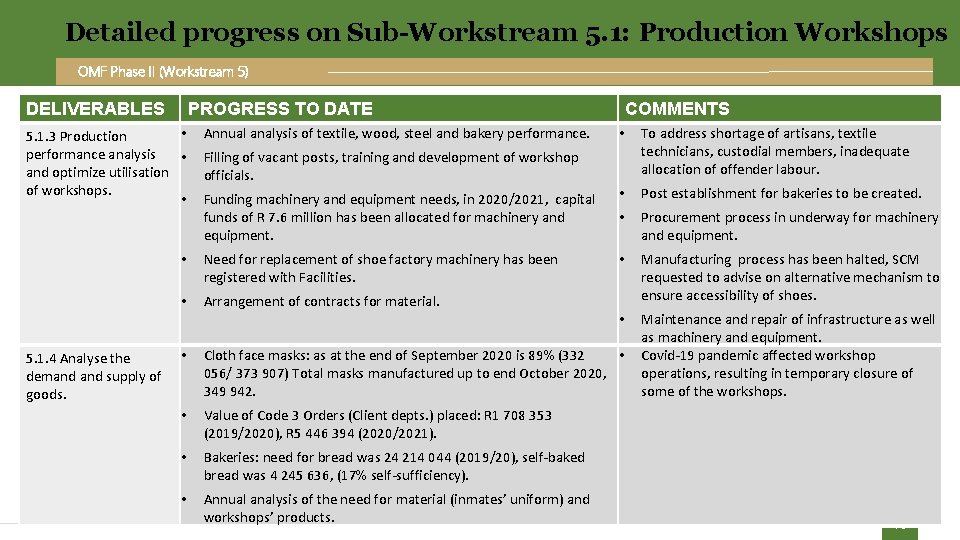
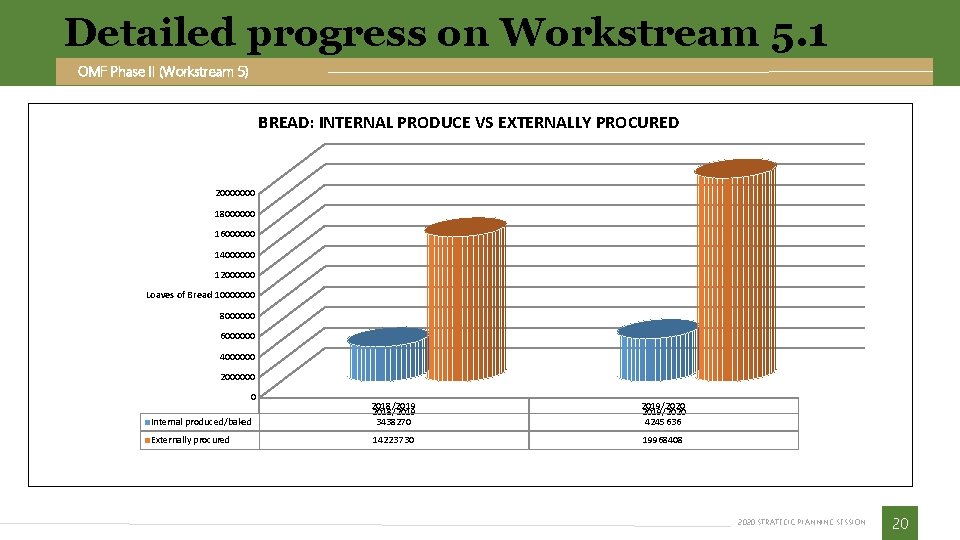
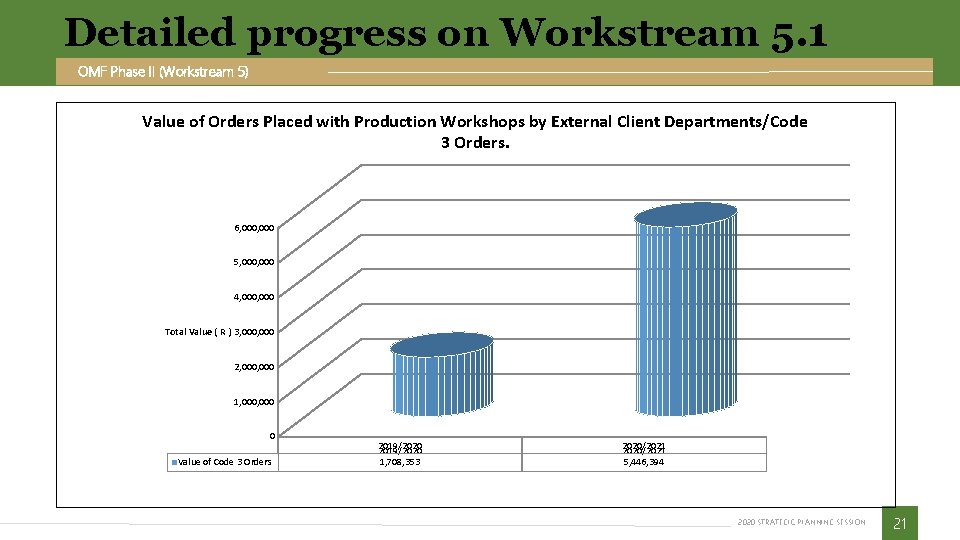
Detailed progress on Sub-Workstream 5. 1: Production Workshops OMF Phase II (Workstream 5) DELIVERABLES PROGRESS TO DATE • To address shortage of artisans, textile technicians, custodial members, inadequate allocation of offender labour. Funding machinery and equipment needs, in 2020/2021, capital funds of R 7. 6 million has been allocated for machinery and equipment. • Post establishment for bakeries to be created. • Procurement process in underway for machinery and equipment. • Need for replacement of shoe factory machinery has been registered with Facilities. • • Arrangement of contracts for material. Manufacturing process has been halted, SCM requested to advise on alternative mechanism to ensure accessibility of shoes. • Maintenance and repair of infrastructure as well as machinery and equipment. Covid-19 pandemic affected workshop operations, resulting in temporary closure of some of the workshops. • 5. 1. 3 Production performance analysis • and optimize utilisation of workshops. • 5. 1. 4 Analyse the demand supply of goods. Annual analysis of textile, wood, steel and bakery performance. COMMENTS Filling of vacant posts, training and development of workshop officials. • Cloth face masks: as at the end of September 2020 is 89% (332 • 056/ 373 907) Total masks manufactured up to end October 2020, 349 942. • Value of Code 3 Orders (Client depts. ) placed: R 1 708 353 (2019/2020), R 5 446 394 (2020/2021). • Bakeries: need for bread was 24 214 044 (2019/20), self-baked bread was 4 245 636, (17% self-sufficiency). • Annual analysis of the need for material (inmates’ uniform) and workshops’ products. 2020 STRATEGIC PLANNING SESSION 16
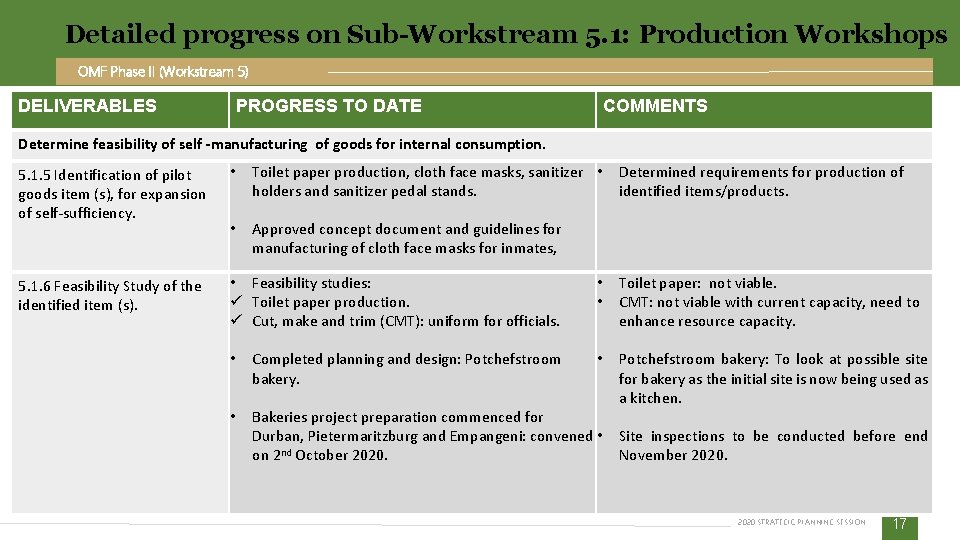
Detailed progress on Sub-Workstream 5. 1: Production Workshops OMF Phase II (Workstream 5) DELIVERABLES PROGRESS TO DATE COMMENTS Determine feasibility of self -manufacturing of goods for internal consumption. 5. 1. 5 Identification of pilot goods item (s), for expansion of self-sufficiency. • Toilet paper production, cloth face masks, sanitizer • holders and sanitizer pedal stands. Determined requirements for production of identified items/products. • Approved concept document and guidelines for manufacturing of cloth face masks for inmates, 5. 1. 6 Feasibility Study of the identified item (s). • Feasibility studies: ü Toilet paper production. ü Cut, make and trim (CMT): uniform for officials. • • Toilet paper: not viable. CMT: not viable with current capacity, need to enhance resource capacity. • Completed planning and design: Potchefstroom bakery. • • Bakeries project preparation commenced for Durban, Pietermaritzburg and Empangeni: convened • on 2 nd October 2020. Potchefstroom bakery: To look at possible site for bakery as the initial site is now being used as a kitchen. Site inspections to be conducted before end November 2020 STRATEGIC PLANNING SESSION 17
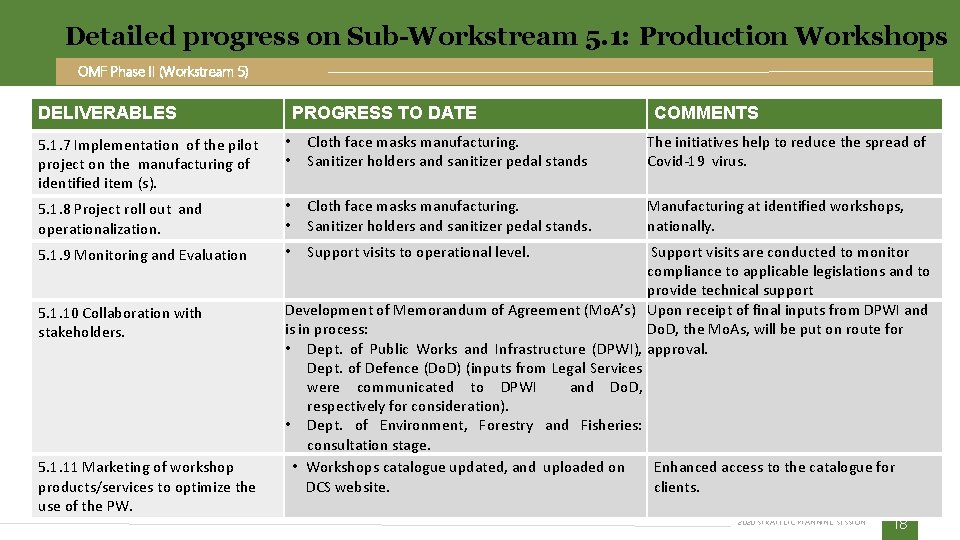
Detailed progress on Sub-Workstream 5. 1: Production Workshops OMF Phase II (Workstream 5) DELIVERABLES PROGRESS TO DATE COMMENTS 5. 1. 7 Implementation of the pilot project on the manufacturing of identified item (s). • • Cloth face masks manufacturing. Sanitizer holders and sanitizer pedal stands The initiatives help to reduce the spread of Covid-19 virus. 5. 1. 8 Project roll out and operationalization. • • Cloth face masks manufacturing. Sanitizer holders and sanitizer pedal stands. Manufacturing at identified workshops, nationally. 5. 1. 9 Monitoring and Evaluation • 5. 1. 10 Collaboration with stakeholders. 5. 1. 11 Marketing of workshop products/services to optimize the use of the PW. Support visits to operational level. Support visits are conducted to monitor compliance to applicable legislations and to provide technical support Development of Memorandum of Agreement (Mo. A’s) Upon receipt of final inputs from DPWI and is in process: Do. D, the Mo. As, will be put on route for • Dept. of Public Works and Infrastructure (DPWI), approval. Dept. of Defence (Do. D) (inputs from Legal Services were communicated to DPWI and Do. D, respectively for consideration). • Dept. of Environment, Forestry and Fisheries: consultation stage. • Workshops catalogue updated, and uploaded on Enhanced access to the catalogue for DCS website. clients. 2020 STRATEGIC PLANNING SESSION 18
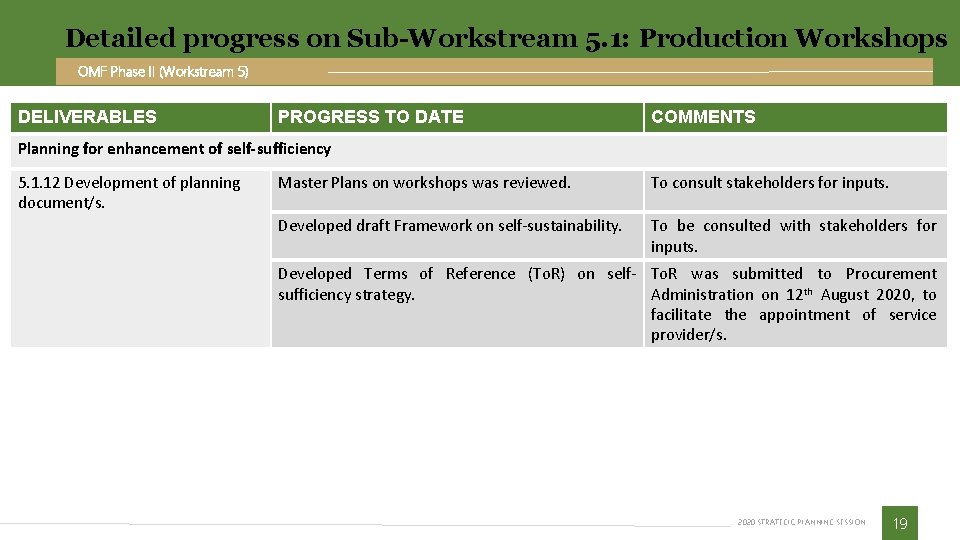
Detailed progress on Sub-Workstream 5. 1: Production Workshops OMF Phase II (Workstream 5) DELIVERABLES PROGRESS TO DATE COMMENTS Planning for enhancement of self-sufficiency 5. 1. 12 Development of planning document/s. Master Plans on workshops was reviewed. To consult stakeholders for inputs. Developed draft Framework on self-sustainability. To be consulted with stakeholders for inputs. Developed Terms of Reference (To. R) on self- To. R was submitted to Procurement sufficiency strategy. Administration on 12 th August 2020, to facilitate the appointment of service provider/s. 2020 STRATEGIC PLANNING SESSION 19
Detailed progress on Workstream 5. 1 OMF Phase II (Workstream 5) BREAD: INTERNAL PRODUCE VS EXTERNALLY PROCURED 20000000 18000000 16000000 14000000 12000000 Loaves of Bread 10000000 8000000 6000000 4000000 2000000 0 Internal produced/baked 2018/2019 3438270 2019/2020 4245636 Externally procured 14223730 19968408 2020 STRATEGIC PLANNING SESSION 20
Detailed progress on Workstream 5. 1 OMF Phase II (Workstream 5) Value of Orders Placed with Production Workshops by External Client Departments/Code 3 Orders. 6, 000 5, 000 4, 000 Total Value ( R ) 3, 000 2, 000 1, 000 0 Value of Code 3 Orders 2019/2020 1, 708, 353 2020/2021 5, 446, 394 2020 STRATEGIC PLANNING SESSION 21
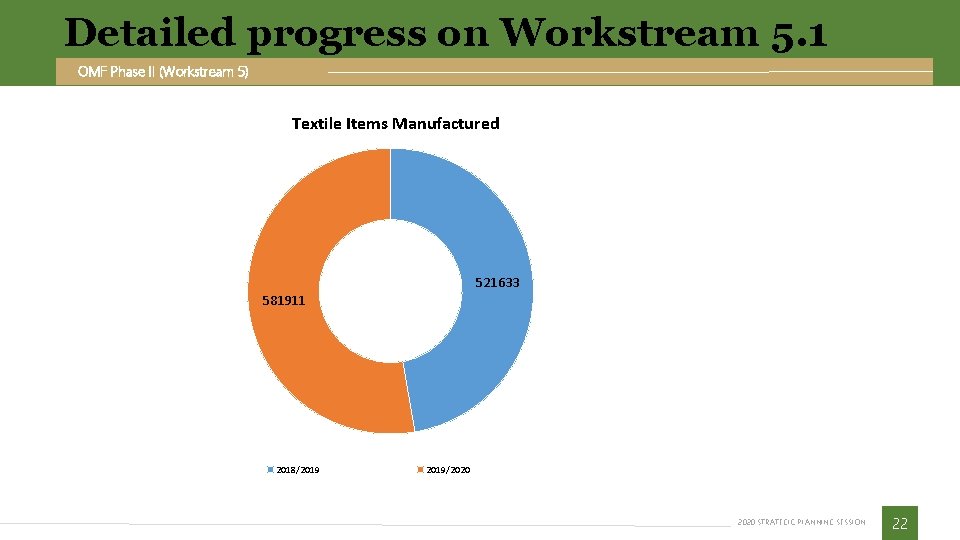
Detailed progress on Workstream 5. 1 OMF Phase II (Workstream 5) Textile Items Manufactured 521633 581911 2018/2019/2020 STRATEGIC PLANNING SESSION 22
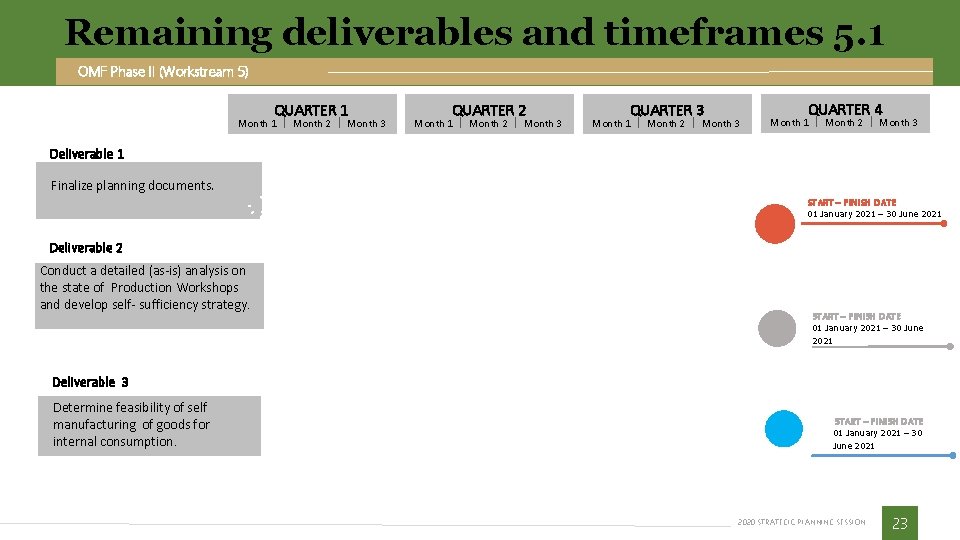
Remaining deliverables and timeframes 5. 1 OMF Phase II (Workstream 5) QUARTER 1 Month 2 Month 3 QUARTER 2 Month 1 Month 2 Month 3 QUARTER 3 Month 1 Month 2 Month 3 QUARTER 4 Month 1 Month 2 Month 3 Deliverable 1 Finalize planning documents. START – FINISH DATE 01 January 2021 – 30 June 2021 Deliverable 2 Conduct a detailed (as-is) analysis on the state of Production Workshops and develop self- sufficiency strategy. START – FINISH DATE 01 January 2021 – 30 June 2021 Deliverable 3 Determine feasibility of self manufacturing of goods for internal consumption. START – FINISH DATE 01 January 2021 – 30 June 2021 2020 STRATEGIC PLANNING SESSION 23
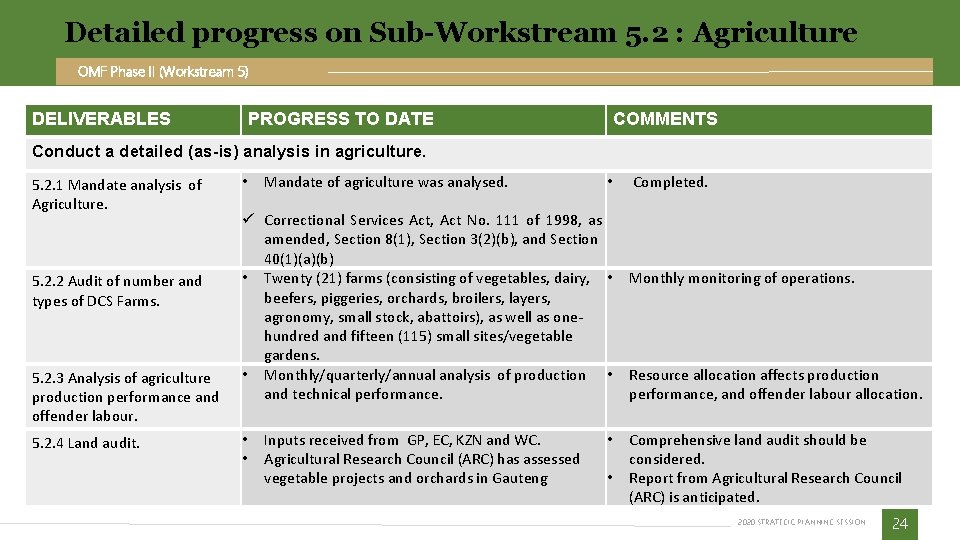
Detailed progress on Sub-Workstream 5. 2 : Agriculture OMF Phase II (Workstream 5) DELIVERABLES PROGRESS TO DATE COMMENTS Conduct a detailed (as-is) analysis in agriculture. 5. 2. 1 Mandate analysis of Agriculture. 5. 2. 2 Audit of number and types of DCS Farms. 5. 2. 3 Analysis of agriculture production performance and offender labour. 5. 2. 4 Land audit. • Mandate of agriculture was analysed. • ü Correctional Services Act, Act No. 111 of 1998, as amended, Section 8(1), Section 3(2)(b), and Section 40(1)(a)(b) • Twenty (21) farms (consisting of vegetables, dairy, • beefers, piggeries, orchards, broilers, layers, agronomy, small stock, abattoirs), as well as onehundred and fifteen (115) small sites/vegetable gardens. • Monthly/quarterly/annual analysis of production • and technical performance. • • Inputs received from GP, EC, KZN and WC. Agricultural Research Council (ARC) has assessed vegetable projects and orchards in Gauteng • • Completed. Monthly monitoring of operations. Resource allocation affects production performance, and offender labour allocation. Comprehensive land audit should be considered. Report from Agricultural Research Council (ARC) is anticipated. 2020 STRATEGIC PLANNING SESSION 24
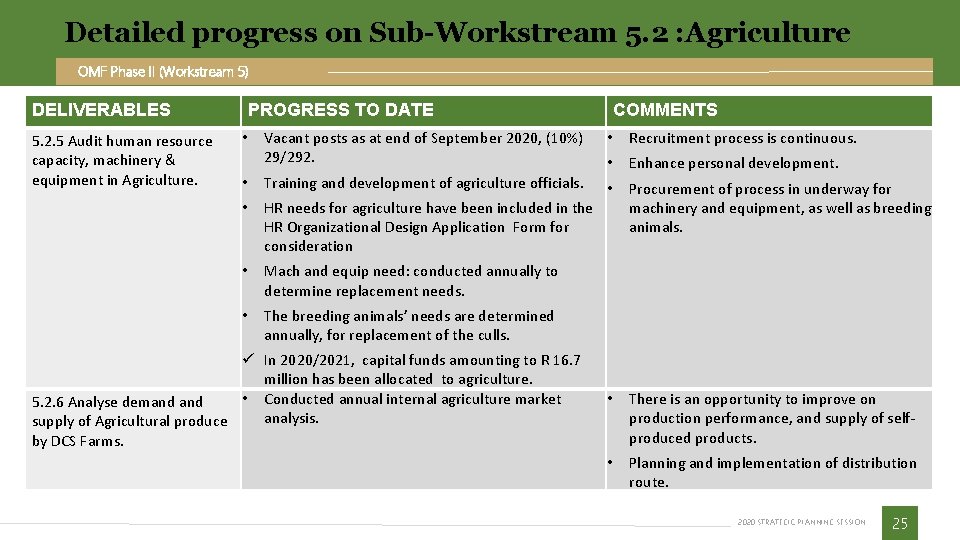
Detailed progress on Sub-Workstream 5. 2 : Agriculture OMF Phase II (Workstream 5) DELIVERABLES 5. 2. 5 Audit human resource capacity, machinery & equipment in Agriculture. PROGRESS TO DATE COMMENTS Vacant posts as at end of September 2020, (10%) 29/292. • Recruitment process is continuous. • • Training and development of agriculture officials. Enhance personal development. • • HR needs for agriculture have been included in the HR Organizational Design Application Form for consideration Procurement of process in underway for machinery and equipment, as well as breeding animals. • Mach and equip need: conducted annually to determine replacement needs. • The breeding animals’ needs are determined annually, for replacement of the culls. • There is an opportunity to improve on production performance, and supply of selfproduced products. • Planning and implementation of distribution route. • ü In 2020/2021, capital funds amounting to R 16. 7 million has been allocated to agriculture. • Conducted annual internal agriculture market 5. 2. 6 Analyse demand analysis. supply of Agricultural produce by DCS Farms. 2020 STRATEGIC PLANNING SESSION 25
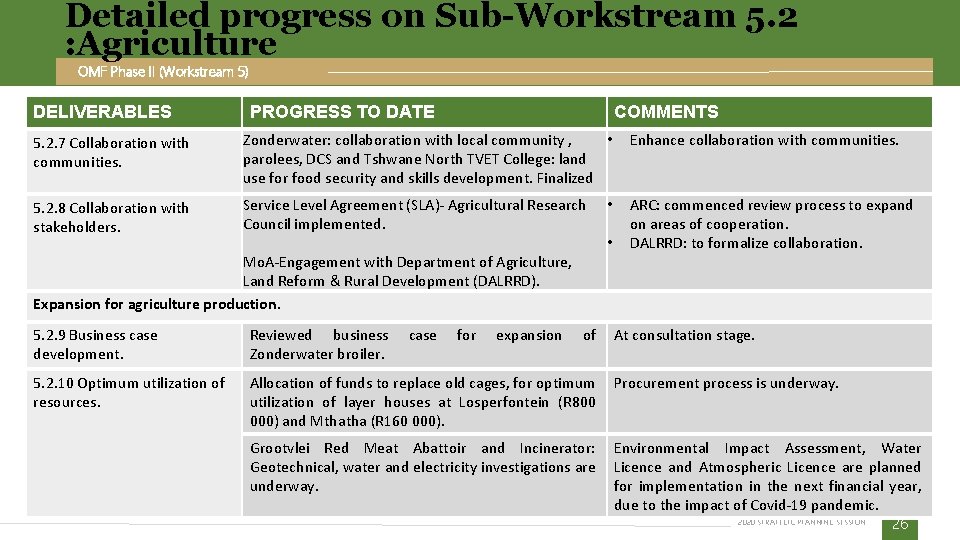
Detailed progress on Sub-Workstream 5. 2 : Agriculture OMF Phase II (Workstream 5) DELIVERABLES PROGRESS TO DATE COMMENTS 5. 2. 7 Collaboration with communities. Zonderwater: collaboration with local community , • parolees, DCS and Tshwane North TVET College: land use for food security and skills development. Finalized Enhance collaboration with communities. 5. 2. 8 Collaboration with stakeholders. Service Level Agreement (SLA)- Agricultural Research Council implemented. ARC: commenced review process to expand on areas of cooperation. DALRRD: to formalize collaboration. Mo. A-Engagement with Department of Agriculture, Land Reform & Rural Development (DALRRD). Expansion for agriculture production. case for expansion of • • 5. 2. 9 Business case development. Reviewed business Zonderwater broiler. At consultation stage. 5. 2. 10 Optimum utilization of resources. Allocation of funds to replace old cages, for optimum utilization of layer houses at Losperfontein (R 800 000) and Mthatha (R 160 000). Procurement process is underway. Grootvlei Red Meat Abattoir and Incinerator: Geotechnical, water and electricity investigations are underway. Environmental Impact Assessment, Water Licence and Atmospheric Licence are planned for implementation in the next financial year, due to the impact of Covid-19 pandemic. 2020 STRATEGIC PLANNING SESSION 26
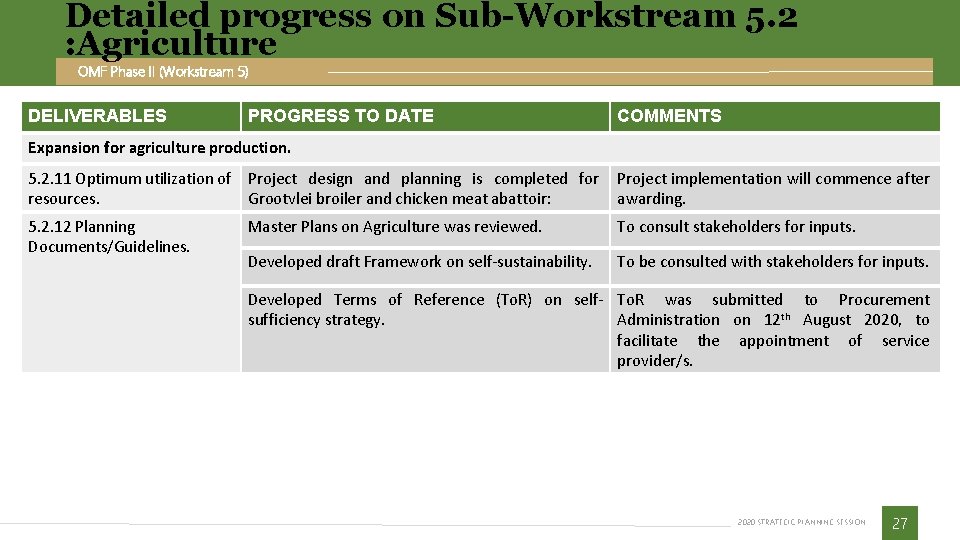
Detailed progress on Sub-Workstream 5. 2 : Agriculture OMF Phase II (Workstream 5) DELIVERABLES PROGRESS TO DATE COMMENTS Expansion for agriculture production. 5. 2. 11 Optimum utilization of Project design and planning is completed for resources. Grootvlei broiler and chicken meat abattoir: Project implementation will commence after awarding. 5. 2. 12 Planning Documents/Guidelines. Master Plans on Agriculture was reviewed. To consult stakeholders for inputs. Developed draft Framework on self-sustainability. To be consulted with stakeholders for inputs. Developed Terms of Reference (To. R) on self- To. R was submitted to Procurement sufficiency strategy. Administration on 12 th August 2020, to facilitate the appointment of service provider/s. 2020 STRATEGIC PLANNING SESSION 27
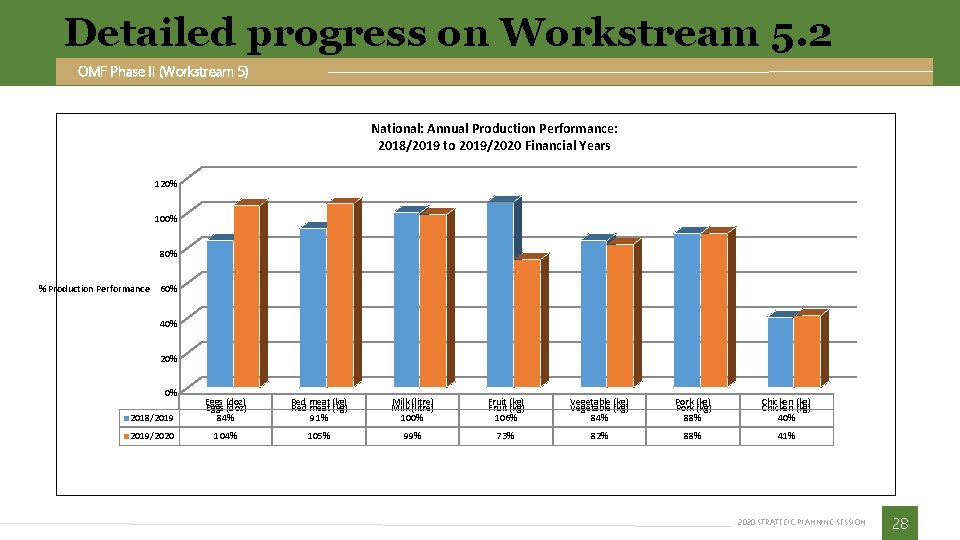
Detailed progress on Workstream 5. 2 OMF Phase II (Workstream 5) National: Annual Production Performance: 2018/2019 to 2019/2020 Financial Years 120% 100% 80% % Production Performance 60% 40% 20% 0% 2018/2019 Eggs (doz) 84% Red meat (kg) 91% Milk (litre) 100% Fruit (kg) 106% Vegetable (kg) 84% Pork (kg) 88% Chicken (kg) 40% 2019/2020 104% 105% 99% 73% 82% 88% 41% 2020 STRATEGIC PLANNING SESSION 28
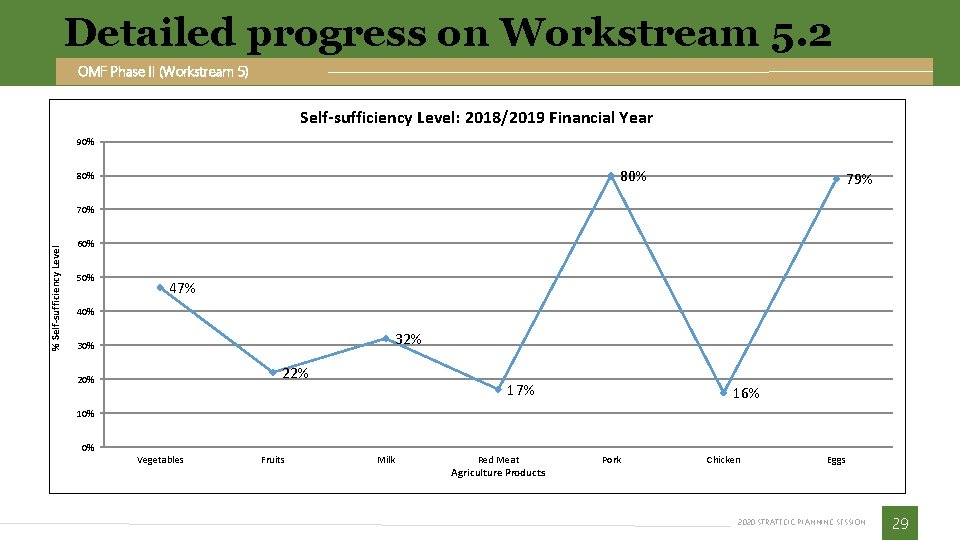
Detailed progress on Workstream 5. 2 OMF Phase II (Workstream 5) Self-sufficiency Level: 2018/2019 Financial Year 90% 80% 79% % Self-sufficiency Level 70% 60% 50% 47% 40% 32% 30% 22% 20% 17% 16% 10% 0% Vegetables Fruits Milk Red Meat Agriculture Products Pork Chicken Eggs 2020 STRATEGIC PLANNING SESSION 29
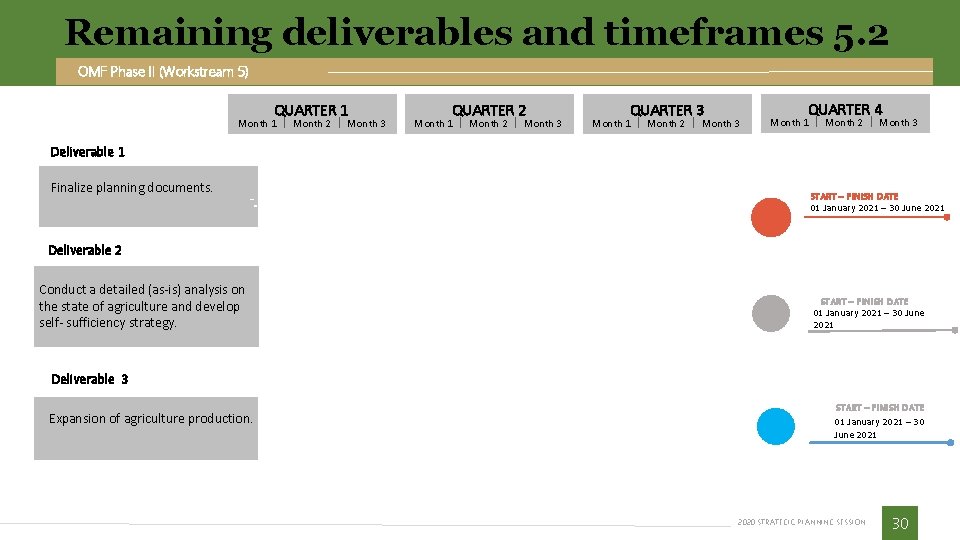
Remaining deliverables and timeframes 5. 2 OMF Phase II (Workstream 5) QUARTER 1 Month 2 Month 3 QUARTER 2 Month 1 Month 2 Month 3 QUARTER 3 Month 1 Month 2 Month 3 QUARTER 4 Month 1 Month 2 Month 3 Deliverable 1 Finalize planning documents. START – FINISH DATE 01 January 2021 – 30 June 2021 Deliverable 2 Conduct a detailed (as-is) analysis on the state of agriculture and develop self- sufficiency strategy. START – FINISH DATE 01 January 2021 – 30 June 2021 Deliverable 3 Expansion of agriculture production. START – FINISH DATE 01 January 2021 – 30 June 2021 2020 STRATEGIC PLANNING SESSION 30
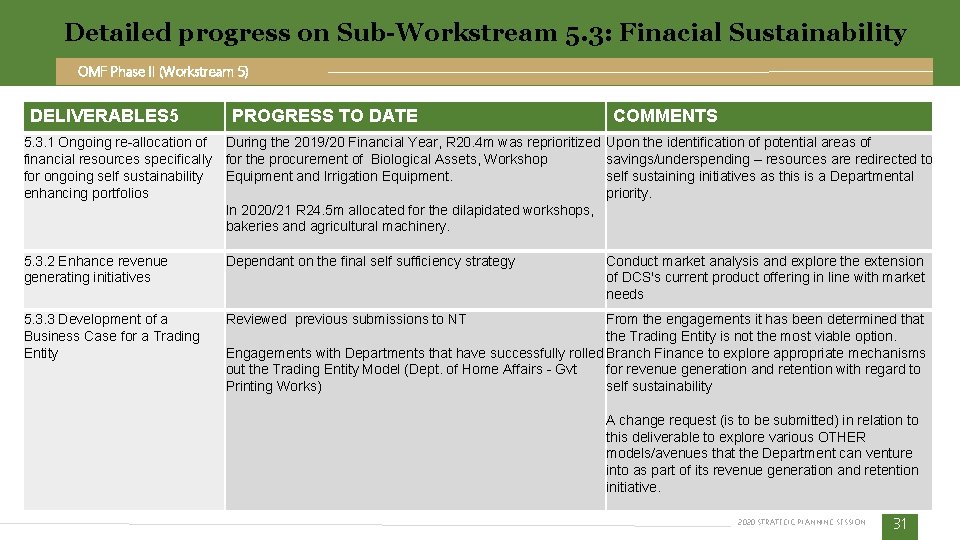
Detailed progress on Sub-Workstream 5. 3: Finacial Sustainability OMF Phase II (Workstream 5) DELIVERABLES 5 PROGRESS TO DATE COMMENTS 5. 3. 1 Ongoing re-allocation of During the 2019/20 Financial Year, R 20. 4 m was reprioritized financial resources specifically for the procurement of Biological Assets, Workshop for ongoing self sustainability Equipment and Irrigation Equipment. enhancing portfolios In 2020/21 R 24. 5 m allocated for the dilapidated workshops, bakeries and agricultural machinery. Upon the identification of potential areas of savings/underspending – resources are redirected to self sustaining initiatives as this is a Departmental priority. 5. 3. 2 Enhance revenue generating initiatives Dependant on the final self sufficiency strategy Conduct market analysis and explore the extension of DCS's current product offering in line with market needs 5. 3. 3 Development of a Business Case for a Trading Entity Reviewed previous submissions to NT From the engagements it has been determined that the Trading Entity is not the most viable option. Engagements with Departments that have successfully rolled Branch Finance to explore appropriate mechanisms out the Trading Entity Model (Dept. of Home Affairs - Gvt for revenue generation and retention with regard to Printing Works) self sustainability A change request (is to be submitted) in relation to this deliverable to explore various OTHER models/avenues that the Department can venture into as part of its revenue generation and retention initiative. 2020 STRATEGIC PLANNING SESSION 31
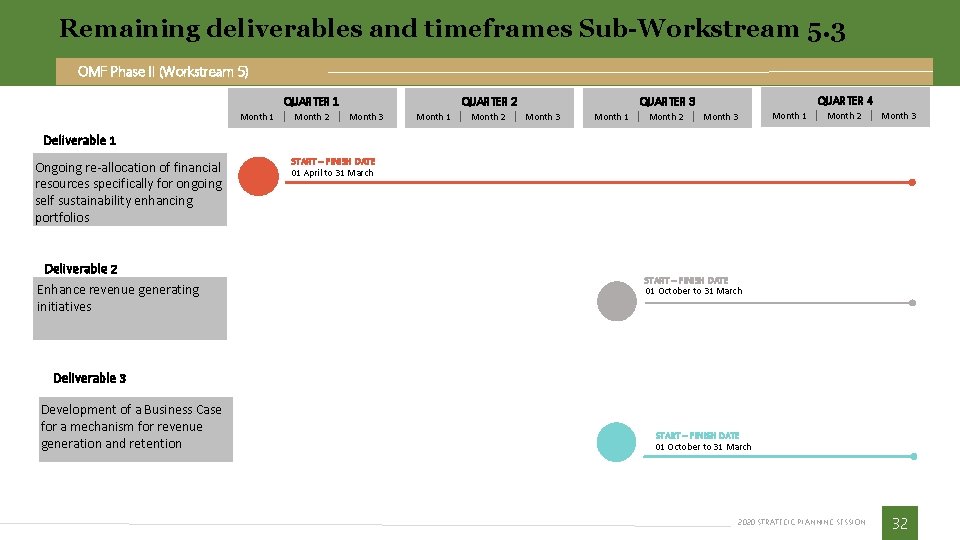
Remaining deliverables and timeframes Sub-Workstream 5. 3 OMF Phase II (Workstream 5) Month 2 Month 3 Month 1 Month 2 QUARTER 4 QUARTER 3 QUARTER 2 QUARTER 1 Month 3 Month 1 Month 2 Month 1 Month 3 Month 2 Month 3 Deliverable 1 Ongoing re-allocation of financial resources specifically for ongoing self sustainability enhancing portfolios Deliverable 2 Enhance revenue generating initiatives START – FINISH DATE 01 April to 31 March START – FINISH DATE 01 October to 31 March Deliverable 3 Development of a Business Case for a mechanism for revenue generation and retention START – FINISH DATE 01 October to 31 March 2020 STRATEGIC PLANNING SESSION 32
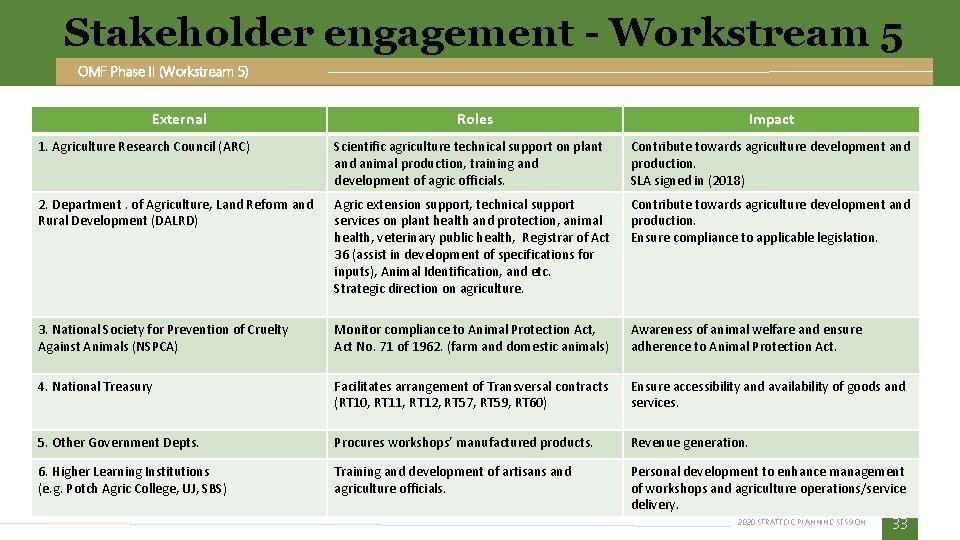
Stakeholder engagement - Workstream 5 OMF Phase II (Workstream 5) External Roles Impact 1. Agriculture Research Council (ARC) Scientific agriculture technical support on plant and animal production, training and development of agric officials. Contribute towards agriculture development and production. SLA signed in (2018) 2. Department. of Agriculture, Land Reform and Rural Development (DALRD) Agric extension support, technical support services on plant health and protection, animal health, veterinary public health, Registrar of Act 36 (assist in development of specifications for inputs), Animal Identification, and etc. Strategic direction on agriculture. Contribute towards agriculture development and production. Ensure compliance to applicable legislation. 3. National Society for Prevention of Cruelty Against Animals (NSPCA) Monitor compliance to Animal Protection Act, Act No. 71 of 1962. (farm and domestic animals) Awareness of animal welfare and ensure adherence to Animal Protection Act. 4. National Treasury Facilitates arrangement of Transversal contracts (RT 10, RT 11, RT 12, RT 57, RT 59, RT 60) Ensure accessibility and availability of goods and services. 5. Other Government Depts. Procures workshops’ manufactured products. Revenue generation. 6. Higher Learning Institutions (e. g. Potch Agric College, UJ, SBS) Training and development of artisans and agriculture officials. Personal development to enhance management of workshops and agriculture operations/service delivery. 2020 STRATEGIC PLANNING SESSION 33
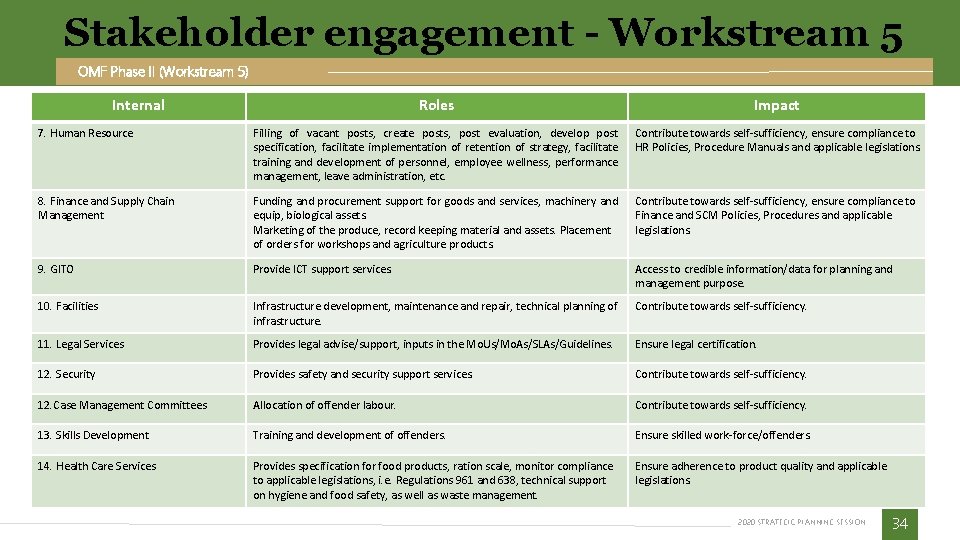
Stakeholder engagement - Workstream 5 OMF Phase II (Workstream 5) Internal Roles Impact 7. Human Resource Filling of vacant posts, create posts, post evaluation, develop post specification, facilitate implementation of retention of strategy, facilitate training and development of personnel, employee wellness, performance management, leave administration, etc. Contribute towards self-sufficiency, ensure compliance to HR Policies, Procedure Manuals and applicable legislations. 8. Finance and Supply Chain Management Funding and procurement support for goods and services, machinery and equip, biological assets. Marketing of the produce, record keeping material and assets. Placement of orders for workshops and agriculture products. Contribute towards self-sufficiency, ensure compliance to Finance and SCM Policies, Procedures and applicable legislations. 9. GITO Provide ICT support services. Access to credible information/data for planning and management purpose. 10. Facilities Infrastructure development, maintenance and repair, technical planning of infrastructure. Contribute towards self-sufficiency. 11. Legal Services Provides legal advise/support, inputs in the Mo. Us/Mo. As/SLAs/Guidelines. Ensure legal certification. 12. Security Provides safety and security support services. Contribute towards self-sufficiency. 12. Case Management Committees Allocation of offender labour. Contribute towards self-sufficiency. 13. Skills Development Training and development of offenders. Ensure skilled work-force/offenders. 14. Health Care Services Provides specification for food products, ration scale, monitor compliance to applicable legislations, i. e. Regulations 961 and 638, technical support on hygiene and food safety, as well as waste management. Ensure adherence to product quality and applicable legislations. 2020 STRATEGIC PLANNING SESSION 34
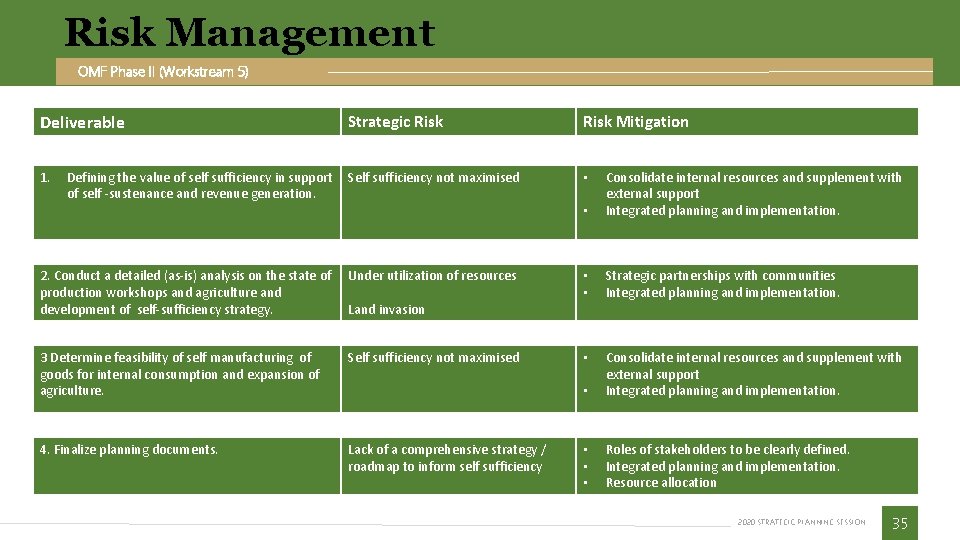
Risk Management OMF Phase II (Workstream 5) Deliverable Strategic Risk Mitigation 1. Defining the value of self sufficiency in support of self -sustenance and revenue generation. Self sufficiency not maximised • 2. Conduct a detailed (as-is) analysis on the state of production workshops and agriculture and development of self-sufficiency strategy. Under utilization of resources 3 Determine feasibility of self manufacturing of goods for internal consumption and expansion of agriculture. Self sufficiency not maximised 4. Finalize planning documents. Lack of a comprehensive strategy / roadmap to inform self sufficiency • Consolidate internal resources and supplement with external support Integrated planning and implementation. • • Strategic partnerships with communities Integrated planning and implementation. • • Consolidate internal resources and supplement with external support Integrated planning and implementation. • • • Roles of stakeholders to be clearly defined. Integrated planning and implementation. Resource allocation Land invasion 2020 STRATEGIC PLANNING SESSION 35
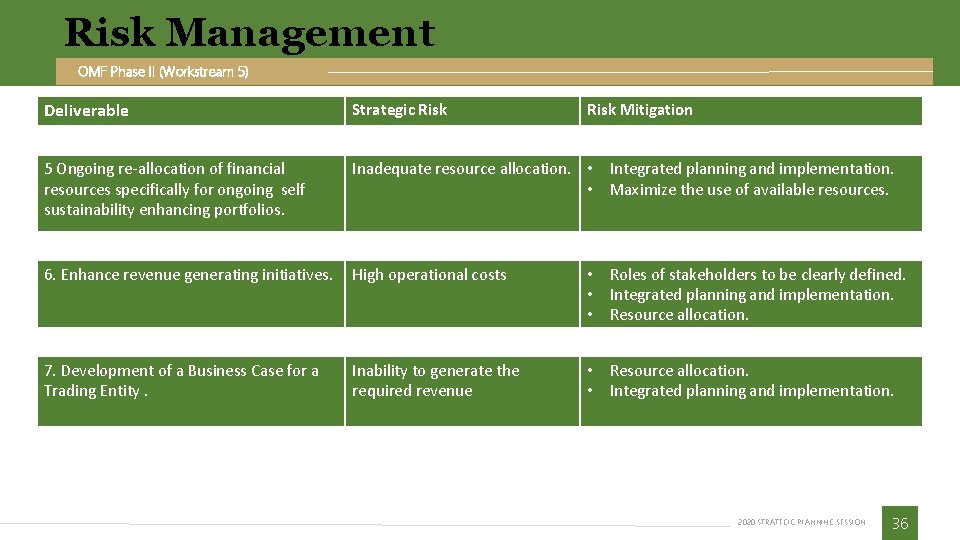
Risk Management OMF Phase II (Workstream 5) Deliverable Strategic Risk 5 Ongoing re-allocation of financial resources specifically for ongoing self sustainability enhancing portfolios. Inadequate resource allocation. • Integrated planning and implementation. • Maximize the use of available resources. 6. Enhance revenue generating initiatives. High operational costs • Roles of stakeholders to be clearly defined. • Integrated planning and implementation. • Resource allocation. 7. Development of a Business Case for a Trading Entity. Inability to generate the required revenue • Resource allocation. • Integrated planning and implementation. Risk Mitigation 2020 STRATEGIC PLANNING SESSION 36
Conclusion OMF Phase II (Workstream 5) 1. An integrated approach towards the enhancement of self-sufficiency holds the key to unlocking challenges that inhibit progress, enhancing cost savings and revenue generation. 2. Support services play a critical role in enabling business/functionaries to achieve the set goals/deliverables. 3. Enhancing compliance with applicable legislations, policies and procedures, could impact positively on the set deliverables. 4. The need for resource assessment, development of self-sufficiency strategy is still pivotal. The limited time frame in the current financial year, pose a challenge to implement activities as it was initially envisaged in the beginning of the financial year. 5. The master plans could be considered for implementation of the self-sufficiency deliverables (in the 2021/2022 financial year), whilst anticipating the development of the strategy. 2020 STRATEGIC PLANNING SESSION 37
THANK YOU