
2020 ANNUAL STRATEGIC PLANNING SESSION OMF PHASE II






- Slides: 27
2020 ANNUAL STRATEGIC PLANNING SESSION OMF PHASE II WORKSTREAM 4
-- Presentation outline 1. 2. 3. 4. 5. 6. 7. 8. Purpose Legislative framework Public Service Operations Management Framework DCS Value Chain Composition of Work Streams & subwork streams Progress Workstream deliverables Planned deliverables and timeframes Conclusion
Purpose The purpose of the presentation is to: 1. Provide context to the DCS Operations Management Framework Phase II with a focus on the deliverables of Workstream 4: Change Management, and support to other workstreams in Phase Two 2. Provide a summary of the guiding prescripts, guidelines, policy mandates that inform the work to be delivered by Workstream 4: Change Management 3. Indicate the core members of Workstream 4: Change Management that have been appointed to deliver on Phase II 4. Provide progress of the work completed by Workstream 4: Change Management since the appointment of the workstream leaders and members in February 2019 5. Indicate the outstanding deliverables for Workstream 4: Change Management with timeframes against the OMF Phase II Charter 6. Provide concluding remarks on the deliverables of Workstream 4: Change Management and the movement into the next phase
Legislative framework - Workstream 4 • Flowing from the DCS Service Delivery Model (SDM) is the requirement to reexamine the department’s organisational design, as well as strengthening and amending governance frameworks and documents to ensure alignment to the SDM: § MTSF 2019 -2024: Outcome 3 – Education, skills and health § NDP 2030 – Chapter 12: Building Safer Communities § DCS Strategic Plan 2020 – 2025 § Tied to this SDM process is the adoption of a clear implementation framework, and change management plan, which recommends a staged implementation to enable organizational re-alignment § Change Management Workstream to provide support to other workstreams in Operations Design Phase § Implementation of the change management plan must be accompanied by dedicated resources to drive sustained change management
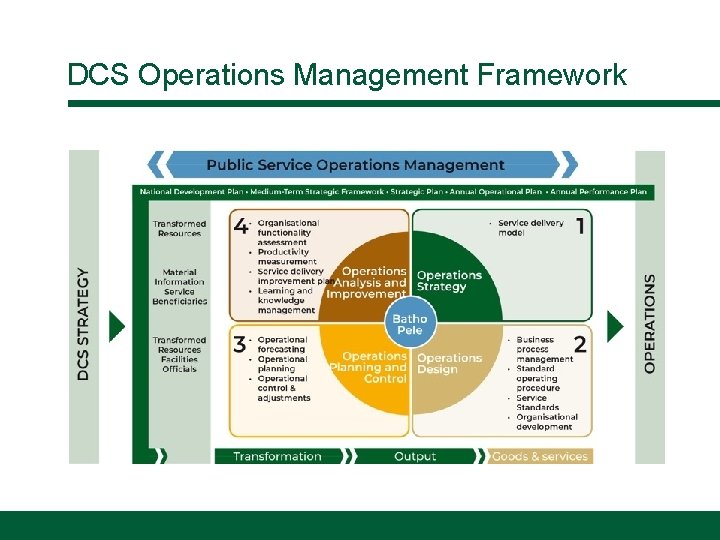
DCS Operations Management Framework
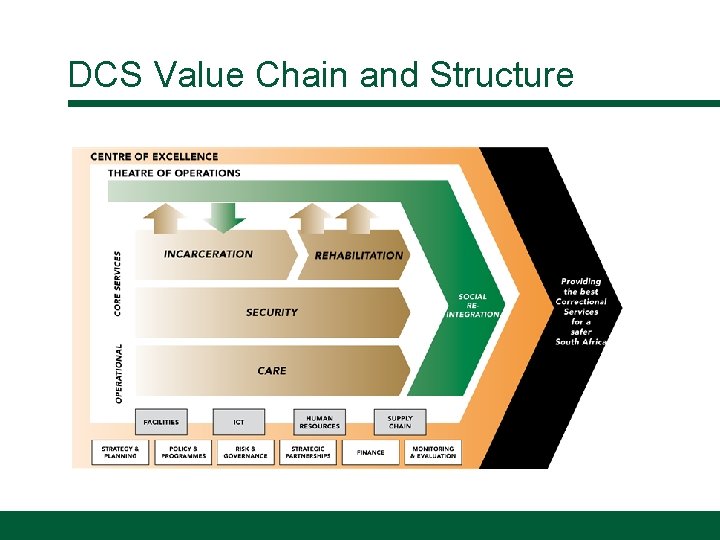
DCS Value Chain and Structure
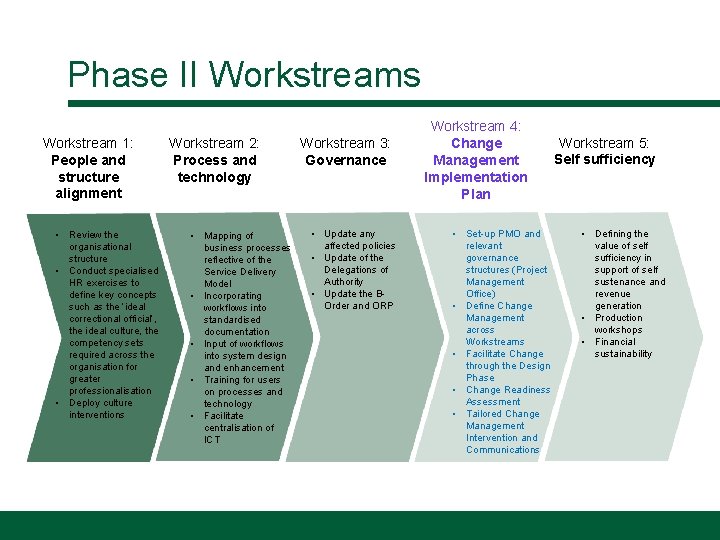
Phase II Workstreams Workstream 1: People and structure alignment • Review the organisational structure • Conduct specialised HR exercises to define key concepts such as the ‘ideal correctional official’, the ideal culture, the competency sets required across the organisation for greater professionalisation • Deploy culture interventions Workstream 2: Process and technology • Mapping of business processes reflective of the Service Delivery Model • Incorporating workflows into standardised documentation • Input of workflows into system design and enhancement • Training for users on processes and technology • Facilitate centralisation of ICT Workstream 3: Governance • Update any affected policies • Update of the Delegations of Authority • Update the BOrder and ORP Workstream 4: Change Management Implementation Plan • Set-up PMO and relevant governance structures (Project Management Office) • Define Change Management across Workstreams • Facilitate Change through the Design Phase • Change Readiness Assessment • Tailored Change Management Intervention and Communications Workstream 5: Self sufficiency • Defining the value of self sufficiency in support of self sustenance and revenue generation • Production workshops • Financial sustainability
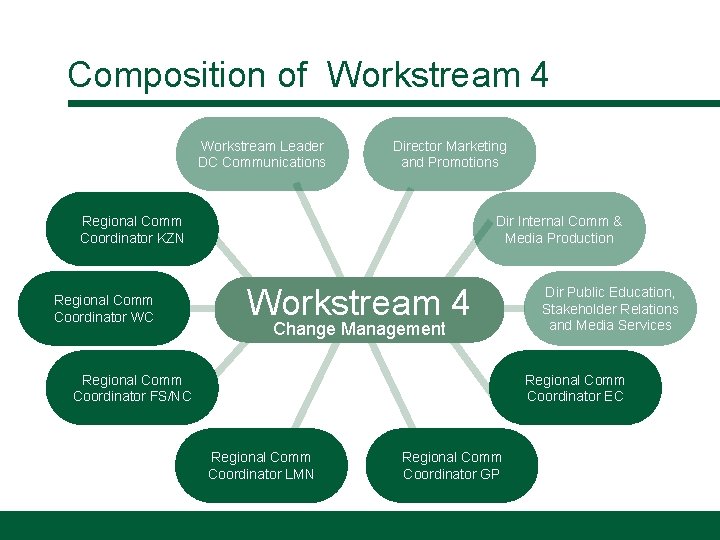
Composition of Workstream 4 Workstream Leader DC Communications Director Marketing and Promotions Regional Comm Coordinator KZN Regional Comm Coordinator WC Dir Internal Comm & Media Production Workstream 4 Change Management Regional Comm Coordinator FS/NC Dir Public Education, Stakeholder Relations and Media Services Regional Comm Coordinator EC Regional Comm Coordinator LMN Regional Comm Coordinator GP
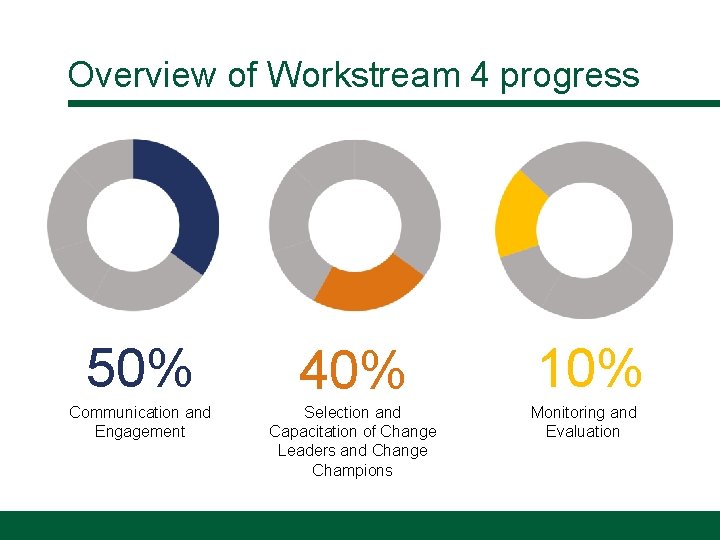
Overview of Workstream 4 progress 50% 40% Communication and Engagement Selection and Capacitation of Change Leaders and Change Champions 10% Monitoring and Evaluation
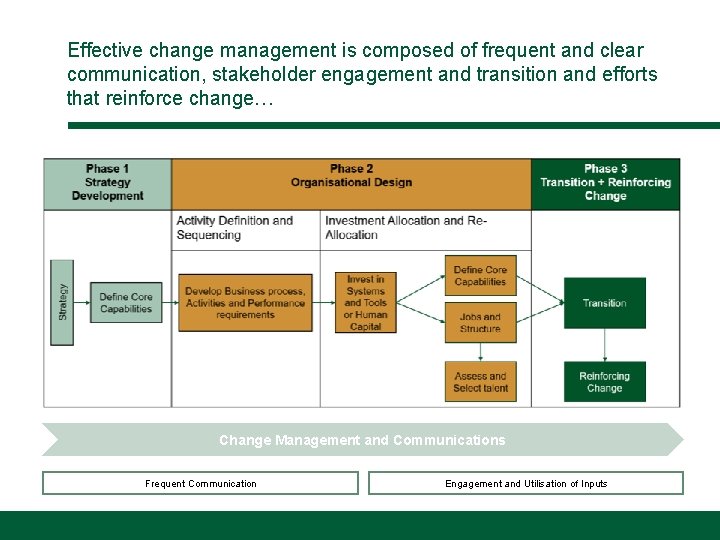
Effective change management is composed of frequent and clear communication, stakeholder engagement and transition and efforts that reinforce change… Change Management and Communications Frequent Communication Engagement and Utilisation of Inputs
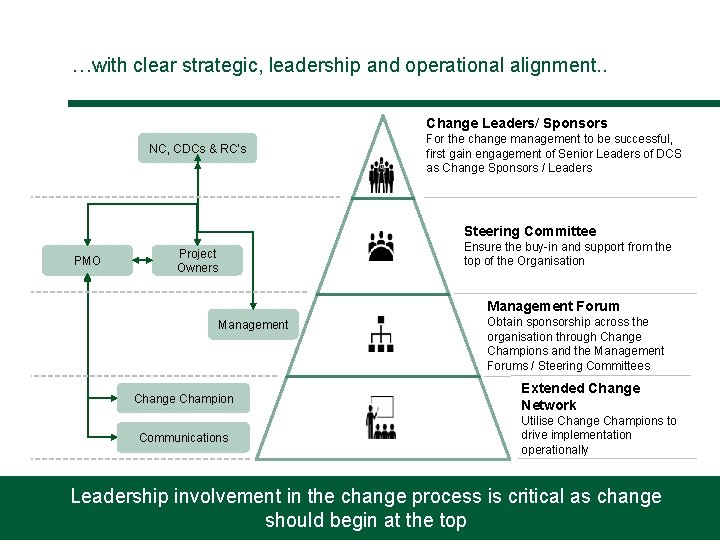
…with clear strategic, leadership and operational alignment. . Change Leaders/ Sponsors NC, CDCs & RC’s For the change management to be successful, first gain engagement of Senior Leaders of DCS as Change Sponsors / Leaders Steering Committee PMO Ensure the buy-in and support from the top of the Organisation Project Owners Management Forum Management Change Champion Communications Obtain sponsorship across the organisation through Change Champions the Management Champions and the Management Forums / Steering Committees Extended Change Network Utilise Change Champions to Change Champions drive. Utilise implementation to drive operationally implementation operationally Leadership involvement in the change process is critical as change should begin at the top
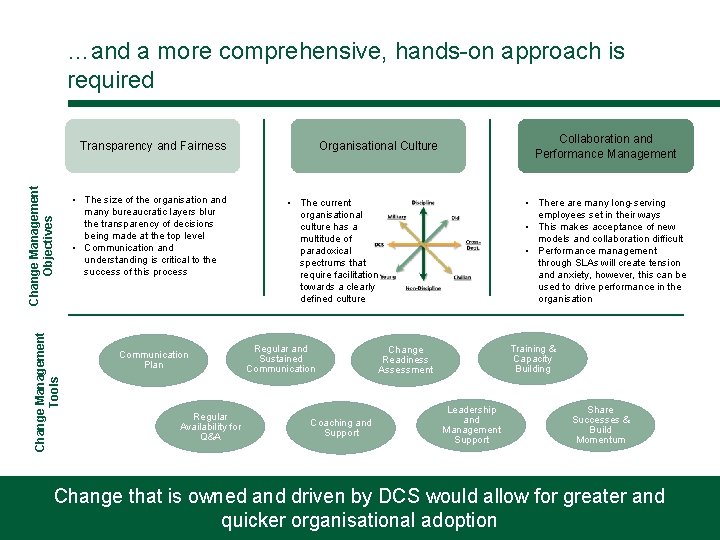
…and a more comprehensive, hands-on approach is required Change Management Tools Change Management Objectives Transparency and Fairness • The size of the organisation and many bureaucratic layers blur the transparency of decisions being made at the top level • Communication and understanding is critical to the success of this process Communication Plan Regular Availability for Q&A Collaboration and Performance Management Organisational Culture • The current organisational culture has a multitude of paradoxical spectrums that require facilitation towards a clearly defined culture Regular and Sustained Communication Coaching and Support • There are many long-serving employees set in their ways • This makes acceptance of new models and collaboration difficult • Performance management through SLAs will create tension and anxiety, however, this can be used to drive performance in the organisation Training & Capacity Building Change Readiness Assessment Leadership and Management Support Share Successes & Build Momentum Change that is owned and driven by DCS would allow for greater and quicker organisational adoption
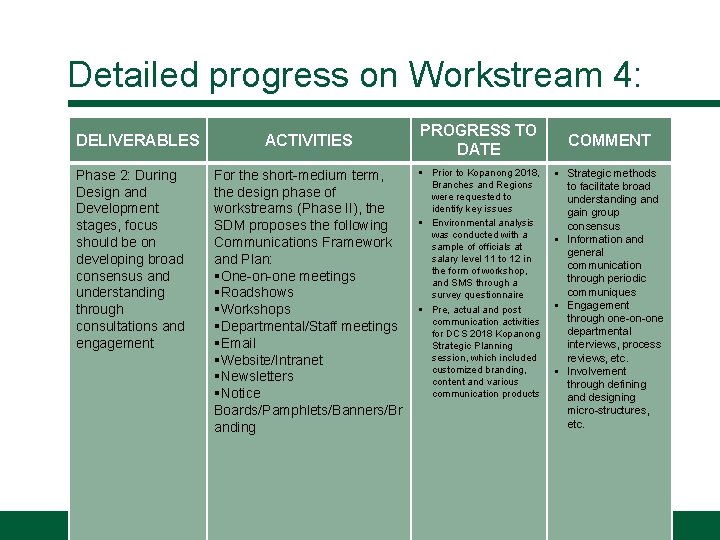
Detailed progress on Workstream 4: DELIVERABLES Phase 2: During Design and Development stages, focus should be on developing broad consensus and understanding through consultations and engagement ACTIVITIES For the short-medium term, the design phase of workstreams (Phase II), the SDM proposes the following Communications Framework and Plan: §One-on-one meetings §Roadshows §Workshops §Departmental/Staff meetings §Email §Website/Intranet §Newsletters §Notice Boards/Pamphlets/Banners/Br anding PROGRESS TO DATE § Prior to Kopanong 2018, Branches and Regions were requested to identify key issues § Environmental analysis was conducted with a sample of officials at salary level 11 to 12 in the form of workshop, and SMS through a survey questionnaire § Pre, actual and post communication activities for DCS 2018 Kopanong Strategic Planning session, which included customized branding, content and various communication products COMMENT § Strategic methods to facilitate broad understanding and gain group consensus § Information and general communication through periodic communiques § Engagement through one-on-one departmental interviews, process reviews, etc. § Involvement through defining and designing micro-structures, etc.
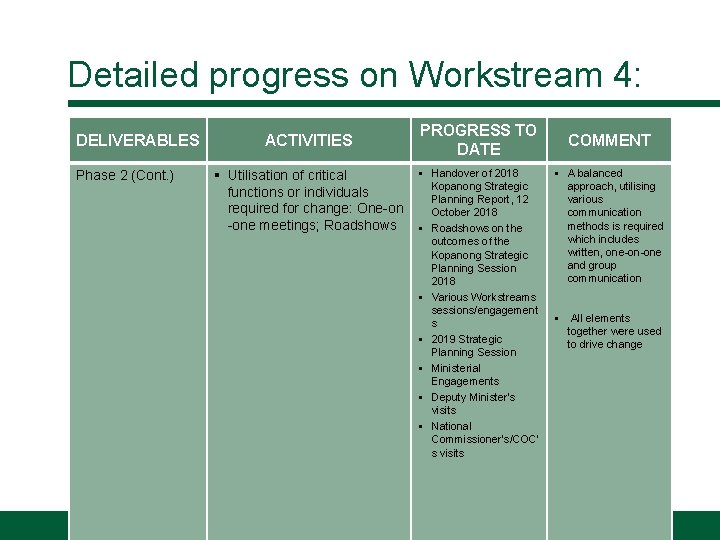
Detailed progress on Workstream 4: DELIVERABLES Phase 2 (Cont. ) ACTIVITIES § Utilisation of critical functions or individuals required for change: One-on -one meetings; Roadshows PROGRESS TO DATE § Handover of 2018 Kopanong Strategic Planning Report, 12 October 2018 § Roadshows on the outcomes of the Kopanong Strategic Planning Session 2018 § Various Workstreams sessions/engagement s § 2019 Strategic Planning Session § Ministerial Engagements § Deputy Minister’s visits § National Commissioner’s/COC’ s visits COMMENT § A balanced approach, utilising various communication methods is required which includes written, one-on-one and group communication § All elements together were used to drive change
Detailed progress on Workstream 4: DELIVERABLES Phase 2 (Cont. ) ACTIVITIES § Strategic methods to facilitate broad understanding and gain group consensus: Workshops; Departmental/Staff meetings PROGRESS TO DATE § Various Branch, Regional and Management Area Engagements § Since 2018, numerous communication support to the various workstreams and OMF processes as part of fostering change (e. g. ) o Insourcing of kitchens o HCCs Workshops o Covid-19 Response Strategy o DMRT Meetings o NOC, MOC, LOC COMMENT § This was done to: o Create anticipation by kicking-off implementation with multi-pronged communications, including emails, roadshows, pamphlets and notices o Follow-up and sustain through regular touchpoints, including departmental meetings, newsletters and email
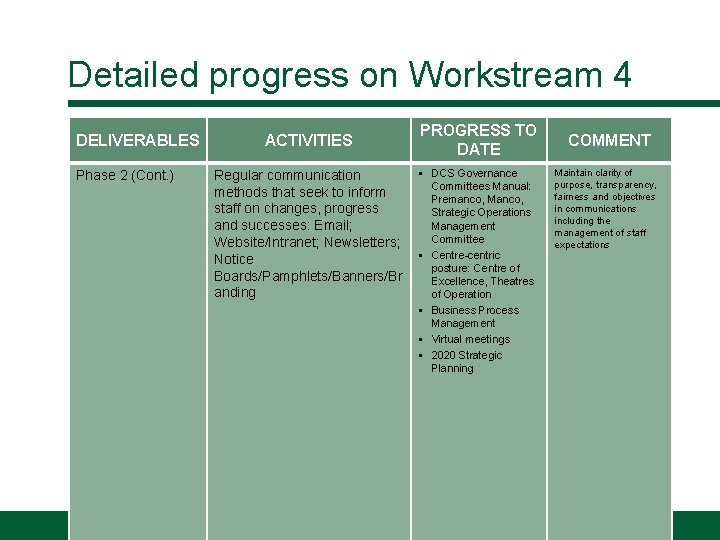
Detailed progress on Workstream 4 DELIVERABLES Phase 2 (Cont. ) ACTIVITIES Regular communication methods that seek to inform staff on changes, progress and successes: Email; Website/Intranet; Newsletters; Notice Boards/Pamphlets/Banners/Br anding PROGRESS TO DATE § DCS Governance Committees Manual: Premanco, Manco, Strategic Operations Management Committee § Centre-centric posture: Centre of Excellence, Theatres of Operation § Business Process Management § Virtual meetings § 2020 Strategic Planning COMMENT Maintain clarity of purpose, transparency, fairness and objectives in communications including the management of staff expectations
Detailed progress on Workstream 4 DELIVERABLES Define Change Management Across Workstreams ACTIVITIES PROGRESS TO DATE § Set up change Next Phase/s management workstreams with defined objectives and clear approach to change management § Enable the setup of change teams across DCS § Design Change Readiness Assessment framework and determine measures of change readiness COMMENT
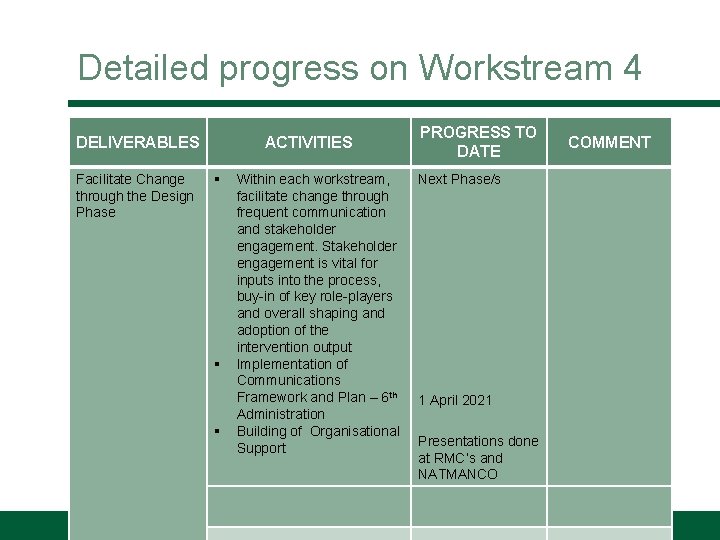
Detailed progress on Workstream 4 DELIVERABLES Facilitate Change through the Design Phase ACTIVITIES § § § Within each workstream, facilitate change through frequent communication and stakeholder engagement. Stakeholder engagement is vital for inputs into the process, buy-in of key role-players and overall shaping and adoption of the intervention output Implementation of Communications Framework and Plan – 6 th Administration Building of Organisational Support PROGRESS TO DATE Next Phase/s 1 April 2021 Presentations done at RMC’s and NATMANCO COMMENT
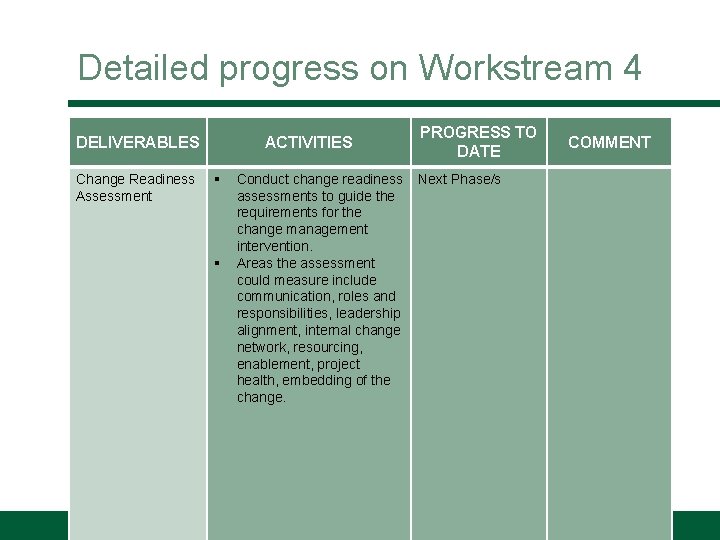
Detailed progress on Workstream 4 DELIVERABLES Change Readiness Assessment ACTIVITIES § § Conduct change readiness assessments to guide the requirements for the change management intervention. Areas the assessment could measure include communication, roles and responsibilities, leadership alignment, internal change network, resourcing, enablement, project health, embedding of the change. PROGRESS TO DATE Next Phase/s COMMENT
Detailed progress on Workstream 4 DELIVERABLES Tailored Change Management Intervention and Communications Monitoring and Evaluation of Change Process Sustain Change in DCS ACTIVITIES § Based on the findings of the assessment, tailored intervention must target weak areas and reinforce strength areas (e. g. ) the intervention could target a weak area of leadership alignment through greater leadership communication of a single, consistent message PROGRESS TO DATE Next Phase/s COMMENT
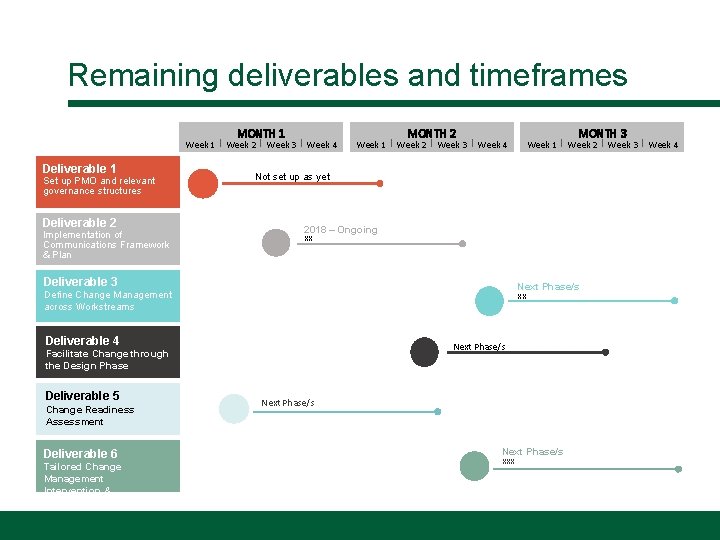
Remaining deliverables and timeframes Week 1 Deliverable 1 Set up PMO and relevant governance structures Deliverable 2 Implementation of Communications Framework & Plan MONTH 1 Week 2 Week 3 Week 4 MONTH 2 Week 1 Week 2 Week 3 Week 4 Not set up as yet 2018 – Ongoing xx Deliverable 3 Next Phase/s xx Define Change Management across Workstreams Deliverable 4 Next Phase/s Facilitate Change through the Design Phase Deliverable 5 Change Readiness Assessment Deliverable 6 Tailored Change Management Intervention & Communications MONTH 3 Week 1 Week 2 Next Phase/s xxx Week 3 Week 4
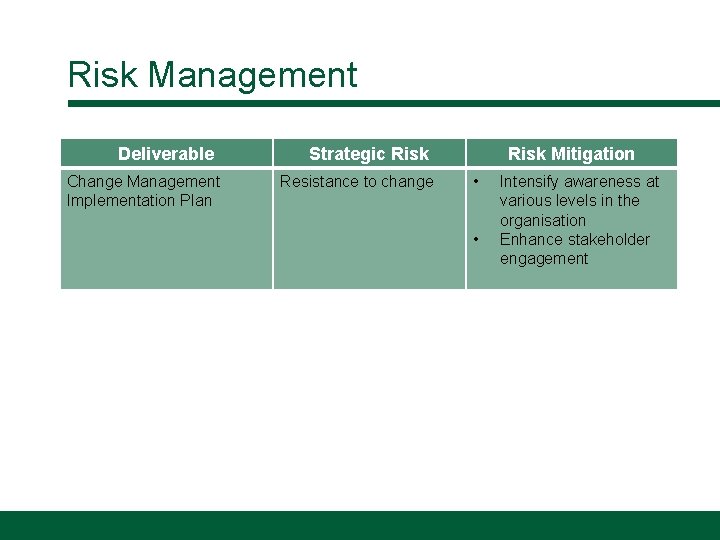
Risk Management Deliverable Change Management Implementation Plan Strategic Risk Resistance to change Risk Mitigation • • Intensify awareness at various levels in the organisation Enhance stakeholder engagement
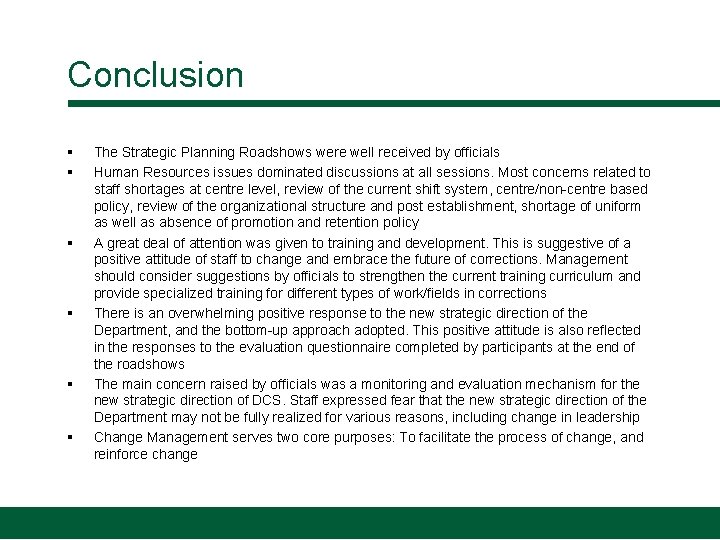
Conclusion § § § The Strategic Planning Roadshows were well received by officials Human Resources issues dominated discussions at all sessions. Most concerns related to staff shortages at centre level, review of the current shift system, centre/non-centre based policy, review of the organizational structure and post establishment, shortage of uniform as well as absence of promotion and retention policy A great deal of attention was given to training and development. This is suggestive of a positive attitude of staff to change and embrace the future of corrections. Management should consider suggestions by officials to strengthen the current training curriculum and provide specialized training for different types of work/fields in corrections There is an overwhelming positive response to the new strategic direction of the Department, and the bottom-up approach adopted. This positive attitude is also reflected in the responses to the evaluation questionnaire completed by participants at the end of the roadshows The main concern raised by officials was a monitoring and evaluation mechanism for the new strategic direction of DCS. Staff expressed fear that the new strategic direction of the Department may not be fully realized for various reasons, including change in leadership Change Management serves two core purposes: To facilitate the process of change, and reinforce change
Conclusion § § § § Within a large organisation such as DCS, change management becomes critical and must be effectively managed Cannot afford to adopt a trial and error, ad-hoc, approach, as this may cause irreparable harm As per Service Delivery Model (SDM), implementation of the change management plan must be accompanied by dedicated resources to drive sustained change management SDM: Setting-up PMO and relevant governance structures (Project Management Office) is imperative PMO responsible for Strategic Implementation and Change Management Support: provide technical expertise to solving key workstream or activity challenges; management of complexity that arises from migration; management of the change management process including communication protocols; ensuring transparency and compliance; key function of the PMO is monitoring and evaluation of the workstreams towards implementing the SDM As part of the next phase/s, change management focus shifts towards Training, Coaching and Support and Reinforcement Integral facets of Change Management include Coaching and Support, Leadership and Management Support as well as Training and Capacity Building
Conclusion § South Africa’s future rests with its people. As DCS, may we continue to both understand appreciate the great responsibility we have been tasked with; to help, to serve and to lead. We dare not let our country, and our people, down § Change is the law of life. And those who look only to the past or present are certain to miss the future (John F. Kennedy) § There is no better time than right now!
Questions?
Thank you!