
2020 Annual GSICS Calibration Report GEO Template for
2020 Annual GSICS Calibration Report - GEO
Template for 2020 (Revised based on the 2019 Template – Many thanks to Masaya Takahashi!) • Major satellite/Instrument events relevant to calibration and the impact on the radiance quality: 1 page for summary + 1 -2 pages to show the impacts, if applicable • Radiometric calibration performance for GEO imagers using GSICS inter-calibration/inter-comparison approaches (2 -3 pages/instrument, ) ü Table/Figure summarizing bias/unc: average of last one year or typical time period ü Time series chart of bias/unc: since operation start or last one year ü Scene Dependent Bias: Scatterplot of scene dependent bias • Detailed information: referred to Calibration Landing Page or other monitoring website 2
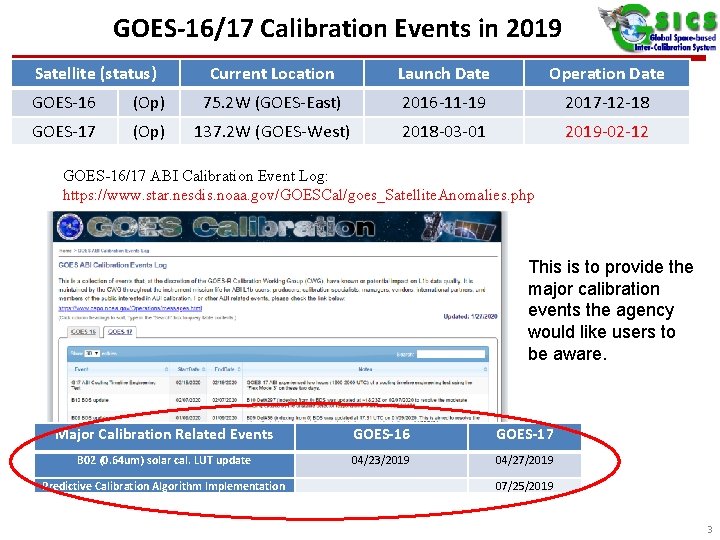
GOES-16/17 Calibration Events in 2019 Satellite (status) Current Location Launch Date Operation Date GOES-16 (Op) 75. 2 W (GOES-East) 2016 -11 -19 2017 -12 -18 GOES-17 (Op) 137. 2 W (GOES-West) 2018 -03 -01 2019 -02 -12 GOES-16/17 ABI Calibration Event Log: https: //www. star. nesdis. noaa. gov/GOESCal/goes_Satellite. Anomalies. php This is to provide the major calibration events the agency would like users to be aware. Major Calibration Related Events GOES-16 GOES-17 B 02 (0. 64 um) solar cal. LUT update 04/23/2019 04/27/2019 Predictive Calibration Algorithm Implementation 07/25/2019 3
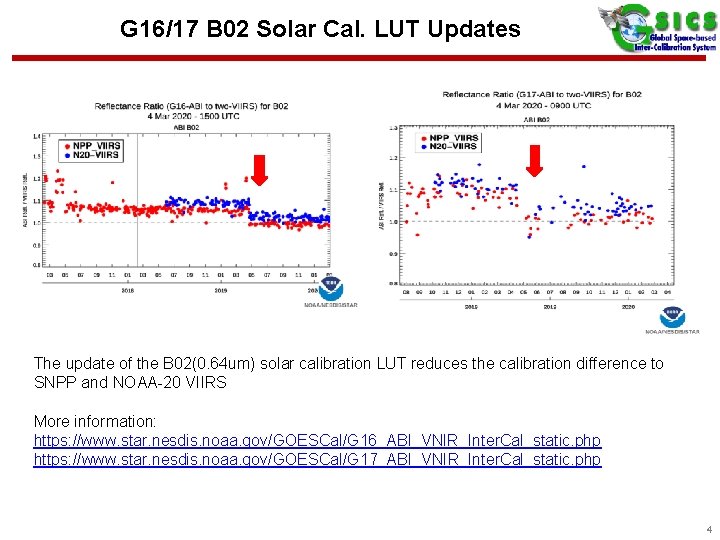
G 16/17 B 02 Solar Cal. LUT Updates The update of the B 02(0. 64 um) solar calibration LUT reduces the calibration difference to SNPP and NOAA-20 VIIRS More information: https: //www. star. nesdis. noaa. gov/GOESCal/G 16_ABI_VNIR_Inter. Cal_static. php https: //www. star. nesdis. noaa. gov/GOESCal/G 17_ABI_VNIR_Inter. Cal_static. php 4
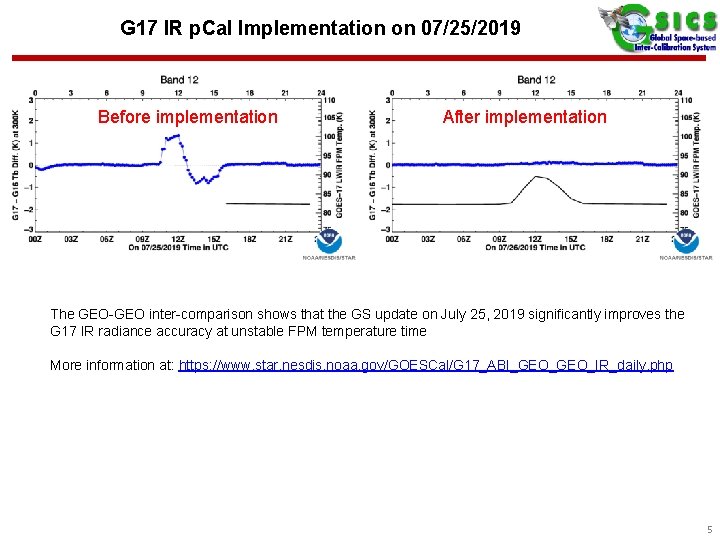
G 17 IR p. Cal Implementation on 07/25/2019 Before implementation After implementation The GEO-GEO inter-comparison shows that the GS update on July 25, 2019 significantly improves the G 17 IR radiance accuracy at unstable FPM temperature time More information at: https: //www. star. nesdis. noaa. gov/GOESCal/G 17_ABI_GEO_IR_daily. php 5
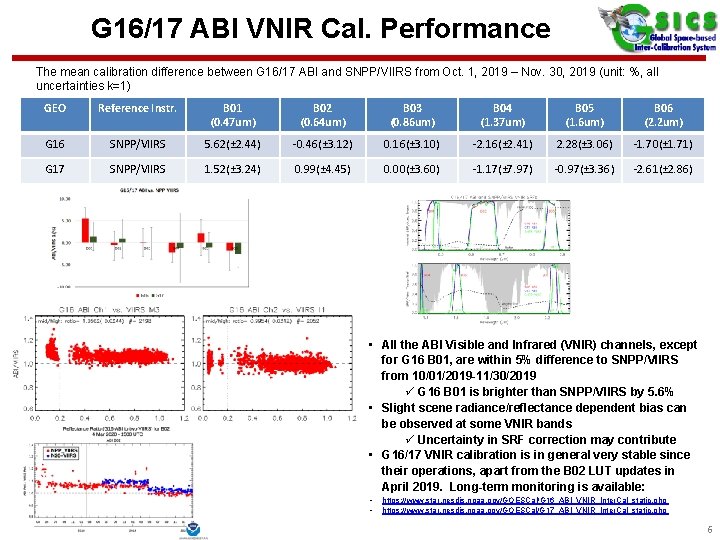
G 16/17 ABI VNIR Cal. Performance The mean calibration difference between G 16/17 ABI and SNPP/VIIRS from Oct. 1, 2019 – Nov. 30, 2019 (unit: %, all uncertainties k=1) GEO Reference Instr. B 01 (0. 47 um) B 02 (0. 64 um) B 03 (0. 86 um) B 04 (1. 37 um) B 05 (1. 6 um) B 06 (2. 2 um) G 16 SNPP/VIIRS 5. 62(± 2. 44) -0. 46(± 3. 12) 0. 16(± 3. 10) -2. 16(± 2. 41) 2. 28(± 3. 06) -1. 70(± 1. 71) G 17 SNPP/VIIRS 1. 52(± 3. 24) 0. 99(± 4. 45) 0. 00(± 3. 60) -1. 17(± 7. 97) -0. 97(± 3. 36) -2. 61(± 2. 86) • All the ABI Visible and Infrared (VNIR) channels, except for G 16 B 01, are within 5% difference to SNPP/VIIRS from 10/01/2019 -11/30/2019 ü G 16 B 01 is brighter than SNPP/VIIRS by 5. 6% • Slight scene radiance/reflectance dependent bias can be observed at some VNIR bands ü Uncertainty in SRF correction may contribute • G 16/17 VNIR calibration is in general very stable since their operations, apart from the B 02 LUT updates in April 2019. Long-term monitoring is available: • • https: //www. star. nesdis. noaa. gov/GOESCal/G 16_ABI_VNIR_Inter. Cal_static. php https: //www. star. nesdis. noaa. gov/GOESCal/G 17_ABI_VNIR_Inter. Cal_static. php 6
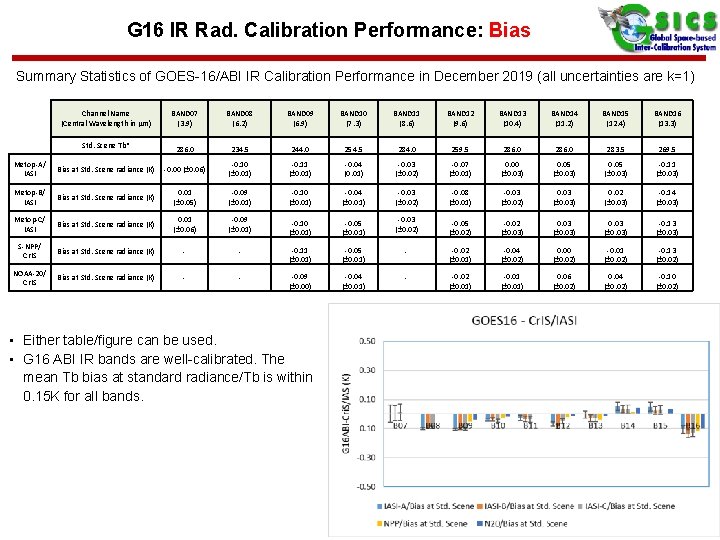
G 16 IR Rad. Calibration Performance: Bias Summary Statistics of GOES-16/ABI IR Calibration Performance in December 2019 (all uncertainties are k=1) Channel Name (Central Wavelength in m) BAND 07 (3. 9) BAND 08 (6. 2) BAND 09 (6. 9) BAND 10 (7. 3) BAND 11 (8. 6) BAND 12 (9. 6) BAND 13 (10. 4) BAND 14 (11. 2) BAND 15 (12. 4) BAND 16 (13. 3) Std. Scene Tb* 286. 0 234. 5 244. 0 254. 5 284. 0 259. 5 286. 0 283. 5 269. 5 Metop-A/ IASI Bias at Std. Scene radiance (K) -0. 00 (± 0. 06) -0. 10 (± 0. 01) -0. 11 (± 0. 01) -0. 04 (0. 01) -0. 03 (± 0. 02) -0. 07 (± 0. 01) 0. 00 (± 0. 03) 0. 05 (± 0. 03) -0. 11 (± 0. 03) Metop-B/ IASI Bias at Std. Scene radiance (K) 0. 01 (± 0. 05) -0. 09 (± 0. 01) -0. 10 (± 0. 01) -0. 04 (± 0. 01) -0. 03 (± 0. 02) -0. 08 (± 0. 01) -0. 03 (± 0. 02) 0. 03 (± 0. 03) 0. 02 (± 0. 03) -0. 14 (± 0. 03) Metop-C/ IASI Bias at Std. Scene radiance (K) 0. 01 (± 0. 06) -0. 09 (± 0. 01) -0. 10 (± 0. 01) -0. 05 (± 0. 01) -0. 03 (± 0. 02) -0. 05 (± 0. 02) -0. 02 (± 0. 03) 0. 03 (± 0. 03) -0. 13 (± 0. 03) S-NPP/ Cr. IS Bias at Std. Scene radiance (K) - - -0. 11 (± 0. 01) -0. 05 (± 0. 01) - -0. 02 (± 0. 01) -0. 04 (± 0. 02) 0. 00 (± 0. 02) -0. 01 (± 0. 02) -0. 13 (± 0. 02) NOAA-20/ Cr. IS Bias at Std. Scene radiance (K) - - -0. 09 (± 0. 00) -0. 04 (± 0. 01) - -0. 02 (± 0. 01) -0. 01 (± 0. 01) 0. 06 (± 0. 02) 0. 04 (± 0. 02) -0. 10 (± 0. 02) • Either table/figure can be used. • G 16 ABI IR bands are well-calibrated. The mean Tb bias at standard radiance/Tb is within 0. 15 K for all bands. 7
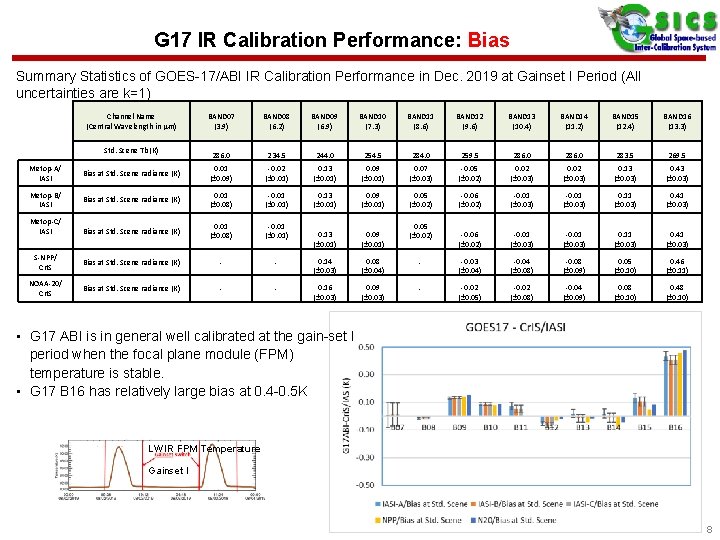
G 17 IR Calibration Performance: Bias Summary Statistics of GOES-17/ABI IR Calibration Performance in Dec. 2019 at Gainset I Period (All uncertainties are k=1) Channel Name (Central Wavelength in m) Std. Scene Tb (K) BAND 07 (3. 9) BAND 08 (6. 2) BAND 09 (6. 9) BAND 10 (7. 3) BAND 11 (8. 6) BAND 12 (9. 6) BAND 13 (10. 4) BAND 14 (11. 2) BAND 15 (12. 4) BAND 16 (13. 3) 286. 0 234. 5 244. 0 254. 5 284. 0 259. 5 286. 0 283. 5 269. 5 -0. 02 (± 0. 01) 0. 13 (± 0. 01) 0. 09 (± 0. 01) 0. 07 (± 0. 03) -0. 05 (± 0. 02) 0. 02 (± 0. 03) 0. 13 (± 0. 03) 0. 43 (± 0. 03) 0. 13 (± 0. 01) 0. 09 (± 0. 01) 0. 05 (± 0. 02) -0. 06 (± 0. 02) -0. 01 (± 0. 03) 0. 11 (± 0. 03) 0. 41 (± 0. 03) 0. 13 (± 0. 01) 0. 09 (± 0. 01) -0. 06 (± 0. 02) -0. 01 (± 0. 03) 0. 11 (± 0. 03) 0. 41 (± 0. 03) Metop-A/ IASI Bias at Std. Scene radiance (K) 0. 01 (± 0. 09) Metop-B/ IASI Bias at Std. Scene radiance (K) 0. 01 (± 0. 08) -0. 01 (± 0. 01) S-NPP/ Cr. IS Bias at Std. Scene radiance (K) - - 0. 14 (± 0. 03) 0. 08 (± 0. 04) - -0. 03 (± 0. 04) -0. 04 (± 0. 08) -0. 08 (± 0. 09) 0. 05 (± 0. 10) 0. 46 (± 0. 11) NOAA-20/ Cr. IS Bias at Std. Scene radiance (K) - - 0. 16 (± 0. 03) 0. 09 (± 0. 03) - -0. 02 (± 0. 05) -0. 02 (± 0. 08) -0. 04 (± 0. 09) 0. 08 (± 0. 10) 0. 48 (± 0. 10) Metop-C/ IASI 0. 05 (± 0. 02) • G 17 ABI is in general well calibrated at the gain-set I period when the focal plane module (FPM) temperature is stable. • G 17 B 16 has relatively large bias at 0. 4 -0. 5 K LWIR FPM Temperature Gainset I 8
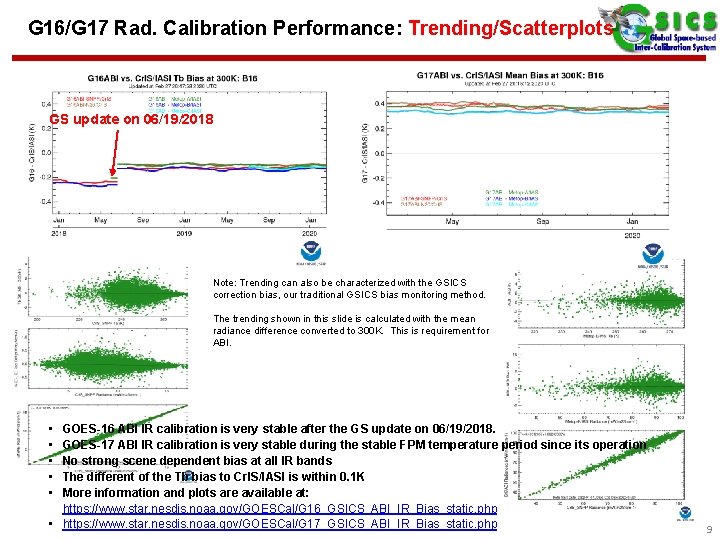
G 16/G 17 Rad. Calibration Performance: Trending/Scatterplots GS update on 06/19/2018 Note: Trending can also be characterized with the GSICS correction bias, our traditional GSICS bias monitoring method. The trending shown in this slide is calculated with the mean radiance difference converted to 300 K. This is requirement for ABI. • • • GOES-16 ABI IR calibration is very stable after the GS update on 06/19/2018. GOES-17 ABI IR calibration is very stable during the stable FPM temperature period since its operation No strong scene dependent bias at all IR bands The different of the Tb bias to Cr. IS/IASI is within 0. 1 K More information and plots are available at: https: //www. star. nesdis. noaa. gov/GOESCal/G 16_GSICS_ABI_IR_Bias_static. php • https: //www. star. nesdis. noaa. gov/GOESCal/G 17_GSICS_ABI_IR_Bias_static. php 9
Discussions • GSICS monitoring vs. GSICS Correction Product Monitoring – Bias vs. Correction bias at reference temperature – Uncertainty of Tb bias at reference temperature – Uncertainty of correction bias at reference temperature • Drift report? – Legacy VNIR bands without on-orbit cal. capacity – How about the on-board cal. instruments? • Degradation of the calibration target(s)? • Scripts for auto tables/plots generations from GSICS products 10
- Slides: 10