
2020 303d Listing and Delisting Methodology EMC November

2020 303(d) Listing and Delisting Methodology EMC, November 14, 2019 Pam Behm, DWR Modeling and Assessment Branch Department of Environmental Quality

Purpose Request approval of the 2020 303(d) Listing and Delisting Assessment Methodology 2
Outline • Statute • History • 2020 Methodology Updates 3
Statute 143 B-282(c): The EMC shall implement the provisions of subsections (d) and (e) of 33 U. S. C. § 1313 by identifying and prioritizing impaired waters 4

Some Terminology • 303(d) List – Refers to section of Clean Water Act (CWA). List of impaired waters where a TMDL or alternative management action is needed • Delisting – removing a water from the 303(d) list • TMDL – Total Maximum Daily Load – establishes maximum amount of pollutant in a waterbody and sets limits on sources • Assessment Unit (AU) – spatial description of an assessed water • Excursion – individual exceedence of a standard • Exceedence (Rate) – # of excursions, expressed as a number or a percent • Integrated Report – combines CWA sections 305(b) and 303(d), list of all assessed waters 5

What is the 303(d) List? • List of impaired waters where a TMDL or alternative management action is needed • Established by Section 303(d) of the Clean Water Act • Public review and comment is required, minimum of 30 days • Due to EPA every even-numbered year on April 1 • EPA has final approval authority 6
What is the 303(d) Listing and Delisting Methodology? • Documents decision making process for determining whether a water should be included OR removed from the 303(d) list • Required to submit to EPA, but EPA not required to approve • However, if EPA does not agree with a listing or delisting decision (which is based on the methodology), they can disapprove the 303(d) list 7
What is the Integrated Report? • List of ALL assessed waters and assigned categories • Established by Sections 305(b) and 303(d) of the Clean Water Act • Not required to receive public comment • CWA requires submittal to EPA, but EPA does not approve/disapprove 8
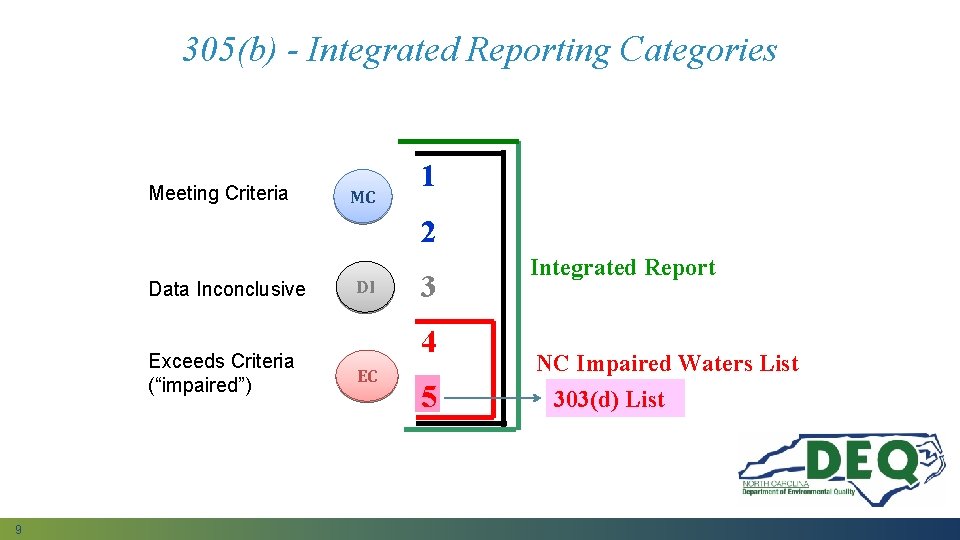
305(b) - Integrated Reporting Categories Meeting Criteria MC 1 2 Data Inconclusive Exceeds Criteria (“impaired”) 9 DI 3 4 EC 5 Integrated Report 305(b) Report NC Impaired Waters List 303(d) List

303(d) Assessment Procedures Data Window – 5 years: 2018 303(d): 2012 -2016 2020 303(d): 2014 -2018 2020 “New Data Years”: 2017 -2018 10
303(d) Assessment Procedures 1. Numerical criteria assessment (10% exceedance method with 90% statistical confidence), minimum of 10 samples 2. Biological rating method used to assess benthic and fish community collections 3. Pathogen criteria method to assess recreation standards 4. Shellfish growing area assessment method to assess waters classified as “SA” 5. Fish advice and advisories with fish tissue data method to assess fish consumption 11
History - 2018 303(d) Assessment Changes were in response to EPA objections that held-up action, caused partial disapprovals in 2014 and 2016 1. Added explicit delisting process 2. Added a process to evaluate small datasets 3. Balanced statistical criteria for meeting and exceeding decisions 12
2018 303(d) Results • EPA issued full approval of the 2018 303(d) list on May 22, 2019 • 50 -day turnaround from submittal • 2 nd fastest turnaround the state has ever received • 1 st unconditional approval the state has received 13
Methodology Updates for 2020 Based on public comments received during 2018 review: • Added a section on assessment unit (AU) delineation* • Addressed an unintended consequence for waters not previously listed with greater than 3 excursions in new data years • Added delisting process for old total metals listings* * Not really a change, but is added to the 2020 303(d) Listing and Delisting Methodology based on public comment 14
What is an Assessment Unit (AU)? • Spatial extent of a water quality “assessment” • Used for 303(d) / Integrated Reporting (IR) • Based on Classification Index Number • Concept of AU: • Represents an area where water quality is expected to be similar • Can have 1 or more monitoring station(s) Example: AU 9 -23 -14 b: Cedar Creek (From SR 1008 to Cove Creek) 15
What causes AU changes? • Monitoring stations are first assessed individually • If there are differences in resulting assessment (where there are multiple stations in 1 AU), AU is split or divided • Due to changes in water quality, or • New stations have been added, or • Methodology changes have impacted assessment decisions • Applied statewide • This has been the procedure since 2004 16
Why is this method used? • Consistent with “not to exceed” standards Chlorophyll-a: not greater than 40 µg/l for lakes, reservoirs, and other waters subject to growths of macroscopic or microscopic vegetation • Adds transparency • Avoids having to make arbitrary decisions • Avoids having to impair or rate inconclusive larger areas than necessary • Acknowledges where waters are meeting criteria • Acknowledges where there are “hot spots” 17
Assessment Unit Delineation • Discussed in detail in DWR’s Response to Comments from 2018 review (https: //files. nc. gov/ncdeq/Water%20 Quality/Planning/TMDL/303 d/2018 303 d-DWR-Response-to-Comments-final. pdf, page 72) • Added section to methodology to explain process for “splitting” assessment units • Improves transparency 18
For waters with: Greater than 10% exceedence/less than 90% statistical confidence in exceeding criteria • Previous language: Greater than 3 excursions in new data years leads to exceed criteria determination - Unintended impact: penalizes those who collect more frequent data • Fix: - Greater than 3 excursions in new data years with 90% confidence in exceeding criteria leads to exceed criteria determination - Impact estimate ~ 10 waters compared to about 15 in 2018 19
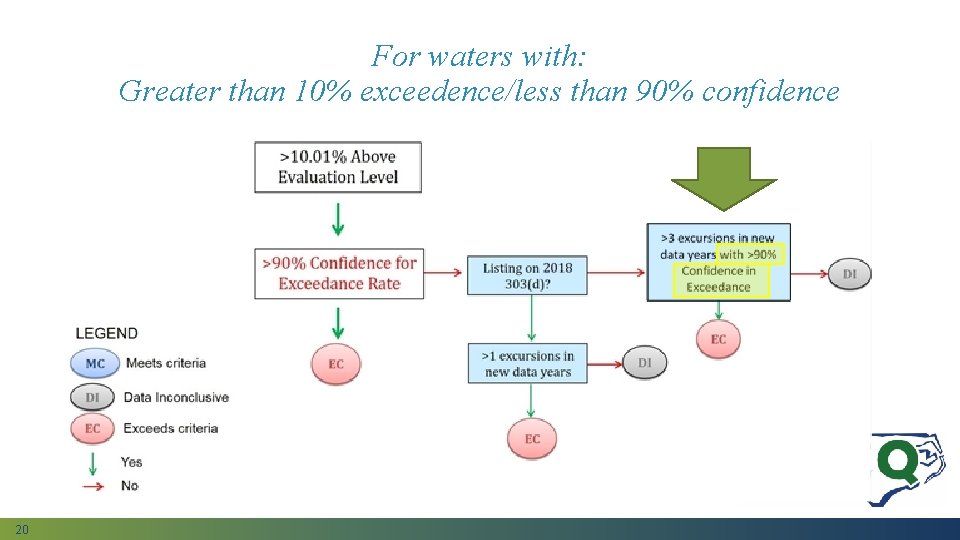
For waters with: Greater than 10% exceedence/less than 90% confidence 20
Delisting Process for Total Metals • New dissolved standards replaced old total metals standards in 2015. • DWR successfully delisted 41 waterbody/parameter combinations in 2018 • Process was not explicit in 2018 methodology • Waters will be delisted for old total metal listings when new data is available for assessment under new standards • No regulatory action (e. g. TMDL) taken on old listings until impairment is confirmed under new standard 21
Delisting Process Added to Methodology For legacy total metals impairments, where total criteria were replaced with dissolved criteria in January 2015, DWR will delist assessments for total metals only when current dissolved metals data are available for assessment. 22
Proposed Timeline • • 23 WQC approves clarifications to methods: September 2019 EMC approves clarifications to methods: November 2019 Perform assessment: 4 -5 months Public comment on 303(d) list: March-April 2020 Clean Water Act due date: April 1, 2020 Report to EMC with an information item: July 2020 Submit to EPA: August 1, 2020
Public Comment Materials • • 24 Draft 303(d) List Draft delistings Draft new listings / fact sheets Draft assessment unit changes 2020 303(d) Listing and Delisting Methodology 2020 Draft Integrated Report Raw data Online map
Action Request approval of the 2020 303(d) Listing and Delisting Assessment Methodology 25

Thank You! Contact Information: Pam Behm 919 -707 -3687 pamela. behm@ncdenr. gov
- Slides: 26