
2020 21 Federal Program Monitoring English Learner Instrument








- Slides: 78
2020– 21 Federal Program Monitoring English Learner Instrument Remote Training July 29– 30, 2020
Federal Program Monitoring and COVID-19 • Due to COVID-19, Federal Program Monitoring (FPM) reviews scheduled September through December 2020 will be conducted online. • For reviews scheduled January through June 2021, decisions regarding on-site reviews will be made in late fall based on the most current guidelines and recommendations by the State Superintendent of Public Instruction. • At the end of this presentation, questions will be addressed regarding providing evidence in light of school and program closures. 2
Presentation Objectives • Demystify the English Learner (EL) Instrument and the FPM process • Discuss answers to frequently asked questions and common pitfalls • Demonstrate effective organization of files and evidence and FPM tips and tricks for a successful review 3
FPM Review Process • Evidence Review Period: Reviewer accesses and provides feedback on Local Educational Agency (LEA) evidence via the California Department of Education Monitoring Tool (CMT). • During Review: Reviewer continues to work with the LEA staff to determine whether the evidence uploaded demonstrates compliance. Interviews of employees funded in whole or in part with Title III funds may occur via teleconference. • Resolution Period: Not applicable for no findings, or, reviewer works with the LEA to resolve each finding within the 45 calendar day resolution period 4
THE 2020– 21 ENGLISH LEARNER PROGRAM INSTRUMENT Let’s Dive In! 5
2020– 21 English Learner Instrument • The EL instrument (along with the other program instruments) can be found on the California Department of Education (CDE) Compliance Monitoring web page: https: //www. cde. ca. gov/ta/cr/#Instruments 6
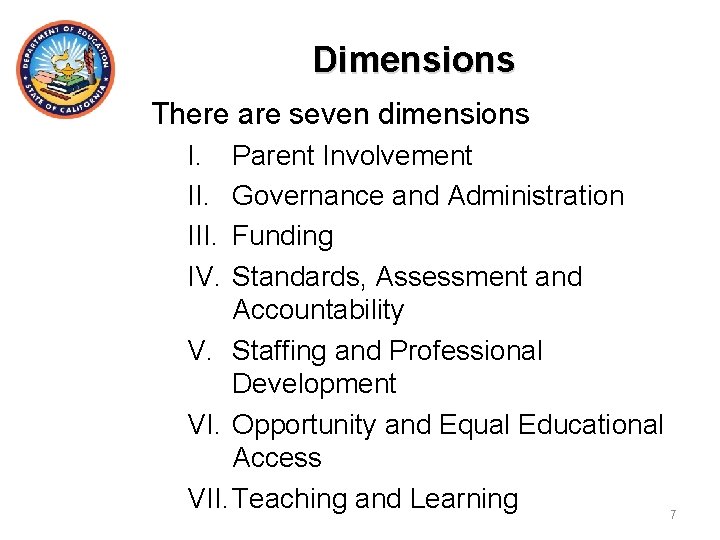
Dimensions There are seven dimensions I. III. IV. Parent Involvement Governance and Administration Funding Standards, Assessment and Accountability V. Staffing and Professional Development VI. Opportunity and Equal Educational Access VII. Teaching and Learning 7
Items • Each dimension has between two and six items. • These items relate to the dimension and include the statutory requirements for each item listed. 8
Evidence Requests • Evidence requests follow each item. • The description lists the suggested documents requested by the reviewer to meet minimum requirements for the item. • These are suggestions. • Other documents may be acceptable. 9
Sampling Method • FPM reviews employ the sampling method • Suggestions for quantities of a particular evidence type can be found in the evidence request descriptions 10
Tip #1 • It is never too early to begin uploading documents into the CMT or to reach out to your reviewer if you have questions. • All phone calls or emails are documented in the CMT as the official record of the review. 11
Dimension I: Involvement • EL 01: English Learner Advisory Committee (ELAC) • EL 02: District English Learner Advisory Committee (DELAC) 12
EL 01: English Learner Advisory Committee (1) • Required for schools with 21 or more English learners • ELAC may be combined with other advisory committees; composition requirements met, etc. • Each ELAC elects at least one member to the DELAC • Members receive training in carrying out their legal responsibilities 13
EL 01: English Learner Advisory Committee (2) Ensure uploaded documentation reflects: • The composition requirements noted in EL 1. 0 a–b, and • Completion of the legally required tasks: – Schoolwide needs assessment – Importance of regular school attendance – Development of a site EL plan and inclusion in the School Plan for Student Achievement (SPSA) 14
EL 02: District English Learner Advisory Committee (1) • Each LEA with at least 51 English learners must have a functioning DELAC. • The majority of DELAC members must be parents or guardians of English learners not employed by the district. • Members receive training. • The LEA may designate DELAC to be the Local Control Accountability Plan (LCAP) parent advisory committee. – If designated as above, the DELAC provides input on development of the LCAP (including language acquisition programs) 15
EL 02: District English Learner Advisory Committee (2) Legally required tasks—provide input on: • • Policies, programs, services for English learners District-wide needs assessment by school Goals/objectives for EL programs Compliance with teacher/instructional aide requirements • The LEA’s reclassification procedures • Written notifications required to be sent to parents/guardians • The consolidated application 16
Tip # 2 • Provide readable agendas and minutes clearly showing the inclusion of the legal tasks. • For sign-in sheets, parent names should be visible but redact student information and personal information such as home phone numbers and email addresses. 17
Dimension II: Governance and Administration • EL 03: EL Identification and Assessment • EL 04: Implement, Monitor, & Revise Title III Plan • EL 05: EL Program Inclusion in Development of the SPSA (Schoolwide) • EL 06: Title III Inventory 18
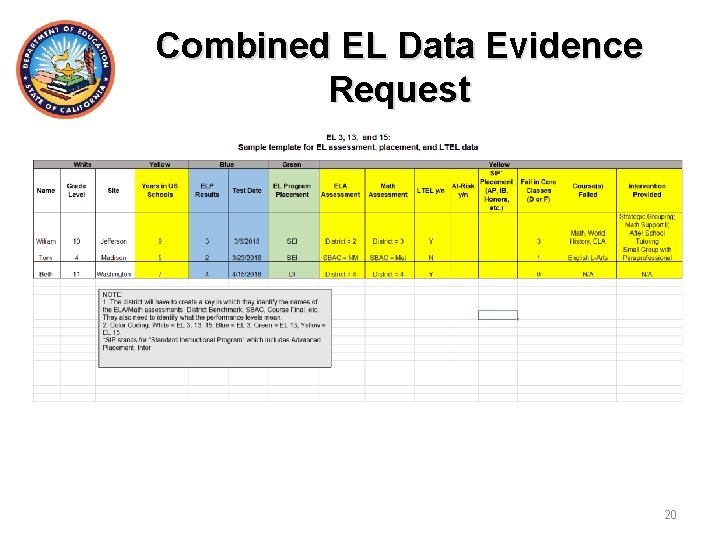
EL 03: EL Identification and Assessment (1) • Combined EL Assessment, Placement, and Enrollment Data – The first evidence request for EL 03 describes combined EL assessment, placement, and enrollment data. Note the “Related Items” under the item instructions. – The Resources page in the CMT contains an Excel spreadsheet to collect data for EL 03, 13, and 15. 19
Combined EL Data Evidence Request 20
EL 03: EL Identification and Assessment (2) Required English language proficiency (ELP) Assessments • • Provide current English Language Proficiency Assessments for California (ELPAC) Initial or Summative Assessment scores for every EL student in the LEA unless their individualized education program (IEP) requires an alternative ELP assessment Provide scores for the alternative assessment if ELPAC is not administered per the IEP 21
EL 03: EL Identification and Assessment (3) • EL Identification – Home Language Survey • EL Identification Policies and Procedures • ELPAC Designated Supports and Accommodations – IEPs need to contain ELPAC or alternate ELP scores, universal tools, designated supports and accommodations 22
Tip #3 • Use the Excel spreadsheet template found on the CMT resources page to provide: – EL 03: ELPAC scores – EL 13: Academic information and long-term English learner (LTEL) information – EL 15: Program placement/services 23
EL 04: Implement, Monitor, and Revise Title III Plan* • Immigrant Services and Procedures – Provide immigrant services and procedures used to provide enhanced opportunities to eligible immigrant students • LEA Title III Plan – Provide the LEA’s LCAP Federal Addendum – Reports activities and services – The budget information from the Consolidated Application Reporting System is matched to the activities • Title III Consortia Memorandum of Understanding (MOU) – If your LEA is not part of a Title III Consortium, make a comment in the CMT and do not upload anything 24
Tip #4 • The complete LCAP will not be requested as evidence. • If referring to the LCAP for evidence, only upload the specific pages related to Title III services and activities. 25
EL 05: EL Program Inclusion in Development of the SPSA (Schoolwide) • The development of the SPSA shall include: – A comprehensive needs assessment – Annual evaluation and implementation monitoring • An approved SPSA must contain: – Goals to improve EL student outcomes – Evidence-based strategies, actions, or services to meet goals – The process for annually evaluating the progress of programs toward accomplishing these goals 26
EL 06: Title III Inventory • Each LEA must maintain a historical inventory record for each piece of equipment – costing more than $500/unit – purchased with Title III funds • If no equipment meeting the criteria to report, indicate this in a comment in the CMT 27
Tip #5 • If your evidence for the Title III Inventory item is a CMT comment, ensure it references the previous five-year period. 28
Dimension III: Funding • EL 07: Supplement, Not Supplant with Title III • EL 08 : Time and Effort Requirements (Title I and Title III) 29
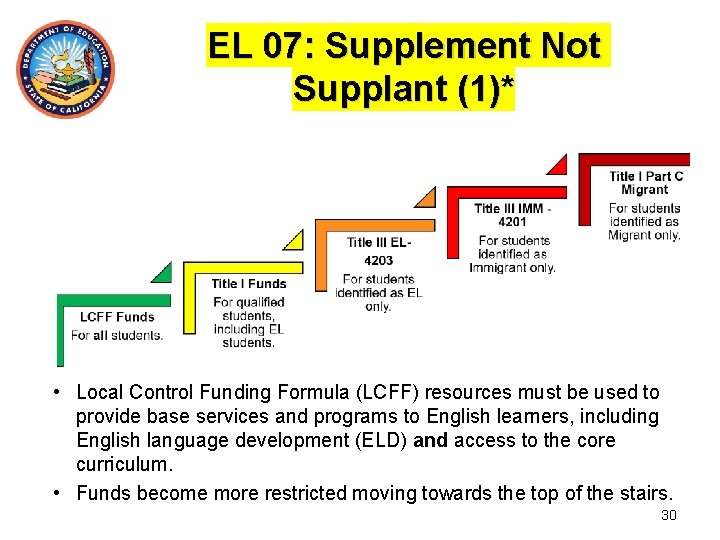
EL 07: Supplement Not Supplant (1)* • Local Control Funding Formula (LCFF) resources must be used to provide base services and programs to English learners, including English language development (ELD) and access to the core curriculum. • Funds become more restricted moving towards the top of the stairs. 30
EL 07: Supplement Not Supplant (2)* Instructional Materials • Provide a list. Be sure to include the funding source for each. Title III Expenditure Report • General ledgers are reviewed for expenditures of Title III funds using a two-step process. 1. Upload the ledgers. Reviewer will then request back-up documentation on certain expenditures from the report. 2. Provide invoices, approval letters, and an explanation of for whom, where and how the expenditure was used and appropriate under Title III. 31
EL 07: Supplement Not Supplant (3)* Title III Funded Professional Development (PD) • Provide a list of all professional development (PD) provided in the LEA. Be sure to include the funding source for each. Title III Job Descriptions and Duties Statements • What is the difference between a duty statement and a job description? Job Descriptions – Are broader and cover all possible duties for all employees in the position Duty statements: – Are tailored to a single employee or position – Include specific tasks tied to the funding source(s) 32
EL 07: Supplement Not Supplant (4)* Title III Payroll Records • Provide a report of salaries and benefits paid to employees from Title III funds, resources 4201 and 4203. • The report should include employee’s name, hours worked, gross pay, net pay, deductions, and payroll period. • Additional documentation may be requested by the reviewer. 33
Tip #6 • Budget estimates alone, or other distribution percentages do not qualify as support for charges to federal awards. Source: California School Accounting Manual (CSAM), Procedure 905 34
EL 08: Time and Effort Requirements (1)* • Each LEA must properly assess charges for direct or indirect costs of Title III EL and Immigrant funds for salaries and wages. • For each employee paid only in part from Title III (multiple cost objectives), complete an approved sampling method such as a Personnel Activity Report (PAR). • If funded solely from Title III, complete a periodic (semiannual) certification. 35
EL 08: Time and Effort Requirements (2)* Evidence Requests: • Time and Effort Reporting Policies and Procedures • Time and Effort Records* • Title III Job Descriptions and Duty Statements (linked to EL 07) • Title III Position Control Report * More details on the next slides 36
EL 08: Time and Effort Requirements (3)* Time and Effort Records Single cost objective employees: periodic (semiannual) certifications • Prepared at least semiannually • State the employee worked only on the single cost objective • A sample semiannual certification can be found on page 905 -19 of the CSAM: https: //www. cde. ca. gov/fg/ac/sa/documents/csam 2019 complete. pdf Source: CSAM, Procedure 905 37
EL 08: Time and Effort Requirements (4)* Time and Effort Records • Multiple cost objective employee: Personnel Activity Report (PAR) or equivalent • PARs or similar document must: – – Reflect after-the-fact, actual activities Account for all activities for which employee is compensated Be prepared at least monthly Be signed by the employee • A sample PAR can be found on page 905 -18 of the CSAM : https: //www. cde. ca. gov/fg/ac/sa/documents/csam 201 9 complete. pdf Source: CSAM, Procedure 905 38
Tip #7 • When considering information to be included in time and effort documents, the safest approach is to provide more documentation rather than less. Source: CSAM, Procedure 905 39
Dimension IV: Standards, Assessment, and Accountability • EL 09: Evaluation of English Learner Program Effectiveness • EL 10: Reclassification 40
EL 09: Evaluation of Title IIIFunded Services and Programs* LEAs that receive Title III funds must: • Evaluate all supplemental services and programs funded with Title III to determine program effectiveness. • Provide relevant EL-related data and an analysis of findings that may result in recommended changes to improve the effectiveness of Title IIIfunded programs and services. 41
EL 10: Reclassification (1) Reclassification Criteria • ELPAC Overall Performance Level 4 – No domain level criteria may be added – Adopted by the State Board of Education in January 2019 • All other criteria remain locally determined – Teacher evaluation, including, but not limited to, a review of curriculum mastery; and – Parent opinion and consultation; and – Comparison of student’s performance in basic skills based on the performance of English proficient students of the same age. 42
EL 10: Reclassification (2) Reclassification Process • Provide the locally adopted process or steps to be followed for reclassifying a student. • Evidence may include: – A flowchart or list of steps – EL Master Plan – Board policy and/or regulations – Charter petition 43
EL 10: Reclassification (3) Reclassification Records/Forms • Upload three samples of reclassification forms • For an on-site review, the reviewer will sample reclassified students’ permanent records for required documents Reclassified to Fluent English Proficient (RFEP) Progress Monitoring • LEAs must monitor progress of reclassified students for a minimum of four years • Provide a sortable spreadsheet of students reclassified during the last four years • Review the item instructions for data to be included 44
Tip #8 • For RFEP Progress Monitoring, include areas of academic concern for individual students and interventions provided as appropriate. • Review the Monitoring Reclassified Students letter on the CDE Reclassification web page: https: //www. cde. ca. gov/sp/el/rd/reclassified 1 22019. asp 45
Dimension V: Staffing and Professional Development EL 11: Teacher English Learner Authorization EL 12: Professional Development Specific to English Learners 46
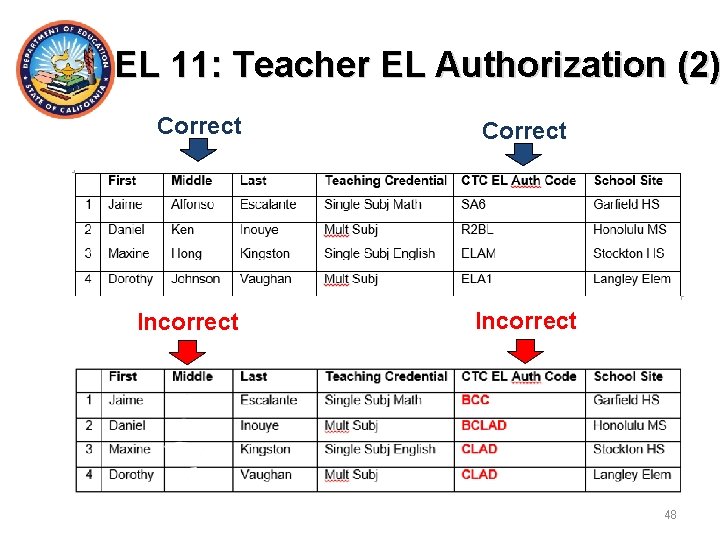
EL 11: Teacher EL Authorization (1) All teachers assigned to provide instruction in subject matter courses for EL students must be appropriately authorized to provide ELD. • Provide a spreadsheet with Commission on Teacher Credentialing (CTC) EL authorization codes for every teacher of record in the LEA (not just sites under review). • Use the list of CTC codes and spreadsheet template on the CMT Resources page. 47
EL 11: Teacher EL Authorization (2) Correct Incorrect 48
Tip #9 • EL 11 can be time-consuming. Begin working with your human resources department or credential analyst on this item as soon as possible. 49
EL: 12 Professional Development Specific to English Learners (1) Important points for EL-specific PD: • Provided to all types of staff—teachers, administrators, classified staff • Designed specifically for increasing EL students’ English language proficiency and subject matter mastery • Is of sufficient intensity and duration (not including one day or short-term workshops) to have a positive and lasting impact 50
EL 12: Professional Development Specific to English Learners (2) Two evidence requests: EL-Specific Professional Development • Provide evidence of the PD itself, such as content, agendas, sign in sheets Teacher Implementation • Are teachers effectively implementing what they learned from the PD in their classrooms or other teaching environment? • Provide evidence such as observation notes, emails, protocols or non-teacher specific feedback to staff regarding use of strategies covered in the PD 51
Tip #10 • Ensure comments are tied to the item or evidence request to which they refer. • In the “View Comments” tab, filter by item number to easily see all the comments related to one item. 52
Dimension VI: Opportunity and Equal Educational Access EL 13: Language Acquisition Program Options and Parent Choice 53
EL 13: Language Acquisition Program Options and Parent Choice (1) • LEAs must, at a minimum, provide English learners with a Structured English Immersion (SEI) program. • Parents/guardians may choose a language acquisition program that best suits their child or request a language acquisition program not currently available. • Note the distinction between a language program and a language acquisition program. * *Explained on the next slide 54
Language Acquisition Programs vs. Language Programs What is the difference? • Language acquisition programs – Designed for English learners – Ensure English acquisition as rapidly as possible – Instruct the ELD standards through designated and integrated ELD • Language programs – Programs for students to be instructed in languages other than English to a degree sufficient to produce proficiency in those languages 55
EL 13: Language Acquisition Program Options and Parent Choice (2) Three evidence requests: • Combined EL Data – See slide 19; include language acquisition program placement for each EL in the LEA • Parental Notice – Provide the notification letter sent to all parents regarding language acquisition, language programs, and placement procedures, including parent choice – Include evidence of how the notice is distributed and when? • Program Request Process – Provide evidence demonstrating the LEA’s processes and procedures for documenting and responding to parent requests for language acquisition programs 56
Dimension VII: Teaching and Learning EL 14: English Language Development EL 15: Access to the Standard Instructional Program 57
EL 14: English Language Development (1) • Part of the standard instructional program provided through general funds • Title III funds can be used to supplement • Intentional, ELD standards-based instruction for English learners to develop proficiency in English as rapidly and effectively as possible • Includes integrated and designated ELD • Required for every EL student at every grade level, including LTELs 58
EL 14: English Language Development (2) Designated ELD Program Description • For elementary grades, provide a daily time schedule of subjects taught as well as grouping/placement criteria. • For secondary grades, provide a master schedule, course descriptions, as well as grouping/placement criteria. • Provide exit criteria used to move students to the next ELD or ELP level, group, or class. • Ensure the evidence provides a snapshot of where every EL student, regardless of grade level, ELP level, or disability, is receiving core ELD. 59
EL 14: English Language Development (3) • EL Instructional Scheduling – For elementary, provide the schedule for subject area instruction at each grade level – For secondary, provide a master schedule and three redacted sample transcripts or student schedules • ELD Evaluation – Provide an evaluation that answers the following questions: • Has ELD been implemented effectively? How measured? • What adjustments are needed? • Instructional Materials – Provide a list for all courses in which English learners are enrolled, denoting funding source for materials 60
EL 14: English Language Development (4) Integrated ELD Program Description • Include a description of how and when EL students at all proficiency levels receive instruction where ELD standards are taught in tandem with core content standards • Evidence may include: – Lesson plans – Instructional schedules – EL Master Plan with direction to page numbers where the integrated ELD program is described 61
EL 15: Access to the Standard Instructional Program (1) The standard instructional program consists of: • Core curriculum courses (language arts, math, science, social science, ELD) • Courses required to meet state and local high school graduation requirements • Courses required for middle school promotion • Enrollment in a full course load of courses that are part of the standard instructional program • Enrollment in courses that meet subject matter requirements for college admissions, such as honors or advanced placement courses 62
EL 15: Access to the Standard Instructional Program (2) ELs and the Standard Instructional Program • EL students cannot be denied access to the standard instructional program • ELD is part of the standard Instructional program • Instruction must be designed for EL students to… – Meet grade level content and performance standards – Meet same challenging state standards and achievement goals all students are expected to meet 63
EL 15: Access to the Standard Instructional Program (3) • Combined EL Data – See slide 19. Include EL progress monitoring data. • EL Access to the Standard Instructional Program – Procedural guidelines for placing ELs in standard instructional program subjects and courses – Criteria for placing ELs in interventions • EL Instructional Scheduling – Same evidence request as for EL 14. See slide 59. 64
EL 15: Access to the Standard Instructional Program (4) • EL Student Progress Monitoring – LEAs must monitor student academic progress and provide additional and appropriate educational services – Provide samples of monitoring individual EL students’ academic progress and interventions implementation • Language Instruction in the Standard Instructional Program – A description of LEA-wide expectations of how instructional strategies and materials are differentiated allowing ELs at all grade and proficiency levels to access core content 65
More Tips, Tricks, and Resources
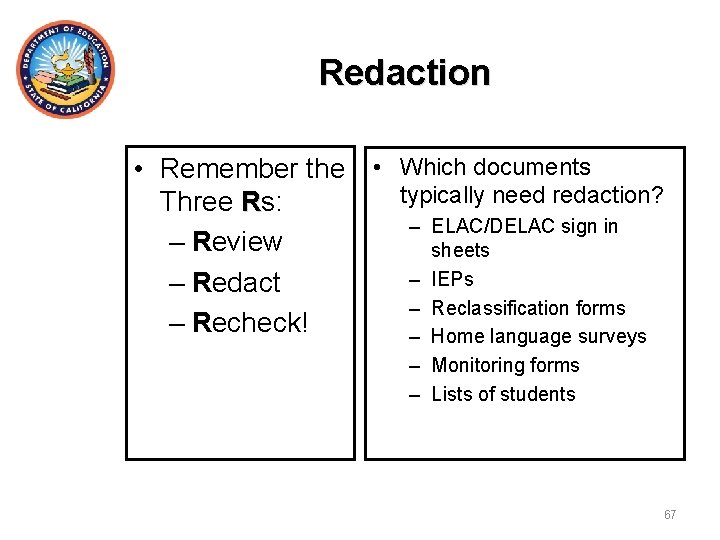
Redaction • Remember the • Which documents typically need redaction? Three Rs: – ELAC/DELAC sign in – Review sheets – IEPs – Redact – Reclassification forms – Recheck! – Home language surveys – Monitoring forms – Lists of students 67
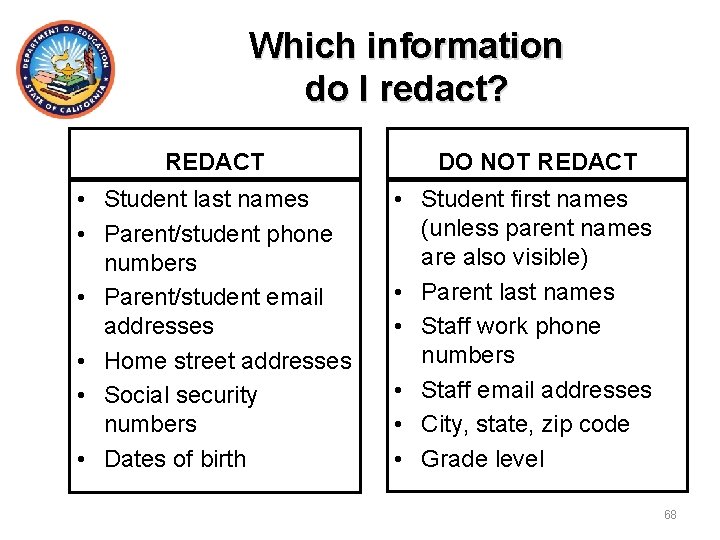
Which information do I redact? REDACT • Student last names • Parent/student phone numbers • Parent/student email addresses • Home street addresses • Social security numbers • Dates of birth DO NOT REDACT • Student first names (unless parent names are also visible) • Parent last names • Staff work phone numbers • Staff email addresses • City, state, zip code • Grade level 68
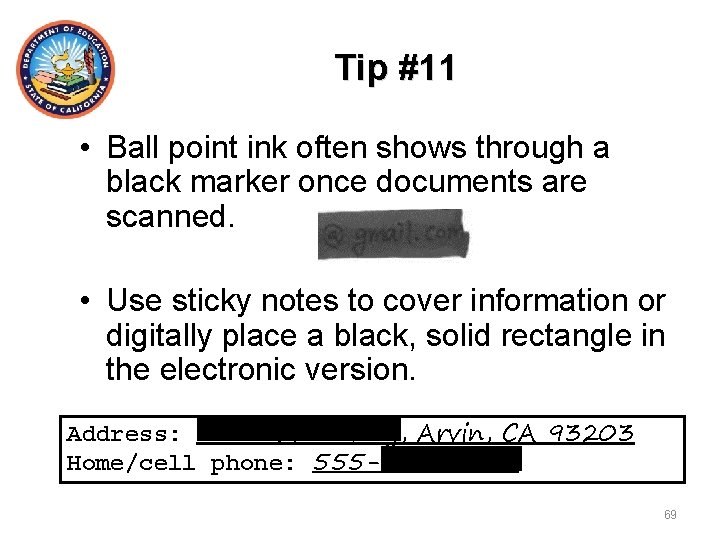
Tip #11 • Ball point ink often shows through a black marker once documents are scanned. • Use sticky notes to cover information or digitally place a black, solid rectangle in the electronic version. Address: 9999 Lima Way, Arvin, CA 93203 Home/cell phone: 555 -777 -8888 69
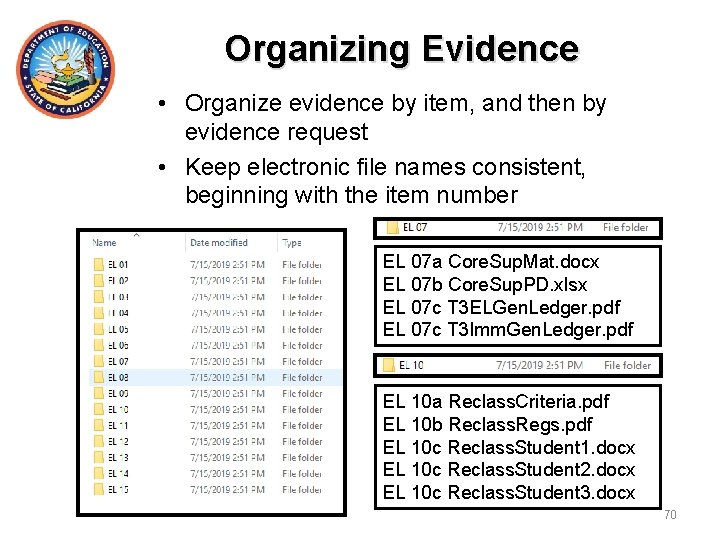
Organizing Evidence • Organize evidence by item, and then by evidence request • Keep electronic file names consistent, beginning with the item number EL 07 a Core. Sup. Mat. docx EL 07 b Core. Sup. PD. xlsx EL 07 c T 3 ELGen. Ledger. pdf EL 07 c T 3 Imm. Gen. Ledger. pdf EL 10 a Reclass. Criteria. pdf EL 10 b Reclass. Regs. pdf EL 10 c Reclass. Student 1. docx EL 10 c Reclass. Student 2. docx EL 10 c Reclass. Student 3. docx 70
CDE COVID-19 Resources • Coronavirus Response and School Reopening Guidance web page: Øhttps: //www. cde. ca. gov/ls/he/hn/coronaviru s. asp • COVID-19 English Learner Resources for Distance Learning web page: Øhttps: //www. cde. ca. gov/sp/el/er/covidelreso urces. asp 71
CDE Resources (1) • Compliance Monitoring web page: Øhttps: //www. cde. ca. gov/ta/cr/ • English Learners web page: Øhttps: //www. cde. ca. gov/sp/el • Title III, LCAP Addendum Criteria and Guidance web page: Øhttps: //www. cde. ca. gov/sp/el/t 3/lcapreviewg uidance. asp 72
CDE Resources (3) • ELPAC web page: Øhttps: //www. cde. ca. gov/ta/tg/ep/ • Definitions, Instructions, & Procedures web page (guidance from the CSAM for accounting and financial reporting by LEAs): Øhttps: //www. cde. ca. gov/466213 73
CDE Resources (4) • Contact information for the Regional County Office of Education English Learner Specialists: Øhttps: //www. cde. ca. gov/sp/el/t 3/coelead scontactlist 13. asp 74
Questions? 75
Technical Assistance and Monitoring Office Contact Information Name and Title Phone Number Email Address Theresa Hawk, Administrator 916 -319 -0950 thawk@cde. ca. gov Ron Addington, Reviewer 916 -319 -0950 raddington@cde. ca. gov Elisa Ayala, Reviewer 916 -319 -0320 eayala@cde. ca. gov Geqigula (GQ) Dlamini, Reviewer 916 -319 -0704 gdlamini@cde. ca. gov Suzie Dollesin, Reviewer 916 -319 -9620 sdollesin@cde. ca. gov Unity Love, Reviewer 916 -322 -3032 ulove@cde. ca. gov William Vang, Reviewer 916 -323 -4872 wvang@cde. ca. gov Stephanie Woo, Reviewer 916 -323 -1025 swoo@cde. ca. gov Emily Ingram, Analyst 916 -319 -0493 eingram@cde. ca. gov 76
Thank you for all you do on behalf of all English learners, and for your time and attention in this session. 77
Text for Slide 30 Graphic explaining federal funding sources from least restrictive to most restrictive. Each source is represented by a step in a staircase going up from right to left with the highest step on the right being the most restrictive. In order of least restrictive to most restrictive, the sources in each step are: LCFF Funds--For all students; Title I Funds--For qualified students, including ELs; Title III EL 4203 --For students identified as EL only; Title III Immigrant 4201 --For students identified as immigrant only; Title I Part C Migrant-For students identified as migrant only. 78