
2020 2024 CONSOLIDATED PLAN ACTION PLAN AND NRSA


- Slides: 21
2020 -2024 CONSOLIDATED PLAN ACTION PLAN AND NRSA (renewal) Districts 1, 2, 5, 6, and 7 Virtual Meeting Wednesday, September 2 nd, 2020
OVERVIEW üCONSOLIDATED PLAN/ACTION PLAN üRESULTS FROM COMMUNITY SURVEYS üNRSA ACCOMPLISHMENTS üNRSA RENEWAL (New Boundaries)
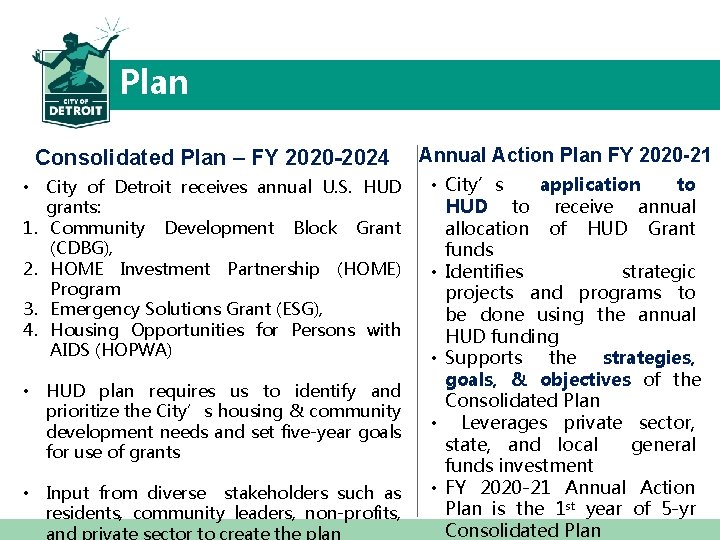
Consolidated Plan & Annual Action Plan Consolidated Plan – FY 2020 -2024 Annual Action Plan FY 2020 -21 • City of Detroit receives annual U. S. HUD grants: 1. Community Development Block Grant (CDBG), 2. HOME Investment Partnership (HOME) Program 3. Emergency Solutions Grant (ESG), 4. Housing Opportunities for Persons with AIDS (HOPWA) • City’s application to HUD to receive annual allocation of HUD Grant funds • Identifies strategic projects and programs to be done using the annual HUD funding • Supports the strategies, goals, & objectives of the Consolidated Plan • Leverages private sector, state, and local general funds investment • FY 2020 -21 Annual Action Plan is the 1 st year of 5 -yr Consolidated Plan • HUD plan requires us to identify and prioritize the City’s housing & community development needs and set five-year goals for use of grants • Input from diverse stakeholders such as residents, community leaders, non-profits, and private sector to create the plan
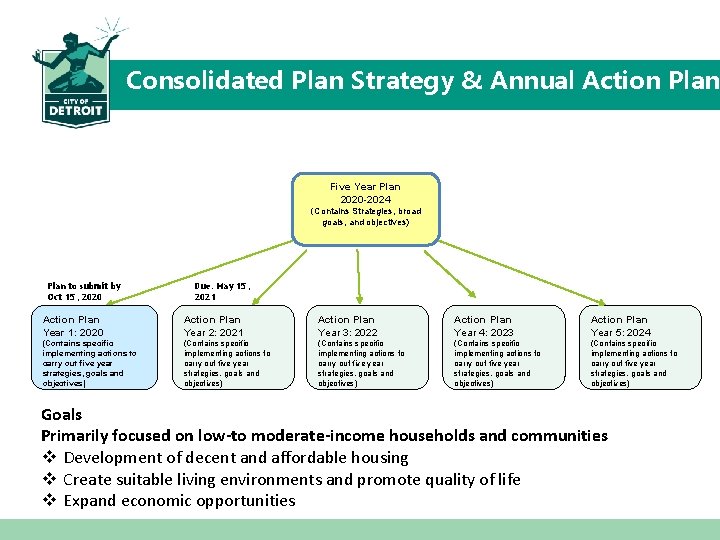
Consolidated Plan Strategy & Annual Action Plan Five Year Plan 2020 -2024 (Contains Strategies, broad goals, and objectives) Plan to submit by Oct 15, 2020 Due: May 15, 2021 Action Plan Year 1: 2020 Action Plan Year 2: 2021 Action Plan Year 3: 2022 Action Plan Year 4: 2023 Action Plan Year 5: 2024 (Contains specific implementing actions to carry out five year strategies, goals and objectives) (Contains specific implementing actions to carry out five year strategies, goals and objectives) Goals Primarily focused on low-to moderate-income households and communities v Development of decent and affordable housing v Create suitable living environments and promote quality of life v Expand economic opportunities
City of Detroit Funding Allocations 2005 – 2020 60 000 50 000 40 000 30 000 20 000 10 000 0 2005 -06 2010 -11 2013 -14 2016 -17 2020 -21
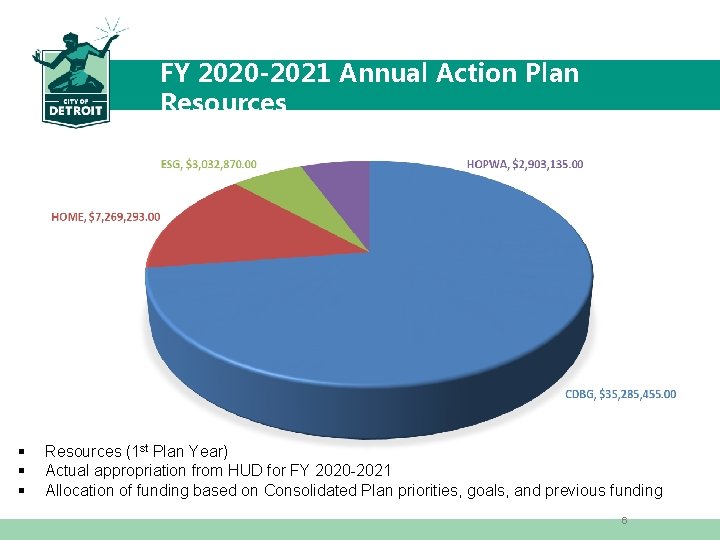
FY 2020 -2021 Annual Action Plan Resources § § § Resources (1 st Plan Year) Actual appropriation from HUD for FY 2020 -2021 Allocation of funding based on Consolidated Plan priorities, goals, and previous funding 6
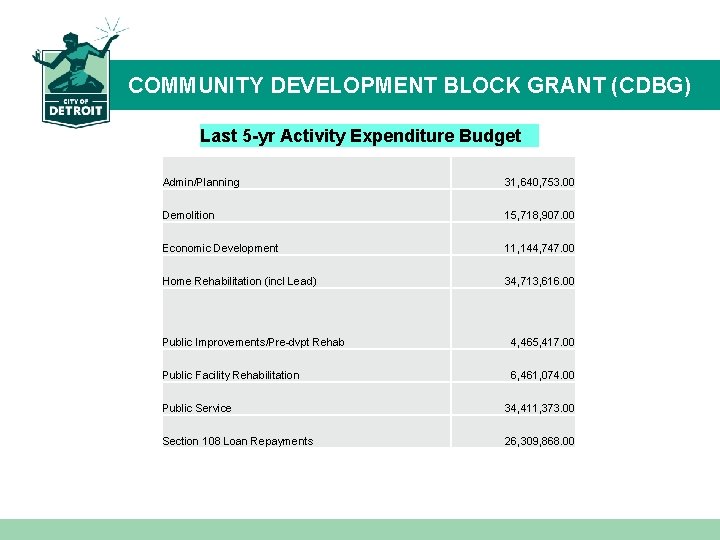
COMMUNITY DEVELOPMENT BLOCK GRANT (CDBG) Last 5 -yr Activity Expenditure Budget Admin/Planning 31, 640, 753. 00 Demolition 15, 718, 907. 00 Economic Development 11, 144, 747. 00 Home Rehabilitation (incl Lead) 34, 713, 616. 00 Public Improvements/Pre-dvpt Rehab 4, 465, 417. 00 Public Facility Rehabilitation 6, 461, 074. 00 Public Service 34, 411, 373. 00 Section 108 Loan Repayments 26, 309, 868. 00
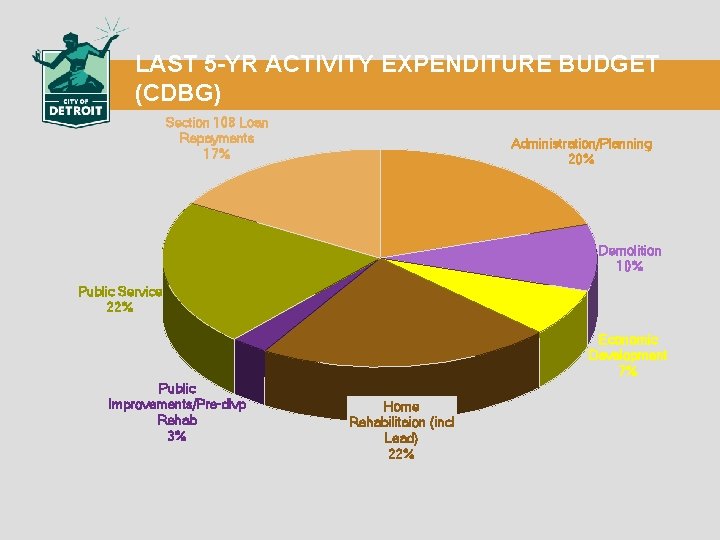
LAST 5 -YR ACTIVITY EXPENDITURE BUDGET (CDBG) Section 108 Loan Repayments 17% Administration/Planning 20% Demolition 10% Public Service 22% Economic Development 7% Public Improvements/Pre-dlvp Rehab 3% Home Rehabilitaion (incl Lead) 22%
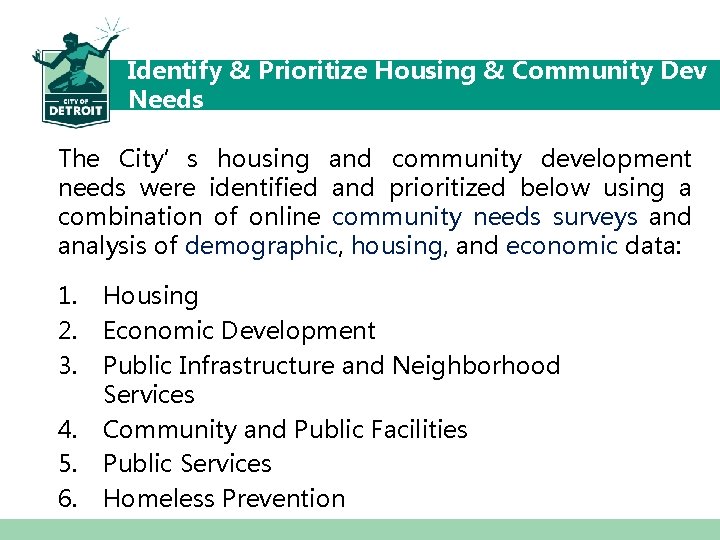
Identify & Prioritize Housing & Community Dev Needs The City’s housing and community development needs were identified and prioritized below using a combination of online community needs surveys and analysis of demographic, housing, and economic data: 1. 2. 3. 4. 5. 6. Housing Economic Development Public Infrastructure and Neighborhood Services Community and Public Facilities Public Services Homeless Prevention
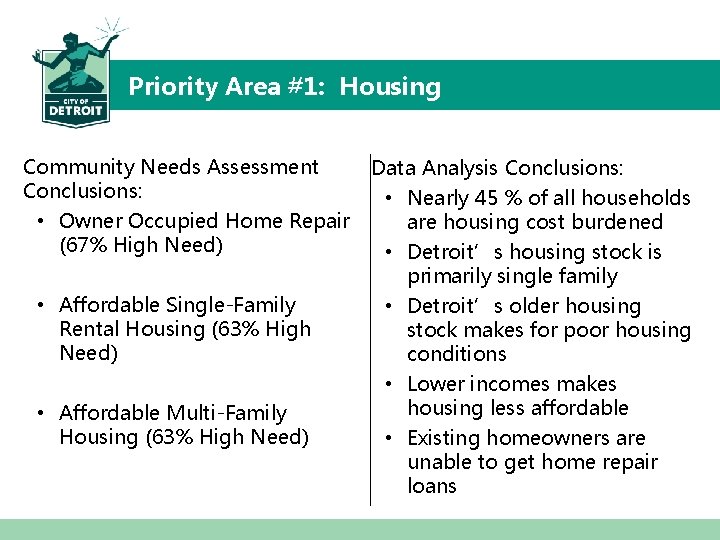
Priority Area #1: Housing Community Needs Assessment Conclusions: • Owner Occupied Home Repair (67% High Need) • Affordable Single-Family Rental Housing (63% High Need) • Affordable Multi-Family Housing (63% High Need) Data Analysis Conclusions: • Nearly 45 % of all households are housing cost burdened • Detroit’s housing stock is primarily single family • Detroit’s older housing stock makes for poor housing conditions • Lower incomes makes housing less affordable • Existing homeowners are unable to get home repair loans
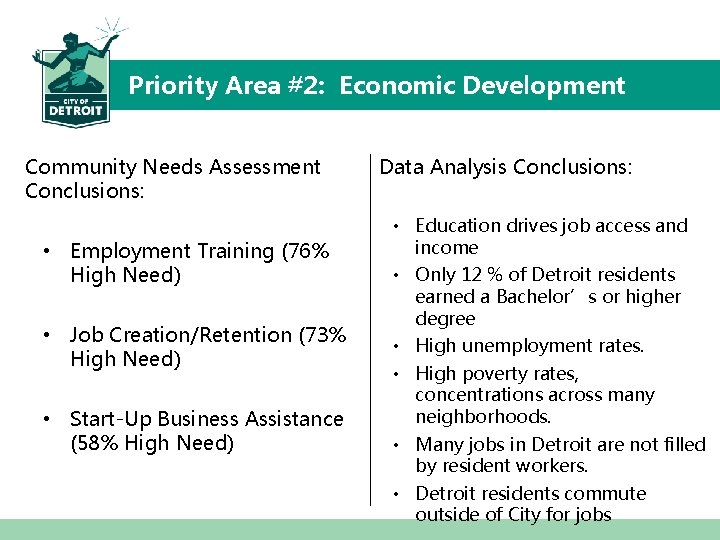
Priority Area #2: Economic Development Community Needs Assessment Conclusions: • Employment Training (76% High Need) • Job Creation/Retention (73% High Need) • Start-Up Business Assistance (58% High Need) Data Analysis Conclusions: • Education drives job access and income • Only 12 % of Detroit residents earned a Bachelor’s or higher degree • High unemployment rates. • High poverty rates, concentrations across many neighborhoods. • Many jobs in Detroit are not filled by resident workers. • Detroit residents commute outside of City for jobs
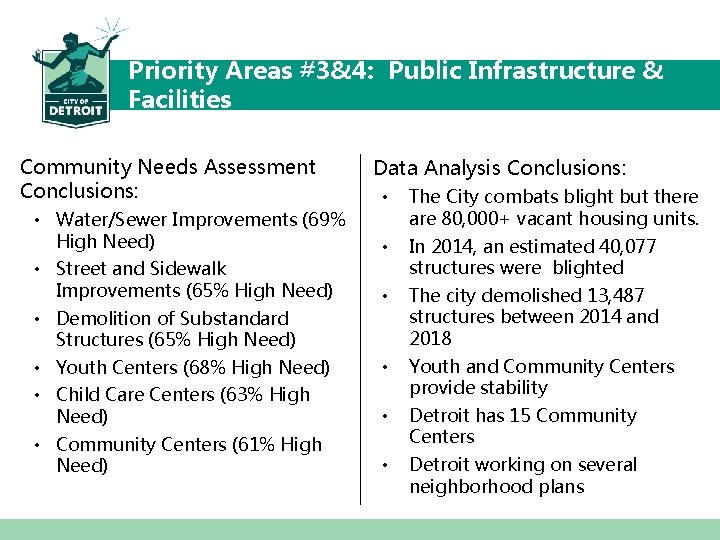
Priority Areas #3&4: Public Infrastructure & Facilities Community Needs Assessment Conclusions: • Water/Sewer Improvements (69% High Need) • Street and Sidewalk Improvements (65% High Need) • Demolition of Substandard Structures (65% High Need) • Youth Centers (68% High Need) • Child Care Centers (63% High Need) • Community Centers (61% High Need) Data Analysis Conclusions: • The City combats blight but there are 80, 000+ vacant housing units. • In 2014, an estimated 40, 077 structures were blighted • The city demolished 13, 487 structures between 2014 and 2018 • Youth and Community Centers provide stability • Detroit has 15 Community Centers • Detroit working on several neighborhood plans
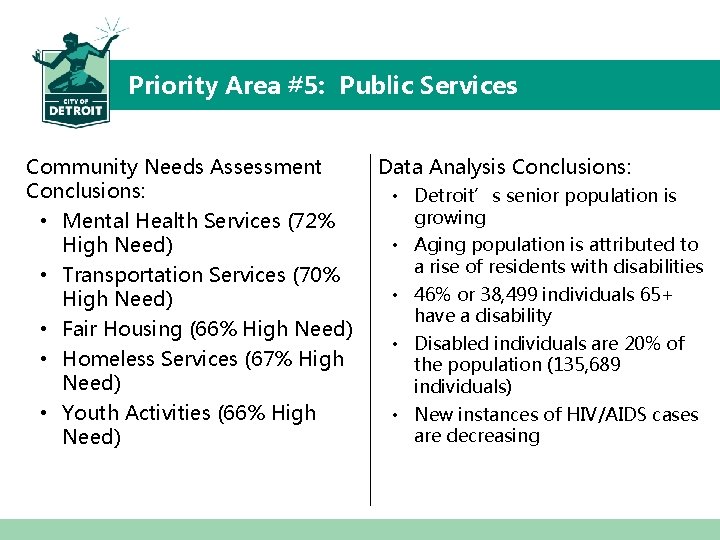
Priority Area #5: Public Services Community Needs Assessment Conclusions: • Mental Health Services (72% High Need) • Transportation Services (70% High Need) • Fair Housing (66% High Need) • Homeless Services (67% High Need) • Youth Activities (66% High Need) Data Analysis Conclusions: • Detroit’s senior population is growing • Aging population is attributed to a rise of residents with disabilities • 46% or 38, 499 individuals 65+ have a disability • Disabled individuals are 20% of the population (135, 689 individuals) • New instances of HIV/AIDS cases are decreasing
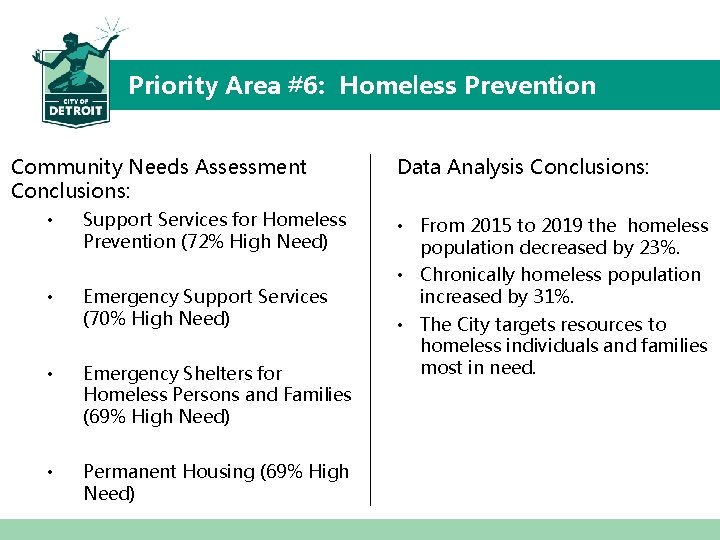
Priority Area #6: Homeless Prevention Community Needs Assessment Conclusions: • Support Services for Homeless Prevention (72% High Need) • Emergency Support Services (70% High Need) • Emergency Shelters for Homeless Persons and Families (69% High Need) • Permanent Housing (69% High Need) Data Analysis Conclusions: • From 2015 to 2019 the homeless population decreased by 23%. • Chronically homeless population increased by 31%. • The City targets resources to homeless individuals and families most in need.
Neighborhood Revitalization Strategy Areas (NRSAs) § Targeted neighborhood investment of CDBG funding. No additional $$ § Attracts and leverages private sector and other government funding § Designation approved by HUD. Five NRSAs approved in 2015. Benefits § City of Detroit requesting extension of NRSA approvals § LMI Job Creation/Retention - Eliminating the need for income tracking § Aggregation of Housing – Furthers mixed income funding of home repair § Aggregate Public Benefit Standard Exemption - Special Economic Development activities in NRSA may be exempt from certain job standards § Public Service Cap Exemption – Allows increased public services
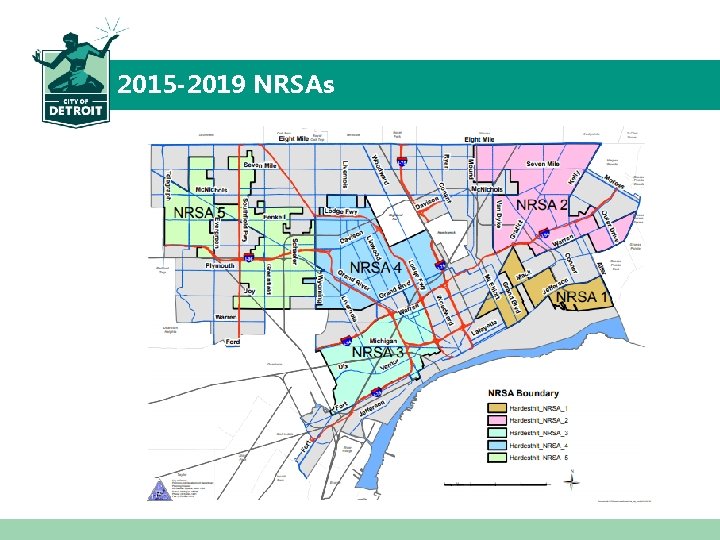
2015 -2019 NRSAs
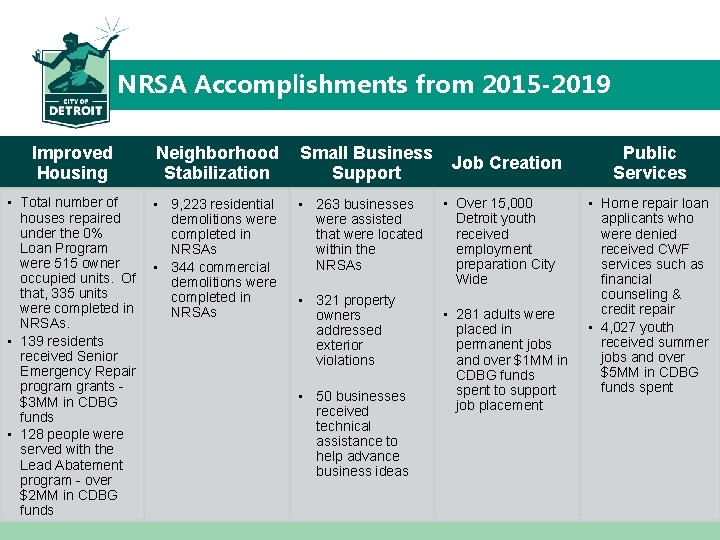
NRSA Accomplishments from 2015 -2019 Improved Housing Neighborhood Stabilization Small Business Support • Total number of houses repaired under the 0% Loan Program were 515 owner occupied units. Of that, 335 units were completed in NRSAs. • 139 residents received Senior Emergency Repair program grants $3 MM in CDBG funds • 128 people were served with the Lead Abatement program - over $2 MM in CDBG funds • 9, 223 residential demolitions were completed in NRSAs • 344 commercial demolitions were completed in NRSAs • 263 businesses were assisted that were located within the NRSAs • 321 property owners addressed exterior violations • 50 businesses received technical assistance to help advance business ideas Job Creation • Over 15, 000 Detroit youth received employment preparation City Wide • 281 adults were placed in permanent jobs and over $1 MM in CDBG funds spent to support job placement Public Services • Home repair loan applicants who were denied received CWF services such as financial counseling & credit repair • 4, 027 youth received summer jobs and over $5 MM in CDBG funds spent
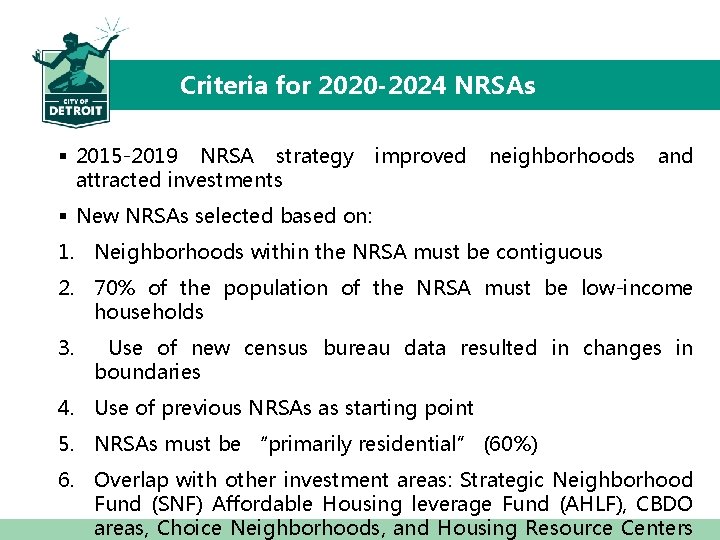
Criteria for 2020 -2024 NRSAs § 2015 -2019 NRSA strategy attracted investments improved neighborhoods and § New NRSAs selected based on: 1. Neighborhoods within the NRSA must be contiguous 2. 70% of the population of the NRSA must be low-income households 3. Use of new census bureau data resulted in changes in boundaries 4. Use of previous NRSAs as starting point 5. NRSAs must be “primarily residential” (60%) 6. Overlap with other investment areas: Strategic Neighborhood Fund (SNF) Affordable Housing leverage Fund (AHLF), CBDO areas, Choice Neighborhoods, and Housing Resource Centers
Proposed New 2020 -2024 NRSAs
Strategies for 2020 -2024 NRSAs v. Improved housing – home repair loans, emergency repair grants, and lead abatement grants v. Neighborhood stabilization - residential and commercial demolition v. Small business support – financial and technical assistance, commercial façade improvements v. Job creation/retention workforce development, jobs v. Public services – youth summer jobs, family
Public Participation • Question and Answer • Comments