
2020 2021 Job Task Analysis for the Pediatric
2020 -2021 Job Task Analysis for the Pediatric Primary Care Mental Health Specialist (PMHS®) Exam WHAT IS IT, AND WHY DO IT?
ü update and validate the inventory of tasks performed by advanced practice nurses (APRNs) with specialty expertise who provide DBMH services to children, adolescents, and young adults; Purpose of the Study ü update the existing inventory of diagnoses presented by patients; ü update the existing inventory of pharmacologic agents prescribed or monitored as well as the treatments and interventions performed or monitored; ü update the inventory of screening and assessment tools used by APRNs in the specialty; ü update and expand the inventory of social determinants of health (SDOH) by including adverse childhood events (ACEs) that may impact patient health; and ü develop updated test specifications and a detailed content outline for the PMHS examination.
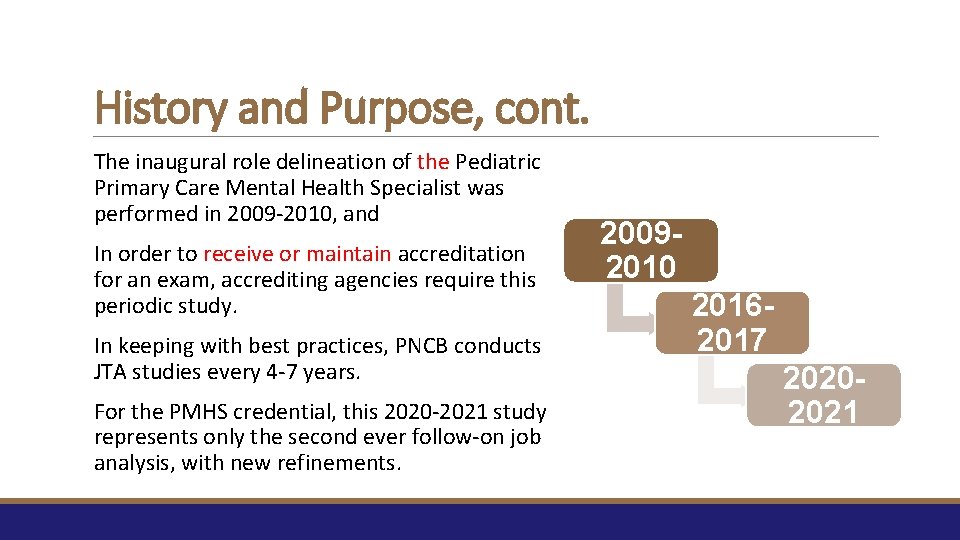
History and Purpose, cont. The inaugural role delineation of the Pediatric Primary Care Mental Health Specialist was performed in 2009 -2010, and In order to receive or maintain accreditation for an exam, accrediting agencies require this periodic study. In keeping with best practices, PNCB conducts JTA studies every 4 -7 years. For the PMHS credential, this 2020 -2021 study represents only the second ever follow-on job analysis, with new refinements. 20092010 20162017 20202021
History and Purpose, cont. In order to develop a content outline for the certification examination, the JTA study identifies tasks, knowledge, skills, or abilities deemed to be important to APRNs who provide developmental, behavioral, and mental health services to children, adolescents, and young adults. A task appears on the updated content outline only if it met validation criteria according to JTA study results.
What are the steps involved? Over a period of several months between July 2020 and January 2021, the following occurred: 1. Development of the survey instrument with subject matter experts (SMEs) from around the country. This involved: § Reflecting on trends in practice since the last study § Commenting on the current outline § Providing feedback or suggestions related to the delineation of practice 2. Pilot testing of the instrument for clarity and comprehensiveness.
(cont. ) What are the steps involved? 3. Dissemination of the survey to § all actively-certified PMHSs, § all PNCB-certified Primary Care Pediatric Nurse Practitioners (CPNP-PCs) who did not otherwise hold the credential, and § a volunteer sample of the Family Nurse Practitioners (FNPs) certified by the American Academy of Nurse Practitioners Certification Board (AANPCB) 4. Analysis of survey data 5. With input from the SMEs, development of test specifications and the updated content outline from survey finding.
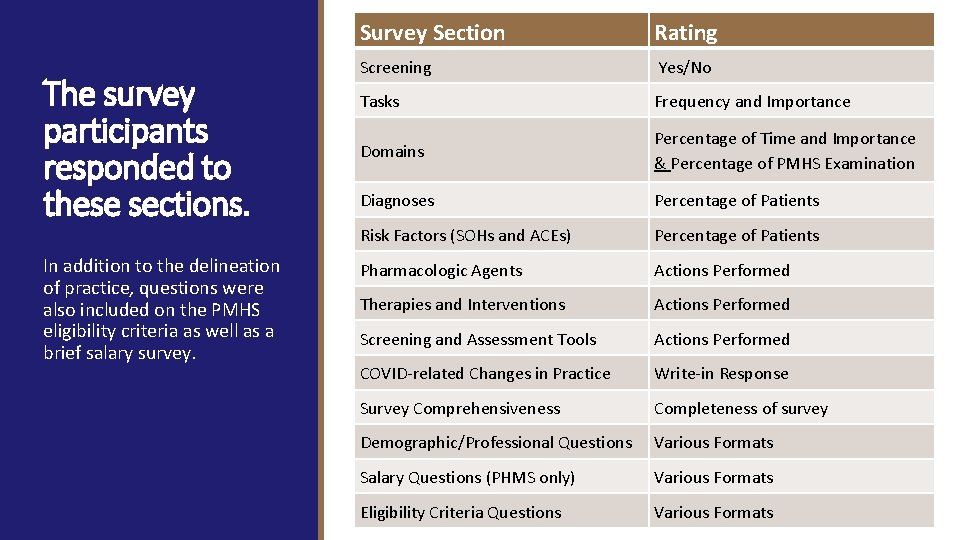
The survey participants responded to these sections. In addition to the delineation of practice, questions were also included on the PMHS eligibility criteria as well as a brief salary survey. Survey Section Rating Screening Yes/No Tasks Frequency and Importance Domains Percentage of Time and Importance & Percentage of PMHS Examination Diagnoses Percentage of Patients Risk Factors (SOHs and ACEs) Percentage of Patients Pharmacologic Agents Actions Performed Therapies and Interventions Actions Performed Screening and Assessment Tools Actions Performed COVID-related Changes in Practice Write-in Response Survey Comprehensiveness Completeness of survey Demographic/Professional Questions Various Formats Salary Questions (PHMS only) Various Formats Eligibility Criteria Questions Various Formats
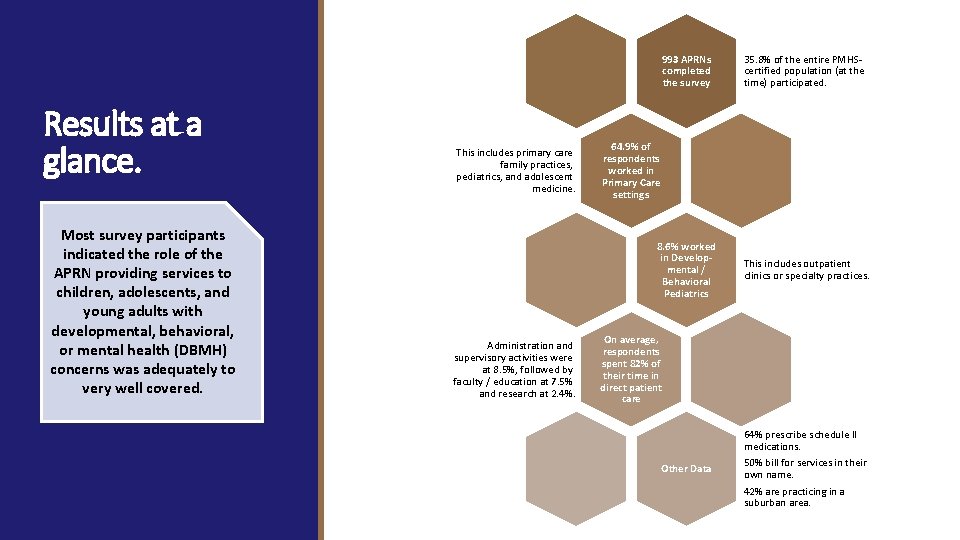
Results at a glance. Most survey participants indicated the role of the APRN providing services to children, adolescents, and young adults with developmental, behavioral, or mental health (DBMH) concerns was adequately to very well covered. This includes primary care family practices, pediatrics, and adolescent medicine. Administration and supervisory activities were at 8. 5%, followed by faculty / education at 7. 5% and research at 2. 4%. 993 APRNs completed the survey 35. 8% of the entire PMHScertified population (at the time) participated. 8. 6% worked in Developmental / Behavioral Pediatrics This includes outpatient clinics or specialty practices. 64. 9% of respondents worked in Primary Care settings On average, respondents spent 82% of their time in direct patient care Other Data 64% prescribe schedule II medications. 50% bill for services in their own name. 42% are practicing in a suburban area.
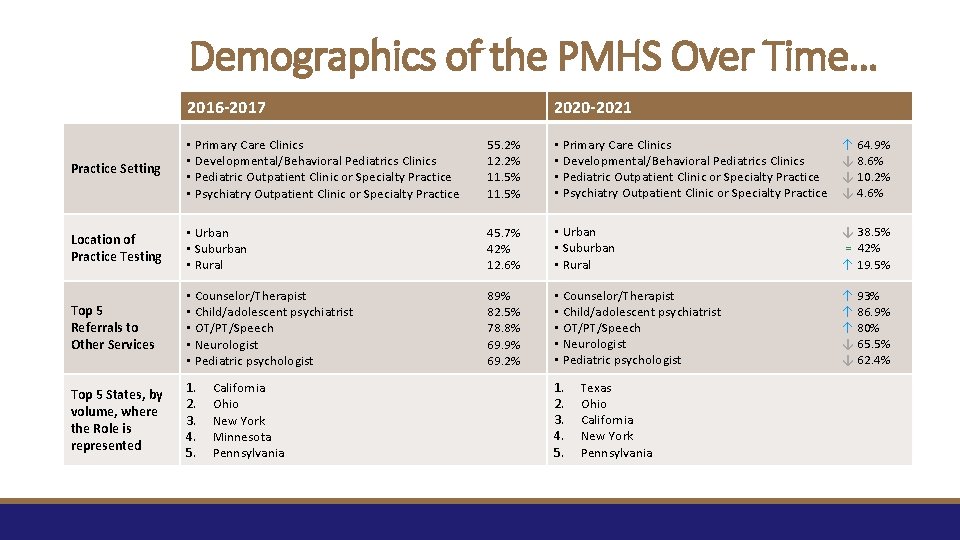
Demographics of the PMHS Over Time… 2016 -2017 2020 -2021 Practice Setting • Primary Care Clinics • Developmental/Behavioral Pediatrics Clinics • Pediatric Outpatient Clinic or Specialty Practice • Psychiatry Outpatient Clinic or Specialty Practice 55. 2% 12. 2% 11. 5% • Primary Care Clinics • Developmental/Behavioral Pediatrics Clinics • Pediatric Outpatient Clinic or Specialty Practice • Psychiatry Outpatient Clinic or Specialty Practice 64. 9% ↓ 8. 6% ↓ 10. 2% ↓ 4. 6% Location of Practice Testing • Urban • Suburban • Rural 45. 7% 42% 12. 6% • Urban • Suburban • Rural ↓ 38. 5% = 42% 19. 5% Top 5 Referrals to Other Services • Counselor/Therapist • Child/adolescent psychiatrist • OT/PT/Speech • Neurologist • Pediatric psychologist 89% 82. 5% 78. 8% 69. 9% 69. 2% • Counselor/Therapist • Child/adolescent psychiatrist • OT/PT/Speech • Neurologist • Pediatric psychologist 93% 86. 9% 80% ↓ 65. 5% ↓ 62. 4% Top 5 States, by volume, where the Role is represented 1. 2. 3. 4. 5. California Ohio New York Minnesota Pennsylvania 1. 2. 3. 4. 5. Texas Ohio California New York Pennsylvania
Content Outline Impact OVERALL The description of the specialty was first reviewed, and minor updates were made to reflect current terminology. Once updated, this description served as an anchor for all subsequent work. All 68 tasks that were surveyed met thresholds and were validated and/or were retained based on their high importance ratings from key subgroups, and thus, included on the final content outline. Additionally, listings of diagnoses, risk factors, pharmacology agents, therapies and interventions, as well as screening and assessment tools were also surveyed for validation and inclusion.
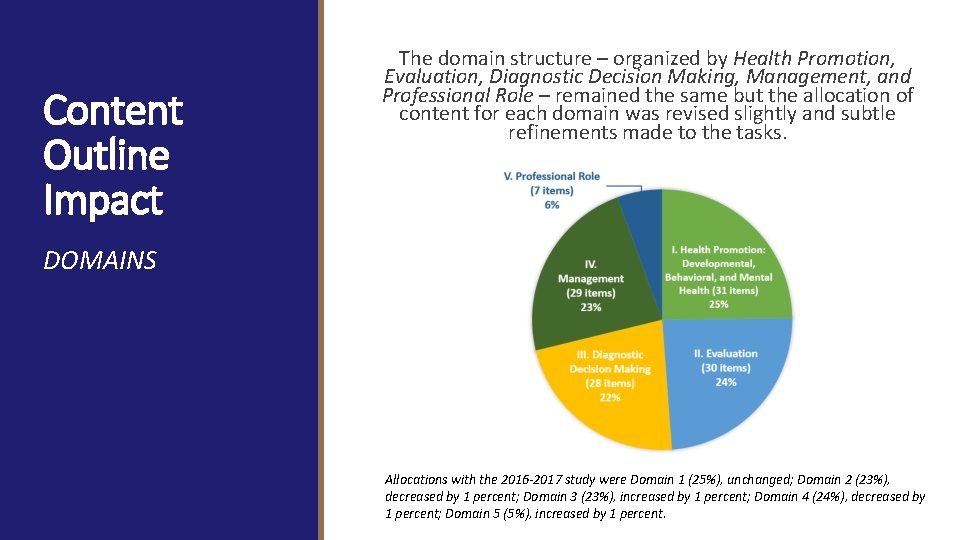
Content Outline Impact The domain structure – organized by Health Promotion, Evaluation, Diagnostic Decision Making, Management, and Professional Role – remained the same but the allocation of content for each domain was revised slightly and subtle refinements made to the tasks. DOMAINS Allocations with the 2016 -2017 study were Domain 1 (25%), unchanged; Domain 2 (23%), decreased by 1 percent; Domain 3 (23%), increased by 1 percent; Domain 4 (24%), decreased by 1 percent; Domain 5 (5%), increased by 1 percent.
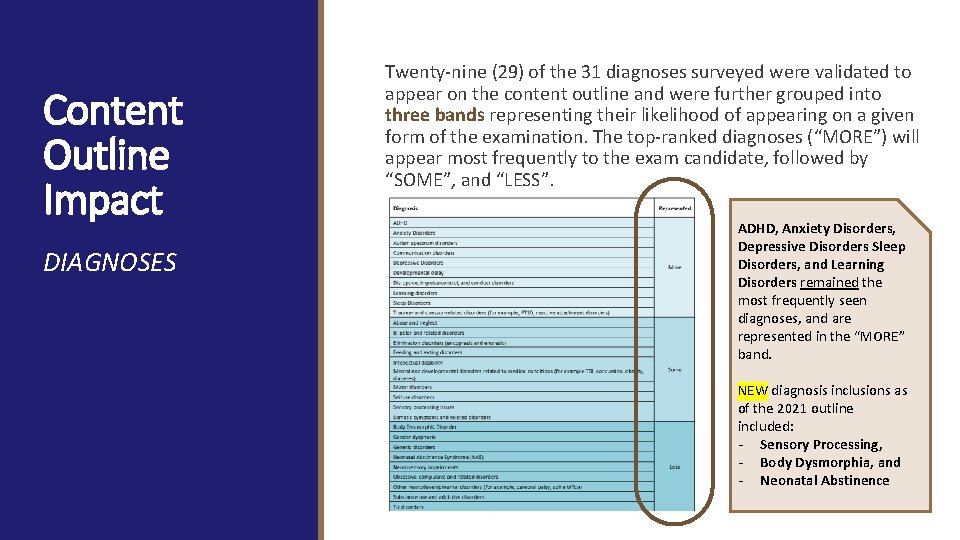
Content Outline Impact DIAGNOSES Twenty-nine (29) of the 31 diagnoses surveyed were validated to appear on the content outline and were further grouped into three bands representing their likelihood of appearing on a given form of the examination. The top-ranked diagnoses (“MORE”) will appear most frequently to the exam candidate, followed by “SOME”, and “LESS”. ADHD, Anxiety Disorders, Depressive Disorders Sleep Disorders, and Learning Disorders remained the most frequently seen diagnoses, and are represented in the “MORE” band. NEW diagnosis inclusions as of the 2021 outline included: - Sensory Processing, - Body Dysmorphia, and - Neonatal Abstinence
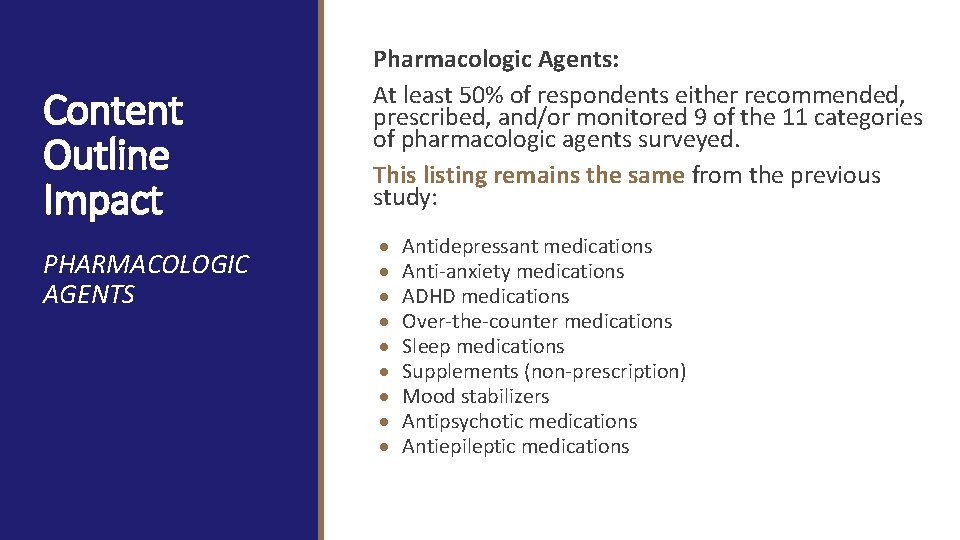
Content Outline Impact PHARMACOLOGIC AGENTS Pharmacologic Agents: At least 50% of respondents either recommended, prescribed, and/or monitored 9 of the 11 categories of pharmacologic agents surveyed. This listing remains the same from the previous study: Antidepressant medications Anti-anxiety medications ADHD medications Over-the-counter medications Sleep medications Supplements (non-prescription) Mood stabilizers Antipsychotic medications Antiepileptic medications
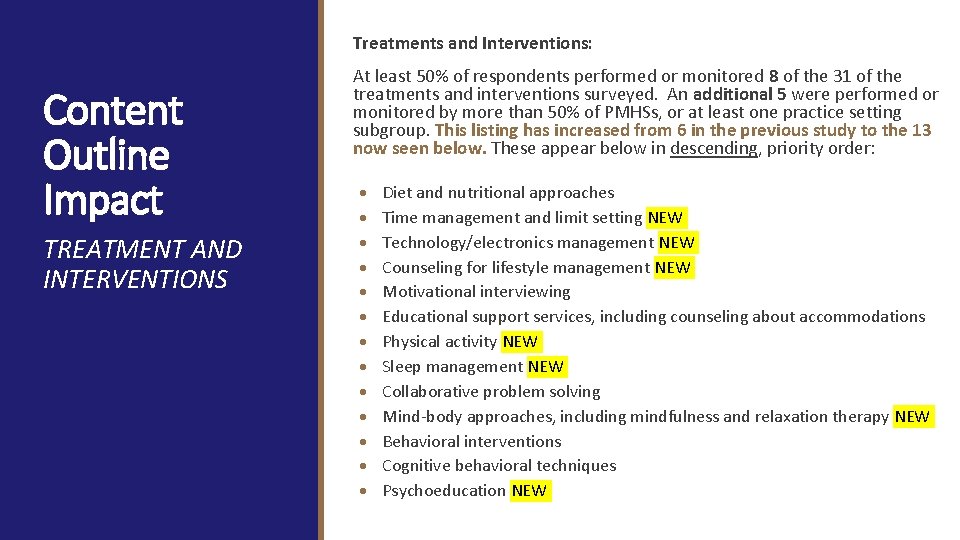
Treatments and Interventions: Content Outline Impact TREATMENT AND INTERVENTIONS At least 50% of respondents performed or monitored 8 of the 31 of the treatments and interventions surveyed. An additional 5 were performed or monitored by more than 50% of PMHSs, or at least one practice setting subgroup. This listing has increased from 6 in the previous study to the 13 now seen below. These appear below in descending, priority order: Diet and nutritional approaches Time management and limit setting NEW Technology/electronics management NEW Counseling for lifestyle management NEW Motivational interviewing Educational support services, including counseling about accommodations Physical activity NEW Sleep management NEW Collaborative problem solving Mind-body approaches, including mindfulness and relaxation therapy NEW Behavioral interventions Cognitive behavioral techniques Psychoeducation NEW
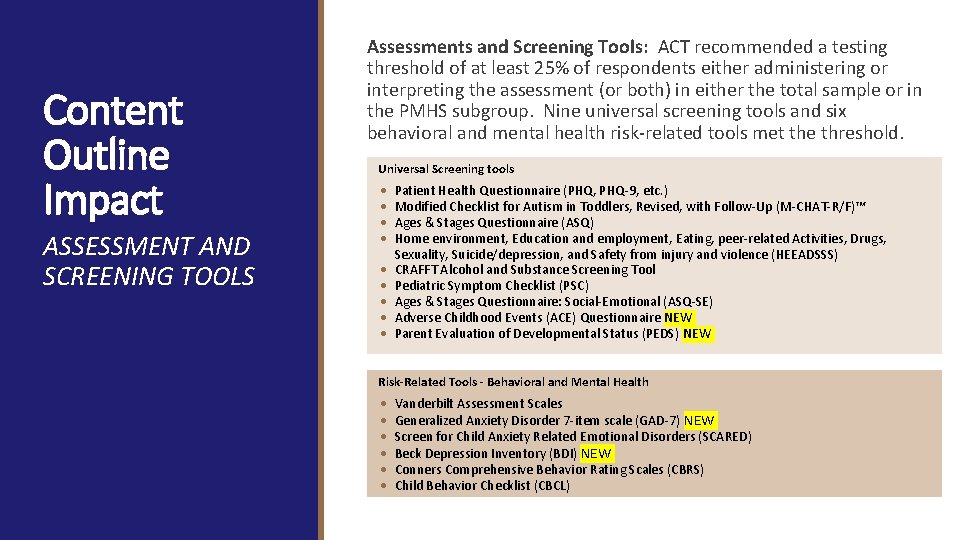
Content Outline Impact ASSESSMENT AND SCREENING TOOLS Assessments and Screening Tools: ACT recommended a testing threshold of at least 25% of respondents either administering or interpreting the assessment (or both) in either the total sample or in the PMHS subgroup. Nine universal screening tools and six behavioral and mental health risk-related tools met the threshold. Universal Screening tools Patient Health Questionnaire (PHQ, PHQ-9, etc. ) Modified Checklist for Autism in Toddlers, Revised, with Follow-Up (M-CHAT-R/F)™ Ages & Stages Questionnaire (ASQ) Home environment, Education and employment, Eating, peer-related Activities, Drugs, Sexuality, Suicide/depression, and Safety from injury and violence (HEEADSSS) CRAFFT Alcohol and Substance Screening Tool Pediatric Symptom Checklist (PSC) Ages & Stages Questionnaire: Social-Emotional (ASQ-SE) Adverse Childhood Events (ACE) Questionnaire NEW Parent Evaluation of Developmental Status (PEDS) NEW Risk-Related Tools - Behavioral and Mental Health Vanderbilt Assessment Scales Generalized Anxiety Disorder 7 -item scale (GAD-7) NEW Screen for Child Anxiety Related Emotional Disorders (SCARED) Beck Depression Inventory (BDI) NEW Conners Comprehensive Behavior Rating Scales (CBRS) Child Behavior Checklist (CBCL)
Exam Details § There were no changes in the number of questions ü 125 scored items and 25 unscored items ü You will not be able to distinguish between scored and non-scored questions. § There was no change in time allotment ü 2. 5 hours
FAQs § Q: When does the updated exam launch? A: The new exam will launch with the testing window beginning October 15, 2021. § Q: Do I need to study differently with this updated outline? A: No, the reference list remains the same because the tasks listed on the new outline have not changed significantly from the previous one. § Q: Have the eligibility requirements changed as a result of this study? A: No, eligibility requirements have remained the same. § Q: Where can I confirm my eligibility? A: Visit PNCB’s website for more information: https: //www. pncb. org/pmhs-exam-eligibility
If you have questions, please visit: www. pncb. org or email exam@pncb. org. Our team will be glad to assist. We wish you much success on your upcoming exam. Updated 08242021
- Slides: 18