
2019 Project Management Introduction By Ph D Samia
2019 Project Management Introduction By Ph. D. Samia Chehbi Gamoura Associate Professor – EM Strasbourg University France
Agenda Project Management • Project • Management • Managing a Project • Definition • Etymology • History • PDCA • Iron Triangle QCT • Risk Management • Resource Management • Communication Management • Procurement Management • Integration Management • Technical Flow Chart • Life Cycle • Planning • Controlling • Reporting • Intellectual property • Cost Analysis • Dash board • Management tools • Maintenance Management • Project Manager
Agenda Project Management • Project • Management • Managing a Project • Definition • Etymology • History • PDCA • Iron Triangle QCT • Risk Management • Resource Management • Communication Management • Procurement Management • Integration Management • Technical Flow Chart • Life Cycle • Planning • Controlling • Reporting • Intellectual property • Cost Analysis • Dash board • Management tools • Maintenance Management • Project Manager
Project What is ‘a project’ ? ! 5 min to answer… 4
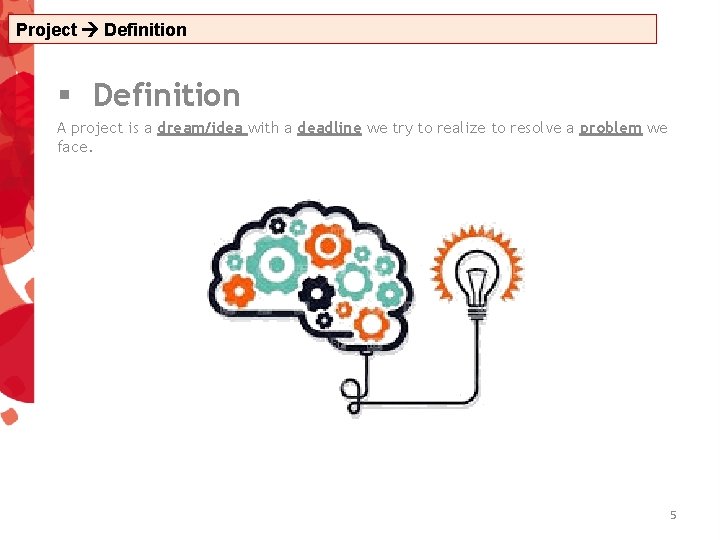
Project Definition § Definition A project is a dream/idea with a deadline we try to realize to resolve a problem we face. 5
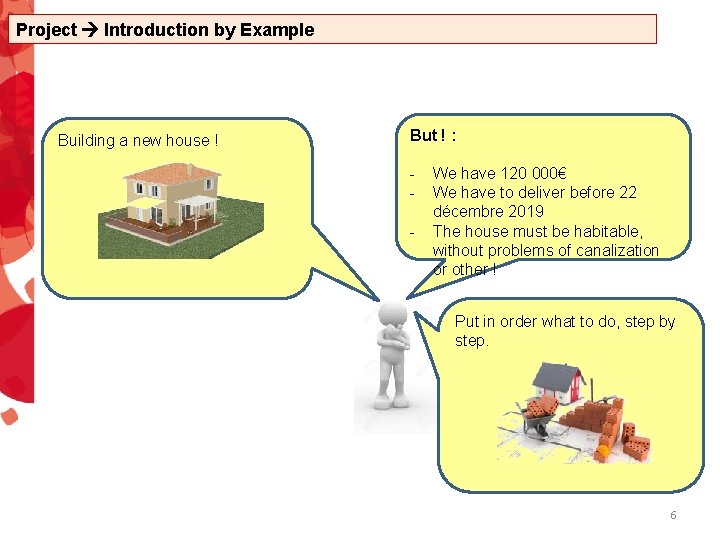
Project Introduction by Example Building a new house ! But ! : - We have 120 000€ We have to deliver before 22 décembre 2019 The house must be habitable, without problems of canalization or other ! Put in order what to do, step by step. 6
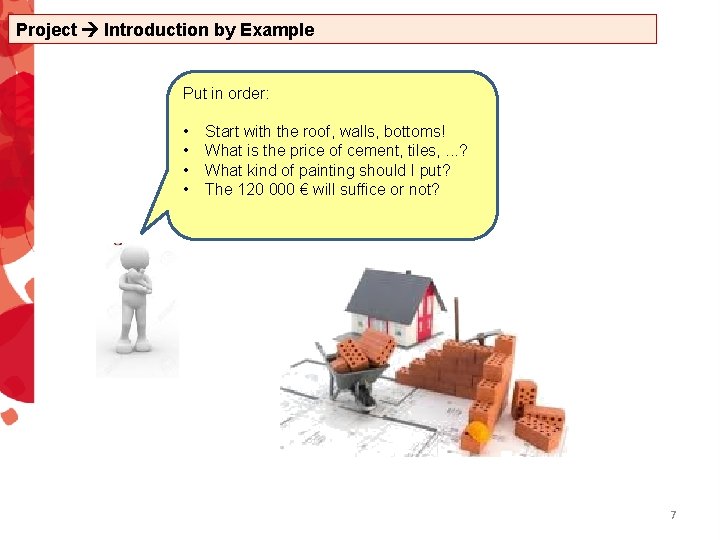
Project Introduction by Example Put in order: • • Start with the roof, walls, bottoms! What is the price of cement, tiles, . . . ? What kind of painting should I put? The 120 000 € will suffice or not? 7
Project Categories § Hard Project A project designed for a unique type of customers (a segment) for a tangible delivrable. This kind of projects can be reiterated in design but customized. Examples : Library, Hotel, house, etc. § Soft Project A project realized to one or more types of customers (segments). The delivrable is an intangible product (service). It is delivered once and the provider usually change. Example: The organization of the Olympic games. § Social Project Is a project designed for a community (not related to segments of cursomers), such as a national event. It is produced once but usually the same provider. Example: Organization of Polls. § Product’s Project Is a project designed for a segment of customers (may be multiple segments of cursomers) for tangible or intangible product and must be recurrent with in a lifecycle. Example: manufaccturing and selling a car. 8
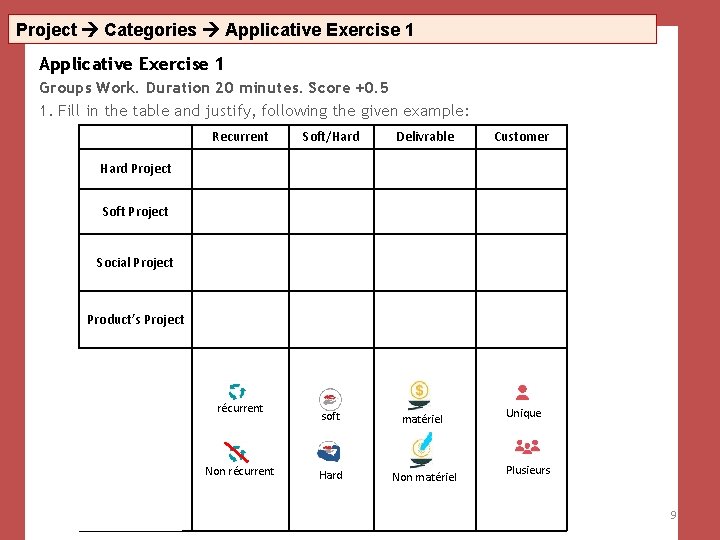
Project Categories Applicative Exercise 1 Groups Work. Duration 20 minutes. Score +0. 5 1. Fill in the table and justify, following the given example: Recurrent Soft/Hard Delivrable Customer soft matériel Unique Hard Non matériel Hard Project Soft Project Social Project Product’s Project récurrent Non récurrent Plusieurs 9
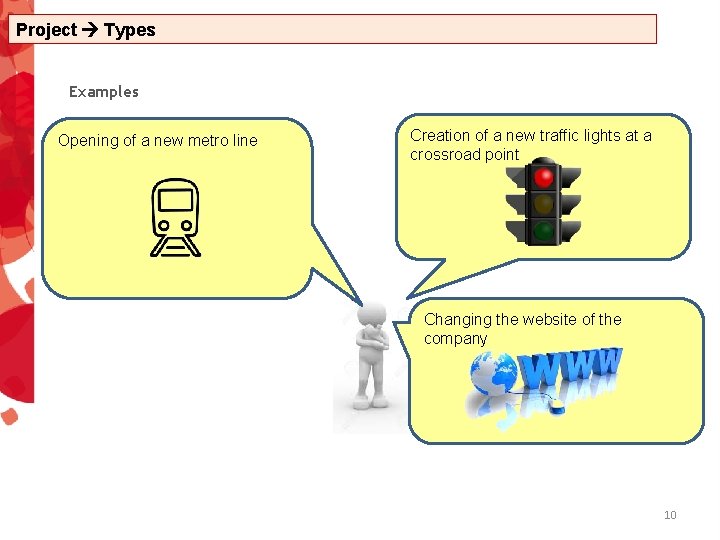
Project Types Examples Opening of a new metro line Creation of a new traffic lights at a crossroad point Changing the website of the company 10
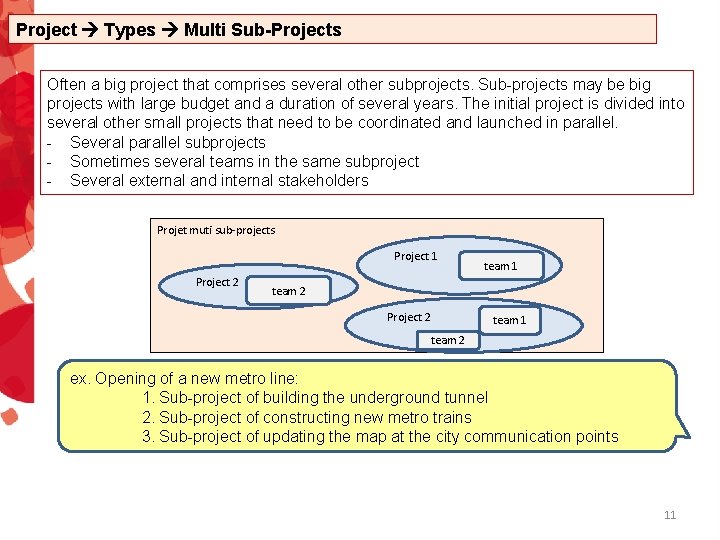
Project Types Multi Sub-Projects Often a big project that comprises several other subprojects. Sub-projects may be big projects with large budget and a duration of several years. The initial project is divided into several other small projects that need to be coordinated and launched in parallel. - Several parallel subprojects - Sometimes several teams in the same subproject - Several external and internal stakeholders Projet muti sub-projects Project 1 Project 2 team 1 team 2 ex. Opening of a new metro line: 1. Sub-project of building the underground tunnel 2. Sub-project of constructing new metro trains 3. Sub-project of updating the map at the city communication points 11
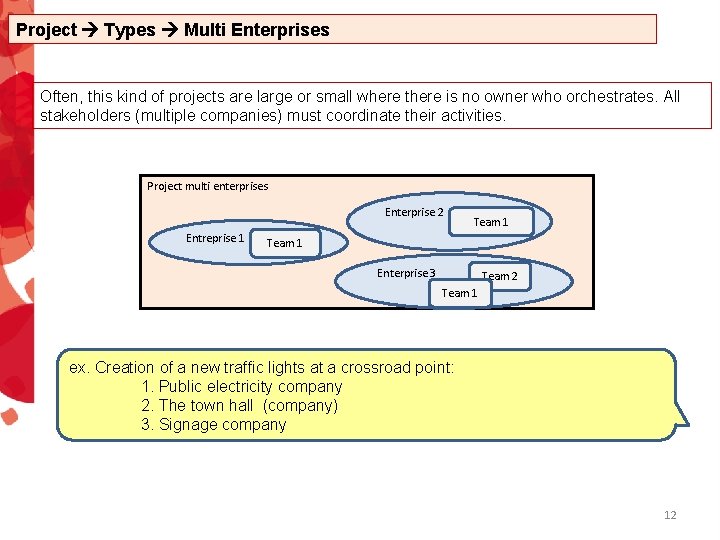
Project Types Multi Enterprises Often, this kind of projects are large or small where there is no owner who orchestrates. All stakeholders (multiple companies) must coordinate their activities. Project multi enterprises Enterprise 2 Entreprise 1 Team 1 Enterprise 3 Team 2 Team 1 ex. Creation of a new traffic lights at a crossroad point: 1. Public electricity company 2. The town hall (company) 3. Signage company 12
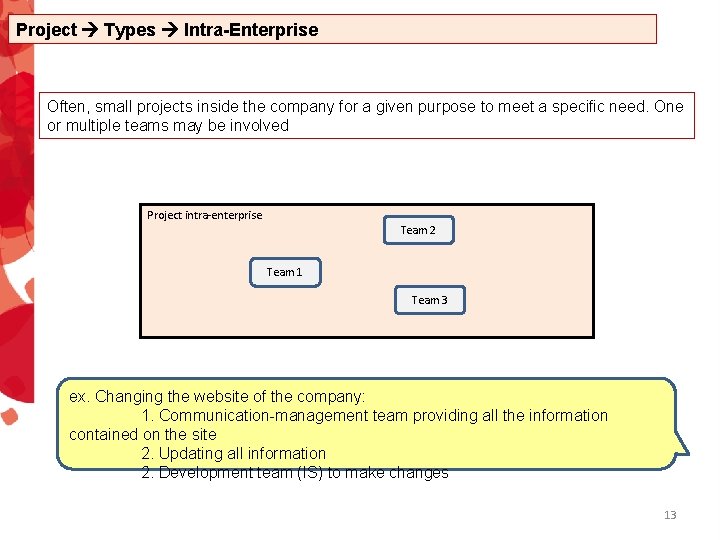
Project Types Intra-Enterprise Often, small projects inside the company for a given purpose to meet a specific need. One or multiple teams may be involved Project intra-enterprise Team 2 Team 1 Team 3 ex. Changing the website of the company: 1. Communication-management team providing all the information contained on the site 2. Updating all information 2. Development team (IS) to make changes 13
Agenda Project Management • Project • Management • Managing a Project • Definition • Etymology • History • PDCA • Iron Triangle QCT • Risk Management • Resource Management • Communication Management • Procurement Management • Integration Management • Technical Flow Chart • Life Cycle • Planning • Controlling • Reporting • Intellectual property • Cost Analysis • Dash board • Management tools • Maintenance Management • Project Manager
Management What is ‘management’ ? ! 5 min to answer… 15
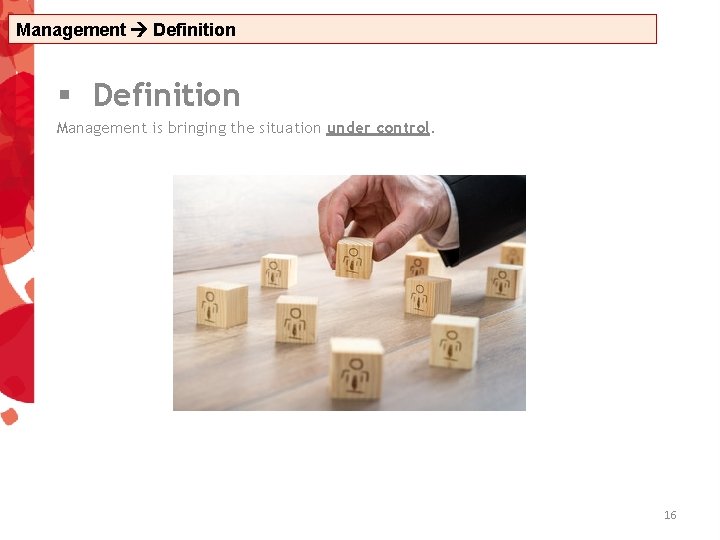
Management Definition § Definition Management is bringing the situation under control. 16
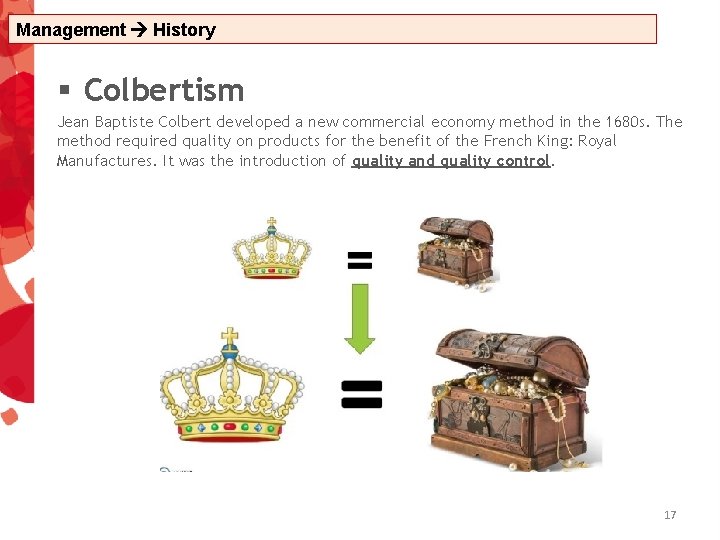
Management History § Colbertism Jean Baptiste Colbert developed a new commercial economy method in the 1680 s. The method required quality on products for the benefit of the French King: Royal Manufactures. It was the introduction of quality and quality control. 17
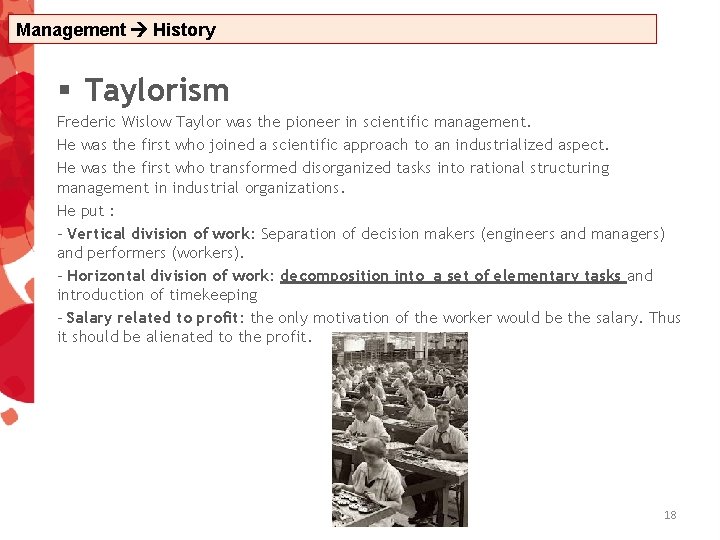
Management History § Taylorism Frederic Wislow Taylor was the pioneer in scientific management. He was the first who joined a scientific approach to an industrialized aspect. He was the first who transformed disorganized tasks into rational structuring management in industrial organizations. He put : - Vertical division of work: Separation of decision makers (engineers and managers) and performers (workers). - Horizontal division of work: decomposition into a set of elementary tasks and introduction of timekeeping - Salary related to profit: the only motivation of the worker would be the salary. Thus it should be alienated to the profit. 18
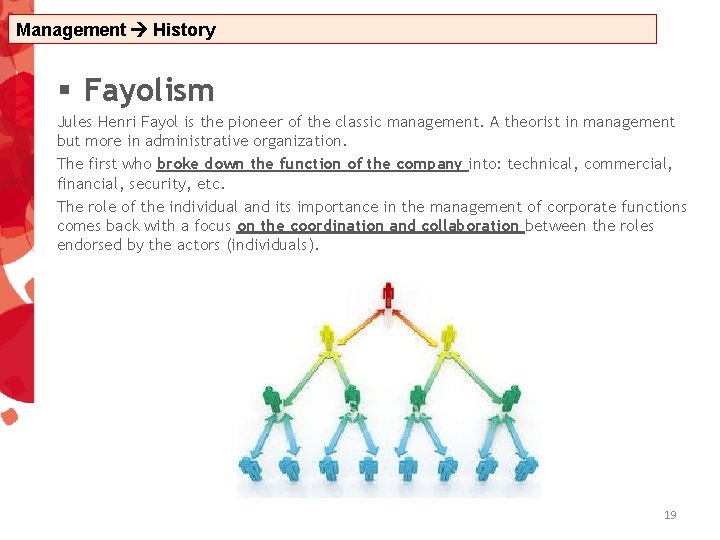
Management History § Fayolism Jules Henri Fayol is the pioneer of the classic management. A theorist in management but more in administrative organization. The first who broke down the function of the company into: technical, commercial, financial, security, etc. The role of the individual and its importance in the management of corporate functions comes back with a focus on the coordination and collaboration between the roles endorsed by the actors (individuals). 19
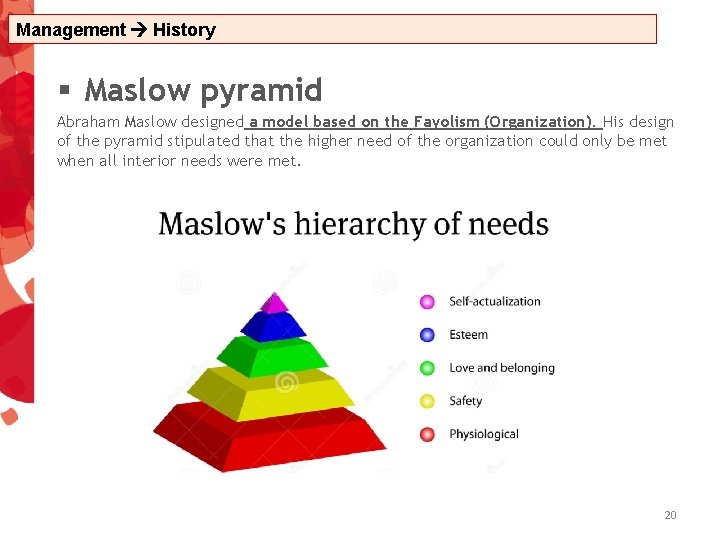
Management History § Maslow pyramid Abraham Maslow designed a model based on the Fayolism (Organization). His design of the pyramid stipulated that the higher need of the organization could only be met when all interior needs were met. 20
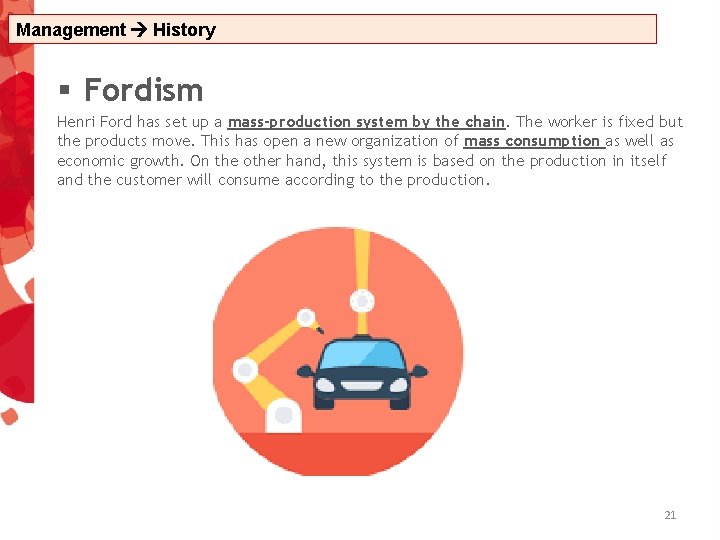
Management History § Fordism Henri Ford has set up a mass-production system by the chain. The worker is fixed but the products move. This has open a new organization of mass consumption as well as economic growth. On the other hand, this system is based on the production in itself and the customer will consume according to the production. 21
Management History § Toyotism Taïchi Ohno put a system by the chain driven by consumption. Continuous chain that produces on demand. The principle is based on the 5 zeros: Zero stock Zero delay Zero fault Zero failure Zero paper 22
Management History Applicative Exercise 2 Groups Work. Duration 30 minutes. Scored +0. 5 1. Create an illustration that displays the relationship of dependence (similarities) between the following concepts. By adding to each concept, the basic idea brought to the management field in few words (one sentence) : - Colbertism - Taylorism - Fayolism - Fordism - Toyotism 2. Draw an illustration of each concept (illustrated idea). The illustration must be empty of any form of text but should be argued only by illustration. 23
Agenda Project Management • Project • Management • Managing a Project • Definition • Etymology • History • PDCA • Iron Triangle QCT • Risk Management • Resource Management • Communication Management • Procurement Management • Integration Management • Technical Flow Chart • Life Cycle • Planning • Controlling • Reporting • Intellectual property • Cost Analysis • Dash board • Management tools • Maintenance Management • Project Manager
Managing a Project What is ‘management of a project’ ? ! 5 min to answer… 25
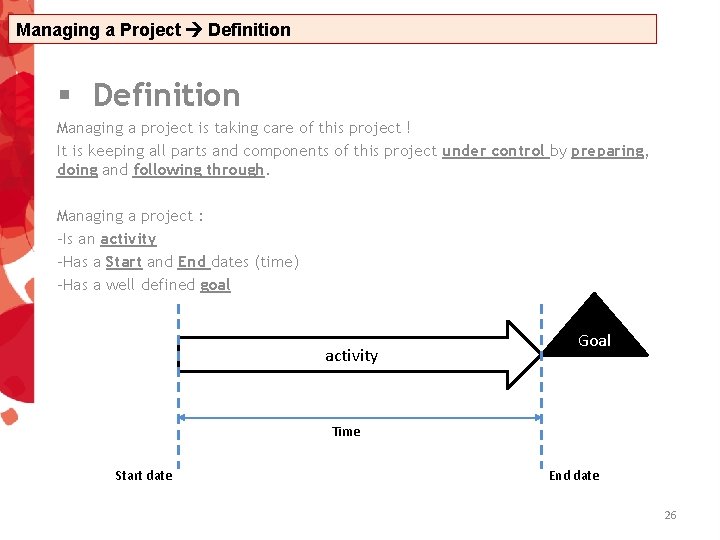
Managing a Project Definition § Definition Managing a project is taking care of this project ! It is keeping all parts and components of this project under control by preparing, doing and following through. Managing a project : -Is an activity -Has a Start and End dates (time) -Has a well defined goal activity Goal Time Start date End date 26
Managing a Project Etymology § Program A set of projects related to the same field: same strategic lineage. Examples: Program of digitalization of the public administration. Ex. job: Program Manager. § Business Case The economic aspect of the project. It is related to all aspects of customer (contrat, exchanges, etc. ). Ex. job: Business Engineer. § Product The product is the deliverable of the project. It can be tangible (goods) or not (services) or both. A project can group several products. Ex. job: Product Director. 27
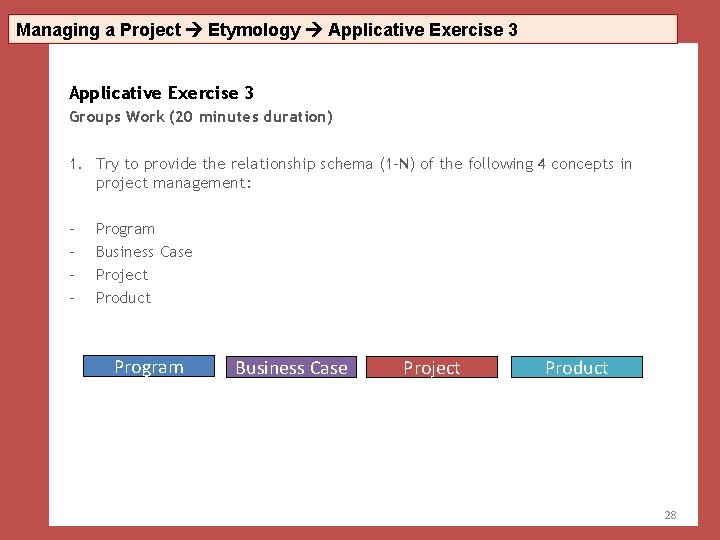
Managing a Project Etymology Applicative Exercise 3 Groups Work (20 minutes duration) 1. Try to provide the relationship schema (1 -N) of the following 4 concepts in project management: - Program Business Case Project Product 28
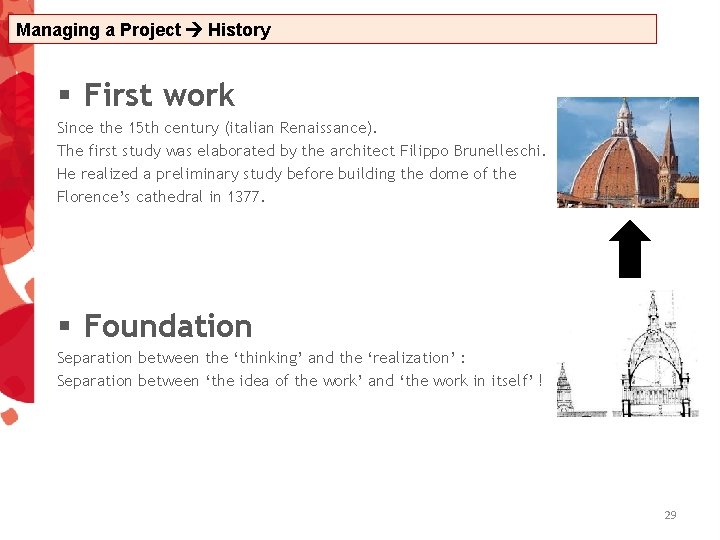
Managing a Project History § First work Since the 15 th century (italian Renaissance). The first study was elaborated by the architect Filippo Brunelleschi. He realized a preliminary study before building the dome of the Florence’s cathedral in 1377. § Foundation Separation between the ‘thinking’ and the ‘realization’ : Separation between ‘the idea of the work’ and ‘the work in itself’ ! 29
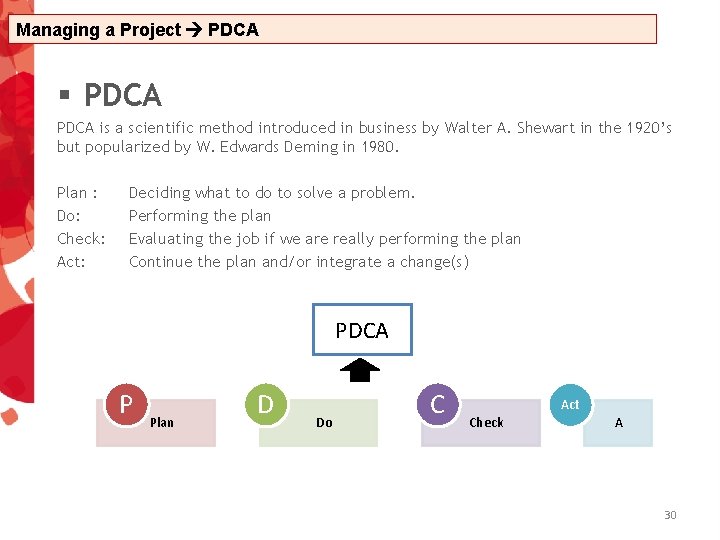
Managing a Project PDCA § PDCA is a scientific method introduced in business by Walter A. Shewart in the 1920’s but popularized by W. Edwards Deming in 1980. Plan : Do: Check: Act: Deciding what to do to solve a problem. Performing the plan Evaluating the job if we are really performing the plan Continue the plan and/or integrate a change(s) PDCA P Plan D Do C Act Check A 30
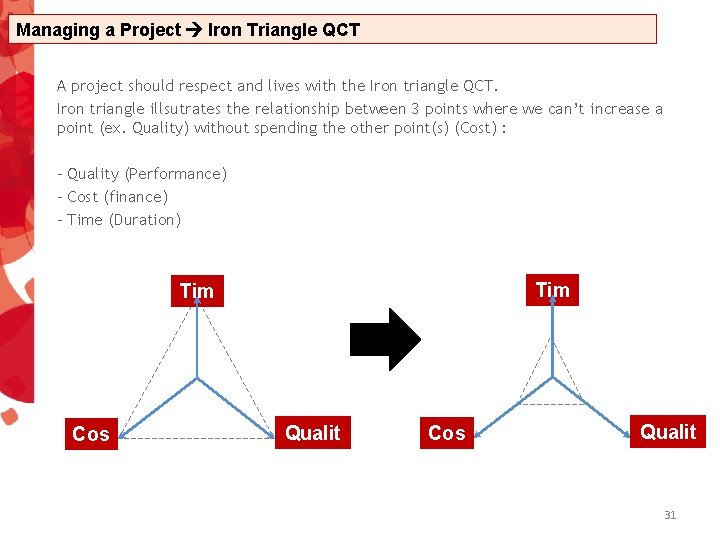
Managing a Project Iron Triangle QCT A project should respect and lives with the Iron triangle QCT. Iron triangle illsutrates the relationship between 3 points where we can’t increase a point (ex. Quality) without spending the other point(s) (Cost) : - Quality (Performance) - Cost (finance) - Time (Duration) Tim e Cos t Qualit y 31
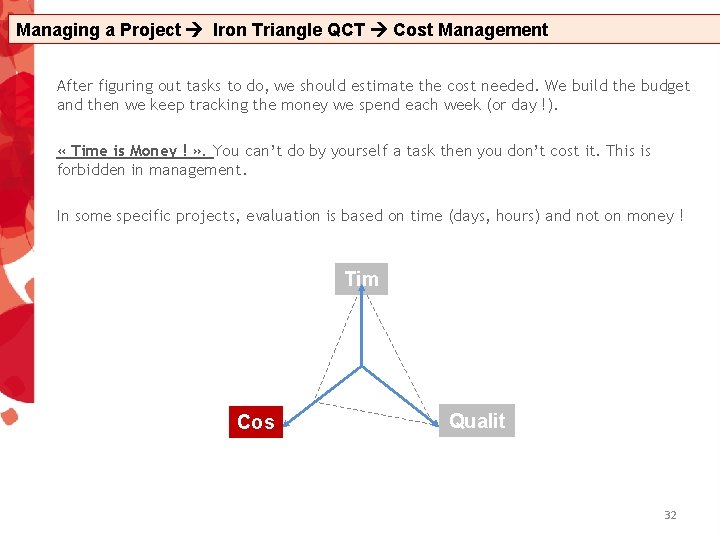
Managing a Project Iron Triangle QCT Cost Management After figuring out tasks to do, we should estimate the cost needed. We build the budget and then we keep tracking the money we spend each week (or day !). « Time is Money ! » . You can’t do by yourself a task then you don’t cost it. This is forbidden in management. In some specific projects, evaluation is based on time (days, hours) and not on money ! Tim e Cos t Qualit y 32
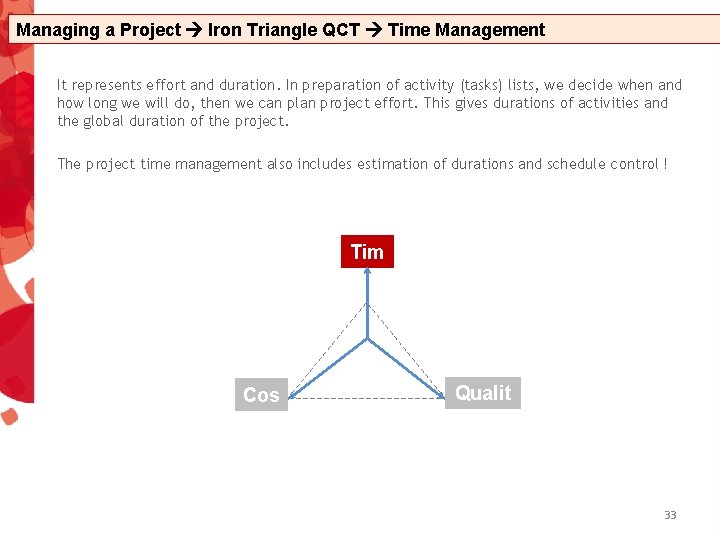
Managing a Project Iron Triangle QCT Time Management It represents effort and duration. In preparation of activity (tasks) lists, we decide when and how long we will do, then we can plan project effort. This gives durations of activities and the global duration of the project. The project time management also includes estimation of durations and schedule control ! Tim e Cos t Qualit y 33
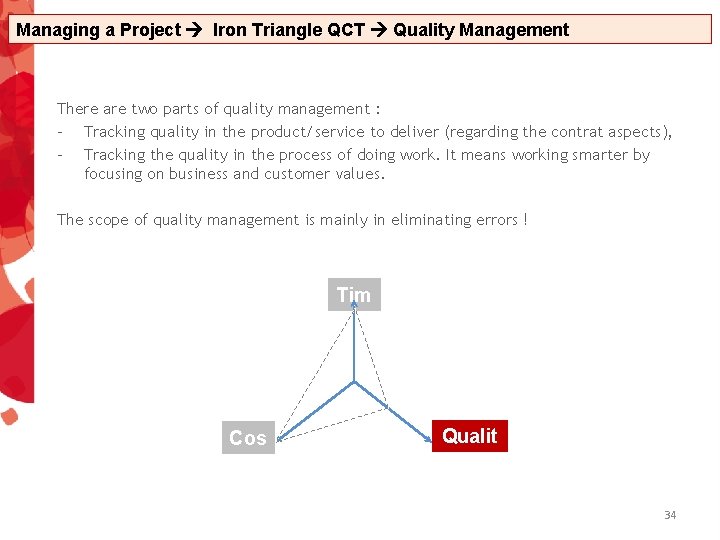
Managing a Project Iron Triangle QCT Quality Management There are two parts of quality management : - Tracking quality in the product/service to deliver (regarding the contrat aspects), - Tracking the quality in the process of doing work. It means working smarter by focusing on business and customer values. The scope of quality management is mainly in eliminating errors ! Tim e Cos t Qualit y 34
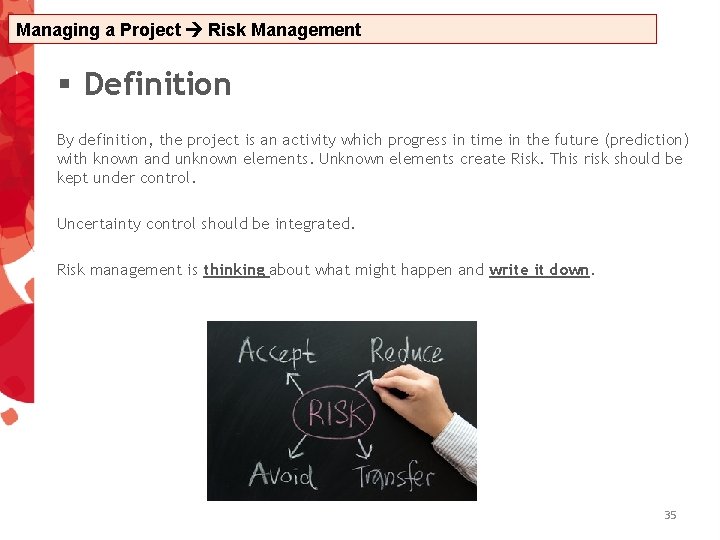
Managing a Project Risk Management § Definition By definition, the project is an activity which progress in time in the future (prediction) with known and unknown elements. Unknown elements create Risk. This risk should be kept under control. Uncertainty control should be integrated. Risk management is thinking about what might happen and write it down. 35
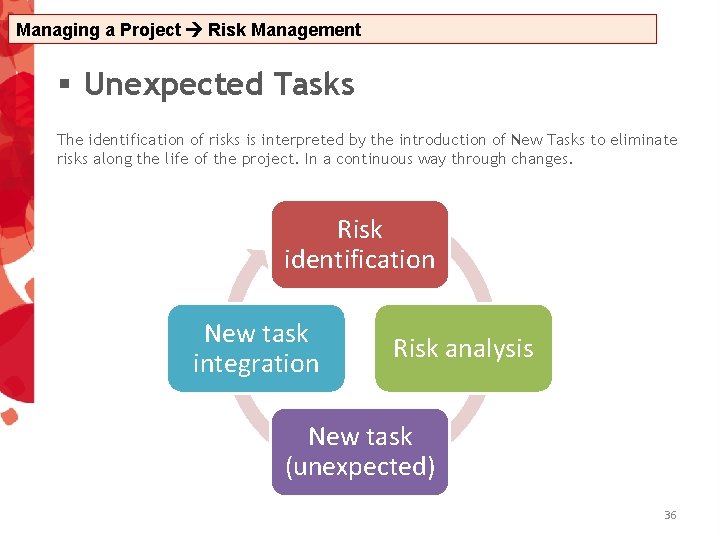
Managing a Project Risk Management § Unexpected Tasks The identification of risks is interpreted by the introduction of New Tasks to eliminate risks along the life of the project. In a continuous way through changes. Risk identification New task integration Risk analysis New task (unexpected) 36
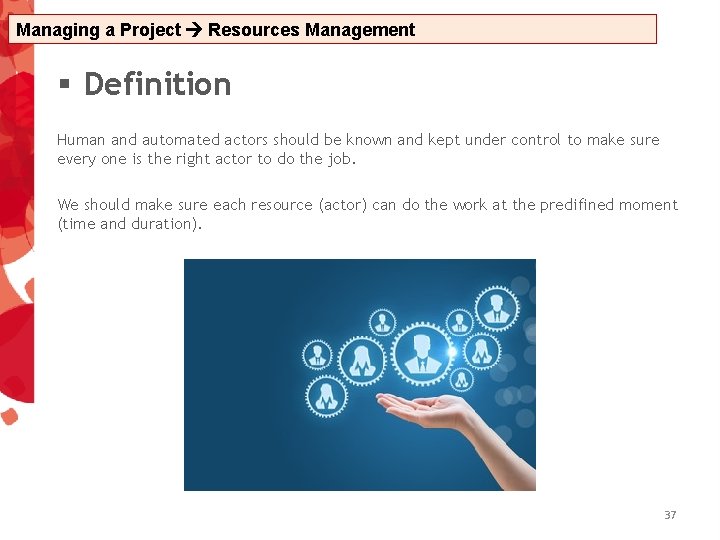
Managing a Project Resources Management § Definition Human and automated actors should be known and kept under control to make sure every one is the right actor to do the job. We should make sure each resource (actor) can do the work at the predifined moment (time and duration). 37
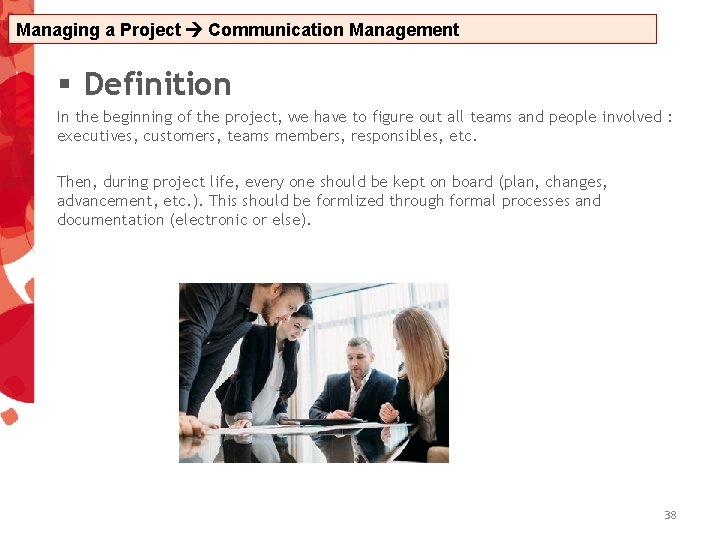
Managing a Project Communication Management § Definition In the beginning of the project, we have to figure out all teams and people involved : executives, customers, teams members, responsibles, etc. Then, during project life, every one should be kept on board (plan, changes, advancement, etc. ). This should be formlized through formal processes and documentation (electronic or else). 38
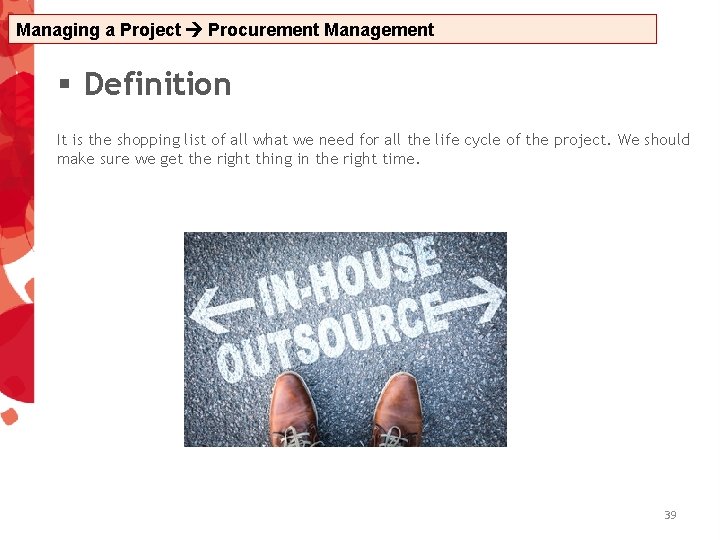
Managing a Project Procurement Management § Definition It is the shopping list of all what we need for all the life cycle of the project. We should make sure we get the right thing in the right time. 39
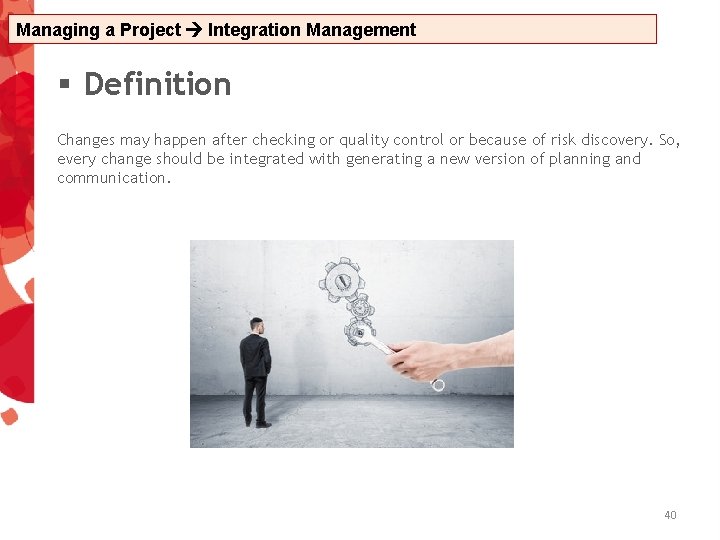
Managing a Project Integration Management § Definition Changes may happen after checking or quality control or because of risk discovery. So, every change should be integrated with generating a new version of planning and communication. 40
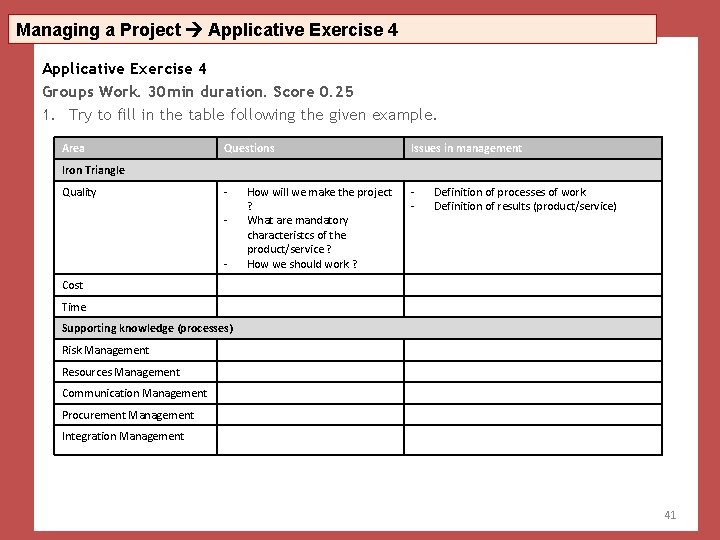
Managing a Project Applicative Exercise 4 Groups Work. 30 min duration. Score 0. 25 1. Try to fill in the table following the given example. Area Questions Issues in management - - Iron Triangle Quality - How will we make the project ? What are mandatory characteristcs of the product/service ? How we should work ? Definition of processes of work Definition of results (product/service) Cost Time Supporting knowledge (processes) Risk Management Resources Management Communication Management Procurement Management Integration Management 41
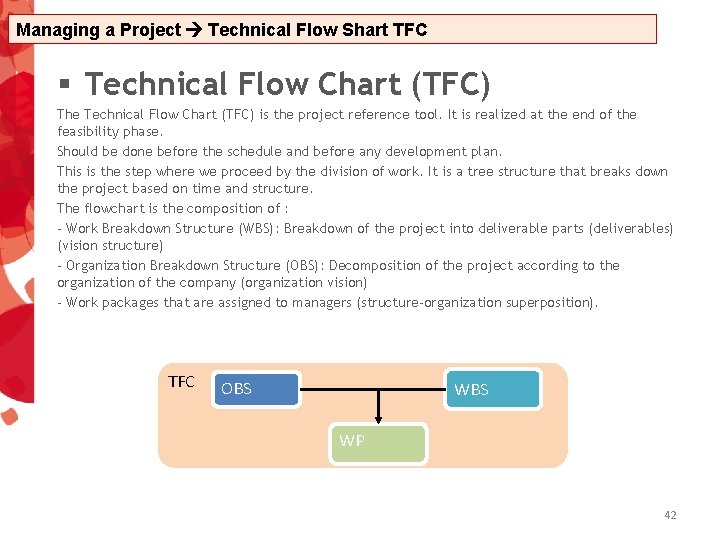
Managing a Project Technical Flow Shart TFC § Technical Flow Chart (TFC) The Technical Flow Chart (TFC) is the project reference tool. It is realized at the end of the feasibility phase. Should be done before the schedule and before any development plan. This is the step where we proceed by the division of work. It is a tree structure that breaks down the project based on time and structure. The flowchart is the composition of : - Work Breakdown Structure (WBS): Breakdown of the project into deliverable parts (deliverables) (vision structure) - Organization Breakdown Structure (OBS): Decomposition of the project according to the organization of the company (organization vision) - Work packages that are assigned to managers (structure-organization superposition). TFC OBS WP 42
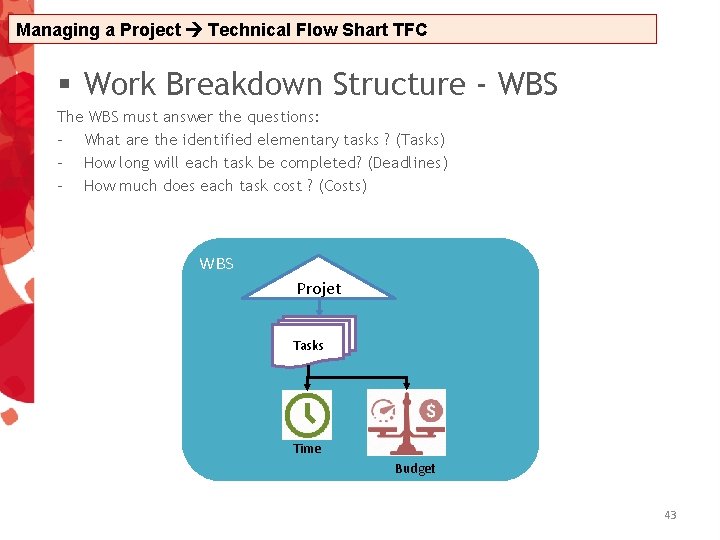
Managing a Project Technical Flow Shart TFC § Work Breakdown Structure - WBS The WBS must answer the questions: - What are the identified elementary tasks ? (Tasks) - How long will each task be completed? (Deadlines) - How much does each task cost ? (Costs) WBS Projet Tasks Time Budget 43
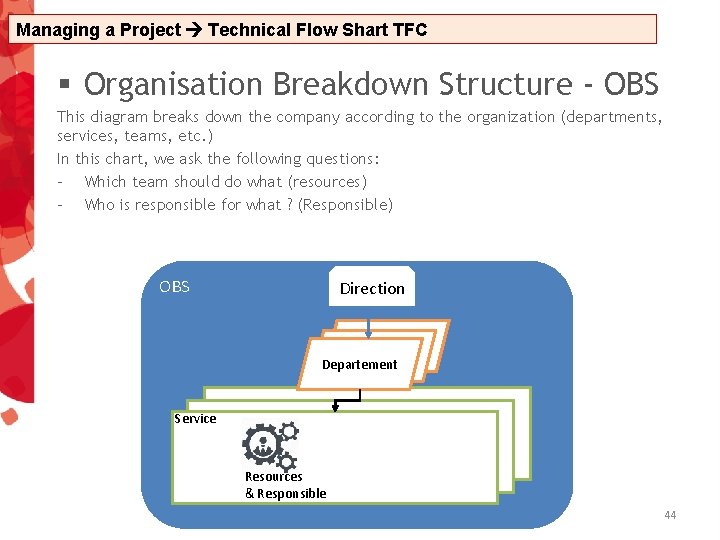
Managing a Project Technical Flow Shart TFC § Organisation Breakdown Structure - OBS This diagram breaks down the company according to the organization (departments, services, teams, etc. ) In this chart, we ask the following questions: - Which team should do what (resources) - Who is responsible for what ? (Responsible) OBS Direction Departement Service Resources & Responsible 44
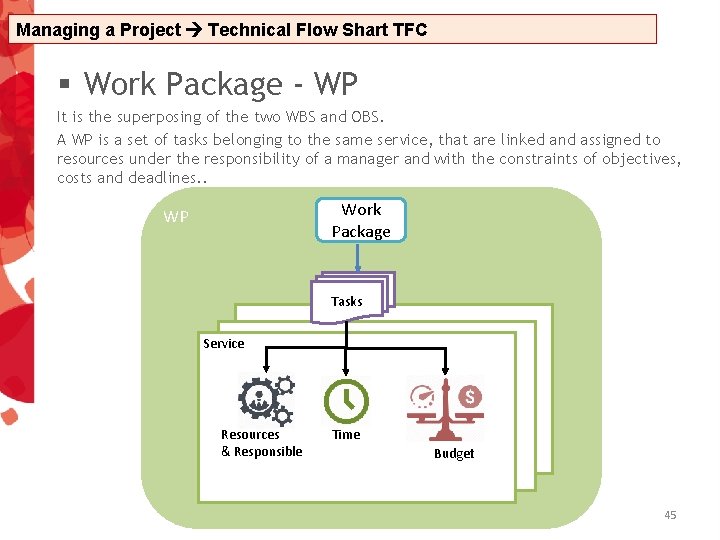
Managing a Project Technical Flow Shart TFC § Work Package - WP It is the superposing of the two WBS and OBS. A WP is a set of tasks belonging to the same service, that are linked and assigned to resources under the responsibility of a manager and with the constraints of objectives, costs and deadlines. . Work Package WP Tasks Service Resources & Responsible Time Budget 45
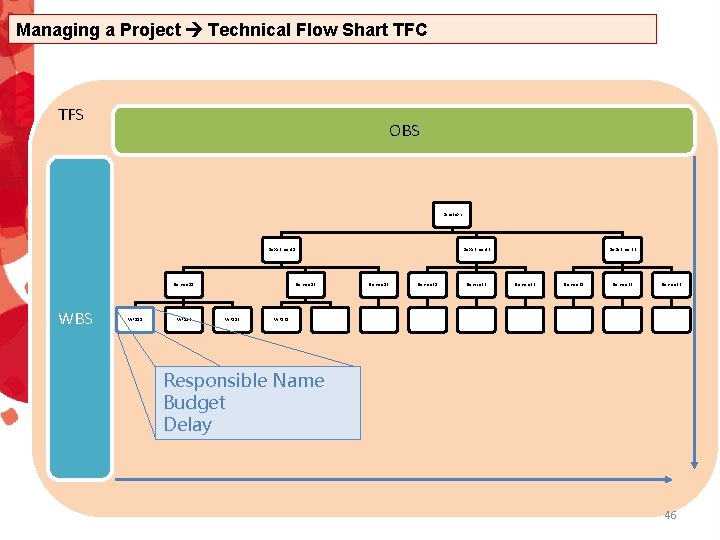
Managing a Project Technical Flow Shart TFC TFS OBS Direction Department 1 Service 11 WBS WP 111 WP 112 Department 2 Service 12 WP 113 WP 121 … Department 3 Service 13 Service 21 Service 22 Service 23 Service 31 Service 32 Service 33 … … … … Responsible Name Budget Delay 46
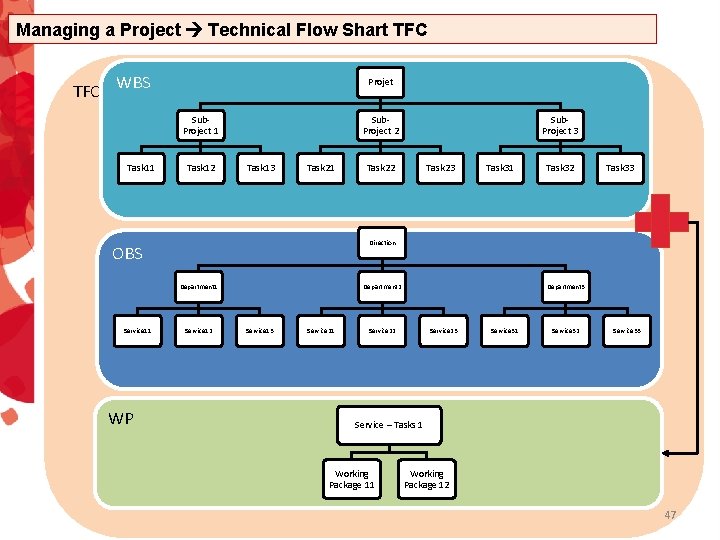
Managing a Project Technical Flow Shart TFC WBS Projet Sub. Project 1 Task 12 Sub. Project 2 Task 13 Task 21 Department 1 WP Task 22 Task 23 Task 31 Task 32 Task 33 Direction OBS Service 11 Sub. Project 3 Service 12 Department 2 Service 13 Service 21 Department 3 Service 22 Service 23 Service 31 Service 32 Service 33 Service – Tasks 1 Working Package 12 47
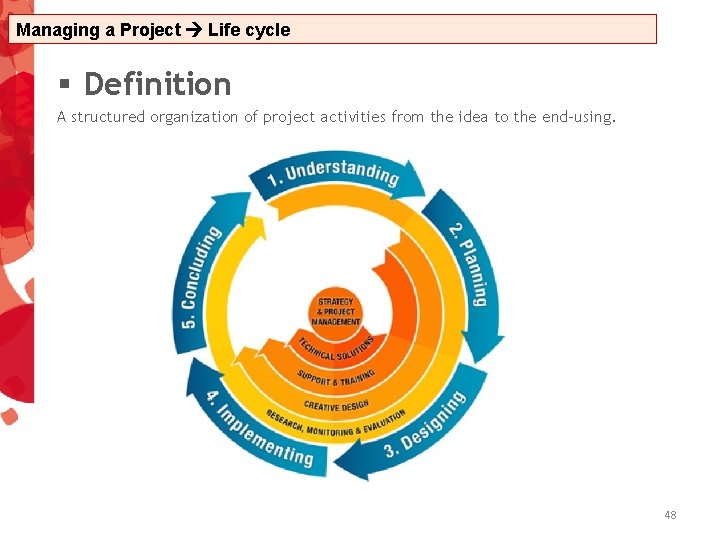
Managing a Project Life cycle § Definition A structured organization of project activities from the idea to the end-using. 48
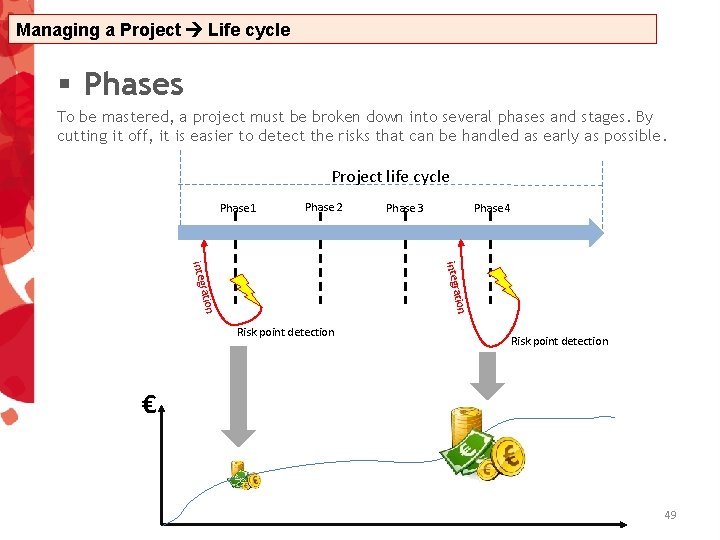
Managing a Project Life cycle § Phases To be mastered, a project must be broken down into several phases and stages. By cutting it off, it is easier to detect the risks that can be handled as early as possible. Project life cycle Phase 1 Phase 2 Phase 4 Phase 3 ation integr ration integ Risk point detection € 49
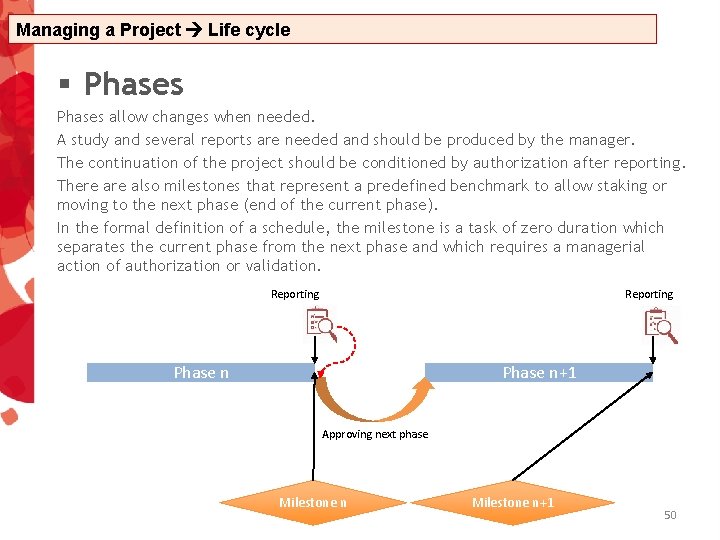
Managing a Project Life cycle § Phases allow changes when needed. A study and several reports are needed and should be produced by the manager. The continuation of the project should be conditioned by authorization after reporting. There also milestones that represent a predefined benchmark to allow staking or moving to the next phase (end of the current phase). In the formal definition of a schedule, the milestone is a task of zero duration which separates the current phase from the next phase and which requires a managerial action of authorization or validation. Reporting Phase n+1 Approving next phase Milestone n+1 50
Managing a Project Life cycle § Phase 0 : Initiation Technical analysis study and field preparation. Analysis of the sector of activity. It helps in identifying the frame objectives and needs. Startup scenarios are needed. § Phase A : Feasibility Is the real first phase of the project life cycle. In this stage, the feasibility is measured where evaluation should be done to decide whether or not to pursue a project. § Phase B : Definition It comprises the technical chart, the planning, the choice of the technical supports, the functional and technical specifications. The consulting of experts is done in this phase. § Phase C : Development The decisions regarding teams and resources are done in this phase: - Triggering procurement processes - Selecting teams (industrial, IS, transport, etc. ) - Triggering functional and technical tests - Triggering documentation 51
Managing a Project Life cycle § Phase D : Execution This is the phase of setting up effective implementation and integration procedures: - Processes of derogations in teams - Processes of incidents handling and anomaly detection - Processes of user training § Phase E : Monitoring In this phase , the project’s products are exploited by customers (users). The activities are operational. Users are trained. It integrates : - Processes of the transfer of responsibility between teams - Processes of Recovery Plan - Processes and documentation of traceability - Customer after sales service - Maintenance management - Experience feedback § Phase F : Closure It involves setting up the deconstruction and the stoppage of services. Although it is a forgotten phase, it is mandatory especially in sensible business activities (ex. transport of nuclear materials) and more regulatory laws are required in the project management profession. 52
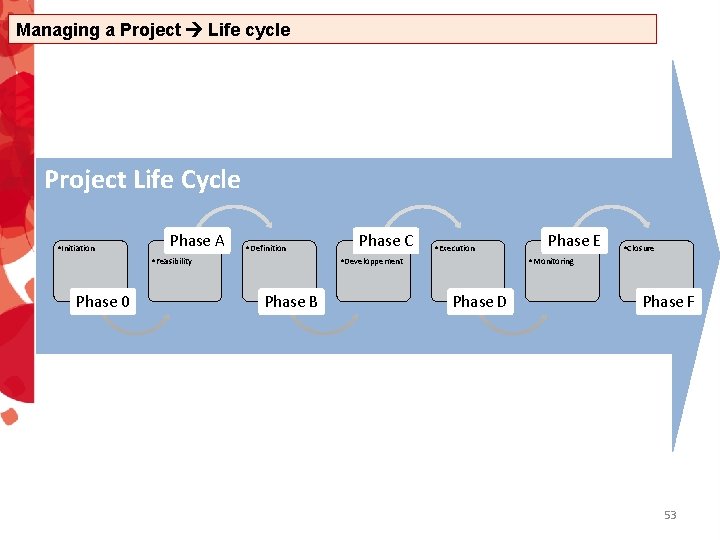
Managing a Project Life cycle Project Life Cycle • Initiation Phase A • Definition • Feasibility Phase 0 Phase C • Execution • Developpement Phase B Phase E • Closure • Monitoring Phase D Phase F 53
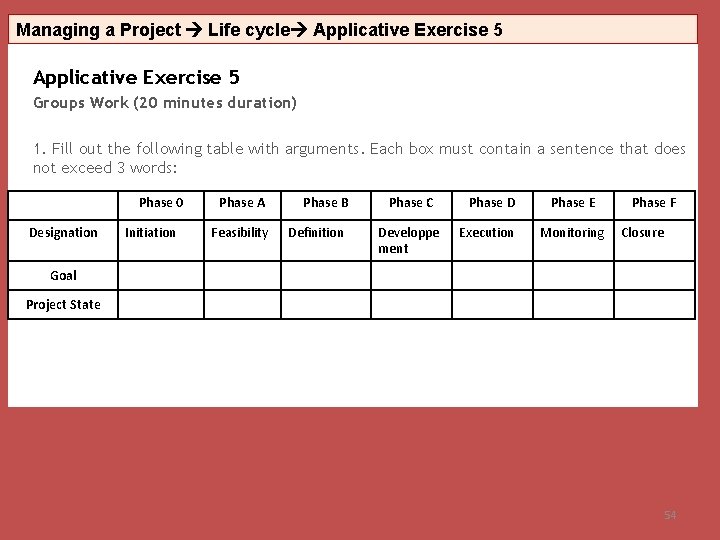
Managing a Project Life cycle Applicative Exercise 5 Groups Work (20 minutes duration) 1. Fill out the following table with arguments. Each box must contain a sentence that does not exceed 3 words: Phase 0 Designation Initiation Phase A Feasibility Phase B Definition Phase C Developpe ment Phase D Execution Phase E Monitoring Phase F Closure Goal Project State 54
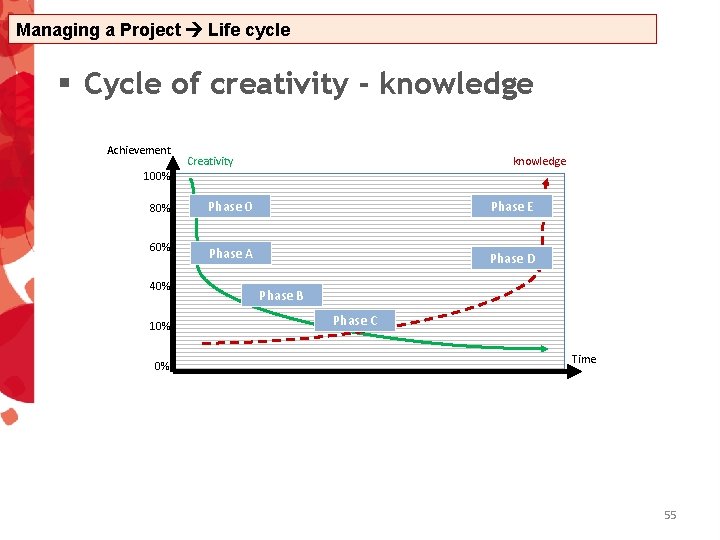
Managing a Project Life cycle § Cycle of creativity - knowledge Achievement Creativity knowledge 100% 80% Phase 0 Phase E 60% Phase A Phase D 40% 10% 0% Phase B Phase C Time 55
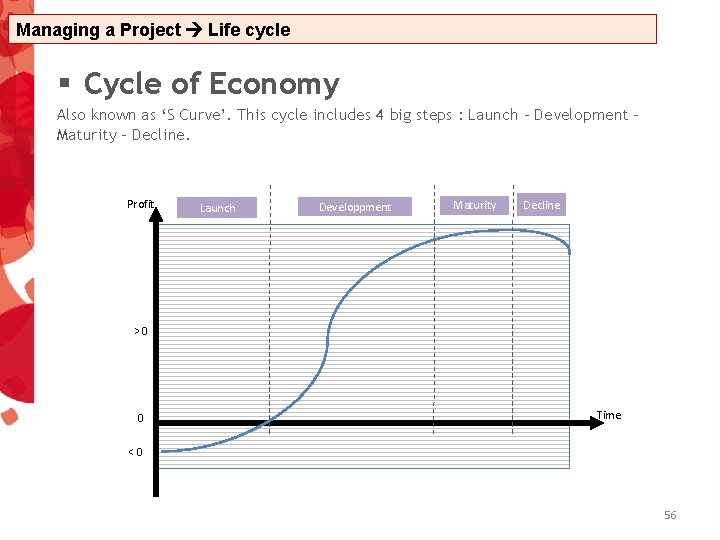
Managing a Project Life cycle § Cycle of Economy Also known as ‘S Curve’. This cycle includes 4 big steps : Launch - Development Maturity - Decline. Profit Launch Developpment Maturity Decline >0 0 Time <0 56
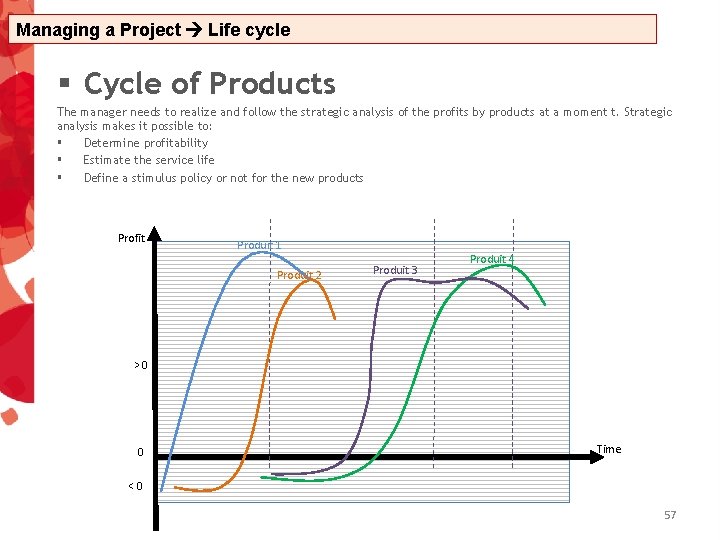
Managing a Project Life cycle § Cycle of Products The manager needs to realize and follow the strategic analysis of the profits by products at a moment t. Strategic analysis makes it possible to: § Determine profitability § Estimate the service life § Define a stimulus policy or not for the new products Profit Produit 1 Produit 2 Produit 3 Produit 4 >0 0 Time <0 57
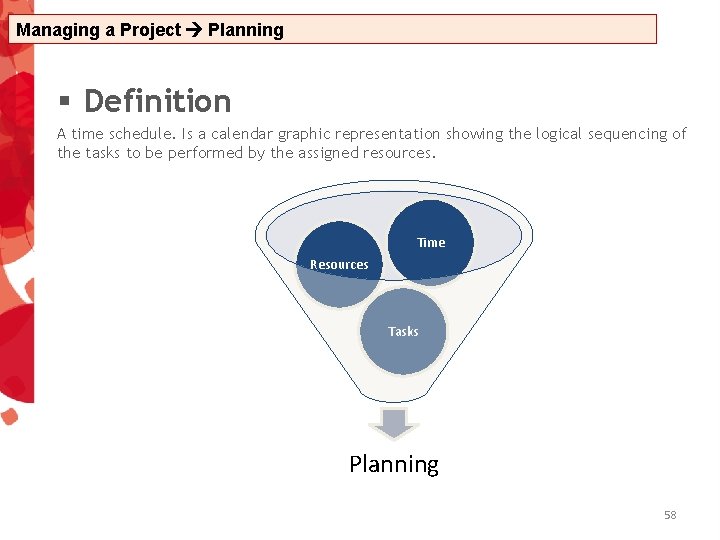
Managing a Project Planning § Definition A time schedule. Is a calendar graphic representation showing the logical sequencing of the tasks to be performed by the assigned resources. Time Resources Tasks Planning 58
Managing a Project Planning § Scheduling Control 3 levels of planning exist : 1. Master Planning Is a macro-tasks calendar. Typically we use the Gantt schedule to have an easy reading of the outline of the project. It includes: - Setting the schedule time scale - Defining the list of tasks to plan - For each task setting the start and end dates - Identifying the constraints of each task - Defining the logical sequence of tasks - Defining the legend (symbols) 59
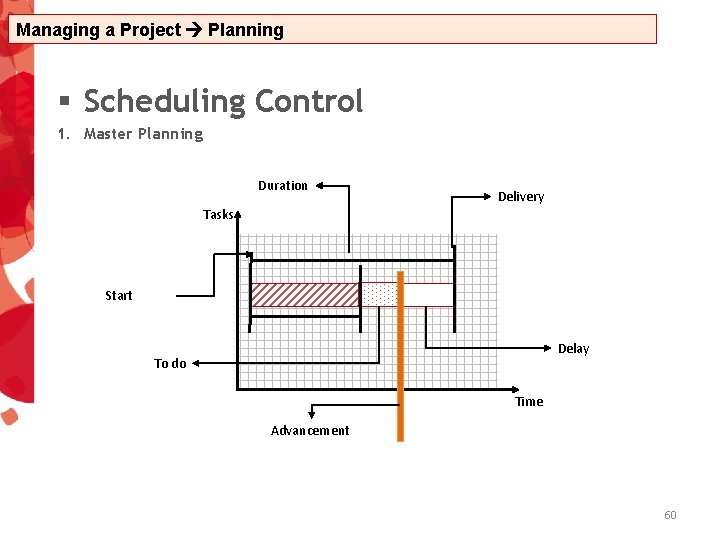
Managing a Project Planning § Scheduling Control 1. Master Planning Duration Delivery Tasks Start Delay To do Time Advancement 60
Managing a Project Planning § Scheduling Control § Detailed Planning This planning has a micro-task view. Several methods are used by managers to study and monitor the completeness of tasks. Among those methods: - CPM - PERT 61
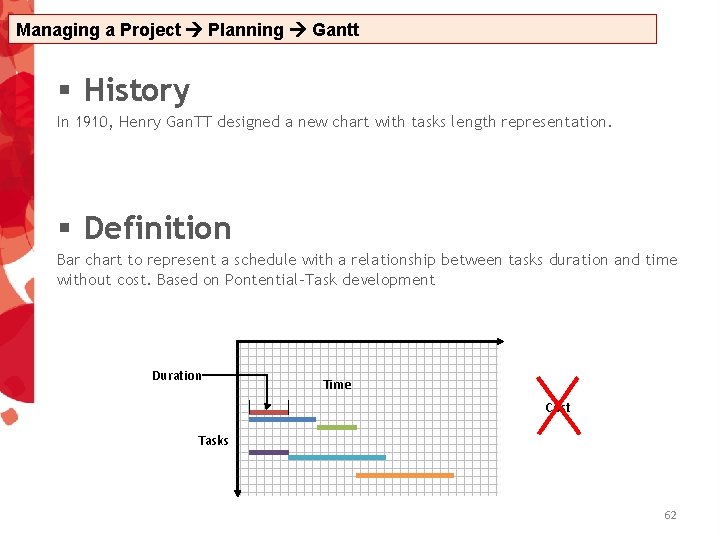
Managing a Project Planning Gantt § History In 1910, Henry Gan. TT designed a new chart with tasks length representation. § Definition Bar chart to represent a schedule with a relationship between tasks duration and time without cost. Based on Pontential-Task development Duration Time Cost Tasks 62
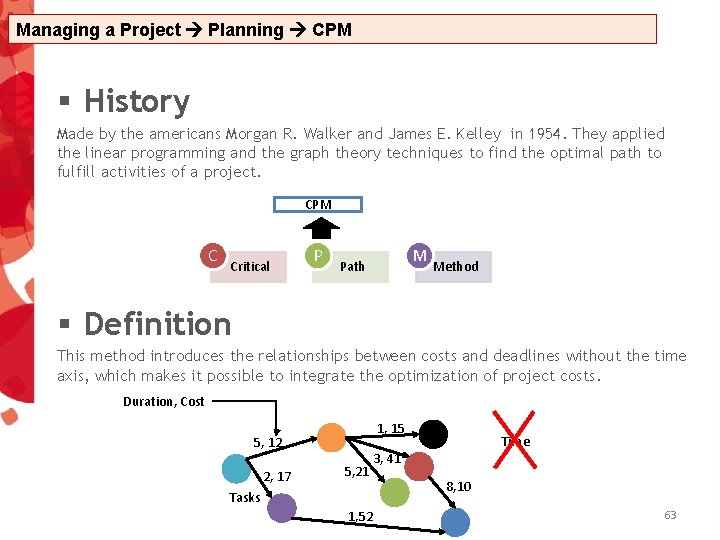
Managing a Project Planning CPM § History Made by the americans Morgan R. Walker and James E. Kelley in 1954. They applied the linear programming and the graph theory techniques to find the optimal path to fulfill activities of a project. CPM C Critical P M Path Method § Definition This method introduces the relationships between costs and deadlines without the time axis, which makes it possible to integrate the optimization of project costs. Duration, Cost 1, 15 5, 12 2, 17 5, 21 Time 3, 41 Tasks 1, 52 8, 10 63
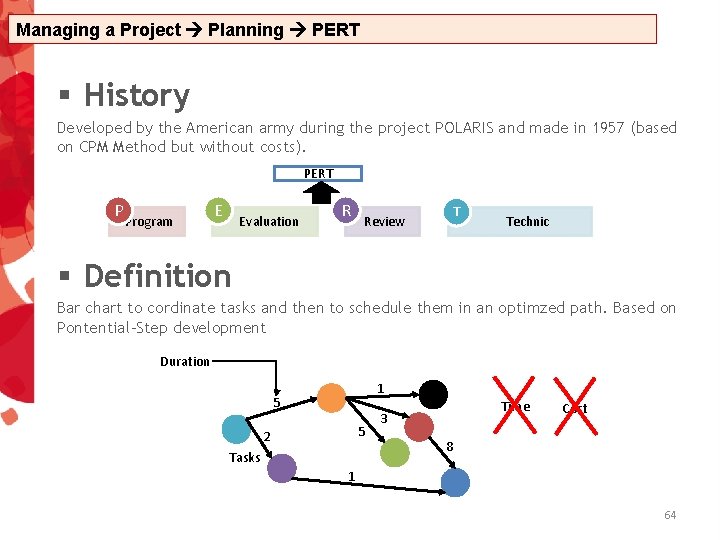
Managing a Project Planning PERT § History Developed by the American army during the project POLARIS and made in 1957 (based on CPM Method but without costs). PERT P Program E Evaluation R Review T Technic § Definition Bar chart to cordinate tasks and then to schedule them in an optimzed path. Based on Pontential-Step development Duration 1 5 5 2 Tasks Time 3 Cost 8 1 64
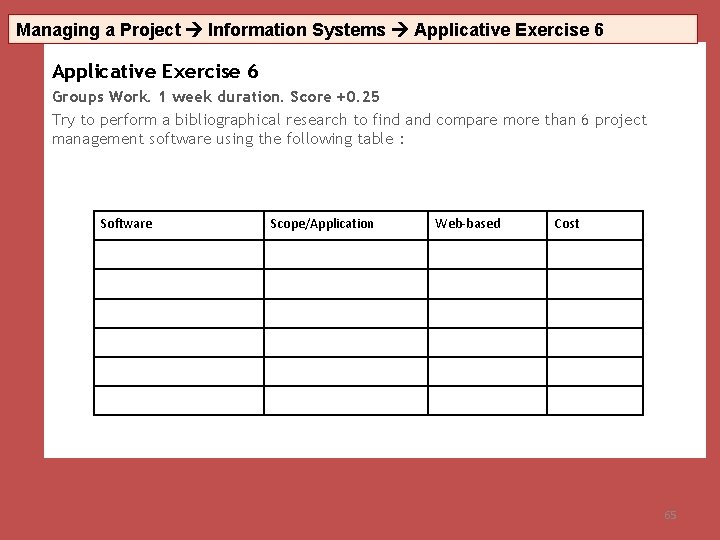
Managing a Project Information Systems Applicative Exercise 6 Groups Work. 1 week duration. Score +0. 25 Try to perform a bibliographical research to find and compare more than 6 project management software using the following table : Software Scope/Application Web-based Cost 65
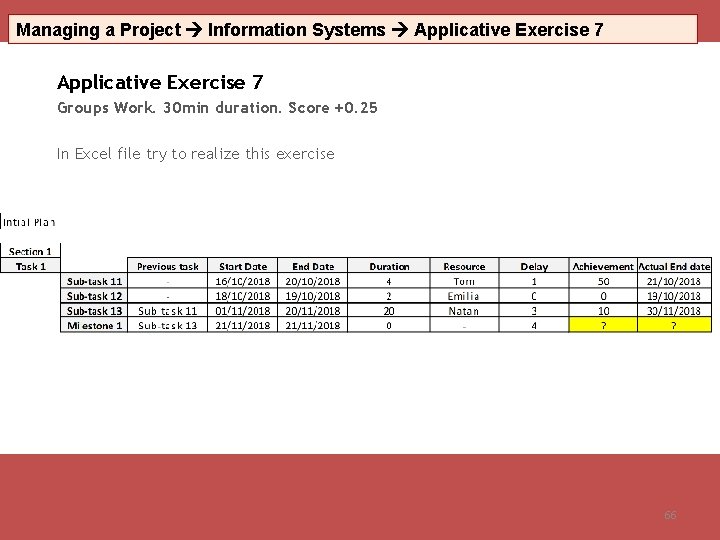
Managing a Project Information Systems Applicative Exercise 7 Groups Work. 30 min duration. Score +0. 25 In Excel file try to realize this exercise 66
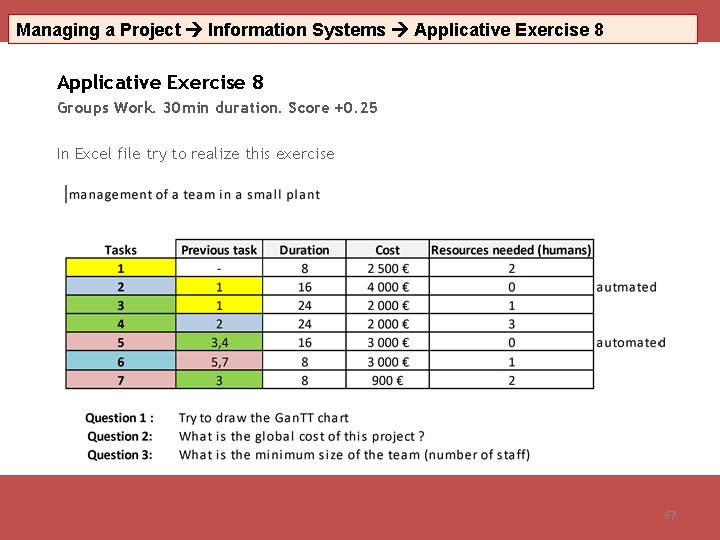
Managing a Project Information Systems Applicative Exercise 8 Groups Work. 30 min duration. Score +0. 25 In Excel file try to realize this exercise 67
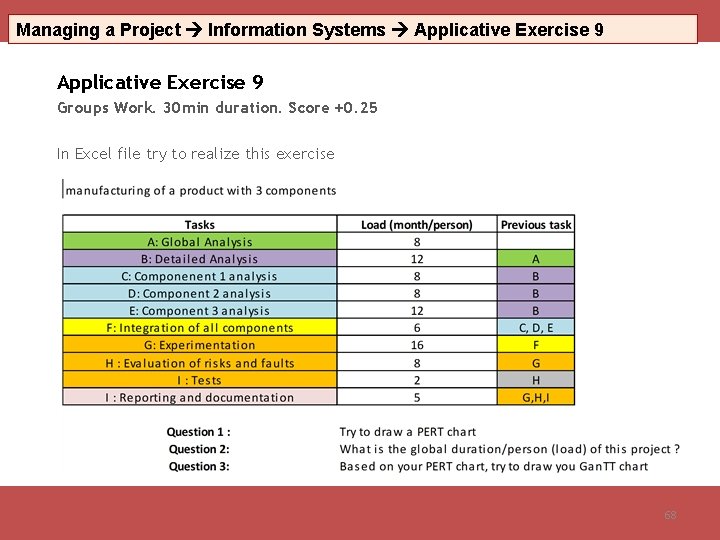
Managing a Project Information Systems Applicative Exercise 9 Groups Work. 30 min duration. Score +0. 25 In Excel file try to realize this exercise 68
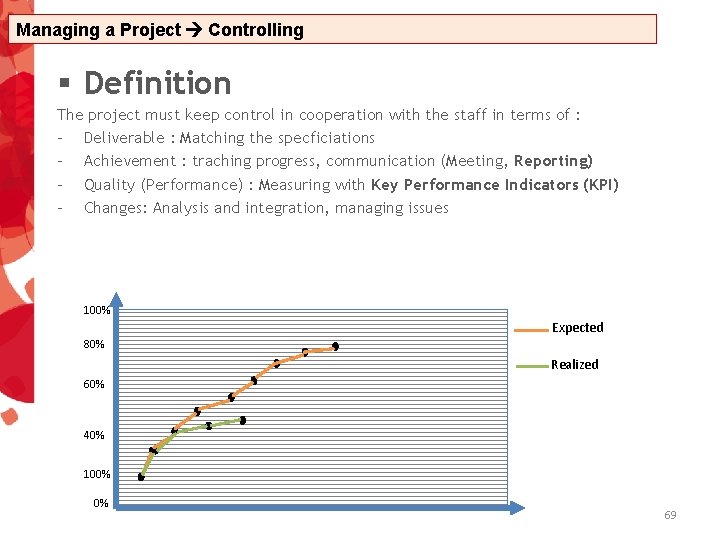
Managing a Project Controlling § Definition The project must keep control in cooperation with the staff in terms of : - Deliverable : Matching the specficiations - Achievement : traching progress, communication (Meeting, Reporting) - Quality (Performance) : Measuring with Key Performance Indicators (KPI) - Changes: Analysis and integration, managing issues 100% Expected 80% Realized 60% 40% 100% 0% 69
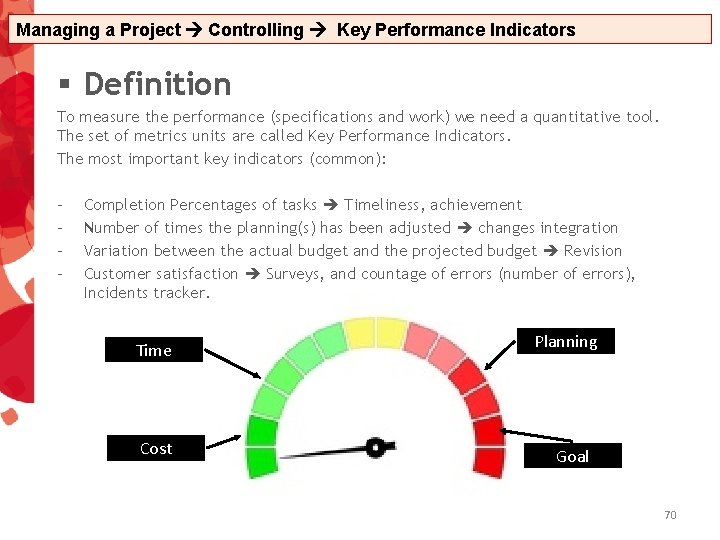
Managing a Project Controlling Key Performance Indicators § Definition To measure the performance (specifications and work) we need a quantitative tool. The set of metrics units are called Key Performance Indicators. The most important key indicators (common): - Completion Percentages of tasks Timeliness, achievement Number of times the planning(s) has been adjusted changes integration Variation between the actual budget and the projected budget Revision Customer satisfaction Surveys, and countage of errors (number of errors), Incidents tracker. Time Cost Planning Goal 70
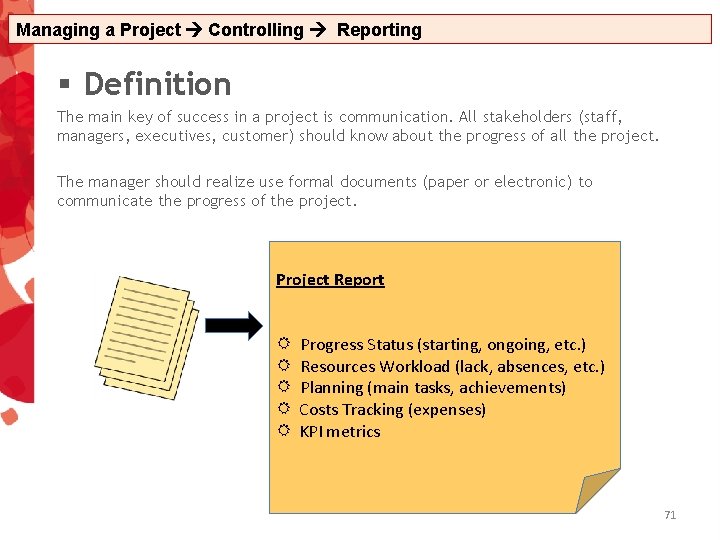
Managing a Project Controlling Reporting § Definition The main key of success in a project is communication. All stakeholders (staff, managers, executives, customer) should know about the progress of all the project. The manager should realize use formal documents (paper or electronic) to communicate the progress of the project. Project Report Progress Status (starting, ongoing, etc. ) Resources Workload (lack, absences, etc. ) Planning (main tasks, achievements) Costs Tracking (expenses) KPI metrics 71
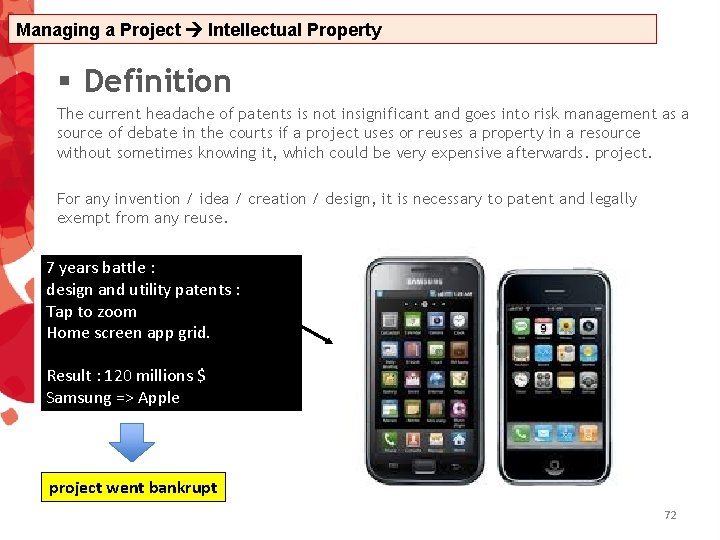
Managing a Project Intellectual Property § Definition The current headache of patents is not insignificant and goes into risk management as a source of debate in the courts if a project uses or reuses a property in a resource without sometimes knowing it, which could be very expensive afterwards. project. For any invention / idea / creation / design, it is necessary to patent and legally exempt from any reuse. 7 years battle : design and utility patents : Tap to zoom Home screen app grid. Result : 120 millions $ Samsung => Apple project went bankrupt 72
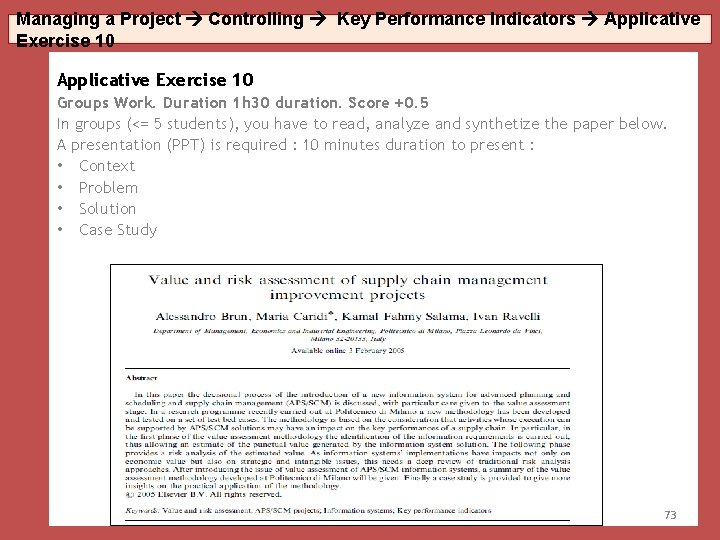
Managing a Project Controlling Key Performance Indicators Applicative Exercise 10 Groups Work. Duration 1 h 30 duration. Score +0. 5 In groups (<= 5 students), you have to read, analyze and synthetize the paper below. A presentation (PPT) is required : 10 minutes duration to present : • Context • Problem • Solution • Case Study 73
Managing a Project Cost Analysis § Definition Good managers never make decision based on instinct ! Managers have to minimize Economy Risk by minimizing risks and maximize gains. 74
Managing a Project Cost Analysis § Definition In a real-time tracking too, the project manager should estimate, Analize and follow up the costs of : - Complete internal factors : tasks, procurement, workforce, etc. External factors (intellectual property, laws impacts, etc. ) Changes impacted by unexpected events Possible inflation of prices 75
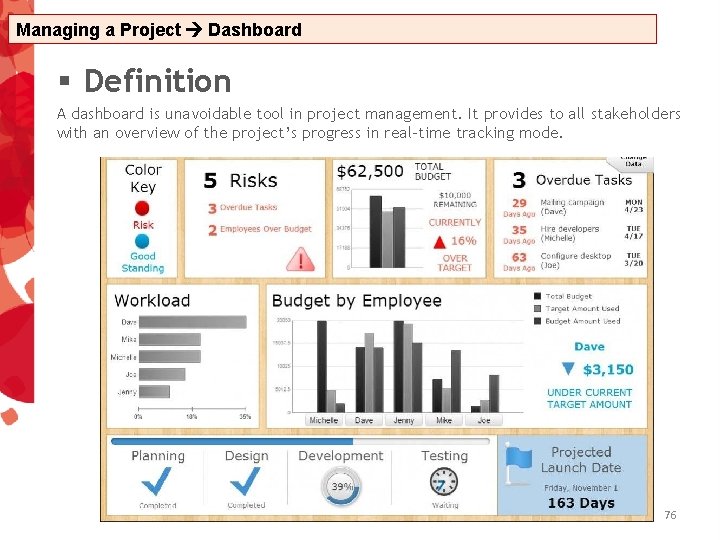
Managing a Project Dashboard § Definition A dashboard is unavoidable tool in project management. It provides to all stakeholders with an overview of the project’s progress in real-time tracking mode. 76
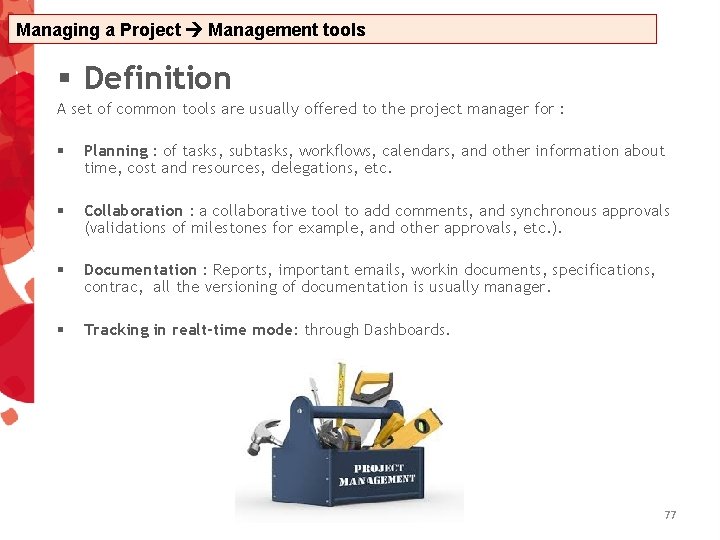
Managing a Project Management tools § Definition A set of common tools are usually offered to the project manager for : § Planning : of tasks, subtasks, workflows, calendars, and other information about time, cost and resources, delegations, etc. § Collaboration : a collaborative tool to add comments, and synchronous approvals (validations of milestones for example, and other approvals, etc. ). § Documentation : Reports, important emails, workin documents, specifications, contrac, all the versioning of documentation is usually manager. § Tracking in realt-time mode: through Dashboards. 77
Managing a Project Maintenance Management § Definition Maintaining the project and all its assets in operational state is a part of management. The maintenance mode must be developed and planed in accordance with the risk and criticality profile of the assets. Maintenance is not related to brocken machines only, but covers services and all project assets: - For exemple : You manage the project of creating the map of trucks for a company of logistics. You use software pads for drivers. You must insure the maintenance of the software and pads ! 78
Managing a Project Manager Applicative Exercise 11 Individual Work. Duration 10 minutes. Score +0. 25 1. Try to provide the 5 main roles of the project manager ? 79
Bibliography § § § Book: ‘Project Management : Case Studies’ by Harold Kerzner. John Wiley & Sons, Inc. Editions. Book: ‘Project Management Workbook: A systems approach to Planning, Scheduling, and Controlling’ by Harold Kerzner. John Wiley & Sons, Inc. Editions. Book: ‘Project Management Made Easy’ by Entrepreneur Press and Sid Kemp. Book: ‘L’essentiel de la Gestion de Projet’ by Roger Aïm. Les Carrés Editions. Book: ‘Le grand livre de la gestion de projet: Méthodologie de Stucturation et de Gestion d’un Projet Industriel’ by Jean-Yves Moine. Afnor Editions. 80
Thanks … any questions ? 81
- Slides: 81