
2019 Pennsylvania State Literacy Plan Pa SLP Contact
- Slides: 26
2019 Pennsylvania State Literacy Plan (Pa. SLP)
Contact/ PDE Mission For more information on the Pa. SLP please visit PDE’s website at www. education. pa. gov The mission of the Department of Education is to ensure that every learner has access to a world-class education system that academically prepares children and adults to succeed as productive citizens. Further, the Department seeks to establish a culture that is committed to improving opportunities throughout the commonwealth by ensuring that technical support, resources, and optimal learning environments are available for all students, whether children or adults. 2019 2
History of Pennsylvania Literacy 1977 - A Comprehensive Reading Communication Arts Plan (written by Dr. Morton Botel) 1998 - The Pennsylvania Framework for Reading, Writing, and Talking Across the Curriculum (written by Dr. Susan Lytle & Dr. Morton Botel) 2000 - The PA Literacy Framework (Dr. Jean Winsand, chairman) 2012 - The Comprehensive Literacy Plan (Dr. Rita Bean, chairman) 2019 - Pennsylvania State Literacy Plan (Dr. Rita Bean, chairman) 2019 3
Purpose of Pa. SLP The Pennsylvania State Literacy Plan (Pa. SLP) provides: • Districts and charter schools with the guidance and tools needed to develop and implement a local literacy plan; • Leadership with information to facilitate the analysis of local literacy needs and to develop curriculum addressing the needs; and • Leadership with information to develop professional learning experiences for teachers. 2019 4
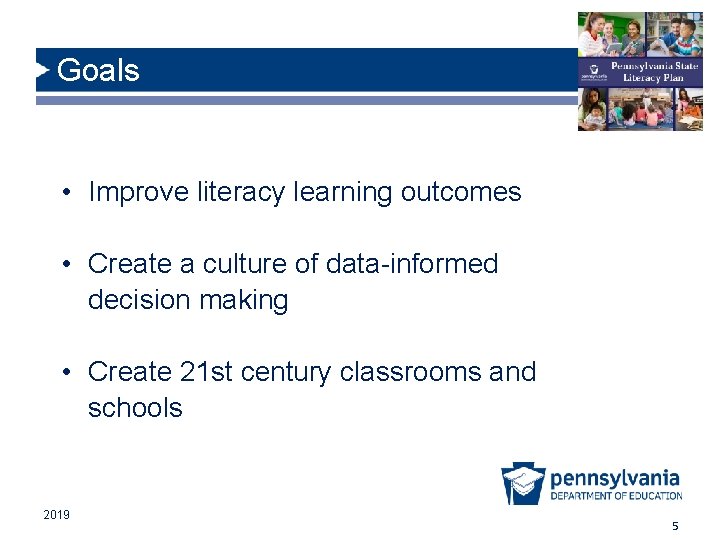
Goals • Improve literacy learning outcomes • Create a culture of data-informed decision making • Create 21 st century classrooms and schools 2019 5
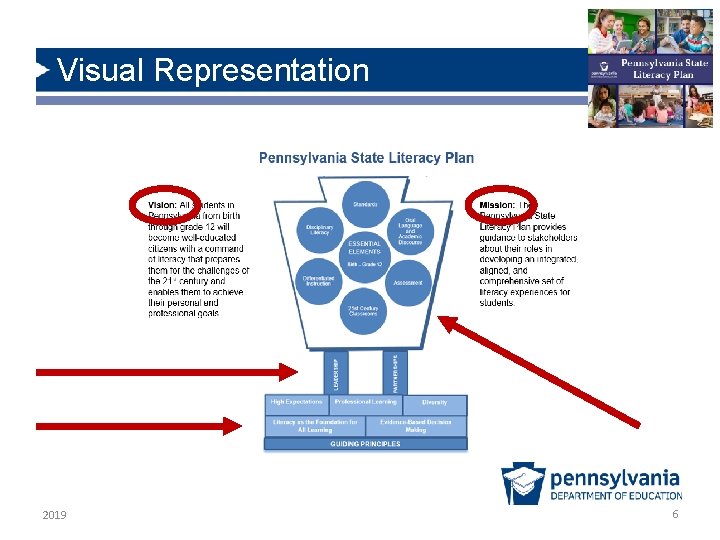
Visual Representation 2019 6
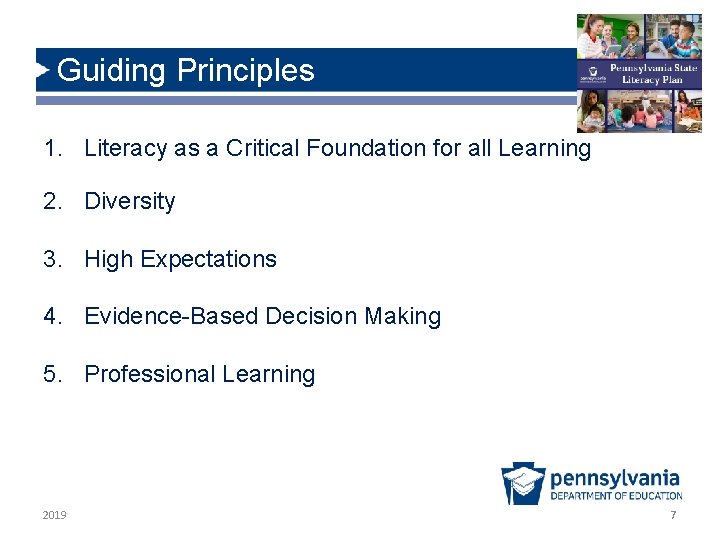
Guiding Principles 1. Literacy as a Critical Foundation for all Learning 2. Diversity 3. High Expectations 4. Evidence-Based Decision Making 5. Professional Learning 2019 7
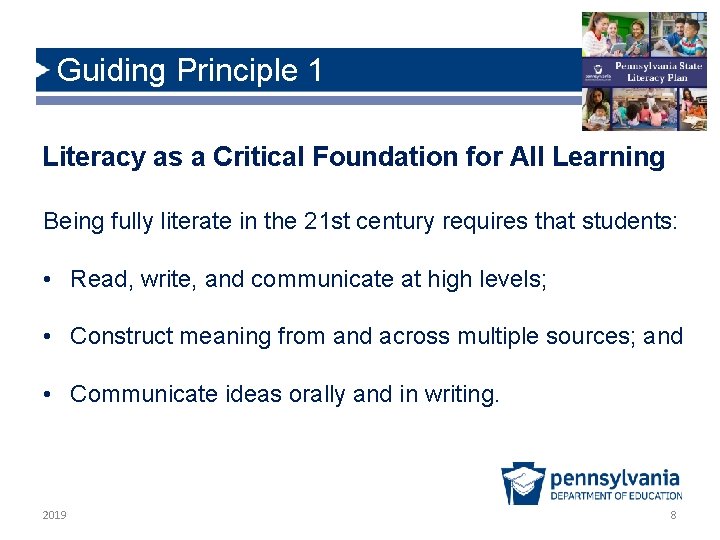
Guiding Principle 1 Literacy as a Critical Foundation for All Learning Being fully literate in the 21 st century requires that students: • Read, write, and communicate at high levels; • Construct meaning from and across multiple sources; and • Communicate ideas orally and in writing. 2019 8
Guiding Principle 2 Diversity • Acknowledge, value, and respect diversity in our schools and classrooms. • Provide educational experiences that enable students to learn about their own culture as well as the culture of others. • Value and acknowledge diversity in our curriculum and instructional practices. 2019 9
Guiding Principle 3 High Expectations • Belief that all students can gain literacy skills that prepare them to be future ready; • Instruction that addresses the full range of learners and differentiated to meet each student’s needs; and • Well-integrated system connecting general, compensatory, gifted, and special education. 2019 10
Guiding Principle 4 Evidence-based Decision Making Literacy programs, practices, and policies must be: • Evidence-based, • Grounded in reliable and valid research results, and • Informed by experiential and contextual evidence (resources for educators). 2019 11
Guiding Principle 5 Professional Learning • Teach effectively in the schools of the 21 st century. • Understand the mechanisms of reading acquisitions, and • Address the diverse needs of students in the 21 st century • Ongoing, job-embedded learning opportunities promoting lifelong learning and reflective teaching. • Understand reading psychology and development, • Understand the structure of the English language, • Apply best practices in all aspects of reading instruction, and • Use validated, reliable, efficient assessments to inform classroom teaching 2019 12
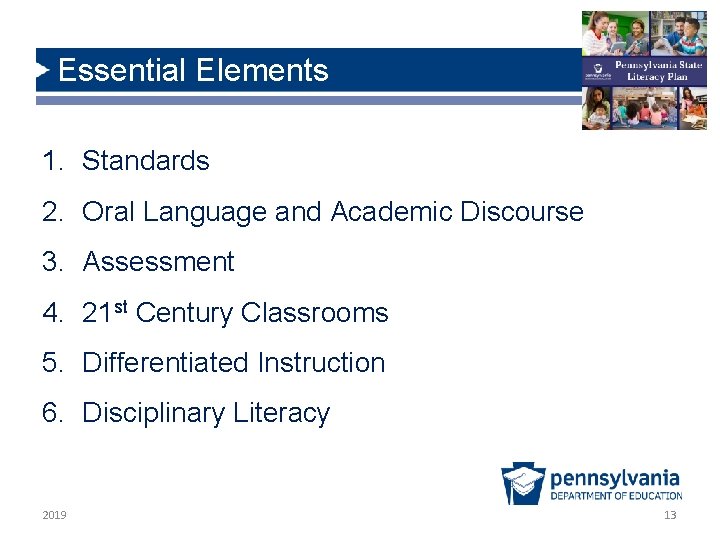
Essential Elements 1. Standards 2. Oral Language and Academic Discourse 3. Assessment 4. 21 st Century Classrooms 5. Differentiated Instruction 6. Disciplinary Literacy 2019 13
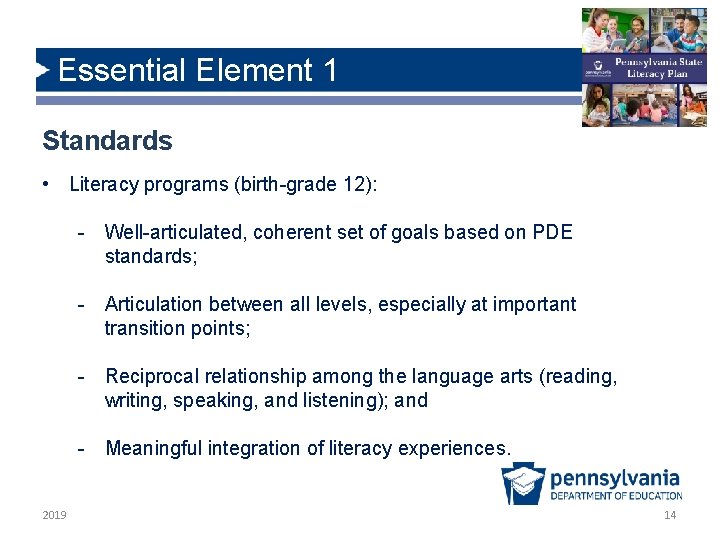
Essential Element 1 Standards • Literacy programs (birth-grade 12): - Well-articulated, coherent set of goals based on PDE standards; - Articulation between all levels, especially at important transition points; - Reciprocal relationship among the language arts (reading, writing, speaking, and listening); and - Meaningful integration of literacy experiences. 2019 14
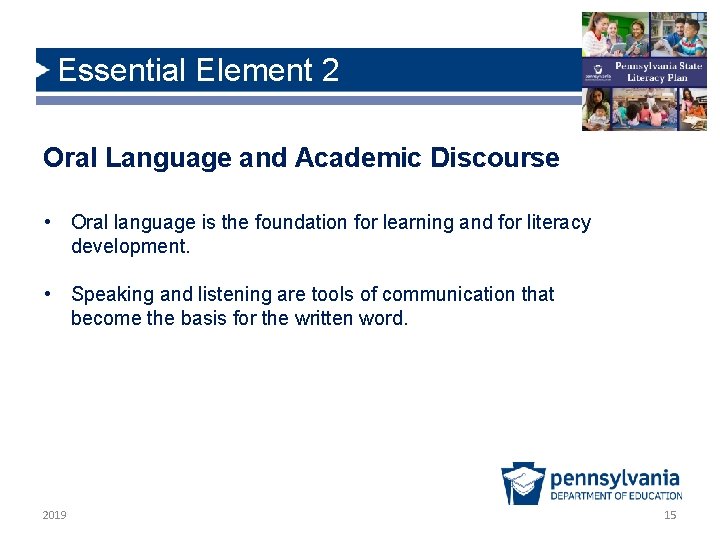
Essential Element 2 Oral Language and Academic Discourse • Oral language is the foundation for learning and for literacy development. • Speaking and listening are tools of communication that become the basis for the written word. 2019 15
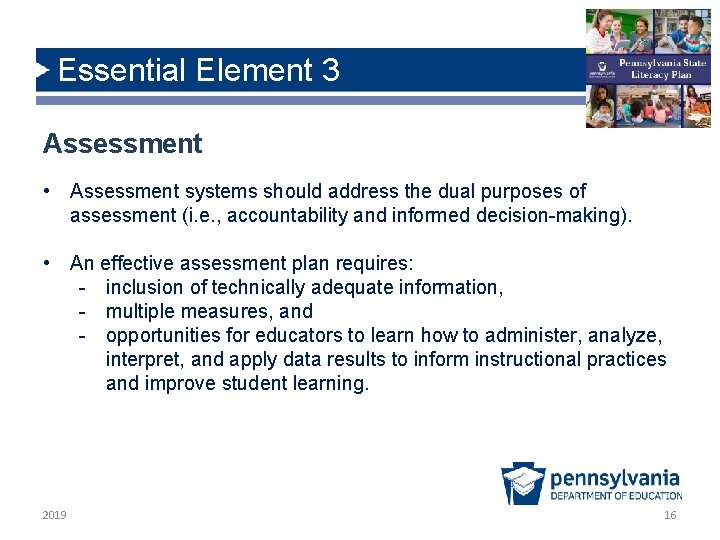
Essential Element 3 Assessment • Assessment systems should address the dual purposes of assessment (i. e. , accountability and informed decision-making). • An effective assessment plan requires: - inclusion of technically adequate information, - multiple measures, and - opportunities for educators to learn how to administer, analyze, interpret, and apply data results to inform instructional practices and improve student learning. 2019 16
Essential Element 4 21 st Century Classrooms • Classrooms must offer students opportunities to develop realworld problem-solving skills that enable them to: - think critically and creatively, - work collaboratively with others, and - analyze, interpret, and synthesize information. 2019 17
Essential Element 5 Differentiated Instruction • Proponents of differentiation purport that its principles and guidelines are grounded in years of educational research and have roots in theories of learning. • Differentiated instruction is an awareness of and active response to students’ various needs. • Differentiation often requires systemic curriculum adaptations which transcend individual classrooms and require alignment of these practices across classrooms. 2019 18
Essential Element 6 Disciplinary Literacy • Provides students with supported experiences and opportunities to read, write, talk, and think deeply in service of content learning. • Allows students to experience deep disciplinary literacy as a means of learning content. 2019 19
Implementing the Plan – Section A • Section A – Specific action areas and recommendations • Action Area #1: Standards and Goals – PDE provides: • PA Learning Standards from birth to grade 12; and • Standards Aligned System (SAS) that integrates standards with instruction and assessment available on website. – Recommendations to districts and charter schools: • Align curriculum to PA Early Learning and PA Core Standards; • Increase rigor in meeting PA Core Standards with commitment to high expectations for all students; and • Utilize SAS to provide professional learning and technical assistance to increase knowledge and use of available resources, including curriculum mapping tool, curriculum frameworks, assessment tools, instructional resources, and transition documents. 2019 20
Implementing the Plan – Section B • Section B - Summary of each guiding principle Guidance for the various entities that support literacy education • 2019 Guiding Principle 1 – Literacy as a Critical Foundation for All Learning - Regional Support Agencies: • Promote professional learning activities that deepen educators’ understanding of the Pennsylvania State Literacy Plan, PA Core Standards, and available resources at the state level. - Districts and Charter Schools: • Develop literacy programs based on a needs assessment process; programs are coherent, aligned vertically and horizontally, and shared by all. - Early Learning Providers: • Seek opportunities to work with schools and families or caregivers to promote early language and literacy learning. 21
Implementing the Plan – Section C • Section C - Resources for developing, implementing, or evaluating a literacy plan • 2019 Pennsylvania State Literacy Plan Needs Assessment - www. education. pa. gov - www. pdesas. org. - Complete PA Literacy Needs Assessment - Partial PA Literacy Needs Assessment • Step 1 • Step 2 • Step 3 • Step 4 • Step 5 22
Appendixes • Appendix A • • Appendix B • • Professional Learning Opportunities Appendix C • 2019 Building Upon Keystones to Opportunity (2011 -2019) Using Student Outcomes Data for Decision Making 23
Resources - SAS Standards Aligned System (SAS) • Standards • Assessment • Curriculum Framework • Instruction • Materials and Resources • Safe and Supportive Schools 2019 24
Resources - Pa. SLP o o o o 2019 Pennsylvania State Literacy Plan Pennsylvania State Literacy Needs Assessment PA Literacy Plan Template PA Learning Paths o Pa. SLP Toolkit o o o o o 2019 Pa. SLP Visual Representation Pa. SLP Guiding Principles Pa. SLP Essential Elements Pa. SLP Guiding Questions Pa. SLP Reading Focus of Instruction Pa. SLP Writing Focus of Instruction Pa. SLP Language Focus of Instruction Pa. SLP Speaking & Listening Focus of Instruction Pa. SLP Bookmarks Pa. SLP Poster 25
Contact Information For more information on ELA updates please visit PDE’s website at www. education. pa. gov. Should you have any questions regarding this information, please contact: Rebekah Baum-Leaman, Ed. D. rbaumleama@pa. gov or RA-EDPASLP@pa. gov. Rebekah Baum-Leaman, Ed. D. | ELA Content and Assessment Advisor Division of Instructional Quality Bureau of Curriculum, Assessment and Instruction Phone: 717. 783. 6538 rbaumleama@pa. gov | www. education. pa. gov 2019 26