
2019 NIH S 10 Program Shared Instrumentation Grant

- Slides: 23
2019 NIH S 10 Program: -Shared Instrumentation Grant -Shared Instrumentation for Animal Research Grant -High End Instrumentation Grant Program Overview & Recent Changes
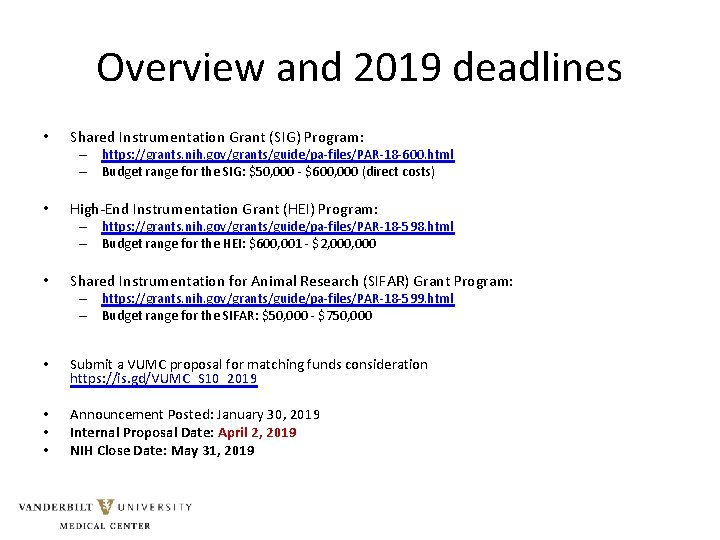
Overview and 2019 deadlines • Shared Instrumentation Grant (SIG) Program: – https: //grants. nih. gov/grants/guide/pa-files/PAR-18 -600. html – Budget range for the SIG: $50, 000 - $600, 000 (direct costs) • High-End Instrumentation Grant (HEI) Program: – https: //grants. nih. gov/grants/guide/pa-files/PAR-18 -598. html – Budget range for the HEI: $600, 001 - $2, 000 • Shared Instrumentation for Animal Research (SIFAR) Grant Program: – https: //grants. nih. gov/grants/guide/pa-files/PAR-18 -599. html – Budget range for the SIFAR: $50, 000 - $750, 000 • Submit a VUMC proposal for matching funds consideration https: //is. gd/VUMC_S 10_2019 • • • Announcement Posted: January 30, 2019 Internal Proposal Date: April 2, 2019 NIH Close Date: May 31, 2019
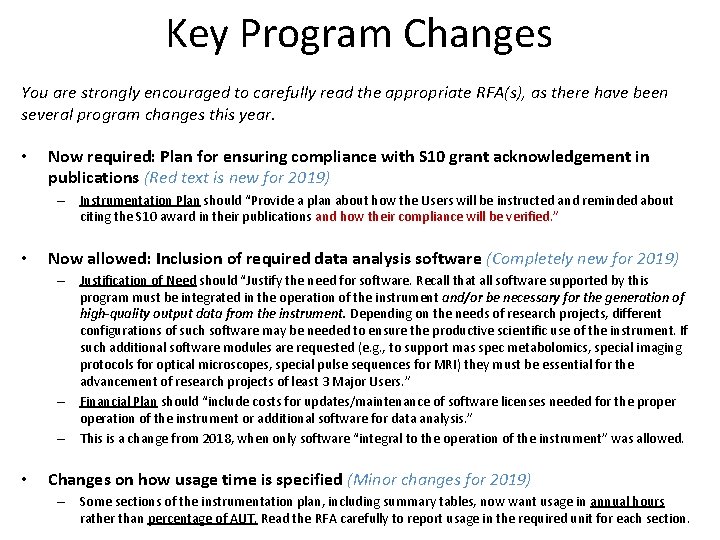
Key Program Changes You are strongly encouraged to carefully read the appropriate RFA(s), as there have been several program changes this year. • Now required: Plan for ensuring compliance with S 10 grant acknowledgement in publications (Red text is new for 2019) – Instrumentation Plan should “Provide a plan about how the Users will be instructed and reminded about citing the S 10 award in their publications and how their compliance will be verified. ” • Now allowed: Inclusion of required data analysis software (Completely new for 2019) – Justification of Need should “Justify the need for software. Recall that all software supported by this program must be integrated in the operation of the instrument and/or be necessary for the generation of high-quality output data from the instrument. Depending on the needs of research projects, different configurations of such software may be needed to ensure the productive scientific use of the instrument. If such additional software modules are requested (e. g. , to support mas spec metabolomics, special imaging protocols for optical microscopes, special pulse sequences for MRI) they must be essential for the advancement of research projects of least 3 Major Users. ” – Financial Plan should “include costs for updates/maintenance of software licenses needed for the properation of the instrument or additional software for data analysis. ” – This is a change from 2018, when only software “integral to the operation of the instrument” was allowed. • Changes on how usage time is specified (Minor changes for 2019) – Some sections of the instrumentation plan, including summary tables, now want usage in annual hours rather than percentage of AUT. Read the RFA carefully to report usage in the required unit for each section.
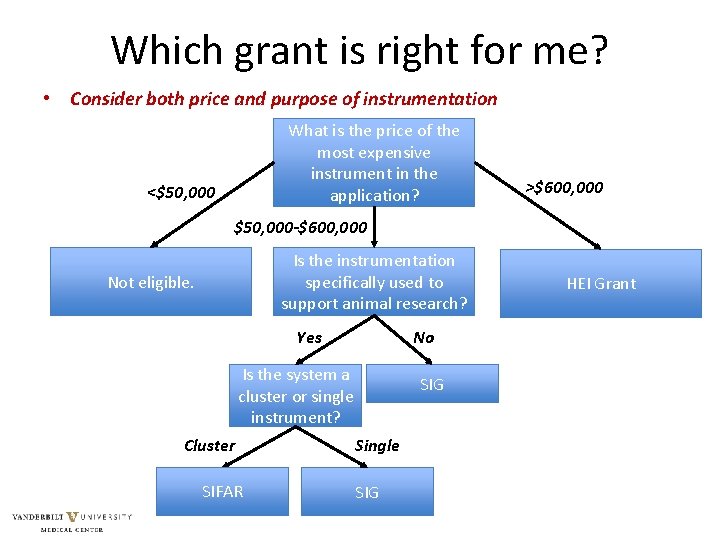
Which grant is right for me? • Consider both price and purpose of instrumentation What is the price of the most expensive instrument in the application? <$50, 000 >$600, 000 $50, 000 -$600, 000 Is the instrumentation specifically used to support animal research? Not eligible. Yes No Is the system a cluster or single instrument? Cluster SIFAR SIG Single SIG HEI Grant
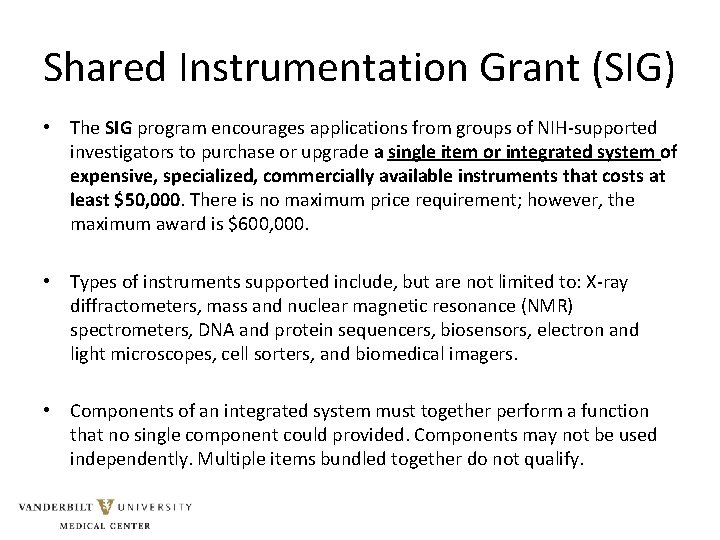
Shared Instrumentation Grant (SIG) • The SIG program encourages applications from groups of NIH-supported investigators to purchase or upgrade a single item or integrated system of expensive, specialized, commercially available instruments that costs at least $50, 000. There is no maximum price requirement; however, the maximum award is $600, 000. • Types of instruments supported include, but are not limited to: X-ray diffractometers, mass and nuclear magnetic resonance (NMR) spectrometers, DNA and protein sequencers, biosensors, electron and light microscopes, cell sorters, and biomedical imagers. • Components of an integrated system must together perform a function that no single component could provided. Components may not be used independently. Multiple items bundled together do not qualify.
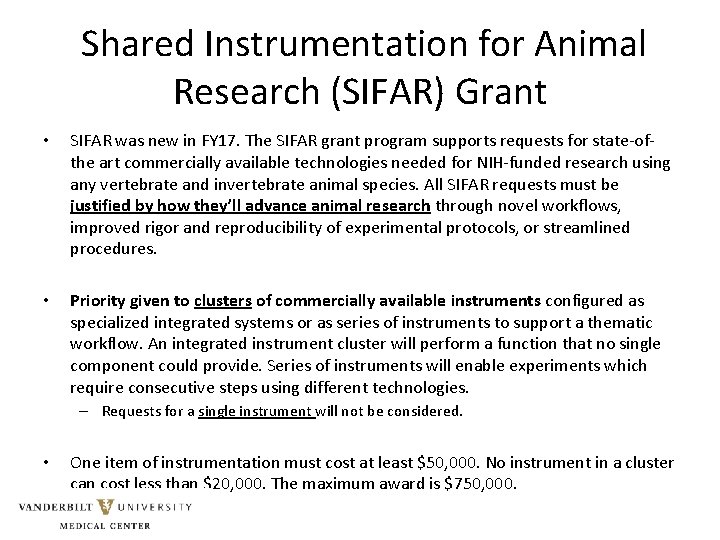
Shared Instrumentation for Animal Research (SIFAR) Grant • SIFAR was new in FY 17. The SIFAR grant program supports requests for state-ofthe art commercially available technologies needed for NIH-funded research using any vertebrate and invertebrate animal species. All SIFAR requests must be justified by how they’ll advance animal research through novel workflows, improved rigor and reproducibility of experimental protocols, or streamlined procedures. • Priority given to clusters of commercially available instruments configured as specialized integrated systems or as series of instruments to support a thematic workflow. An integrated instrument cluster will perform a function that no single component could provide. Series of instruments will enable experiments which require consecutive steps using different technologies. – Requests for a single instrument will not be considered. • One item of instrumentation must cost at least $50, 000. No instrument in a cluster can cost less than $20, 000. The maximum award is $750, 000.
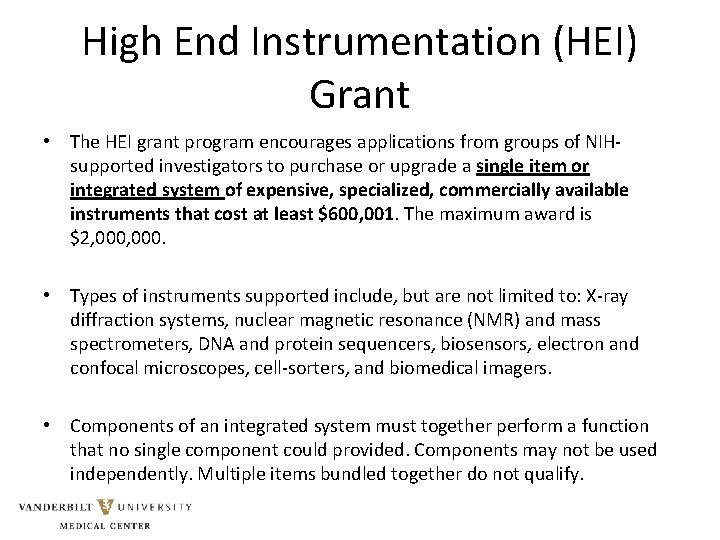
High End Instrumentation (HEI) Grant • The HEI grant program encourages applications from groups of NIHsupported investigators to purchase or upgrade a single item or integrated system of expensive, specialized, commercially available instruments that cost at least $600, 001. The maximum award is $2, 000. • Types of instruments supported include, but are not limited to: X-ray diffraction systems, nuclear magnetic resonance (NMR) and mass spectrometers, DNA and protein sequencers, biosensors, electron and confocal microscopes, cell-sorters, and biomedical imagers. • Components of an integrated system must together perform a function that no single component could provided. Components may not be used independently. Multiple items bundled together do not qualify.
Eligibility Overview
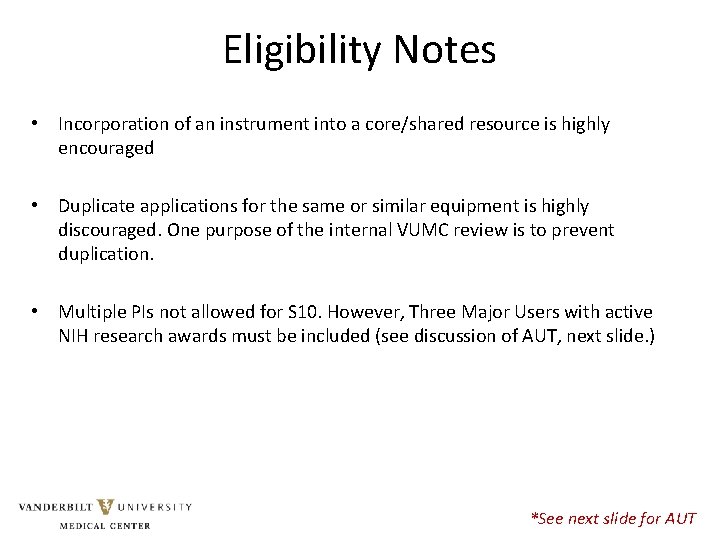
Eligibility Notes • Incorporation of an instrument into a core/shared resource is highly encouraged • Duplicate applications for the same or similar equipment is highly discouraged. One purpose of the internal VUMC review is to prevent duplication. • Multiple PIs not allowed for S 10. However, Three Major Users with active NIH research awards must be included (see discussion of AUT, next slide. ) *See next slide for AUT
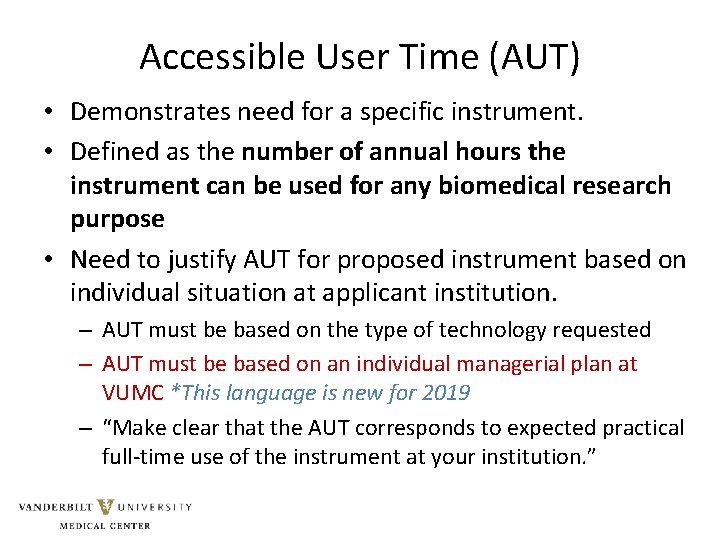
Accessible User Time (AUT) • Demonstrates need for a specific instrument. • Defined as the number of annual hours the instrument can be used for any biomedical research purpose • Need to justify AUT for proposed instrument based on individual situation at applicant institution. – AUT must be based on the type of technology requested – AUT must be based on an individual managerial plan at VUMC *This language is new for 2019 – “Make clear that the AUT corresponds to expected practical full-time use of the instrument at your institution. ”
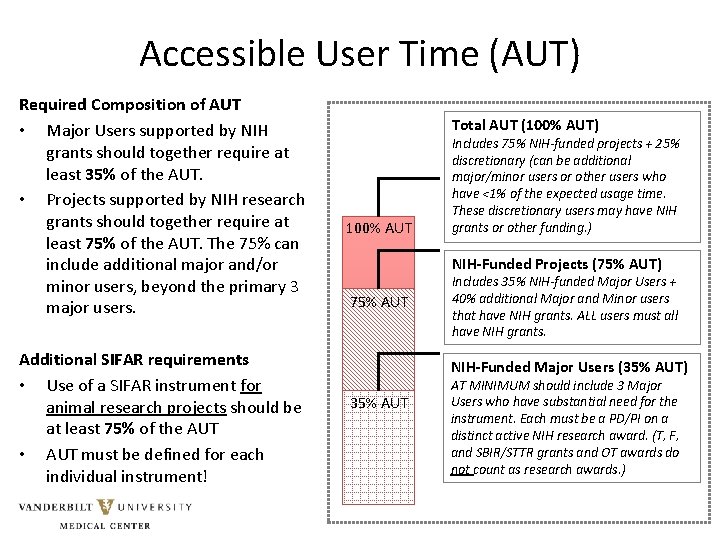
Accessible User Time (AUT) Required Composition of AUT • Major Users supported by NIH grants should together require at least 35% of the AUT. • Projects supported by NIH research grants should together require at least 75% of the AUT. The 75% can include additional major and/or minor users, beyond the primary 3 major users. Additional SIFAR requirements • Use of a SIFAR instrument for animal research projects should be at least 75% of the AUT • AUT must be defined for each individual instrument! Total AUT (100% AUT) 100% AUT Includes 75% NIH-funded projects + 25% discretionary (can be additional major/minor users or other users who have <1% of the expected usage time. These discretionary users may have NIH grants or other funding. ) NIH-Funded Projects (75% AUT) 75% AUT Includes 35% NIH-funded Major Users + 40% additional Major and Minor users that have NIH grants. ALL users must all have NIH grants. NIH-Funded Major Users (35% AUT) 35% AUT AT MINIMUM should include 3 Major Users who have substantial need for the instrument. Each must be a PD/PI on a distinct active NIH research award. (T, F, and SBIR/STTR grants and OT awards do not count as research awards. )
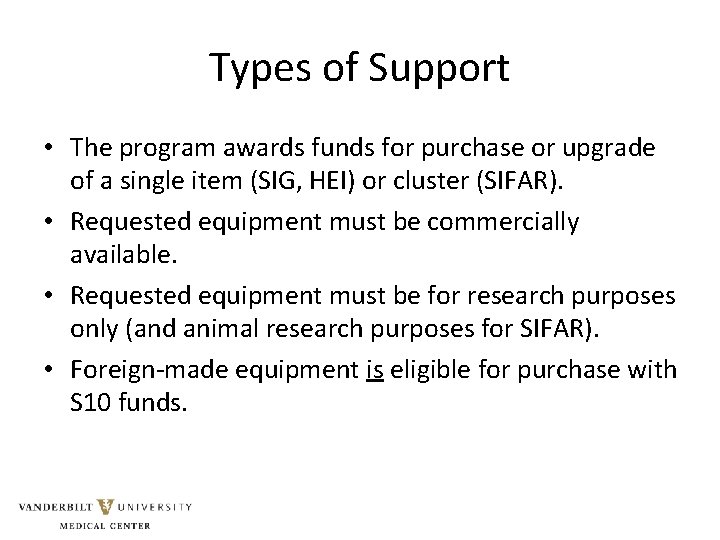
Types of Support • The program awards funds for purchase or upgrade of a single item (SIG, HEI) or cluster (SIFAR). • Requested equipment must be commercially available. • Requested equipment must be for research purposes only (and animal research purposes for SIFAR). • Foreign-made equipment is eligible for purchase with S 10 funds.
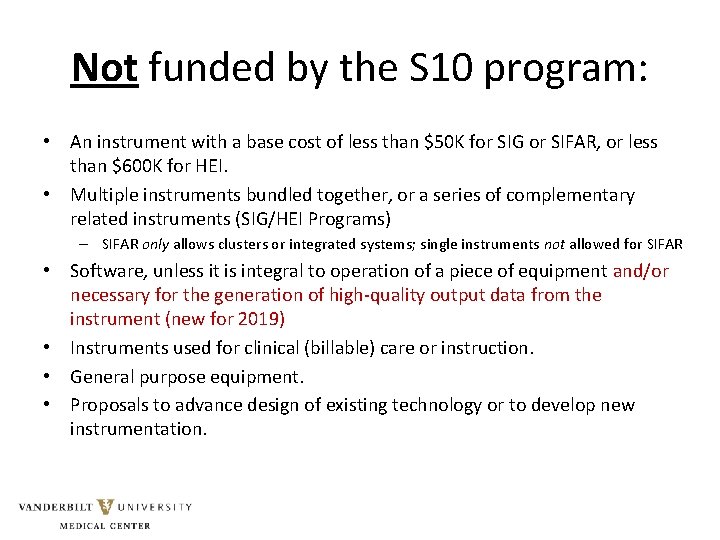
Not funded by the S 10 program: • An instrument with a base cost of less than $50 K for SIG or SIFAR, or less than $600 K for HEI. • Multiple instruments bundled together, or a series of complementary related instruments (SIG/HEI Programs) – SIFAR only allows clusters or integrated systems; single instruments not allowed for SIFAR • Software, unless it is integral to operation of a piece of equipment and/or necessary for the generation of high-quality output data from the instrument (new for 2019) • Instruments used for clinical (billable) care or instruction. • General purpose equipment. • Proposals to advance design of existing technology or to develop new instrumentation.
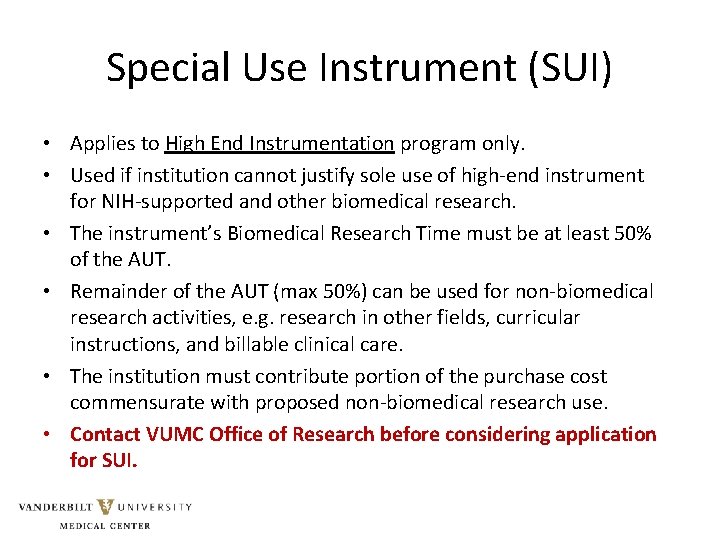
Special Use Instrument (SUI) • Applies to High End Instrumentation program only. • Used if institution cannot justify sole use of high-end instrument for NIH-supported and other biomedical research. • The instrument’s Biomedical Research Time must be at least 50% of the AUT. • Remainder of the AUT (max 50%) can be used for non-biomedical research activities, e. g. research in other fields, curricular instructions, and billable clinical care. • The institution must contribute portion of the purchase cost commensurate with proposed non-biomedical research use. • Contact VUMC Office of Research before considering application for SUI.
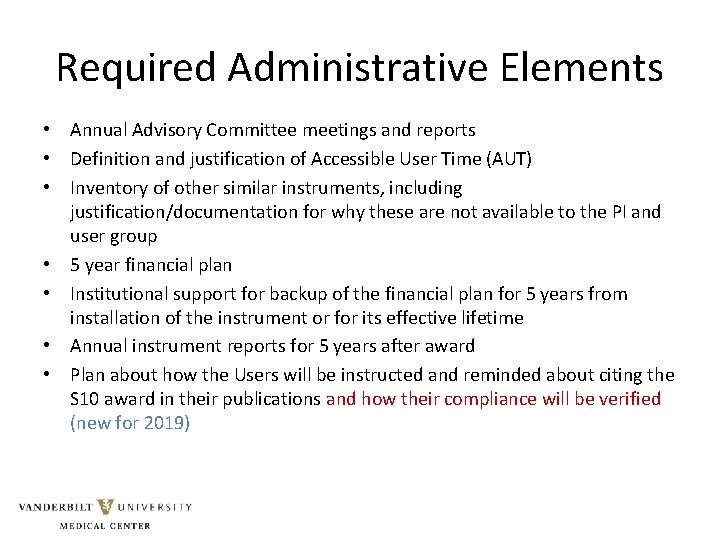
Required Administrative Elements • Annual Advisory Committee meetings and reports • Definition and justification of Accessible User Time (AUT) • Inventory of other similar instruments, including justification/documentation for why these are not available to the PI and user group • 5 year financial plan • Institutional support for backup of the financial plan for 5 years from installation of the instrument or for its effective lifetime • Annual instrument reports for 5 years after award • Plan about how the Users will be instructed and reminded about citing the S 10 award in their publications and how their compliance will be verified (new for 2019)
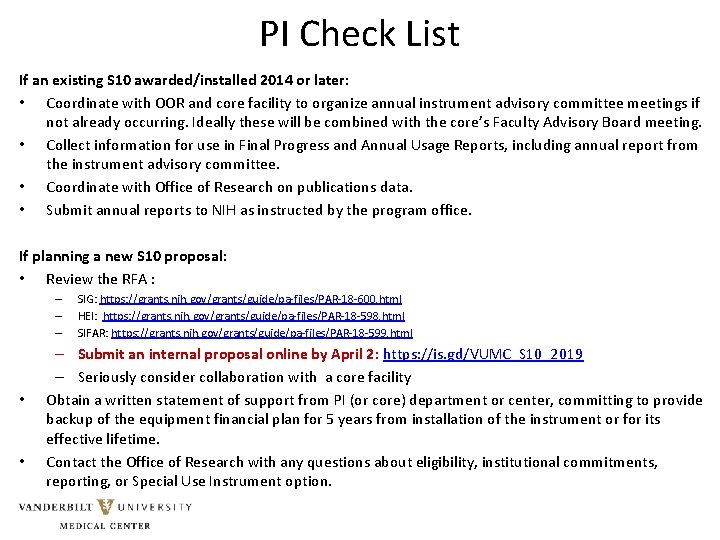
PI Check List If an existing S 10 awarded/installed 2014 or later: • Coordinate with OOR and core facility to organize annual instrument advisory committee meetings if not already occurring. Ideally these will be combined with the core’s Faculty Advisory Board meeting. • Collect information for use in Final Progress and Annual Usage Reports, including annual report from the instrument advisory committee. • Coordinate with Office of Research on publications data. • Submit annual reports to NIH as instructed by the program office. If planning a new S 10 proposal: • Review the RFA : – – – • • SIG: https: //grants. nih. gov/grants/guide/pa-files/PAR-18 -600. html HEI: https: //grants. nih. gov/grants/guide/pa-files/PAR-18 -598. html SIFAR: https: //grants. nih. gov/grants/guide/pa-files/PAR-18 -599. html – Submit an internal proposal online by April 2: https: //is. gd/VUMC_S 10_2019 – Seriously consider collaboration with a core facility Obtain a written statement of support from PI (or core) department or center, committing to provide backup of the equipment financial plan for 5 years from installation of the instrument or for its effective lifetime. Contact the Office of Research with any questions about eligibility, institutional commitments, reporting, or Special Use Instrument option.
Questions? • Contact us with any questions about the S 10 program. VUMC Investigators Amy Martinez Office of Research amy. f. martinez@Vanderbilt. edu 615 -875 -0740 VU Investigators Liane Moneta-Koehler (non-SOM) liane. monetakoehler@vanderbilt. edu Chuck Sanders (Basic Sciences) chuck. sanders@vanderbilt. edu • Find general program information HERE • Find FAQs on the NIH site HERE
Post-Award Reporting
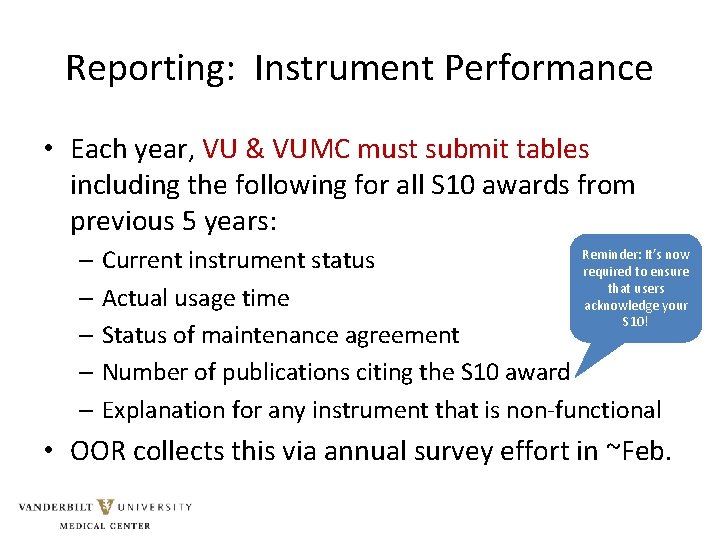
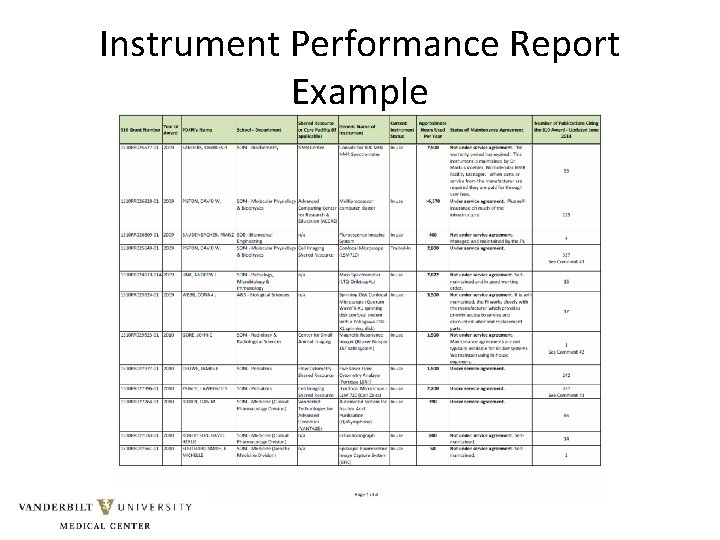
Reporting: Instrument Performance • Each year, VU & VUMC must submit tables including the following for all S 10 awards from previous 5 years: Reminder: It’s now – Current instrument status required to ensure that users – Actual usage time acknowledge your S 10! – Status of maintenance agreement – Number of publications citing the S 10 award – Explanation for any instrument that is non-functional • OOR collects this via annual survey effort in ~Feb.
Instrument Performance Report Example
Reporting: Final Progress Report • At the end of Funding Year 1, the PI must submit a Final Progress Report, including the following: – List of users, their funding and hours of use – List of publications – Narrative describing impact – Report from Advisory Committee
Reporting: Annual Instrument Usage Report • At the end of Year 2, the PI must submit a Usage Report, similar to the Final Progress Report and including the Advisory Committee Report. • The NIH Scientific Research/Contact staff will provide specific instructions to grantees prior to the due date for report. • First awards to require this new report were made in 2014.
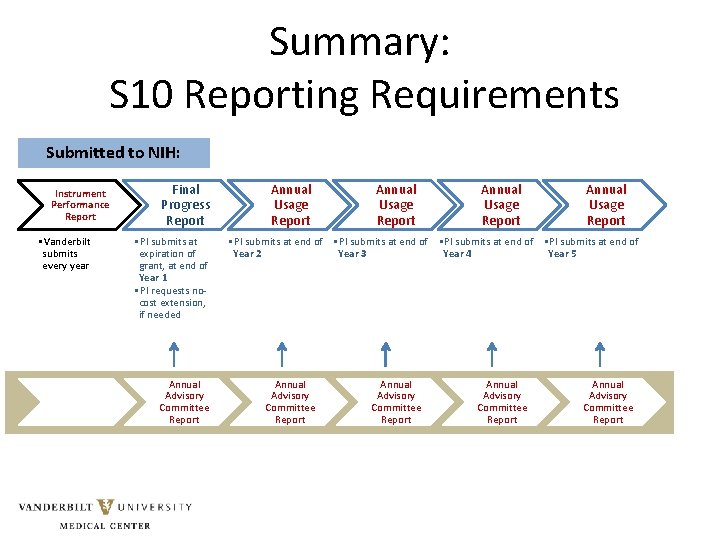
Summary: S 10 Reporting Requirements Submitted to NIH: Instrument Performance Report • Vanderbilt submits every year Final Progress Report • PI submits at expiration of grant, at end of Year 1 • PI requests nocost extension, if needed Annual Advisory Committee Report Annual Usage Report • PI submits at end of Year 2 Year 3 Year 4 Year 5 Annual Advisory Committee Report