
2019 Joint Commission Medical Staff Update Laurie Mc










- Slides: 110
2019 Joint Commission Medical Staff Update Laurie Mc. Court, MD, ABFM, CJCP Consultant Joint Commission Resources, Inc. © 2019 Joint Commission Resources. All Rights Reserved.
Joint Commission Resources Disclaimer – These slides are current as of March 1, 2019. Joint Commission Resources reserves the right to change the content of the information, as appropriate. – These slides are only meant to be cue points, which were expounded upon verbally by the original presenter and are not meant to be comprehensive statements of standards interpretation or represent all the content of the presentation. Thus, care should be exercised in interpreting Joint Commission requirements based solely on the content of these slides. – Copyright © 2019 by Joint Commission Resources, Inc. All rights reserved. No part of this publication may be reproduced in any form or by any means without written permission from the publisher. Request for permission to reproduce any part of this program should be addressed to permissions@jcrinc. com. © 2019 Joint Commission Resources. All Rights Reserved. 2
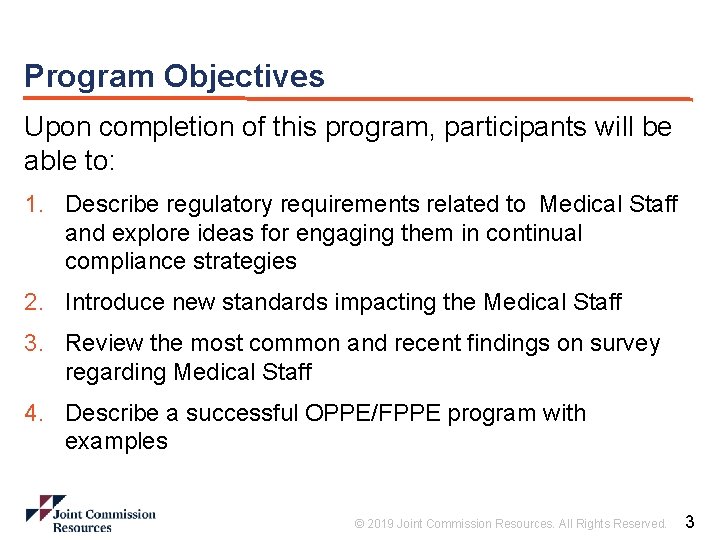
Program Objectives Upon completion of this program, participants will be able to: 1. Describe regulatory requirements related to Medical Staff and explore ideas for engaging them in continual compliance strategies 2. Introduce new standards impacting the Medical Staff 3. Review the most common and recent findings on survey regarding Medical Staff 4. Describe a successful OPPE/FPPE program with examples © 2019 Joint Commission Resources. All Rights Reserved. 3
– Let’s assume. . © 2019 Joint Commission Resources. All Rights Reserved. 4
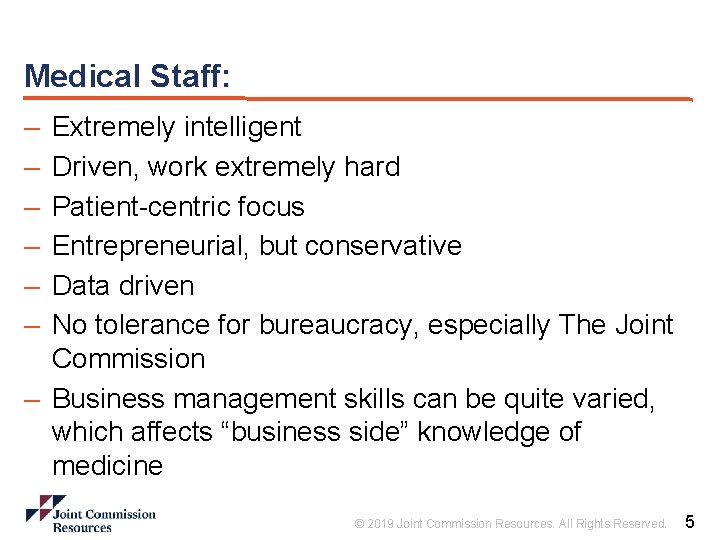
Medical Staff: – – – Extremely intelligent Driven, work extremely hard Patient-centric focus Entrepreneurial, but conservative Data driven No tolerance for bureaucracy, especially The Joint Commission – Business management skills can be quite varied, which affects “business side” knowledge of medicine © 2019 Joint Commission Resources. All Rights Reserved. 5
Medical Staff: – Like technology, but like the proven tested ways – Need for increased efficiency – Financial pressures – Huge contributor to the culture of a unit, clinic, department, or organization – Chances are the medical staff is more stable and longer tenured than hospital administration © 2019 Joint Commission Resources. All Rights Reserved. 6
Key Steps to Achieving Engagement – Medical staff leadership must be on board – Include the medical staff early – Rely on performance data to articulate need for change – Create and communicate organizational vision and goals to the medical staff – Building medical staff confidence and trust in the leadership team – Developing and training the medical staff © 2019 Joint Commission Resources. All Rights Reserved. 7
Medical Staff Education and Training – Conducted by a physician champion – A dedicated, sustained organizational effort with tracked outcomes – Structured to create medical staff change: – Create buy-in, explain “why” – Deliver evidence-based behaviors to medical staff Goal: Achieve high reliability! © 2019 Joint Commission Resources. All Rights Reserved. 8
Drivers to Change – – – Effective Leadership Organizational Responsiveness Trust and Confidence in the Leadership Team Efficiency in Practice Experience Knowledge of Performance Clarity of Expectations; Explain the “Why” Participation in Change Strategies Coaching to Improve Colleagues Enrolled in the Effort Recognition for Doing Well Incentives © 2019 Joint Commission Resources. All Rights Reserved. 9
Joint Commission Accreditation Process Update 2019 © 2019 Joint Commission Resources. All Rights Reserved. 10
Project REFRESH: What is it? § Real-time information gathering between − surveyors and Standards Interpretation Group − during survey § Enhanced mobile technology § Fewer standards: No REFRESH changes in MS Chapter as yet § Revised criticality models § Easier & less complex decision process § Streamlined post-survey process § Higher consistency in interpretation of standards © 2019 Joint Commission Resources. All Rights Reserved. 11
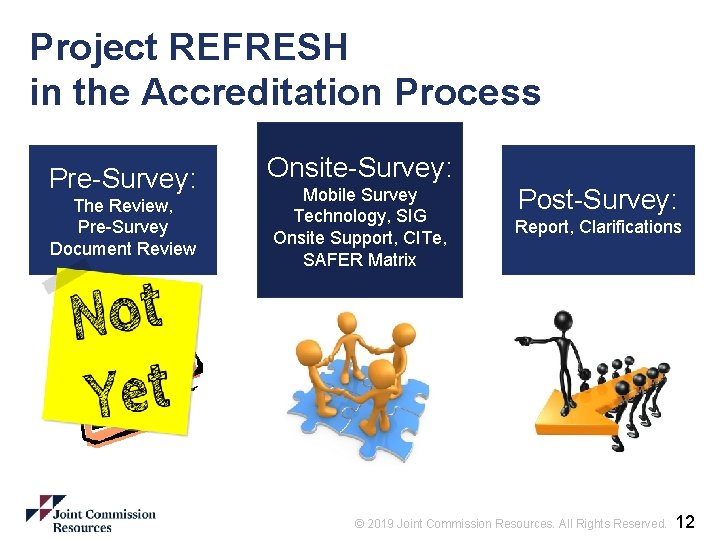
Project REFRESH in the Accreditation Process Pre-Survey: The Review, Pre-Survey Document Review Onsite-Survey: Mobile Survey Technology, SIG Onsite Support, CITe, SAFER Matrix Post-Survey: Report, Clarifications © 2019 Joint Commission Resources. All Rights Reserved. 12
© 2019 Joint Commission Resources. All Rights Reserved. 13
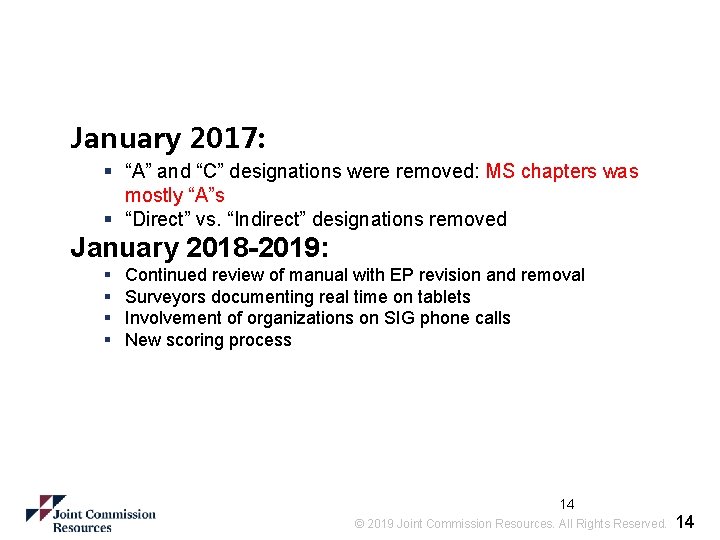
Changes to Surveys January 2017: § “A” and “C” designations were removed: MS chapters was mostly “A”s § “Direct” vs. “Indirect” designations removed January 2018 -2019: § § Continued review of manual with EP revision and removal Surveyors documenting real time on tablets Involvement of organizations on SIG phone calls New scoring process 14 © 2019 Joint Commission Resources. All Rights Reserved. 14
Survey Analysis for Evaluating Risk™ (SAFER™) Matrix © 2019 Joint Commission Resources. All Rights Reserved. 15
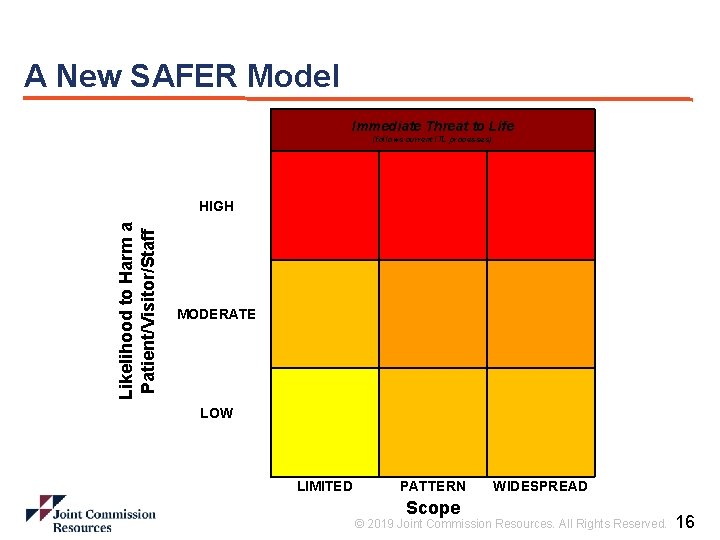
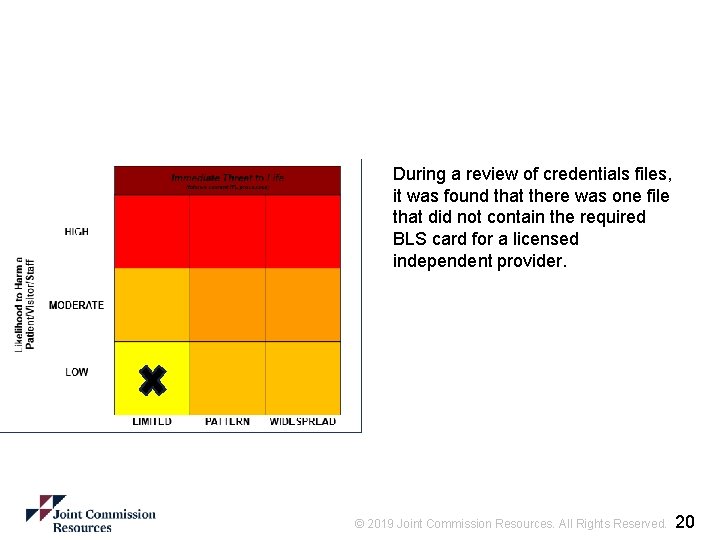
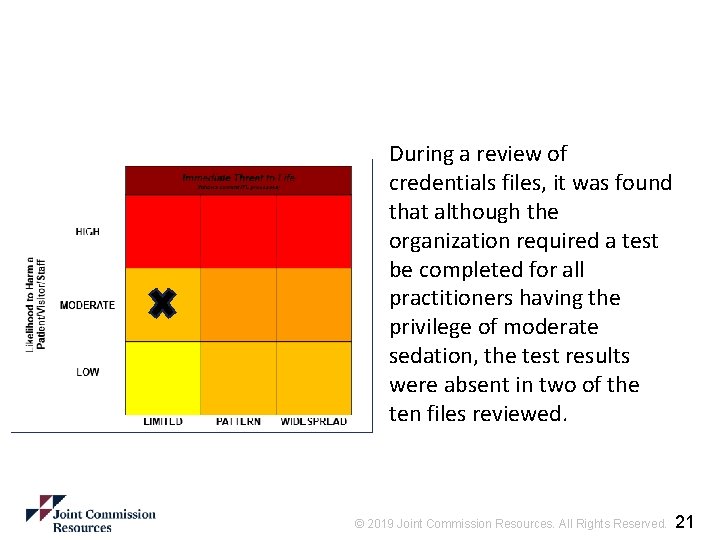
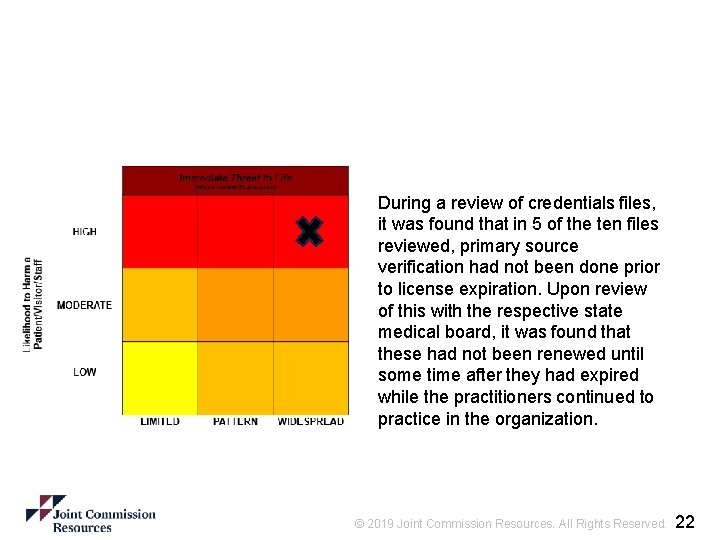
A New SAFER Model Immediate Threat to Life (follows current ITL processes) Likelihood to Harm a Patient/Visitor/Staff HIGH MODERATE LOW LIMITED PATTERN Scope WIDESPREAD © 2019 Joint Commission Resources. All Rights Reserved. 16
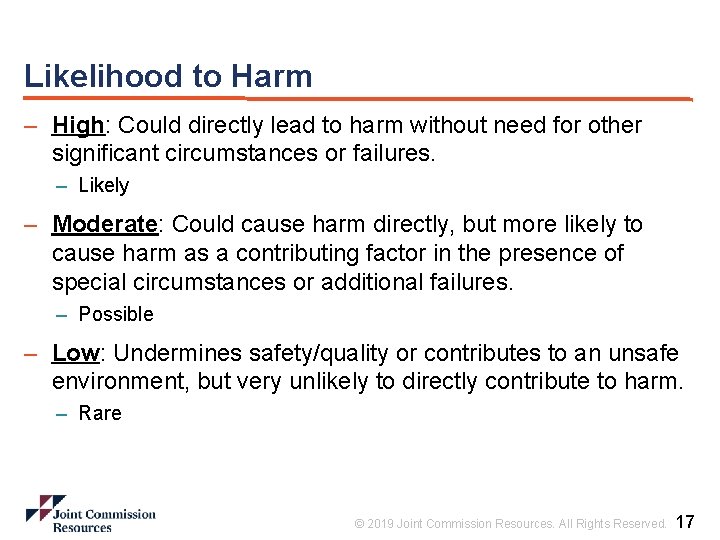
Likelihood to Harm – High: Could directly lead to harm without need for other significant circumstances or failures. – Likely – Moderate: Could cause harm directly, but more likely to cause harm as a contributing factor in the presence of special circumstances or additional failures. – Possible – Low: Undermines safety/quality or contributes to an unsafe environment, but very unlikely to directly contribute to harm. – Rare © 2019 Joint Commission Resources. All Rights Reserved. 17
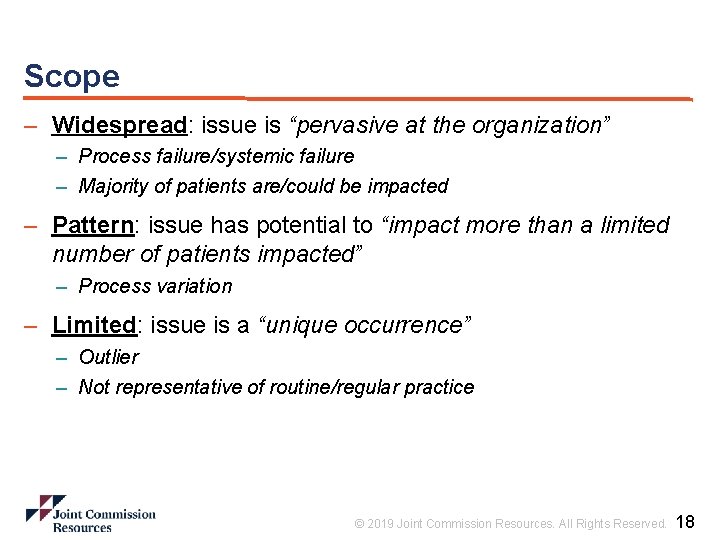
Scope – Widespread: issue is “pervasive at the organization” – Process failure/systemic failure – Majority of patients are/could be impacted – Pattern: issue has potential to “impact more than a limited number of patients impacted” – Process variation – Limited: issue is a “unique occurrence” – Outlier – Not representative of routine/regular practice © 2019 Joint Commission Resources. All Rights Reserved. 18
Let’s Practice… © 2019 Joint Commission Resources. All Rights Reserved. 19
Example #1 During a review of credentials files, it was found that there was one file that did not contain the required BLS card for a licensed independent provider. © 2019 Joint Commission Resources. All Rights Reserved. 20
Example #2 During a review of credentials files, it was found that although the organization required a test be completed for all practitioners having the privilege of moderate sedation, the test results were absent in two of the ten files reviewed. © 2019 Joint Commission Resources. All Rights Reserved. 21
Example #3 During a review of credentials files, it was found that in 5 of the ten files reviewed, primary source verification had not been done prior to license expiration. Upon review of this with the respective state medical board, it was found that these had not been renewed until some time after they had expired while the practitioners continued to practice in the organization. © 2019 Joint Commission Resources. All Rights Reserved. 22
Post-Survey: Report, Clarifications © 2019 Joint Commission Resources. All Rights Reserved. 23
Follow-up Actions – Follow-up customized and prioritized according to placement within SAFER Matrix © 2019 Joint Commission Resources. All Rights Reserved. 24
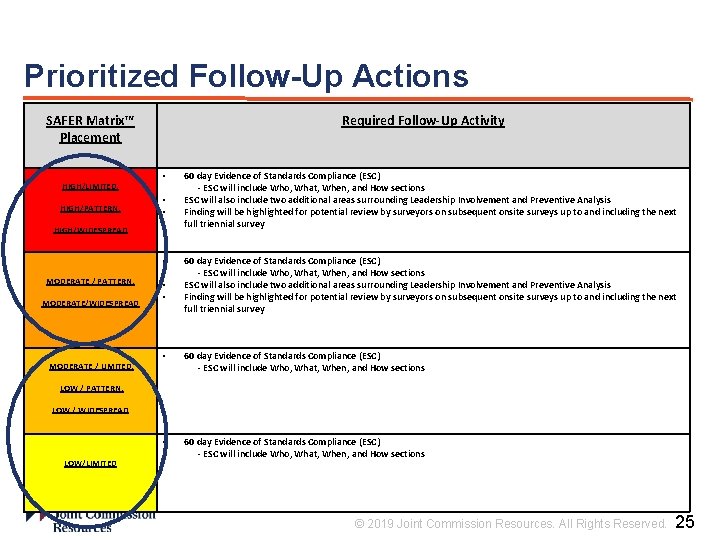
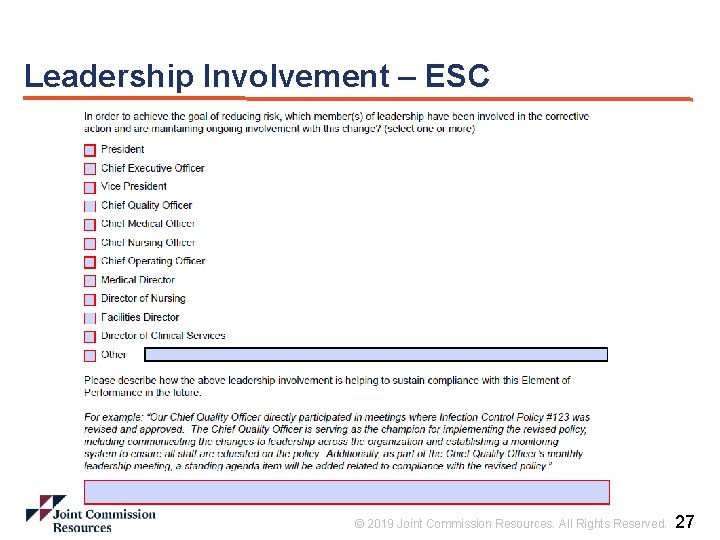
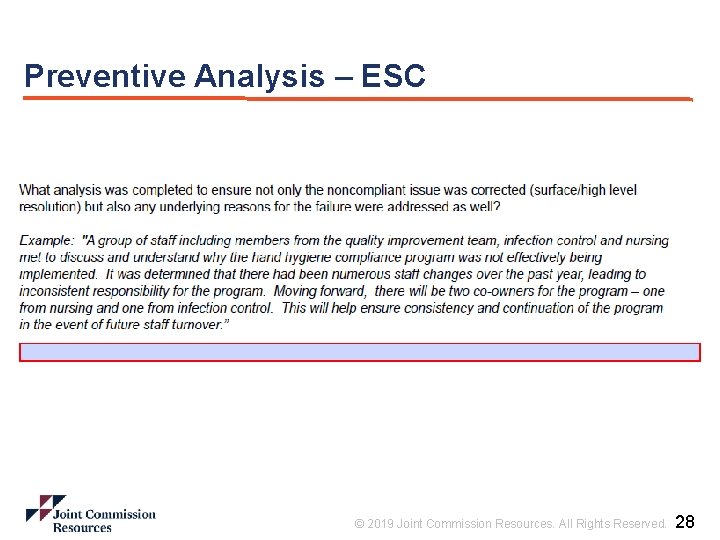
Prioritized Follow-Up Actions SAFER Matrix™ Placement HIGH/LIMITED, HIGH/PATTERN, Required Follow-Up Activity • • • HIGH/WIDESPREAD • MODERATE / PATTERN, MODERATE/WIDESPREAD MODERATE / LIMITED, • • 60 day Evidence of Standards Compliance (ESC) - ESC will include Who, What, When, and How sections ESC will also include two additional areas surrounding Leadership Involvement and Preventive Analysis Finding will be highlighted for potential review by surveyors on subsequent onsite surveys up to and including the next full triennial survey • 60 day Evidence of Standards Compliance (ESC) - ESC will include Who, What, When, and How sections LOW / PATTERN, LOW / WIDESPREAD LOW/LIMITED © 2019 Joint Commission Resources. All Rights Reserved. 25
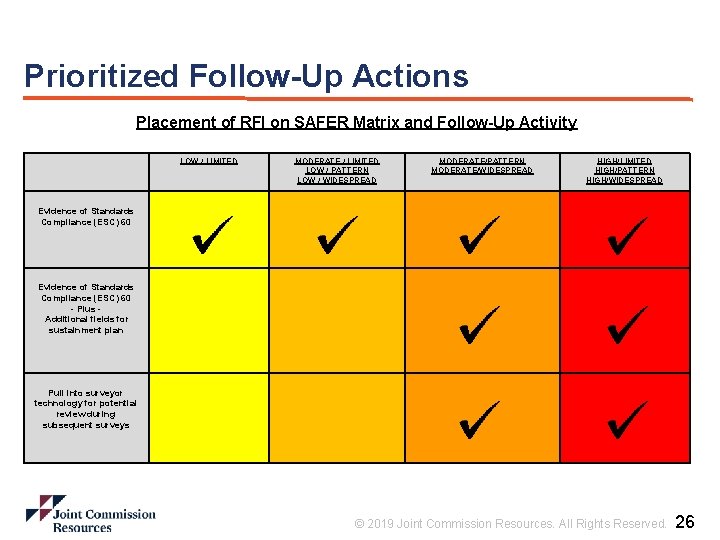
Prioritized Follow-Up Actions Placement of RFI on SAFER Matrix and Follow-Up Activity LOW / LIMITED MODERATE / LIMITED LOW / PATTERN LOW / WIDESPREAD MODERATE/PATTERN MODERATE/WIDESPREAD HIGH/LIMITED HIGH/PATTERN HIGH/WIDESPREAD Evidence of Standards Compliance (ESC) 60 - Plus - Additional fields for sustainment plan Pull into surveyor technology for potential review during subsequent surveys © 2019 Joint Commission Resources. All Rights Reserved. 26
Leadership Involvement – ESC © 2019 Joint Commission Resources. All Rights Reserved. 27
Preventive Analysis – ESC © 2019 Joint Commission Resources. All Rights Reserved. 28
© 2019 Joint Commission Resources. All Rights Reserved. 29
Sign Up for Joint Commission News, Alerts & New FAQs! © 2019 Joint Commission Resources. All Rights Reserved. 30
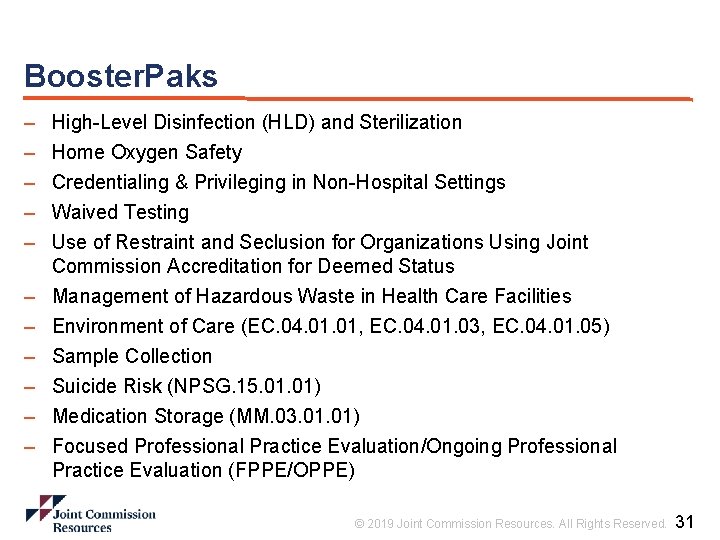
Booster. Paks – – – High-Level Disinfection (HLD) and Sterilization Home Oxygen Safety Credentialing & Privileging in Non-Hospital Settings Waived Testing Use of Restraint and Seclusion for Organizations Using Joint Commission Accreditation for Deemed Status Management of Hazardous Waste in Health Care Facilities Environment of Care (EC. 04. 01, EC. 04. 01. 03, EC. 04. 01. 05) Sample Collection Suicide Risk (NPSG. 15. 01) Medication Storage (MM. 03. 01) Focused Professional Practice Evaluation/Ongoing Professional Practice Evaluation (FPPE/OPPE) © 2019 Joint Commission Resources. All Rights Reserved. 31
Joint Commission Portals – Infection Prevention and Control Portal – Transitions of Care Portal – The Physical Environment Portal – Emergency Management Portal – Pain Management Portal © 2019 Joint Commission Resources. All Rights Reserved. 32
Patient Safety Systems Chapter – Informs and educates hospital leaders on the importance and the structure of an integrated patient safety system. – There are no new requirements. – The chapter serves as a road map for hospital leaders to use existing requirements to improve patient safety. – The chapter is included on E-dition and in the 2019 Comprehensive Accreditation Manual for Hospitals, located under “Accreditation Process Information” © 2019 Joint Commission Resources. All Rights Reserved. 33
Pain Management Standards © 2019 Joint Commission Resources. All Rights Reserved. 34
Pain Management – Standard MS. 03. 01. 03 – The management and coordination of each patient’s care, treatment, and services is the responsibility of a practitioner with appropriate privileges. MS. 03. 01. 03 EP 2 DELETED Effective 1/1/2018 The hospital educates all licensed independent practitioners on assessing and managing pain. But don’t get too excited… © 2019 Joint Commission Resources. All Rights Reserved. 35
New Standards/EPs: Pain Management – Effective January 1, 2018 – Includes Leadership (LD); Medical Staff (MS); Provision of Care, Treatment, and Services (PC); and Performance Improvement (PI) chapters © 2019 Joint Commission Resources. All Rights Reserved. 36
New Standards/EPs: Pain Management – LD. 04. 03. 13 EP 1 -7: Pain assessment and pain management, including safe opioid prescribing, is identified as an organizational priority for the hospital. – MS. 05. 01 EP 18: The organized medical staff has a leadership role in organization performance improvement activities to improve quality of care, treatment, and services and patient safety. – PC. 01. 02. 07 EP 1 -8: The hospital assesses and manages the patient’s pain and minimizes the risks associated with treatment. – PI. 01. 01 EP 56: The hospital collects data to monitor its performance. – PI. 02. 01 EP 18: The hospital compiles and analyzes data © 2019 Joint Commission Resources. All Rights Reserved. 37
LD. 04. 03. 13 Pain Management – EP 1 The hospital has a leader or leadership team that is responsible for pain management and safe opioid prescribing and develops and monitors performance improvement activities – EP 2 The hospital provides nonpharmacologic pain treatment modalities – EP 3 The hospital provides staff and licensed independent practitioners with educational resources and programs to improve pain assessment, pain management, and the safe use of opioid medications based on the identified needs of its patient population © 2019 Joint Commission Resources. All Rights Reserved. 38
LD. 04. 03. 13 Pain Management – EP 4 The hospital provides information to staff and licensed independent practitioners on available services for consultation and referral of patients with complex pain management needs – EP 5 The hospital identifies opioid treatment programs that can be used for patient referrals – EP 6 The hospital facilitates practitioner and pharmacist access to the Prescription Drug Monitoring Program databases. (If available) – EP 7 Hospital leadership works with its clinical staff to identify and acquire the equipment needed to monitor patients who are at high risk for adverse outcomes from opioid treatment © 2019 Joint Commission Resources. All Rights Reserved. 39
MS. 05. 01 EP 18 Pain Management – Standard MS. 05. 01 The organized medical staff has a leadership role in organization performance improvement activities to improve quality of care, treatment, and services and patient safety. – MS. 05. 01 EP 18 The medical staff is actively involved in pain assessment, pain management, and safe opioid prescribing through the following: – Participating in the establishment of protocols and quality metrics – Reviewing performance improvement data Effective January 1, 2018 © 2019 Joint Commission Resources. All Rights Reserved. 40
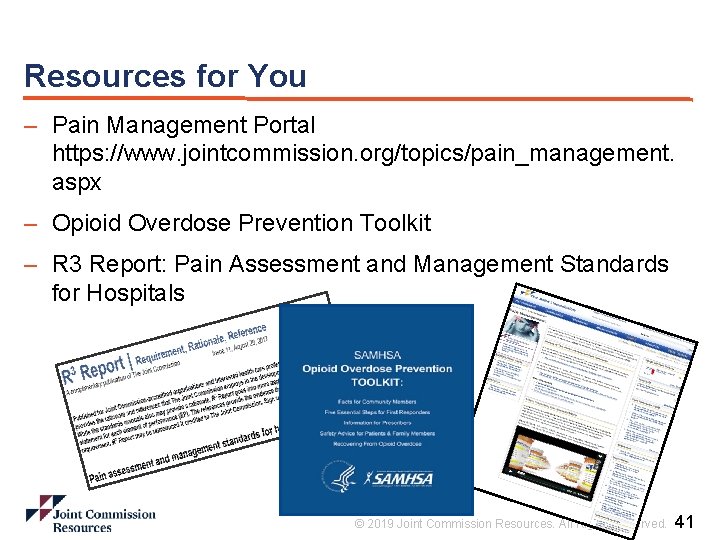
Resources for You – Pain Management Portal https: //www. jointcommission. org/topics/pain_management. aspx – Opioid Overdose Prevention Toolkit – R 3 Report: Pain Assessment and Management Standards for Hospitals © 2019 Joint Commission Resources. All Rights Reserved. 41
2018 Proposed Changes for Contracted LIPS © 2019 Joint Commission Resources. All Rights Reserved. 42
– An example of why the Joint Commission process of Field Review is so important… we need to hear from you! © 2019 Joint Commission Resources. All Rights Reserved. 43
Elimination of MS. 13. 01 and MS. 13. 01. 03 – These standards currently define the credentialing and privileging of telemedicine. © 2019 Joint Commission Resources. All Rights Reserved. 44
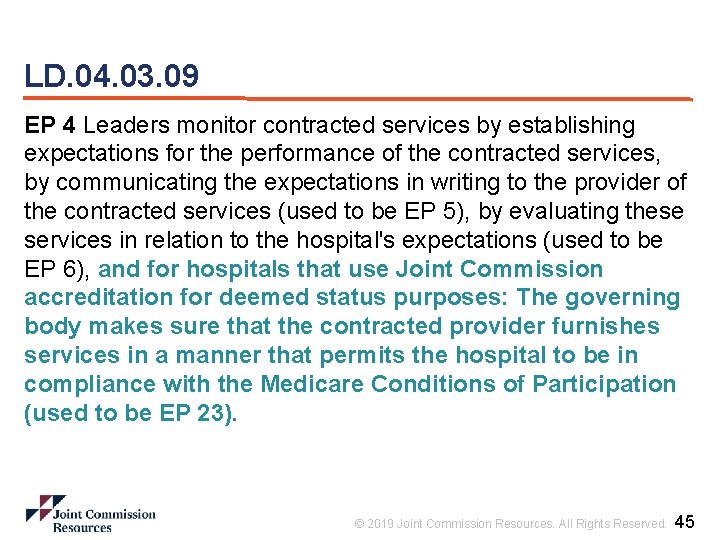
LD. 04. 03. 09 EP 4 Leaders monitor contracted services by establishing expectations for the performance of the contracted services, by communicating the expectations in writing to the provider of the contracted services (used to be EP 5), by evaluating these services in relation to the hospital's expectations (used to be EP 6), and for hospitals that use Joint Commission accreditation for deemed status purposes: The governing body makes sure that the contracted provider furnishes services in a manner that permits the hospital to be in compliance with the Medicare Conditions of Participation (used to be EP 23). © 2019 Joint Commission Resources. All Rights Reserved. 45
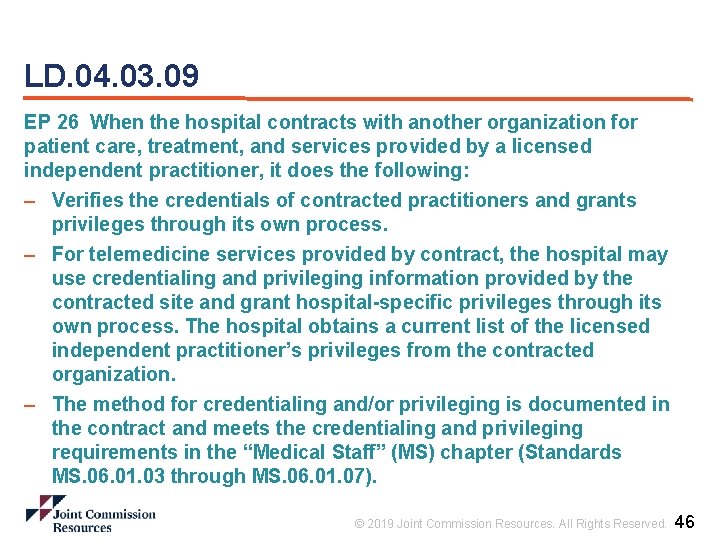
LD. 04. 03. 09 EP 26 When the hospital contracts with another organization for patient care, treatment, and services provided by a licensed independent practitioner, it does the following: – Verifies the credentials of contracted practitioners and grants privileges through its own process. – For telemedicine services provided by contract, the hospital may use credentialing and privileging information provided by the contracted site and grant hospital-specific privileges through its own process. The hospital obtains a current list of the licensed independent practitioner’s privileges from the contracted organization. – The method for credentialing and/or privileging is documented in the contract and meets the credentialing and privileging requirements in the “Medical Staff” (MS) chapter (Standards MS. 06. 01. 03 through MS. 06. 01. 07). © 2019 Joint Commission Resources. All Rights Reserved. 46
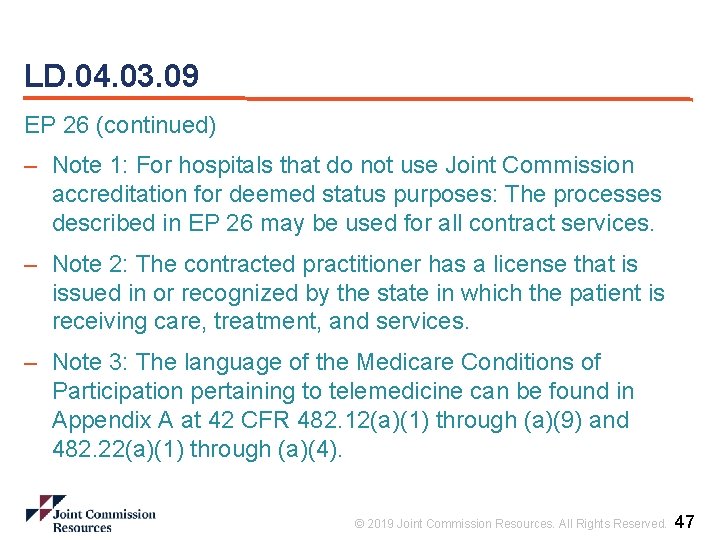
LD. 04. 03. 09 EP 26 (continued) – Note 1: For hospitals that do not use Joint Commission accreditation for deemed status purposes: The processes described in EP 26 may be used for all contract services. – Note 2: The contracted practitioner has a license that is issued in or recognized by the state in which the patient is receiving care, treatment, and services. – Note 3: The language of the Medicare Conditions of Participation pertaining to telemedicine can be found in Appendix A at 42 CFR 482. 12(a)(1) through (a)(9) and 482. 22(a)(1) through (a)(4). © 2019 Joint Commission Resources. All Rights Reserved. 47
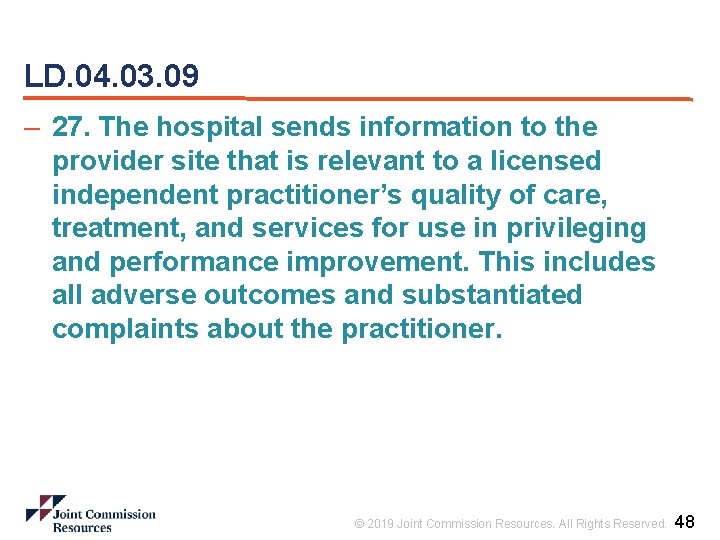
LD. 04. 03. 09 – 27. The hospital sends information to the provider site that is relevant to a licensed independent practitioner’s quality of care, treatment, and services for use in privileging and performance improvement. This includes all adverse outcomes and substantiated complaints about the practitioner. © 2019 Joint Commission Resources. All Rights Reserved. 48
– These changes went through field review and are currently being further evaluated by Joint Commission central office as to their feasibility… – So stay tuned… © 2019 Joint Commission Resources. All Rights Reserved. 49
Bylaws © 2019 Joint Commission Resources. All Rights Reserved. 50
MS. 01. 01 – “The Bylaws Standard” – EP 3: Most commonly scored EP in Medical Staff Chapter, must be scored if one of EPs 12 -37 is scored © 2019 Joint Commission Resources. All Rights Reserved. 51
MS. 01. 01 – Every requirement set forth in MS. 01. 01, Elements of Performance (EPs) 12– 37, is in the medical staff bylaws. These requirements may have associated details, some of which may be extensive; such details may reside in the medical staff bylaws, rules and regulations, or policies. The organized medical staff adopts what constitutes the associated details, where they reside, and whether their adoption can be delegated. Adoption of associated details that reside in medical staff bylaws cannot be delegated. For those EPs 12– 37 that require a process, the medical staff bylaws include, at a minimum, the basic steps required for implementation of the requirement, as determined by the organized medical staff and approved by the governing body. © 2019 Joint Commission Resources. All Rights Reserved. 52
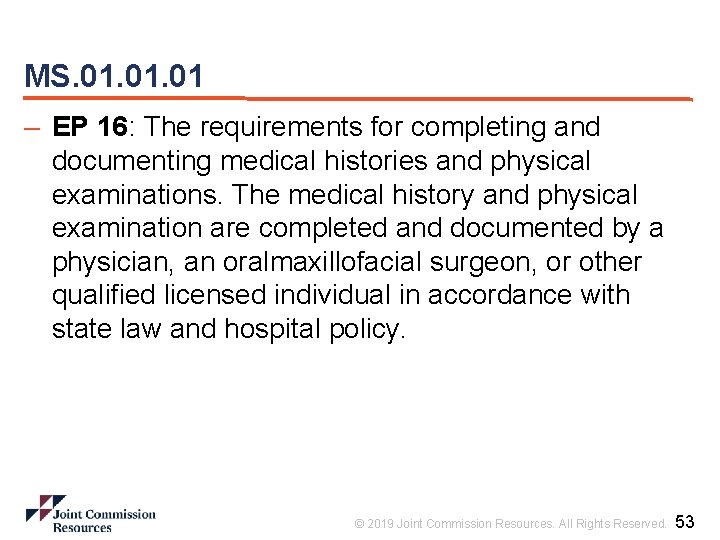
MS. 01. 01 – EP 16: The requirements for completing and documenting medical histories and physical examinations. The medical history and physical examination are completed and documented by a physician, an oralmaxillofacial surgeon, or other qualified licensed individual in accordance with state law and hospital policy. © 2019 Joint Commission Resources. All Rights Reserved. 53
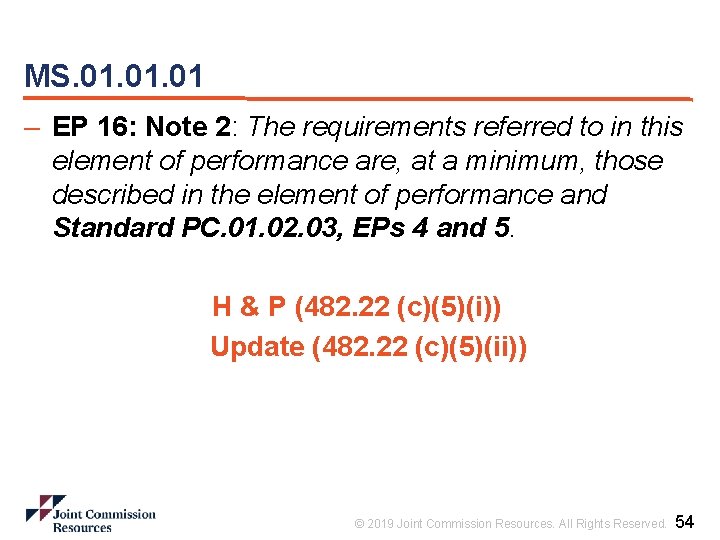
MS. 01. 01 – EP 16: Note 2: The requirements referred to in this element of performance are, at a minimum, those described in the element of performance and Standard PC. 01. 02. 03, EPs 4 and 5. H & P (482. 22 (c)(5)(i)) Update (482. 22 (c)(5)(ii)) © 2019 Joint Commission Resources. All Rights Reserved. 54
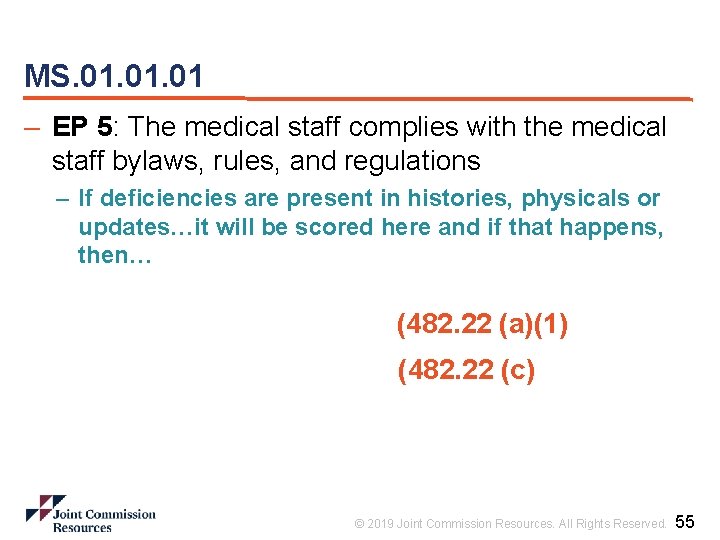
MS. 01. 01 – EP 5: The medical staff complies with the medical staff bylaws, rules, and regulations – If deficiencies are present in histories, physicals or updates…it will be scored here and if that happens, then… (482. 22 (a)(1) (482. 22 (c) © 2019 Joint Commission Resources. All Rights Reserved. 55
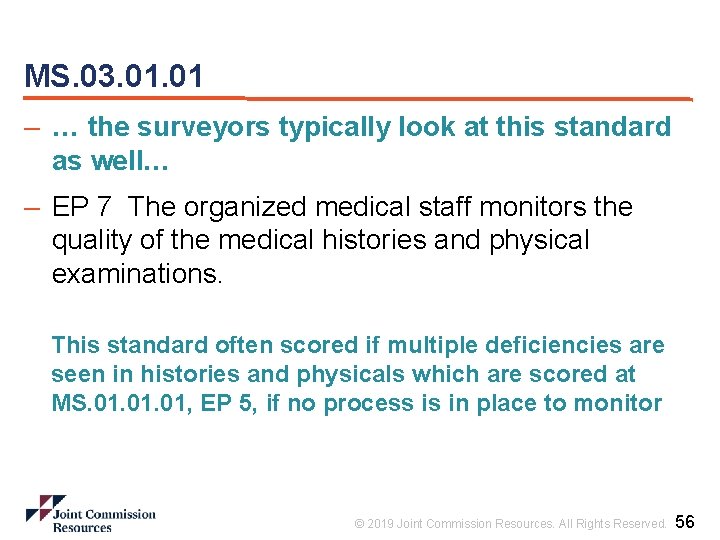
MS. 03. 01 – … the surveyors typically look at this standard as well… – EP 7 The organized medical staff monitors the quality of the medical histories and physical examinations. This standard often scored if multiple deficiencies are seen in histories and physicals which are scored at MS. 01. 01, EP 5, if no process is in place to monitor © 2019 Joint Commission Resources. All Rights Reserved. 56
MS. 01. 01 – EP 37 For hospitals that use Joint Commission accreditation for deemed status purposes: When a multihospital system has a unified and integrated medical staff, the bylaws describe the process by which medical staff members at each separately accredited hospital (that is, all medical staff members who hold privileges to practice at that specific hospital) are advised of their right to opt out of the unified and integrated medical staff structure after a majority vote by the members to maintain a separate and distinct medical staff for their respective hospital. (482. 22 (b)(4)) © 2019 Joint Commission Resources. All Rights Reserved. 57
MS. 01. 05 – MS. 01. 05 EPs 1 -4 contain the details of what is required in multihospital systems and all begin with the same language as a reminder: – “If a multihospital system with separately accredited hospitals chooses to establish a unified and integrated medical staff, the following occurs: ” © 2019 Joint Commission Resources. All Rights Reserved. 58
Tips for Compliance – Take a copy of the bylaws and the standard EPs 12 -37 and tab where each of the EP’s is located – If the details of any of EPs 12 -37 are in other areas such as the rules, regs, or policies, keep these handy and updated. – Keep these updated every time bylaws, etc. , are revised © 2019 Joint Commission Resources. All Rights Reserved. 59
Ongoing Professional Practice Evaluation (OPPE) MS. 08. 01. 03 (482. 22 (a)(1)) © 2019 Joint Commission Resources. All Rights Reserved. 60
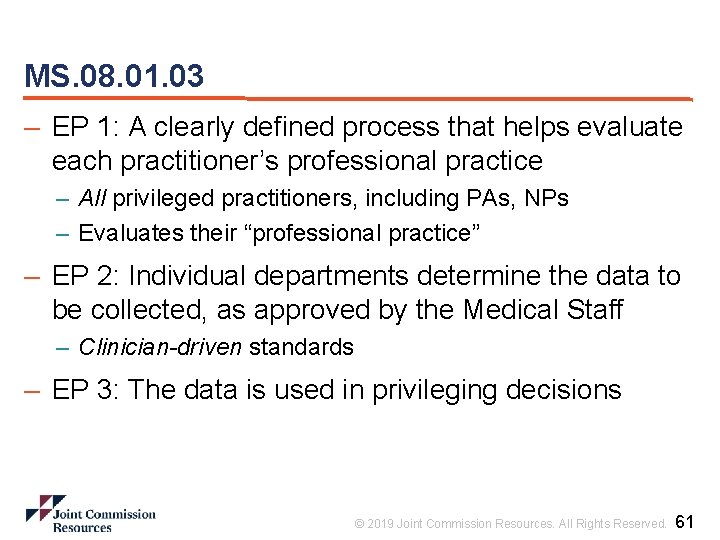
MS. 08. 01. 03 – EP 1: A clearly defined process that helps evaluate each practitioner’s professional practice – All privileged practitioners, including PAs, NPs – Evaluates their “professional practice” – EP 2: Individual departments determine the data to be collected, as approved by the Medical Staff – Clinician-driven standards – EP 3: The data is used in privileging decisions © 2019 Joint Commission Resources. All Rights Reserved. 61
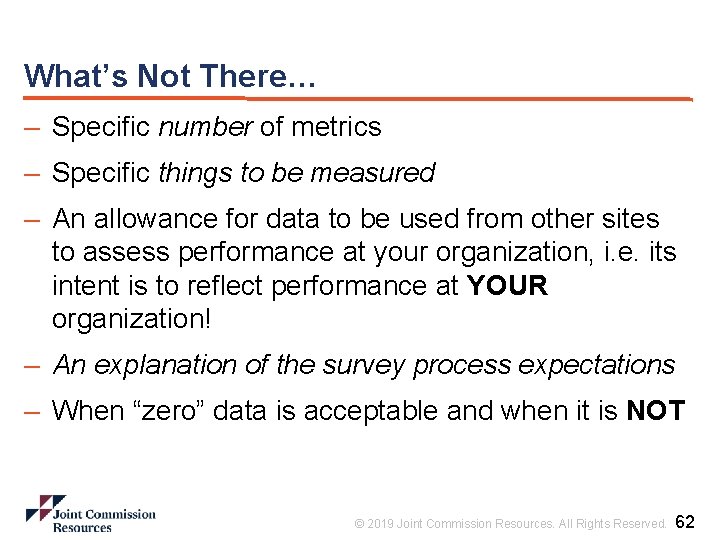
What’s Not There… – Specific number of metrics – Specific things to be measured – An allowance for data to be used from other sites to assess performance at your organization, i. e. its intent is to reflect performance at YOUR organization! – An explanation of the survey process expectations – When “zero” data is acceptable and when it is NOT © 2019 Joint Commission Resources. All Rights Reserved. 62
Essentially… – Who? – When? – What? – How? © 2019 Joint Commission Resources. All Rights Reserved. 63
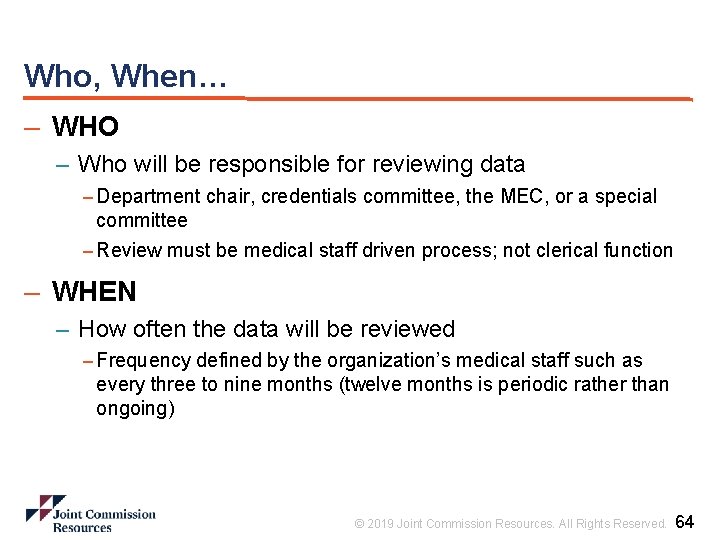
Who, When… – WHO – Who will be responsible for reviewing data – Department chair, credentials committee, the MEC, or a special committee – Review must be medical staff driven process; not clerical function – WHEN – How often the data will be reviewed – Frequency defined by the organization’s medical staff such as every three to nine months (twelve months is periodic rather than ongoing) © 2019 Joint Commission Resources. All Rights Reserved. 64
What… – WHAT – Defined by individual medical staff departments and approved by the organized medical staff – This can be as department-specific as warranted by the organization’s service lines – Departments will know best what type of data will reflect both good and problem performance for the various practitioners in their departments – Data not just negative/outlier/trending data, but also data on good performance © 2019 Joint Commission Resources. All Rights Reserved. 65
– HMMM … I must be forgetting something? © 2019 Joint Commission Resources. All Rights Reserved. 66
HOW? © 2019 Joint Commission Resources. All Rights Reserved. 67
So, OPPE Should Be… – Ongoing (vs. “periodic”) information… – …able to help make privileging decisions… – …for all privileged providers It’s an ongoing assessment of clinical competency – similar to what most of the rest of the healthcare team have been doing for decades © 2019 Joint Commission Resources. All Rights Reserved. 68
“Ongoing” (continued) – Examples of effective “ongoing” assessments: – Promptly assessing all post-op infections against a set of indicators (rather than simply aggregating a year’s worth of post-op infections) – Collecting data on response time for pages in ER, ICU, etc. – Compliance with measures already being collected, i. e. required data sets from The Joint Commission, CMS, DOH, etc. © 2019 Joint Commission Resources. All Rights Reserved. 69
“Ongoing” (continued) HOWEVER, Don’t make the mistake of including every piece of data that is currently being gathered in OPPE. This will dilute the value of the process to the physicians…they need to see the value. So, guide the department chairs to guide their members to choose the data to track that should lead to a measurable improvement in care…that is how you show value to the medical staff and get buy-in. © 2019 Joint Commission Resources. All Rights Reserved. 70
“…able to help make privileging decisions…” – Ideally, measures will be based on “SMART” goals: – – – Specific Measurable Attainable Relevant Turn-Around in care achieved © 2019 Joint Commission Resources. All Rights Reserved. 71
“…for all privileged providers” – Measures will vary by specialty, clinical setting, and aspect to be assessed; must be consistent for all providers holding a privilege – So, it is important to remember…if an employed practitioner holds a privilege for which metrics are being used in OPPE, then an independent practitioner with the same privilege must also be evaluated by the same metric(s) © 2019 Joint Commission Resources. All Rights Reserved. 72
“…for all privileged providers” – So, now, look at the metrics being followed for OPPE. For example, items you may be able to track for all ambulatory practitioners may be: – Acceptance of recommendations from radiologists when test appropriateness is questioned – Response time for critical test results/values – Communication with hospitalists regarding patient care © 2019 Joint Commission Resources. All Rights Reserved. 73
“…for all privileged providers” – In other words, don’t say you are tracking Hgb. A 1 C levels or performance of heart failure education if this data is not available on all LIPs with the same privileges – You may still track any and all of these items for your employed physicians, but they don’t have to be a part of OPPE. © 2019 Joint Commission Resources. All Rights Reserved. 74
“…for all privileged providers” – Remember, you are assessing the ability to perform a privilege, not their choice of employment status. – It is not OK to say to a surveyor, “We can only get the information on our employed doctors” – If this is the issue, then review the medical staff categories and their associated privileges – For example: Do you have a “refer and follow” category with no clinical privileges? © 2019 Joint Commission Resources. All Rights Reserved. 75
(Potential) Barriers to Success – Data Pitfalls – – – Trying to collect data which is too difficult to obtain Attribution Inaccurate data: review signed anyway Too much data Reliance on a program without specifics of its capabilities – Getting buy-in – Seen as “another program/mandate” – Fear of misuse – or even proper use – Can be a tool to lead to self-correction © 2019 Joint Commission Resources. All Rights Reserved. 76
Allied Health Providers – If they have privileges, they’re subject to OPPE (and FPPE) – PAs, NPs, CRNAs, etc. – RN First Assists: CMS expectation is that they are credentialed. – Surgical Techs (non-PA, RN, NP): not necessarily, but if in HR, they need to be evaluated the same whether employed by hospital or doctor – Private physician’s employed RN: Should be under HR. 01. 07. 01, EP 5, not credentialed. If credentialed, need privileges and OPPE © 2019 Joint Commission Resources. All Rights Reserved. 77
Allied Health Providers – If they have a physician counterpart, consider using same indicators if applicable – Neonatologist/Neonatal NP; Anesthesiologist/CRNA – Struggle with obtaining data since often coded under collaborating physician – Should have the allied health providers look at their professional organizations for resources; should have their own committee to determine indicators – It is OK to have them review each other and then up to department chair © 2019 Joint Commission Resources. All Rights Reserved. 78
Focused Professional Practice Evaluation (FPPE) MS. 08. 01 (482. 22 (a)(1)) © 2019 Joint Commission Resources. All Rights Reserved. 79
MS. 08. 01 – EP 1: “A period of focused professional practice evaluation is implemented for all initially requested privileges” – New staff members – Newly requested privileges – EP 2 -9: Essentially “Peer Review” Process © 2019 Joint Commission Resources. All Rights Reserved. 80
MS. 08. 01 – The four required components for design of the process are: – Criteria for conducting performance evaluations, – Method for establishing the monitoring plan specific to the requested privilege, – Method to determining the duration of performance monitoring, and – Circumstances under which monitoring by an external source is required © 2019 Joint Commission Resources. All Rights Reserved. 81
“Initial” FPPE: Guidelines – “Begin with the end in mind” – Trying to validate an assumed level of competence based on application, references, etc. – Integrating a new provider into your culture – Ideally, establish indicators which identify potential problem areas – Clearly define what will be expectations during appointment process and send a copy to practitioner with board letter: ideally send two copies and have them sign one and return to you © 2019 Joint Commission Resources. All Rights Reserved. 82
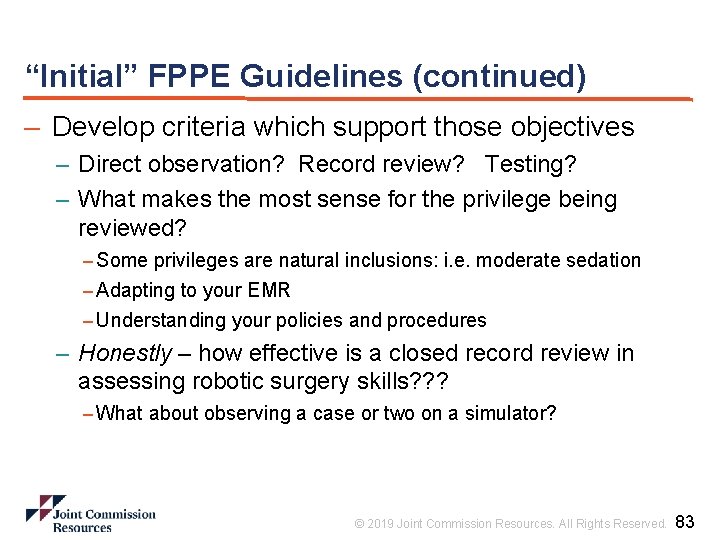
“Initial” FPPE Guidelines (continued) – Develop criteria which support those objectives – Direct observation? Record review? Testing? – What makes the most sense for the privilege being reviewed? – Some privileges are natural inclusions: i. e. moderate sedation – Adapting to your EMR – Understanding your policies and procedures – Honestly – how effective is a closed record review in assessing robotic surgery skills? ? ? – What about observing a case or two on a simulator? © 2019 Joint Commission Resources. All Rights Reserved. 83
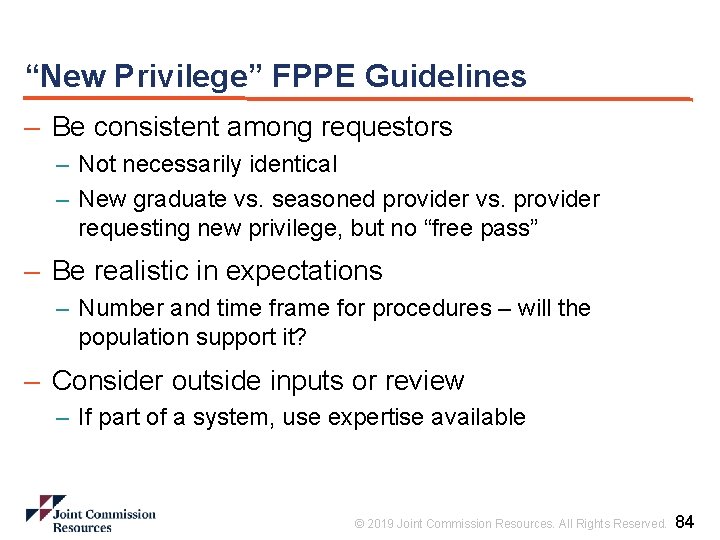
“New Privilege” FPPE Guidelines – Be consistent among requestors – Not necessarily identical – New graduate vs. seasoned provider vs. provider requesting new privilege, but no “free pass” – Be realistic in expectations – Number and time frame for procedures – will the population support it? – Consider outside inputs or review – If part of a system, use expertise available © 2019 Joint Commission Resources. All Rights Reserved. 84
– At what point should your organization “close out” FPPE and just implement a 100% review as OPPE if practitioner comes into facility? – Example: several members in a large practice but only one or two come to your organization © 2019 Joint Commission Resources. All Rights Reserved. 85
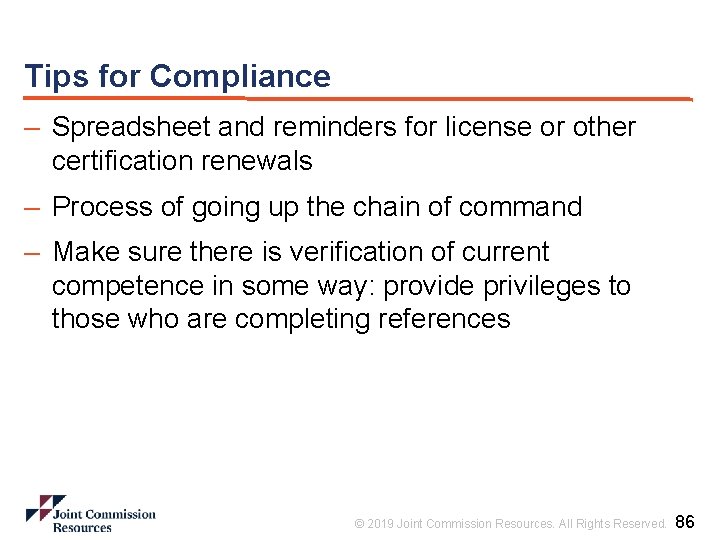
Tips for Compliance – Spreadsheet and reminders for license or other certification renewals – Process of going up the chain of command – Make sure there is verification of current competence in some way: provide privileges to those who are completing references © 2019 Joint Commission Resources. All Rights Reserved. 86
EXAMPLES © 2019 Joint Commission Resources. All Rights Reserved. 87
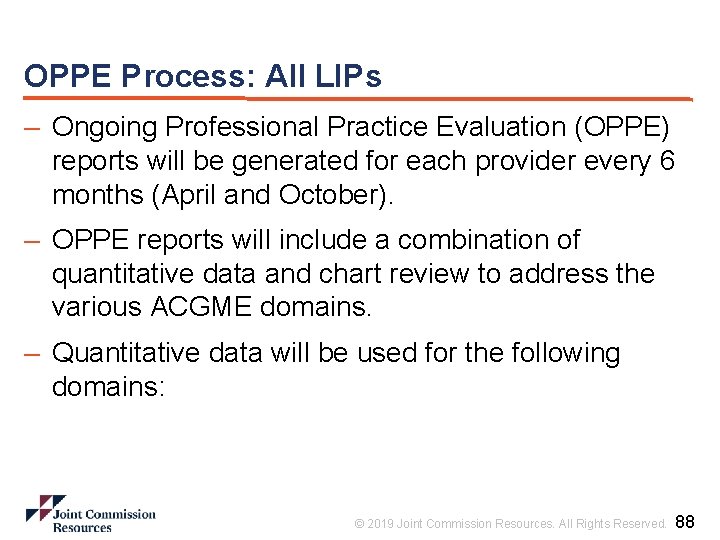
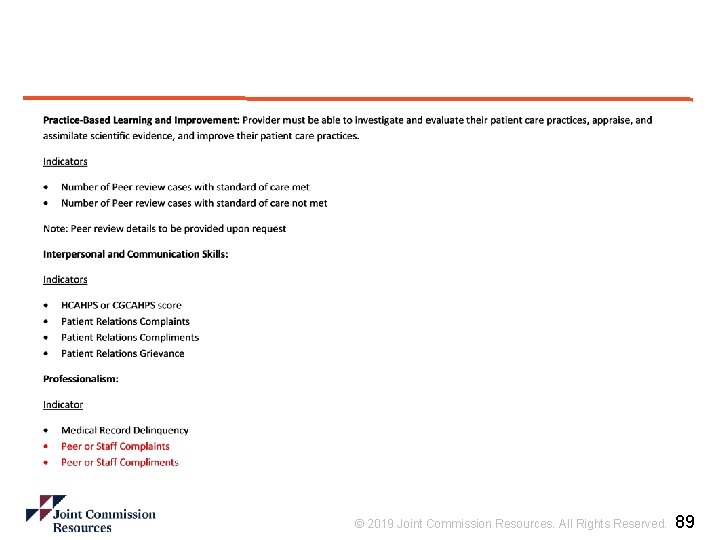
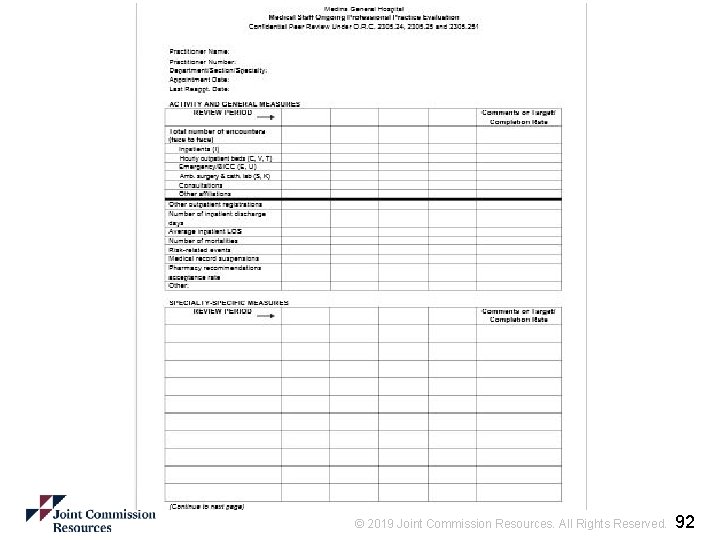
OPPE Process: All LIPs – Ongoing Professional Practice Evaluation (OPPE) reports will be generated for each provider every 6 months (April and October). – OPPE reports will include a combination of quantitative data and chart review to address the various ACGME domains. – Quantitative data will be used for the following domains: © 2019 Joint Commission Resources. All Rights Reserved. 88
© 2019 Joint Commission Resources. All Rights Reserved. 89
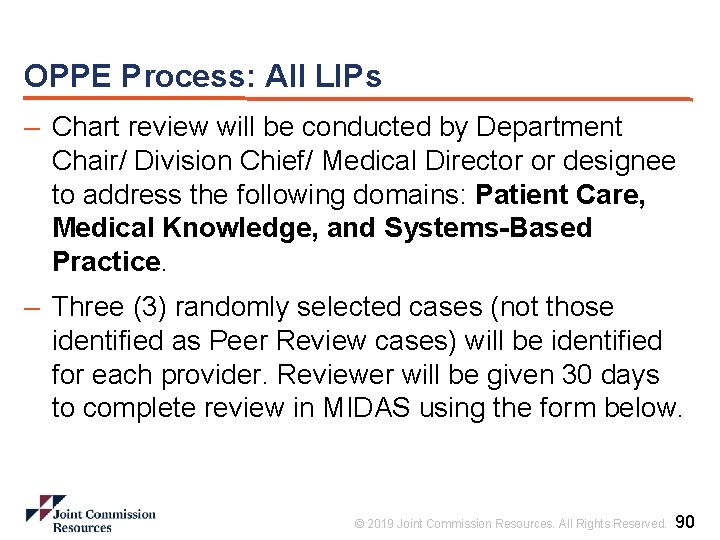
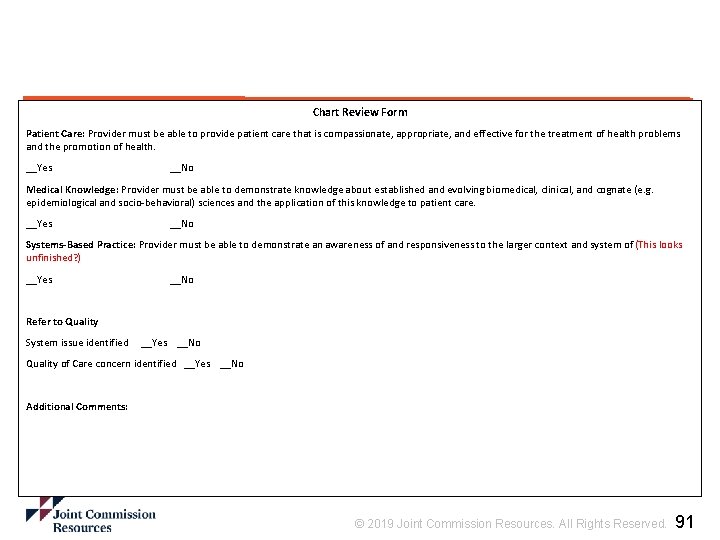
OPPE Process: All LIPs – Chart review will be conducted by Department Chair/ Division Chief/ Medical Director or designee to address the following domains: Patient Care, Medical Knowledge, and Systems-Based Practice. – Three (3) randomly selected cases (not those identified as Peer Review cases) will be identified for each provider. Reviewer will be given 30 days to complete review in MIDAS using the form below. © 2019 Joint Commission Resources. All Rights Reserved. 90
Chart Review Form Patient Care: Provider must be able to provide patient care that is compassionate, appropriate, and effective for the treatment of health problems and the promotion of health. __Yes __No Medical Knowledge: Provider must be able to demonstrate knowledge about established and evolving biomedical, clinical, and cognate (e. g. epidemiological and socio-behavioral) sciences and the application of this knowledge to patient care. __Yes __No Systems-Based Practice: Provider must be able to demonstrate an awareness of and responsiveness to the larger context and system of (This looks unfinished? ) __Yes __No Refer to Quality System issue identified __Yes __No Quality of Care concern identified __Yes __No Additional Comments: © 2019 Joint Commission Resources. All Rights Reserved. 91
© 2019 Joint Commission Resources. All Rights Reserved. 92
© 2019 Joint Commission Resources. All Rights Reserved. 93
Other Standards and Issues to Keep Your On © 2019 Joint Commission Resources. All Rights Reserved. 94
MS. 06. 01. 05, EP 10 – The hospital has a process to determine whethere is sufficient clinical performance information to make a decision to grant, limit, or deny the requested privilege. (482. 22 (a)(1)) © 2019 Joint Commission Resources. All Rights Reserved. 95
Tips for Success – Develop solid criteria and use it as a checklist during the credentialing process. – At the time of reappointment, ensure that you have documentation of the performance of a privilege – Pre-populate the privilege forms with the number of times each privilege has been done and outcomes © 2019 Joint Commission Resources. All Rights Reserved. 96
MS 06. 01, EP 1 – There is a process to determine whether sufficient space, equipment, staffing, and financial resources are in place or available within a specified time frame to support each requested privilege © 2019 Joint Commission Resources. All Rights Reserved. 97
Tips for Success – Review privilege lists regularly within medical staff departments – Keep open lines of communication with directors of departments to get updates if services change © 2019 Joint Commission Resources. All Rights Reserved. 98
Scribes, Documentation Assistants – Definition of scribe – Joint Commission has no position on whether an organization uses scribes or not. – According to Joint Commission and CMS until August 2018, scribes could not enter orders for practitioners; not necessarily the case now – Joint Commission Standards FAQ at: TJC website under “Standards”, “Hospital”, “Record of Care” © 2019 Joint Commission Resources. All Rights Reserved. 99
Radiation Safety – SEA #47: Original Publishing September 2011 – Revision February 2019 to include fluoroscopy – New standards also added © 2019 Joint Commission Resources. All Rights Reserved. 100
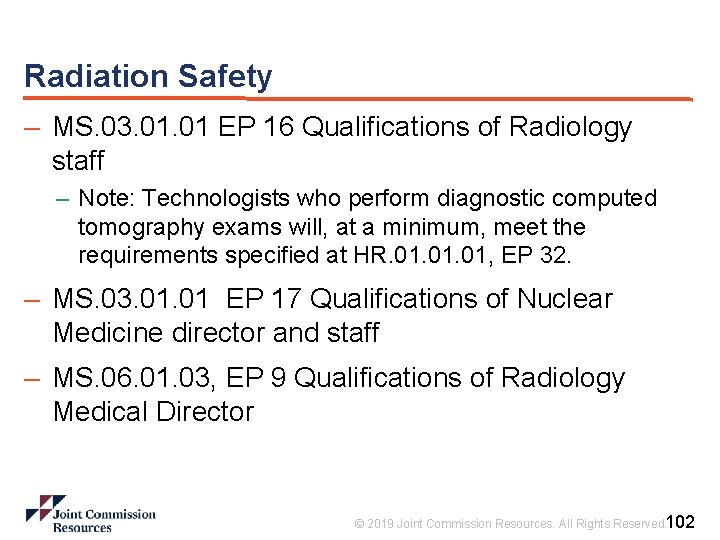
Radiation Safety – LD. 04. 01. 05, EP 25 Radiation Safety Officer Designation – The hospital designates an individual to serve as the radiation safety officer who is responsible for making certain that radiologic services are provided in accordance with law, regulation, and organizational policy. This individual has the necessary authority and leadership support to do the following: – Monitor and verify compliance with established radiation safety practices (including oversight of dosimetry monitoring) – Provide recommendations for improved radiation safety – Intervene as needed to stop unsafe practices – Implement corrective action © 2019 Joint Commission Resources. All Rights Reserved. 101
Radiation Safety – MS. 03. 01 EP 16 Qualifications of Radiology staff – Note: Technologists who perform diagnostic computed tomography exams will, at a minimum, meet the requirements specified at HR. 01. 01, EP 32. – MS. 03. 01 EP 17 Qualifications of Nuclear Medicine director and staff – MS. 06. 01. 03, EP 9 Qualifications of Radiology Medical Director © 2019 Joint Commission Resources. All Rights Reserved. 102
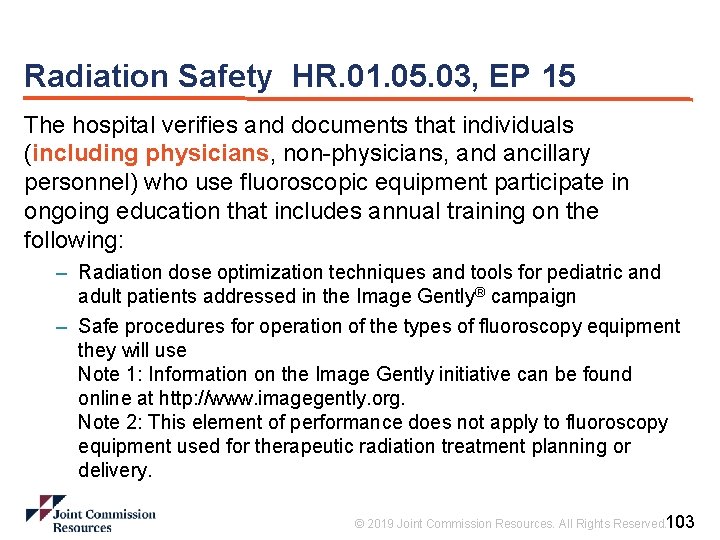
Radiation Safety HR. 01. 05. 03, EP 15 The hospital verifies and documents that individuals (including physicians, non-physicians, and ancillary personnel) who use fluoroscopic equipment participate in ongoing education that includes annual training on the following: – Radiation dose optimization techniques and tools for pediatric and adult patients addressed in the Image Gently® campaign – Safe procedures for operation of the types of fluoroscopy equipment they will use Note 1: Information on the Image Gently initiative can be found online at http: //www. imagegently. org. Note 2: This element of performance does not apply to fluoroscopy equipment used for therapeutic radiation treatment planning or delivery. © 2019 Joint Commission Resources. All Rights Reserved. 103
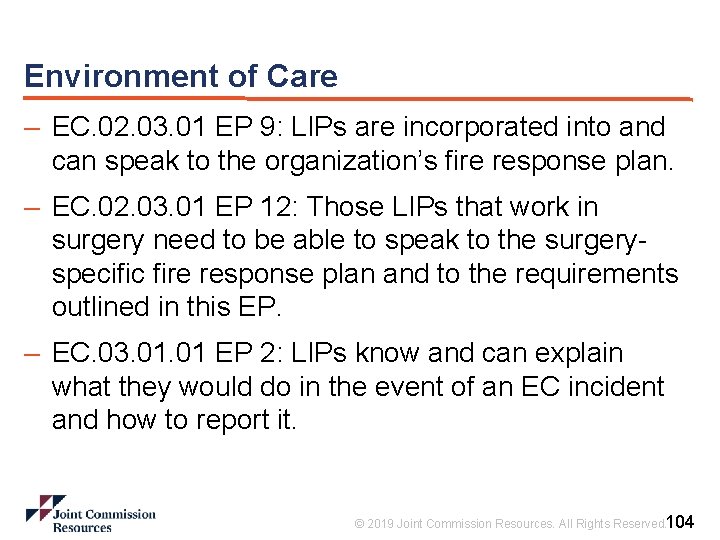
Environment of Care – EC. 02. 03. 01 EP 9: LIPs are incorporated into and can speak to the organization’s fire response plan. – EC. 02. 03. 01 EP 12: Those LIPs that work in surgery need to be able to speak to the surgeryspecific fire response plan and to the requirements outlined in this EP. – EC. 03. 01 EP 2: LIPs know and can explain what they would do in the event of an EC incident and how to report it. © 2019 Joint Commission Resources. All Rights Reserved. 104
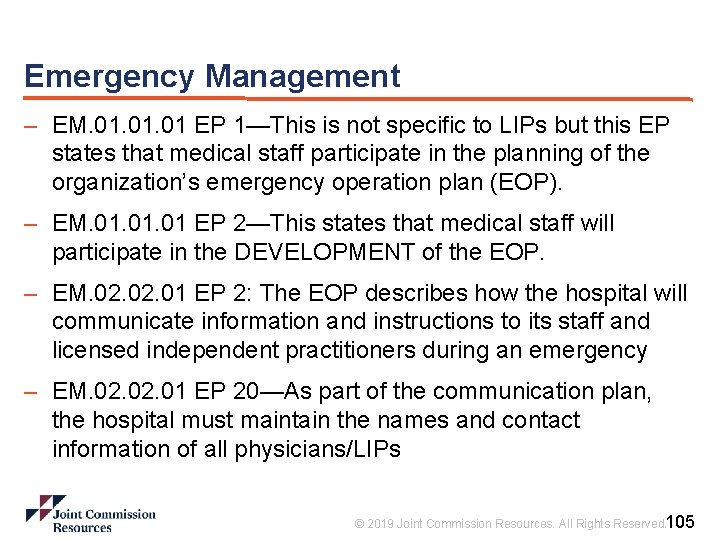
Emergency Management – EM. 01. 01 EP 1—This is not specific to LIPs but this EP states that medical staff participate in the planning of the organization’s emergency operation plan (EOP). – EM. 01. 01 EP 2—This states that medical staff will participate in the DEVELOPMENT of the EOP. – EM. 02. 01 EP 2: The EOP describes how the hospital will communicate information and instructions to its staff and licensed independent practitioners during an emergency – EM. 02. 01 EP 20—As part of the communication plan, the hospital must maintain the names and contact information of all physicians/LIPs © 2019 Joint Commission Resources. All Rights Reserved. 105
Emergency Management – EM. 02. 07 EP 8—The hospital must communicate in writing how it will communicate with each of its LIPs as to their role and who they report to in an emergency – EM. 02. 07 EP 9 –The EOP describes how the hospital will identify LIPs during an emergency – EM. 02. 07 EP 14—EOP describes the integration of state or federally designated health care professionals during an emergency – EM. 02. 13 EP 1—How the hospital grants disaster privileges to volunteer LIPs © 2019 Joint Commission Resources. All Rights Reserved. 106
Emergency Management – EM. 02. 13 EP 2—Medical staff identifies individual(s) responsible for granting disaster privileges to LIPS in its bylaws – EM. 02. 03. 13 EP 3—Hospital determines how to identify volunteer LIPs from other LIPs – EM. 02. 03. 13 EP 4—The hospitals describe how the medical staff oversees performance of LIPs – EM. 02. 03. 13 EP 5—LIP’s license and qualifications are verified – EM. 02. 03. 13 EP 6—During the disaster, medical staff oversees LIPs © 2019 Joint Commission Resources. All Rights Reserved. 107
Emergency Management – EM. 02. 03. 13 EP 7—The hospital determines within 72 hours from the time the LIP arrives if granted privileges should continue. – EM. 02. 03. 13 EP 8—Primary source verification of licensure occurs as soon as the disaster is under control or within 72 hours or EP 9 Under extraordinary circumstances if 72 house is exceeded, it will be as soon as possible – EM. 02. 15 EP 1 -9—Address when hospitals assign disaster responsibilities to volunteer practitioners who are not LIPs. – EM. 03. 01. 03 EP 13—The hospital evaluates all emergency response exercise—which includes LIPs © 2019 Joint Commission Resources. All Rights Reserved. 108
Questions? © 2019 Joint Commission Resources. All Rights Reserved. 109
Contact Information lmccourt@jcrinc. com PH: 216 -409 -4643 © 2019 Joint Commission Resources. All Rights Reserved. 110