
2019 ENGLISH FIRST ADDITIONAL LANGUAGE Welcome Paper 1

- Slides: 20
2019 ENGLISH FIRST ADDITIONAL LANGUAGE Welcome
Paper 1 Comprehension, Summary, Language FAIR PAPER
QUESTION 1: COMPREHENSION § A lack of vocabulary prevented candidates from providing substantial responses in higher order questions. Vocabulary enrichment exercises should be done in class § Learners should read and adhere to instructions- one word responses/ own opinion and text- based responses § Learners must practise writing in their own words Q 1. 1. 2 Using your OWN words explain…(2) Q 1. 5 How did…(2) 3
Comprehension § Explaining a quote in context warrants attention Q 1. 2 What does the writer mean…(2) Mention 2 points and refer to the text • Provide exercises to practise the suitability of titles to texts Q 1. 12 ‘Sole-searching’. (2)Refer to title and then text • Learners must be taught to find the message in visual texts Q 1. 15 Does the text succeed in conveying its message? (2) 4
QUESTION 2: SUMMARY WRITING § Candidates fared well. Thank you § Teach the skill of extracting relevant points and rephrasing them in order to respond to the question Fact 5: “Your toothbrush is often moist and kept in an enclosed storage space”- Store your toothbrush in an open space § Teach learners to guard against quoting § Learners should not follow the format of the marking guidelines, but stick to the given instructions. Only 1 -7 sentences 5
Summary § Encourage the writing and then crossing out of rough drafts § Pay attention to sentence structure do not write phrases § Stick to the required length, after 70 words facts are not marked. § Practise and practise and more practise. 6
QUESTION 3: ANALYSING AN ADVERTISEMENT § Performance in this question was average. § Learners should be taught to interpret visual clues to determine purpose and intention Q 3. 2 Why has the advertiser included…(1) § Teach learners about figurative language and poetic devices to create impact § Visual design and layout Q 3. 3. 2 How do the visual aspects…(3) 7
Advertising § Advertising skills should be taught Q 3. 5 Does this advertisement convince…(2) Give learners more practise 8
QUESTION 4: ANALYSING A CARTOON § Below-average performance from learners. American text with poor interpretation § More visual texts should be studied § Teach visual techniques of body language and facial expressions to convey feelings Q 4. 1. 2 Give TWO reasons why you say the facial expression indicates…(2) § Practise the identification of and then the explanation of the effect of verbal and visual clues Q 4. 2 Why is the word written in bold font. . (1) Q 4. 3. 1 How does the cartoonist use a verbal clue…(2) 9
Cartoon § Finding the imbedded message and teaching the necessary vocabulary to explain their responses is crucial Q 4. 4 Do you think this cartoon is humorous … (2) § Learners should be taught to identify humour, pun and irony in a cartoon Learners should analyze questions and refer to the mark allocation 10
QUESTION 5: LANGUAGE & EDITING SKILLS § Average to poor performance § Learners do not know basic language structures: § Active and Passive Q 5. 1. 3 Rewrite in ACTIVE voice (1) § Question tags Q 5. 1. 5 Complete the tag question(1) § Tenses Q 5. 2. 1 Rewrite in the present continuous tense 11
Language § Reported Speech Q 5. 1. 7 Rewrite in reported speech…(4) Pattern: 3 for changes 1 for punctuation Learners struggled with the verb changes § Parts of Speech Q 5. 11 d Correct the error…(1) Q 5. 2. 2 State the part of speech…(2) § Negatives Q 5. 2. 5 Rewrite…in the negative form. (1) 12
Language Learners must be provided with a number of exercises to hone their skill, especially with the identification of errors. Q 5. 1. 1 (4) § Previous exam papers should be used for revision 13
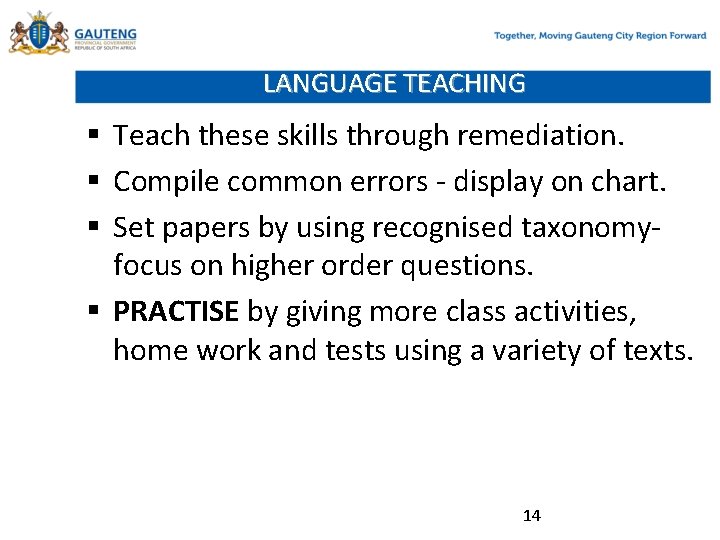
LANGUAGE TEACHING § Teach these skills through remediation. § Compile common errors - display on chart. § Set papers by using recognised taxonomyfocus on higher order questions. § PRACTISE by giving more class activities, home work and tests using a variety of texts. 14
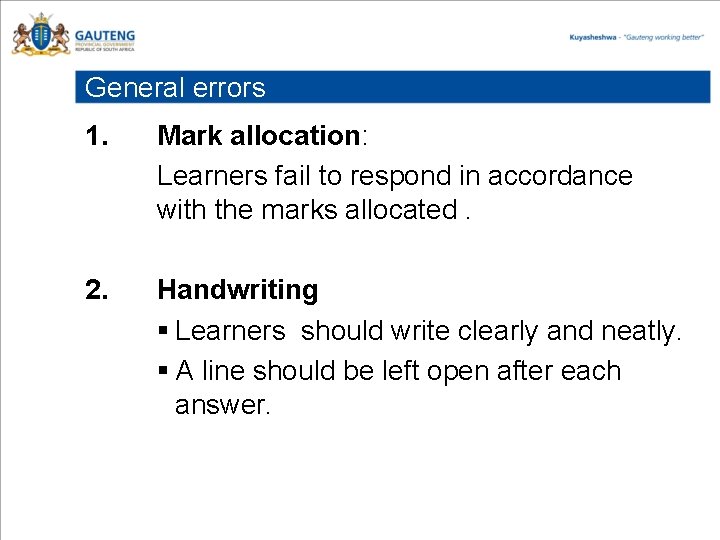
General errors 1. Mark allocation: Learners fail to respond in accordance with the marks allocated. 2. Handwriting § Learners should write clearly and neatly. § A line should be left open after each answer.
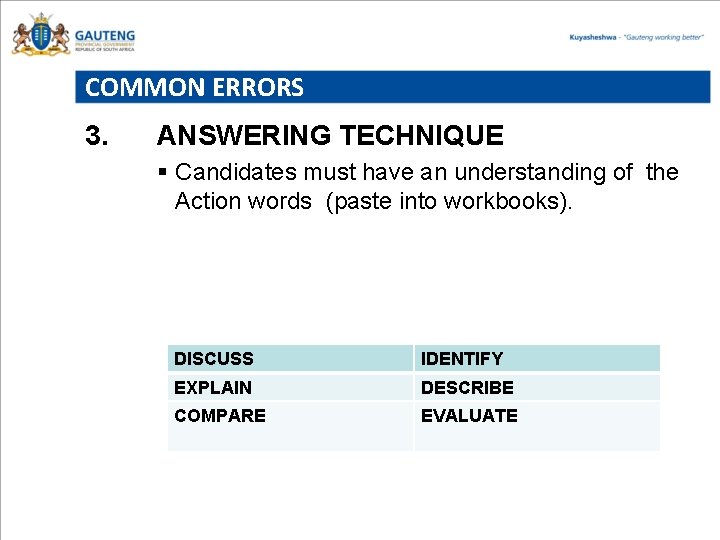
COMMON ERRORS 3. ANSWERING TECHNIQUE § Candidates must have an understanding of the Action words (paste into workbooks). DISCUSS IDENTIFY EXPLAIN DESCRIBE COMPARE EVALUATE
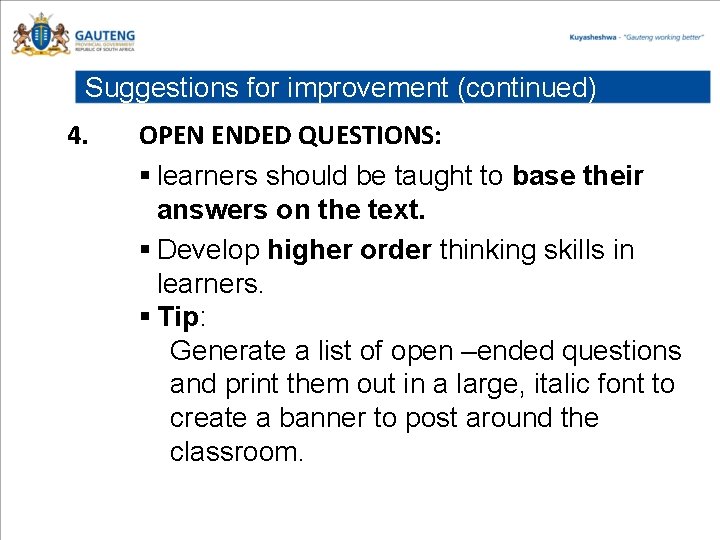
Suggestions for improvement (continued) 4. OPEN ENDED QUESTIONS: § learners should be taught to base their answers on the text. § Develop higher order thinking skills in learners. § Tip: Generate a list of open –ended questions and print them out in a large, italic font to create a banner to post around the classroom.
OPEN ENDED QUESTIONS (Continued) § Make asking open-ended questions a regular part of your teaching practice. § Check SPOT ON Grade 10 page 30 for suggestions on this aspect. § Yes and No answers: No, should be followed by a statement in the negative and likewise, Yes, should be followed by a statement in the affirmative:
PAST PAPERS • Past question papers are an excellent resource for short tests to only be used after you have taught the book. NB : DO NOT USE FOR SBA • Learners not to memorise answers from the memoranda of past papers.
THANK YOU & GOOD LUCK Teach, Teach 20