
2019 EDITION v 1 0 BASIC PRINCIPLES AND
2019 EDITION – v 1. 0 BASIC PRINCIPLES AND PRACTICES OF PROPANE MODULE 3 Sources and Physical Properties of Propane
2019 EDITION – v 1. 0 BASIC PRINCIPLES AND PRACTICES OF PROPANE Introduction After completing this module, you will be able to: § Identify the sources of Liquefied Petroleum gases (LP -gases) § Name the primary LP-gases and their characteristics § Identify differences between propane and other LPgases § Recognize the specific gravity of propane liquid and vapor § Identify the effects of pressure and temperature on propane LESSON 1 2
2019 EDITION – v 1. 0 BASIC PRINCIPLES AND PRACTICES OF PROPANE LESSON 1 Sources and Characteristics of LP-Gases 3
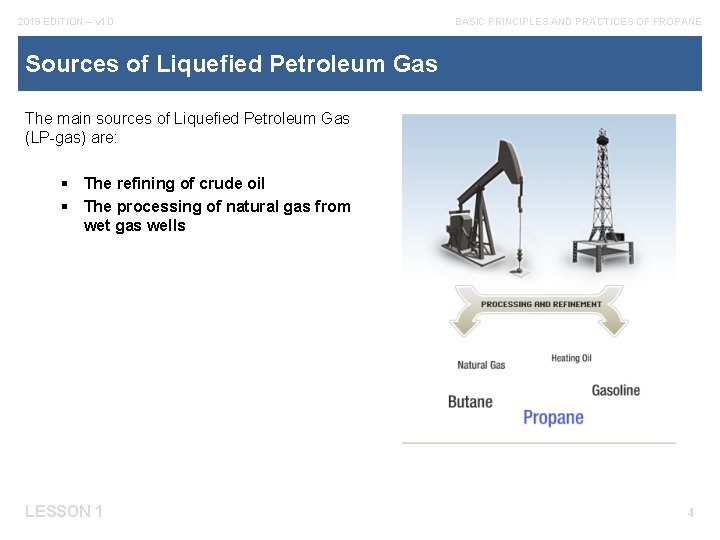
2019 EDITION – v 1. 0 BASIC PRINCIPLES AND PRACTICES OF PROPANE Sources of Liquefied Petroleum Gas The main sources of Liquefied Petroleum Gas (LP-gas) are: § The refining of crude oil § The processing of natural gas from wet gas wells LESSON 1 4
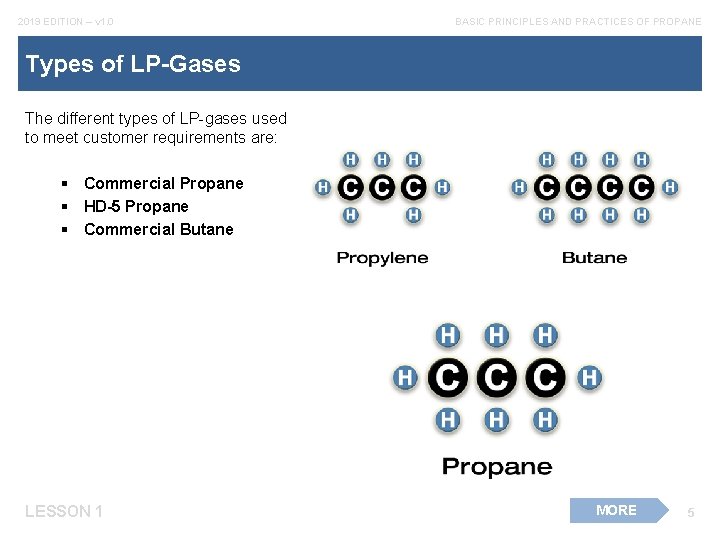
2019 EDITION – v 1. 0 BASIC PRINCIPLES AND PRACTICES OF PROPANE Types of LP-Gases The different types of LP-gases used to meet customer requirements are: § Commercial Propane § HD-5 Propane § Commercial Butane LESSON 1 MORE 5
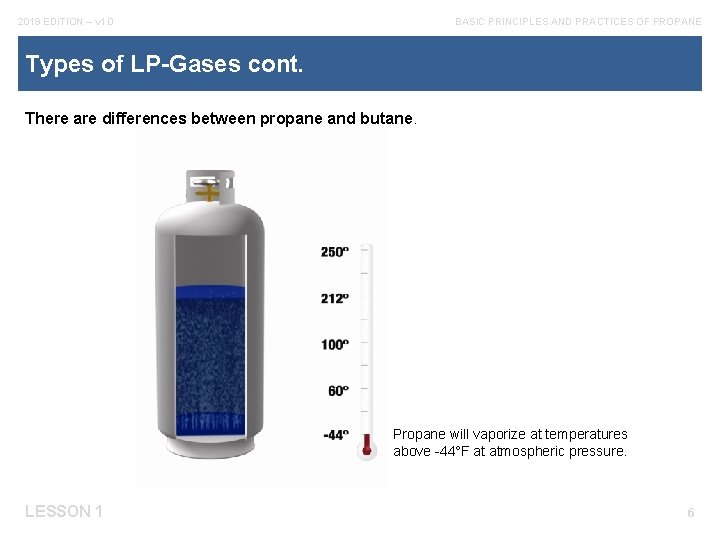
2019 EDITION – v 1. 0 BASIC PRINCIPLES AND PRACTICES OF PROPANE Types of LP-Gases cont. There are differences between propane and butane. Propane will vaporize at temperatures above -44°F at atmospheric pressure. LESSON 1 6
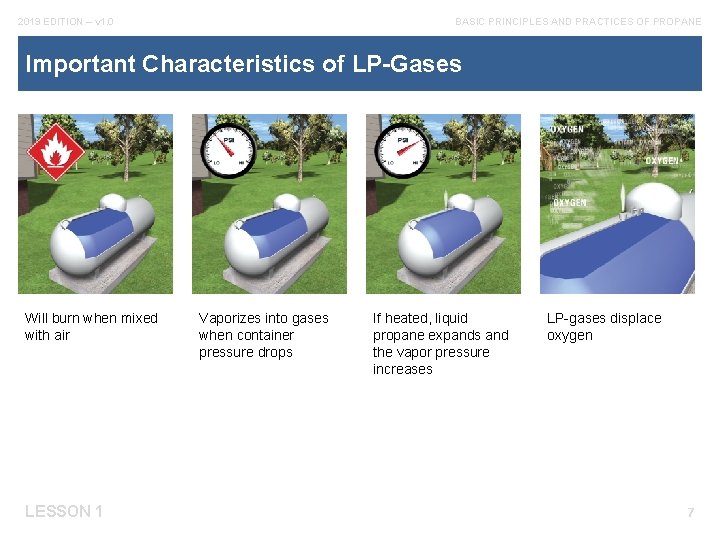
2019 EDITION – v 1. 0 BASIC PRINCIPLES AND PRACTICES OF PROPANE Important Characteristics of LP-Gases Will burn when mixed with air LESSON 1 Vaporizes into gases when container pressure drops If heated, liquid propane expands and the vapor pressure increases LP-gases displace oxygen 7
2019 EDITION – v 1. 0 BASIC PRINCIPLES AND PRACTICES OF PROPANE LESSON 2 Physical Properties of Propane 8
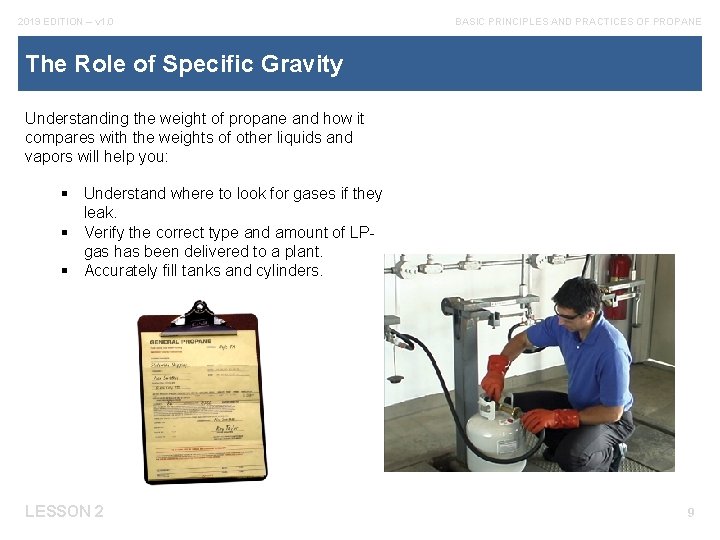
2019 EDITION – v 1. 0 BASIC PRINCIPLES AND PRACTICES OF PROPANE The Role of Specific Gravity Understanding the weight of propane and how it compares with the weights of other liquids and vapors will help you: § Understand where to look for gases if they leak. § Verify the correct type and amount of LPgas has been delivered to a plant. § Accurately fill tanks and cylinders. LESSON 2 9
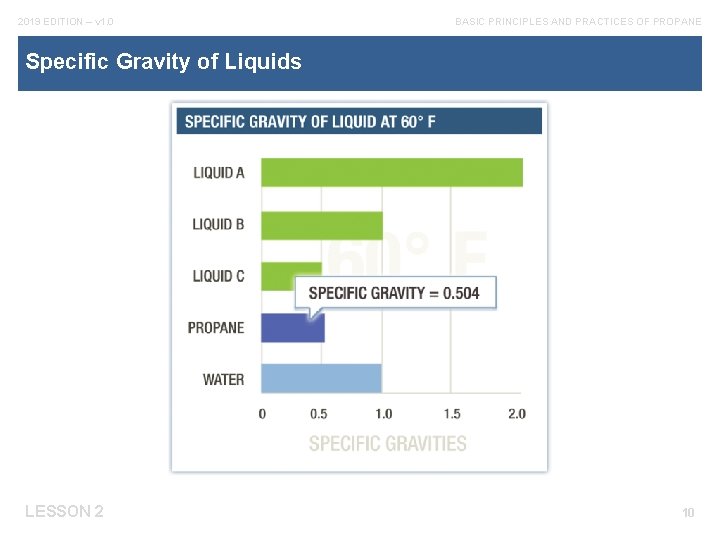
2019 EDITION – v 1. 0 BASIC PRINCIPLES AND PRACTICES OF PROPANE Specific Gravity of Liquids LESSON 2 10
2019 EDITION – v 1. 0 BASIC PRINCIPLES AND PRACTICES OF PROPANE Learning Activity: Specific Gravity of Liquid LESSON 2

2019 EDITION – v 1. 0 BASIC PRINCIPLES AND PRACTICES OF PROPANE Specific Gravity of Vapors LESSON 2 MORE 12

2019 EDITION – v 1. 0 BASIC PRINCIPLES AND PRACTICES OF PROPANE Specific Gravity of Vapors cont. § If the specific gravity of a vapor at 60°F is 1. 0, then a given volume of that vapor at 60°F weighs the same as the same volume of air at 60°F. § If the specific gravity of a vapor at 60°F is. 5, then a given volume of that vapor at 60°F weighs half as much as the same volume of air at 60°F. Commercial propane vapor has a specific gravity of 1. 50 at 60°F. This means that propane vapor weighs 1½ times the weight of air at 60°F. LESSON 2 13
2019 EDITION – v 1. 0 BASIC PRINCIPLES AND PRACTICES OF PROPANE Learning Activity: Specific Gravity of Vapor LESSON 2
2019 EDITION – v 1. 0 BASIC PRINCIPLES AND PRACTICES OF PROPANE Check for Understanding CHECK FOR UNDERSTANDING: SOURCES AND PHYSICAL PROPERTIES OF PROPANE LESSON 2
2019 EDITION – v 1. 0 Questions? LESSON 2 BASIC PRINCIPLES AND PRACTICES OF PROPANE
2019 EDITION – v 1. 0 BASIC PRINCIPLES AND PRACTICES OF PROPANE LESSON 3 Effects of Pressure and Temperature on Propane 17
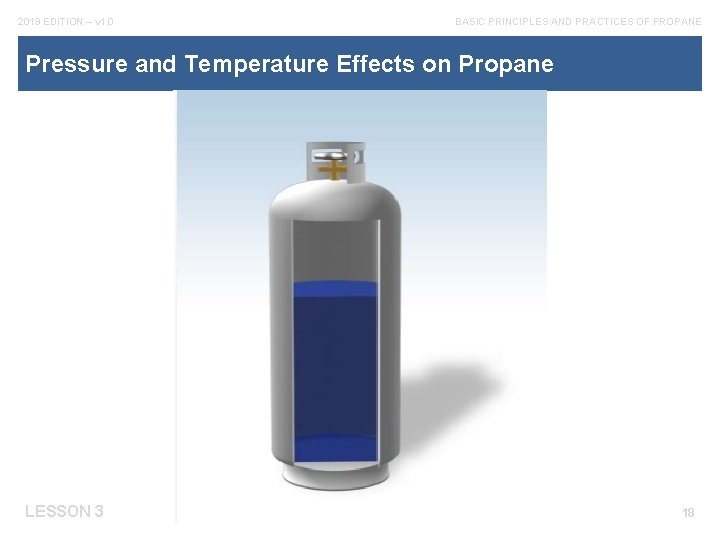
2019 EDITION – v 1. 0 BASIC PRINCIPLES AND PRACTICES OF PROPANE Pressure and Temperature Effects on Propane LESSON 3 18
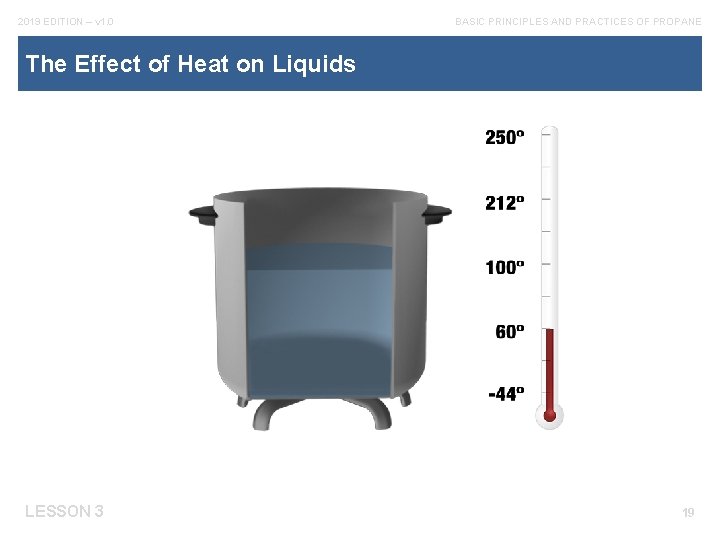
2019 EDITION – v 1. 0 BASIC PRINCIPLES AND PRACTICES OF PROPANE The Effect of Heat on Liquids LESSON 3 19
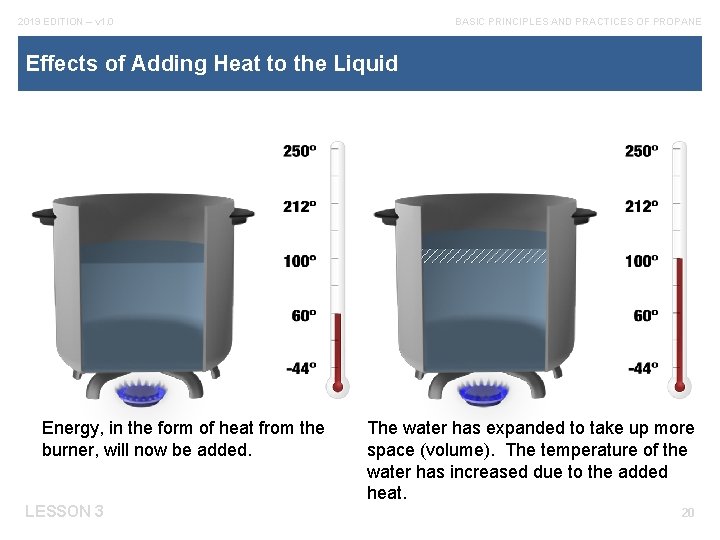
2019 EDITION – v 1. 0 BASIC PRINCIPLES AND PRACTICES OF PROPANE Effects of Adding Heat to the Liquid Energy, in the form of heat from the burner, will now be added. LESSON 3 The water has expanded to take up more space (volume). The temperature of the water has increased due to the added heat. 20
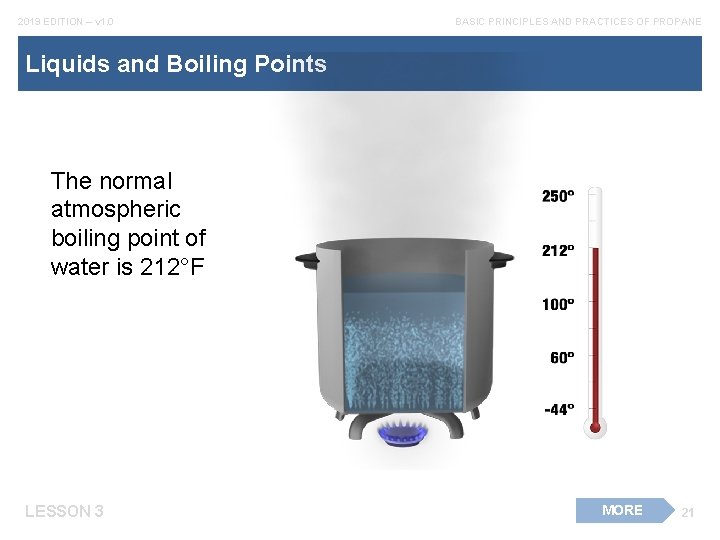
2019 EDITION – v 1. 0 BASIC PRINCIPLES AND PRACTICES OF PROPANE Liquids and Boiling Points The normal atmospheric boiling point of water is 212°F LESSON 3 MORE 21
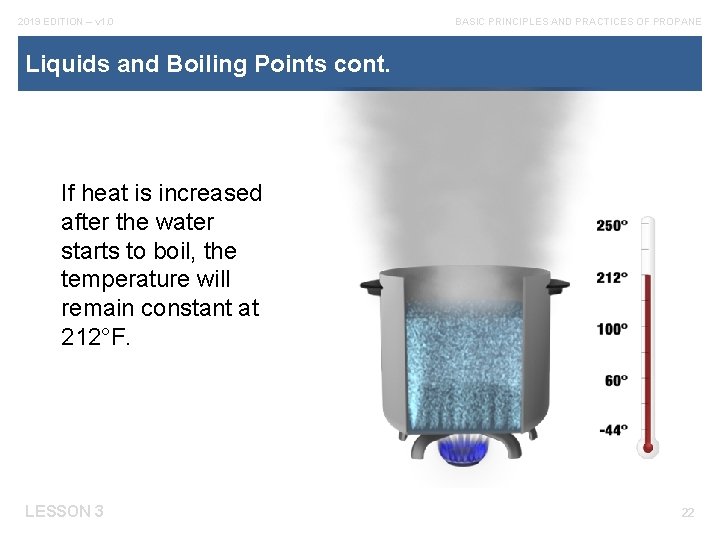
2019 EDITION – v 1. 0 BASIC PRINCIPLES AND PRACTICES OF PROPANE Liquids and Boiling Points cont. If heat is increased after the water starts to boil, the temperature will remain constant at 212°F. LESSON 3 22
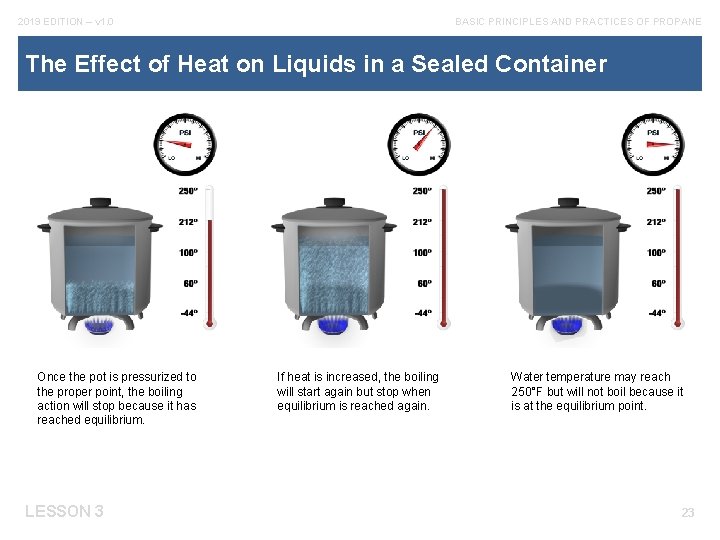
2019 EDITION – v 1. 0 BASIC PRINCIPLES AND PRACTICES OF PROPANE The Effect of Heat on Liquids in a Sealed Container Once the pot is pressurized to the proper point, the boiling action will stop because it has reached equilibrium. LESSON 3 If heat is increased, the boiling will start again but stop when equilibrium is reached again. Water temperature may reach 250°F but will not boil because it is at the equilibrium point. 23
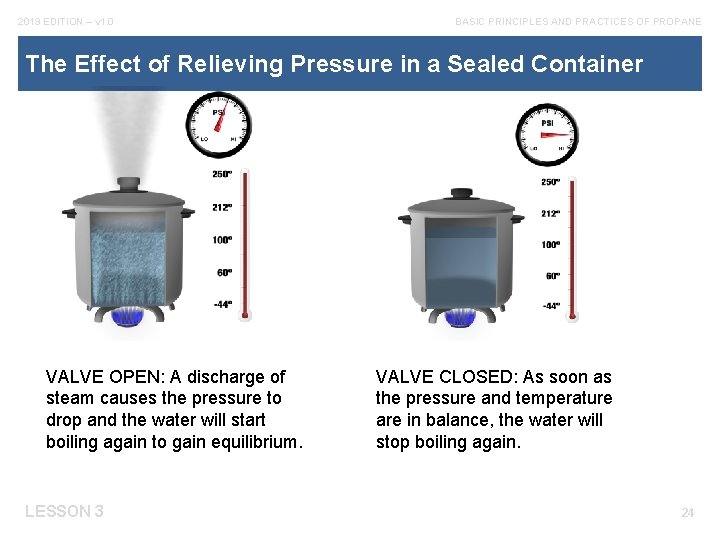
2019 EDITION – v 1. 0 BASIC PRINCIPLES AND PRACTICES OF PROPANE The Effect of Relieving Pressure in a Sealed Container VALVE OPEN: A discharge of steam causes the pressure to drop and the water will start boiling again to gain equilibrium. LESSON 3 VALVE CLOSED: As soon as the pressure and temperature are in balance, the water will stop boiling again. 24
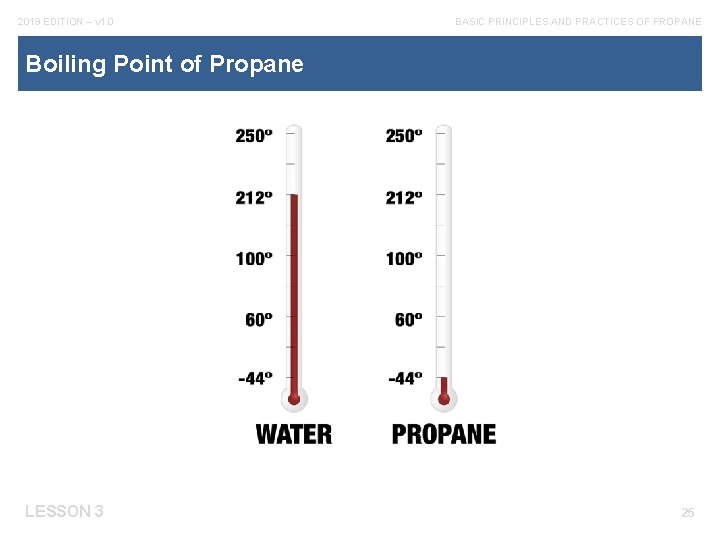
2019 EDITION – v 1. 0 BASIC PRINCIPLES AND PRACTICES OF PROPANE Boiling Point of Propane LESSON 3 25
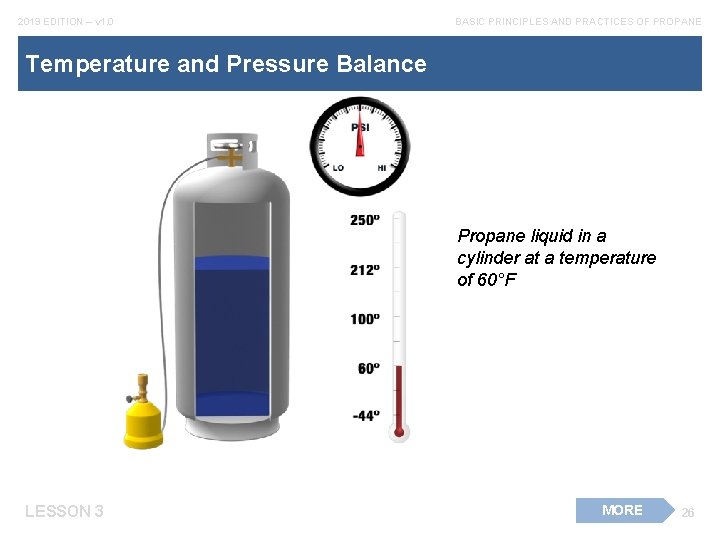
2019 EDITION – v 1. 0 BASIC PRINCIPLES AND PRACTICES OF PROPANE Temperature and Pressure Balance Propane liquid in a cylinder at a temperature of 60°F LESSON 3 MORE 26
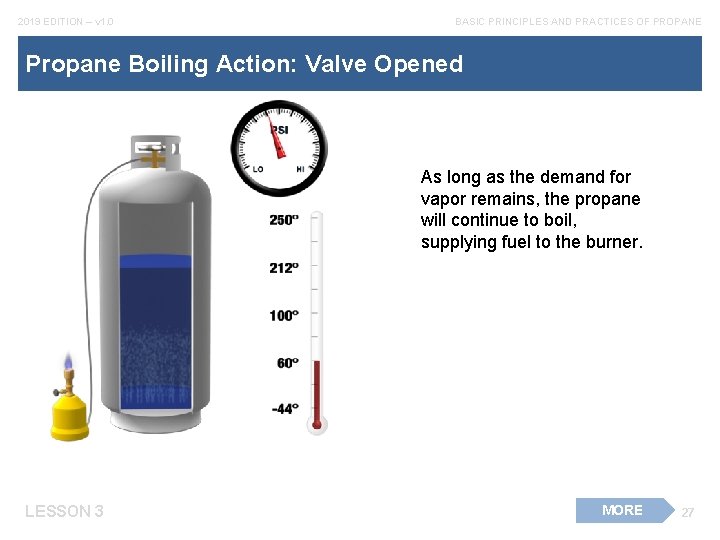
2019 EDITION – v 1. 0 BASIC PRINCIPLES AND PRACTICES OF PROPANE Propane Boiling Action: Valve Opened As long as the demand for vapor remains, the propane will continue to boil, supplying fuel to the burner. LESSON 3 MORE 27
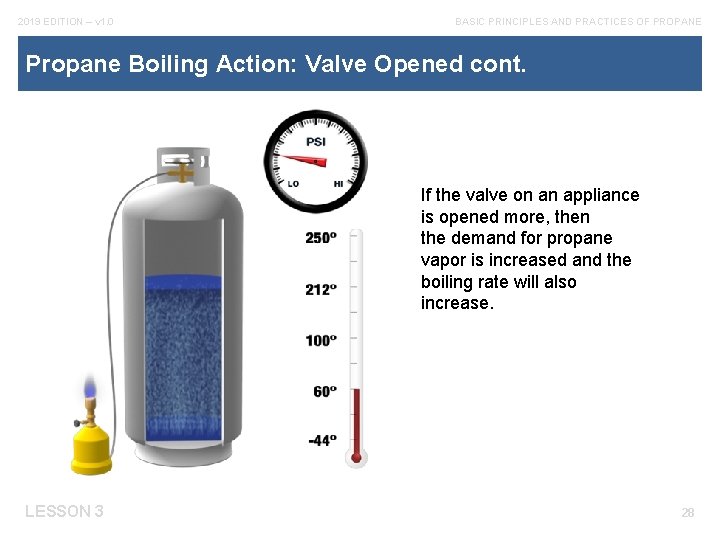
2019 EDITION – v 1. 0 BASIC PRINCIPLES AND PRACTICES OF PROPANE Propane Boiling Action: Valve Opened cont. If the valve on an appliance is opened more, then the demand for propane vapor is increased and the boiling rate will also increase. LESSON 3 28
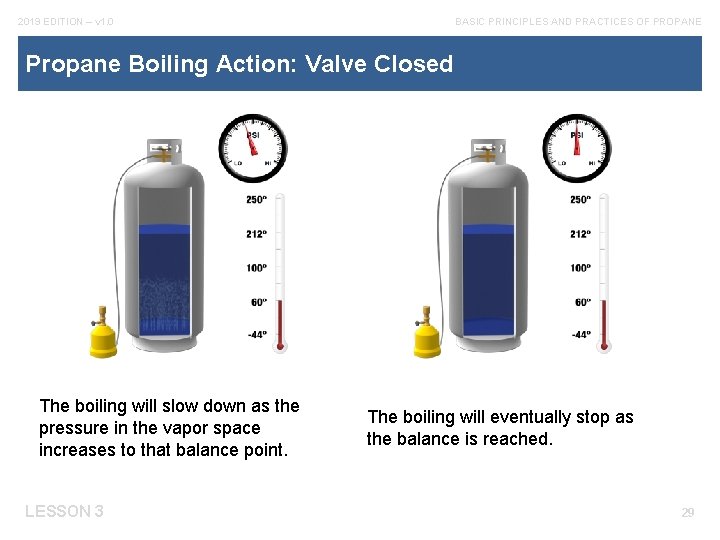
2019 EDITION – v 1. 0 BASIC PRINCIPLES AND PRACTICES OF PROPANE Propane Boiling Action: Valve Closed The boiling will slow down as the pressure in the vapor space increases to that balance point. LESSON 3 The boiling will eventually stop as the balance is reached. 29
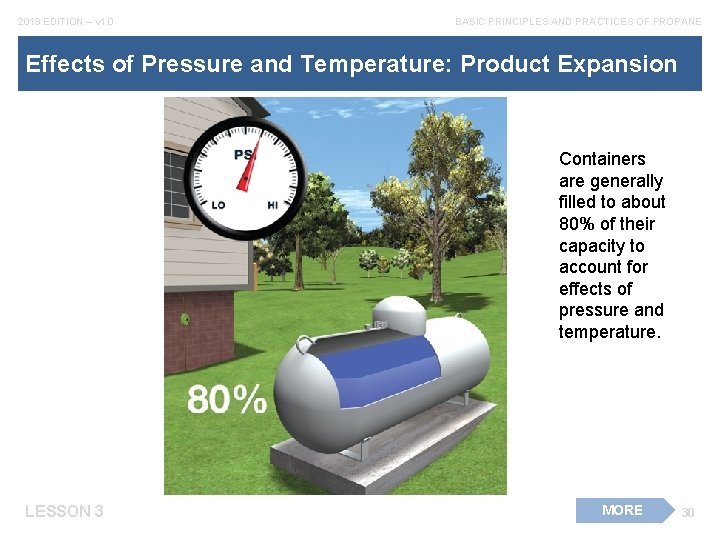
2019 EDITION – v 1. 0 BASIC PRINCIPLES AND PRACTICES OF PROPANE Effects of Pressure and Temperature: Product Expansion Containers are generally filled to about 80% of their capacity to account for effects of pressure and temperature. LESSON 3 MORE 30
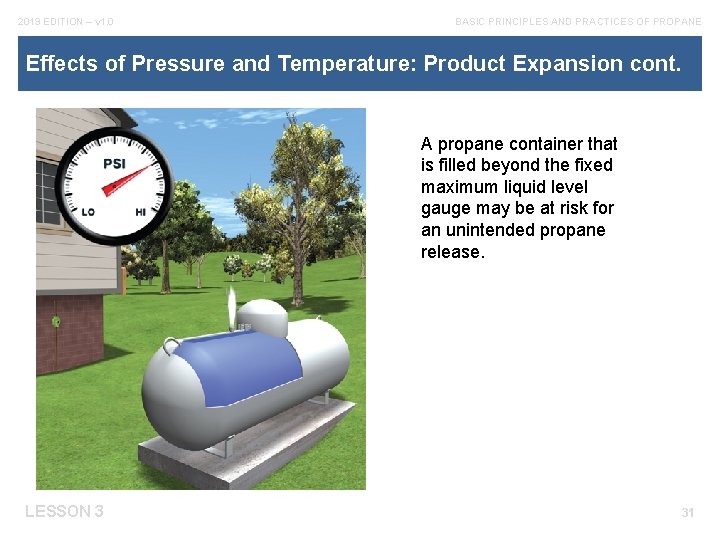
2019 EDITION – v 1. 0 BASIC PRINCIPLES AND PRACTICES OF PROPANE Effects of Pressure and Temperature: Product Expansion cont. A propane container that is filled beyond the fixed maximum liquid level gauge may be at risk for an unintended propane release. LESSON 3 31
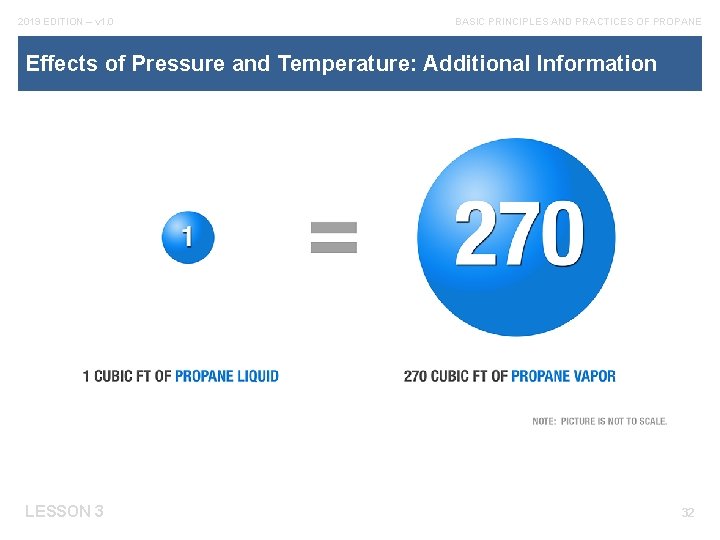
2019 EDITION – v 1. 0 BASIC PRINCIPLES AND PRACTICES OF PROPANE Effects of Pressure and Temperature: Additional Information LESSON 3 32
2019 EDITION – v 1. 0 BASIC PRINCIPLES AND PRACTICES OF PROPANE Summary Some important points to remember from the module are: § The main source of Liquefied Petroleum Gas (LP-gas) is the refining of crude oil. § A basic understanding of propane’s physical characteristics will help you in several ways § Propane will vaporize at temperatures above -44°F at atmospheric pressure. § One of the most common ways to calculate and compare the weights of liquids and vapors is to use a value called specific gravity. § When water and propane liquid are exposed to the same temperature increase, propane expands in volume nearly 17 times greater than water. LESSON 3 33
2019 EDITION – v 1. 0 Questions? LESSON 3 BASIC PRINCIPLES AND PRACTICES OF PROPANE
2019 EDITION – v 1. 0 BASIC PRINCIPLES AND PRACTICES OF PROPANE Module 3 Quiz MODULE 3 QUIZ
2019 EDITION – v 1. 0 BASIC PRINCIPLES AND PRACTICES OF PROPANE Module 3 Quiz 1. The main sources of Liquefied Petroleum Gas (LP-gas) are from the processing of natural gas from wet gas wells and _____. a. The refining of crude oil b. Commercial propane plants c. Vapor wells d. Butane wells MODULE 3 QUIZ 36
2019 EDITION – v 1. 0 BASIC PRINCIPLES AND PRACTICES OF PROPANE Module 3 Quiz 2. Once refined, there is little difference between LP-gases processed from wet gas wells and those processed from crude oil wells. a. True b. False MODULE 3 QUIZ 37
2019 EDITION – v 1. 0 BASIC PRINCIPLES AND PRACTICES OF PROPANE Module 3 Quiz 3. Which of the following is characteristic of LP-gases? a. They are tasteless, colorless, and have a pungent smell. b. When mixed with the proper proportions of water, they can burn. c. LP-gases are stored and transported as gases under pressure. d. When liquid LP-gases are released to atmospheric pressure in moderate outdoor temperatures, they readily vaporize and expand. MODULE 3 QUIZ 38
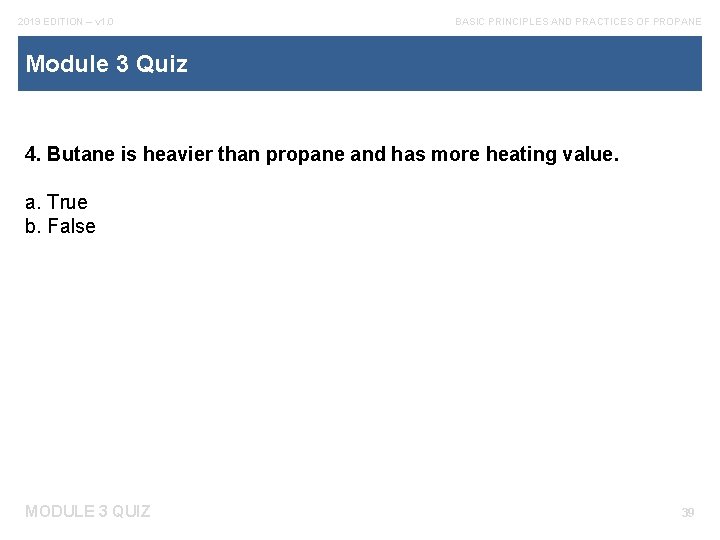
2019 EDITION – v 1. 0 BASIC PRINCIPLES AND PRACTICES OF PROPANE Module 3 Quiz 4. Butane is heavier than propane and has more heating value. a. True b. False MODULE 3 QUIZ 39
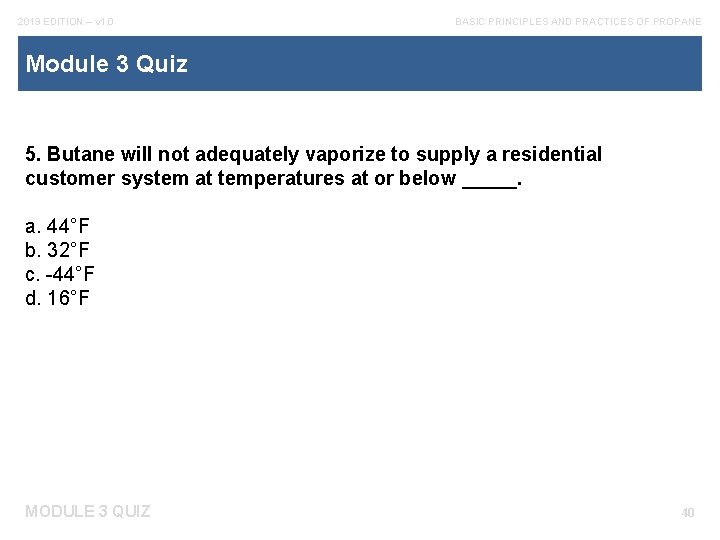
2019 EDITION – v 1. 0 BASIC PRINCIPLES AND PRACTICES OF PROPANE Module 3 Quiz 5. Butane will not adequately vaporize to supply a residential customer system at temperatures at or below _____. a. 44°F b. 32°F c. -44°F d. 16°F MODULE 3 QUIZ 40
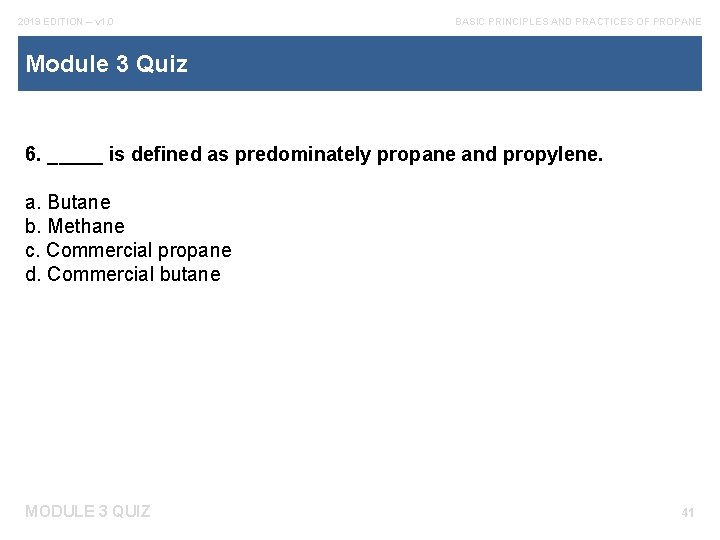
2019 EDITION – v 1. 0 BASIC PRINCIPLES AND PRACTICES OF PROPANE Module 3 Quiz 6. _____ is defined as predominately propane and propylene. a. Butane b. Methane c. Commercial propane d. Commercial butane MODULE 3 QUIZ 41
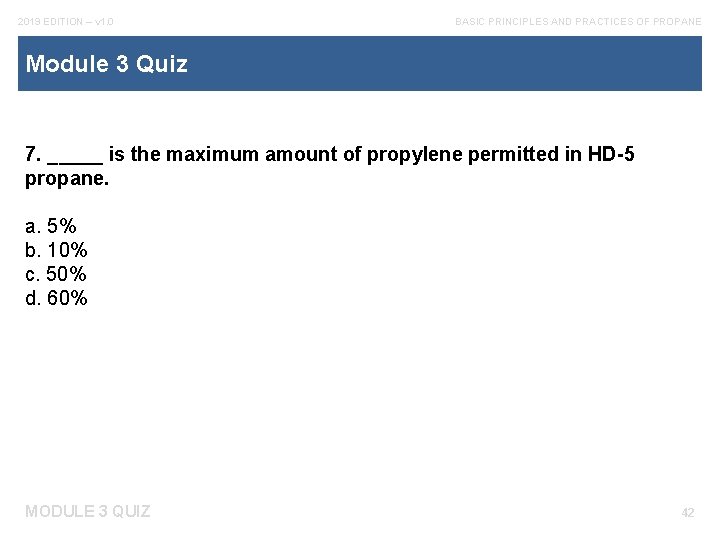
2019 EDITION – v 1. 0 BASIC PRINCIPLES AND PRACTICES OF PROPANE Module 3 Quiz 7. _____ is the maximum amount of propylene permitted in HD-5 propane. a. 5% b. 10% c. 50% d. 60% MODULE 3 QUIZ 42
2019 EDITION – v 1. 0 BASIC PRINCIPLES AND PRACTICES OF PROPANE Module 3 Quiz 8. A Safety Data Sheet contains information such as the chemical’s physical properties, hazards identification, and first aid measures. a. True b. False MODULE 3 QUIZ 43
2019 EDITION – v 1. 0 BASIC PRINCIPLES AND PRACTICES OF PROPANE Module 3 Quiz 9. The specific gravity of propane liquid is approximately _____ at 60°F. a. 0. 504 b. 2 c. 1. 15 d. 970 MODULE 3 QUIZ 44
2019 EDITION – v 1. 0 BASIC PRINCIPLES AND PRACTICES OF PROPANE Module 3 Quiz 10. The specific gravity of propane vapor is _____. a. 0. 504 b. 2 c. 1. 50 d. 970 MODULE 3 QUIZ 45
2019 EDITION – v 1. 0 BASIC PRINCIPLES AND PRACTICES OF PROPANE Module 3 Quiz 11. Understanding the weight of liquid propane as compared with the weight of water will help employees _____. a. Determine the amount of odorant to add to the propane b. Accurately fill cylinders c. Identify the cause of a gas leak d. Find to which plants the LP-gas was delivered MODULE 3 QUIZ 46
2019 EDITION – v 1. 0 BASIC PRINCIPLES AND PRACTICES OF PROPANE Module 3 Quiz 12. A hazardous material with a liquid specific gravity of 0. 618 is _____ than propane. a. Equal to b. Heavier c. Lighter d. Cleaner MODULE 3 QUIZ 47
2019 EDITION – v 1. 0 BASIC PRINCIPLES AND PRACTICES OF PROPANE Module 3 Quiz 13. A hazardous material with a vapor specific gravity of 1. 35 is _____ than propane. a. Equal to b. Heavier c. Lighter d. Cleaner MODULE 3 QUIZ 48
2019 EDITION – v 1. 0 BASIC PRINCIPLES AND PRACTICES OF PROPANE Module 3 Quiz 14. Every propane container must be equipped with at least _____ pressure relief valve(s). a. 1 b. 2 c. 3 d. 4 MODULE 3 QUIZ 49
2019 EDITION – v 1. 0 BASIC PRINCIPLES AND PRACTICES OF PROPANE Module 3 Quiz 15. The normal atmospheric boiling point of propane liquid is _____. a. 44°F b. 32°F c. -44°F d. 16°F MODULE 3 QUIZ 50
2019 EDITION – v 1. 0 BASIC PRINCIPLES AND PRACTICES OF PROPANE Module 3 Quiz 16. The heat energy needed to raise the temperature is called a/an _____. a. Inch b. Btu c. Pound d. Vapor MODULE 3 QUIZ 51
2019 EDITION – v 1. 0 BASIC PRINCIPLES AND PRACTICES OF PROPANE Module 3 Quiz 17. When a liquid in a sealed container is heated to a temperature above its normal atmospheric boiling point, the pressure in the sealed container will _____. a. Decrease b. Not change c. Leak d. Increase MODULE 3 QUIZ 52
2019 EDITION – v 1. 0 BASIC PRINCIPLES AND PRACTICES OF PROPANE Module 3 Quiz 18. Because of the expansion of propane when there is a temperature increase, cylinders containing propane are filled to about _____ percent of their capacity. a. 80 b. 90 c. 50 d. 20 MODULE 3 QUIZ 53
2019 EDITION – v 1. 0 BASIC PRINCIPLES AND PRACTICES OF PROPANE Module 3 Quiz 19. One cubic foot of propane liquid will boil off approximately _____ cubic feet of vapor. a. 200 b. 150 c. 270 d. 370 MODULE 3 QUIZ 54
2019 EDITION – v 1. 0 BASIC PRINCIPLES AND PRACTICES OF PROPANE Module 3 Quiz 20. The outside temperature does not affect the vapor pressure inside the container. a. True b. False MODULE 3 QUIZ 55
2019 EDITION – v 1. 0 Questions? MODULE 3 QUIZ BASIC PRINCIPLES AND PRACTICES OF PROPANE
- Slides: 56