
2019 Cengage CHAPTER 1 ELECTRICAL SAFETY INTRODUCTION A
- Slides: 20
© 2019 Cengage
CHAPTER 1 ELECTRICAL SAFETY INTRODUCTION • A live electrical circuit is one being supplied with electrical energy • The single most important element to remember when dealing with electrical circuits is to respect them • Good service technicians cannot fear being shocked, must pay attention, and must not get careless © 2019 Cengage
CHAPTER 1 ELECTRICAL SAFETY Electrical Injuries • Electrical shock • Person becomes part of an electrical circuit • Passes through the body • Stinging sensation to death • Severity • Amount • Path • Amount of time © 2019 Cengage
CHAPTER 1 ELECTRICAL SAFETY Electrical Injuries • Electromotive force • • • Electrical energy supplied to electrical circuit Measured in volts 24 volts 120 volts 240 volts © 2019 Cengage
CHAPTER 1 ELECTRICAL SAFETY Electrical Injuries • Becoming part of the circuit • Contact with both a conductor and the neutral conductor at the same time • Contact with both a conductor and with the ground • Touching two conductors © 2019 Cengage
CHAPTER 1 ELECTRICAL SAFETY Electrical Injuries • Arc flash • Generally occur in higher voltage applications • Electric current leaves its intended path • Travels through the air to an unintended path © 2019 Cengage
CHAPTER 1 ELECTRICAL SAFETY Electrical Injuries • Burns • Usually occur when shocked by high voltage • Current flow through the body of 0. 015 ampere or less can prove fatal • Current draw of a 60 -watt bulb is only. 50 ampere © 2019 Cengage
CHAPTER 1 ELECTRICAL SAFETY Dealing With Shock Victims • Personal safety • Do not touch the victim • Switch off or disconnect electrical power source • Dry, nonconductive material to push the victim away from the source • Request medical assistance © 2019 Cengage
CHAPTER 1 ELECTRICAL SAFETY National Electrical Code® • Minimum standards • National Electrical Code® (NEC®) • Specifies minimum standards for installation of electrical systems • Revised every four years • Chapters 1 -4 contains standards related to refrigeration, heating, and air-conditioning © 2019 Cengage
CHAPTER 1 ELECTRICAL SAFETY Electrical Grounding • Ground wire • Allows current to flow back through the ground • Electrical current flows through a device • Ground wires are identified by the color • Green in almost all cases © 2019 Cengage
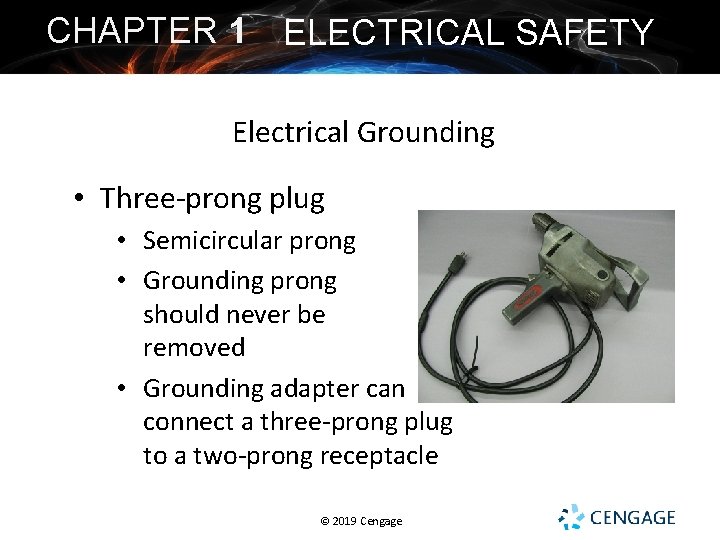
CHAPTER 1 ELECTRICAL SAFETY Electrical Grounding • Three-prong plug • Semicircular prong • Grounding prong should never be removed • Grounding adapter can connect a three-prong plug to a two-prong receptacle © 2019 Cengage
CHAPTER 1 ELECTRICAL SAFETY Electrical Grounding • Ground fault circuit interrupter • Detects electrical leaks to ground • Prevents current flow when leak detected • Recommended for use with portable electric power tools • Available in the form of circuit breakers © 2019 Cengage
CHAPTER 1 ELECTRICAL SAFETY Circuit Protection • Electrical circuits • Operate at or below a specific current (ampere) rating • Standard wire use for residential receptacles is #12 TW • Maximum current protection is 20 amperes © 2019 Cengage
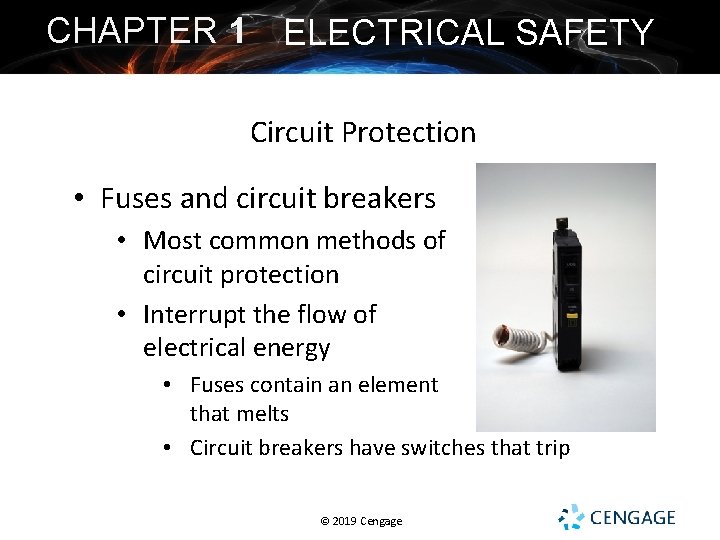
CHAPTER 1 ELECTRICAL SAFETY Circuit Protection • Fuses and circuit breakers • Most common methods of circuit protection • Interrupt the flow of electrical energy • Fuses contain an element that melts • Circuit breakers have switches that trip © 2019 Cengage
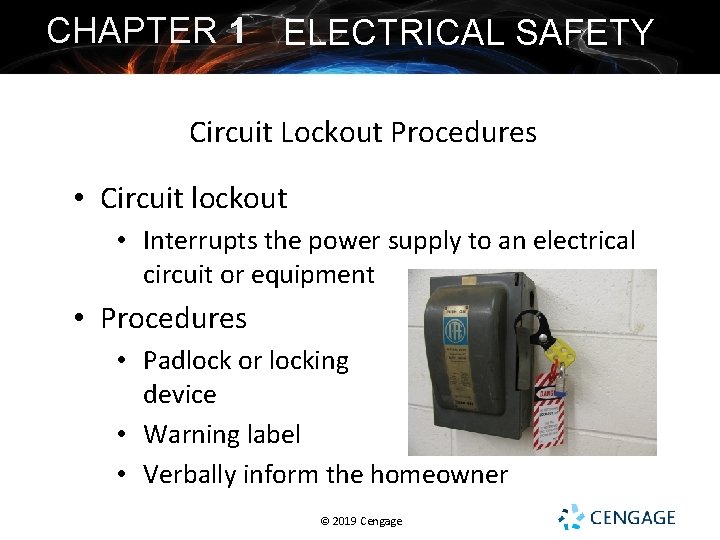
CHAPTER 1 ELECTRICAL SAFETY Circuit Lockout Procedures • Circuit lockout • Interrupts the power supply to an electrical circuit or equipment • Procedures • Padlock or locking device • Warning label • Verbally inform the homeowner © 2019 Cengage
CHAPTER 1 ELECTRICAL SAFETY Electrical Safety Guidelines • Guidelines Follow the NEC® Locked out or marked Power supply is off on the unit Keep your body out of contact with damp or wet surfaces • Be cautious • • © 2019 Cengage
CHAPTER 1 ELECTRICAL SAFETY Electrical Safety Guidelines • Guidelines • • • Properly grounded power tools Do not wear jewelry Insulating sole and heel Do not use metal ladders Examine all extension cords and power tools for damage © 2019 Cengage
CHAPTER 1 ELECTRICAL SAFETY Electrical Safety Guidelines • Guidelines • Replace or close all covers on receptacles that house electrical wiring and controls • Meter and the test leads being used are in good condition • Discharge all capacitors with a 20, 000 -ohm, 4 watt resistor before touching the terminals © 2019 Cengage
CHAPTER 1 ELECTRICAL SAFETY Electrical Safety Guidelines • Guidelines • When attempting to help someone who is being electrocuted, do not become part of the circuit • Keep tools in good condition and frequently check the insulated handles © 2019 Cengage
CHAPTER 1 ELECTRICAL SAFETY SUMMARY • Electricity cannot be seen but it certainly can be felt • A small amount of electricity can cause injury or even death • Heating and air-conditioning technicians must respect and be cautious around electrical circuits © 2019 Cengage