
2019 Biology 2 Chapter 28 Nervous system Copyright
2019 Biology 2 Chapter 28. Nervous system Copyright © 2003 Pearson Education, Inc. publishing as Benjamin Cummings
NERVOUS SYSTEM STRUCTURE AND FUNCTION 28. 1 Nervous systems receive sensory input, interpret it, and send out appropriate commands • The nervous system has three interconnected functions – Sensory input – Integration – Motor output Copyright © 2003 Pearson Education, Inc. publishing as Benjamin Cummings

Analysis and interpretation Formulation of appropriate responses SENSORY INPUT Sensory neuron INTEGRATION Sensor interneuron MOTOR OUTPUT Motor neuron Brain and spinal cord Effector Muscle, gland Peripheral nervous system (PNS) Central nervous system (CNS) Figure 28. 1 A Copyright © 2003 Pearson Education, Inc. publishing as Benjamin Cummings
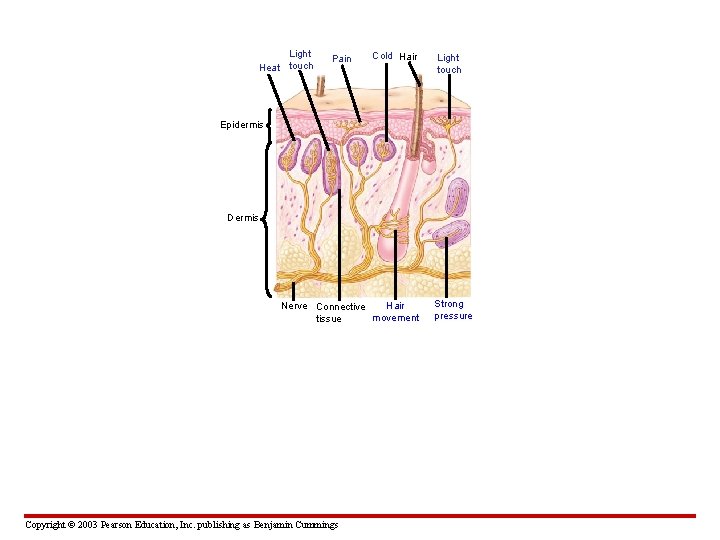
Light Heat touch Pain Cold Hair Light touch Epidermis Dermis Hair Nerve Connective movement tissue Copyright © 2003 Pearson Education, Inc. publishing as Benjamin Cummings Strong pressure
• The nervous system can be divided into two main divisions – The central nervous system (CNS) consists of the brain and, in vertebrates, the spinal cord – The peripheral nervous system (PNS) is made up of nerves and ganglia that carry signals into and out of the CNS A cluster of neuron cell bodies Copyright © 2003 Pearson Education, Inc. publishing as Benjamin Cummings
• Three types of neurons correspond to the nervous system’s three main functions – Sensory neurons convey signals from sensory receptors into the CNS – Interneurons integrate data and relay signals – Motor neurons convey signals to effectors Copyright © 2003 Pearson Education, Inc. publishing as Benjamin Cummings
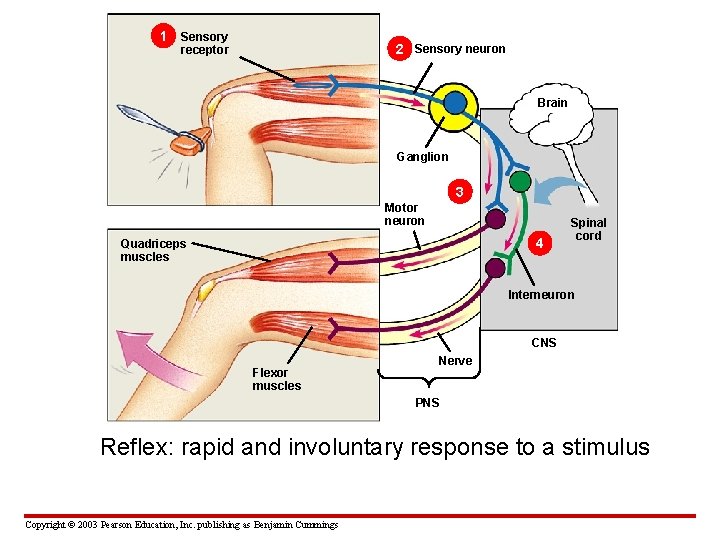
1 Sensory 2 Sensory neuron receptor Brain Ganglion 3 Motor neuron 4 Quadriceps muscles Spinal cord Interneuron CNS Flexor muscles Nerve PNS Reflex: rapid and involuntary response to a stimulus Copyright © 2003 Pearson Education, Inc. publishing as Benjamin Cummings
28. 2 Neurons are the functional units of nervous systems • Neurons are cells specialized to transmit nervous impulses • They consist of – a cell body – dendrites (highly branched fibers) – an axon (long fiber) Copyright © 2003 Pearson Education, Inc. publishing as Benjamin Cummings
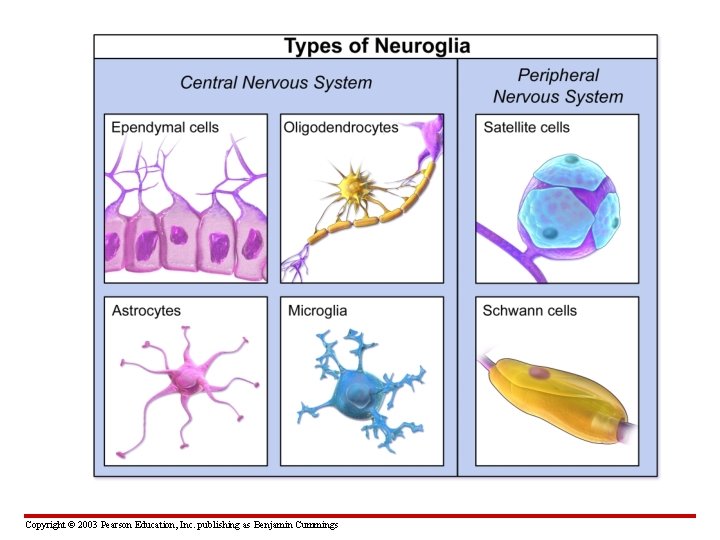
• Supporting cells (glia) protect, insulate, and reinforce neurons • The myelin sheath is the insulating material in vertebrates – It is composed of a chain of Schwann cells linked by nodes of Ranvier (oligodendrocytes in CNS) – It speeds up signal transmission – Multiple sclerosis (MS) involves the destruction of myelin sheaths by the immune system Copyright © 2003 Pearson Education, Inc. publishing as Benjamin Cummings
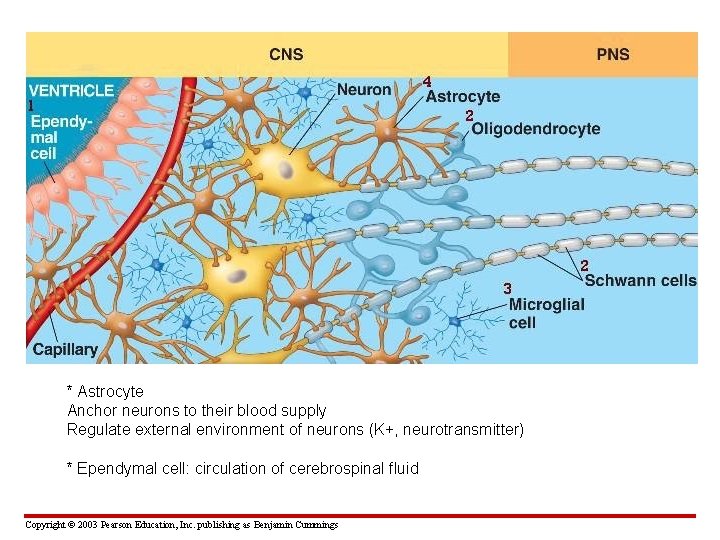
* Astrocyte Anchor neurons to their blood supply Regulate external environment of neurons (K+, neurotransmitter) * Ependymal cell: circulation of cerebrospinal fluid Copyright © 2003 Pearson Education, Inc. publishing as Benjamin Cummings
Copyright © 2003 Pearson Education, Inc. publishing as Benjamin Cummings
Glia: astocyte, satellite cell, microglia • Surround neurons and hold them in place • Regulate the external environment of neurons • Supply nutrients and oxygen to neurons • Insulate the neuron from another • Destroy pathogens and remove dead neurons Copyright © 2003 Pearson Education, Inc. publishing as Benjamin Cummings
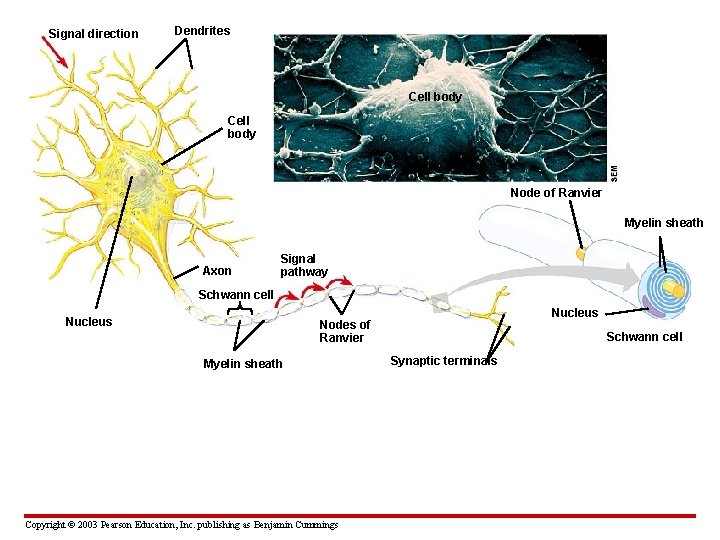
Signal direction Dendrites Cell body Node of Ranvier Myelin sheath Axon Signal pathway Schwann cell Nucleus Nodes of Ranvier Myelin sheath Copyright © 2003 Pearson Education, Inc. publishing as Benjamin Cummings Schwann cell Synaptic terminals
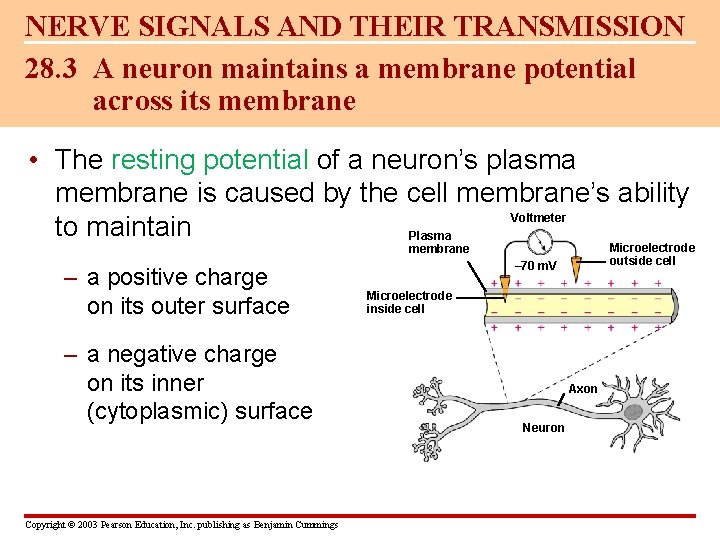
NERVE SIGNALS AND THEIR TRANSMISSION 28. 3 A neuron maintains a membrane potential across its membrane • The resting potential of a neuron’s plasma membrane is caused by the cell membrane’s ability Voltmeter to maintain Plasma Microelectrode outside cell membrane – a positive charge on its outer surface – a negative charge on its inner (cytoplasmic) surface Copyright © 2003 Pearson Education, Inc. publishing as Benjamin Cummings – 70 m. V Microelectrode inside cell Axon Neuron
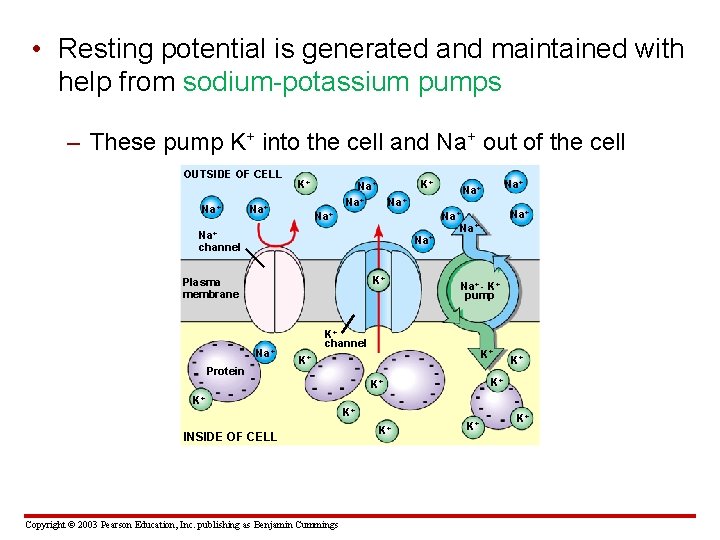
• Resting potential is generated and maintained with help from sodium-potassium pumps – These pump K+ into the cell and Na+ out of the cell OUTSIDE OF CELL Na+ K+ Na+ Na+ Na+ channel Na+ K+ Plasma membrane Na+ Protein Na+ - K+ pump K+ K+ Copyright © 2003 Pearson Education, Inc. publishing as Benjamin Cummings K+ K+ K+ INSIDE OF CELL Na+ Na+ K+ channel K+ Na+ K+ K+
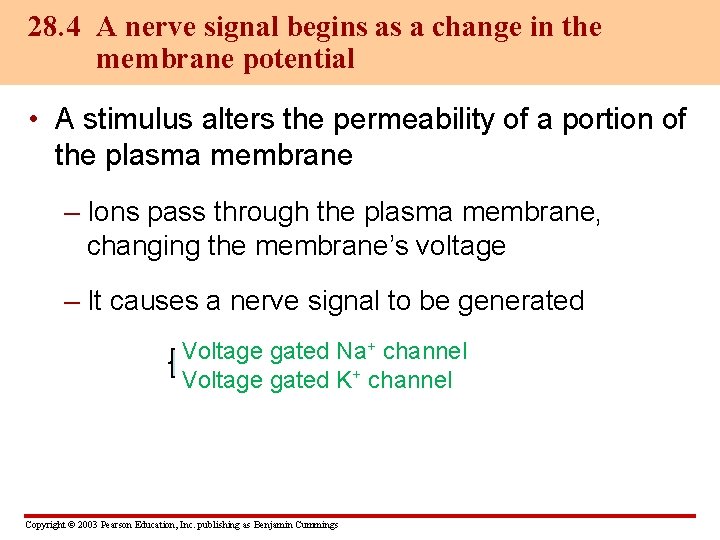
28. 4 A nerve signal begins as a change in the membrane potential • A stimulus alters the permeability of a portion of the plasma membrane – Ions pass through the plasma membrane, changing the membrane’s voltage – It causes a nerve signal to be generated Voltage gated Na+ channel Voltage gated K+ channel Copyright © 2003 Pearson Education, Inc. publishing as Benjamin Cummings
• An action potential is a nerve signal – It is an electrical change in the plasma membrane voltage from the resting potential to a maximum level and back to the resting potential Copyright © 2003 Pearson Education, Inc. publishing as Benjamin Cummings
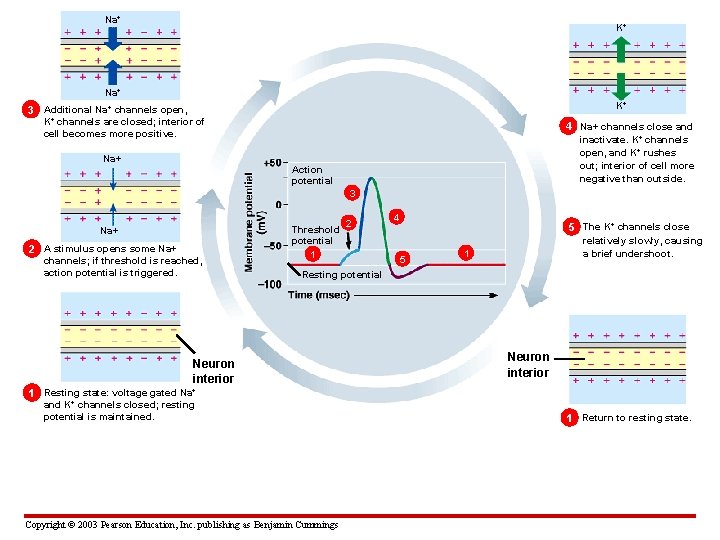
Na+ K+ 3 Additional Na+ channels open, K+ channels are closed; interior of cell becomes more positive. Na+ 4 Na+ channels close and inactivate. K+ channels open, and K+ rushes out; interior of cell more negative than outside. Action potential 3 Na+ 2 A stimulus opens some Na+ channels; if threshold is reached, action potential is triggered. Threshold potential 1 2 4 5 The K+ channels close 5 relatively slowly, causing a brief undershoot. 1 Resting potential Neuron interior 1 Resting state: voltage gated Na+ and K+ channels closed; resting potential is maintained. Copyright © 2003 Pearson Education, Inc. publishing as Benjamin Cummings 1 Return to resting state.

28. 5 The action potential propagates itself along the neuron Axon Action potential 1 Axon segment Na+ K+ 2 Action potential Na+ K+ K+ 3 Na+ K+ Copyright © 2003 Pearson Education, Inc. publishing as Benjamin Cummings Action potential

Saltatory conduction Copyright © 2003 Pearson Education, Inc. publishing as Benjamin Cummings
28. 6 Neurons communicate at synapses • The synapse is a key element of nervous systems – It is a junction or relay point between two neurons or between a neuron and an effector cell • Synapses are either electrical or chemical – Action potentials pass between cells at electrical synapses (through gap junctions) – At chemical synapses, neurotransmitters cross the synaptic cleft to bind to receptors on the surface of the receiving cell (ionotropic receptor, metabotropic receptor) norepinephrin Copyright © 2003 Pearson Education, Inc. publishing as Benjamin Cummings
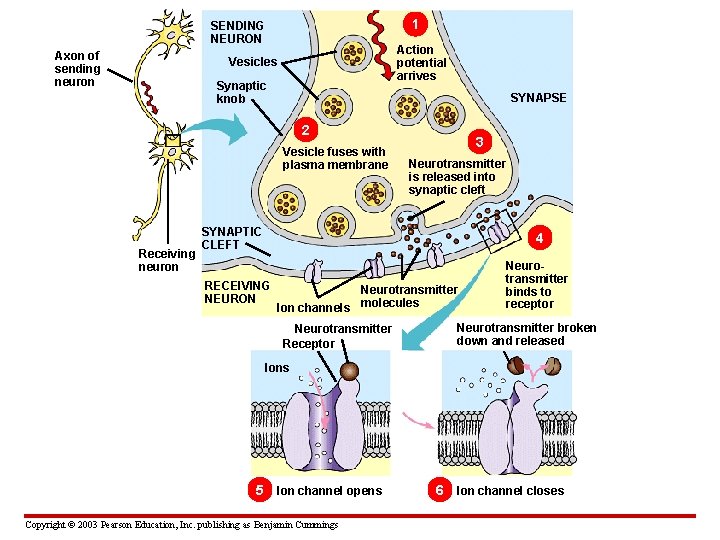
1 SENDING NEURON Axon of sending neuron Action potential arrives Vesicles Synaptic knob SYNAPSE 2 Vesicle fuses with plasma membrane Receiving neuron 3 Neurotransmitter is released into synaptic cleft SYNAPTIC CLEFT 4 RECEIVING NEURON Neurotransmitter Ion channels molecules Neurotransmitter Receptor Neurotransmitter binds to receptor Neurotransmitter broken down and released Ions 5 Ion channel opens Copyright © 2003 Pearson Education, Inc. publishing as Benjamin Cummings 6 Ion channel closes
28. 7 Chemical synapses make complex information processing possible • Excitatory neurotransmitters trigger action potentials in the receiving cell • Inhibitory neurotransmitters decrease the cell’s ability to develop action potentials • The summation of excitation and inhibition determines whether or not the cell will transmit a nerve signal Copyright © 2003 Pearson Education, Inc. publishing as Benjamin Cummings
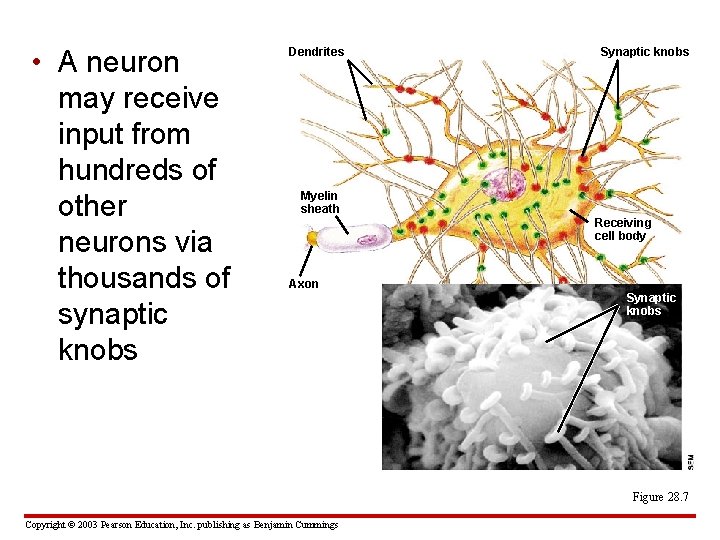
• A neuron may receive input from hundreds of other neurons via thousands of synaptic knobs Dendrites Synaptic knobs Myelin sheath Receiving cell body Axon Synaptic knobs Figure 28. 7 Copyright © 2003 Pearson Education, Inc. publishing as Benjamin Cummings
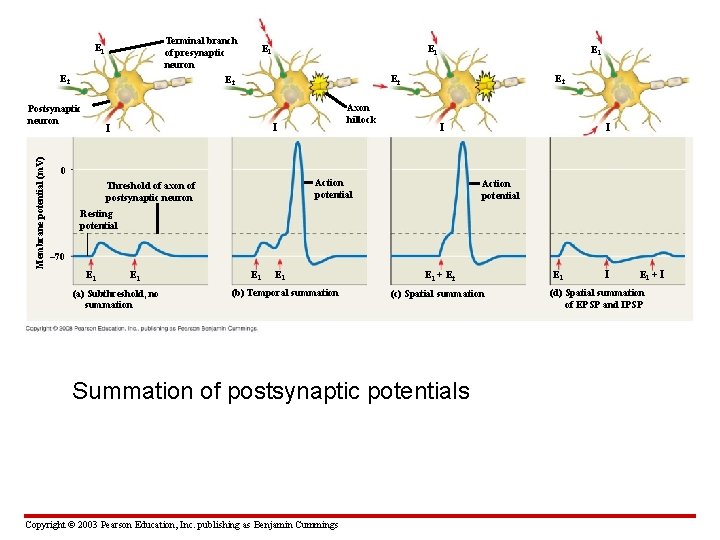
Terminal branch of presynaptic neuron E 2 E 1 E 2 Membrane potential (m. V) Postsynaptic neuron E 1 E 1 E 2 Axon hillock I I 0 Action potential Threshold of axon of postsynaptic neuron Action potential Resting potential – 70 E 1 (a) Subthreshold, no summation E 1 (b) Temporal summation E 1 + E 2 (c) Spatial summation Summation of postsynaptic potentials Copyright © 2003 Pearson Education, Inc. publishing as Benjamin Cummings E 1 I E 1 + I (d) Spatial summation of EPSP and IPSP
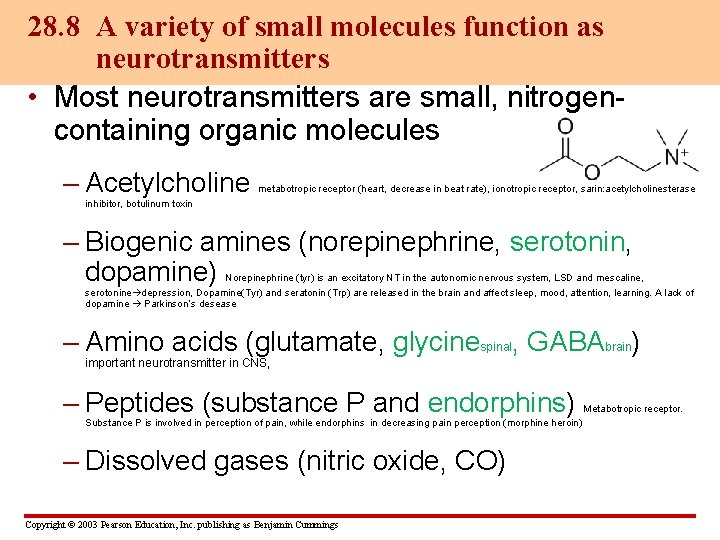
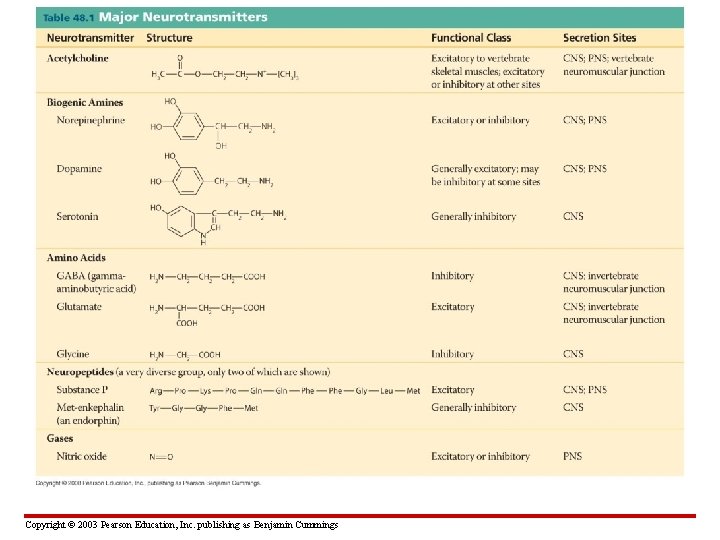
28. 8 A variety of small molecules function as neurotransmitters • Most neurotransmitters are small, nitrogencontaining organic molecules – Acetylcholine metabotropic receptor (heart, decrease in beat rate), ionotropic receptor, sarin: acetylcholinesterase inhibitor, botulinum toxin – Biogenic amines (norepinephrine, serotonin, dopamine) Norepinephrine (tyr) is an excitatory NT in the autonomic nervous system, LSD and mescaline, serotonine depression, Dopamine(Tyr) and seratonin (Trp) are released in the brain and affect sleep, mood, attention, learning. A lack of dopamine Parkinson’s desease – Amino acids (glutamate, glycinespinal, GABAbrain) important neurotransmitter in CNS, – Peptides (substance P and endorphins) Substance P is involved in perception of pain, while endorphins in decreasing pain perception (morphine heroin) – Dissolved gases (nitric oxide, CO) Copyright © 2003 Pearson Education, Inc. publishing as Benjamin Cummings Metabotropic receptor.
Copyright © 2003 Pearson Education, Inc. publishing as Benjamin Cummings
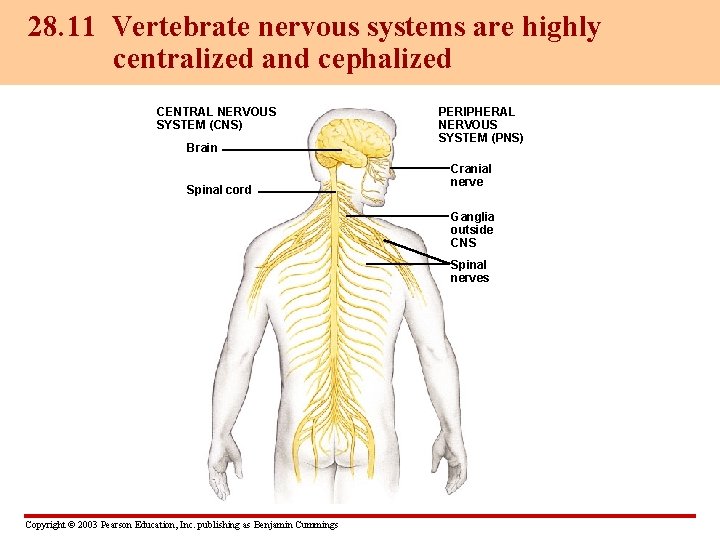
28. 11 Vertebrate nervous systems are highly centralized and cephalized CENTRAL NERVOUS SYSTEM (CNS) Brain Spinal cord PERIPHERAL NERVOUS SYSTEM (PNS) Cranial nerve Ganglia outside CNS Spinal nerves Copyright © 2003 Pearson Education, Inc. publishing as Benjamin Cummings
Brain: master control center 1. Homeostatic center 2. Sensory center 3. Center of emotion and intellect 4. Motor command center Spinal cord Copyright © 2003 Pearson Education, Inc. publishing as Benjamin Cummings
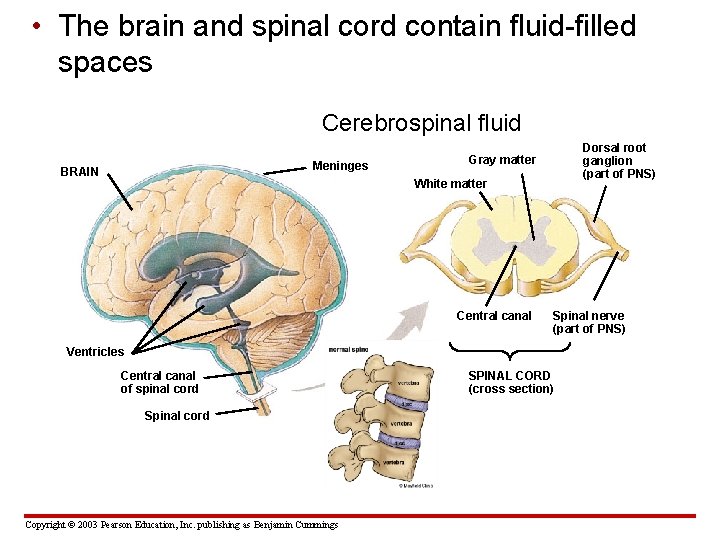
• The brain and spinal cord contain fluid-filled spaces Cerebrospinal fluid Meninges BRAIN Dorsal root ganglion (part of PNS) Gray matter White matter Central canal Spinal nerve (part of PNS) Ventricles Central canal of spinal cord Spinal cord Copyright © 2003 Pearson Education, Inc. publishing as Benjamin Cummings SPINAL CORD (cross section)
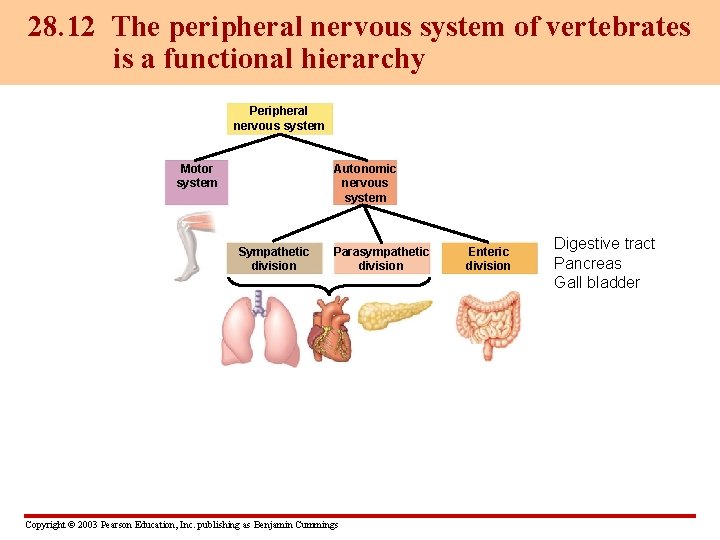
28. 12 The peripheral nervous system of vertebrates is a functional hierarchy Peripheral nervous system Motor system Autonomic nervous system Sympathetic division Parasympathetic division Copyright © 2003 Pearson Education, Inc. publishing as Benjamin Cummings Enteric division Digestive tract Pancreas Gall bladder
• PNS – The autonomic nervous system exerts involuntary control over the internal organs – The motor nervous system exerts voluntary control over skeletal muscles Copyright © 2003 Pearson Education, Inc. publishing as Benjamin Cummings
28. 13 Opposing actions of sympathetic and parasympathetic neurons regulate the internal environment • The autonomic nervous system consists of two major divisions – The parasympathetic division: rest and digest – The sympathetic division: arousal and energy generation Copyright © 2003 Pearson Education, Inc. publishing as Benjamin Cummings
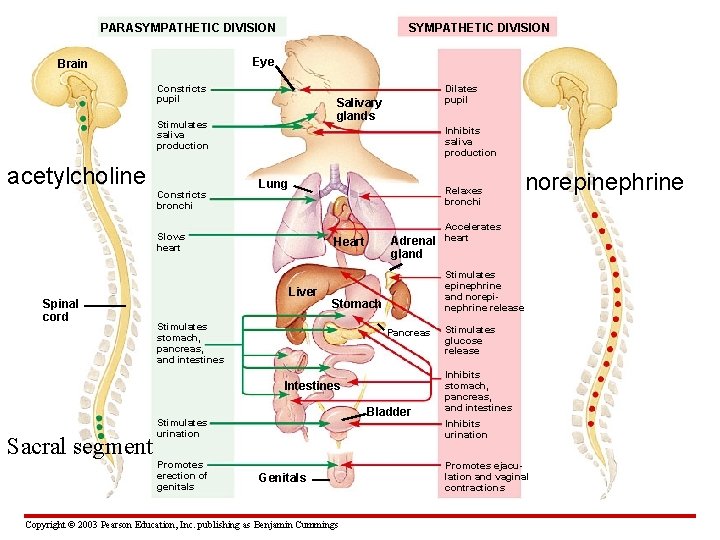
PARASYMPATHETIC DIVISION Eye Brain Constricts pupil Stimulates saliva production acetylcholine Constricts bronchi Inhibits saliva production Lung Relaxes bronchi Slows heart Spinal cord Dilates pupil Salivary glands Adrenal gland Heart Liver Pancreas Intestines Sacral segment Bladder Stimulates urination Promotes erection of genitals Genitals Copyright © 2003 Pearson Education, Inc. publishing as Benjamin Cummings Accelerates heart Stimulates epinephrine and norepinephrine release Stomach Stimulates stomach, pancreas, and intestines norepinephrine Stimulates glucose release Inhibits stomach, pancreas, and intestines Inhibits urination Promotes ejaculation and vaginal contractions
- Slides: 34