
2019 Biology 2 Chapter 22 Gas Exchange Copyright
2019 Biology 2 Chapter 22. Gas Exchange Copyright © 2005 Pearson Education, Inc. Publishing as Benjamin Cummings
MECHANISMS OF GAS EXCHANGE • Respiration is the interchange of O 2 and CO 2 between an organism and its environment Copyright © 2003 Pearson Education, Inc. publishing as Benjamin Cummings

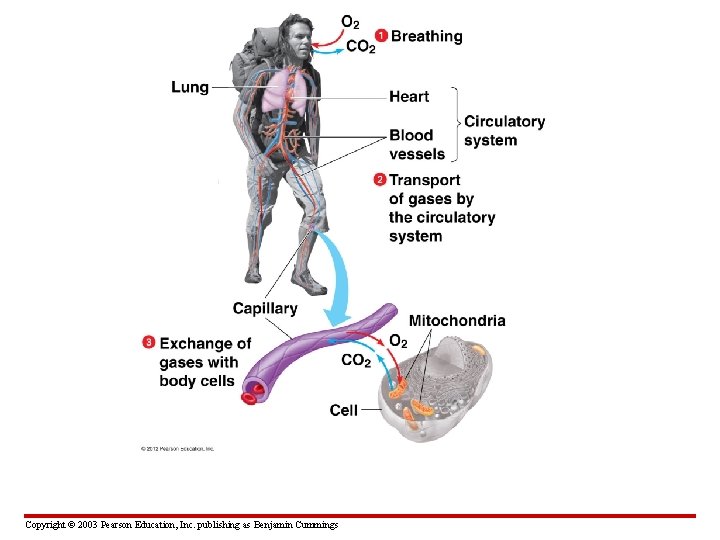
22. 1 Overview: Gas exchange involves breathing, the transport of gases, and the servicing of tissue cells • Gas exchange is essential because energy metabolism requires O 2 and produces CO 2 • There are three phases of gas exchange • The O 2/CO 2 gas exchange involves the respiratory system and the circulatory system. Copyright © 2003 Pearson Education, Inc. publishing as Benjamin Cummings
Copyright © 2003 Pearson Education, Inc. publishing as Benjamin Cummings
22. 2 Animals exchange O 2 and CO 2 through moist body surfaces • O 2 enters an animal and CO 2 leaves by diffusion through a respiratory surface • Respiratory surface: the part of an animal where O 2 diffuses into the animal and where CO 2 diffuses out to the surrounding environment - Respiratory surfaces are made up of a single layer of living cells - Respiratory surfaces must be moist Copyright © 2003 Pearson Education, Inc. publishing as Benjamin Cummings
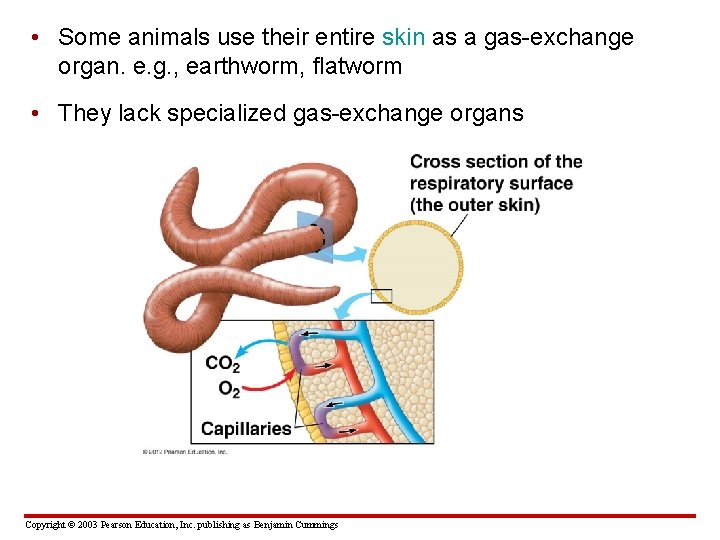
• Some animals use their entire skin as a gas-exchange organ. e. g. , earthworm, flatworm • They lack specialized gas-exchange organs Copyright © 2003 Pearson Education, Inc. publishing as Benjamin Cummings
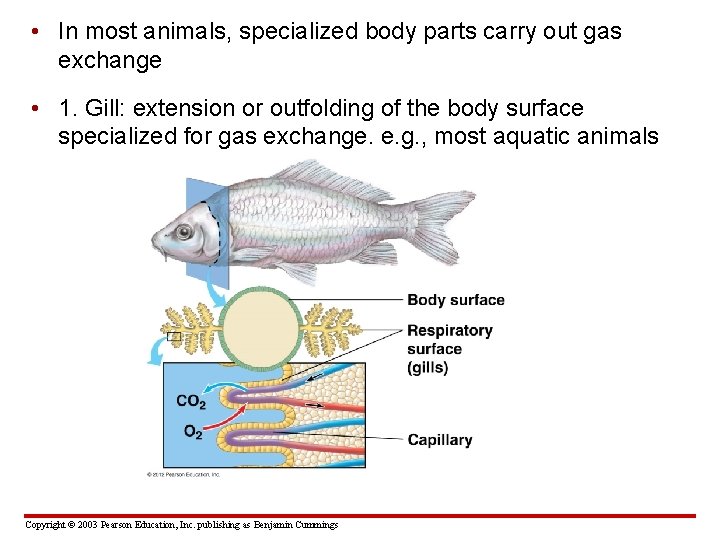
• In most animals, specialized body parts carry out gas exchange • 1. Gill: extension or outfolding of the body surface specialized for gas exchange. e. g. , most aquatic animals Copyright © 2003 Pearson Education, Inc. publishing as Benjamin Cummings

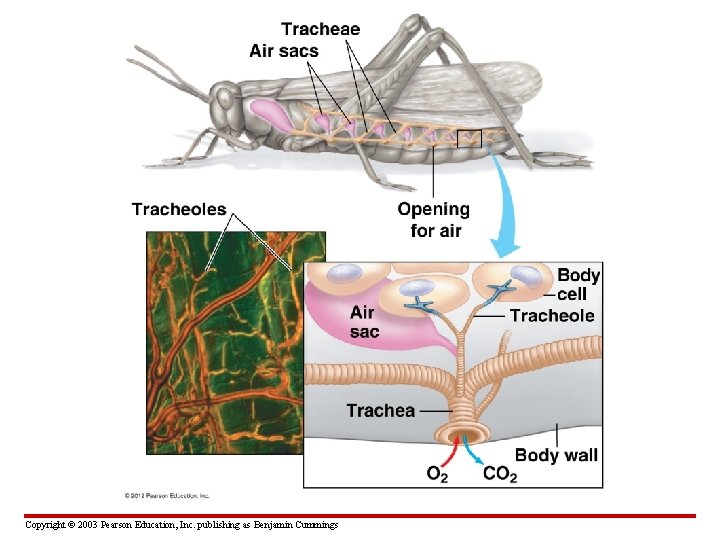
2. Trachea in insects Extensive system of internal tubes specialized for gas exchange Tracheae branch throughout the body, exchanging gases directly with body cells The circulatory system is not needed for the gas exchange Copyright © 2003 Pearson Education, Inc. publishing as Benjamin Cummings
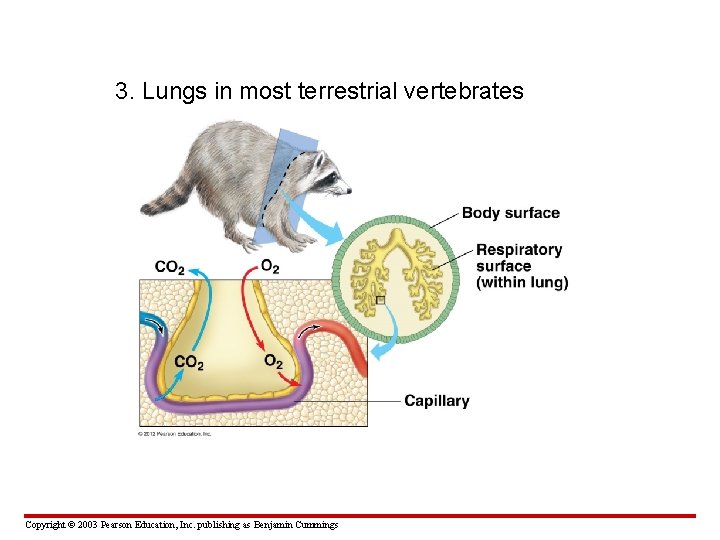
3. Lungs in most terrestrial vertebrates Copyright © 2003 Pearson Education, Inc. publishing as Benjamin Cummings
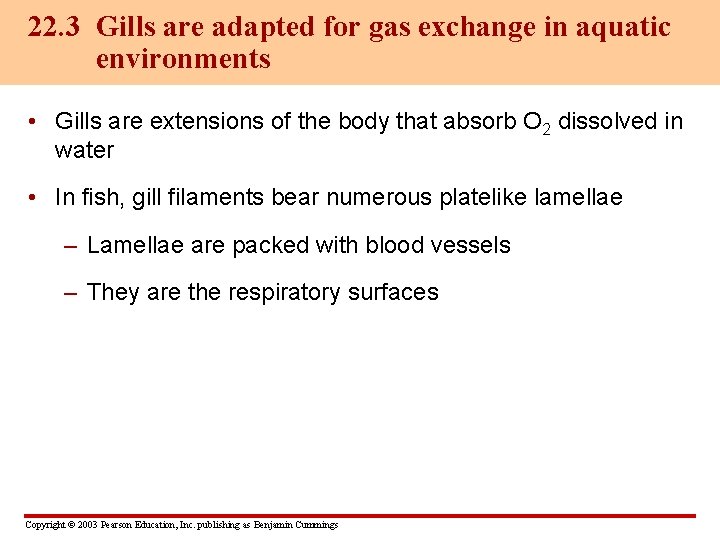
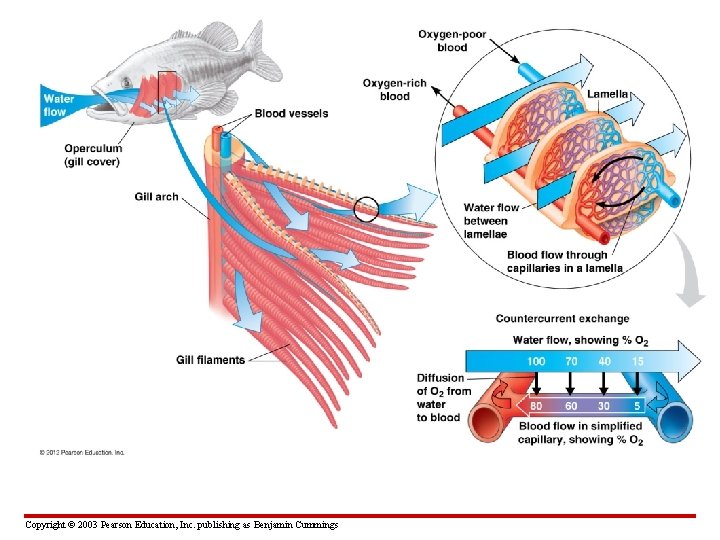
22. 3 Gills are adapted for gas exchange in aquatic environments • Gills are extensions of the body that absorb O 2 dissolved in water • In fish, gill filaments bear numerous platelike lamellae – Lamellae are packed with blood vessels – They are the respiratory surfaces Copyright © 2003 Pearson Education, Inc. publishing as Benjamin Cummings

• The structure of fish gills 1. Four gill arches on each side of the body 2. Two rows of gill filaments project from each gill arch 3. Each filament bears many plate-like structures called lamellae Water mouth gill water Copyright © 2003 Pearson Education, Inc. publishing as Benjamin Cummings
Copyright © 2003 Pearson Education, Inc. publishing as Benjamin Cummings
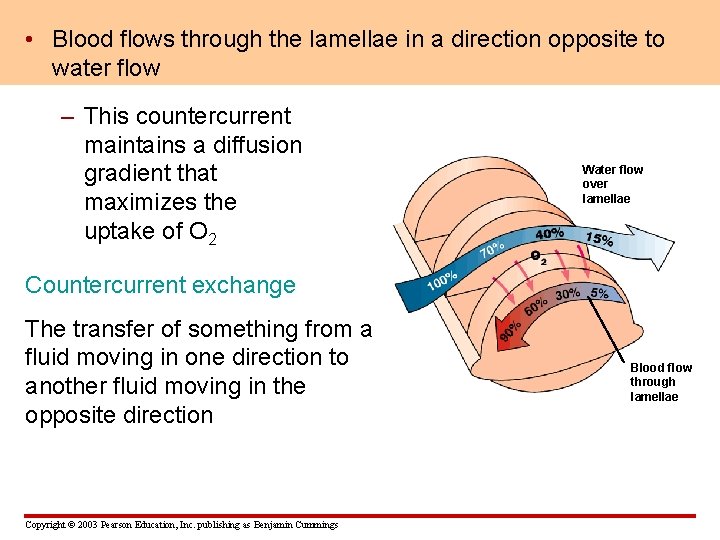
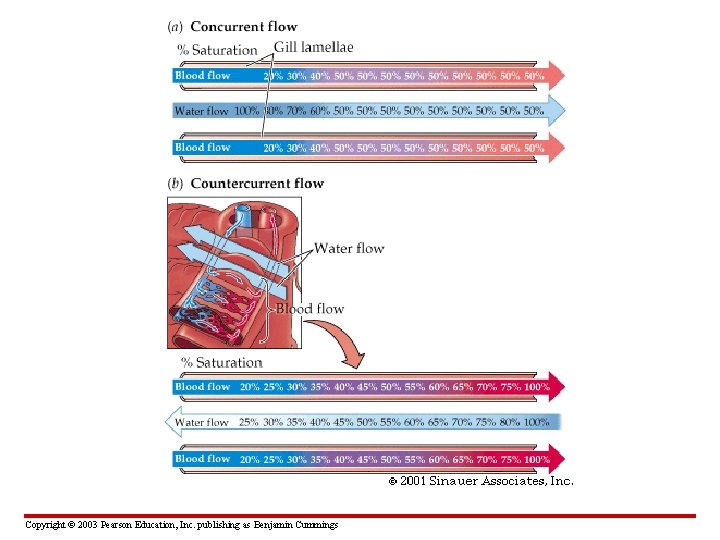
• Blood flows through the lamellae in a direction opposite to water flow – This countercurrent maintains a diffusion gradient that maximizes the uptake of O 2 Water flow over lamellae Countercurrent exchange The transfer of something from a fluid moving in one direction to another fluid moving in the opposite direction Copyright © 2003 Pearson Education, Inc. publishing as Benjamin Cummings Blood flow through lamellae
Copyright © 2003 Pearson Education, Inc. publishing as Benjamin Cummings
22. 4 The tracheal system of insects provides direct exchange between the air and body cells • Land animals exchange gases by breathing air – Air contains more O 2 and is easier to move than water – But water loss from the respiratory surfaces can be a problem Copyright © 2003 Pearson Education, Inc. publishing as Benjamin Cummings
Tracheal system e. g. , insects The tracheal system of insects is made up of air tubes that branch throughout the body Air tube Trachea Tracheole The tiny tips of the tracheoles are closed and contain fluid The circulatory system is not involved in transporting O 2 Air sac Copyright © 2003 Pearson Education, Inc. publishing as Benjamin Cummings
Copyright © 2003 Pearson Education, Inc. publishing as Benjamin Cummings
Terrestrial vertebrates have lungs Lung e. g. , reptiles, birds, mammals, and many amphibians In contrast to the tracheal system, lungs are restricted to one location in the body the circulatory system is required for transporting O 2 The size and complexity of lungs are correlated with an animal’s metabolic rate e. g. , the surface area of respiration: endotherm > ectotherm Amphibians have small lungs respiration through the skin Copyright © 2003 Pearson Education, Inc. publishing as Benjamin Cummings
22. 6 In the human respiratory system, branching tubes convey air to lungs located in the chest cavity • In humans and other mammals, air enters through the nasal cavity – It passes through the pharynx and larynx into the trachea – The trachea forks to form two bronchi – Each bronchus branches into numerous bronchioles Lungs are located in the chest cavity Diaphragm: contraction of the diaphragm inhalation Copyright © 2003 Pearson Education, Inc. publishing as Benjamin Cummings
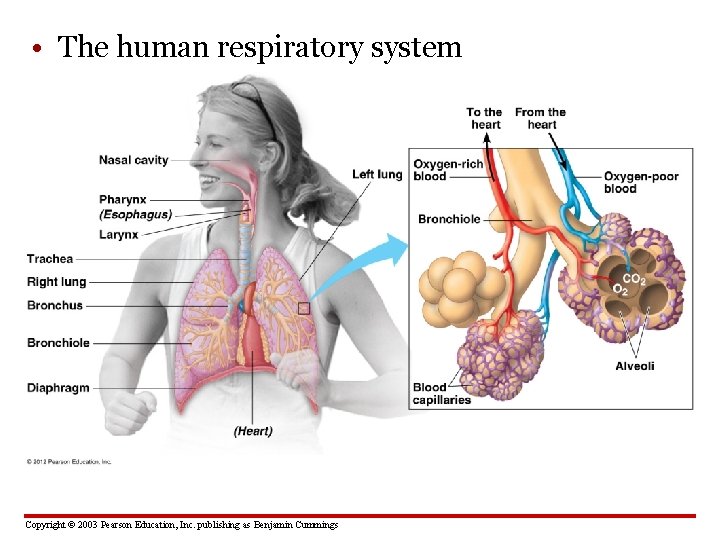
• The human respiratory system Copyright © 2003 Pearson Education, Inc. publishing as Benjamin Cummings
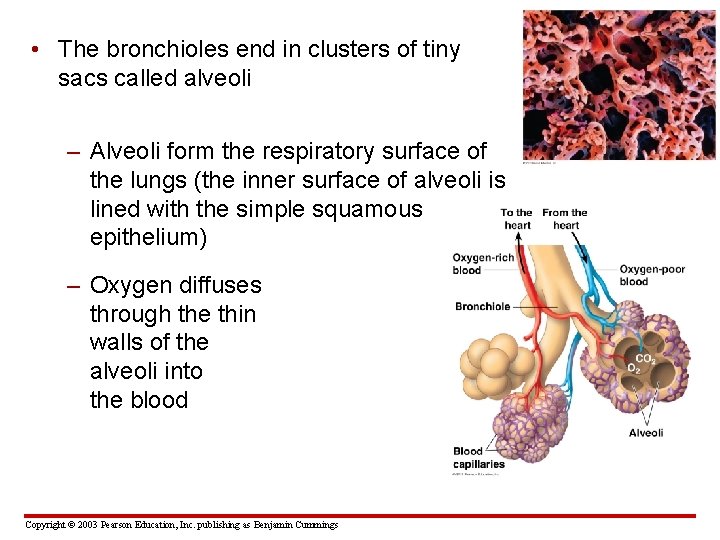
• The bronchioles end in clusters of tiny sacs called alveoli – Alveoli form the respiratory surface of the lungs (the inner surface of alveoli is lined with the simple squamous epithelium) – Oxygen diffuses through the thin walls of the alveoli into the blood Copyright © 2003 Pearson Education, Inc. publishing as Benjamin Cummings
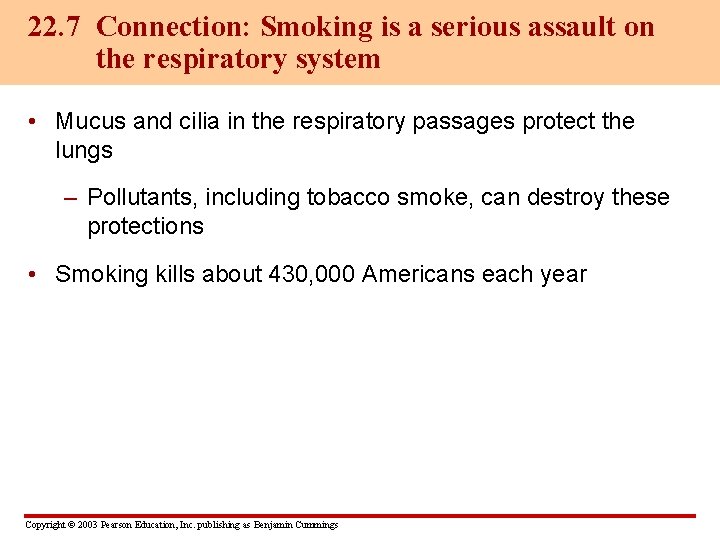
22. 7 Connection: Smoking is a serious assault on the respiratory system • Mucus and cilia in the respiratory passages protect the lungs – Pollutants, including tobacco smoke, can destroy these protections • Smoking kills about 430, 000 Americans each year Copyright © 2003 Pearson Education, Inc. publishing as Benjamin Cummings
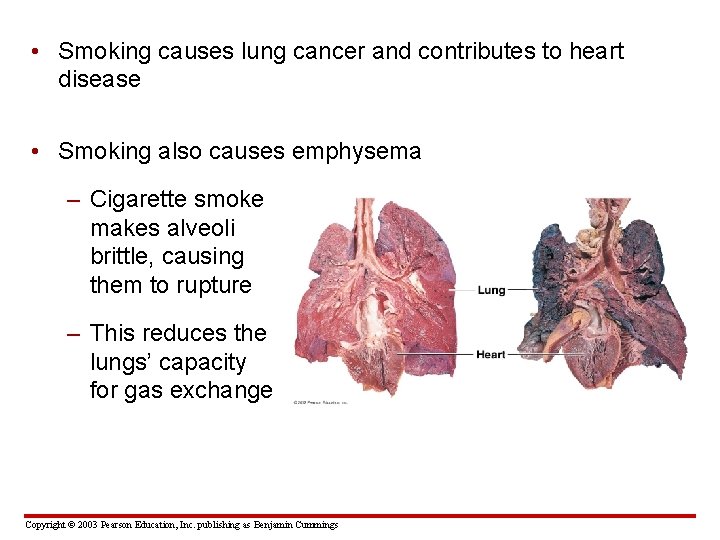
• Smoking causes lung cancer and contributes to heart disease • Smoking also causes emphysema – Cigarette smoke makes alveoli brittle, causing them to rupture – This reduces the lungs’ capacity for gas exchange Copyright © 2003 Pearson Education, Inc. publishing as Benjamin Cummings

22. 8 Negative pressure breathing ventilates our lungs • Breathing is the alternation of inhalation and exhalation Copyright © 2003 Pearson Education, Inc. publishing as Benjamin Cummings
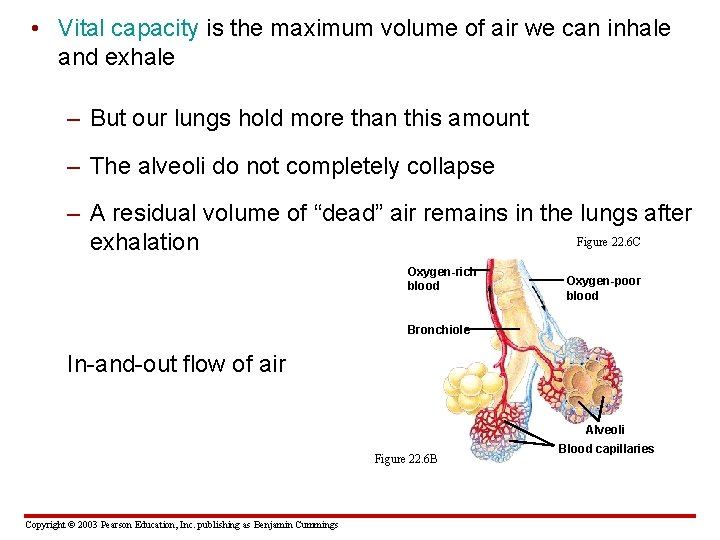
• Vital capacity is the maximum volume of air we can inhale and exhale – But our lungs hold more than this amount – The alveoli do not completely collapse – A residual volume of “dead” air remains in the lungs after Figure 22. 6 C exhalation Oxygen-rich blood Oxygen-poor blood Bronchiole In-and-out flow of air Alveoli Figure 22. 6 B Copyright © 2003 Pearson Education, Inc. publishing as Benjamin Cummings Blood capillaries
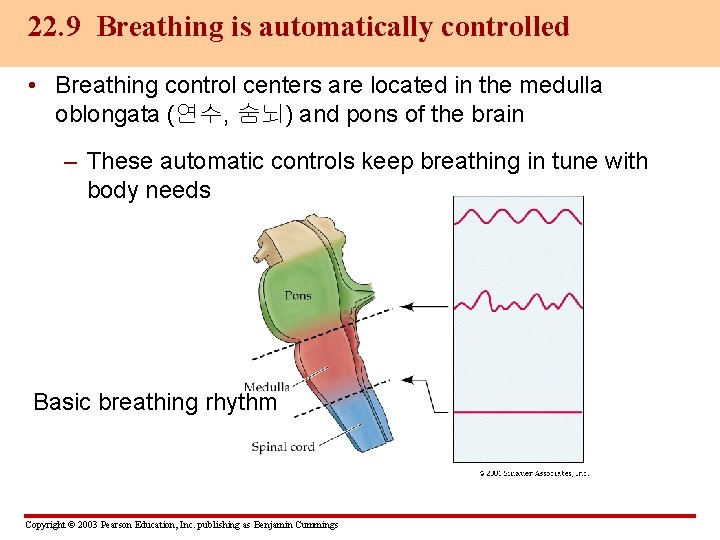
22. 9 Breathing is automatically controlled • Breathing control centers are located in the medulla oblongata (연수, 숨뇌) and pons of the brain – These automatic controls keep breathing in tune with body needs Basic breathing rhythm Copyright © 2003 Pearson Education, Inc. publishing as Benjamin Cummings
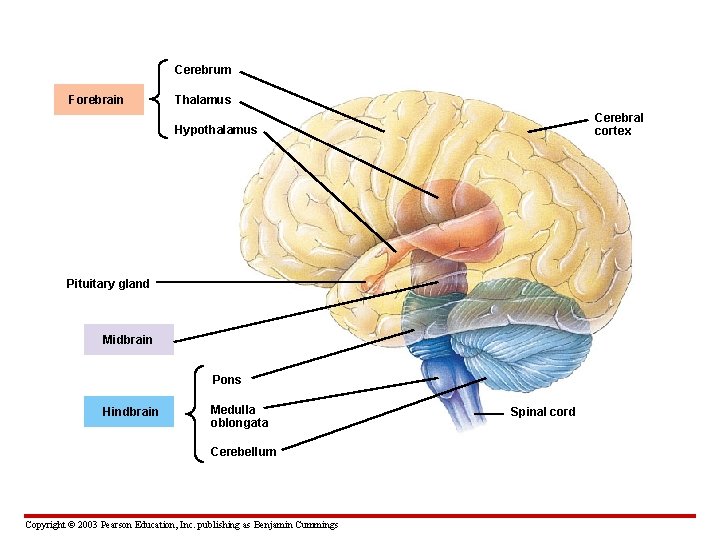
Cerebrum Forebrain Thalamus Cerebral cortex Hypothalamus Pituitary gland Midbrain Pons Hindbrain Medulla oblongata Cerebellum Copyright © 2003 Pearson Education, Inc. publishing as Benjamin Cummings Spinal cord
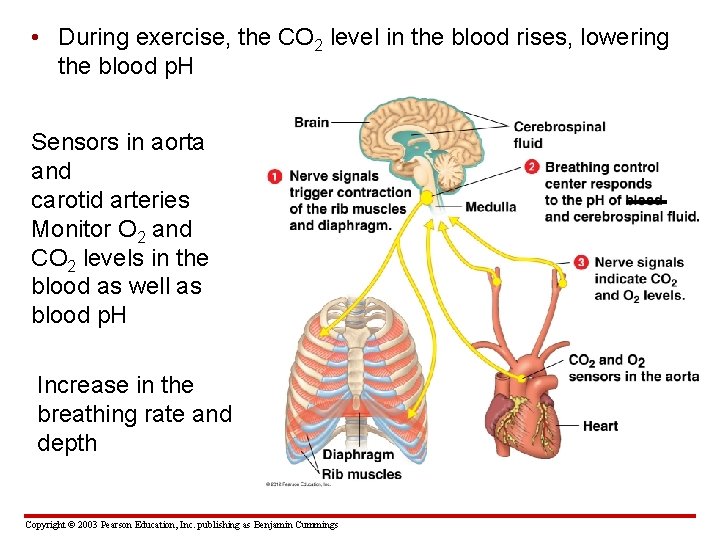
• During exercise, the CO 2 level in the blood rises, lowering the blood p. H Sensors in aorta and carotid arteries Monitor O 2 and CO 2 levels in the blood as well as blood p. H Increase in the breathing rate and depth Copyright © 2003 Pearson Education, Inc. publishing as Benjamin Cummings
TRANSPORT OF GASES IN THE BODY 22. 10 Blood transports the respiratory gases • The heart pumps oxygen-poor blood to the lungs – In the lungs it picks up O 2 and drops off CO 2 – In the tissues, cells pick up CO 2 and drop off O 2 – Gases diffuse down pressure gradients in the lungs and the tissues Copyright © 2003 Pearson Education, Inc. publishing as Benjamin Cummings
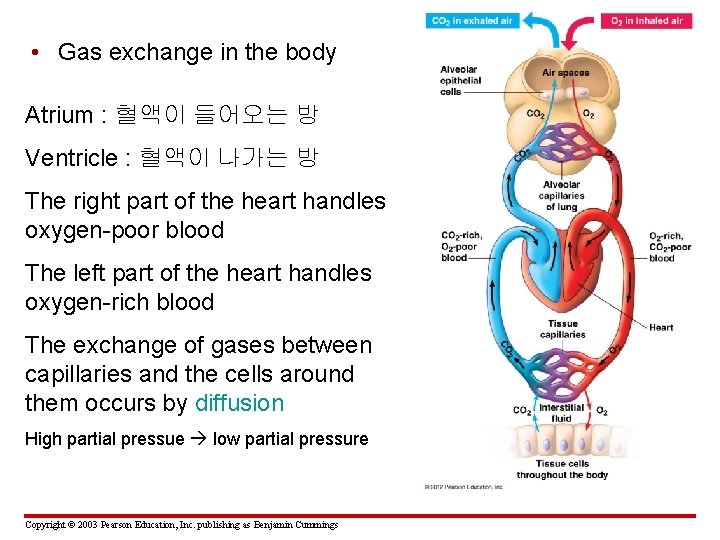
• Gas exchange in the body Atrium : 혈액이 들어오는 방 Ventricle : 혈액이 나가는 방 The right part of the heart handles oxygen-poor blood The left part of the heart handles oxygen-rich blood The exchange of gases between capillaries and the cells around them occurs by diffusion High partial pressue low partial pressure Copyright © 2003 Pearson Education, Inc. publishing as Benjamin Cummings
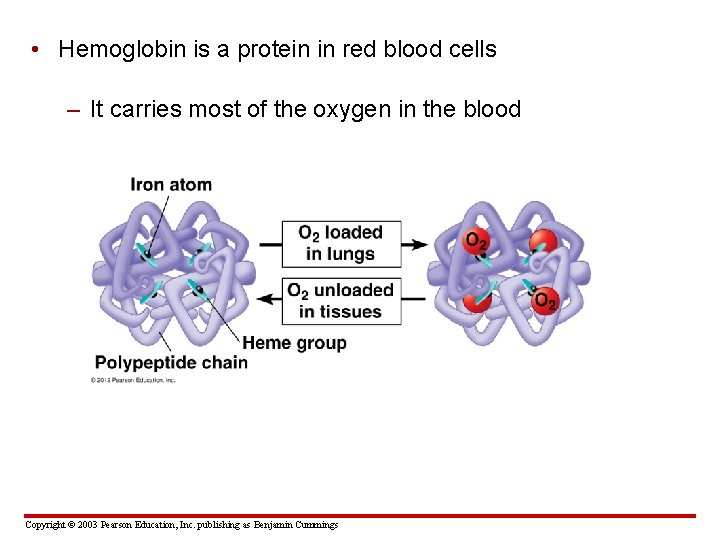
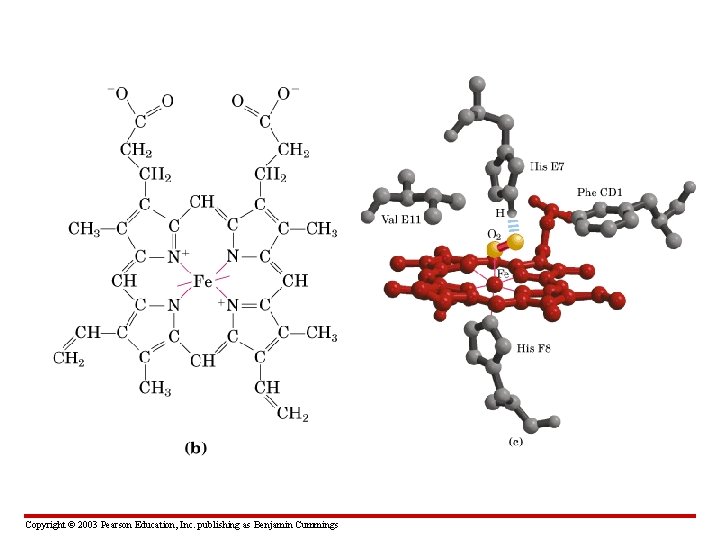
• Hemoglobin is a protein in red blood cells – It carries most of the oxygen in the blood Copyright © 2003 Pearson Education, Inc. publishing as Benjamin Cummings
Copyright © 2003 Pearson Education, Inc. publishing as Benjamin Cummings
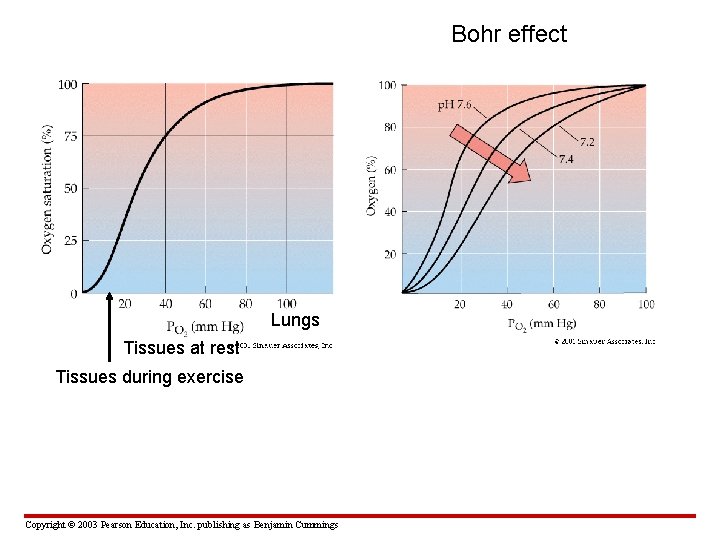
Bohr effect Lungs Tissues at rest Tissues during exercise Copyright © 2003 Pearson Education, Inc. publishing as Benjamin Cummings
22. 11 Hemoglobin carries O 2, helps transport CO 2, and buffer the blood • Hemoglobin helps buffer the p. H of blood and carries some CO 2 Copyright © 2003 Pearson Education, Inc. publishing as Benjamin Cummings
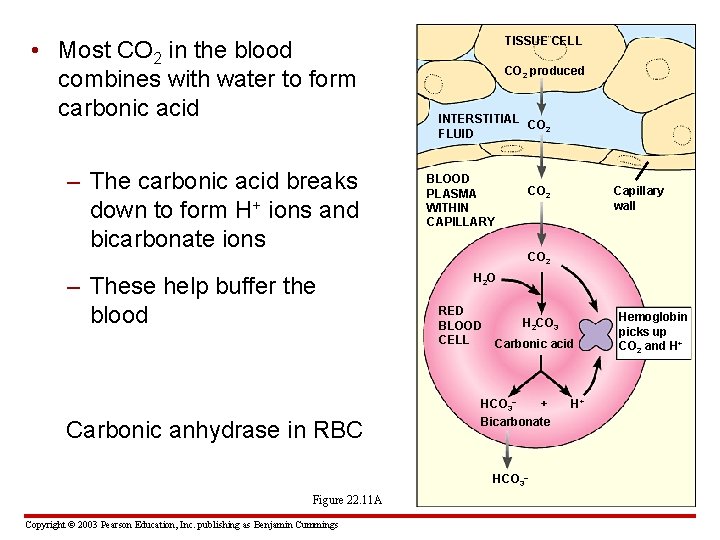
• Most CO 2 in the blood combines with water to form carbonic acid – The carbonic acid breaks down to form H+ ions and bicarbonate ions – These help buffer the blood Carbonic anhydrase in RBC TISSUE CELL CO 2 produced INTERSTITIAL CO 2 FLUID BLOOD PLASMA WITHIN CAPILLARY CO 2 H 2 O RED BLOOD CELL H 2 CO 3 Carbonic acid HCO 3– + Bicarbonate HCO 3– Figure 22. 11 A Copyright © 2003 Pearson Education, Inc. publishing as Benjamin Cummings Capillary wall H+ Hemoglobin picks up CO 2 and H+
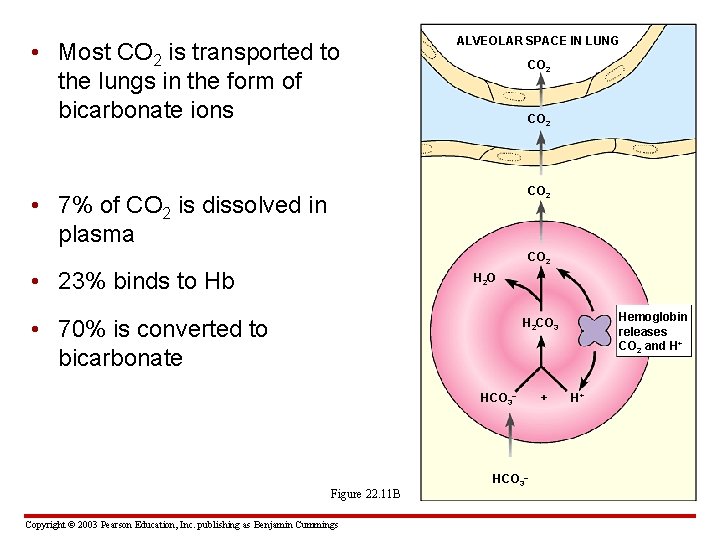
• Most CO 2 is transported to the lungs in the form of bicarbonate ions ALVEOLAR SPACE IN LUNG CO 2 • 7% of CO 2 is dissolved in plasma CO 2 • 23% binds to Hb H 2 O • 70% is converted to bicarbonate Hemoglobin releases CO 2 and H+ H 2 CO 3 HCO 3– Figure 22. 11 B Copyright © 2003 Pearson Education, Inc. publishing as Benjamin Cummings HCO 3– + H+
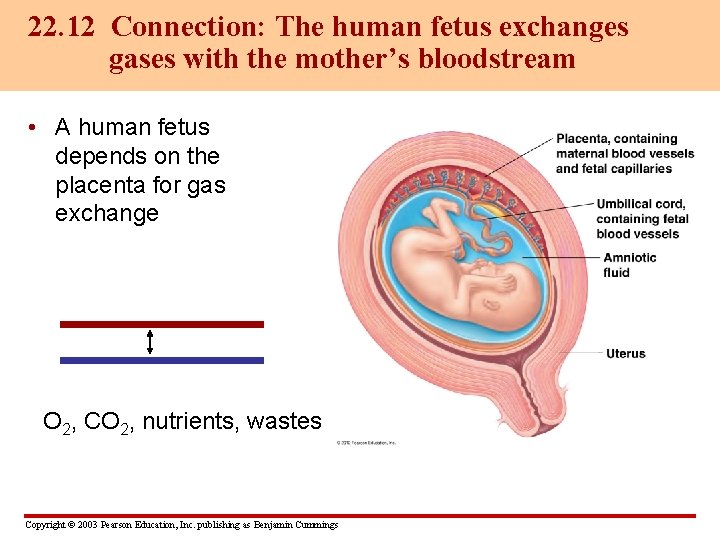
22. 12 Connection: The human fetus exchanges gases with the mother’s bloodstream • A human fetus depends on the placenta for gas exchange O 2, CO 2, nutrients, wastes Copyright © 2003 Pearson Education, Inc. publishing as Benjamin Cummings
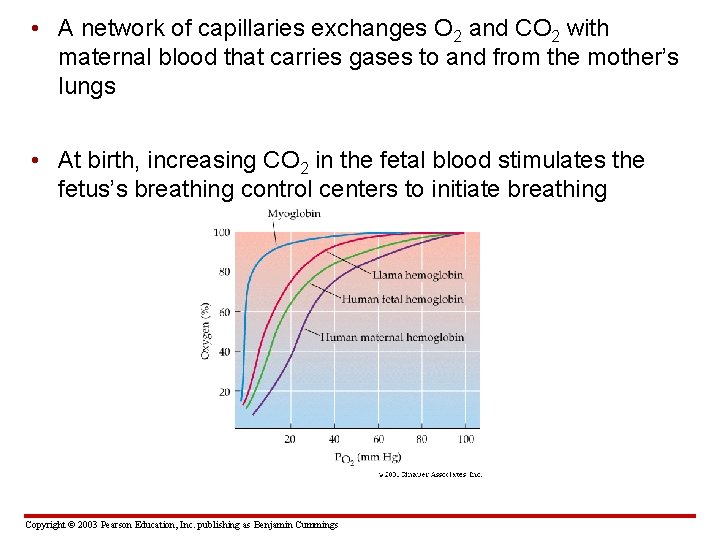
• A network of capillaries exchanges O 2 and CO 2 with maternal blood that carries gases to and from the mother’s lungs • At birth, increasing CO 2 in the fetal blood stimulates the fetus’s breathing control centers to initiate breathing Copyright © 2003 Pearson Education, Inc. publishing as Benjamin Cummings
- Slides: 38