
20182019 ABOUT NEW JERSEY FCCLA DESCRIPTION Family Career

20182019
ABOUT NEW JERSEY FCCLA DESCRIPTION: Family, Career and Community Leaders of America is a national youth leadership organization for young men and women in grades 6 – 12. It is a Career and Technical Student Organization that has family as its central focus. Our mission is to promote personal growth and leadership development through Family and Consumer Sciences education. The New Jersey Association of Family, Career and Community Leaders of America has a membership of over 3, 000 middle and high school members. The association provides challenging competitive events, valuable leadership workshops, and exciting state conferences for its members. NJ FCCLA offers opportunities for leadership development and preparation for adult life. MISSION: To promote personal growth and leadership development through Family and Consumer Sciences education. Focusing on the multiple roles of family member, wage earner and community leader, members develop skills for life through: character development, creative and critical thinking, interpersonal communication, practical knowledge, and career preparation. PURPO 1. To provide opportunities for personal development and preparation for adult life SES: 2. 3. 4. 5. 6. 7. 8. To strengthen the function of the family as a basic unit of society To encourage democracy through cooperative action in the home and community To encourage individual and group involvement in helping achieve global cooperation and harmony To promote greater understanding between youth and adults To provide opportunities for making decisions and for assuming responsibilities To prepare for the multiple roles of men and women in today’s society To promote Family and Consumer Sciences and related occupations CREED: We are the Family, Career and Community Leaders of America. We face the future with warm courage and high hope. For we have the clear consciousness of seeking old and precious values. For we are the builders of homes, Homes for America’s future, Homes where living will be the expression of everything that is good and fair, Homes where truth and love and security and faith will be realities, not dreams. We are the Family, Career and Community Leaders of America. We face the future with warm courage and high hope. MOTTO: Toward New Horizons TAGLINE: The Ultimate Leadership Expereince
WHY FCCLA? Whether you work in a large urban school district, a small rural community, or a mid-sized suburban school, FCCLA can enhance your FCS program and put learning into action for your students. STUDENTS CAN: • • • • develop leadership and career skills develop interpersonal relationship and organizational skills improve self-esteem learn and apply creative and critical thinking skills gain recognition for achievement develop skill in the use of parliamentary procedure set goals and reach them improve communication and public speaking skills travel and meet members from across the nation learn more about Family and Consumer Sciences become involved in service learning use character education principles in everyday life master career readiness practices ADVISERS CAN: • • • improve rapport with students gain assistance in curriculum planning gain satisfaction through student growth broaden horizons and contacts through a professional support system receive national and state resources to incorporate into curriculum expand professional experience and fulfillment FAMILY AND CONSUMER SCIENCES PROGRAMS CAN: • • • gain enrichment through school and community projects motivate students to learn create interest through relevant experiences enhance visibility to administrators, parents and communities gain interest in Family and Consumer Science enrollment receive national and state resources to incorporate into curriculum COMMUNITIES CAN: • • provide a link with schools increase student participation in civic affairs provide young citizens with constructive uses of leisure time provide links between service and development of workforce skills A club is just an internal experience, whereas an FCCLA Chapter, because it is part of a national organization, develops an identity and an esprit de corps that an individual local school club lacks. Members have mutual interests and activities with thousands of other students in the nation. FCCLA can be an integrated part of the FCS classroom. FCCLA is a CTSO, a Career and Technical Student Organization.

THE FCCLA ADVISER Although FCCLA Chapters are youth-centered, with emphasis on members running the chapters, there is a role for the adult adviser. The adviser should encourage and guide the members; provide them with ideas and resources when needed; and help them develop leadership skills through planning and carrying out chapter activities. The Chapter Adviser should serve as a source of continuity from year to year. FCCLA provides a wealth of benefits for your students, Family and Consumer Sciences program, school, community, and your own professional development. New advisers find that FCCLA offers a broad spectrum of program choices. The word “choices” is the key to survival and success. Remember: you don’t have to do it all! FCCLA offers a variety of National Programs and events to help increase the effective- ness of your Family and Consumer Sciences program and motivates students. During your chapter’s first years, guide members toward the programs that seem to best serve your local community needs. As members gain experience and build a tradition of chapter success, they will be ready to branch out into additional programs and events. QUALIFICATIONS: Teachers certified to teach Family and Consumer Sciences Education, or as determined by the state department of education, can serve as the FCCLA chapter adviser. THE ADVISER SHOULD: 1. 2. Interpret the organization to the chapter members. Interpret the value of FCCLA to administrators and teachers as a part of growth, leadership, citizenship, school and community. 3. 4. 5. 6. 7. 8. 9. 10. 11. Be ready with suggestions and resources. Be positive, but firm. Help keep the chapter visible in the school and community. Help students learn from their experiences, whether they are successful or not. Identify and encourage outstanding members to run for chapter, state or national office. Organize transportation for chapter members to chapter and state activities. Supervise members at all local, state and national conferences and events. Coordinate all Chapter activities with the FCS department. Check on students’ return of materials for state activities on time (affiliation, nominations, registration for conferences, etc. ) 12. Through all of this, be positive and enthusiastic – it’s contagious! The Chapter Adviser shows enthusiasm, a positive attitude, concern for students, dedication, and a willingness to share. The Adviser’s role is to give support, recognition and opportunities. The chapter is only as successful as the amount of involvement the Chapter Adviser puts into FCCLA activities. “No one knows how much you know, until they know how much you care. ” - Theodore Roosevelt
AFFILIATING A CHAPTER 1. Discuss with school administrators the advantage of starting a local chapter, pointing out the relationship of FCCLA to the Family, and Consumer Sciences curriculum and value to the school program. 2. 3. 4. Contact the State Adviser for information and materials needed to start a chapter at njfccla@gmail. com. 5. Find a mentor and talk with teachers who have chapters. Visit an active chapter so interested students can talk with their members. 6. 7. 8. Invite an FCCLA State Officer to speak to prospective members. 9. At the first meeting with students, brainstorm which leaders, officers and committees will be needed and determine a procedure for selecting them. Set up a date to elect officers and set up committees to involve all members. 10. Develop a calendar for the year’s activities. For each activity or concern, use the FCCLA Planning Process to set chapter goals and form a plan for carrying out, evaluating, and publicizing the chapter’s activities. Make sure dates are included on the master school calendar. Pull together a Program of Work. Check the state website for the NJ FCCLA Program of Work and Calendar of Activities. 11. Set up a committee to write or update chapter bylaws, using State and National Bylaws as guides. Develop an itemized budget for the year. Keep minutes of each meeting. Plan regular executive and chapter meetings. 12. 13. 14. 15. Become familiar with FCCLA National Programs and State and STAR Events. 16. Take students to the Fall Leadership Connection and the State Leadership Conference. Promote FCCLA in FCS classes, explaining the FCCLA Purposes and how they relate to the curriculum. Discuss possible chapter activities. Encourage students to talk with other eligible students about their interest in starting a chapter. Familiarize yourself with the State and National websites; learn as much as you can about the organization. Meet with the students who are interested and collect State and National dues. Send in dues as soon as possible to begin receiving Teen Times and other chapter mailings. Create committees to organize chapter initiatives such as fundraisers or community service projects Involve your chapter in local, state and national service projects. Create a fundraising campaign in order to raise money to attend conferences, and support chapter functions and service projects.
MEMBERS HIP FCCLA has a national membership of over 160, 000 young men and women in nearly 6, 000 chapters. There are 50 state associa- tions including the District of Columbia, Puerto Rico, and the Virgin Islands. Since its founding in 1945, FCCLA has involved more than nine million youth. Former members are eligible to become members of the State alumni organization, Friends of FCCLA, and Alumni & Associates, the national organization. WHO IS ELIGIBLE TO BE A MEMBER OF FCCLA? Any student who has taken a course in Family and Consumer Sciences, grade 6 through 12, is eligible for active membership in an organized chapter. Once State and National dues are paid, the student will be an official affiliated member. The combined membership cost is $13 person. WHAT IS NEEDED TO FORM A CHAPTER? In order to create a chapter, a minimum of 12 members must be affiliated by paying state ($4. 00) and national ($9. 00) dues. Chapters will have to select their type of membership; comprehensive or occupational. Comprehensive members are enrolled in FACS programs of study. Occupational members are enrolled in educational programs that prepare them for paid employment in a specific FCS related career. We use three R’s of membership to build a chapter. Focus on friendliness. People get involved in groups that make them feel welcome and involved. Work to create positive, warm, working relationships among all chapter members and potential members. Make it your job. Strong chapter membership depends on every member’s participation. You are a “walking billboard” for your chapter and the organization. Everything you do and say affects membership. Encourage the “bring a friend” concept. Ask! Often, the most effective way to get someone to join your chapter is to personally invite him or her to get involved. Don’t be shy – speak up and ask people to try FCCLA.
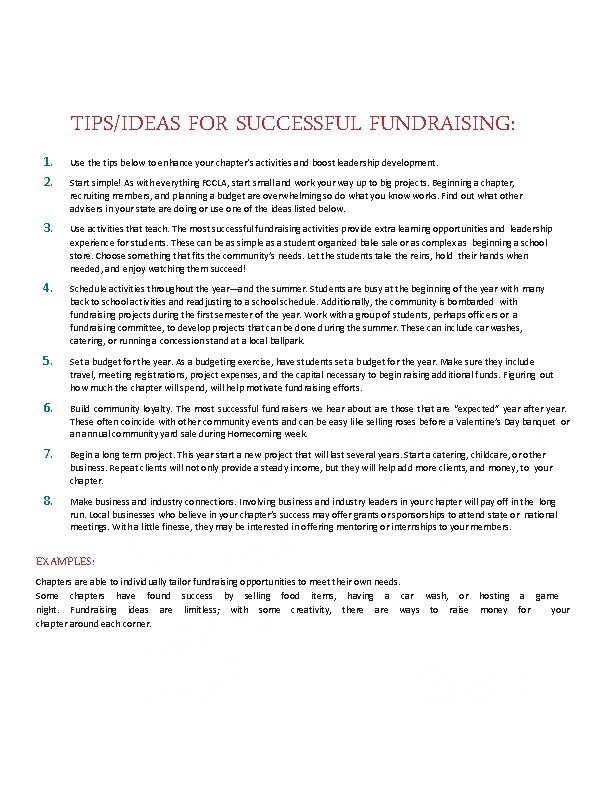
FUNDRAISI TIPS/IDEAS FOR SUCCESSFUL FUNDRAISING: NG 1. 2. Use the tips below to enhance your chapter’s activities and boost leadership development. 3. Use activities that teach. The most successful fundraising activities provide extra learning opportunities and leadership experience for students. These can be as simple as a student organized bake sale or as complex as beginning a school store. Choose something that fits the community’s needs. Let the students take the reins, hold their hands when needed, and enjoy watching them succeed! 4. Schedule activities throughout the year—and the summer. Students are busy at the beginning of the year with many back to school activities and readjusting to a school schedule. Additionally, the community is bombarded with fundraising projects during the first semester of the year. Work with a group of students, perhaps officers or a fundraising committee, to develop projects that can be done during the summer. These can include car washes, catering, or running a concession stand at a local ballpark. 5. Set a budget for the year. As a budgeting exercise, have students set a budget for the year. Make sure they include travel, meeting registrations, project expenses, and the capital necessary to begin raising additional funds. Figuring out how much the chapter will spend, will help motivate fundraising efforts. 6. Build community loyalty. The most successful fundraisers we hear about are those that are “expected” year after year. These often coincide with other community events and can be easy like selling roses before a Valentine’s Day banquet or an annual community yard sale during Homecoming week. 7. Begin a long term project. This year start a new project that will last several years. Start a catering, childcare, or other business. Repeat clients will not only provide a steady income, but they will help add more clients, and money, to your chapter. 8. Make business and industry connections. Involving business and industry leaders in your chapter will pay off in the long run. Local businesses who believe in your chapter’s success may offer grants or sponsorships to attend state or national meetings. With a little finesse, they may be interested in offering mentoring or internships to your members. Start simple! As with everything FCCLA, start small and work your way up to big projects. Beginning a chapter, recruiting members, and planning a budget are overwhelming so do what you know works. Find out what other advisers in your state are doing or use one of the ideas listed below. EXAMPLES: Chapters are able to individually tailor fundraising opportunities to meet their own needs. Some chapters have found success by selling food items, having a car wash, or night. Fundraising ideas are limitless; with some creativity, there are ways to raise chapter around each corner. hosting a game money for your
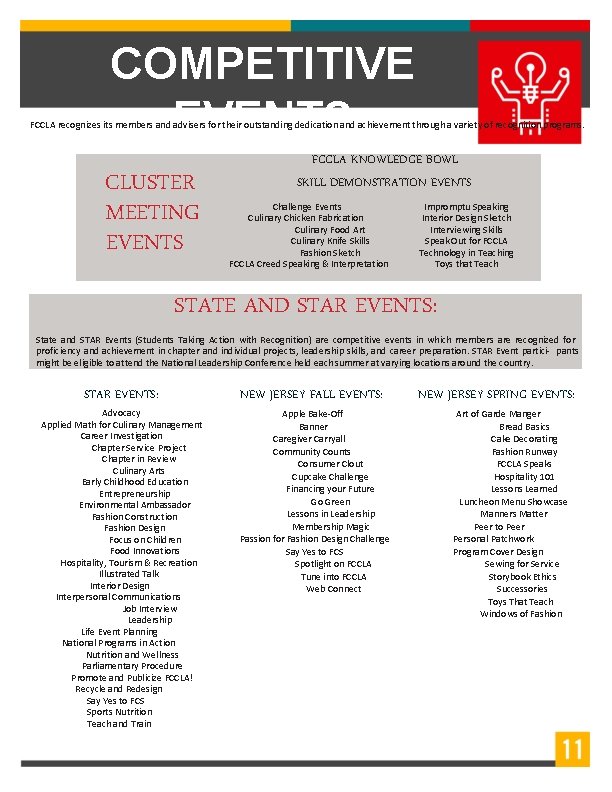
COMPETITIVE EVENTS FCCLA recognizes its members and advisers for their outstanding dedication and achievement through a variety of recognition programs. CLUSTER MEETING EVENTS FCCLA KNOWLEDGE BOWL SKILL DEMONSTRATION EVENTS Challenge Events Culinary Chicken Fabrication Culinary Food Art Culinary Knife Skills Fashion Sketch FCCLA Creed Speaking & Interpretation Impromptu Speaking Interior Design Sketch Interviewing Skills Speak Out for FCCLA Technology in Teaching Toys that Teach STATE AND STAR EVENTS: State and STAR Events (Students Taking Action with Recognition) are competitive events in which members are recognized for proficiency and achievement in chapter and individual projects, leadership skills, and career preparation. STAR Event partici- pants might be eligible to attend the National Leadership Conference held each summer at varying locations around the country. STAR EVENTS: Advocacy Applied Math for Culinary Management Career Investigation Chapter Service Project Chapter in Review Culinary Arts Early Childhood Education Entrepreneurship Environmental Ambassador Fashion Construction Fashion Design Focus on Children Food Innovations Hospitality, Tourism & Recreation Illustrated Talk Interior Design Interpersonal Communications Job Interview Leadership Life Event Planning National Programs in Action Nutrition and Wellness Parliamentary Procedure Promote and Publicize FCCLA! Recycle and Redesign Say Yes to FCS Sports Nutrition Teach and Train NEW JERSEY FALL EVENTS: Apple Bake-Off Banner Caregiver Carryall Community Counts Consumer Clout Cupcake Challenge Financing your Future Go Green Lessons in Leadership Membership Magic Passion for Fashion Design Challenge Say Yes to FCS Spotlight on FCCLA Tune into FCCLA Web Connect NEW JERSEY SPRING EVENTS: Art of Garde Manger Bread Basics Cake Decorating Fashion Runway FCCLA Speaks Hospitality 101 Lessons Learned Luncheon Menu Showcase Manners Matter Peer to Peer Personal Patchwork Program Cover Design Sewing for Service Storybook Ethics Successories Toys That Teach Windows of Fashion
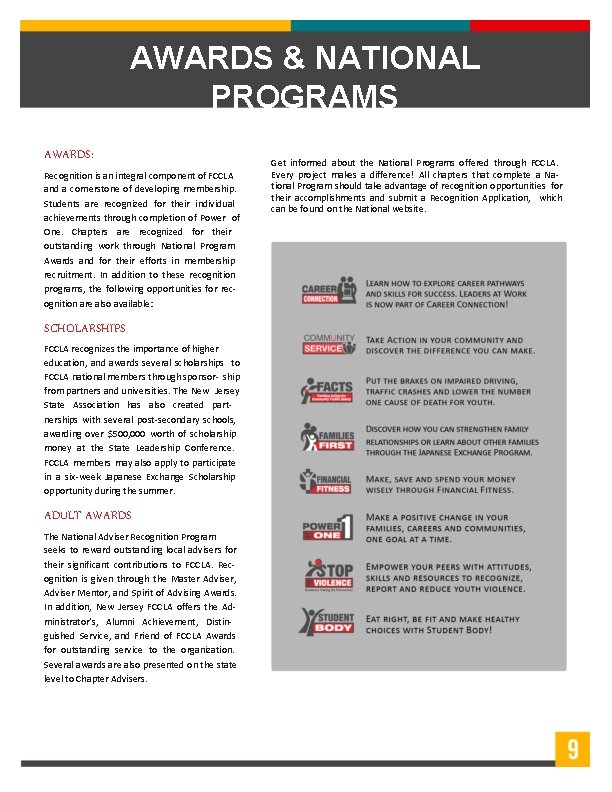
AWARDS & NATIONAL PROGRAMS AWARDS: Recognition is an integral component of FCCLA and a cornerstone of developing membership. Students are recognized for their individual achievements through completion of Power of One. Chapters are recognized for their outstanding work through National Program Awards and for their efforts in membership recruitment. In addition to these recognition programs, the following opportunities for recognition are also available: SCHOLARSHIPS FCCLA recognizes the importance of higher education, and awards several scholarships to FCCLA national members through sponsor- ship from partners and universities. The New Jersey State Association has also created partnerships with several post-secondary schools, awarding over $500, 000 worth of scholarship money at the State Leadership Conference. FCCLA members may also apply to participate in a six-week Japanese Exchange Scholarship opportunity during the summer. ADULT AWARDS The National Adviser Recognition Program seeks to reward outstanding local advisers for their significant contributions to FCCLA. Recognition is given through the Master Adviser, Adviser Mentor, and Spirit of Advising Awards. In addition, New Jersey FCCLA offers the Administrator’s, Alumni Achievement, Distinguished Service, and Friend of FCCLA Awards for outstanding service to the organization. Several awards are also presented on the state level to Chapter Advisers. Get informed about the National Programs offered through FCCLA. Every project makes a difference! All chapters that complete a National Program should take advantage of recognition opportunities for their accomplishments and submit a Recognition Application, which can be found on the National website.
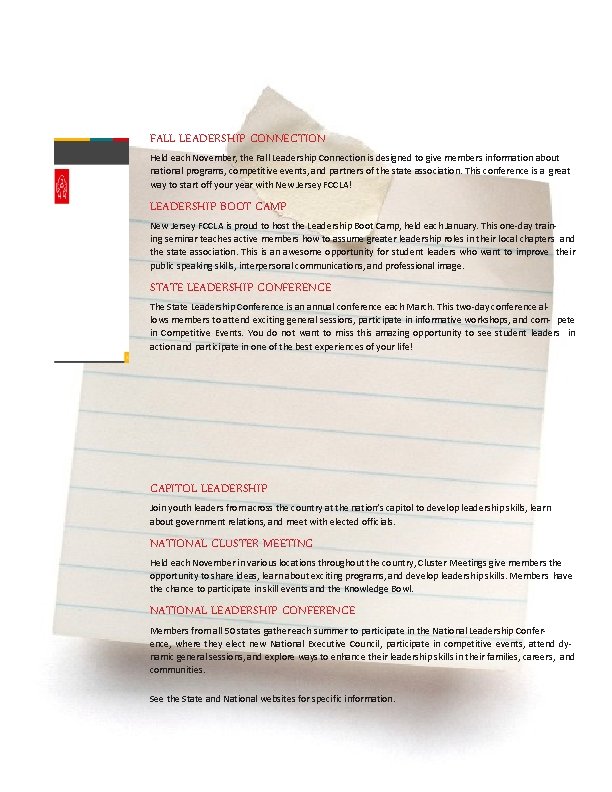
MEETIN GS FALL LEADERSHIP CONNECTION Held each November, the Fall Leadership Connection is designed to give members information about national programs, competitive events, and partners of the state association. This conference is a great way to start off your year with New Jersey FCCLA! LEADERSHIP BOOT CAMP New Jersey FCCLA is proud to host the Leadership Boot Camp, held each January. This one-day training seminar teaches active members how to assume greater leadership roles in their local chapters and the state association. This is an awesome opportunity for student leaders who want to improve their public speaking skills, interpersonal communications, and professional image. STATE LEADERSHIP CONFERENCE The State Leadership Conference is an annual conference each March. This two-day conference allows members to attend exciting general sessions, participate in informative workshops, and com- pete in Competitive Events. You do not want to miss this amazing opportunity to see student leaders in action and participate in one of the best experiences of your life! CAPITOL LEADERSHIP Join youth leaders from across the country at the nation’s capitol to develop leadership skills, learn about government relations, and meet with elected officials. NATIONAL CLUSTER MEETING Held each November in various locations throughout the country, Cluster Meetings give members the opportunity to share ideas, learn about exciting programs, and develop leadership skills. Members have the chance to participate in skill events and the Knowledge Bowl. NATIONAL LEADERSHIP CONFERENCE Members from all 50 states gather each summer to participate in the National Leadership Conference, where they elect new National Executive Council, participate in competitive events, attend dynamic general sessions, and explore ways to enhance their leadership skills in their families, careers, and communities. See the State and National websites for specific information.
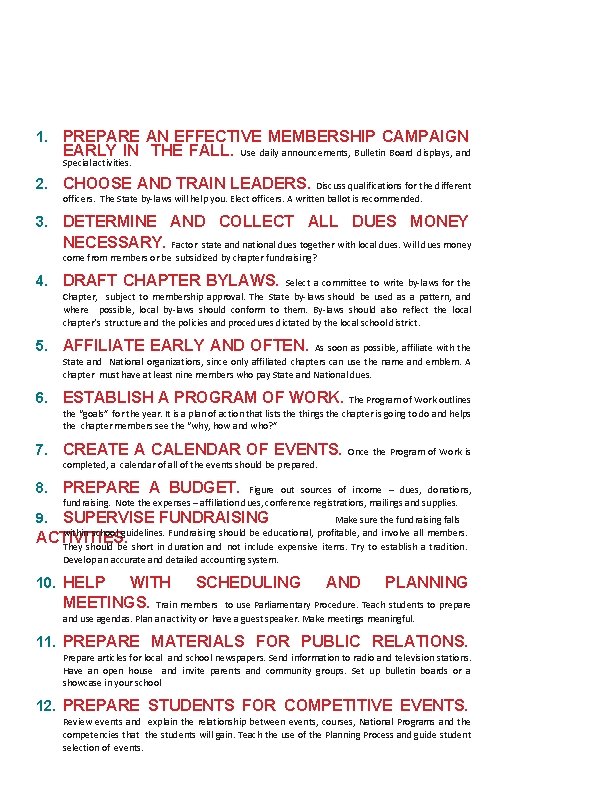
ORGANIZING A CHAPTER 1. PREPARE AN EFFECTIVE MEMBERSHIP CAMPAIGN EARLY IN THE FALL. Use daily announcements, Bulletin Board displays, and Special activities. 2. CHOOSE AND TRAIN LEADERS. 3. DETERMINE AND COLLECT ALL DUES MONEY NECESSARY. Factor state and national dues together with local dues. Will dues money Discuss qualifications for the different officers. The State by-laws will help you. Elect officers. A written ballot is recommended. come from members or be subsidized by chapter fundraising? 4. DRAFT CHAPTER BYLAWS. 5. AFFILIATE EARLY AND OFTEN. 6. ESTABLISH A PROGRAM OF WORK. The Program of Work outlines Select a committee to write by-laws for the Chapter, subject to membership approval. The State by-laws should be used as a pattern, and where possible, local by-laws should conform to them. By-laws should also reflect the local chapter’s structure and the policies and procedures dictated by the local school district. As soon as possible, affiliate with the State and National organizations, since only affiliated chapters can use the name and emblem. A chapter must have at least nine members who pay State and National dues. the “goals” for the year. It is a plan of action that lists the things the chapter is going to do and helps the chapter members see the “why, how and who? ” 7. CREATE A CALENDAR OF EVENTS. Once the Program of Work is completed, a calendar of all of the events should be prepared. 8. PREPARE A BUDGET. Figure out sources of income – dues, donations, fundraising. Note the expenses – affiliation dues, conference registrations, mailings and supplies. Make sure the fundraising falls SUPERVISE FUNDRAISING within school guidelines. Fundraising should be educational, profitable, and involve all members. ACTIVITIES. They should be short in duration and not include expensive items. Try to establish a tradition. 9. Develop an accurate and detailed accounting system. 10. HELP WITH SCHEDULING AND PLANNING MEETINGS. Train members to use Parliamentary Procedure. Teach students to prepare and use agendas. Plan an activity or have a guest speaker. Make meetings meaningful. 11. PREPARE MATERIALS FOR PUBLIC RELATIONS. Prepare articles for local and school newspapers. Send information to radio and television stations. Have an open house and invite parents and community groups. Set up bulletin boards or a showcase in your school 12. PREPARE STUDENTS FOR COMPETITIVE EVENTS. Review events and explain the relationship between events, courses, National Programs and the competencies that the students will gain. Teach the use of the Planning Process and guide student selection of events.
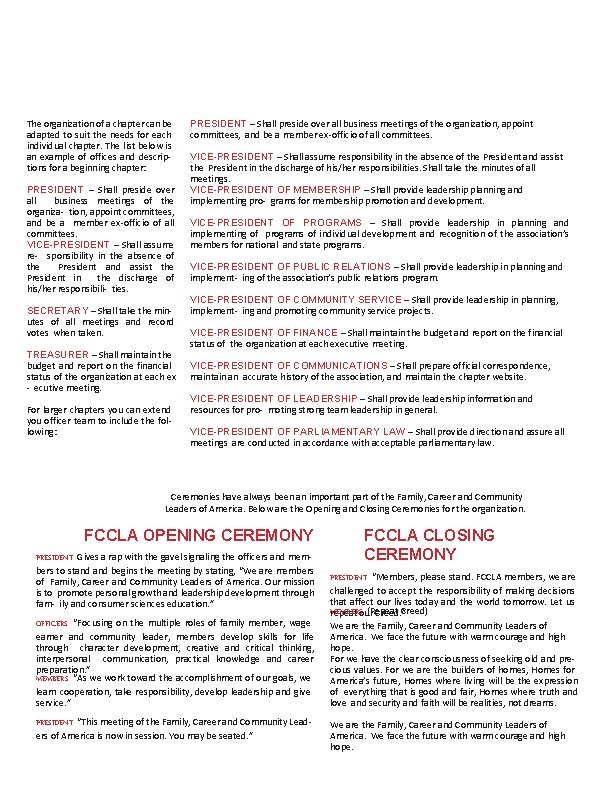
OFFICERS & CEREMONIES The organization of a chapter can be adapted to suit the needs for each individual chapter. The list below is an example of offices and descriptions for a beginning chapter: PRESIDENT – Shall preside over all business meetings of the organiza- tion, appoint committees, and be a member ex-officio of all committees. VICE-PRESIDENT – Shall assume re- sponsibility in the absence of the President and assist the President in the discharge of his/her responsibili- ties. SECRETARY – Shall take the minutes of all meetings and record votes when taken. TREASURER – Shall maintain the budget and report on the financial status of the organization at each ex - ecutive meeting. For larger chapters you can extend you officer team to include the following: PRESIDENT – Shall preside over all business meetings of the organization, appoint committees, and be a member ex-officio of all committees. VICE-PRESIDENT – Shall assume responsibility in the absence of the President and assist the President in the discharge of his/her responsibilities. Shall take the minutes of all meetings. VICE-PRESIDENT OF MEMBERSHIP – Shall provide leadership planning and implementing pro- grams for membership promotion and development. VICE-PRESIDENT OF PROGRAMS – Shall provide leadership in planning and implementing of programs of individual development and recognition of the association’s members for national and state programs. VICE-PRESIDENT OF PUBLIC RELATIONS – Shall provide leadership in planning and implement- ing of the association’s public relations program. VICE-PRESIDENT OF COMMUNITY SERVICE – Shall provide leadership in planning, implement- ing and promoting community service projects. VICE-PRESIDENT OF FINANCE – Shall maintain the budget and report on the financial status of the organization at each executive meeting. VICE-PRESIDENT OF COMMUNICATIONS – Shall prepare official correspondence, maintain an accurate history of the association, and maintain the chapter website. VICE-PRESIDENT OF LEADERSHIP – Shall provide leadership information and resources for pro- moting strong team leadership in general. VICE-PRESIDENT OF PARLIAMENTARY LAW – Shall provide direction and assure all meetings are conducted in accordance with acceptable parliamentary law. Ceremonies have always been an important part of the Family, Career and Community Leaders of America. Below are the Opening and Closing Ceremonies for the organization. FCCLA OPENING CEREMONY PRESIDENT: Gives a rap with the gavel signaling the officers and members to stand begins the meeting by stating, “We are members of Family, Career and Community Leaders of America. Our mission is to promote personal growth and leadership development through fam- ily and consumer sciences education. ” OFFICERS: “Focusing on the multiple roles of family member, wage earner and community leader, members develop skills for life through character development, creative and critical thinking, interpersonal communication, practical knowledge and career preparation. ” MEMBERS: “As we work toward the accomplishment of our goals, we learn cooperation, take responsibility, develop leadership and give service. ” PRESIDENT: “This meeting of the Family, Career and Community Leaders of America is now in session. You may be seated. ” FCCLA CLOSING CEREMONY PRESIDENT: “Members, please stand. FCCLA members, we are challenged to accept the responsibility of making decisions that affect our lives today and the world tomorrow. Let us MEMBERS: (Repeat Creed) repeat our Creed. ” We are the Family, Career and Community Leaders of America. We face the future with warm courage and high hope. For we have the clear consciousness of seeking old and precious values. For we are the builders of homes, Homes for America’s future, Homes where living will be the expression of everything that is good and fair, Homes where truth and love and security and faith will be realities, not dreams. We are the Family, Career and Community Leaders of America. We face the future with warm courage and high hope.

CHAPTER MEETINGS Many activities and components of FCCLA are planned and carried out at chapter meetings. It must be remembered that there are several types of meetings, each with its own function. The meeting types below can help your chapter meet many needs, be sure to plan meetings with each function in mind. A chapter meeting may be a combination of any of the function below; adapt meetings to suit the needs of your chapter! BUSINESS FUNCTIONS: Some functions of the business meeting may be to discuss and plan activities, carry out responsibilities, present officer/commit- tee reports, elect officers, and establish committees. EDUCATIONAL FUNCTION: Educational meetings are those at which special presentations are made through films, Power. Point Presentations, guest speak- ers, panel discussions or field trips. SOCIAL FUNCTION: These functions are usually held outside of class and are of a recreational nature, such as dances, bowling, ice cream/pizza par- ties, etc. SERVICE FUNCTION: Service functions are usually community-based and include activities for the benefit of people within the community such as special needs groups, the elderly or terminally ill children. CHAPTER OF FC CLA DATE When planning meetings, it is important to use an agenda to keep meetings on track and cover the business that needs to be discussed. An agenda template is pictured on the right: 1. 2. 3. 4. 5. 6. 7. 8. 9. 10. Call to Order Roll Call Secretary’s M inutes Financial Repo rt Committee Re ports Unfinished Bu siness New Business Announcemen ts Closing Cere mony Adjournmen t
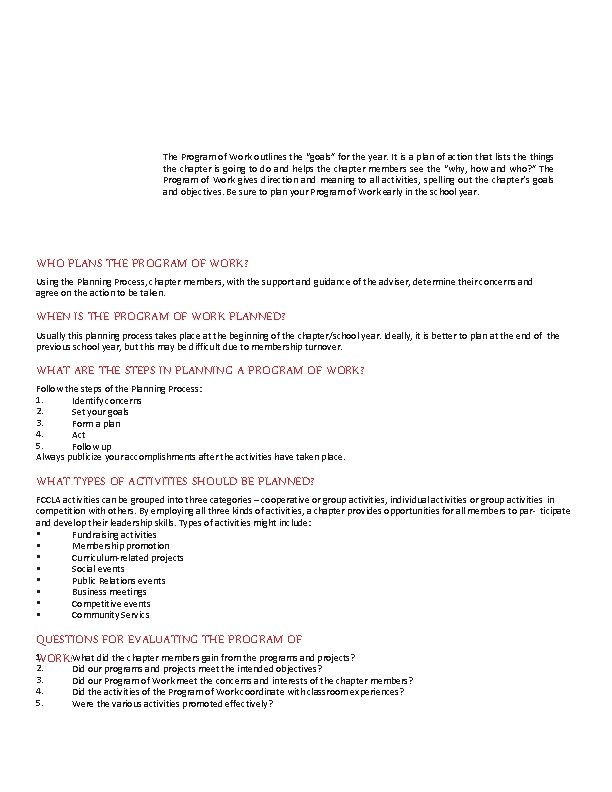
PROGRAM OF WORK The Program of Work outlines the “goals” for the year. It is a plan of action that lists the things the chapter is going to do and helps the chapter members see the “why, how and who? ” The Program of Work gives direction and meaning to all activities, spelling out the chapter’s goals and objectives. Be sure to plan your Program of Work early in the school year. WHO PLANS THE PROGRAM OF WORK? Using the Planning Process, chapter members, with the support and guidance of the adviser, determine their concerns and agree on the action to be taken. WHEN IS THE PROGRAM OF WORK PLANNED? Usually this planning process takes place at the beginning of the chapter/school year. Ideally, it is better to plan at the end of the previous school year, but this may be difficult due to membership turnover. WHAT ARE THE STEPS IN PLANNING A PROGRAM OF WORK? Follow the steps of the Planning Process: 1. Identify concerns 2. Set your goals 3. Form a plan 4. Act 5. Follow up Always publicize your accomplishments after the activities have taken place. WHAT TYPES OF ACTIVITIES SHOULD BE PLANNED? FCCLA activities can be grouped into three categories – cooperative or group activities, individual activities or group activities in competition with others. By employing all three kinds of activities, a chapter provides opportunities for all members to par- ticipate and develop their leadership skills. Types of activities might include: • Fundraising activities • Membership promotion • Curriculum-related projects • Social events • Public Relations events • Business meetings • Competitive events • Community Servics QUESTIONS FOR EVALUATING THE PROGRAM OF 1. WORK: What did the chapter members gain from the programs and projects? 2. 3. 4. 5. Did our programs and projects meet the intended objectives? Did our Program of Work meet the concerns and interests of the chapter members? Did the activities of the Program of Work coordinate with classroom experiences? Were the various activities promoted effectively?
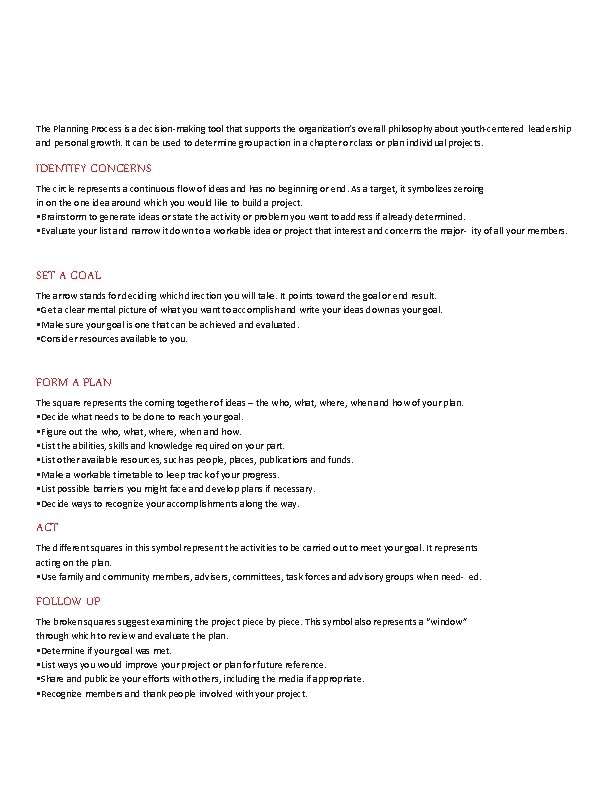
THE PLANNING PROCESS The Planning Process is a decision-making tool that supports the organization’s overall philosophy about youth-centered leadership and personal growth. It can be used to determine group action in a chapter or class or plan individual projects. IDENTIFY CONCERNS The circle represents a continuous flow of ideas and has no beginning or end. As a target, it symbolizes zeroing in on the one idea around which you would like to build a project. • Brainstorm to generate ideas or state the activity or problem you want to address if already determined. • Evaluate your list and narrow it down to a workable idea or project that interest and concerns the major- ity of all your members. SET A GOAL The arrow stands for deciding which direction you will take. It points toward the goal or end result. • Get a clear mental picture of what you want to accomplish and write your ideas down as your goal. • Make sure your goal is one that can be achieved and evaluated. • Consider resources available to you. FORM A PLAN The square represents the coming together of ideas – the who, what, where, when and how of your plan. • Decide what needs to be done to reach your goal. • Figure out the who, what, where, when and how. • List the abilities, skills and knowledge required on your part. • List other available resources, such as people, places, publications and funds. • Make a workable timetable to keep track of your progress. • List possible barriers you might face and develop plans if necessary. • Decide ways to recognize your accomplishments along the way. ACT The different squares in this symbol represent the activities to be carried out to meet your goal. It represents acting on the plan. • Use family and community members, advisers, committees, task forces and advisory groups when need- ed. FOLLOW UP The broken squares suggest examining the project piece by piece. This symbol also represents a “window” through which to review and evaluate the plan. • Determine if your goal was met. • List ways you would improve your project or plan for future reference. • Share and publicize your efforts with others, including the media if appropriate. • Recognize members and thank people involved with your project.
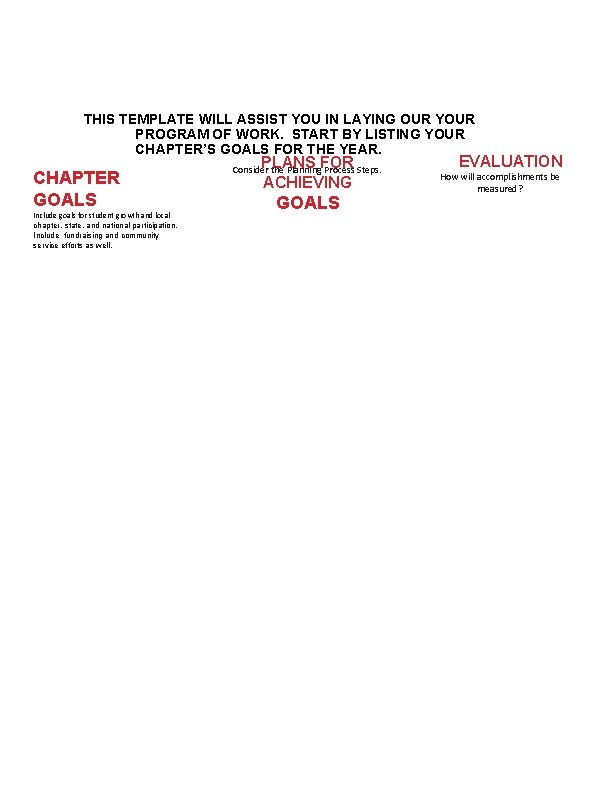
SETTING CHAPTER GOALS THIS TEMPLATE WILL ASSIST YOU IN LAYING OUR YOUR PROGRAM OF WORK. START BY LISTING YOUR CHAPTER’S GOALS FOR THE YEAR. CHAPTER GOALS Include goals for student growth and local chapter, state, and national participation. Include fundraising and community service efforts as well. PLANS FOR ACHIEVING Consider the Planning Process Steps. GOALS EVALUATION How will accomplishments be measured?

DEVELOPING A PROGRAM OF WORK DEVELOP A PROGRAM OF WORK BY IDENTIFYING KEY ACTIVITIES THROUGHOUT THE YEAR.
PUBLIC RELATIONS By using effective Marketing and Public Relations skills, chapters, members, and advisers can spread the word about FCCLA and Family and Consumer Sciences education. NJ FCCLA chapters do great things every day – it’s up to all of us to spread the word and let others know about them! Members and advisers can encourage participation and support for the organization by imple- menting strong PR campaigns. WHY IS MEDIA IMPORTANT? If you want the media to know your chapter, you must first know the media! Pay attention to radio, television, and newspaper reports. Ask yourself why they’re covering what they do, and make special note of stories related to FCCLA programs. Look for instances where someone from your chapter could have easily been a resource. If a reporter does a story even remotely related to the issues you cover, send the person a nice note praising the story. Attach a brochure, fact sheet, or one of the program information sheets about FCCLA, available on the national website, for future use. The media can position your chapter as a vital community resource. But don’t limit your media outreach to planned events. Be proactive. Get to know reporters and media professionals who are interested in your chapter activities, and suggest stories to them throughout the year. This helps you elevate the importance of volunteer action! As you develop relationships with media members, make sure they realize that you can be a valuable resource on many community concerns. The more recognizable FCCLA and your chapter names are the more likely media representatives are to respond to your story ideas. WHAT TYPES OF MEDIA SHOULD MY CHAPTER CONCENTRATE ON? There are many ways to involve the media in your public relations campaign. Some examples are: • Submit an article for your school newspaper • Create a chapter website • Use social media websites • Submit a press release to a local newspaper • Contact the local access cable station to do a story on your chapter RECOGNITION FOR PUBLIC RELATIONS: The National Chapter Public Relations Award recognizes chapters who have excelled in planning and implementing an exemplary public relations campaign to increase public awareness of Family, Career, and Community Leaders of America and Family and Consumer Sciences education. The winning chapter will receive an award of $500, which will be presented at the National Leadership Conference.
RESOUR CES THE BYLAWS OF FCCLA CAN BE FOUND AT WWW. FCCLAINC. ORG. PUBLICATIONS: TEEN TIMES is the official magazine of FCCLA. It is published on a regular basis. One copy is sent to every dues-paying member four times a year. NEW DIRECTIONS is the state-wide newsletter, published two to three times a year, that attempts to “Connect New Jersey – One Chapter at a Time. ” It is filled with the latest FCCLA news, provides recognition to members and advisers, and gives students a chance to voice their opinions and concerns. Articles should be sent to the New Jersey State Office. The most resent issue of New Directions is posted on the state website. THE ADVISER is a bi-yearly publication from the national organization that provides resources and information on national meetings and strategies to increase chapter membership and activity. THE STATE OFFICER is also a bi-yearly newsletter aimed to help State Officers across the country in accomplishing their goals and raising spirit in their states. WEBSITES: WWW. FCCLANJ. ORG The website for the state organization is changed often and has a tremendous amount of information. WWW. FCCLA. COM The website for the national organization can provide in-depth descriptions about each facet of the organization. STATE HEADQUARTERS: The State Office for New Jersey is located at John P. Stevens High School in Edison. Although the official office hours are Monday through Friday, 1 pm to 7 pm, please do not hesitate to call or e-mail the State Adviser if you have any questions. The contact information is as follows: Patricia Di. Gioia-Laird, State Adviser John P. Stevens High School 855 Grove Avenue Edison, NJ 08820 -2201 Phone (732) 452 -2862 Fax (732) 494 -4103 E-mail njfccla@verizon. net
- Slides: 19