
2018 Traffic Signal Benchmarking Self Assessment Web Briefing
2018 Traffic Signal Benchmarking Self Assessment Web Briefing April 4, 2018 1
Presentation Outline • • Why Are We Assessing Traffic Signal Programs Some History Assumptions Underlying Concepts • Objectives & Performance Based Management • Traffic Signal Program and Organizational Capability • Gc. OST Framework • The Self Assessment 2
Why Are We Assessing Traffic Signal Programs Goal Improved Mobility, Safety and Efficiency, Reduce Congestion Objectives and performance-based management in design, operations, and maintenance Strategy / Program of Activities Benchmark traffic signal infrastructure: What is the current level and extent of assets which is integral to informing investment decisions. Capture for traffic signal management, operation and maintenance • Organizational and workforce trends: • Technology implementation • Current practices Value To encourage improvements in practice to benefit the traveling public through proactive management of traffic signal programs leading to consistent system and organizational reliability. 3
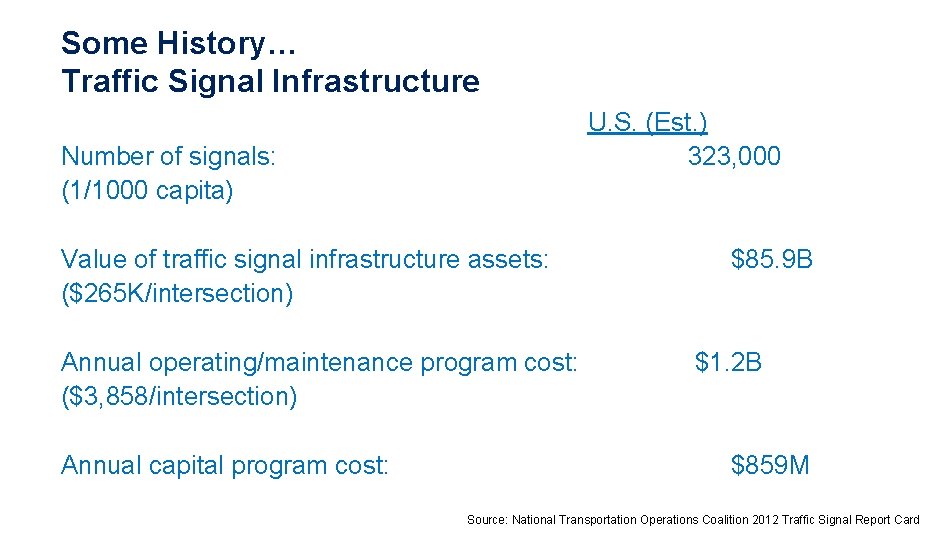
Some History… Traffic Signal Infrastructure U. S. (Est. ) 323, 000 Number of signals: (1/1000 capita) Value of traffic signal infrastructure assets: ($265 K/intersection) Annual operating/maintenance program cost: ($3, 858/intersection) Annual capital program cost: $85. 9 B $1. 2 B $859 M Source: National Transportation Operations Coalition 2012 Traffic Signal Report Card
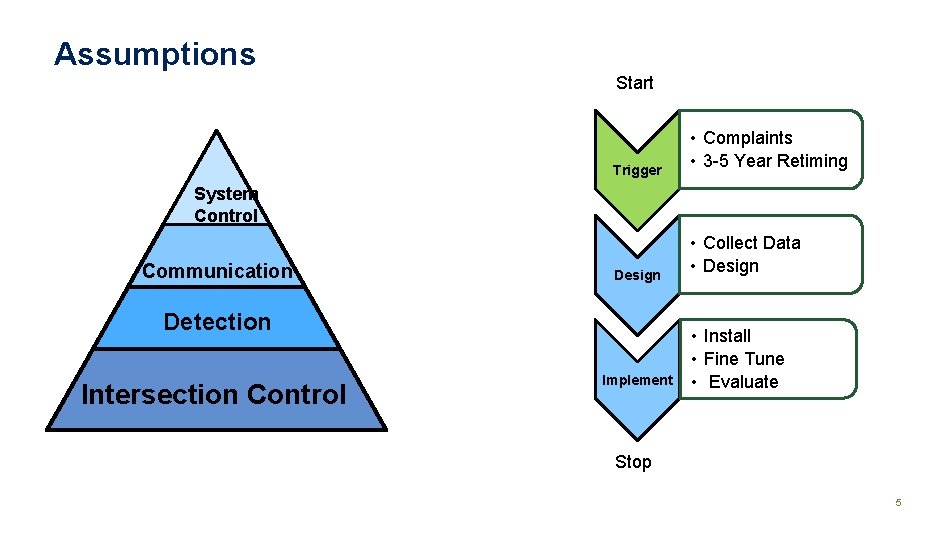
Assumptions Start Trigger • Complaints • 3 -5 Year Retiming System Control Communication Design Detection Intersection Control Implement • Collect Data • Design • Install • Fine Tune • Evaluate Stop 5
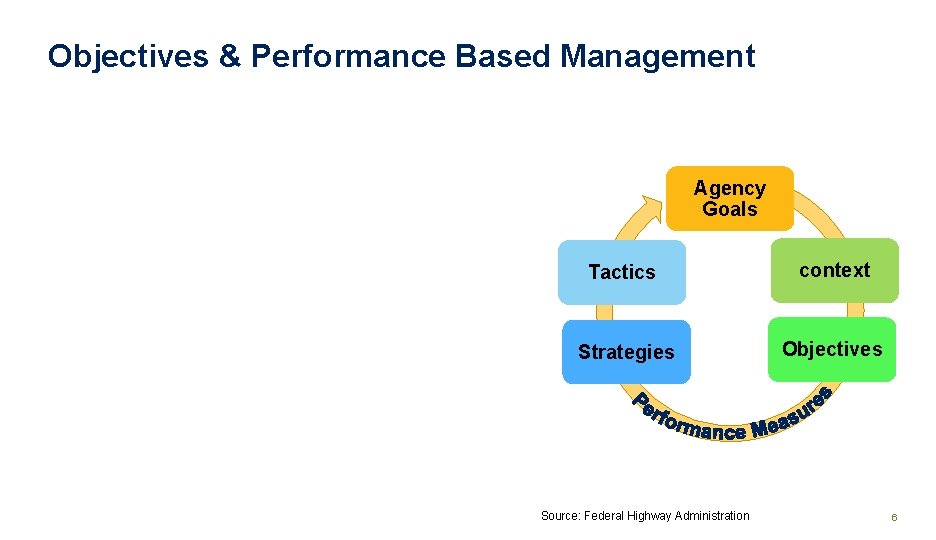
Objectives & Performance Based Management Agency Goals Tactics context Strategies Objectives Source: Federal Highway Administration 6
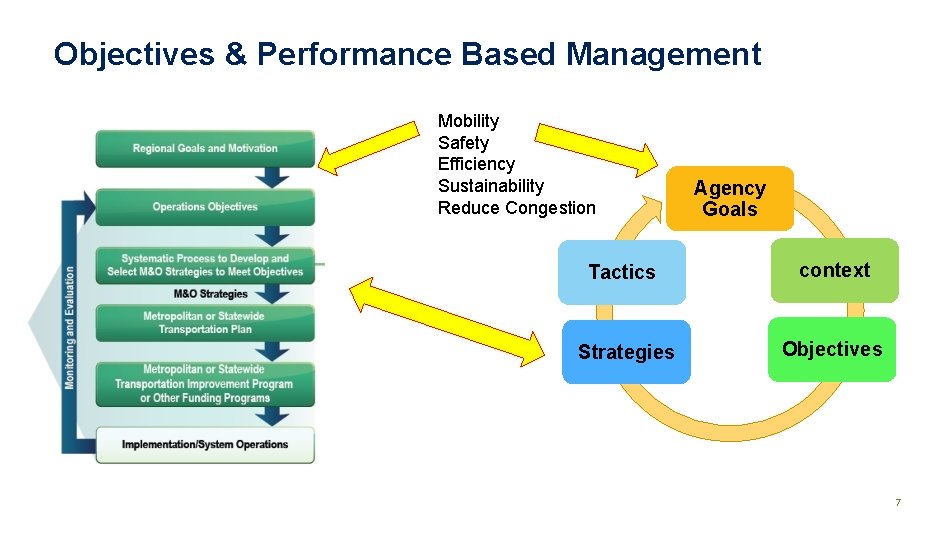
Objectives & Performance Based Management Mobility Safety Efficiency Sustainability Reduce Congestion Agency Goals Tactics context Strategies Objectives 7

Traffic Signal Program Tasks: Design Operations Maintenance System Control Communication Objectives Detection Intersection Control Workforce Management and Administration
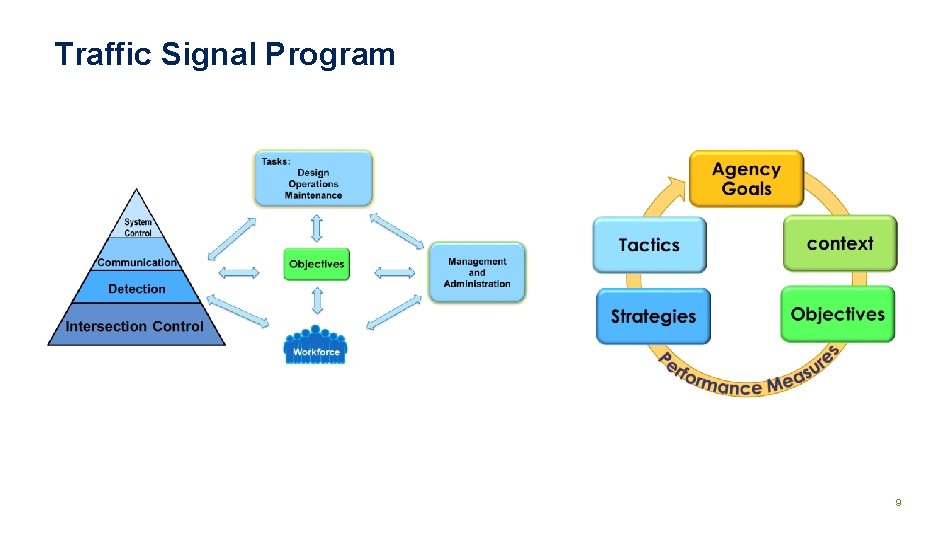
Traffic Signal Program 9
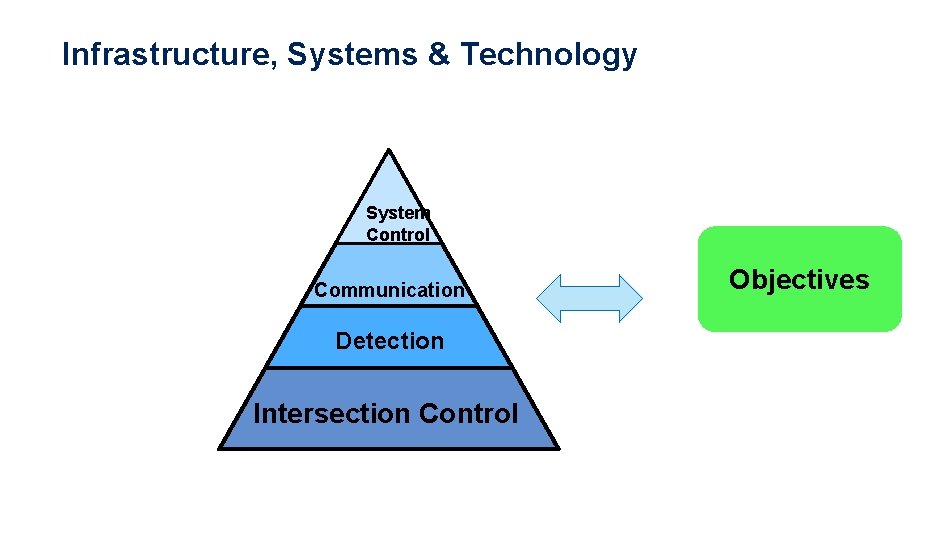
Infrastructure, Systems & Technology System Control Communication Detection Intersection Control Objectives
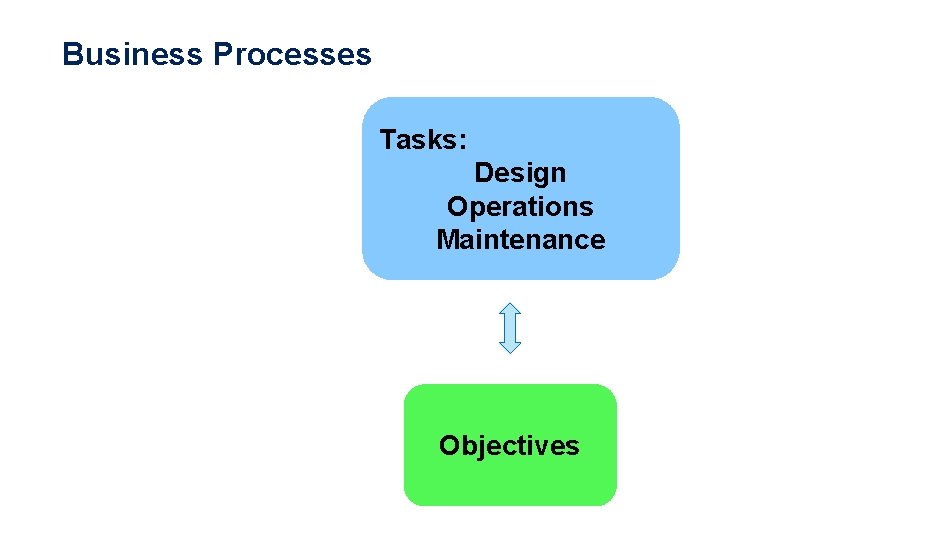
Business Processes Tasks: Design Operations Maintenance Objectives
Workforce Objectives Workforce
Management and Administration Objectives Management and Administration
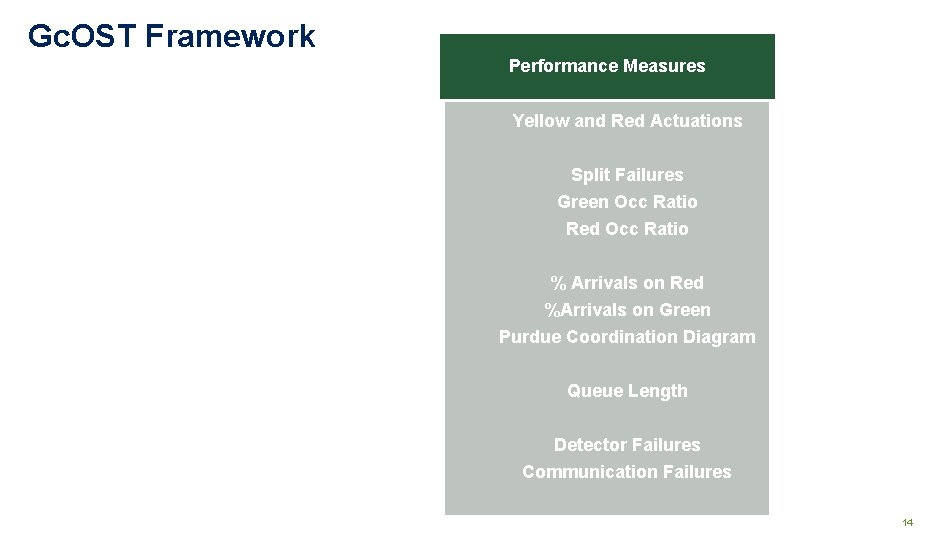
Gc. OST Framework Performance Measures Yellow and Red Actuations Split Failures Green Occ Ratio Red Occ Ratio % Arrivals on Red %Arrivals on Green Purdue Coordination Diagram Queue Length Detector Failures Communication Failures 14
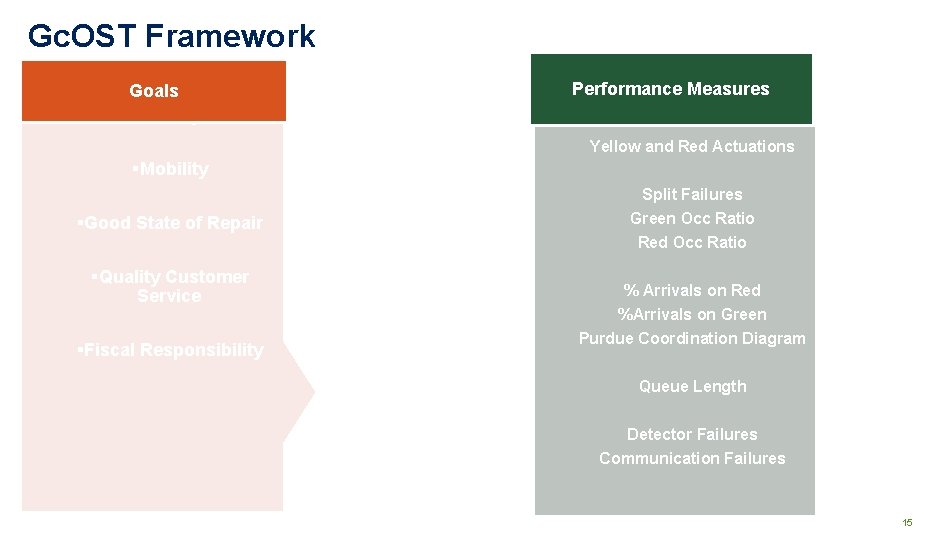
Gc. OST Framework Goals §Safety Performance Measures Yellow and Red Actuations §Mobility §Good State of Repair Split Failures Green Occ Ratio Red Occ Ratio §Quality Customer Service §Fiscal Responsibility % Arrivals on Red %Arrivals on Green Purdue Coordination Diagram Queue Length Detector Failures Communication Failures 15
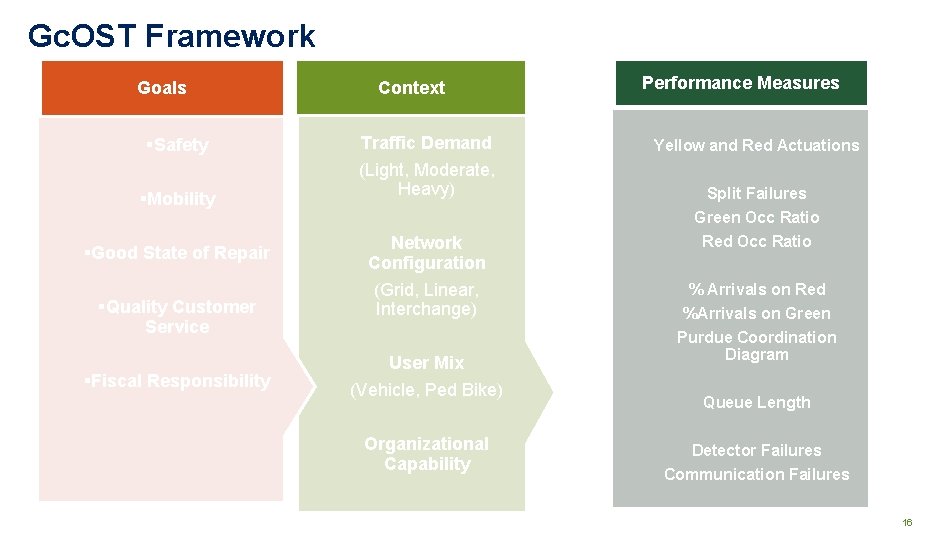
Gc. OST Framework Goals §Safety §Mobility §Good State of Repair §Quality Customer Service §Fiscal Responsibility Context Traffic Demand (Light, Moderate, Heavy) Network Configuration (Grid, Linear, Interchange) User Mix (Vehicle, Ped Bike) Organizational Capability Performance Measures Yellow and Red Actuations Split Failures Green Occ Ratio Red Occ Ratio % Arrivals on Red %Arrivals on Green Purdue Coordination Diagram Queue Length Detector Failures Communication Failures 16
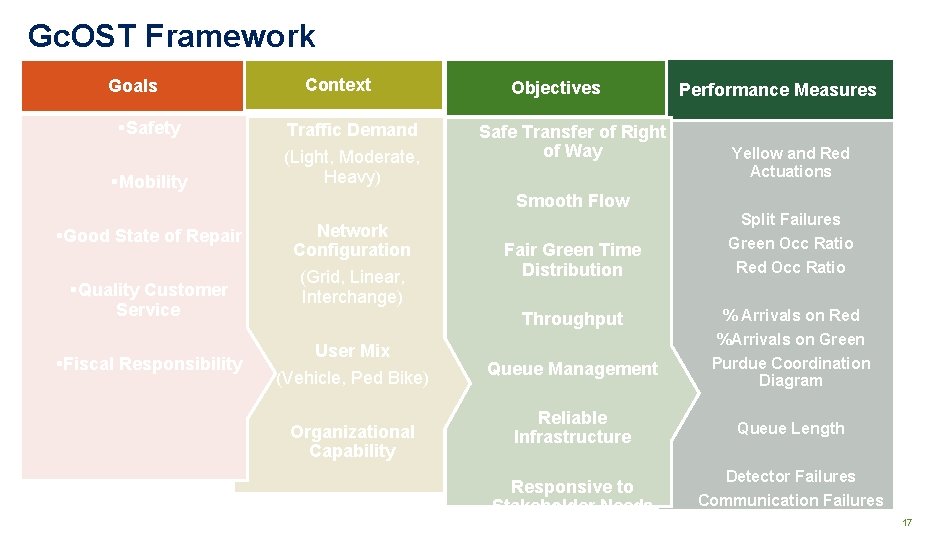
Gc. OST Framework Goals Context §Safety Traffic Demand §Mobility (Light, Moderate, Heavy) §Good State of Repair §Quality Customer Service §Fiscal Responsibility Objectives Safe Transfer of Right of Way Smooth Flow Network Configuration (Grid, Linear, Interchange) Fair Green Time Distribution Throughput User Mix (Vehicle, Ped Bike) Organizational Capability Queue Management Reliable Infrastructure Responsive to Stakeholder Needs Performance Measures Yellow and Red Actuations Split Failures Green Occ Ratio Red Occ Ratio % Arrivals on Red %Arrivals on Green Purdue Coordination Diagram Queue Length Detector Failures Communication Failures 17
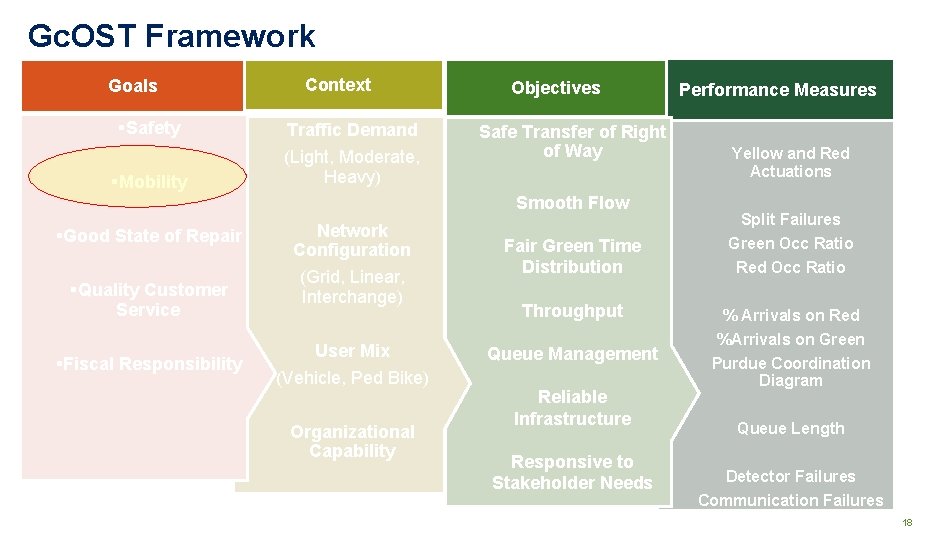
Gc. OST Framework Goals Context §Safety Traffic Demand §Mobility (Light, Moderate, Heavy) Objectives Safe Transfer of Right of Way Smooth Flow §Good State of Repair §Quality Customer Service §Fiscal Responsibility Network Configuration (Grid, Linear, Interchange) Fair Green Time Distribution User Mix Queue Management (Vehicle, Ped Bike) Organizational Capability Throughput Reliable Infrastructure Responsive to Stakeholder Needs Performance Measures Yellow and Red Actuations Split Failures Green Occ Ratio Red Occ Ratio % Arrivals on Red %Arrivals on Green Purdue Coordination Diagram Queue Length Detector Failures Communication Failures 18
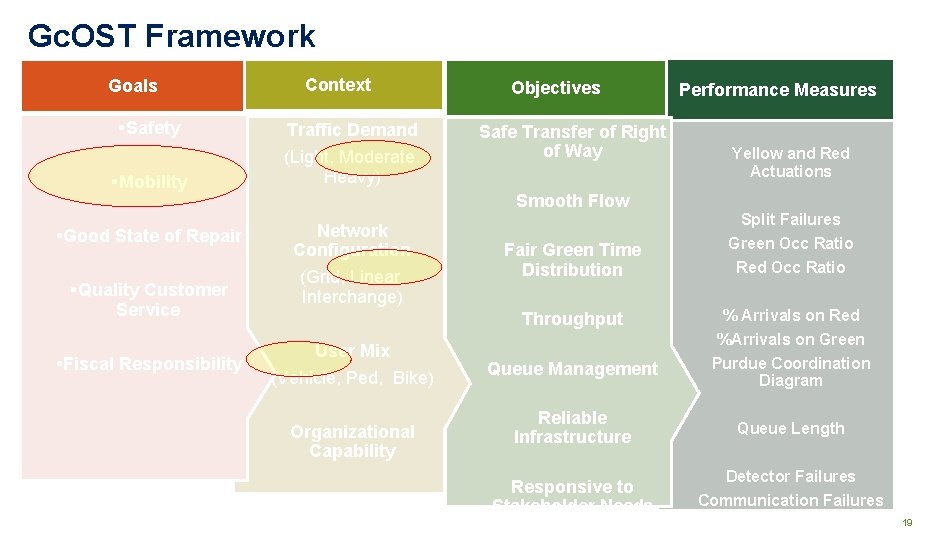
Gc. OST Framework Goals Context §Safety Traffic Demand §Mobility (Light, Moderate, Heavy) §Good State of Repair §Quality Customer Service §Fiscal Responsibility Objectives Safe Transfer of Right of Way Smooth Flow Network Configuration (Grid, Linear, Interchange) Fair Green Time Distribution Throughput User Mix (Vehicle, Ped, Bike) Organizational Capability Queue Management Reliable Infrastructure Responsive to Stakeholder Needs Performance Measures Yellow and Red Actuations Split Failures Green Occ Ratio Red Occ Ratio % Arrivals on Red %Arrivals on Green Purdue Coordination Diagram Queue Length Detector Failures Communication Failures 19
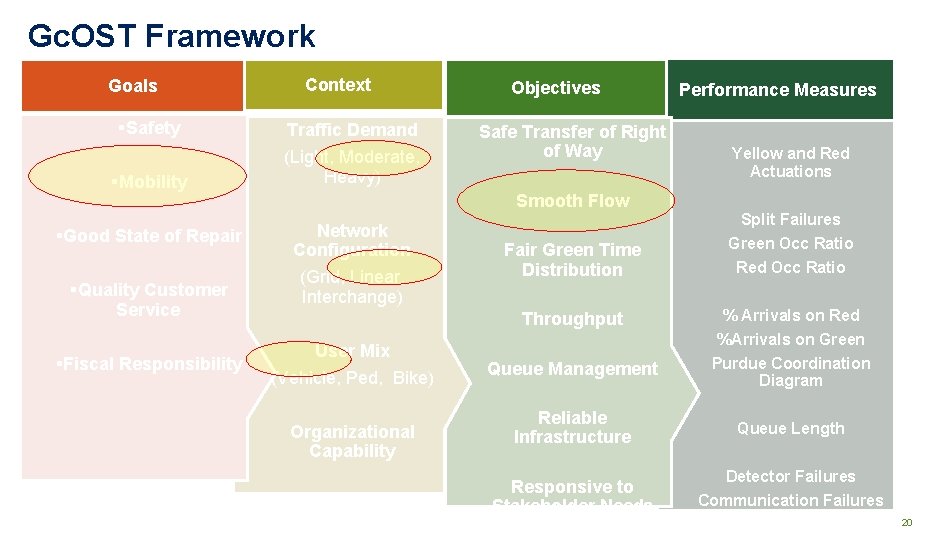
Gc. OST Framework Goals Context §Safety Traffic Demand §Mobility (Light, Moderate, Heavy) §Good State of Repair §Quality Customer Service §Fiscal Responsibility Objectives Safe Transfer of Right of Way Smooth Flow Network Configuration (Grid, Linear, Interchange) Fair Green Time Distribution Throughput User Mix (Vehicle, Ped, Bike) Organizational Capability Queue Management Reliable Infrastructure Responsive to Stakeholder Needs Performance Measures Yellow and Red Actuations Split Failures Green Occ Ratio Red Occ Ratio % Arrivals on Red %Arrivals on Green Purdue Coordination Diagram Queue Length Detector Failures Communication Failures 20
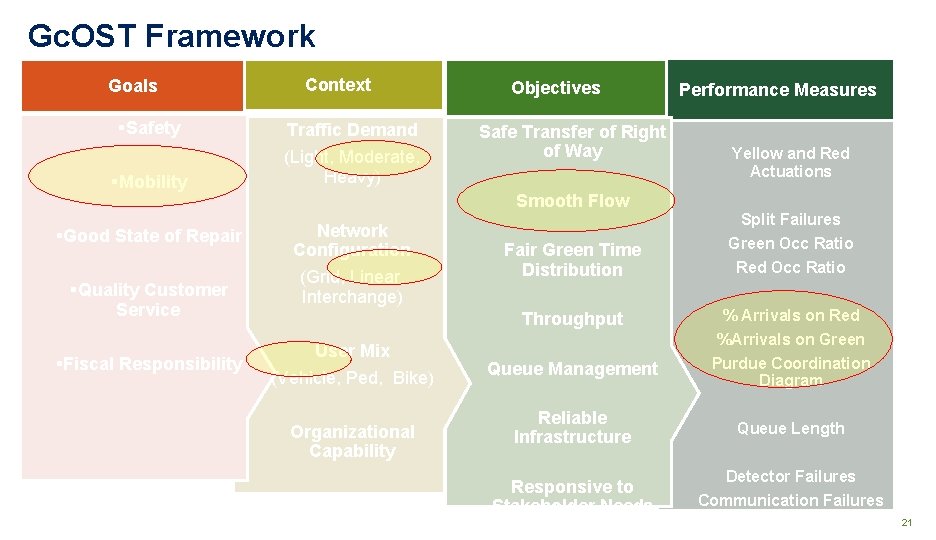
Gc. OST Framework Goals Context §Safety Traffic Demand §Mobility (Light, Moderate, Heavy) §Good State of Repair §Quality Customer Service §Fiscal Responsibility Objectives Safe Transfer of Right of Way Smooth Flow Network Configuration (Grid, Linear, Interchange) Fair Green Time Distribution Throughput User Mix (Vehicle, Ped, Bike) Organizational Capability Queue Management Reliable Infrastructure Responsive to Stakeholder Needs Performance Measures Yellow and Red Actuations Split Failures Green Occ Ratio Red Occ Ratio % Arrivals on Red %Arrivals on Green Purdue Coordination Diagram Queue Length Detector Failures Communication Failures 21
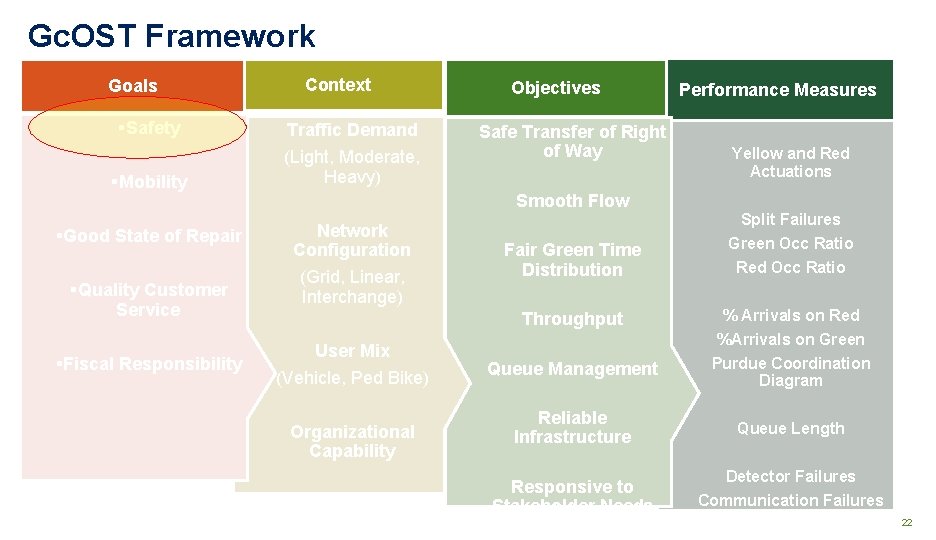
Gc. OST Framework Goals Context §Safety Traffic Demand §Mobility (Light, Moderate, Heavy) §Good State of Repair §Quality Customer Service §Fiscal Responsibility Objectives Safe Transfer of Right of Way Smooth Flow Network Configuration (Grid, Linear, Interchange) Fair Green Time Distribution Throughput User Mix (Vehicle, Ped Bike) Organizational Capability Queue Management Reliable Infrastructure Responsive to Stakeholder Needs Performance Measures Yellow and Red Actuations Split Failures Green Occ Ratio Red Occ Ratio % Arrivals on Red %Arrivals on Green Purdue Coordination Diagram Queue Length Detector Failures Communication Failures 22
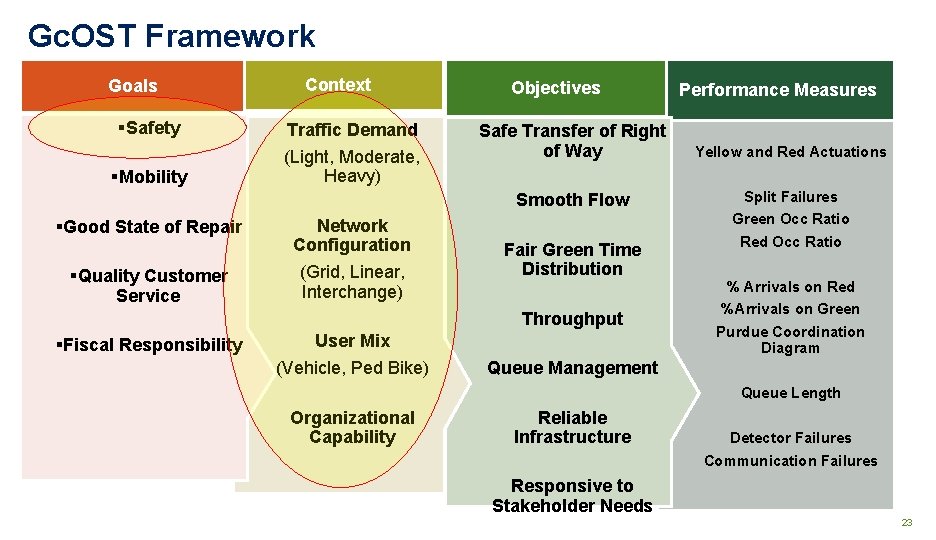
Gc. OST Framework Goals Context §Safety Traffic Demand §Mobility (Light, Moderate, Heavy) Objectives Safe Transfer of Right of Way Smooth Flow §Good State of Repair §Quality Customer Service Network Configuration (Grid, Linear, Interchange) Fair Green Time Distribution Throughput §Fiscal Responsibility User Mix (Vehicle, Ped Bike) Performance Measures Yellow and Red Actuations Split Failures Green Occ Ratio Red Occ Ratio % Arrivals on Red %Arrivals on Green Purdue Coordination Diagram Queue Management Queue Length Organizational Capability Reliable Infrastructure Detector Failures Communication Failures Responsive to Stakeholder Needs 23
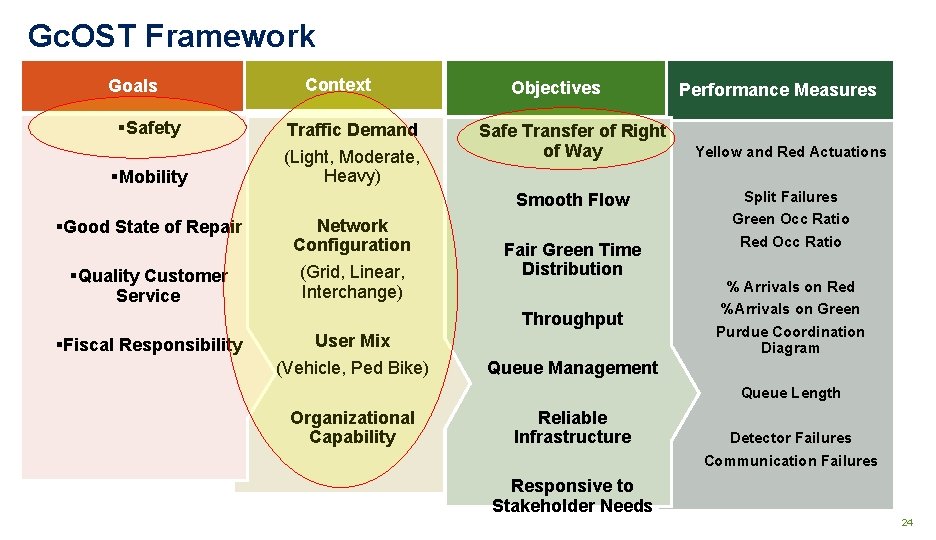
Gc. OST Framework Goals Context §Safety Traffic Demand §Mobility (Light, Moderate, Heavy) Objectives Safe Transfer of Right of Way Smooth Flow §Good State of Repair §Quality Customer Service Network Configuration (Grid, Linear, Interchange) Fair Green Time Distribution Throughput §Fiscal Responsibility User Mix (Vehicle, Ped Bike) Performance Measures Yellow and Red Actuations Split Failures Green Occ Ratio Red Occ Ratio % Arrivals on Red %Arrivals on Green Purdue Coordination Diagram Queue Management Queue Length Organizational Capability Reliable Infrastructure Detector Failures Communication Failures Responsive to Stakeholder Needs 24
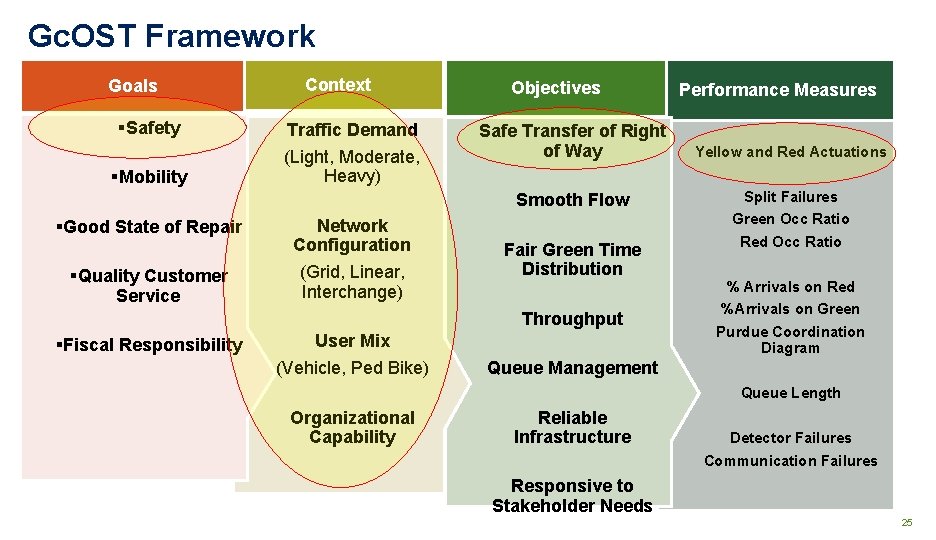
Gc. OST Framework Goals Context §Safety Traffic Demand §Mobility (Light, Moderate, Heavy) Objectives Safe Transfer of Right of Way Smooth Flow §Good State of Repair §Quality Customer Service Network Configuration (Grid, Linear, Interchange) Fair Green Time Distribution Throughput §Fiscal Responsibility User Mix (Vehicle, Ped Bike) Performance Measures Yellow and Red Actuations Split Failures Green Occ Ratio Red Occ Ratio % Arrivals on Red %Arrivals on Green Purdue Coordination Diagram Queue Management Queue Length Organizational Capability Reliable Infrastructure Detector Failures Communication Failures Responsive to Stakeholder Needs 25
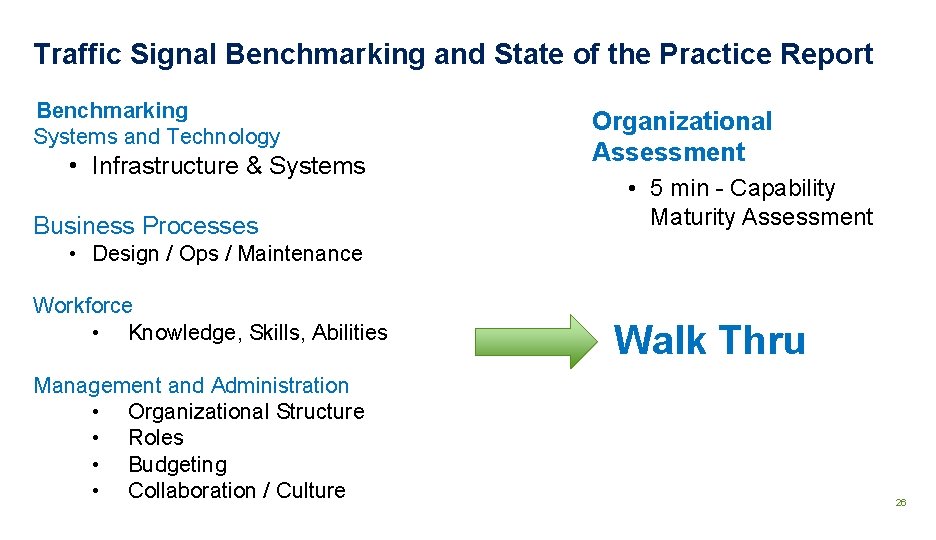
Traffic Signal Benchmarking and State of the Practice Report Benchmarking Systems and Technology • Infrastructure & Systems Business Processes Organizational Assessment • 5 min - Capability Maturity Assessment • Design / Ops / Maintenance Workforce • Knowledge, Skills, Abilities Management and Administration • Organizational Structure • Roles • Budgeting • Collaboration / Culture Walk Thru 26
Questions? Eddie Curtis Federal Highway Administration eddie. curtis@dot. gov | (404) 780 -0927 Raise hand Wait for signal Douglas E. Noble, P. E. , PTOE Institute of Transportation Engineers dnoble@ite. org | ((202) 464 -6248 Steven Lavrenz, Ph. D. E. I. National Operations Center of Excellence slavrenz@transportationops. org | (202) 464 -6222 The unexamined traffic signal is not worth operating. ~ Curtis
2018 Traffic Signal Benchmarking Self Assessment
- Slides: 28