
2018 Syntax A First Encounter Marcel den Dikken




- Slides: 22
: 2018
Syntax: A First Encounter Marcel den Dikken Department of English Linguistics ELTE
SAFE 12 Referential Dependencies → • • • 3 SAFEty First the nominal phrase has an internal structure that looks very much like that of the clause functional categories in the structure of nominal phrases include quantifiers (Q) and determiners (D) adjunction is possible both in the nominal phrase and in the clause – the particular example of adjunction in the nominal phrase that we looked at was the attachment of relative clauses in the nominal phrase, the highest specifier position can be occupied by a possessor, which entertains a relation of Spec-Head agreement with the D-head, filled by the genitival marker ’s the idea that the possessor in DP are very much like the subject in IP is the starting point of this last segment
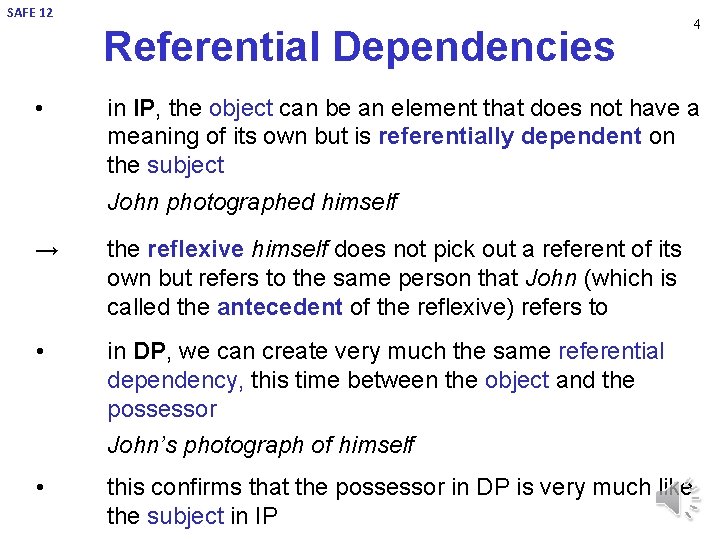
SAFE 12 Referential Dependencies • in IP, the object can be an element that does not have a meaning of its own but is referentially dependent on the subject John photographed himself → the reflexive himself does not pick out a referent of its own but refers to the same person that John (which is called the antecedent of the reflexive) refers to • in DP, we can create very much the same referential dependency, this time between the object and the possessor John’s photograph of himself • 4 this confirms that the possessor in DP is very much like the subject in IP
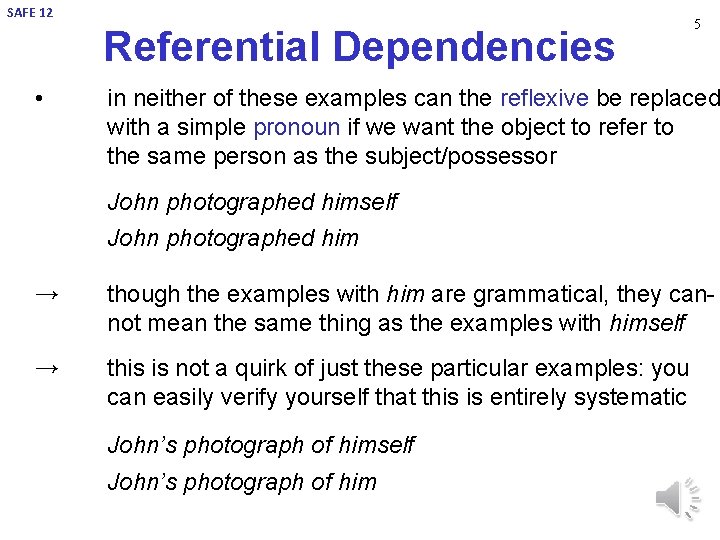
SAFE 12 Referential Dependencies • 5 in neither of these examples can the reflexive be replaced with a simple pronoun if we want the object to refer to the same person as the subject/possessor John photographed himself John photographed him → though the examples with him are grammatical, they cannot mean the same thing as the examples with himself → this is not a quirk of just these particular examples: you can easily verify yourself that this is entirely systematic John’s photograph of himself John’s photograph of him
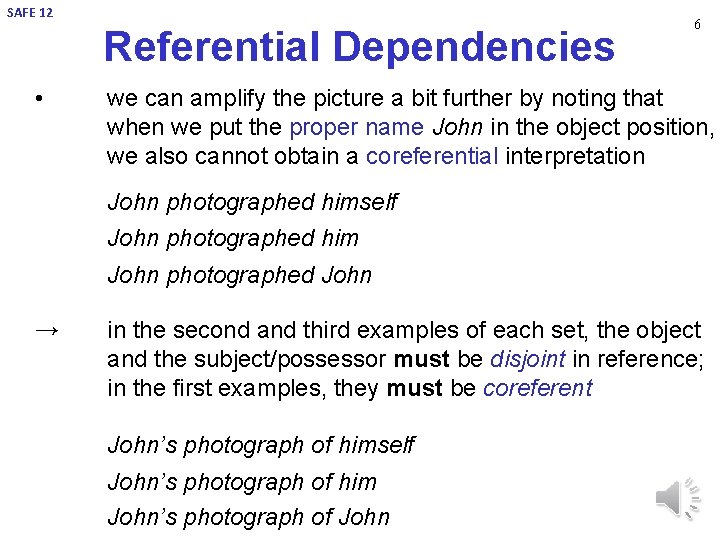
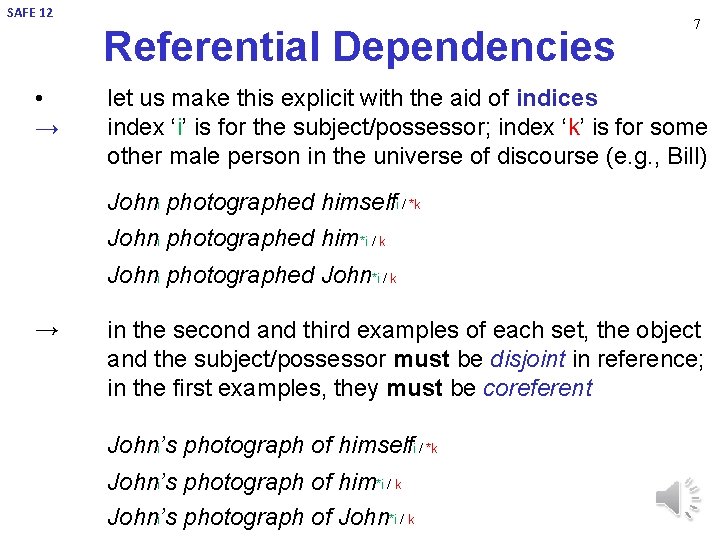
SAFE 12 Referential Dependencies • 6 we can amplify the picture a bit further by noting that when we put the proper name John in the object position, we also cannot obtain a coreferential interpretation John photographed himself John photographed him John photographed John → in the second and third examples of each set, the object and the subject/possessor must be disjoint in reference; in the first examples, they must be coreferent John’s photograph of himself John’s photograph of him John’s photograph of John
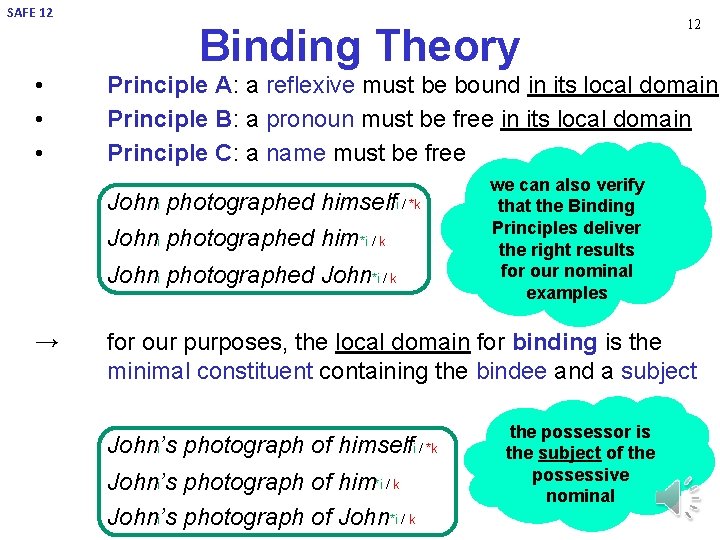
SAFE 12 Referential Dependencies • → 7 let us make this explicit with the aid of indices index ‘i’ is for the subject/possessor; index ‘k’ is for some other male person in the universe of discourse (e. g. , Bill) Johni photographed himselfi / *k Johni photographed him*i / k Johni photographed John*i / k → in the second and third examples of each set, the object and the subject/possessor must be disjoint in reference; in the first examples, they must be coreferent i John’s photograph of himselfi / *k i John’s photograph of him*i / k i John’s photograph of John*i / k
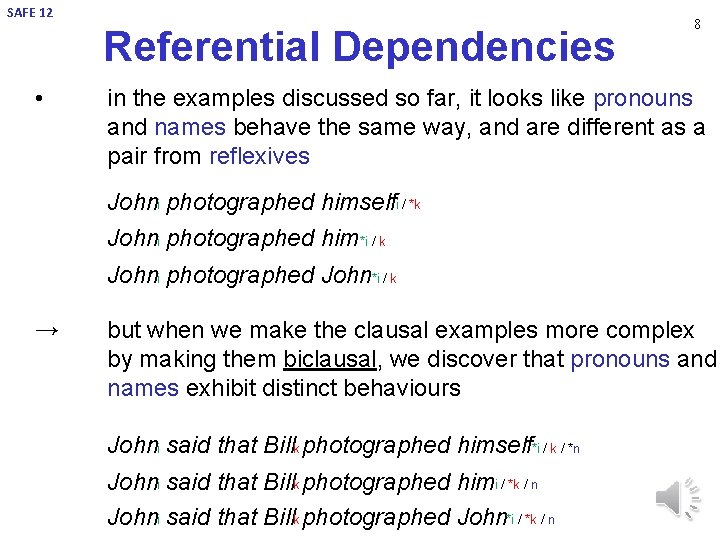
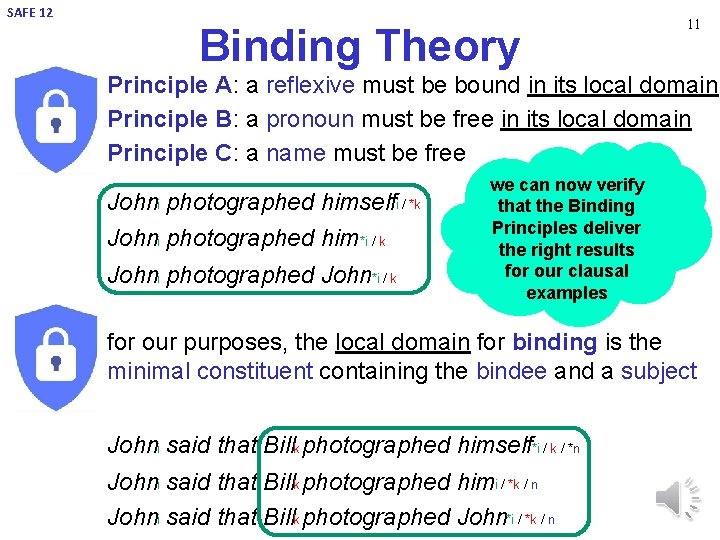
SAFE 12 Referential Dependencies • 8 in the examples discussed so far, it looks like pronouns and names behave the same way, and are different as a pair from reflexives Johni photographed himselfi / *k Johni photographed him*i / k Johni photographed John*i / k → but when we make the clausal examples more complex by making them biclausal, we discover that pronouns and names exhibit distinct behaviours Johni said that Billk photographed himself*i / k / *n Johni said that Billk photographed himi / *k / n Johni said that Billk photographed John*i / *k / n
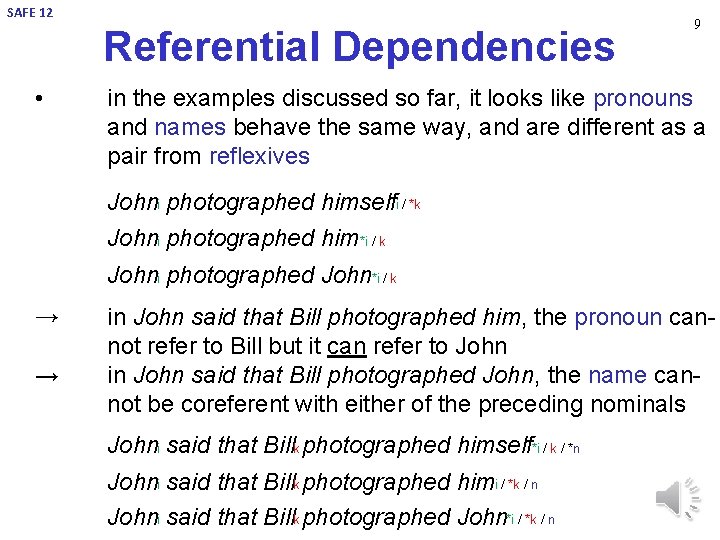
SAFE 12 Referential Dependencies • 9 in the examples discussed so far, it looks like pronouns and names behave the same way, and are different as a pair from reflexives Johni photographed himselfi / *k Johni photographed him*i / k Johni photographed John*i / k → → in John said that Bill photographed him, the pronoun cannot refer to Bill but it can refer to John in John said that Bill photographed John, the name cannot be coreferent with either of the preceding nominals Johni said that Billk photographed himself*i / k / *n Johni said that Billk photographed himi / *k / n Johni said that Billk photographed John*i / *k / n
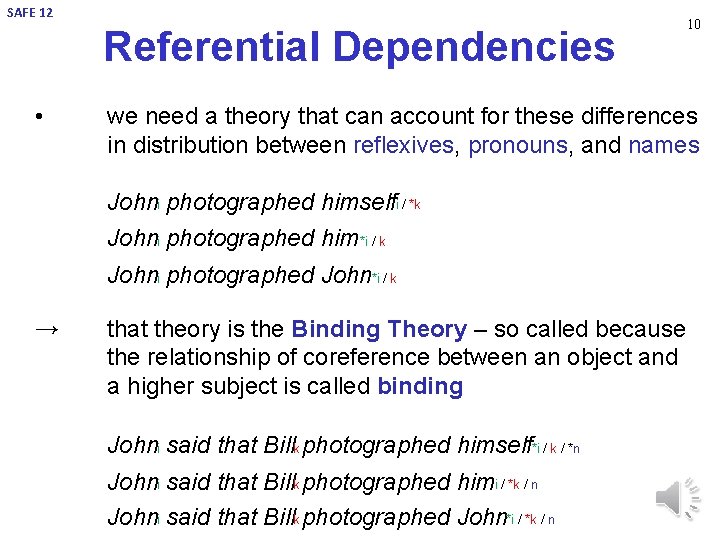
SAFE 12 Referential Dependencies • we need a theory that can account for these differences in distribution between reflexives, pronouns, and names Johni photographed himselfi / *k Johni photographed him*i / k Johni photographed John*i / k → 10 that theory is the Binding Theory – so called because the relationship of coreference between an object and a higher subject is called binding Johni said that Billk photographed himself*i / k / *n Johni said that Billk photographed himi / *k / n Johni said that Billk photographed John*i / *k / n
SAFE 12 Binding Theory • • • Principle A: a reflexive must be bound in its local domain Principle B: a pronoun must be free in its local domain Principle C: a name must be free Johni photographed himselfi / *k Johni photographed him*i / k Johni photographed John*i / k → 11 we can now verify that the Binding Principles deliver the right results for our clausal examples for our purposes, the local domain for binding is the minimal constituent containing the bindee and a subject Johni said that Billk photographed himself*i / k / *n Johni said that Billk photographed himi / *k / n Johni said that Billk photographed John*i / *k / n
SAFE 12 Binding Theory • • • Principle A: a reflexive must be bound in its local domain Principle B: a pronoun must be free in its local domain Principle C: a name must be free Johni photographed himselfi / *k Johni photographed him*i / k Johni photographed John*i / k → 12 we can also verify that the Binding Principles deliver the right results for our nominal examples for our purposes, the local domain for binding is the minimal constituent containing the bindee and a subject i John’s photograph of himselfi / *k i John’s photograph of him*i / k i John’s photograph of John*i / k the possessor is the subject of the possessive nominal
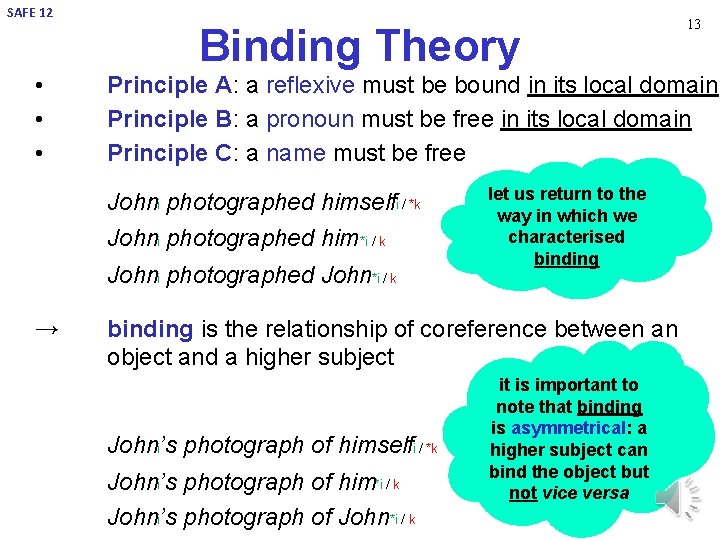
SAFE 12 Binding Theory • • • Principle A: a reflexive must be bound in its local domain Principle B: a pronoun must be free in its local domain Principle C: a name must be free Johni photographed himselfi / *k Johni photographed him*i / k Johni photographed John*i / k → 13 let us return to the way in which we characterised binding is the relationship of coreference between an object and a higher subject i John’s photograph of himselfi / *k i John’s photograph of him*i / k i John’s photograph of John*i / k it is important to note that binding is asymmetrical: a higher subject can bind the object but not vice versa
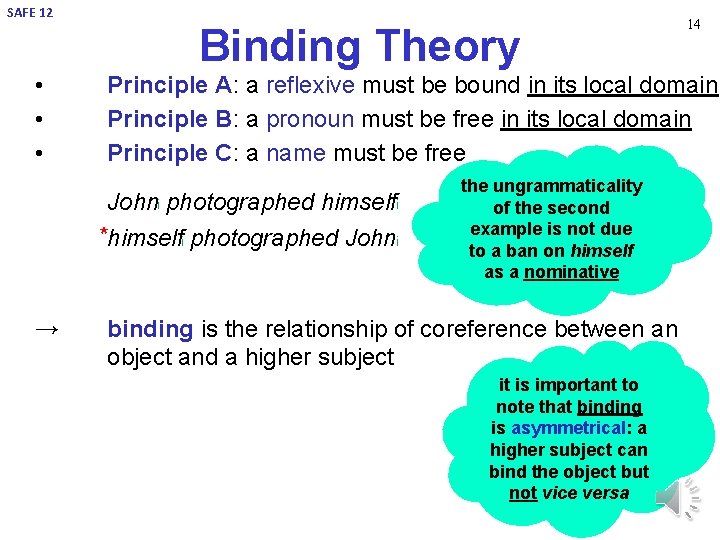
SAFE 12 Binding Theory • • • Principle A: a reflexive must be bound in its local domain Principle B: a pronoun must be free in its local domain Principle C: a name must be free Johni photographed himselfi *himselfi photographed Johni → 14 the ungrammaticality of the second example is not due to a ban on himself as a nominative binding is the relationship of coreference between an object and a higher subject it is important to note that binding is asymmetrical: a higher subject can bind the object but not vice versa
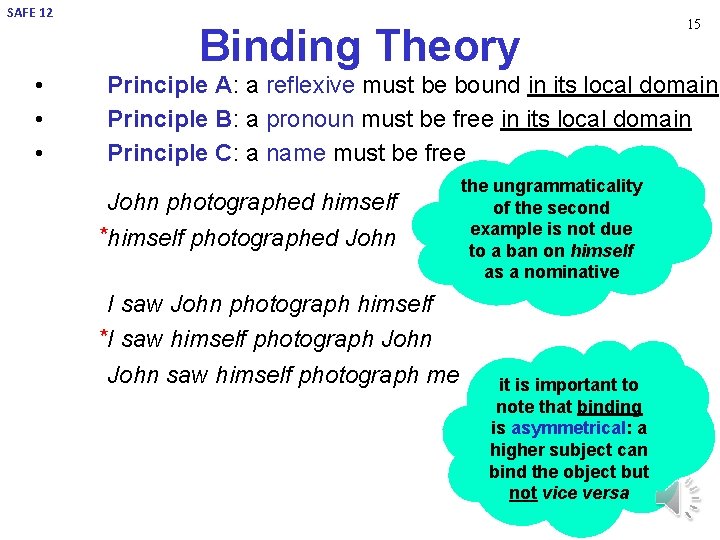
SAFE 12 Binding Theory • • • 15 Principle A: a reflexive must be bound in its local domain Principle B: a pronoun must be free in its local domain Principle C: a name must be free John photographed himself *himself photographed John I saw John photograph himself *I saw himself photograph John saw himself photograph me the ungrammaticality of the second example is not due to a ban on himself as a nominative it is important to note that binding is asymmetrical: a higher subject can bind the object but not vice versa
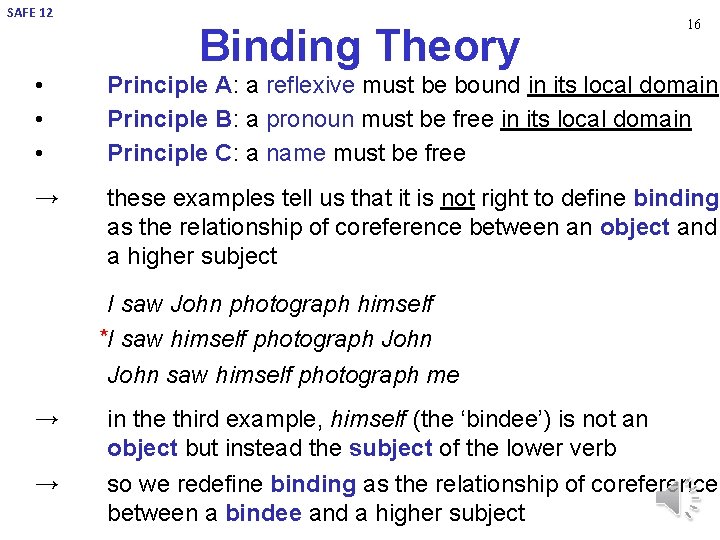
SAFE 12 Binding Theory 16 • • • Principle A: a reflexive must be bound in its local domain Principle B: a pronoun must be free in its local domain Principle C: a name must be free → these examples tell us that it is not right to define binding as the relationship of coreference between an object and a higher subject I saw John photograph himself *I saw himself photograph John saw himself photograph me → → in the third example, himself (the ‘bindee’) is not an object but instead the subject of the lower verb so we redefine binding as the relationship of coreference between a bindee and a higher subject
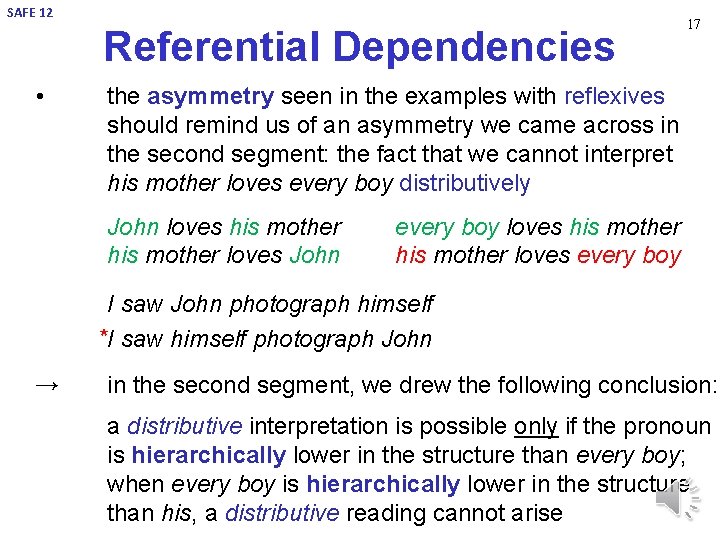
SAFE 12 Referential Dependencies • 17 the asymmetry seen in the examples with reflexives should remind us of an asymmetry we came across in the second segment: the fact that we cannot interpret his mother loves every boy distributively John loves his mother loves John every boy loves his mother loves every boy I saw John photograph himself *I saw himself photograph John → in the second segment, we drew the following conclusion: a distributive interpretation is possible only if the pronoun is hierarchically lower in the structure than every boy; when every boy is hierarchically lower in the structure than his, a distributive reading cannot arise
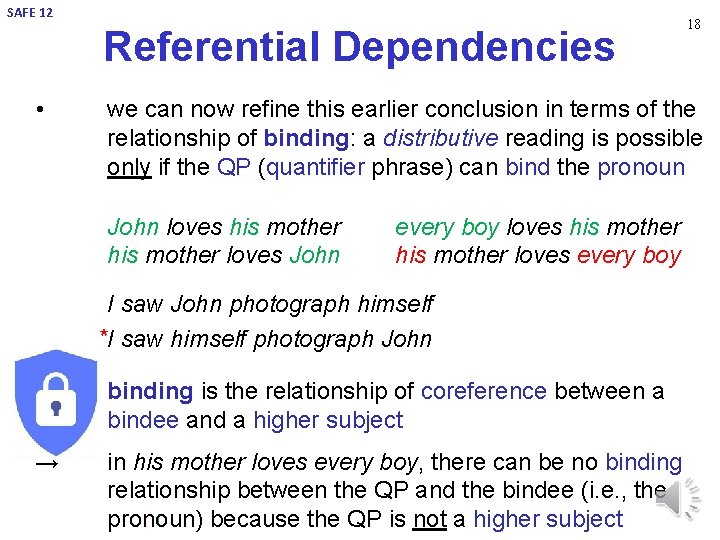
SAFE 12 Referential Dependencies • 18 we can now refine this earlier conclusion in terms of the relationship of binding: a distributive reading is possible only if the QP (quantifier phrase) can bind the pronoun John loves his mother loves John every boy loves his mother loves every boy I saw John photograph himself *I saw himself photograph John → binding is the relationship of coreference between a bindee and a higher subject → in his mother loves every boy, there can be no binding relationship between the QP and the bindee (i. e. , the i pronoun) because the QP is not a higher subject
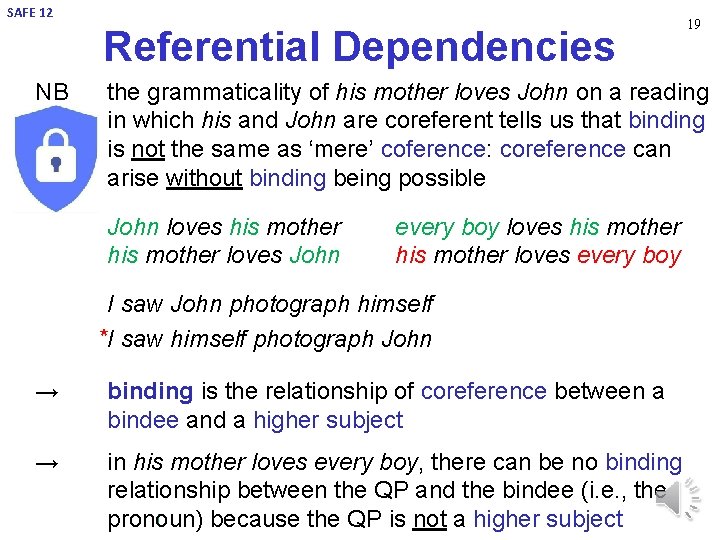
SAFE 12 Referential Dependencies NB 19 the grammaticality of his mother loves John on a reading in which his and John are coreferent tells us that binding is not the same as ‘mere’ coference: coreference can arise without binding being possible John loves his mother loves John every boy loves his mother loves every boy I saw John photograph himself *I saw himself photograph John → binding is the relationship of coreference between a bindee and a higher subject → in his mother loves every boy, there can be no binding relationship between the QP and the bindee (i. e. , the i pronoun) because the QP is not a higher subject
SAFE 12 → • • • SAFE Deposits 20 for the last time, we visit our SAFE Deposit Box referential dependencies involving binding are sensitive to asymmetrical structural configurations there are three different types of nominal phrases with respect to binding: reflexives, pronouns, and names of these, the reflexives have the narrowest distribution: they must be bound inside the minimal constituent that contains them as well as a subject, and they must be bound by that subject binding also gives us a handle on the distribution of distributive interpretations for sentences featuring a QP and a referentially dependent pronoun: a distributive reading is possible only if the QP binds the pronoun this conclusion reaffirms the importance of hierarchy in syntax, the topic of SAFE 2 – and on this note, we close
Syntax: A First Encounter Marcel den Dikken Department of English Linguistics ELTE
: 2018