
2018 Syntax A First Encounter Marcel den Dikken


- Slides: 26
: 2018
Syntax: A First Encounter Marcel den Dikken Department of English Linguistics ELTE
SAFE 4 → • • Subcategorisation 3 SAFEty First syntactic structures are projections of properties stored for each word or subword atom (‘morpheme’, such as -ed in our previous example) in a great pre-syntactic storage house called the lexicon harbours three syntactically relevant types of lexical information ✓category – – subcategorisation – thematic roles we have discussed category information, the determinant of the labels of phrases the central topic for this segment: subcategorisation and the internal structure of phrases
SAFE 4 Subcategorisation 4 • category information gives us the labels of phrases in syntactic structures: e. g. , a phrase projected by a verb has the label ‘V’, and is thus called a ‘verb phrase’, VP • the lexicon harbours three syntactically relevant types of lexical information ✓category – – subcategorisation – thematic roles → but not all VPs have the same internal structure: some contain no object, others have one, and still others two this depends on the nature of the verb: verbs belong to various different subcategories – they can be intransitive, (mono)transitive or ditransitive →
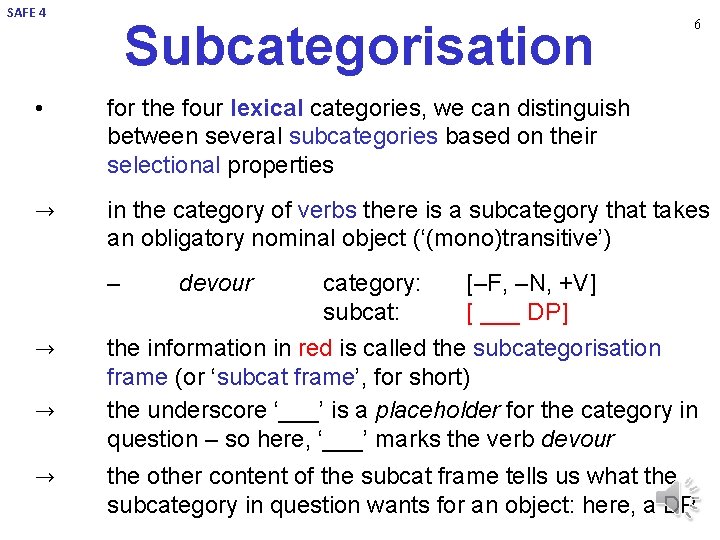
SAFE 4 Subcategorisation 5 • for the four lexical categories, we can distinguish between several subcategories based on their selectional properties → in the category of verbs there is a subcategory that takes an obligatory nominal object (‘(mono)transitive’) – devour category: subcat: [–F, –N, +V] [ ___ DP] how to read this?
SAFE 4 Subcategorisation 6 • for the four lexical categories, we can distinguish between several subcategories based on their selectional properties → in the category of verbs there is a subcategory that takes an obligatory nominal object (‘(mono)transitive’) – → → → devour category: subcat: [–F, –N, +V] [ ___ DP] the information in red is called the subcategorisation frame (or ‘subcat frame’, for short) the underscore ‘___’ is a placeholder for the category in question – so here, ‘___’ marks the verb devour the other content of the subcat frame tells us what the subcategory in question wants for an object: here, a DP
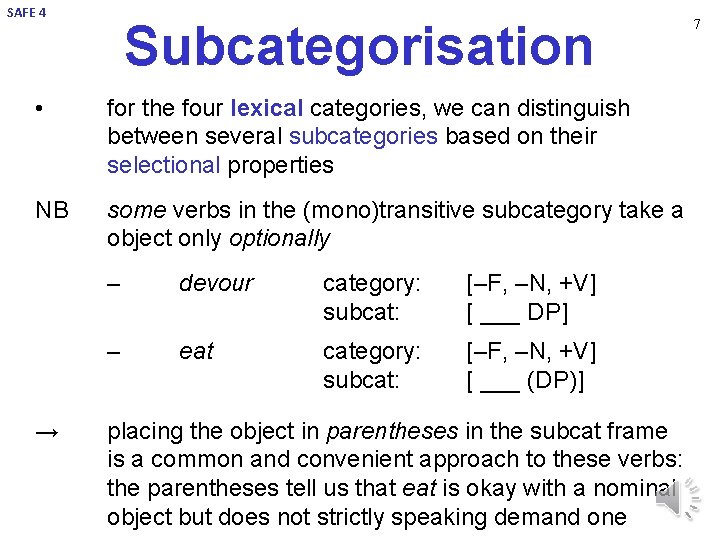
SAFE 4 Subcategorisation • for the four lexical categories, we can distinguish between several subcategories based on their selectional properties NB some verbs in the (mono)transitive subcategory take a object only optionally → – devour category: subcat: [–F, –N, +V] [ ___ DP] – eat category: subcat: [–F, –N, +V] [ ___ (DP)] placing the object in parentheses in the subcat frame is a common and convenient approach to these verbs: the parentheses tell us that eat is okay with a nominal object but does not strictly speaking demand one 7
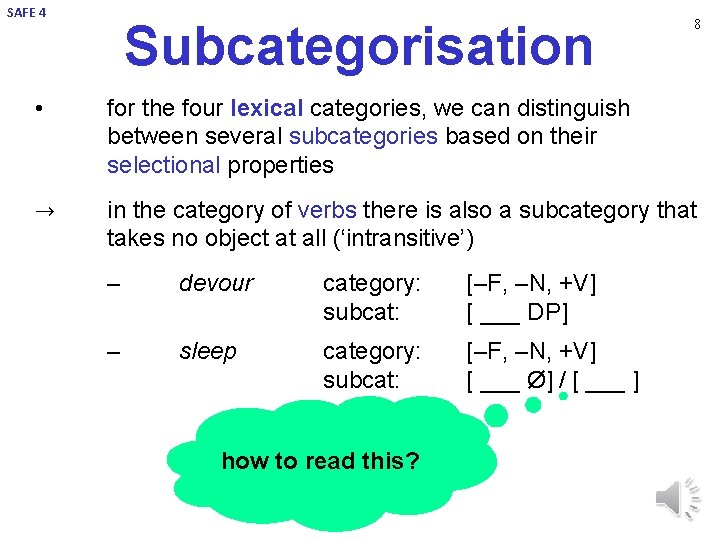
SAFE 4 Subcategorisation 8 • for the four lexical categories, we can distinguish between several subcategories based on their selectional properties → in the category of verbs there is also a subcategory that takes no object at all (‘intransitive’) – devour category: subcat: [–F, –N, +V] [ ___ DP] – sleep category: subcat: [–F, –N, +V] [ ___ Ø] / [ ___ ] how to read this?
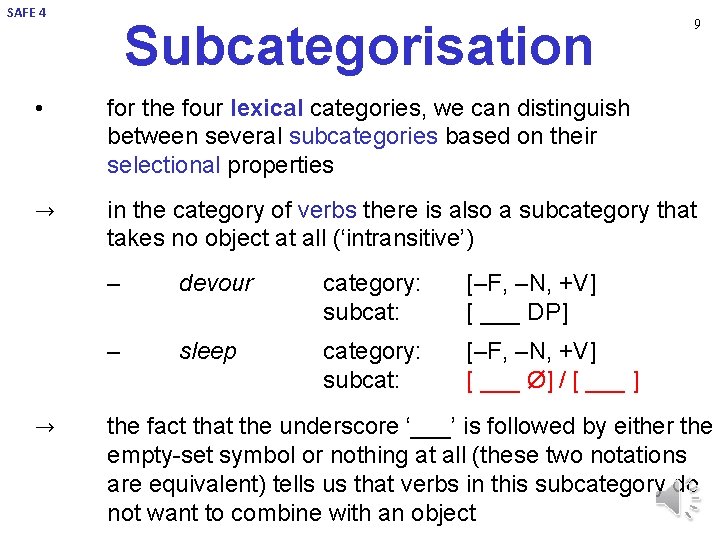
SAFE 4 Subcategorisation 9 • for the four lexical categories, we can distinguish between several subcategories based on their selectional properties → in the category of verbs there is also a subcategory that takes no object at all (‘intransitive’) → – devour category: subcat: [–F, –N, +V] [ ___ DP] – sleep category: subcat: [–F, –N, +V] [ ___ Ø] / [ ___ ] the fact that the underscore ‘___’ is followed by either the empty-set symbol or nothing at all (these two notations are equivalent) tells us that verbs in this subcategory do not want to combine with an object
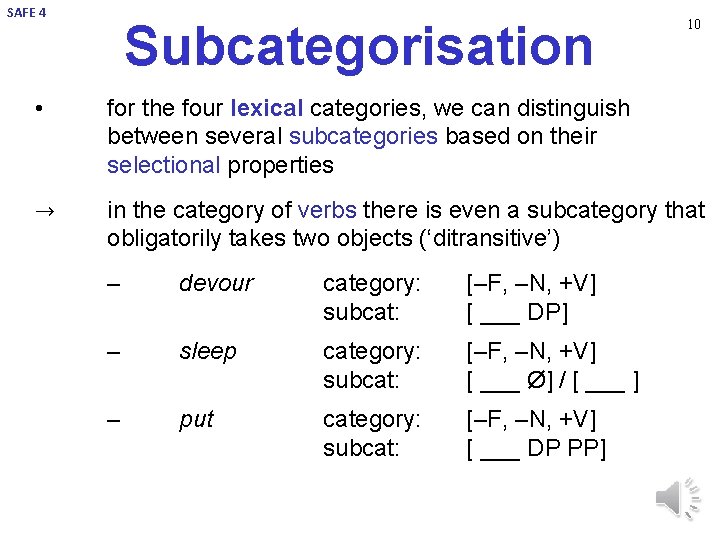
SAFE 4 Subcategorisation 10 • for the four lexical categories, we can distinguish between several subcategories based on their selectional properties → in the category of verbs there is even a subcategory that obligatorily takes two objects (‘ditransitive’) – devour category: subcat: [–F, –N, +V] [ ___ DP] – sleep category: subcat: [–F, –N, +V] [ ___ Ø] / [ ___ ] – put category: subcat: [–F, –N, +V] [ ___ DP PP]
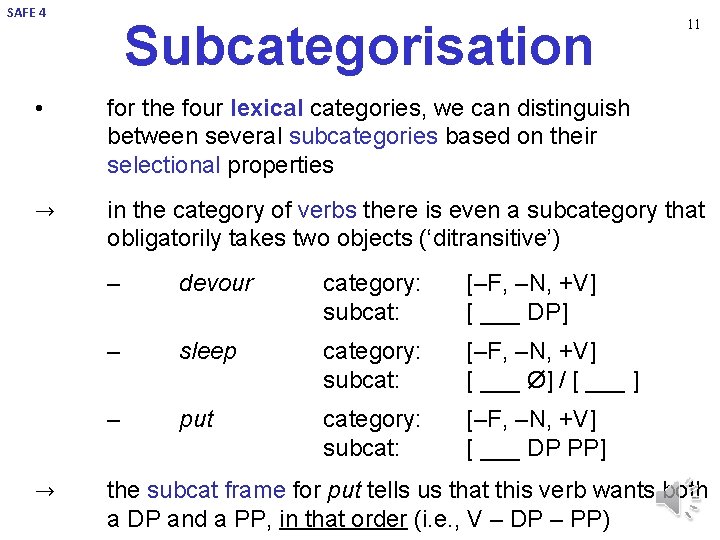
SAFE 4 Subcategorisation 11 • for the four lexical categories, we can distinguish between several subcategories based on their selectional properties → in the category of verbs there is even a subcategory that obligatorily takes two objects (‘ditransitive’) → – devour category: subcat: [–F, –N, +V] [ ___ DP] – sleep category: subcat: [–F, –N, +V] [ ___ Ø] / [ ___ ] – put category: subcat: [–F, –N, +V] [ ___ DP PP] the subcat frame for put tells us that this verb wants both a DP and a PP, in that order (i. e. , V – DP – PP)
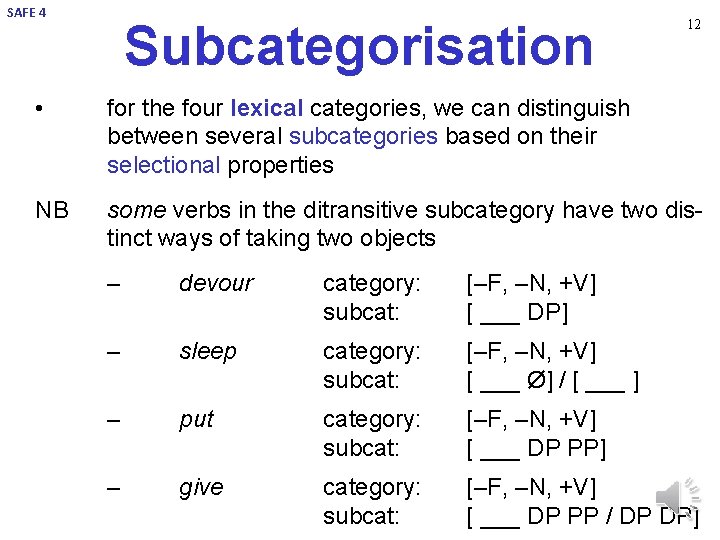
SAFE 4 Subcategorisation 12 • for the four lexical categories, we can distinguish between several subcategories based on their selectional properties NB some verbs in the ditransitive subcategory have two distinct ways of taking two objects – devour category: subcat: [–F, –N, +V] [ ___ DP] – sleep category: subcat: [–F, –N, +V] [ ___ Ø] / [ ___ ] – put category: subcat: [–F, –N, +V] [ ___ DP PP] – give category: subcat: [–F, –N, +V] [ ___ DP PP / DP DP]
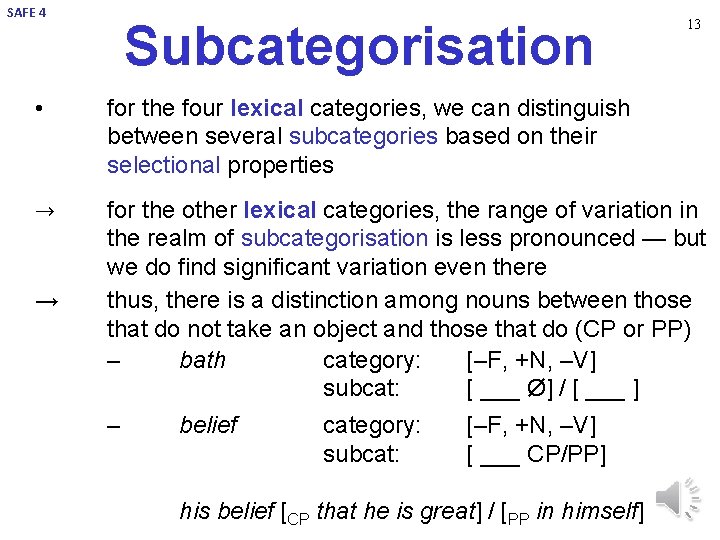
SAFE 4 Subcategorisation 13 • for the four lexical categories, we can distinguish between several subcategories based on their selectional properties → for the other lexical categories, the range of variation in the realm of subcategorisation is less pronounced — but we do find significant variation even there thus, there is a distinction among nouns between those that do not take an object and those that do (CP or PP) – bath category: [–F, +N, –V] subcat: [ ___ Ø] / [ ___ ] → – belief category: subcat: [–F, +N, –V] [ ___ CP/PP] his belief [CP that he is great] / [PP in himself]
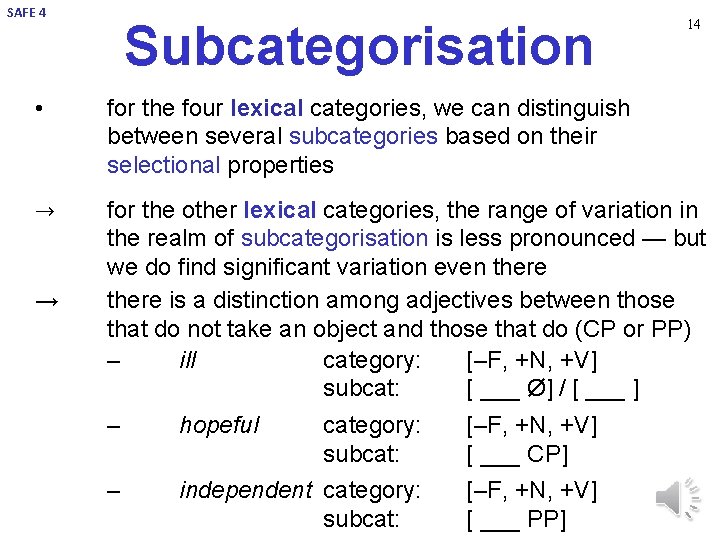
SAFE 4 Subcategorisation 14 • for the four lexical categories, we can distinguish between several subcategories based on their selectional properties → for the other lexical categories, the range of variation in the realm of subcategorisation is less pronounced — but we do find significant variation even there is a distinction among adjectives between those that do not take an object and those that do (CP or PP) – ill category: [–F, +N, +V] subcat: [ ___ Ø] / [ ___ ] → – hopeful category: subcat: [–F, +N, +V] [ ___ CP] – independent category: subcat: [–F, +N, +V] [ ___ PP]
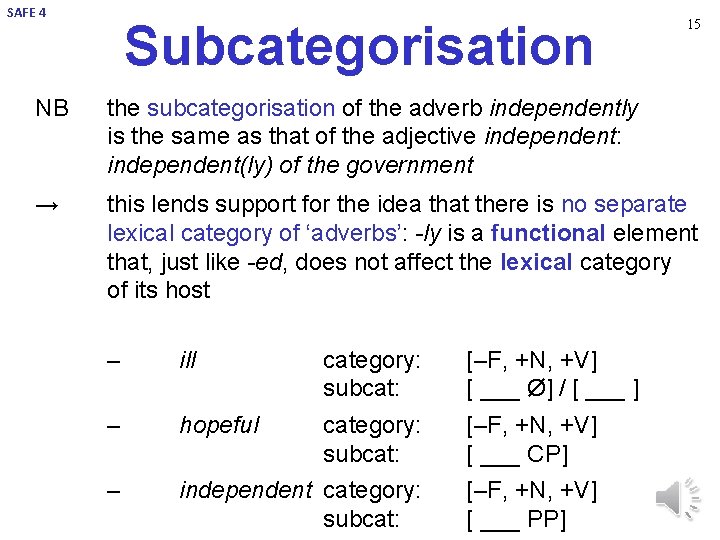
SAFE 4 Subcategorisation 15 NB the subcategorisation of the adverb independently is the same as that of the adjective independent: independent(ly) of the government → this lends support for the idea that there is no separate lexical category of ‘adverbs’: -ly is a functional element that, just like -ed, does not affect the lexical category of its host – ill category: subcat: [–F, +N, +V] [ ___ Ø] / [ ___ ] – hopeful category: subcat: [–F, +N, +V] [ ___ CP] – independent category: subcat: [–F, +N, +V] [ ___ PP]
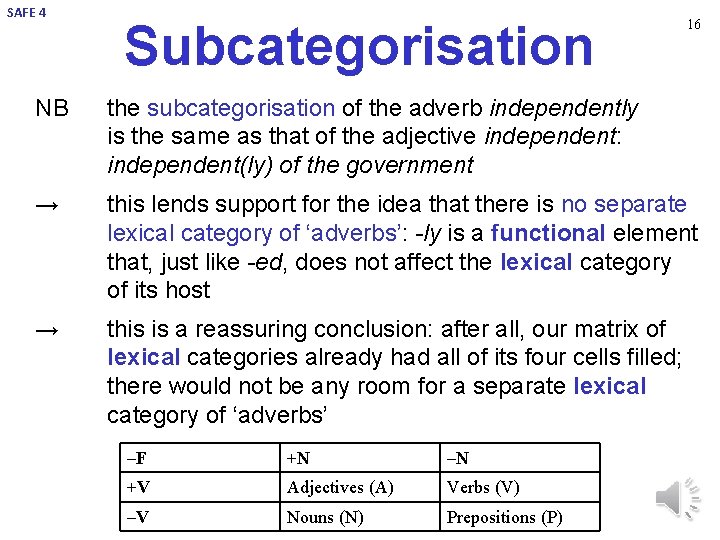
SAFE 4 Subcategorisation 16 NB the subcategorisation of the adverb independently is the same as that of the adjective independent: independent(ly) of the government → this lends support for the idea that there is no separate lexical category of ‘adverbs’: -ly is a functional element that, just like -ed, does not affect the lexical category of its host → this is a reassuring conclusion: after all, our matrix of lexical categories already had all of its four cells filled; there would not be any room for a separate lexical category of ‘adverbs’ –F +N –N +V Adjectives (A) Verbs (V) –V Nouns (N) Prepositions (P)
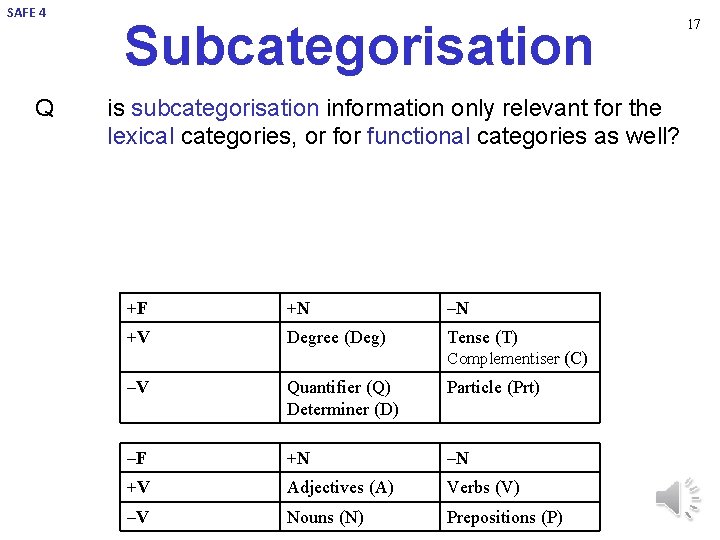
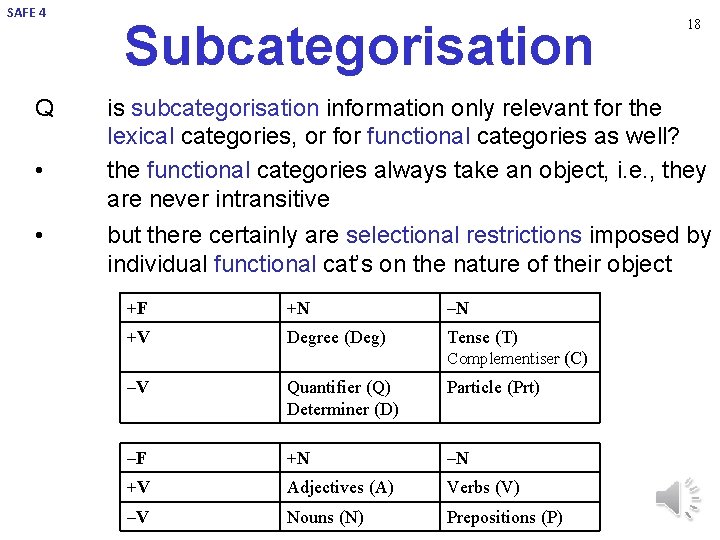
SAFE 4 Q Subcategorisation is subcategorisation information only relevant for the lexical categories, or functional categories as well? +F +N –N +V Degree (Deg) Tense (T) Complementiser (C) –V Quantifier (Q) Determiner (D) Particle (Prt) –F +N –N +V Adjectives (A) Verbs (V) –V Nouns (N) Prepositions (P) 17
SAFE 4 Q • • Subcategorisation 18 is subcategorisation information only relevant for the lexical categories, or functional categories as well? the functional categories always take an object, i. e. , they are never intransitive but there certainly are selectional restrictions imposed by individual functional cat’s on the nature of their object +F +N –N +V Degree (Deg) Tense (T) Complementiser (C) –V Quantifier (Q) Determiner (D) Particle (Prt) –F +N –N +V Adjectives (A) Verbs (V) –V Nouns (N) Prepositions (P)
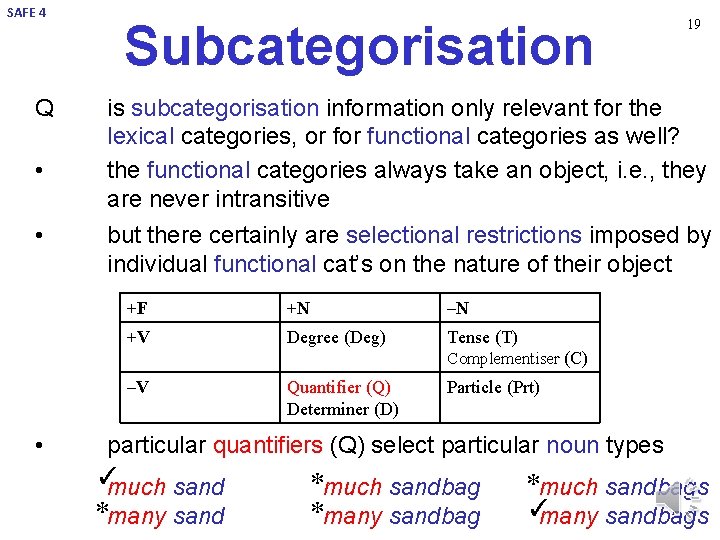
SAFE 4 Q • • Subcategorisation 19 is subcategorisation information only relevant for the lexical categories, or functional categories as well? the functional categories always take an object, i. e. , they are never intransitive but there certainly are selectional restrictions imposed by individual functional cat’s on the nature of their object +F +N –N +V Degree (Deg) Tense (T) Complementiser (C) –V • Quantifier (Q) Determiner (D) Particle (Prt) particular quantifiers (Q) select particular noun types ✓ *much sandbags much sand ✓many sandbags *many sandbag
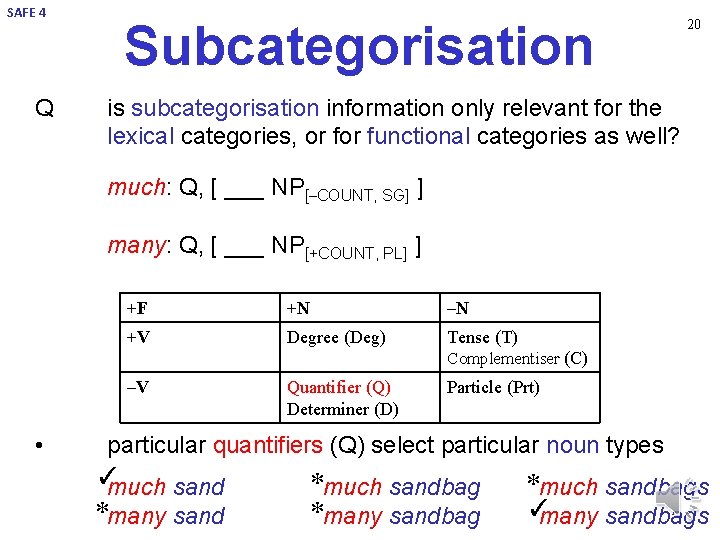
SAFE 4 Q Subcategorisation 20 is subcategorisation information only relevant for the lexical categories, or functional categories as well? much: Q, [ ___ NP[–COUNT, SG] ] many: Q, [ ___ NP[+COUNT, PL] ] +F +N –N +V Degree (Deg) Tense (T) Complementiser (C) –V • Quantifier (Q) Determiner (D) Particle (Prt) particular quantifiers (Q) select particular noun types ✓ *much sandbags much sand ✓many sandbags *many sandbag
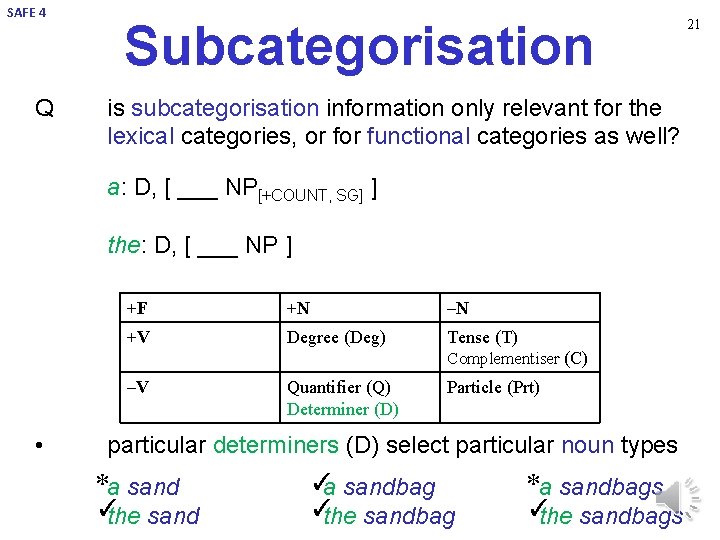
SAFE 4 Q Subcategorisation is subcategorisation information only relevant for the lexical categories, or functional categories as well? a: D, [ ___ NP[+COUNT, SG] ] the: D, [ ___ NP ] +F +N –N +V Degree (Deg) Tense (T) Complementiser (C) –V • Quantifier (Q) Determiner (D) Particle (Prt) particular determiners (D) select particular noun types *a sand ✓ the sand ✓a sandbag ✓the sandbag *a sandbags ✓the sandbags 21
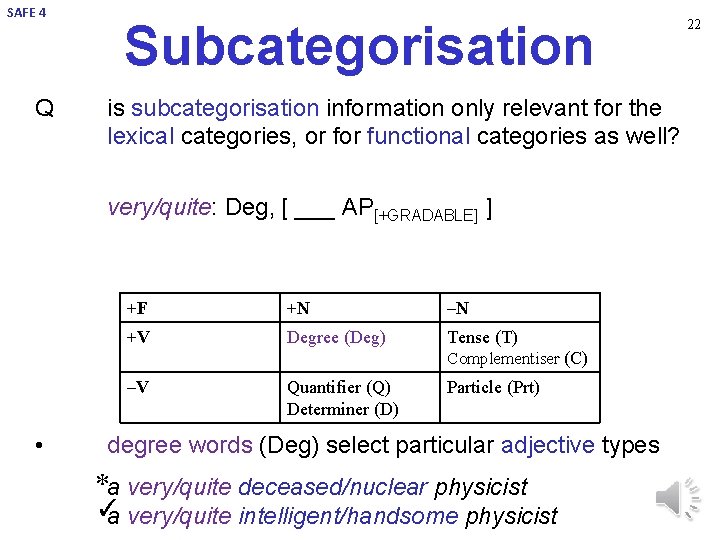
SAFE 4 Q Subcategorisation is subcategorisation information only relevant for the lexical categories, or functional categories as well? very/quite: Deg, [ ___ AP[+GRADABLE] ] +F +N –N +V Degree (Deg) Tense (T) Complementiser (C) –V • Quantifier (Q) Determiner (D) Particle (Prt) degree words (Deg) select particular adjective types *a very/quite deceased/nuclear physicist ✓ a very/quite intelligent/handsome physicist 22
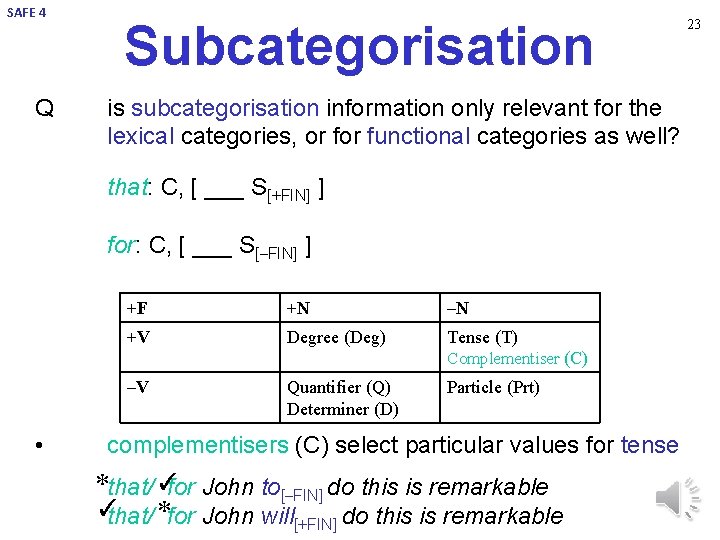
SAFE 4 Q Subcategorisation is subcategorisation information only relevant for the lexical categories, or functional categories as well? that: C, [ ___ S[+FIN] ] for: C, [ ___ S[–FIN] ] +F +N –N +V Degree (Deg) Tense (T) Complementiser (C) –V • Quantifier (Q) Determiner (D) Particle (Prt) complementisers (C) select particular values for tense *that/ ✓for John to[–FIN] do this is remarkable ✓ that/ *for John will[+FIN] do this is remarkable 23
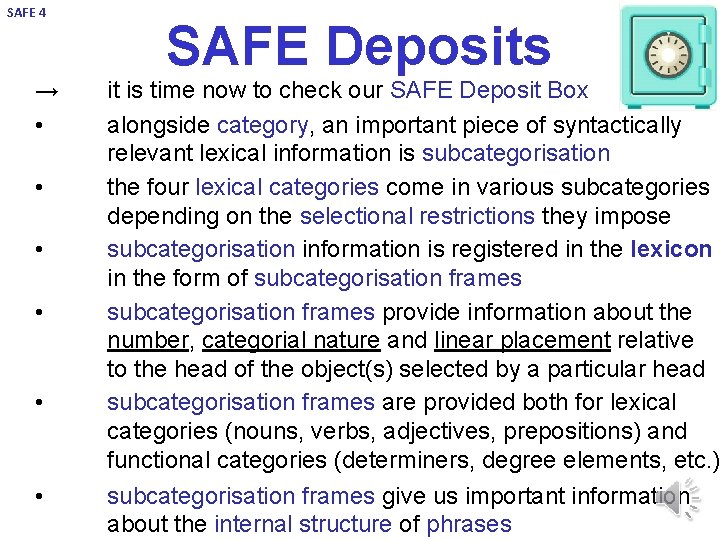
SAFE 4 → • • • SAFE Deposits 24 it is time now to check our SAFE Deposit Box alongside category, an important piece of syntactically relevant lexical information is subcategorisation the four lexical categories come in various subcategories depending on the selectional restrictions they impose subcategorisation information is registered in the lexicon in the form of subcategorisation frames provide information about the number, categorial nature and linear placement relative to the head of the object(s) selected by a particular head subcategorisation frames are provided both for lexical categories (nouns, verbs, adjectives, prepositions) and functional categories (determiners, degree elements, etc. ) subcategorisation frames give us important information about the internal structure of phrases
Syntax: A First Encounter Marcel den Dikken Department of English Linguistics ELTE
: 2018