
2018 Manufacturing Energy Consumption Survey MECS 2018 www





- Slides: 42
2018 Manufacturing Energy Consumption Survey #MECS 2018 | www. eia. gov/consumption/manufacturing
2018 Manufacturing Energy Consumption Survey December 2021 U. S. Energy Information Administration Office of Energy Statistics U. S. Department of Energy Washington, DC 20585 This publication is available at https: //www. eia. gov/consumption/manufacturing This report was prepared by the U. S. Energy Information Administration (EIA), the statistical and analytical agency within the U. S. Department of Energy. By law, EIA's data and analyses are independent of approval by any other officer or employee of the United States Government. The views in this report therefore should not be construed as representing those of the U. S. Department of Energy or other federal agencies. U. S. Energy Information Administration #MECS 2018 | www. eia. gov/consumption/manufacturing 2
What is the Manufacturing Energy Consumption Survey (MECS)? MECS is the only nationally representative source for estimates of energy-related characteristics, consumption, and expenditures for manufacturing establishments in the United States. We collect data for manufacturing establishments mainly through web questionnaires. • We drew the 2018 MECS sample size of approximately 15, 000 establishments from a national sample frame representing 97%– 98% of the manufacturing payroll. We estimate the sample to represent at least that percentage of manufacturing energy consumption. • This sample allows us to report separate estimates of energy use for 21 three-digit manufacturing subsectors and 50 industry groups and industries, as defined by the North American Industry Classification System (NAICS). We have conducted the MECS periodically since 1985. • The 2018 MECS is the 10 th release. U. S. Energy Information Administration #MECS 2018 | www. eia. gov/consumption/manufacturing 3
Key takeaways from our 2018 MECS results • Natural gas and hydrocarbon gas liquids (HGLs)* have continued to increase their shares of total consumption. • Gross output has continued to outpace manufacturing energy consumption, resulting in an overall decrease in energy intensity. • From 1998 to 2018, manufacturing energy intensity decreased by 26%. During this same period, manufacturing gross output increased by 12%, indicating continued energy efficiency gains. • As of 2018, nonfuel consumption (or the use of energy as a feedstock or raw input rather than for fuel) is most common in the chemicals subsector. • Four subsectors—chemicals, petroleum and coal products, paper, and primary metals—accounted for most of manufacturing energy consumption. • Most subsectors cannot easily switch from natural gas to alternative fuels such as coal, electricity, and renewables within a 30 -day period. Long-term fuel-switching requires significant capital investment, such as purchasing new equipment. * HGLs include ethane, ethylene, propane, propylene, normal butane, butylene, ethane-propane mixtures, propane-butane mixtures, and isobutane produced at refineries or natural gas processing plants, including plants that fractionate raw natural gas liquids (NGLs). MECS excludes natural gasoline from its definition because natural gasoline is not used as an energy source—fuel or feedstock—at manufacturing establishments. Note: The 2018 MECS final data supersede the 2018 preliminary data previously published. For example, the MECS preliminary data showed an increase in energy intensity; however, the final data for the 2018 MECS show that manufacturing energy intensity slightly decreased. U. S. Energy Information Administration #MECS 2018 | www. eia. gov/consumption/manufacturing 4
Table of Contents Manufacturing energy consumption 6 Fuel-switching and capability 16 Expenditures and pricing 21 Manufacturing floorspace and establishment counts 25 Energy management 28 Top energy consuming subsectors 35 References and additional information 40 U. S. Energy Information Administration #MECS 2018 | www. eia. gov/consumption/manufacturing 5
Manufacturing energy consumption Manufacturing is the physical, mechanical, or chemical transformation of materials or substances into new products. Manufacturing operations are generally conducted in facilities described as plants, factories, or mills and characteristically use power-driven machines and material-handling equipment. In addition, assembling the components of manufactured products is considered manufacturing, for example, blending materials, such as lubricating oils, plastics, resins, or liquors. An establishment is an economic unit at a single location where manufacturing is performed. Manufacturing establishments are classified by the North American Industrial Classification System (NAICS), which categorizes establishments according to the types of production processes they primarily use. Manufacturers have two types of energy consumption—fuel and nonfuel. Fuel consumption is the use of any substance that can be burned to produce heat and power or to generate electricity. Nonfuel consumption is the use of energy as feedstock or raw material input.
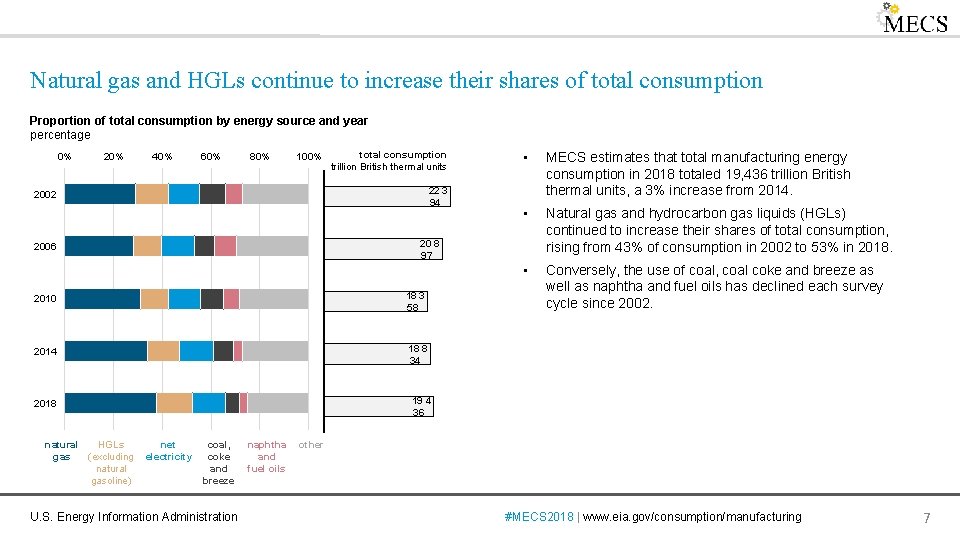
Natural gas and HGLs continue to increase their shares of total consumption Proportion of total consumption by energy source and year percentage 0% 20% 40% 60% 80% 100% total consumption trillion British thermal units 22 3 94 2002 MECS estimates that total manufacturing energy consumption in 2018 totaled 19, 436 trillion British thermal units, a 3% increase from 2014. • Natural gas and hydrocarbon gas liquids (HGLs) continued to increase their shares of total consumption, rising from 43% of consumption in 2002 to 53% in 2018. • Conversely, the use of coal, coal coke and breeze as well as naphtha and fuel oils has declined each survey cycle since 2002. 20 8 97 2006 2010 18 3 58 2014 18 8 34 19 4 36 2018 natural HGLs gas (excluding natural gasoline) • net electricity coal, coke and breeze U. S. Energy Information Administration naphtha and fuel oils other #MECS 2018 | www. eia. gov/consumption/manufacturing 7
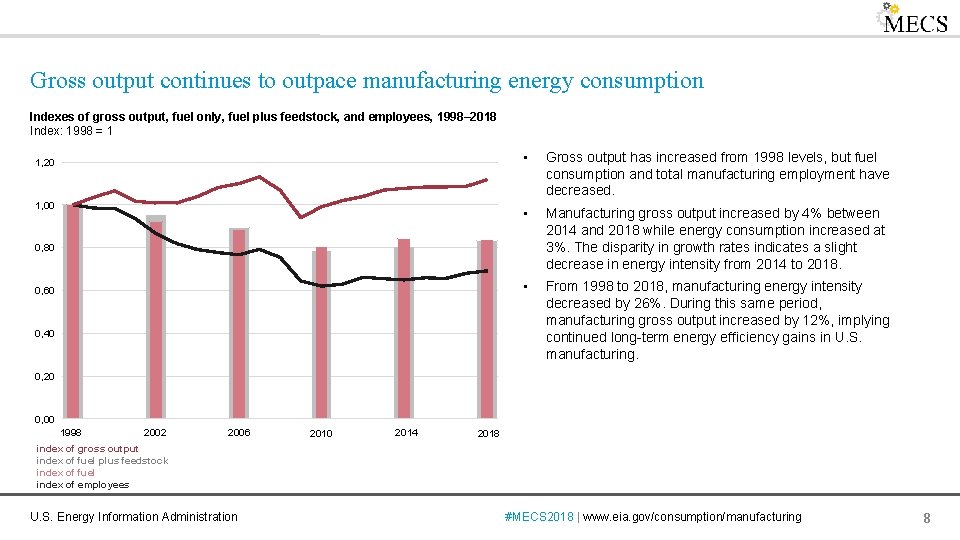
Gross output continues to outpace manufacturing energy consumption Indexes of gross output, fuel only, fuel plus feedstock, and employees, 1998– 2018 Index: 1998 = 1 1, 20 1, 00 • Gross output has increased from 1998 levels, but fuel consumption and total manufacturing employment have decreased. • Manufacturing gross output increased by 4% between 2014 and 2018 while energy consumption increased at 3%. The disparity in growth rates indicates a slight decrease in energy intensity from 2014 to 2018. • From 1998 to 2018, manufacturing energy intensity decreased by 26%. During this same period, manufacturing gross output increased by 12%, implying continued long-term energy efficiency gains in U. S. manufacturing. 0, 80 0, 60 0, 40 0, 20 0, 00 1998 2002 2006 2010 2014 2018 index of gross output index of fuel plus feedstock index of fuel index of employees U. S. Energy Information Administration #MECS 2018 | www. eia. gov/consumption/manufacturing 8
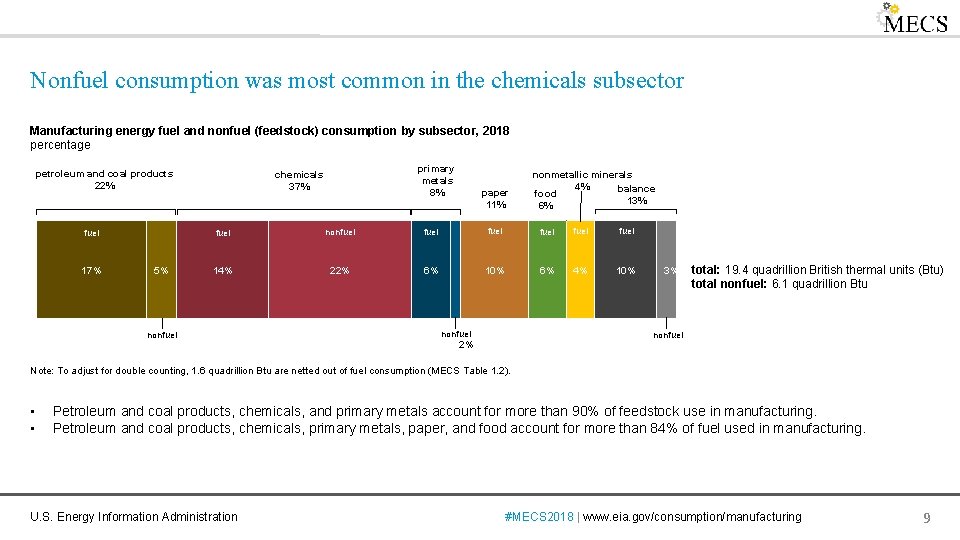
Nonfuel consumption was most common in the chemicals subsector Manufacturing energy fuel and nonfuel (feedstock) consumption by subsector, 2018 percentage petroleum and coal products 22% fuel 17% 5% primary metals 8% chemicals 37% paper 11% nonmetallic minerals 4% balance food 13% 6% fuel nonfuel fuel 14% 22% 6% 10% 6% 4% 10% nonfuel 3% total: 19. 4 quadrillion British thermal units (Btu) total nonfuel: 6. 1 quadrillion Btu nonfuel 2% Note: To adjust for double counting, 1. 6 quadrillion Btu are netted out of fuel consumption (MECS Table 1. 2). • • Petroleum and coal products, chemicals, and primary metals account for more than 90% of feedstock use in manufacturing. Petroleum and coal products, chemicals, primary metals, paper, and food account for more than 84% of fuel used in manufacturing. U. S. Energy Information Administration #MECS 2018 | www. eia. gov/consumption/manufacturing 9
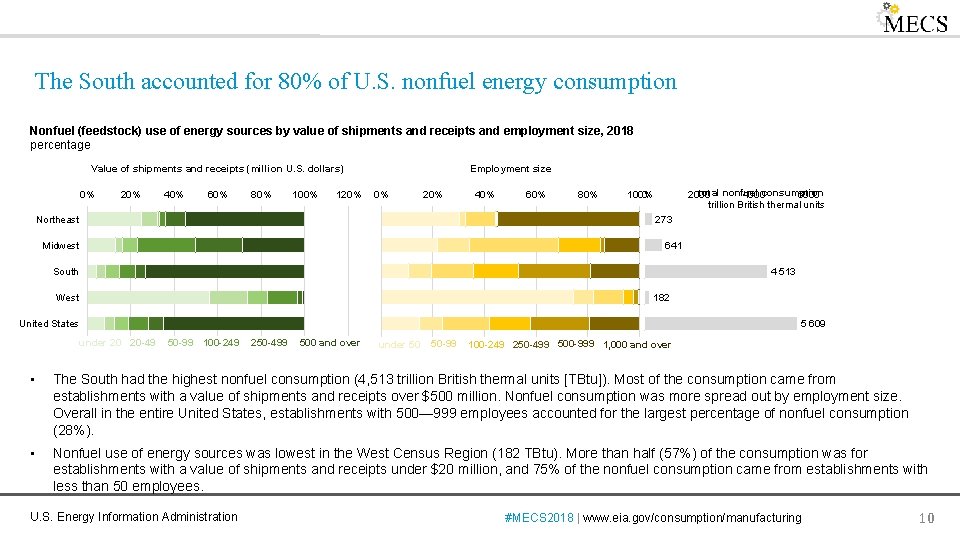
The South accounted for 80% of U. S. nonfuel energy consumption Nonfuel (feedstock) use of energy sources by value of shipments and receipts and employment size, 2018 percentage Value of shipments and receipts (million U. S. dollars) 0% 20% 40% 60% 80% 100% 120% Employment size 0% 20% 40% 60% 80% total nonfuel 2000 4000 consumption 6000 trillion British thermal units 100% 0 273 Northeast 641 Midwest 4 513 South 182 West 5 609 United States under 20 20 -49 50 -99 100 -249 250 -499 500 and over under 50 50 -99 100 -249 250 -499 500 -999 1, 000 and over • The South had the highest nonfuel consumption (4, 513 trillion British thermal units [TBtu]). Most of the consumption came from establishments with a value of shipments and receipts over $500 million. Nonfuel consumption was more spread out by employment size. Overall in the entire United States, establishments with 500— 999 employees accounted for the largest percentage of nonfuel consumption (28%). • Nonfuel use of energy sources was lowest in the West Census Region (182 TBtu). More than half (57%) of the consumption was for establishments with a value of shipments and receipts under $20 million, and 75% of the nonfuel consumption came from establishments with less than 50 employees. U. S. Energy Information Administration #MECS 2018 | www. eia. gov/consumption/manufacturing 10
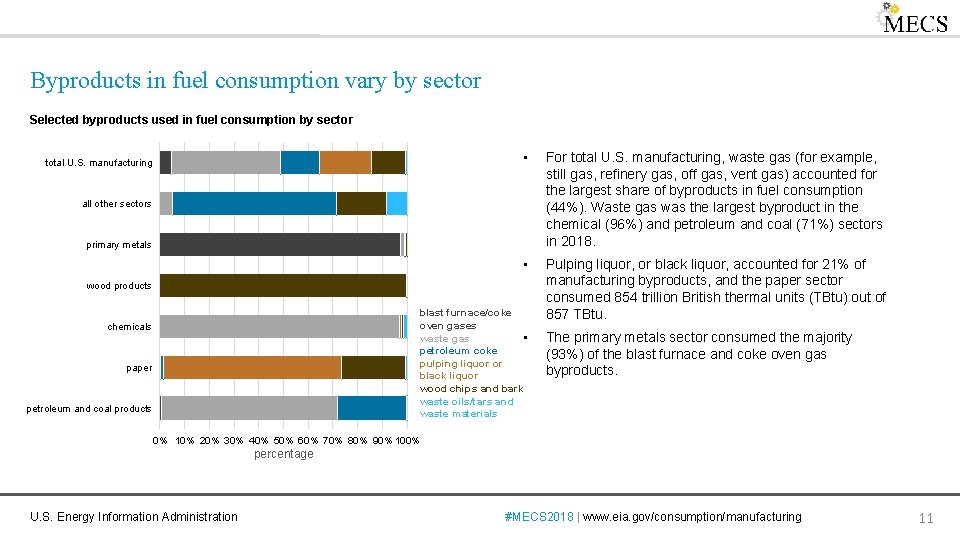
Byproducts in fuel consumption vary by sector Selected byproducts used in fuel consumption by sector total U. S. manufacturing • For total U. S. manufacturing, waste gas (for example, still gas, refinery gas, off gas, vent gas) accounted for the largest share of byproducts in fuel consumption (44%). Waste gas was the largest byproduct in the chemical (96%) and petroleum and coal (71%) sectors in 2018. • Pulping liquor, or black liquor, accounted for 21% of manufacturing byproducts, and the paper sector consumed 854 trillion British thermal units (TBtu) out of 857 TBtu. all other sectors primary metals wood products blast furnace/coke oven gases waste gas • petroleum coke pulping liquor or black liquor wood chips and bark waste oils/tars and waste materials chemicals paper petroleum and coal products The primary metals sector consumed the majority (93%) of the blast furnace and coke oven gas byproducts. 0% 10% 20% 30% 40% 50% 60% 70% 80% 90% 100% percentage U. S. Energy Information Administration #MECS 2018 | www. eia. gov/consumption/manufacturing 11
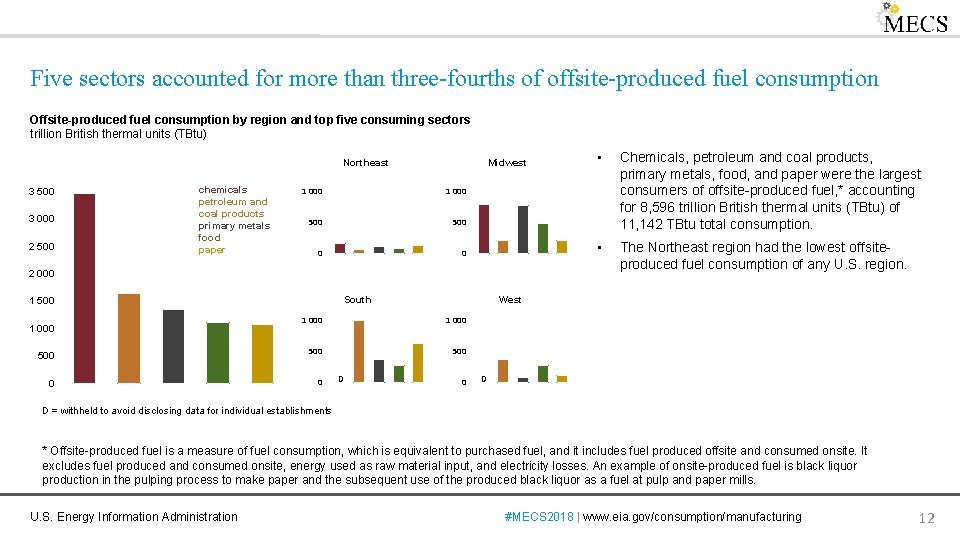
Five sectors accounted for more than three-fourths of offsite-produced fuel consumption Offsite-produced fuel consumption by region and top five consuming sectors trillion British thermal units (TBtu) Northeast 3 500 3 000 2 500 chemicals petroleum and coal products primary metals food paper Midwest 1 000 500 0 0 2 000 South 1 500 1 000 500 500 D Chemicals, petroleum and coal products, primary metals, food, and paper were the largest consumers of offsite-produced fuel, * accounting for 8, 596 trillion British thermal units (TBtu) of 11, 142 TBtu total consumption. • The Northeast region had the lowest offsiteproduced fuel consumption of any U. S. region. West 1 000 0 • 0 D D = withheld to avoid disclosing data for individual establishments * Offsite-produced fuel is a measure of fuel consumption, which is equivalent to purchased fuel, and it includes fuel produced offsite and consumed onsite. It excludes fuel produced and consumed onsite, energy used as raw material input, and electricity losses. An example of onsite-produced fuel is black liquor production in the pulping process to make paper and the subsequent use of the produced black liquor as a fuel at pulp and paper mills. U. S. Energy Information Administration #MECS 2018 | www. eia. gov/consumption/manufacturing 12
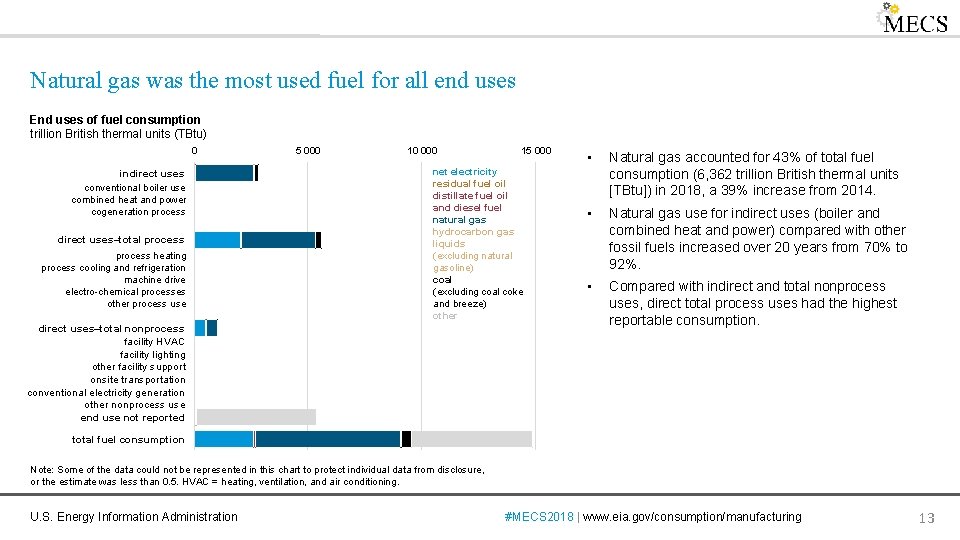
Natural gas was the most used fuel for all end uses End uses of fuel consumption trillion British thermal units (TBtu) 0 indirect uses conventional boiler use combined heat and power cogeneration process direct uses–total process heating process cooling and refrigeration machine drive electro-chemical processes other process use 5 000 10 000 15 000 net electricity residual fuel oil distillate fuel oil and diesel fuel natural gas hydrocarbon gas liquids (excluding natural gasoline) coal (excluding coal coke and breeze) other direct uses–total nonprocess facility HVAC facility lighting other facility support onsite transportation conventional electricity generation other nonprocess use end use not reported • Natural gas accounted for 43% of total fuel consumption (6, 362 trillion British thermal units [TBtu]) in 2018, a 39% increase from 2014. • Natural gas use for indirect uses (boiler and combined heat and power) compared with other fossil fuels increased over 20 years from 70% to 92%. • Compared with indirect and total nonprocess uses, direct total process uses had the highest reportable consumption. total fuel consumption Note: Some of the data could not be represented in this chart to protect individual data from disclosure, or the estimate was less than 0. 5. HVAC = heating, ventilation, and air conditioning. U. S. Energy Information Administration #MECS 2018 | www. eia. gov/consumption/manufacturing 13
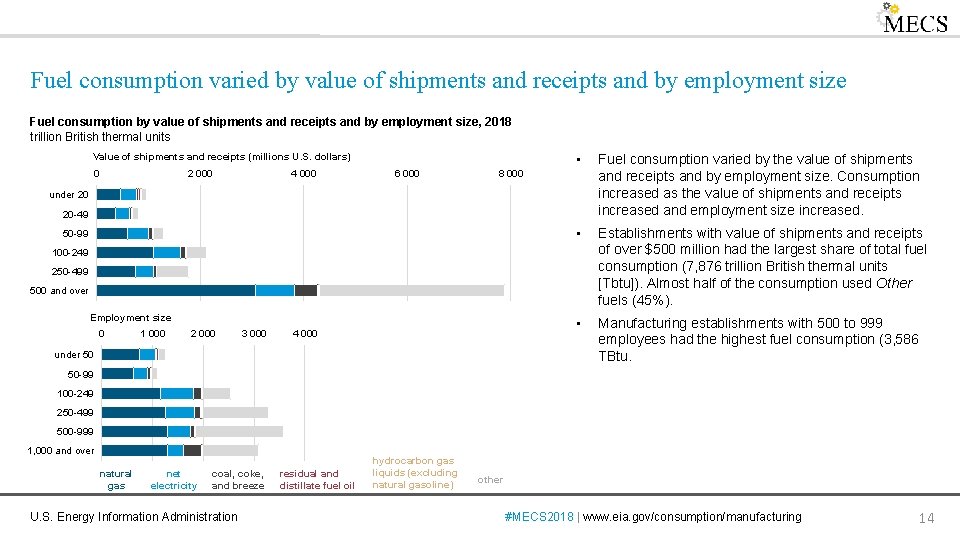
Fuel consumption varied by value of shipments and receipts and by employment size Fuel consumption by value of shipments and receipts and by employment size, 2018 trillion British thermal units Value of shipments and receipts (millions U. S. dollars) 0 2 000 4 000 6 000 • Fuel consumption varied by the value of shipments and receipts and by employment size. Consumption increased as the value of shipments and receipts increased and employment size increased. • Establishments with value of shipments and receipts of over $500 million had the largest share of total fuel consumption (7, 876 trillion British thermal units [Tbtu]). Almost half of the consumption used Other fuels (45%). • Manufacturing establishments with 500 to 999 employees had the highest fuel consumption (3, 586 TBtu. 8 000 under 20 20 -49 50 -99 100 -249 250 -499 500 and over Employment size 0 1 000 2 000 3 000 4 000 under 50 50 -99 100 -249 250 -499 500 -999 1, 000 and over natural gas net electricity coal, coke, and breeze U. S. Energy Information Administration residual and distillate fuel oil hydrocarbon gas liquids (excluding natural gasoline) other #MECS 2018 | www. eia. gov/consumption/manufacturing 14
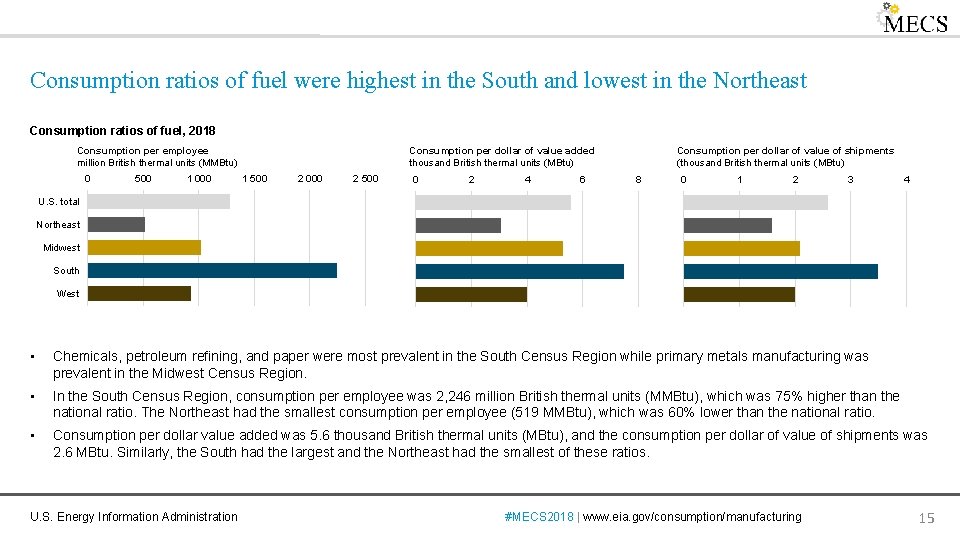
Consumption ratios of fuel were highest in the South and lowest in the Northeast Consumption ratios of fuel, 2018 Consumption per employee million British thermal units (MMBtu) 0 500 1 000 Consumption per dollar of value of shipments (thousand British thermal units (MBtu) Consumption per dollar of value added thousand British thermal units (MBtu) 1 500 2 000 2 500 0 2 4 6 8 0 1 2 3 4 U. S. total Northeast Midwest South West • Chemicals, petroleum refining, and paper were most prevalent in the South Census Region while primary metals manufacturing was prevalent in the Midwest Census Region. • In the South Census Region, consumption per employee was 2, 246 million British thermal units (MMBtu), which was 75% higher than the national ratio. The Northeast had the smallest consumption per employee (519 MMBtu), which was 60% lower than the national ratio. • Consumption per dollar value added was 5. 6 thousand British thermal units (MBtu), and the consumption per dollar of value of shipments was 2. 6 MBtu. Similarly, the South had the largest and the Northeast had the smallest of these ratios. U. S. Energy Information Administration #MECS 2018 | www. eia. gov/consumption/manufacturing 15
Fuel-switching capability Manufacturing establishments have short-term capability to use substitute energy sources in place of those actually consumed. Capability to use substitute energy sources means that the establishment’s combustors (for example, boilers, furnaces, ovens, and blast furnaces) had the machinery or equipment either in place or available for installation so that they could introduce substitutions within 30 days without extensive modifications. Fuel-switching capability does not depend on the relative prices of energy sources; it depends only on the characteristics of the equipment and certain legal constraints.
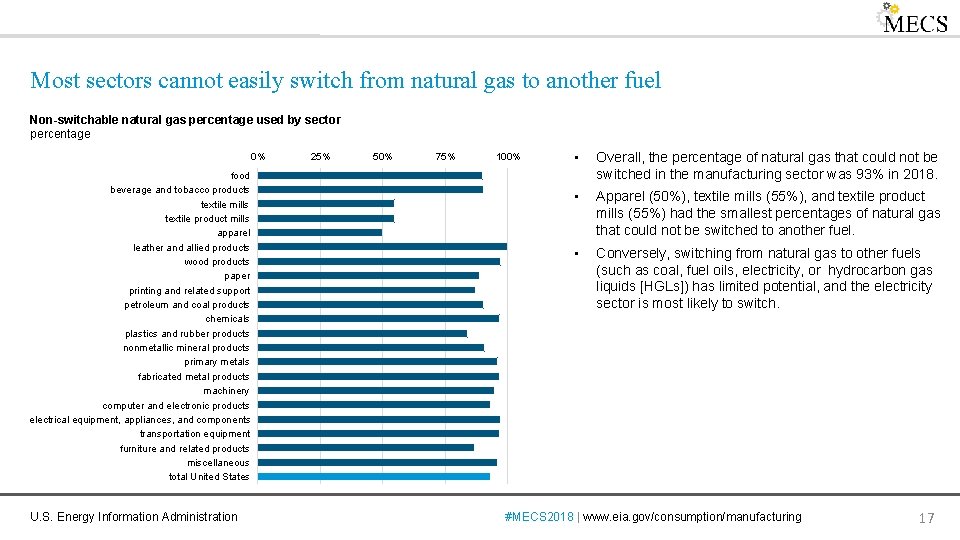
Most sectors cannot easily switch from natural gas to another fuel Non-switchable natural gas percentage used by sector percentage 0% food beverage and tobacco products textile mills textile product mills apparel leather and allied products wood products paper printing and related support petroleum and coal products chemicals plastics and rubber products nonmetallic mineral products primary metals fabricated metal products machinery computer and electronic products electrical equipment, appliances, and components transportation equipment furniture and related products miscellaneous total United States U. S. Energy Information Administration 25% 50% 75% 100% • Overall, the percentage of natural gas that could not be switched in the manufacturing sector was 93% in 2018. • Apparel (50%), textile mills (55%), and textile product mills (55%) had the smallest percentages of natural gas that could not be switched to another fuel. • Conversely, switching from natural gas to other fuels (such as coal, fuel oils, electricity, or hydrocarbon gas liquids [HGLs]) has limited potential, and the electricity sector is most likely to switch. #MECS 2018 | www. eia. gov/consumption/manufacturing 17
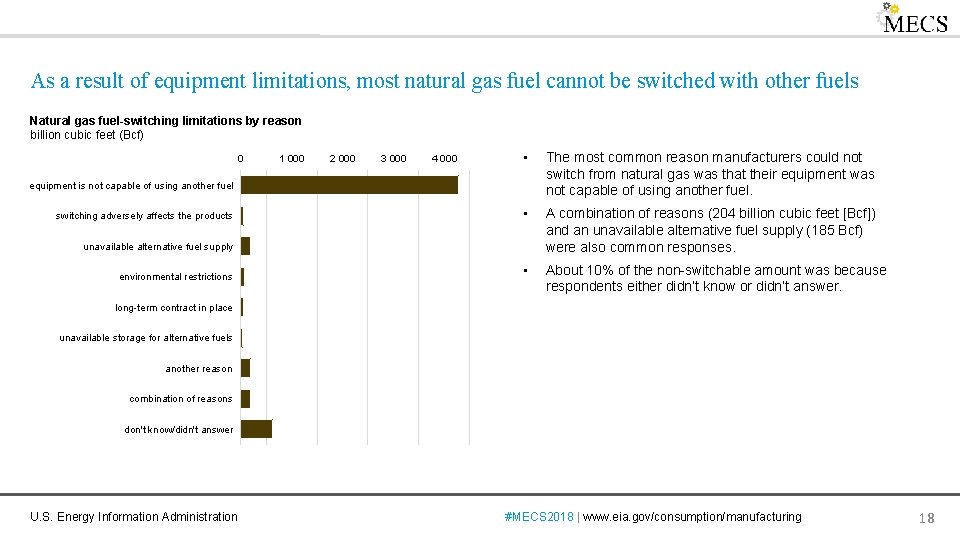
As a result of equipment limitations, most natural gas fuel cannot be switched with other fuels Natural gas fuel-switching limitations by reason billion cubic feet (Bcf) 0 1 000 2 000 3 000 4 000 • The most common reason manufacturers could not switch from natural gas was that their equipment was not capable of using another fuel. • A combination of reasons (204 billion cubic feet [Bcf]) and an unavailable alternative fuel supply (185 Bcf) were also common responses. • About 10% of the non-switchable amount was because respondents either didn’t know or didn’t answer. equipment is not capable of using another fuel switching adversely affects the products unavailable alternative fuel supply environmental restrictions long-term contract in place unavailable storage for alternative fuels another reason combination of reasons don't know/didn't answer U. S. Energy Information Administration #MECS 2018 | www. eia. gov/consumption/manufacturing 18
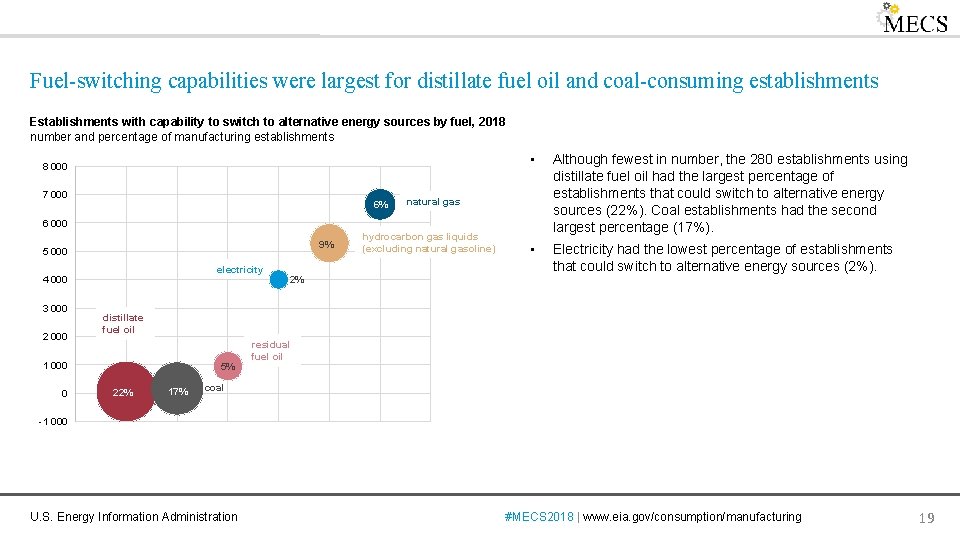
Fuel-switching capabilities were largest for distillate fuel oil and coal-consuming establishments Establishments with capability to switch to alternative energy sources by fuel, 2018 number and percentage of manufacturing establishments 8 000 7 000 6% • Although fewest in number, the 280 establishments using distillate fuel oil had the largest percentage of establishments that could switch to alternative energy sources (22%). Coal establishments had the second largest percentage (17%). • Electricity had the lowest percentage of establishments that could switch to alternative energy sources (2%). natural gas 6 000 9% 5 000 electricity 4 000 3 000 2 000 distillate fuel oil 1 000 0 2% hydrocarbon gas liquids (excluding natural gasoline) 5% 22% 17% residual fuel oil coal -1 000 U. S. Energy Information Administration #MECS 2018 | www. eia. gov/consumption/manufacturing 19
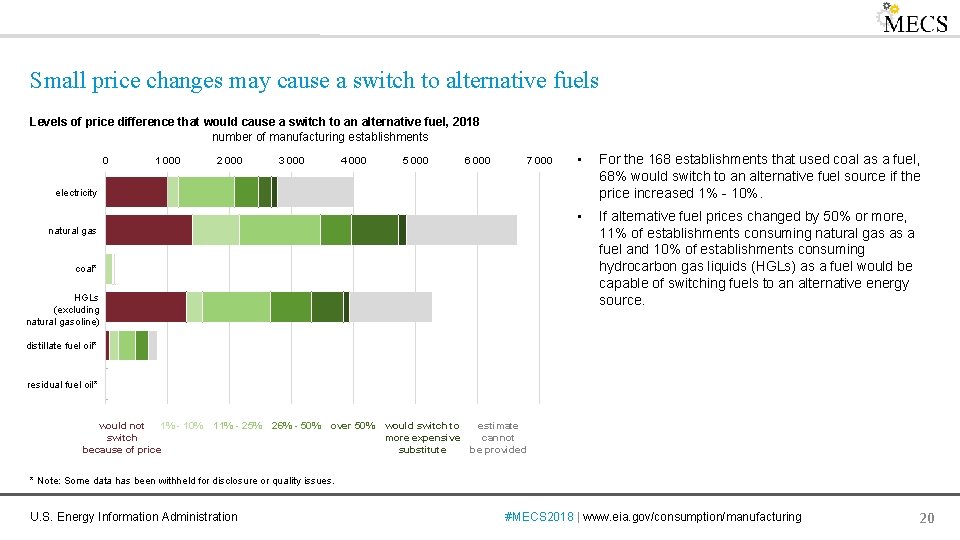
Small price changes may cause a switch to alternative fuels Levels of price difference that would cause a switch to an alternative fuel, 2018 number of manufacturing establishments 0 1 000 2 000 3 000 4 000 5 000 6 000 7 000 • For the 168 establishments that used coal as a fuel, 68% would switch to an alternative fuel source if the price increased 1% - 10%. • If alternative fuel prices changed by 50% or more, 11% of establishments consuming natural gas as a fuel and 10% of establishments consuming hydrocarbon gas liquids (HGLs) as a fuel would be capable of switching fuels to an alternative energy source. electricity natural gas coal* HGLs (excluding natural gasoline) distillate fuel oil* residual fuel oil* would not 1% - 10% switch because of price 11% - 25% 26% - 50% over 50% would switch to more expensive substitute estimate cannot be provided * Note: Some data has been withheld for disclosure or quality issues. U. S. Energy Information Administration #MECS 2018 | www. eia. gov/consumption/manufacturing 20
Expenditures and pricing include funds spent for energy purchased and paid for or delivered to a manufacturer during a calendar year. For the Manufacturing Energy Consumption Survey (MECS), expenditures include state and local taxes and delivery charges.
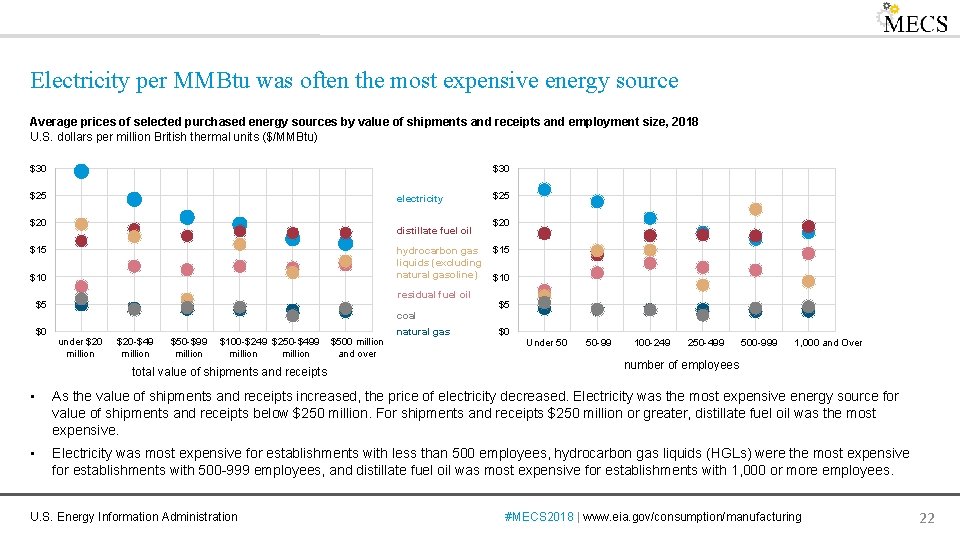
Electricity per MMBtu was often the most expensive energy source Average prices of selected purchased energy sources by value of shipments and receipts and employment size, 2018 U. S. dollars per million British thermal units ($/MMBtu) $30 $25 electricity $20 distillate fuel oil $15 hydrocarbon gas liquids (excluding natural gasoline) $10 residual fuel oil $5 $0 coal under $20 million $20 -$49 million $50 -$99 million $100 -$249 $250 -$499 million total value of shipments and receipts $500 million and over natural gas $25 $20 $15 $10 $5 $0 Under 50 50 -99 100 -249 250 -499 500 -999 1, 000 and Over number of employees • As the value of shipments and receipts increased, the price of electricity decreased. Electricity was the most expensive energy source for value of shipments and receipts below $250 million. For shipments and receipts $250 million or greater, distillate fuel oil was the most expensive. • Electricity was most expensive for establishments with less than 500 employees, hydrocarbon gas liquids (HGLs) were the most expensive for establishments with 500 -999 employees, and distillate fuel oil was most expensive for establishments with 1, 000 or more employees. U. S. Energy Information Administration #MECS 2018 | www. eia. gov/consumption/manufacturing 22
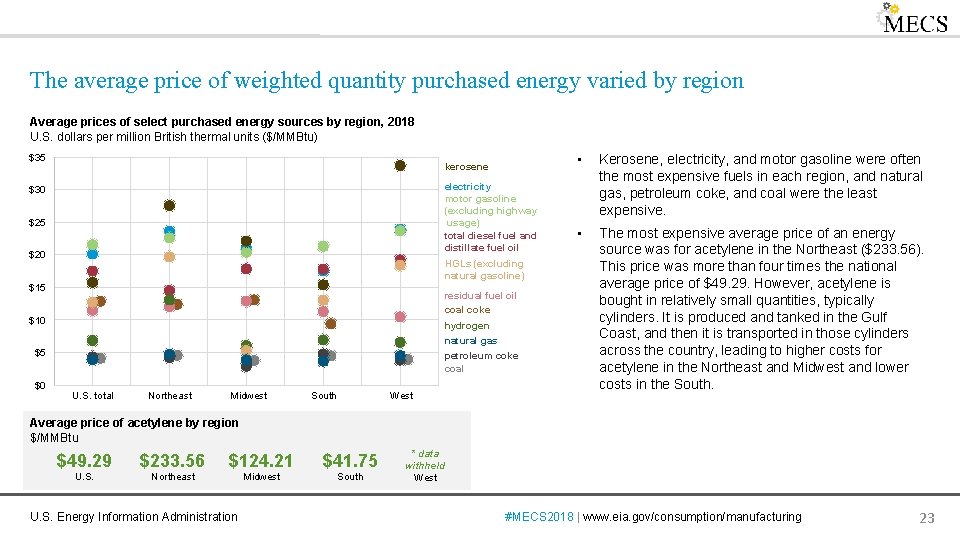
The average price of weighted quantity purchased energy varied by region Average prices of select purchased energy sources by region, 2018 U. S. dollars per million British thermal units ($/MMBtu) $35 kerosene electricity motor gasoline (excluding highway usage) total diesel fuel and distillate fuel oil $30 $25 $20 HGLs (excluding natural gasoline) $15 residual fuel oil coal coke $10 hydrogen natural gas petroleum coke coal $5 $0 U. S. total Northeast Midwest West South • Kerosene, electricity, and motor gasoline were often the most expensive fuels in each region, and natural gas, petroleum coke, and coal were the least expensive. • The most expensive average price of an energy source was for acetylene in the Northeast ($233. 56). This price was more than four times the national average price of $49. 29. However, acetylene is bought in relatively small quantities, typically cylinders. It is produced and tanked in the Gulf Coast, and then it is transported in those cylinders across the country, leading to higher costs for acetylene in the Northeast and Midwest and lower costs in the South. Average price of acetylene by region $/MMBtu $49. 29 $233. 56 $124. 21 $41. 75 U. S. Northeast Midwest South U. S. Energy Information Administration * data withheld West #MECS 2018 | www. eia. gov/consumption/manufacturing 23
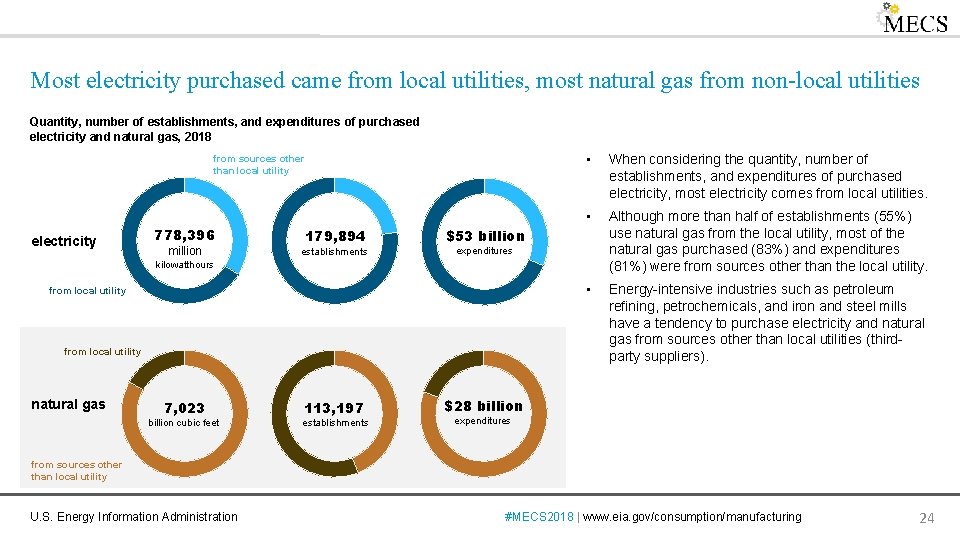
Most electricity purchased came from local utilities, most natural gas from non-local utilities Quantity, number of establishments, and expenditures of purchased electricity and natural gas, 2018 from sources other than local utility electricity 778, 396 million 179, 894 establishments • When considering the quantity, number of establishments, and expenditures of purchased electricity, most electricity comes from local utilities. • Although more than half of establishments (55%) use natural gas from the local utility, most of the natural gas purchased (83%) and expenditures (81%) were from sources other than the local utility. • Energy-intensive industries such as petroleum refining, petrochemicals, and iron and steel mills have a tendency to purchase electricity and natural gas from sources other than local utilities (thirdparty suppliers). $53 billion expenditures kilowatthours from local utility natural gas 7, 023 113, 197 billion cubic feet establishments $28 billion expenditures from sources other than local utility U. S. Energy Information Administration #MECS 2018 | www. eia. gov/consumption/manufacturing 24
Manufacturing floorspace and establishment counts The Manufacturing Energy Consumption Survey (MECS) collects data about how many buildings are on each establishment site as well as the approximate square footage of the buildings onsite. Buildings include structures enclosed by walls extending from the foundation to the roof; parking garages, even if not totally enclosed by walls and a roof; or structures erected on pillars to elevate the first fully enclosed level. Excluded buildings are structures (other than the exceptions noted above) that are not totally enclosed by walls and a roof; mobile homes and trailers, even if they house manufacturing activity; structures not ordinarily intended to be entered by humans, such as storage tanks; or non-buildings that consume energy (such as pumps and construction sites).
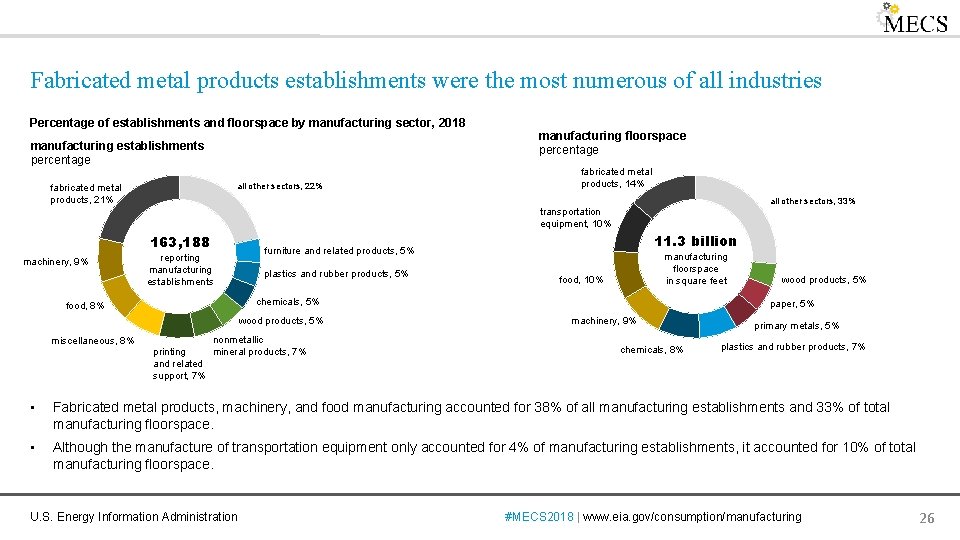
Fabricated metal products establishments were the most numerous of all industries Percentage of establishments and floorspace by manufacturing sector, 2018 manufacturing establishments percentage all other sectors, 22% fabricated metal products, 21% manufacturing floorspace percentage fabricated metal products, 14% all other sectors, 33% transportation equipment, 10% 163, 188 machinery, 9% reporting manufacturing establishments 11. 3 billion furniture and related products, 5% plastics and rubber products, 5% manufacturing floorspace in square feet food, 10% chemicals, 5% food, 8% wood products, 5% miscellaneous, 8% printing and related support, 7% nonmetallic mineral products, 7% wood products, 5% paper, 5% machinery, 9% chemicals, 8% primary metals, 5% plastics and rubber products, 7% • Fabricated metal products, machinery, and food manufacturing accounted for 38% of all manufacturing establishments and 33% of total manufacturing floorspace. • Although the manufacture of transportation equipment only accounted for 4% of manufacturing establishments, it accounted for 10% of total manufacturing floorspace. U. S. Energy Information Administration #MECS 2018 | www. eia. gov/consumption/manufacturing 26
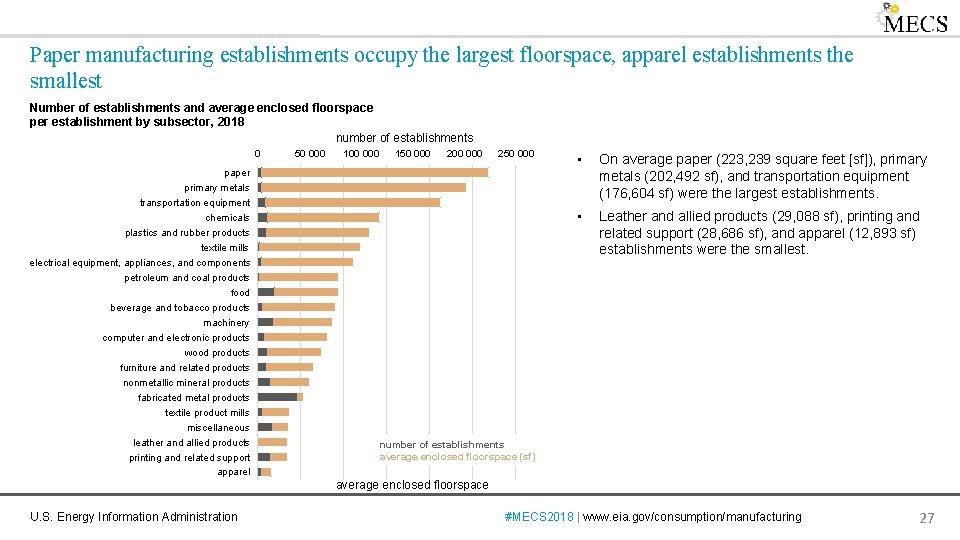
Paper manufacturing establishments occupy the largest floorspace, apparel establishments the smallest Number of establishments and average enclosed floorspace per establishment by subsector, 2018 number of establishments 0 paper primary metals transportation equipment chemicals plastics and rubber products textile mills electrical equipment, appliances, and components petroleum and coal products food beverage and tobacco products machinery computer and electronic products wood products furniture and related products nonmetallic mineral products fabricated metal products textile product mills miscellaneous leather and allied products printing and related support apparel 50 000 100 000 150 000 200 000 250 000 • On average paper (223, 239 square feet [sf]), primary metals (202, 492 sf), and transportation equipment (176, 604 sf) were the largest establishments. • Leather and allied products (29, 088 sf), printing and related support (28, 686 sf), and apparel (12, 893 sf) establishments were the smallest. number of establishments average enclosed floorspace (sf) average enclosed floorspace U. S. Energy Information Administration #MECS 2018 | www. eia. gov/consumption/manufacturing 27
Energy management The participation, awareness, and implementation of energy management activities at manufacturing establishments.
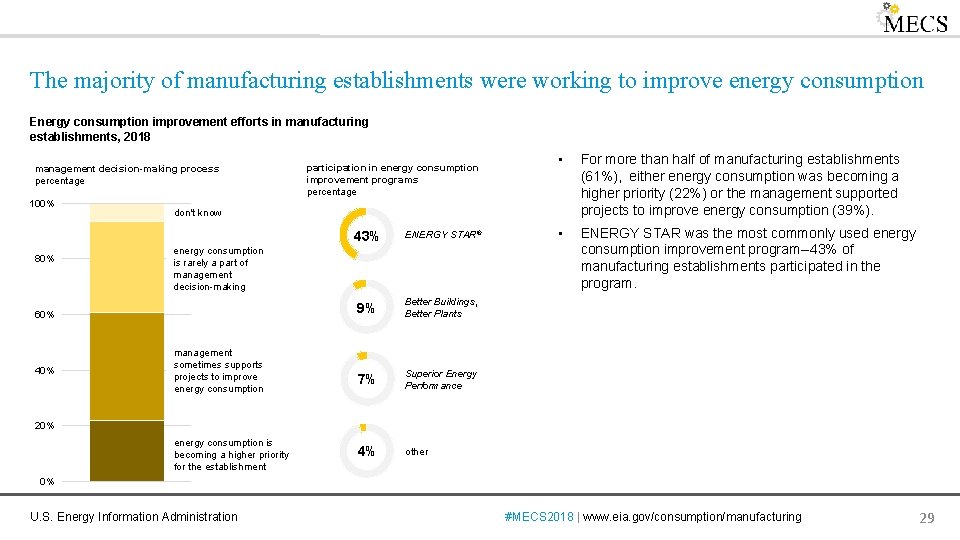
The majority of manufacturing establishments were working to improve energy consumption Energy consumption improvement efforts in manufacturing establishments, 2018 management decision-making process percentage 100% 80% • For more than half of manufacturing establishments (61%), either energy consumption was becoming a higher priority (22%) or the management supported projects to improve energy consumption (39%). • ENERGY STAR was the most commonly used energy consumption improvement program--43% of manufacturing establishments participated in the program. don't know 43% ENERGY STAR® 9% Better Buildings, Better Plants 7% Superior Energy Performance 4% other energy consumption is rarely a part of management decision-making 60% 40% participation in energy consumption improvement programs percentage management sometimes supports projects to improve energy consumption 20% energy consumption is becoming a higher priority for the establishment 0% U. S. Energy Information Administration #MECS 2018 | www. eia. gov/consumption/manufacturing 29
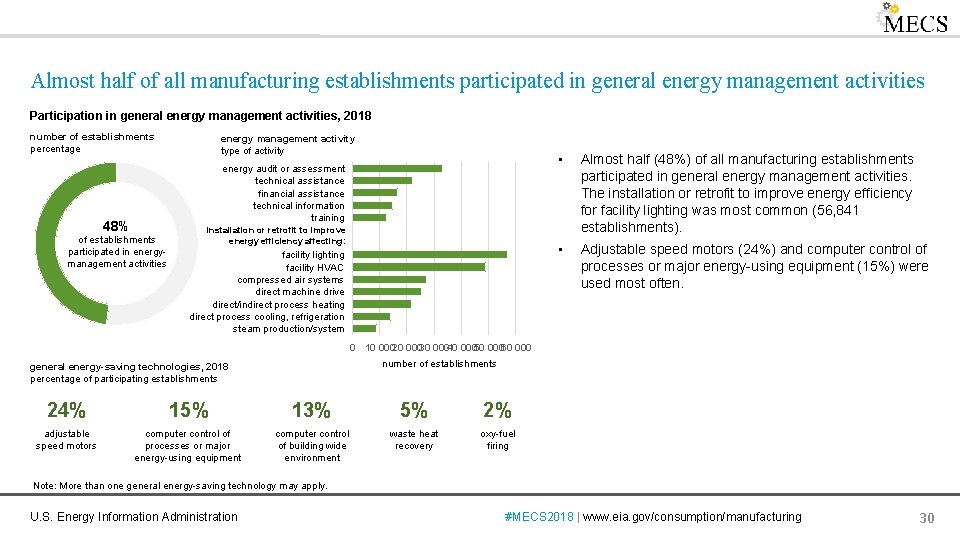
Almost half of all manufacturing establishments participated in general energy management activities Participation in general energy management activities, 2018 number of establishments percentage energy management activity type of activity energy audit or assessment technical assistance financial assistance technical information training 48% of establishments participated in energymanagement activities installation or retrofit to improve energy efficiency affecting: facility lighting facility HVAC compressed air systems direct machine drive direct/indirect process heating direct process cooling, refrigeration steam production/system • Almost half (48%) of all manufacturing establishments participated in general energy management activities. The installation or retrofit to improve energy efficiency for facility lighting was most common (56, 841 establishments). • Adjustable speed motors (24%) and computer control of processes or major energy-using equipment (15%) were used most often. 0 10 00020 00030 00040 00050 00060 000 number of establishments general energy-saving technologies, 2018 percentage of participating establishments 24% 15% 13% 5% 2% adjustable speed motors computer control of processes or major energy-using equipment computer control of building wide environment waste heat recovery oxy-fuel firing Note: More than one general energy-saving technology may apply. U. S. Energy Information Administration #MECS 2018 | www. eia. gov/consumption/manufacturing 30
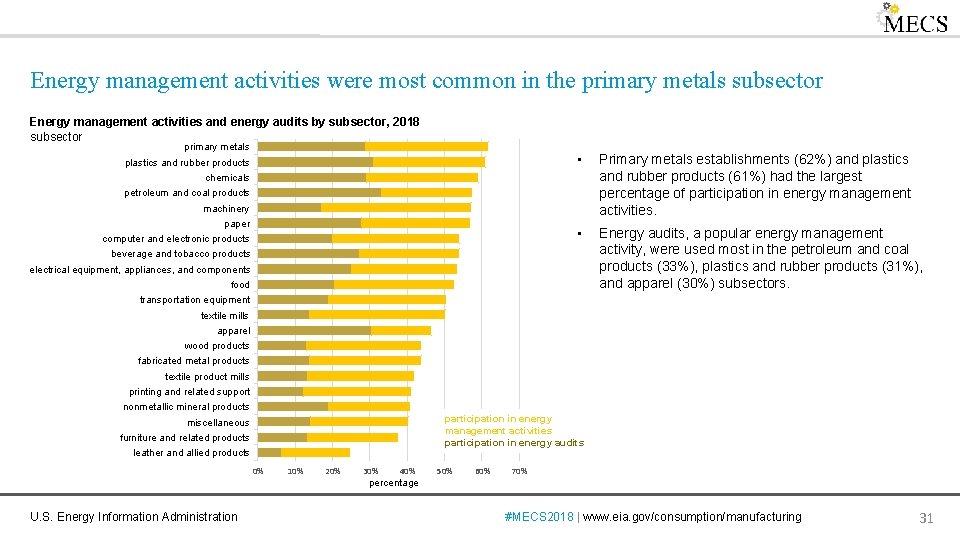
Energy management activities were most common in the primary metals subsector Energy management activities and energy audits by subsector, 2018 subsector primary metals plastics and rubber products • Primary metals establishments (62%) and plastics and rubber products (61%) had the largest percentage of participation in energy management activities. • Energy audits, a popular energy management activity, were used most in the petroleum and coal products (33%), plastics and rubber products (31%), and apparel (30%) subsectors. chemicals petroleum and coal products machinery paper computer and electronic products beverage and tobacco products electrical equipment, appliances, and components food transportation equipment textile mills apparel wood products fabricated metal products textile product mills printing and related support nonmetallic mineral products participation in energy management activities participation in energy audits miscellaneous furniture and related products leather and allied products 0% 10% 20% 30% 40% 50% 60% 70% percentage U. S. Energy Information Administration #MECS 2018 | www. eia. gov/consumption/manufacturing 31
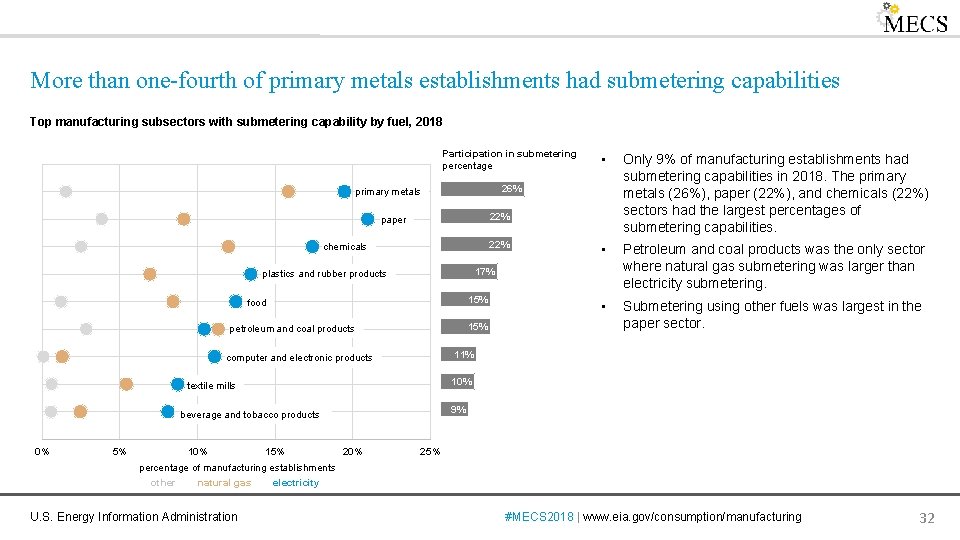
More than one-fourth of primary metals establishments had submetering capabilities Top manufacturing subsectors with submetering capability by fuel, 2018 Participation in submetering percentage 22% chemicals Petroleum and coal products was the only sector where natural gas submetering was larger than electricity submetering. • Submetering using other fuels was largest in the paper sector. 17% plastics and rubber products 15% food 15% petroleum and coal products 11% computer and electronic products 10% textile mills 9% beverage and tobacco products 10% • 22% paper 5% Only 9% of manufacturing establishments had submetering capabilities in 2018. The primary metals (26%), paper (22%), and chemicals (22%) sectors had the largest percentages of submetering capabilities. 26% primary metals 0% • 15% 20% 25% percentage of manufacturing establishments other natural gas U. S. Energy Information Administration electricity #MECS 2018 | www. eia. gov/consumption/manufacturing 32
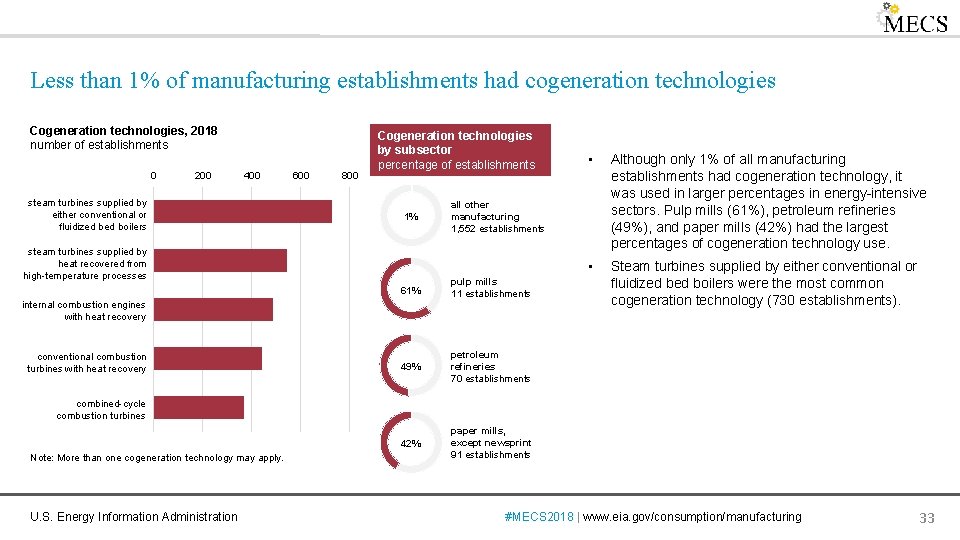
Less than 1% of manufacturing establishments had cogeneration technologies Cogeneration technologies, 2018 number of establishments 0 200 400 steam turbines supplied by either conventional or fluidized boilers 600 800 Cogeneration technologies by subsector percentage of establishments 1% steam turbines supplied by heat recovered from high-temperature processes Although only 1% of all manufacturing establishments had cogeneration technology, it was used in larger percentages in energy-intensive sectors. Pulp mills (61%), petroleum refineries (49%), and paper mills (42%) had the largest percentages of cogeneration technology use. • Steam turbines supplied by either conventional or fluidized boilers were the most common cogeneration technology (730 establishments). all other manufacturing 1, 552 establishments 61% pulp mills 11 establishments 49% petroleum refineries 70 establishments 42% paper mills, except newsprint 91 establishments internal combustion engines with heat recovery conventional combustion turbines with heat recovery • combined-cycle combustion turbines Note: More than one cogeneration technology may apply. U. S. Energy Information Administration #MECS 2018 | www. eia. gov/consumption/manufacturing 33
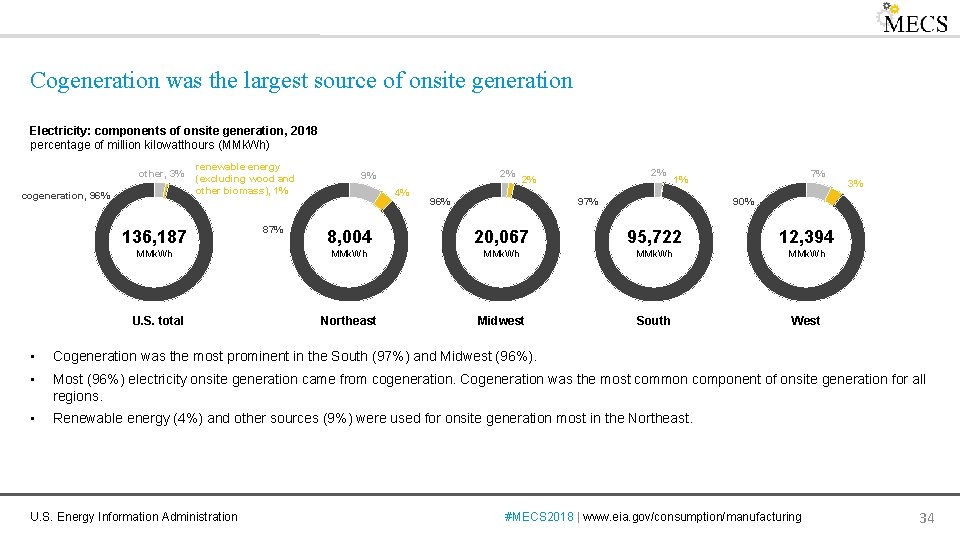
Cogeneration was the largest source of onsite generation Electricity: components of onsite generation, 2018 percentage of million kilowatthours (MMk. Wh) other, 3% cogeneration, 96% renewable energy (excluding wood and other biomass), 1% 136, 187 MMk. Wh U. S. total 87% 2% 9% 4% 2% 2% 96% 7% 1% 3% 90% 97% 8, 004 20, 067 95, 722 12, 394 MMk. Wh Northeast Midwest South West • Cogeneration was the most prominent in the South (97%) and Midwest (96%). • Most (96%) electricity onsite generation came from cogeneration. Cogeneration was the most common component of onsite generation for all regions. • Renewable energy (4%) and other sources (9%) were used for onsite generation most in the Northeast. U. S. Energy Information Administration #MECS 2018 | www. eia. gov/consumption/manufacturing 34
Top energy-consuming subsectors These subsectors are typically the most energy-intensive within manufacturing, and they usually consume large amounts of energy for nonfuel (feedstock) purposes.
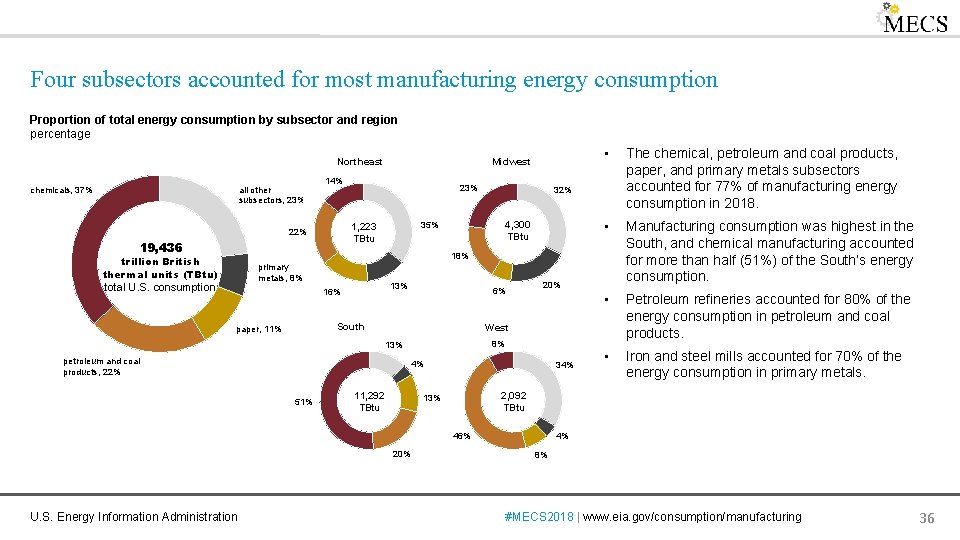
Four subsectors accounted for most manufacturing energy consumption Proportion of total energy consumption by subsector and region percentage Northeast all other subsectors, 23% chemicals, 37% Midwest 14% 23% 19, 436 The chemical, petroleum and coal products, paper, and primary metals subsectors accounted for 77% of manufacturing energy consumption in 2018. • Manufacturing consumption was highest in the South, and chemical manufacturing accounted for more than half (51%) of the South’s energy consumption. • Petroleum refineries accounted for 80% of the energy consumption in petroleum and coal products. • Iron and steel mills accounted for 70% of the energy consumption in primary metals. 32% 4, 300 TBtu 35% 1, 223 TBtu 22% • 18% trillion British thermal units (TBtu) total U. S. consumption primary metals, 8% 13% 16% 6% South paper, 11% West 8% 13% petroleum and coal products, 22% 20% 4% 51% 11, 292 TBtu 34% 2, 092 TBtu 13% 46% 20% U. S. Energy Information Administration 4% 8% #MECS 2018 | www. eia. gov/consumption/manufacturing 36
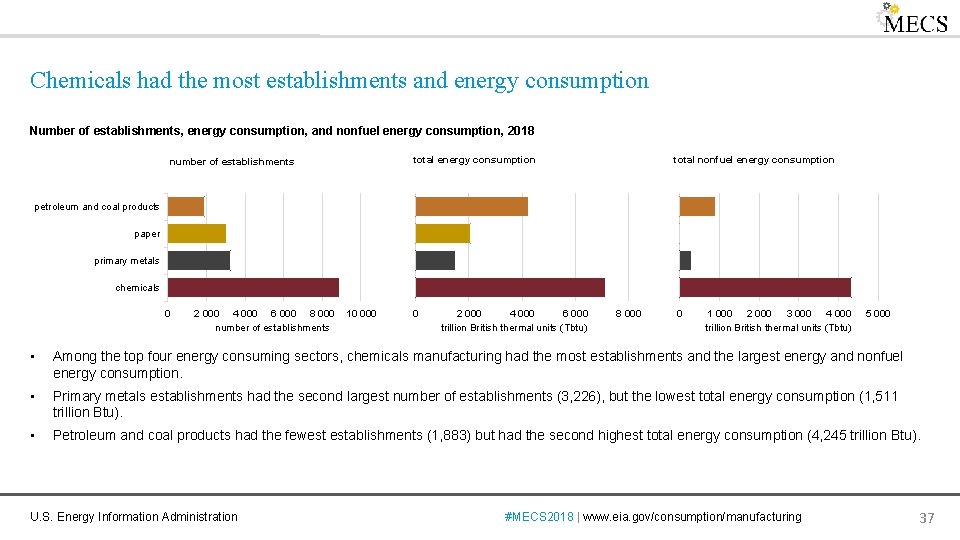
Chemicals had the most establishments and energy consumption Number of establishments, energy consumption, and nonfuel energy consumption, 2018 total nonfuel energy consumption total energy consumption number of establishments petroleum and coal products paper primary metals chemicals 0 2 000 4 000 6 000 8 000 number of establishments 10 000 0 2 000 4 000 6 000 trillion British thermal units (Tbtu) 8 000 0 1 000 2 000 3 000 4 000 trillion British thermal units (Tbtu) 5 000 • Among the top four energy consuming sectors, chemicals manufacturing had the most establishments and the largest energy and nonfuel energy consumption. • Primary metals establishments had the second largest number of establishments (3, 226), but the lowest total energy consumption (1, 511 trillion Btu). • Petroleum and coal products had the fewest establishments (1, 883) but had the second highest total energy consumption (4, 245 trillion Btu). U. S. Energy Information Administration #MECS 2018 | www. eia. gov/consumption/manufacturing 37
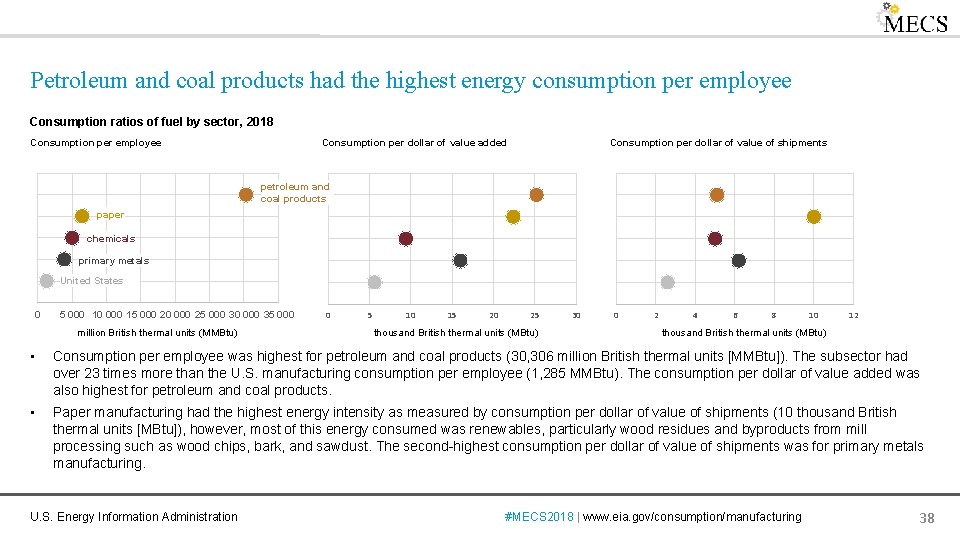
Petroleum and coal products had the highest energy consumption per employee Consumption ratios of fuel by sector, 2018 Consumption per employee Consumption per dollar of value added Consumption per dollar of value of shipments petroleum and coal products paper chemicals primary metals United States 0 5 000 10 000 15 000 20 000 25 000 30 000 35 000 million British thermal units (MMBtu) 0 5 10 15 20 25 thousand British thermal units (MBtu) 30 0 2 4 6 8 10 12 thousand British thermal units (MBtu) • Consumption per employee was highest for petroleum and coal products (30, 306 million British thermal units [MMBtu]). The subsector had over 23 times more than the U. S. manufacturing consumption per employee (1, 285 MMBtu). The consumption per dollar of value added was also highest for petroleum and coal products. • Paper manufacturing had the highest energy intensity as measured by consumption per dollar of value of shipments (10 thousand British thermal units [MBtu]), however, most of this energy consumed was renewables, particularly wood residues and byproducts from mill processing such as wood chips, bark, and sawdust. The second-highest consumption per dollar of value of shipments was for primary metals manufacturing. U. S. Energy Information Administration #MECS 2018 | www. eia. gov/consumption/manufacturing 38
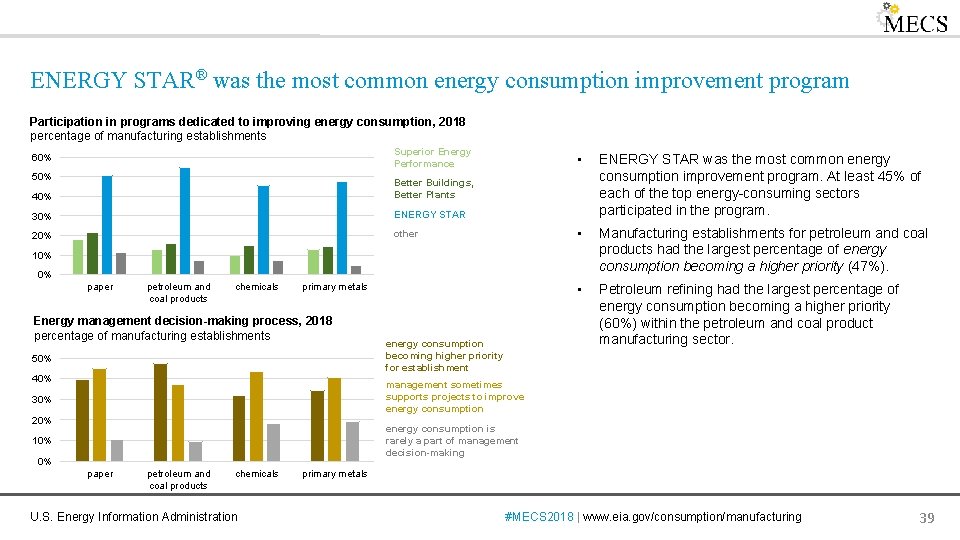
ENERGY STAR® was the most common energy consumption improvement program Participation in programs dedicated to improving energy consumption, 2018 percentage of manufacturing establishments Superior Energy Performance 60% 50% 40% Better Buildings, Better Plants 30% ENERGY STAR 20% other • ENERGY STAR was the most common energy consumption improvement program. At least 45% of each of the top energy-consuming sectors participated in the program. • Manufacturing establishments for petroleum and coal products had the largest percentage of energy consumption becoming a higher priority (47%). • Petroleum refining had the largest percentage of energy consumption becoming a higher priority (60%) within the petroleum and coal product manufacturing sector. 10% 0% paper petroleum and coal products chemicals primary metals Energy management decision-making process, 2018 percentage of manufacturing establishments 50% 40% energy consumption becoming higher priority for establishment management sometimes supports projects to improve energy consumption 30% 20% energy consumption is rarely a part of management decision-making 10% 0% paper petroleum and coal products chemicals U. S. Energy Information Administration primary metals #MECS 2018 | www. eia. gov/consumption/manufacturing 39
References and additional information
References All graphs are sourced from Form EIA-846 A/B, Manufacturing Energy Consumption Survey. Gross output estimates are sourced from the Bureau of Economic Analysis, Gross Output by Industry data series. Manufacturing employee estimates are sourced from the U. S. Census Bureau, based on one-year estimates from the Annual Survey of Manufacturers. Please direct questions about the MECS to Tom Lorenz, Survey Manager, thomas. lorenz@eia. gov. U. S. Energy Information Administration #MECS 2018 | www. eia. gov/consumption/manufacturing 41
For more information U. S. Energy Information Administration homepage | www. eia. gov Manufacturing Energy Consumption Survey | www. eia. gov/consumption/manufacturing Consumption and Efficiency | https: //www. eia. gov/consumption Today in Energy | www. eia. gov/todayinenergy U. S. Energy Information Administration #MECS 2018 | www. eia. gov/consumption/manufacturing 42