
2018 L 5 Big Ideas 1 2 Establishing
2018 L 5: Big Ideas 1 & 2 -Establishing Your Own Credibility
Lesson 5: Focus 2018 ► How will you know if you are using strong source materials for your inquiry? ► What criteria should you use to determine the strength of your sources? ► What criteria will you use to determine what components of the sources you will incorporate or not incorporate in your inquiry?
"Research" vs "research" ► Little “r” research is search 2018 and report to develop an argument or stance around an issue. ► Capital “R” Research is where a student has a wellarticulated method to come to a new understanding or new piece of knowledge which, if someone else “repeated” it, that other person could come up with the same understanding and validate the new piece of knowledge. ► The argument you will make in AP Research are just that — you have come to a new understanding, and, if someone else repeats your work, they will come to the same new understanding. ► This is establishing your credibility.
The Credibility Test 2018 ► Purpose: the reason the information exists ► Accuracy: reliability, truthfulness, and correctness ► Authority: source of the information ► Relevance: importance of the information for your needs ► Currency: timeliness of the information
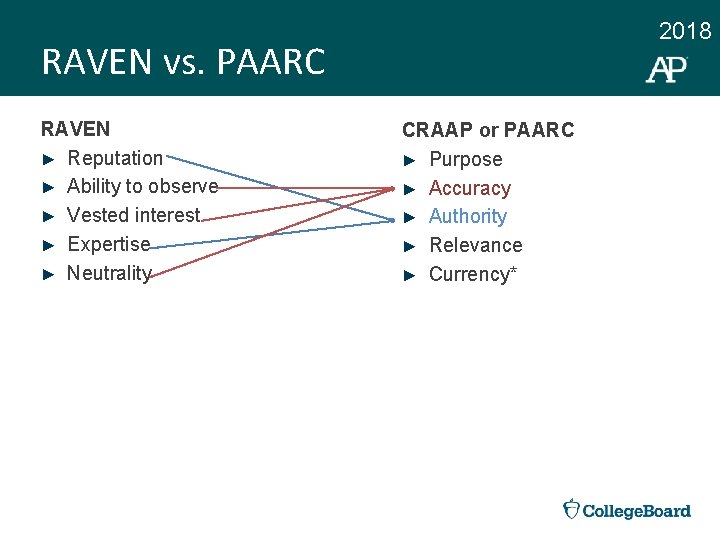
2018 RAVEN vs. PAARC RAVEN ► Reputation ► Ability to observe ► Vested interest ► Expertise ► Neutrality CRAAP or PAARC ► Purpose ► Accuracy ► Authority ► Relevance ► Currency*
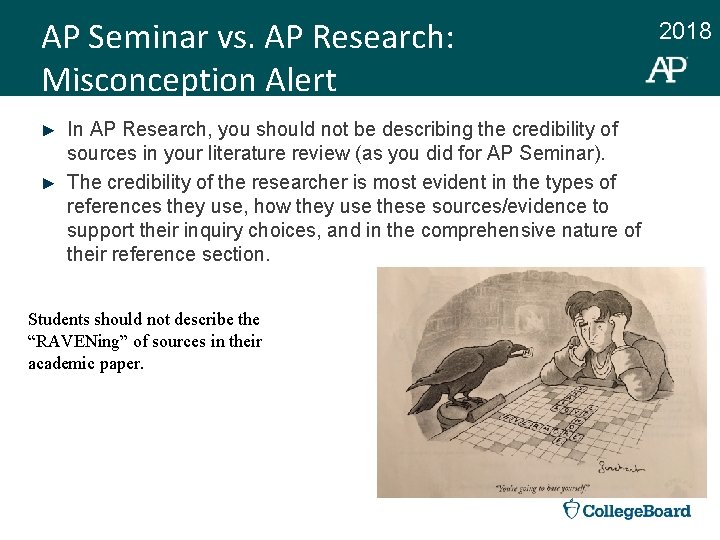
AP Seminar vs. AP Research: Misconception Alert In AP Research, you should not be describing the credibility of sources in your literature review (as you did for AP Seminar). ► The credibility of the researcher is most evident in the types of references they use, how they use these sources/evidence to support their inquiry choices, and in the comprehensive nature of their reference section. ► Students should not describe the “RAVENing” of sources in their academic paper. 2018
Credibility is Relative 2018 What if you were investigating the topic of inquiry pertaining to exploring the attitudes and perspectives of parents of children with autism as to the cause of the disorder? Would your PAARC evaluation of one or both of the sources change? ► If so, how? ►
Considering Multiple Perspectives 2018 How will I know I have spent enough time considering the contributions of others to my topic of inquiry? ► You need to identify multiple perspectives pertaining to all the choices you can make in the inquiry process (definitions, variables, scope, method). ► Taking too narrow a perspective (myopic view) or too broad a perspective (theory of everything) can diminish your credibility by leaving your eventual conclusion open to criticism.
Putting Sources in Conversation with Each Other 2018 ► In scholarly research, it is the usual practice to use several relevant, significant sources in the literature review, which represent a variety of perspectives on your topic of inquiry. ► Again, a “variety of perspectives” means different than your perspective. ► However, it is also important that the sources are in conversation with each other and connected to your topic of inquiry.

Putting Sources in Conversation with Each Other 2018 ► If each source is simply identified and summarized, it becomes obvious that you are having trouble effectively synthesizing what is known in the field about your topic of inquiry. ► You need to practice writing about how the sources relate to each other in terms of significance and also how they relate (in terms of significance) to your own topic of inquiry.
Incorporating Multiple Perspectives 2018 ► You need to find another view and/or way pertaining to every choice you will make in the inquiry process so that you are well informed and are making not just a decision, but a wellinformed decision, considering. • • • You must acknowledge that there were other perspectives, understandings, and methods that were valid and different from your own. You MUST be able to justify why you chose option A over option B and C. You must say why A was better than B or C for your inquiry purposes.
Constructing Meaning from Multiple Sources Imagine you are researching the question, To what extent do school-based drug education programs succeed in reducing drug use in teens? ► Skim the West & O’Neal article ► Identify or highlight specific elements and quotes from this article that address this research question. ► Use those elements to fill in the Constructing Meaning from Multiple Sources template below for article 1. ► Follow the same steps after reading the Hammond et al. article. 2018
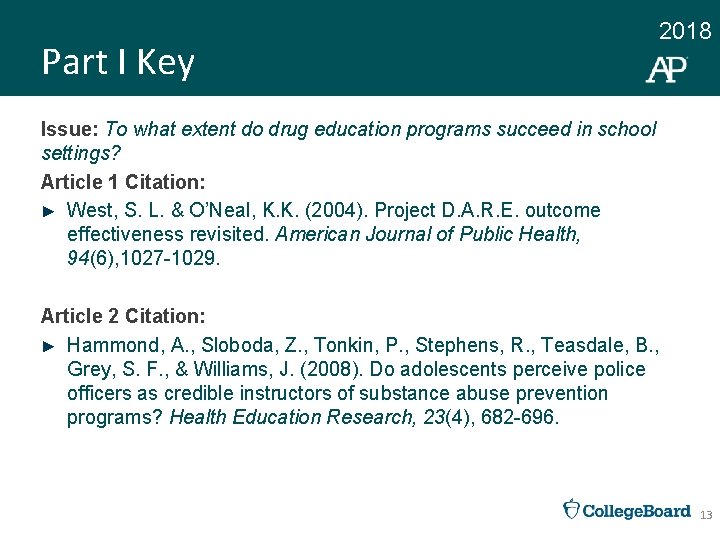
Part I Key 2018 Issue: To what extent do drug education programs succeed in school settings? Article 1 Citation: ► West, S. L. & O’Neal, K. K. (2004). Project D. A. R. E. outcome effectiveness revisited. American Journal of Public Health, 94(6), 1027 -1029. Article 2 Citation: ► Hammond, A. , Sloboda, Z. , Tonkin, P. , Stephens, R. , Teasdale, B. , Grey, S. F. , & Williams, J. (2008). Do adolescents perceive police officers as credible instructors of substance abuse prevention programs? Health Education Research, 23(4), 682 -696. 13
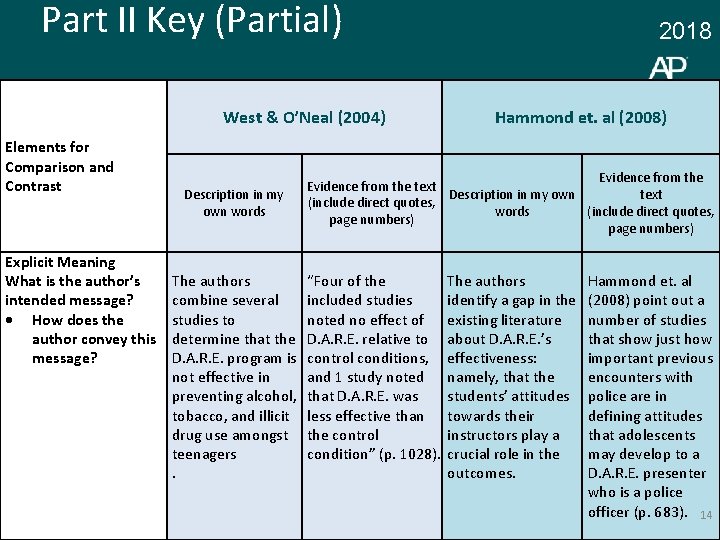
Part II Key (Partial) West & O’Neal (2004) Elements for Comparison and Contrast Explicit Meaning What is the author’s intended message? How does the author convey this message? Description in my own words The authors combine several studies to determine that the D. A. R. E. program is not effective in preventing alcohol, tobacco, and illicit drug use amongst teenagers. 2018 Hammond et. al (2008) Evidence from the text Description in my own text (include direct quotes, words (include direct quotes, page numbers) “Four of the included studies noted no effect of D. A. R. E. relative to control conditions, and 1 study noted that D. A. R. E. was less effective than the control condition” (p. 1028). The authors identify a gap in the existing literature about D. A. R. E. ’s effectiveness: namely, that the students’ attitudes towards their instructors play a crucial role in the outcomes. Hammond et. al (2008) point out a number of studies that show just how important previous encounters with police are in defining attitudes that adolescents may develop to a D. A. R. E. presenter who is a police officer (p. 683). 14
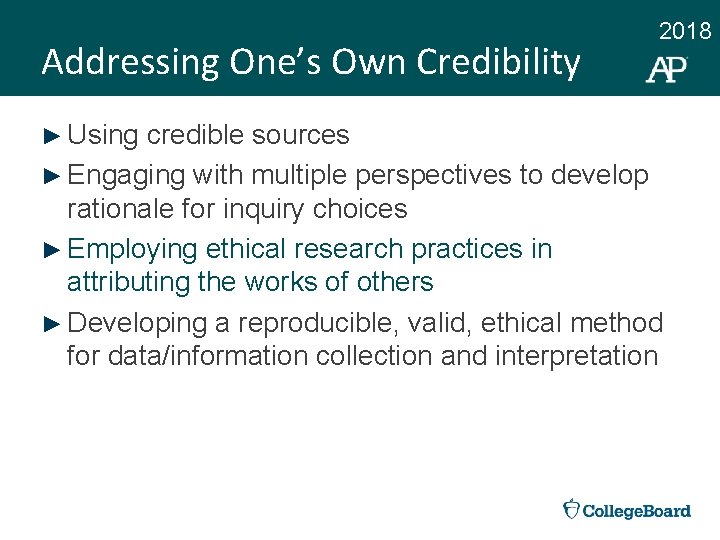
Addressing One’s Own Credibility 2018 ► Using credible sources ► Engaging with multiple perspectives to develop rationale for inquiry choices ► Employing ethical research practices in attributing the works of others ► Developing a reproducible, valid, ethical method for data/information collection and interpretation
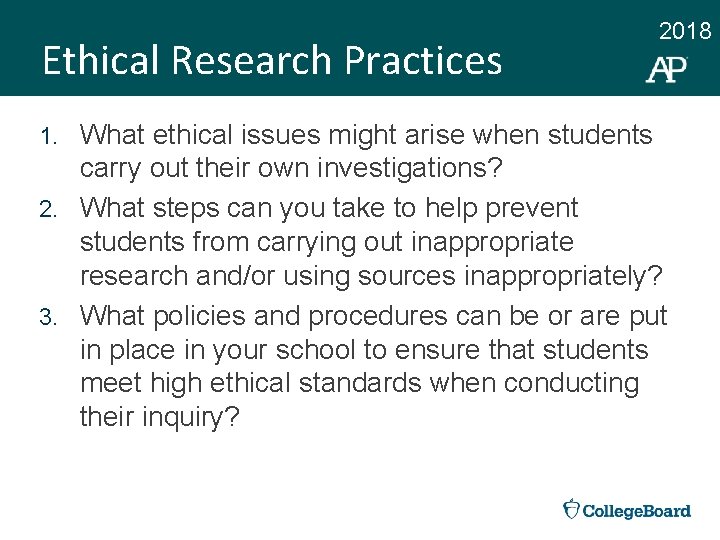
Ethical Research Practices 2018 What ethical issues might arise when students carry out their own investigations? 2. What steps can you take to help prevent students from carrying out inappropriate research and/or using sources inappropriately? 3. What policies and procedures can be or are put in place in your school to ensure that students meet high ethical standards when conducting their inquiry? 1.
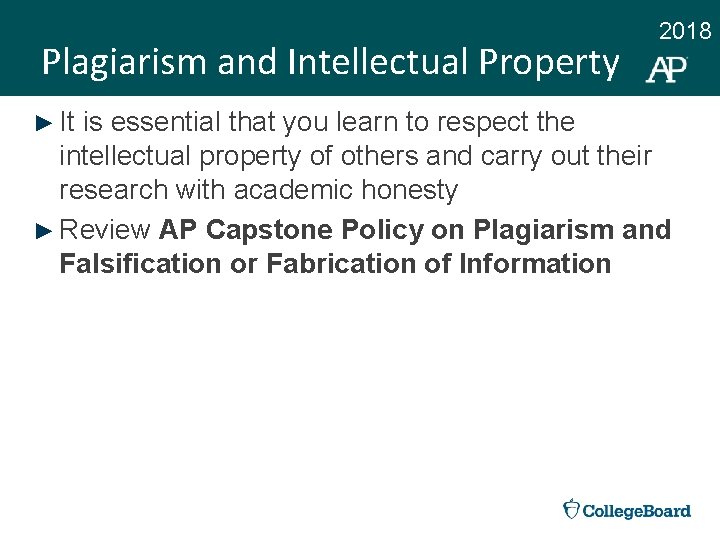
Plagiarism and Intellectual Property 2018 ► It is essential that you learn to respect the intellectual property of others and carry out their research with academic honesty ► Review AP Capstone Policy on Plagiarism and Falsification or Fabrication of Information
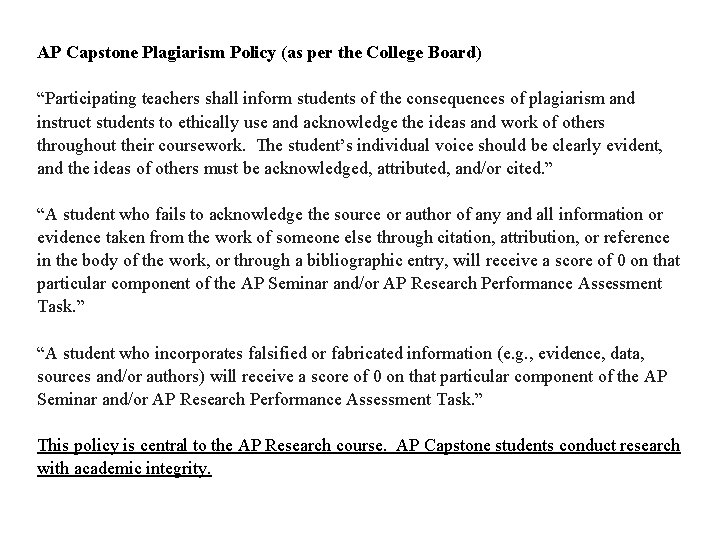
AP Capstone Plagiarism Policy (as per the College Board) “Participating teachers shall inform students of the consequences of plagiarism and instruct students to ethically use and acknowledge the ideas and work of others throughout their coursework. The student’s individual voice should be clearly evident, and the ideas of others must be acknowledged, attributed, and/or cited. ” “A student who fails to acknowledge the source or author of any and all information or evidence taken from the work of someone else through citation, attribution, or reference in the body of the work, or through a bibliographic entry, will receive a score of 0 on that particular component of the AP Seminar and/or AP Research Performance Assessment Task. ” “A student who incorporates falsified or fabricated information (e. g. , evidence, data, sources and/or authors) will receive a score of 0 on that particular component of the AP Seminar and/or AP Research Performance Assessment Task. ” This policy is central to the AP Research course. AP Capstone students conduct research with academic integrity.
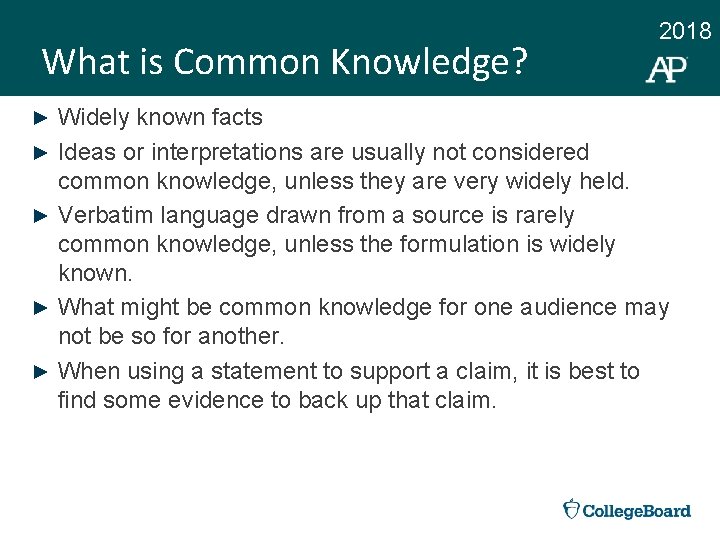
What is Common Knowledge? 2018 Widely known facts ► Ideas or interpretations are usually not considered common knowledge, unless they are very widely held. ► Verbatim language drawn from a source is rarely common knowledge, unless the formulation is widely known. ► What might be common knowledge for one audience may not be so for another. ► When using a statement to support a claim, it is best to find some evidence to back up that claim. ►
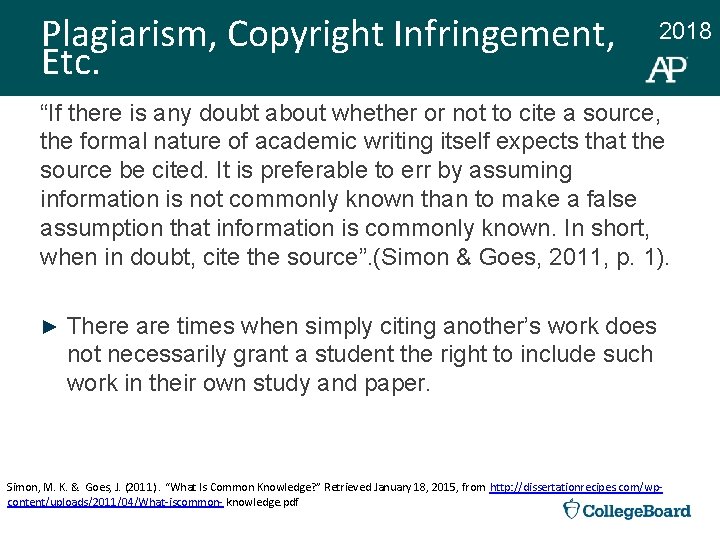
Plagiarism, Copyright Infringement, Etc. 2018 “If there is any doubt about whether or not to cite a source, the formal nature of academic writing itself expects that the source be cited. It is preferable to err by assuming information is not commonly known than to make a false assumption that information is commonly known. In short, when in doubt, cite the source”. (Simon & Goes, 2011, p. 1). ► There are times when simply citing another’s work does not necessarily grant a student the right to include such work in their own study and paper. Simon, M. K. & Goes, J. (2011). “What Is Common Knowledge? ” Retrieved January 18, 2015, from http: //dissertationrecipes. com/wpcontent/uploads/2011/04/What-iscommon- knowledge. pdf
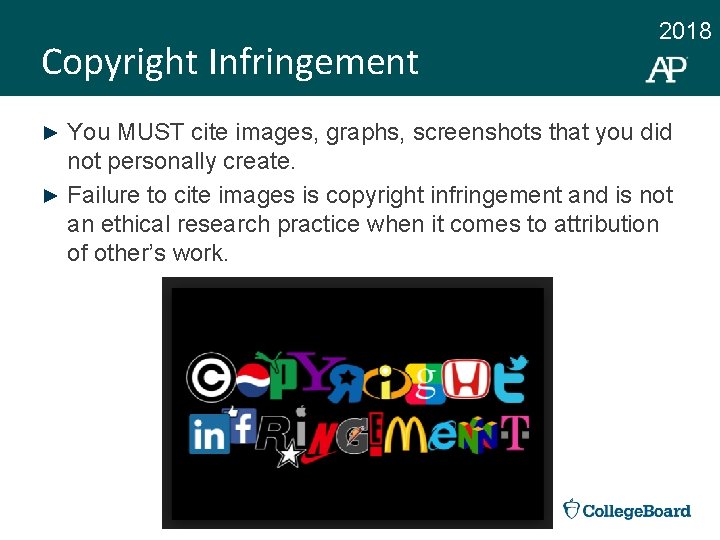
Copyright Infringement 2018 You MUST cite images, graphs, screenshots that you did not personally create. ► Failure to cite images is copyright infringement and is not an ethical research practice when it comes to attribution of other’s work. ►
Plagiarism, Copyright Infringement, Etc. 2018 Section 107 of the Copyright Act of 1976 (fair use provision; see states that use of copyrighted materials for purposes of “criticism, comment, news reporting, teaching including multiple copies for classroom use), scholarship, or research, is not an infringement of copyright” (p. 19). However, this applies to shorter sections or paraphrased portions of the work. If a significant portion of the work is to be used, written permission may need to be sought (see Bedford Researcher, 4 th ed. , 2012, 126– 127, for a sample letter). Audio and visual material and/or performances, as well as products of private citizens or companies, are subject to different copyright laws than written work. If in doubt, consult the Copyright Act copyright. gov
Fabrication of Information 2018 Fabrication is the intentional act of making up data or results and recording or reporting them. ► Examples of fabrication 1 In the social sciences, a researcher/interviewer completing a questionnaire for a fictitious subject that was never interviewed. • In the biological sciences, the creation of a data set for an experiment that was never actually conducted. • The practice of adding fictitious data to a real data set collected during an actual experiment for the purpose of providing additional statistical validity. • In clinical research the insertion of a clinical note into the research record to indicate compliance with an element of the protocol. 1 From: Office of Research Education and Training, University of Miami: http: //researchedu. med. miami. edu/x 7. xml •
Falsification of Information 2018 Falsification is manipulating research materials, equipment, or processes, or changing or omitting/suppressing data or results without scientific or statistical justification, such that the research is not accurately represented in the research record. This would include the "misrepresentation of uncertainty" during statistical analysis of the data. ► 1 From: Office of Research Education and Training, University of Miami: http: //researchedu. med. miami. edu/x 19. xml(accessed 17 April 2009)
Falsification of Information • • • ► 2018 Alteration of data to render a modification of the variances in the data Falsification of dates and experimental procedures in the study notebook Misrepresenting the results from statistical analysis Misrepresenting the methods of an experiment such as the model used to conduct the experiment The addition of false or misleading statements in the manuscript or published paper. Misrepresentation of the materials or methods of a research study in a published paper 1 From: Office of Research Education and Training, University of Miami: http: //researchedu. med. miami. edu/x 19. xml(accessed 17 April 2009)
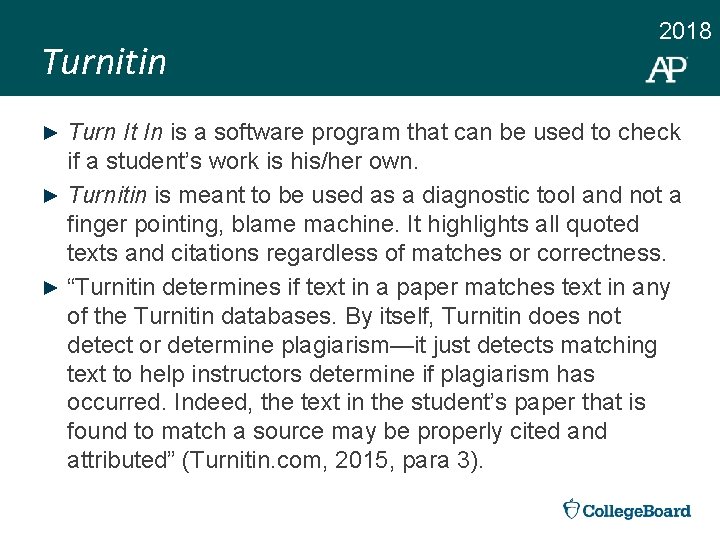
Turnitin 2018 Turn It In is a software program that can be used to check if a student’s work is his/her own. ► Turnitin is meant to be used as a diagnostic tool and not a finger pointing, blame machine. It highlights all quoted texts and citations regardless of matches or correctness. ► “Turnitin determines if text in a paper matches text in any of the Turnitin databases. By itself, Turnitin does not detect or determine plagiarism—it just detects matching text to help instructors determine if plagiarism has occurred. Indeed, the text in the student’s paper that is found to match a source may be properly cited and attributed” (Turnitin. com, 2015, para 3). ►
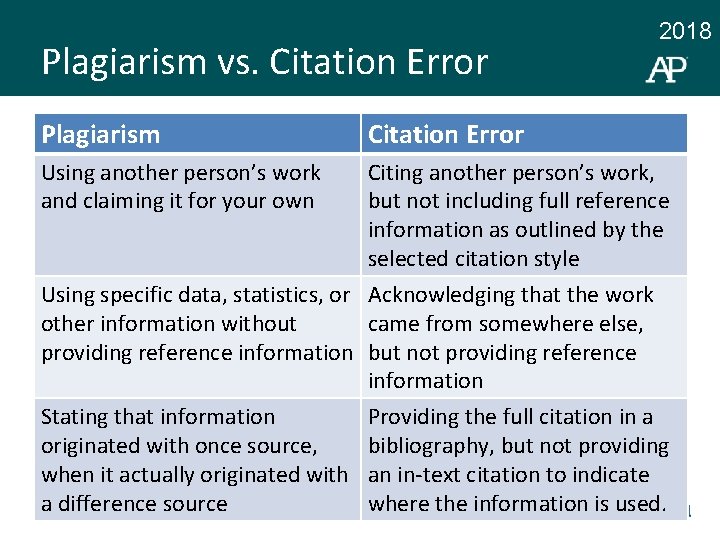
Plagiarism vs. Citation Error Plagiarism 2018 Citation Error Using another person’s work and claiming it for your own Citing another person’s work, but not including full reference information as outlined by the selected citation style Using specific data, statistics, or Acknowledging that the work other information without came from somewhere else, providing reference information but not providing reference information Stating that information originated with once source, when it actually originated with a difference source Providing the full citation in a bibliography, but not providing an in-text citation to indicate where the information is used.
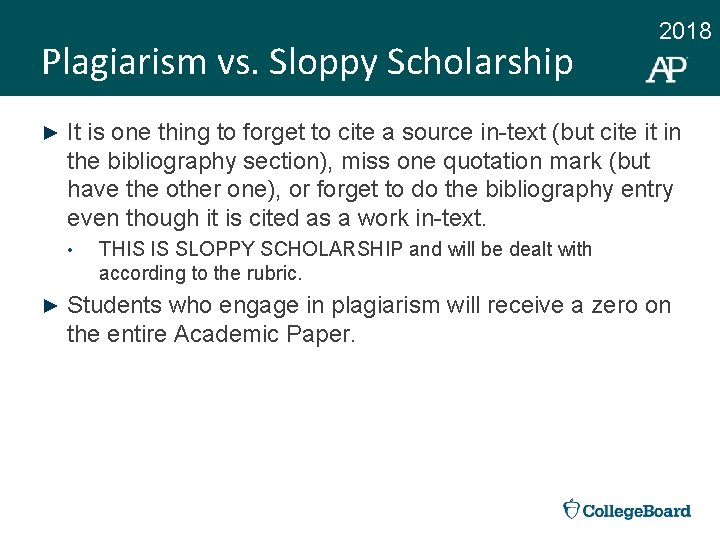
Plagiarism vs. Sloppy Scholarship ► It is one thing to forget to cite a source in-text (but cite it in the bibliography section), miss one quotation mark (but have the other one), or forget to do the bibliography entry even though it is cited as a work in-text. • ► 2018 THIS IS SLOPPY SCHOLARSHIP and will be dealt with according to the rubric. Students who engage in plagiarism will receive a zero on the entire Academic Paper.
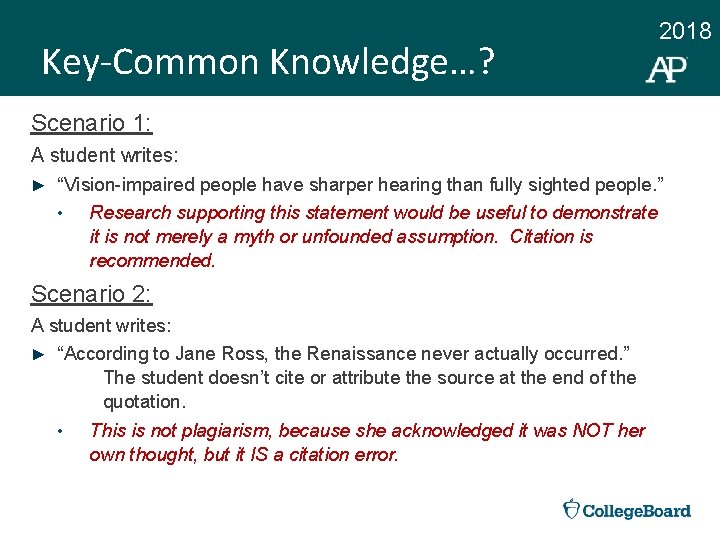
Key-Common Knowledge…? 2018 Scenario 1: A student writes: ► “Vision-impaired people have sharper hearing than fully sighted people. ” • Research supporting this statement would be useful to demonstrate it is not merely a myth or unfounded assumption. Citation is recommended. Scenario 2: A student writes: ► “According to Jane Ross, the Renaissance never actually occurred. ” The student doesn’t cite or attribute the source at the end of the quotation. • This is not plagiarism, because she acknowledged it was NOT her own thought, but it IS a citation error.
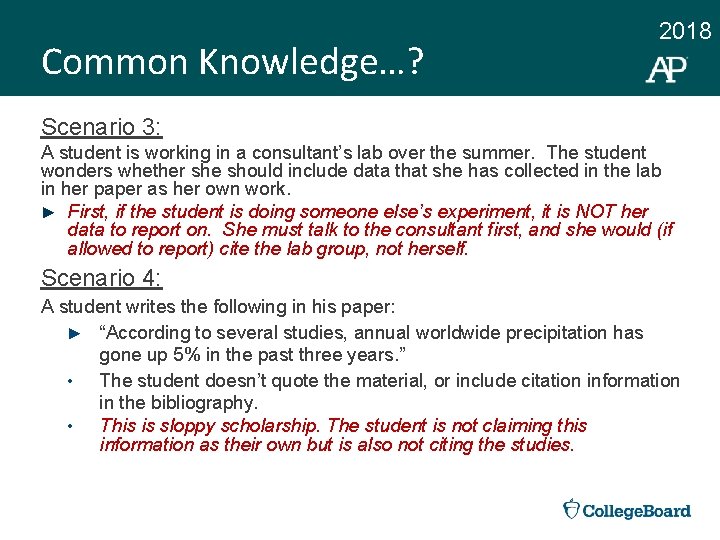
Common Knowledge…? 2018 Scenario 3: A student is working in a consultant’s lab over the summer. The student wonders whether she should include data that she has collected in the lab in her paper as her own work. ► First, if the student is doing someone else’s experiment, it is NOT her data to report on. She must talk to the consultant first, and she would (if allowed to report) cite the lab group, not herself. Scenario 4: A student writes the following in his paper: ► “According to several studies, annual worldwide precipitation has gone up 5% in the past three years. ” • The student doesn’t quote the material, or include citation information in the bibliography. • This is sloppy scholarship. The student is not claiming this information as their own but is also not citing the studies.
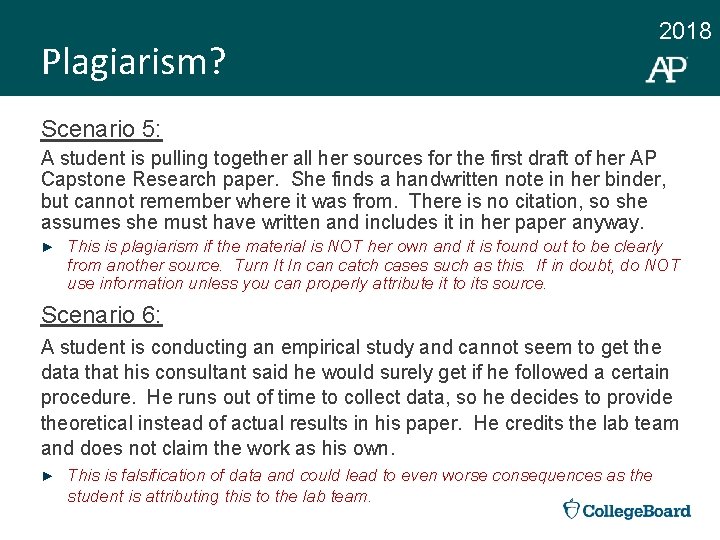
Plagiarism? 2018 Scenario 5: A student is pulling together all her sources for the first draft of her AP Capstone Research paper. She finds a handwritten note in her binder, but cannot remember where it was from. There is no citation, so she assumes she must have written and includes it in her paper anyway. ► This is plagiarism if the material is NOT her own and it is found out to be clearly from another source. Turn It In catch cases such as this. If in doubt, do NOT use information unless you can properly attribute it to its source. Scenario 6: A student is conducting an empirical study and cannot seem to get the data that his consultant said he would surely get if he followed a certain procedure. He runs out of time to collect data, so he decides to provide theoretical instead of actual results in his paper. He credits the lab team and does not claim the work as his own. ► This is falsification of data and could lead to even worse consequences as the student is attributing this to the lab team.
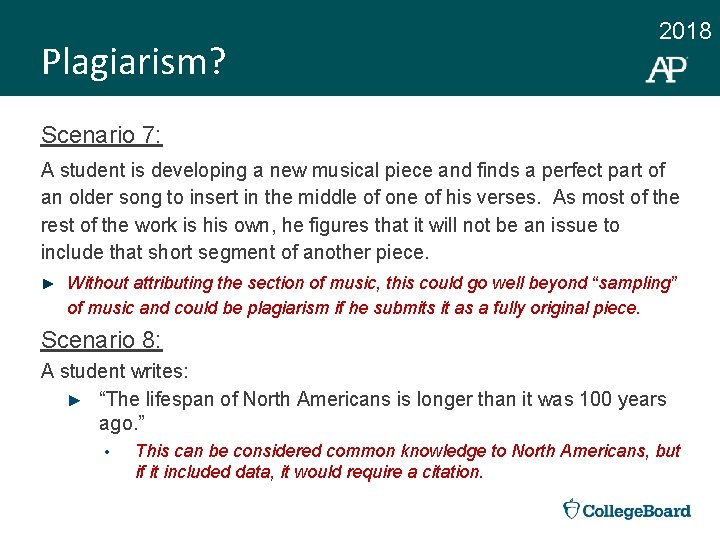
Plagiarism? 2018 Scenario 7: A student is developing a new musical piece and finds a perfect part of an older song to insert in the middle of one of his verses. As most of the rest of the work is his own, he figures that it will not be an issue to include that short segment of another piece. ► Without attributing the section of music, this could go well beyond “sampling” of music and could be plagiarism if he submits it as a fully original piece. Scenario 8: A student writes: ► “The lifespan of North Americans is longer than it was 100 years ago. ” • This can be considered common knowledge to North Americans, but if it included data, it would require a citation.
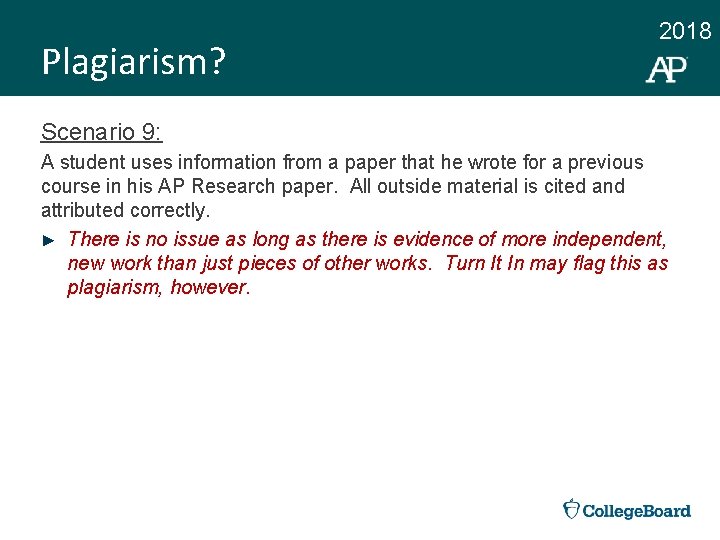
Plagiarism? 2018 Scenario 9: A student uses information from a paper that he wrote for a previous course in his AP Research paper. All outside material is cited and attributed correctly. ► There is no issue as long as there is evidence of more independent, new work than just pieces of other works. Turn It In may flag this as plagiarism, however.
Plagiarism? 2018 Scenario 10: A student uses a figure from another published work but fails to cite the figure in their own paper (in-text or bibliography section). ► Without attributing the figure to the actual source (either in-text or in the bibliography) this is considered both plagiarism and copyright infringement.
Reflection 2018 How can you use the credibility test to evaluate your own work? ► What steps can you take to help prevent you from carrying out unethical research practices in your academic writing? ► What policies and procedures are put in place in your school to ensure you meet high ethical standards when communicating the results of your scholarly inquiry? ►
- Slides: 35