
2018 2019 Enduring Understanding and Essential Questions Individuals
- Slides: 8
2018 -2019 Enduring Understanding and Essential Questions
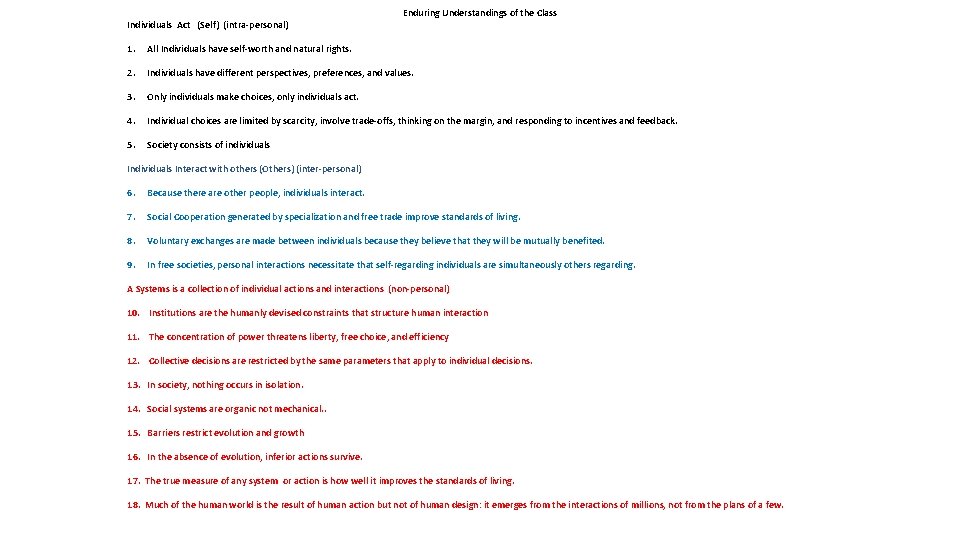
Individuals Act (Self) (intra-personal) Enduring Understandings of the Class 1. All Individuals have self-worth and natural rights. 2. Individuals have different perspectives, preferences, and values. 3. Only individuals make choices, only individuals act. 4. Individual choices are limited by scarcity, involve trade-offs, thinking on the margin, and responding to incentives and feedback. 5. Society consists of individuals Interact with others (Others) (inter-personal) 6. Because there are other people, individuals interact. 7. Social Cooperation generated by specialization and free trade improve standards of living. 8. Voluntary exchanges are made between individuals because they believe that they will be mutually benefited. 9. In free societies, personal interactions necessitate that self-regarding individuals are simultaneously others regarding. A Systems is a collection of individual actions and interactions (non-personal) 10. Institutions are the humanly devised constraints that structure human interaction 11. The concentration of power threatens liberty, free choice, and efficiency 12. Collective decisions are restricted by the same parameters that apply to individual decisions. 13. In society, nothing occurs in isolation. 14. Social systems are organic not mechanical. . 15. Barriers restrict evolution and growth 16. In the absence of evolution, inferior actions survive. 17. The true measure of any system or action is how well it improves the standards of living. 18. Much of the human world is the result of human action but not of human design: it emerges from the interactions of millions, not from the plans of a few.
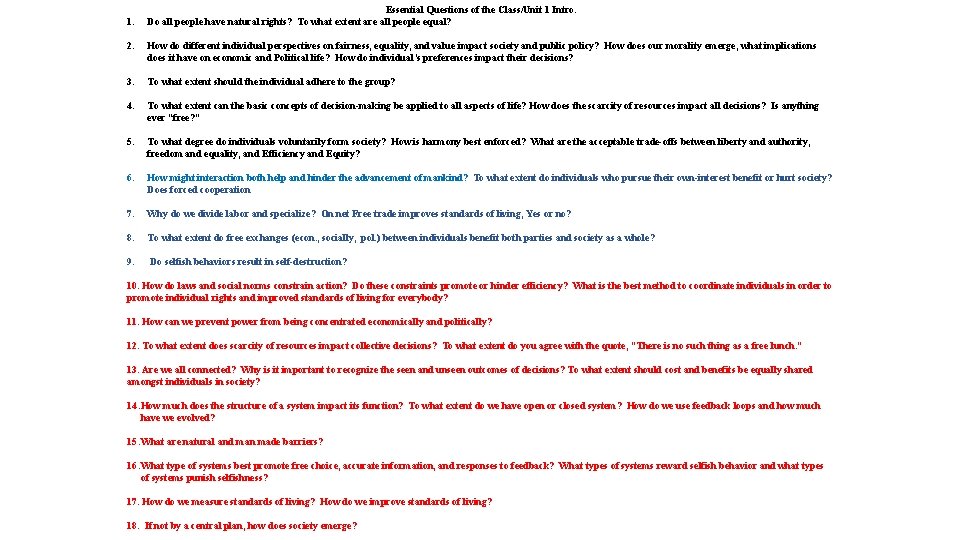
1. Essential Questions of the Class/Unit 1 Intro. Do all people have natural rights? To what extent are all people equal? 2. How do different individual perspectives on fairness, equality, and value impact society and public policy? How does our morality emerge, what implications does it have on economic and Political life? How do individual’s preferences impact their decisions? 3. To what extent should the individual adhere to the group? 4. To what extent can the basic concepts of decision-making be applied to all aspects of life? How does the scarcity of resources impact all decisions? Is anything ever “free? ” 5. To what degree do individuals voluntarily form society? How is harmony best enforced? What are the acceptable trade-offs between liberty and authority, freedom and equality, and Efficiency and Equity? 6. How might interaction both help and hinder the advancement of mankind? To what extent do individuals who pursue their own-interest benefit or hurt society? Does forced cooperation 7. Why do we divide labor and specialize? On net Free trade improves standards of living, Yes or no? 8. To what extent do free exchanges (econ. , socially, pol. ) between individuals benefit both parties and society as a whole? 9. Do selfish behaviors result in self-destruction? 10. How do laws and social norms constrain action? Do these constraints promote or hinder efficiency? What is the best method to coordinate individuals in order to promote individual rights and improved standards of living for everybody? 11. How can we prevent power from being concentrated economically and politically? 12. To what extent does scarcity of resources impact collective decisions? To what extent do you agree with the quote, “There is no such thing as a free lunch. ” 13. Are we all connected? Why is it important to recognize the seen and unseen outcomes of decisions? To what extent should cost and benefits be equally shared amongst individuals in society? 14. How much does the structure of a system impact its function? To what extent do we have open or closed system? How do we use feedback loops and how much have we evolved? 15. What are natural and man made barriers? 16. What type of systems best promote free choice, accurate information, and responses to feedback? What types of systems reward selfish behavior and what types of systems punish selfishness? 17. How do we measure standards of living? How do we improve standards of living? 18. If not by a central plan, how does society emerge?
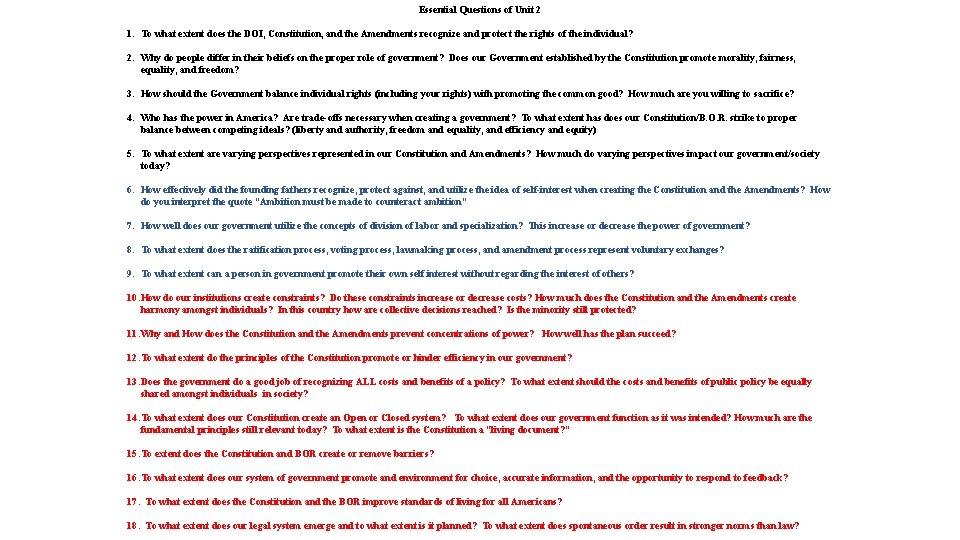
Essential Questions of Unit 2 1. To what extent does the DOI, Constitution, and the Amendments recognize and protect the rights of the individual? 2. Why do people differ in their beliefs on the proper role of government? Does our Government established by the Constitution promote morality, fairness, equality, and freedom? 3. How should the Government balance individual rights (including your rights) with promoting the common good? How much are you willing to sacrifice? 4. Who has the power in America? Are trade-offs necessary when creating a government? To what extent has does our Constitution/B. O. R. strike to proper balance between competing ideals? (liberty and authority, freedom and equality, and efficiency and equity) 5. To what extent are varying perspectives represented in our Constitution and Amendments? How much do varying perspectives impact our government/society today? 6. How effectively did the founding fathers recognize, protect against, and utilize the idea of self-interest when creating the Constitution and the Amendments? How do you interpret the quote “Ambition must be made to counteract ambition” 7. How well does our government utilize the concepts of division of labor and specialization? This increase or decrease the power of government? 8. To what extent does the ratification process, voting process, lawmaking process, and amendment process represent voluntary exchanges? 9. To what extent can a person in government promote their own self interest without regarding the interest of others? 10. How do our institutions create constraints? Do these constraints increase or decrease costs? How much does the Constitution and the Amendments create harmony amongst individuals? In this country how are collective decisions reached? Is the minority still protected? 11. Why and How does the Constitution and the Amendments prevent concentrations of power? How well has the plan succeed? 12. To what extent do the principles of the Constitution promote or hinder efficiency in our government? 13. Does the government do a good job of recognizing ALL costs and benefits of a policy? To what extent should the costs and benefits of public policy be equally shared amongst individuals in society? 14. To what extent does our Constitution create an Open or Closed system? To what extent does our government function as it was intended? How much are the fundamental principles still relevant today? To what extent is the Constitution a “living document? ” 15. To extent does the Constitution and BOR create or remove barriers? 16. To what extent does our system of government promote and environment for choice, accurate information, and the opportunity to respond to feedback? 17. To what extent does the Constitution and the BOR improve standards of living for all Americans? 18. To what extent does our legal system emerge and to what extent is it planned? To what extent does spontaneous order result in stronger norms than law?
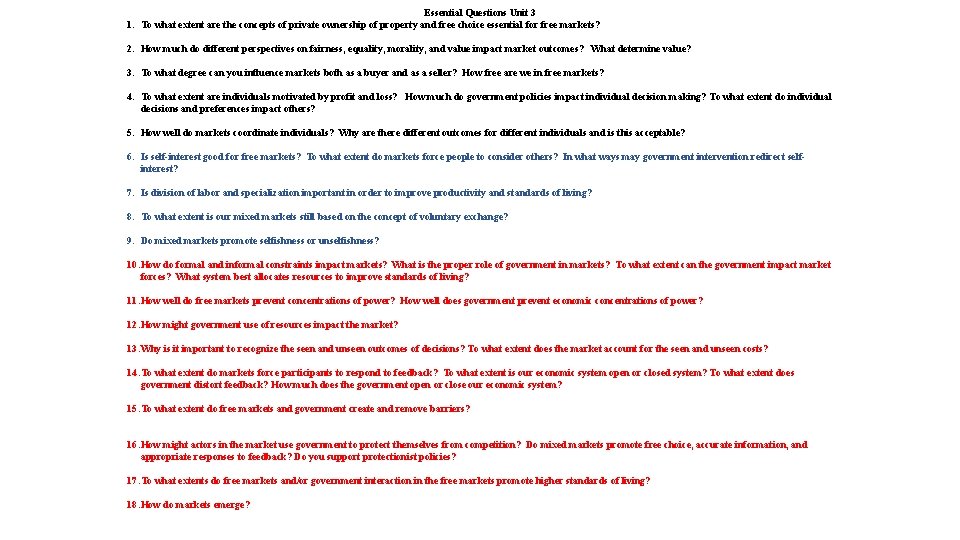
Essential Questions Unit 3 1. To what extent are the concepts of private ownership of property and free choice essential for free markets? 2. How much do different perspectives on fairness, equality, morality, and value impact market outcomes? What determine value? 3. To what degree can you influence markets both as a buyer and as a seller? How free are we in free markets? 4. To what extent are individuals motivated by profit and loss? How much do government policies impact individual decision making? To what extent do individual decisions and preferences impact others? 5. How well do markets coordinate individuals? Why are there different outcomes for different individuals and is this acceptable? 6. Is self-interest good for free markets? To what extent do markets force people to consider others? In what ways may government intervention redirect selfinterest? 7. Is division of labor and specialization important in order to improve productivity and standards of living? 8. To what extent is our mixed markets still based on the concept of voluntary exchange? 9. Do mixed markets promote selfishness or unselfishness? 10. How do formal and informal constraints impact markets? What is the proper role of government in markets? To what extent can the government impact market forces? What system best allocates resources to improve standards of living? 11. How well do free markets prevent concentrations of power? How well does government prevent economic concentrations of power? 12. How might government use of resources impact the market? 13. Why is it important to recognize the seen and unseen outcomes of decisions? To what extent does the market account for the seen and unseen costs? 14. To what extent do markets force participants to respond to feedback? To what extent is our economic system open or closed system? To what extent does government distort feedback? How much does the government open or close our economic system? 15. To what extent do free markets and government create and remove barriers? 16. How might actors in the market use government to protect themselves from competition? Do mixed markets promote free choice, accurate information, and appropriate responses to feedback? Do you support protectionist policies? 17. To what extents do free markets and/or government interaction in the free markets promote higher standards of living? 18. How do markets emerge?
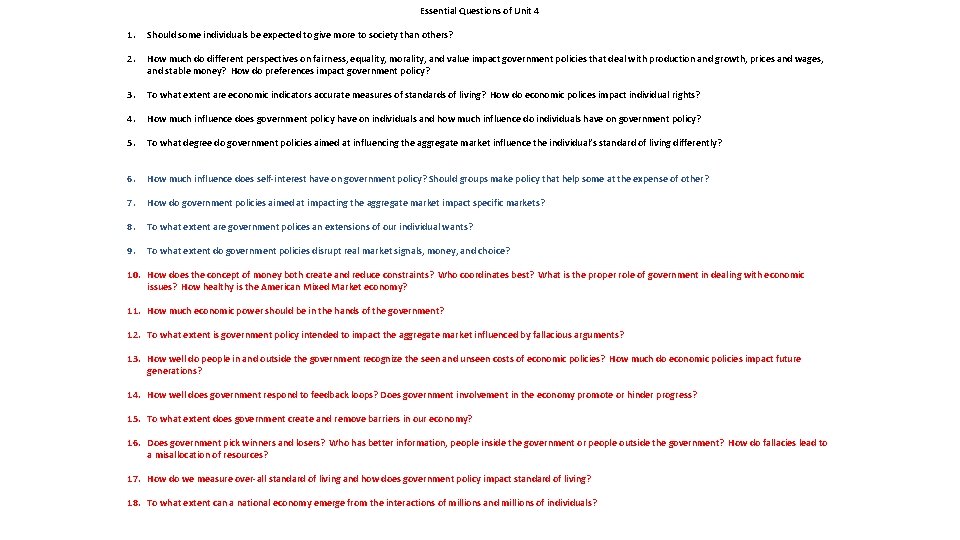
Essential Questions of Unit 4 1. Should some individuals be expected to give more to society than others? 2. How much do different perspectives on fairness, equality, morality, and value impact government policies that deal with production and growth, prices and wages, and stable money? How do preferences impact government policy? 3. To what extent are economic indicators accurate measures of standards of living? How do economic polices impact individual rights? 4. How much influence does government policy have on individuals and how much influence do individuals have on government policy? 5. To what degree do government policies aimed at influencing the aggregate market influence the individual’s standard of living differently? 6. How much influence does self-interest have on government policy? Should groups make policy that help some at the expense of other? 7. How do government policies aimed at impacting the aggregate market impact specific markets? 8. To what extent are government polices an extensions of our individual wants? 9. To what extent do government policies disrupt real market signals, money, and choice? 10. How does the concept of money both create and reduce constraints? Who coordinates best? What is the proper role of government in dealing with economic issues? How healthy is the American Mixed Market economy? 11. How much economic power should be in the hands of the government? 12. To what extent is government policy intended to impact the aggregate market influenced by fallacious arguments? 13. How well do people in and outside the government recognize the seen and unseen costs of economic policies? How much do economic policies impact future generations? 14. How well does government respond to feedback loops? Does government involvement in the economy promote or hinder progress? 15. To what extent does government create and remove barriers in our economy? 16. Does government pick winners and losers? Who has better information, people inside the government or people outside the government? How do fallacies lead to a misallocation of resources? 17. How do we measure over-all standard of living and how does government policy impact standard of living? 18. To what extent can a national economy emerge from the interactions of millions and millions of individuals?
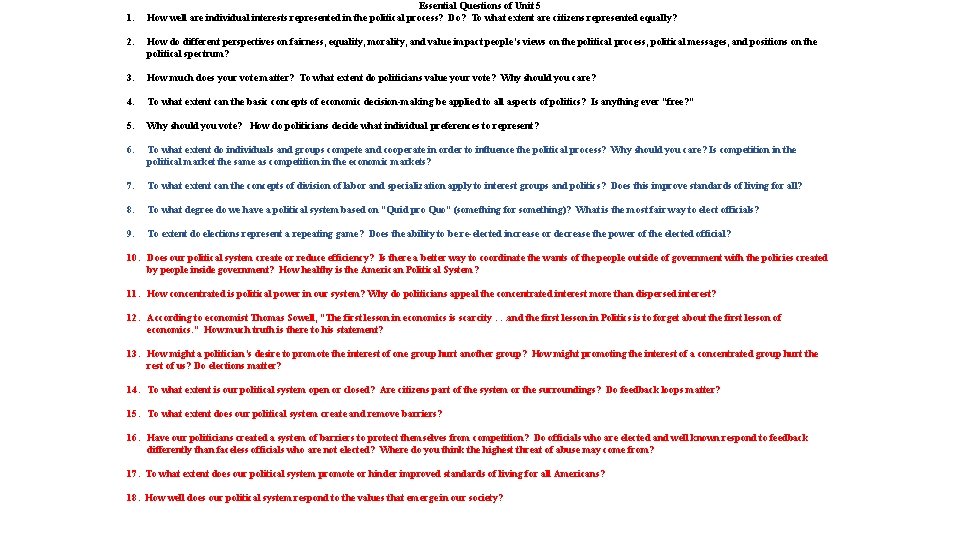
1. Essential Questions of Unit 5 How well are individual interests represented in the political process? Do? To what extent are citizens represented equally? 2. How do different perspectives on fairness, equality, morality, and value impact people’s views on the political process, political messages, and positions on the political spectrum? 3. How much does your vote matter? To what extent do politicians value your vote? Why should you care? 4. To what extent can the basic concepts of economic decision-making be applied to all aspects of politics? Is anything ever “free? ” 5. Why should you vote? How do politicians decide what individual preferences to represent? 6. To what extent do individuals and groups compete and cooperate in order to influence the political process? Why should you care? Is competition in the political market the same as competition in the economic markets? 7. To what extent can the concepts of division of labor and specialization apply to interest groups and politics? Does this improve standards of living for all? 8. To what degree do we have a political system based on “Quid pro Quo” (something for something)? What is the most fair way to elect officials? 9. To extent do elections represent a repeating game? Does the ability to be re-elected increase or decrease the power of the elected official? 10. Does our political system create or reduce efficiency? Is there a better way to coordinate the wants of the people outside of government with the policies created by people inside government? How healthy is the American Political System? 11. How concentrated is political power in our system? Why do politicians appeal the concentrated interest more than dispersed interest? 12. According to economist Thomas Sowell, “The first lesson in economics is scarcity. . . and the first lesson in Politics is to forget about the first lesson of economics. ” How much truth is there to his statement? 13. How might a politician’s desire to promote the interest of one group hurt another group? How might promoting the interest of a concentrated group hurt the rest of us? Do elections matter? 14. To what extent is our political system open or closed? Are citizens part of the system or the surroundings? Do feedback loops matter? 15. To what extent does our political system create and remove barriers? 16. Have our politicians created a system of barriers to protect themselves from competition? Do officials who are elected and well known respond to feedback differently than faceless officials who are not elected? Where do you think the highest threat of abuse may come from? 17. To what extent does our political system promote or hinder improved standards of living for all Americans? 18. How well does our political system respond to the values that emerge in our society?
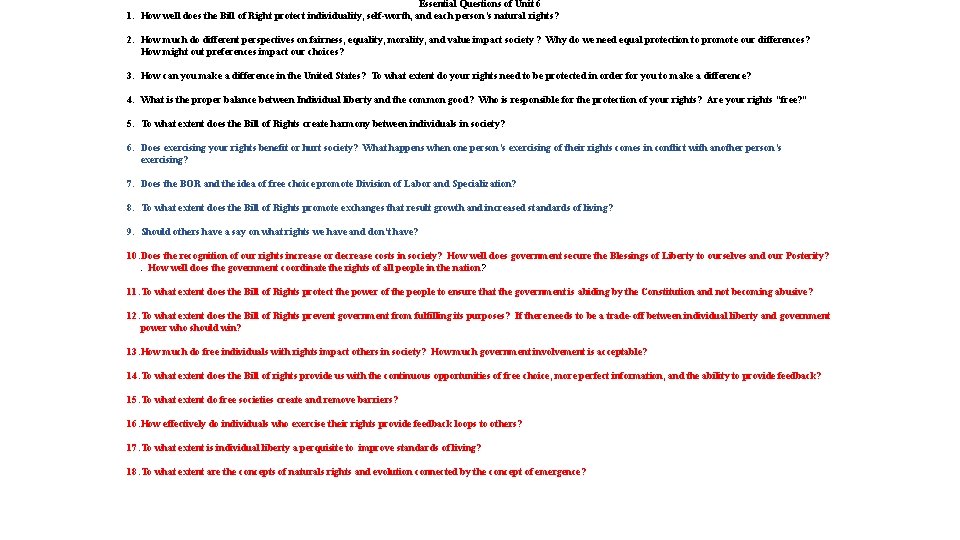
Essential Questions of Unit 6 1. How well does the Bill of Right protect individuality, self-worth, and each person’s natural rights? 2. How much do different perspectives on fairness, equality, morality, and value impact society ? Why do we need equal protection to promote our differences? How might out preferences impact our choices? 3. How can you make a difference in the United States? To what extent do your rights need to be protected in order for you to make a difference? 4. What is the proper balance between Individual liberty and the common good? Who is responsible for the protection of your rights? Are your rights “free? ” 5. To what extent does the Bill of Rights create harmony between individuals in society? 6. Does exercising your rights benefit or hurt society? What happens when one person’s exercising of their rights comes in conflict with another person’s exercising? 7. Does the BOR and the idea of free choice promote Division of Labor and Specialization? 8. To what extent does the Bill of Rights promote exchanges that result growth and increased standards of living? 9. Should others have a say on what rights we have and don’t have? 10. Does the recognition of our rights increase or decrease costs in society? How well does government secure the Blessings of Liberty to ourselves and our Posterity? . How well does the government coordinate the rights of all people in the nation? 11. To what extent does the Bill of Rights protect the power of the people to ensure that the government is abiding by the Constitution and not becoming abusive? 12. To what extent does the Bill of Rights prevent government from fulfilling its purposes? If there needs to be a trade-off between individual liberty and government power who should win? 13. How much do free individuals with rights impact others in society? How much government involvement is acceptable? 14. To what extent does the Bill of rights provide us with the continuous opportunities of free choice, more perfect information, and the ability to provide feedback? 15. To what extent do free societies create and remove barriers? 16. How effectively do individuals who exercise their rights provide feedback loops to others? 17. To what extent is individual liberty a perquisite to improve standards of living? 18. To what extent are the concepts of naturals rights and evolution connected by the concept of emergence?