
2017 week 1 B Rose van der Zwaard
2017 – week 1 B Rose van der Zwaard R. vander. Zwaard@uva. nl P. C. Hoofthuis 5. 42 Office hour: Wednesdays 12 -13
§ Retracing the beginning of L 2 learning § Discussing your experiences as an L 2 learner (today’s homework) § Break § Technology vs ecology § Discussion/debate
§ First foreign languages learned? Why? How? Who? When? What? § Before 1800 (as early as 6 th century) Latin and Ancient Greek, Hebrew § Clergy and individual scholars § Intellectual development (mental gymnastics) – to read texts in target language § principle of language learning: an end in itself (rather than means to an end) § 13 th century: first grammar school for children – 18 th century: more languages
§ Teaching pedagogy resembled the principles of teaching classical languages (reading and translating) § Grammar-translation method § Learners “know everything about something rather than the thing itself” (Rouse, 1925). § Studying texts, grammar and vocabulary § Translating from the native language into the target language
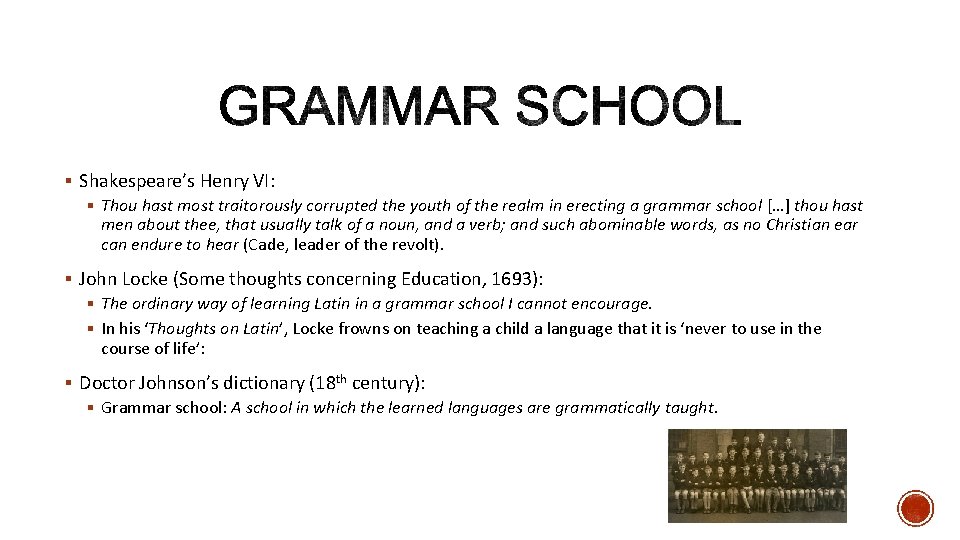
§ Shakespeare’s Henry VI: § Thou hast most traitorously corrupted the youth of the realm in erecting a grammar school […] thou hast men about thee, that usually talk of a noun, and a verb; and such abominable words, as no Christian ear can endure to hear (Cade, leader of the revolt). § John Locke (Some thoughts concerning Education, 1693): § The ordinary way of learning Latin in a grammar school I cannot encourage. § In his ‘Thoughts on Latin’, Locke frowns on teaching a child a language that it is ‘never to use in the course of life’: § Doctor Johnson’s dictionary (18 th century): § Grammar school: A school in which the learned languages are grammatically taught.
§ Still practiced today (usually without the translation): § WHY? § the language of instruction is the students’ native language, § practicing oral skills or listening skills is not part of the curriculum § the main focus is on reading, writing and explicit grammar. § suitable method for teaching large groups of language learners since it focuses on the ‘silent’ language learning components rather than the oral and audio skills.
§ At high school all my language courses were aimed at developing explicit knowledge as they all § § § § mainly consisted of studying vocabulary and grammar. Especially my German teacher never spoke German in class. There were a lot of grammatical rules, and the most of them I’ve forgotten already. High schools in the Netherlands teach mostly grammar and individual words. Teachers show movies, let students listen to audiotapes, have them write essays etc. In most Dutch high schools, however, instruction of the L 2 language is in Dutch. Nothing that I learnt about the subjonctif or the futur simple stuck. The focus was grammatical structures. The teacher kept explaining the suffixes we had to add, in order to get the right case (nominative, accusative etc…). Unfortunately, in my country, teachers and parents care only for the explicit knowledge and in the grade that the child will be able to acquire the basic certification in English.
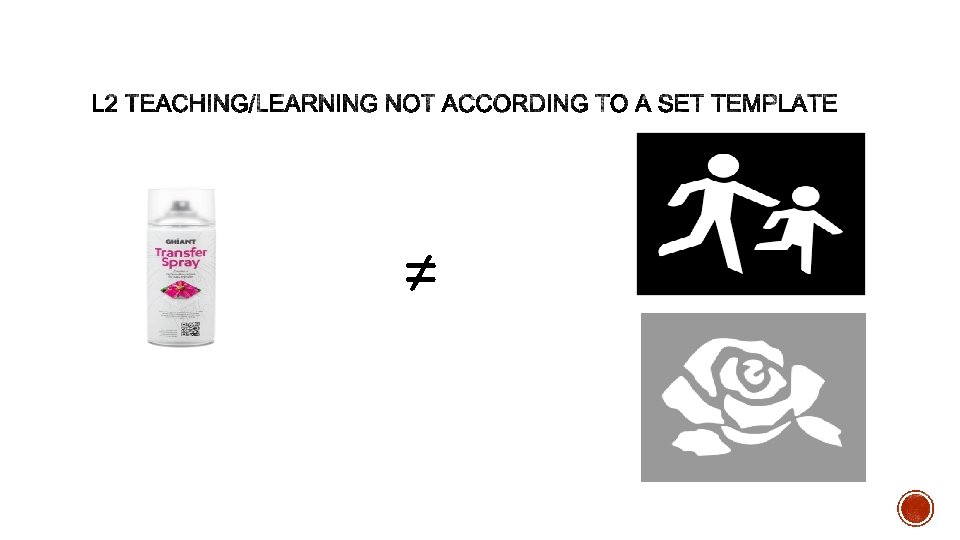
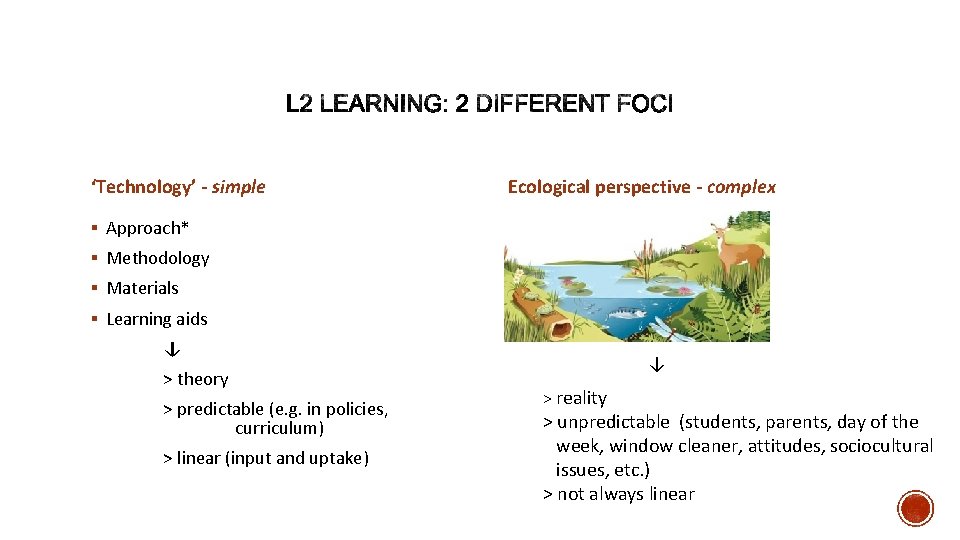
‘Technology’ - simple Ecological perspective - complex § Approach* § Methodology § Materials § Learning aids ↓ > theory > predictable (e. g. in policies, curriculum) > linear (input and uptake) ↓ > reality > unpredictable (students, parents, day of the week, window cleaner, attitudes, sociocultural issues, etc. ) > not always linear
§ Grammar-Translation method § Direct method: no translation, target language, conversation, grammar inductive, focus on speaking § Audio-lingual method: language labs, drills language patterns, automatic usage § Content-based instruction: CLIL approach (TTO in Dutch schools) – integrates language learning with another content, e. g. geography lessons in the target language. § Task-based language learning: meaningful tasks rather than linguistic items § AIM language methodology: https: //www. youtube. com/watch? v=OZLb. DMz. R 1 u 8 § Etc.
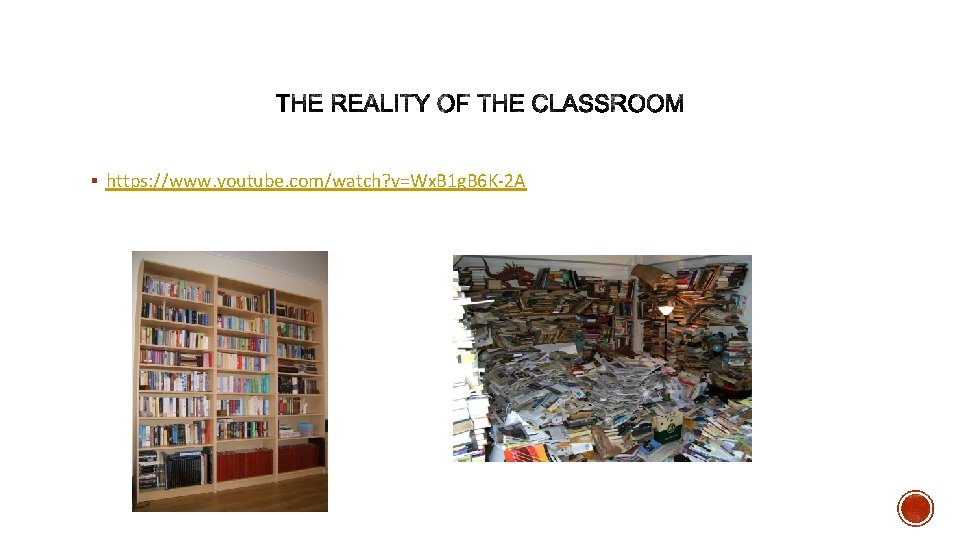
§ https: //www. youtube. com/watch? v=Wx. B 1 g. B 6 K-2 A
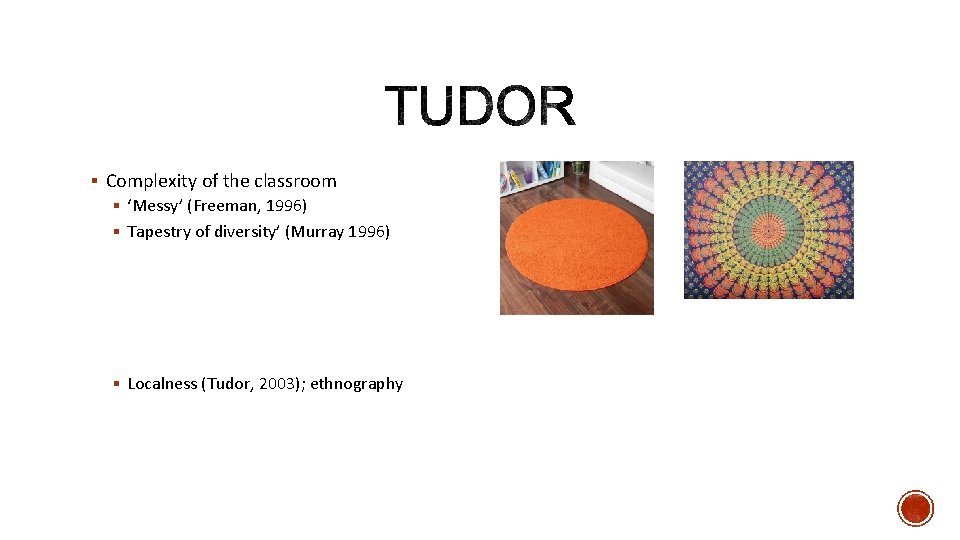
§ Complexity of the classroom § ‘Messy’ (Freeman, 1996) § Tapestry of diversity’ (Murray 1996) § Localness (Tudor, 2003); ethnography
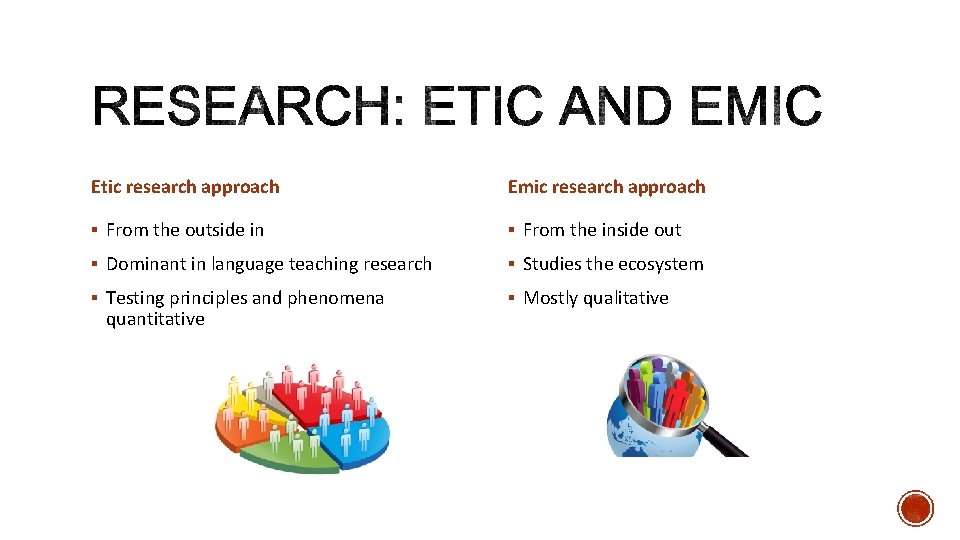
Etic research approach Emic research approach § From the outside in § From the inside out § Dominant in language teaching research § Studies the ecosystem § Testing principles and phenomena § Mostly qualitative quantitative
§ There is no value in teaching explicit knowledge grammar. § We cannot really teach language; we can only create conditions in which it will develop spontaneously in the mind in its own way (Von Humboldt- German philosopher – late 19 th century). § If the only input students get is the lessons and homework, they are unlikely to achieve high levels of L 2.
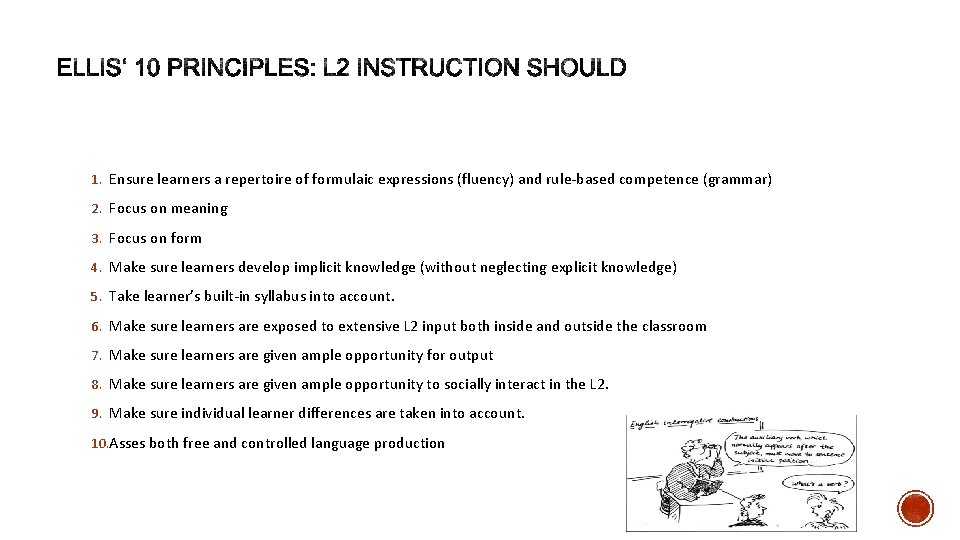
1. Ensure learners a repertoire of formulaic expressions (fluency) and rule-based competence (grammar) 2. Focus on meaning 3. Focus on form 4. Make sure learners develop implicit knowledge (without neglecting explicit knowledge) 5. Take learner’s built-in syllabus into account. 6. Make sure learners are exposed to extensive L 2 input both inside and outside the classroom 7. Make sure learners are given ample opportunity for output 8. Make sure learners are given ample opportunity to socially interact in the L 2. 9. Make sure individual learner differences are taken into account. 10. Asses both free and controlled language production
- Slides: 15