
2017 Version Chemistry AS 91391 C 3 5

- Slides: 182
2017 Version Chemistry AS 91391 C 3. 5 Organic Chemistry
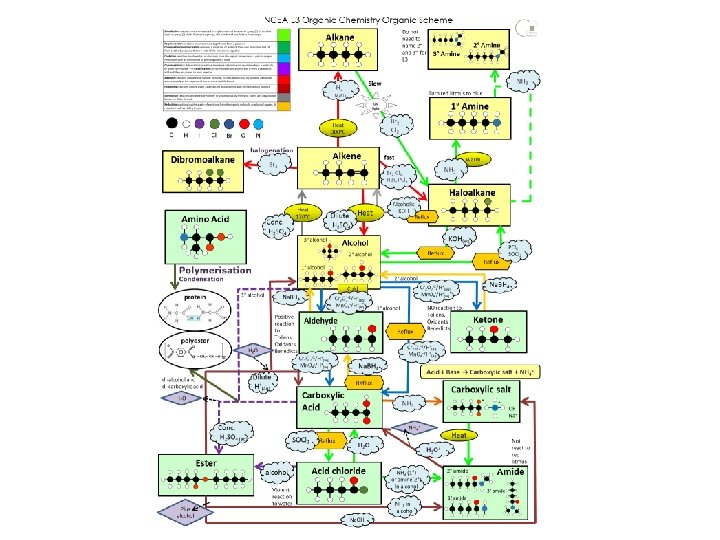
Achievement Criteria This achievement standard involves describing the structure, AS 91391 physical properties, and reactions of organic compounds. C 3. 5 q Organic compounds will be limited to those containing one or more of the following functional groups: alkene, haloalkane, amine, alcohol, aldehyde, ketone, carboxylic acid, ester (including triglycerides), acyl chloride, amide. Reactivity of organic compounds will be limited to q substitution reactions using the following reagents: concentrated HCl, HBr, Zn. Cl 2/HCl, SOCl 2, PCl 3, Na. OH, KOH (in alcohol or aqueous solution), concentrated NH 3, primary amines, primary alcohols/H+, primary alcohols, H 2 O/H+, H 2 O/OH– (Substitution reactions include esterification, condensation, hydrolysis, and polymerisation. ) q oxidation reactions using the following reagents: Mn. O 4–/H+, Cr 2 O 72–/H+, Tollens’, Fehling’s and Benedict’s. Reduction of aldehydes and ketones with Li. Al. H 4 q elimination reactions using the following reagents: KOH in alcohol and concentrated H 2 SO 4 (includes major and minor products from asymmetric alcohols and haloalkanes) q polymerisation reactions of formation of polyesters and polyamides including proteins q addition reactions of alkenes (used for the identification of the products of elimination reactions). Appropriate information relating to other oxidants or reductants will be provided. Physical properties of organic compounds will be limited to q solubility q melting point and boiling point q rotation of plane polarised light.
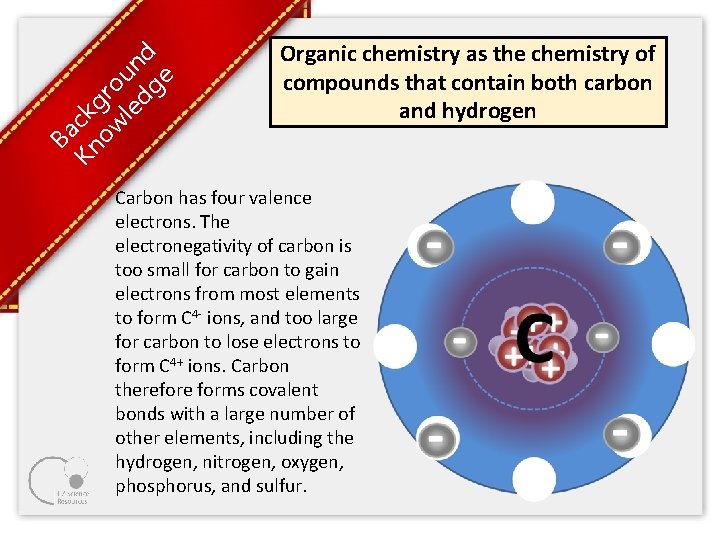
Ba Kn ck ow gro le un dg d e Organic chemistry as the chemistry of compounds that contain both carbon and hydrogen Carbon has four valence electrons. The electronegativity of carbon is too small for carbon to gain electrons from most elements to form C 4 ions, and too large for carbon to lose electrons to form C 4+ ions. Carbon therefore forms covalent bonds with a large number of other elements, including the hydrogen, nitrogen, oxygen, phosphorus, and sulfur.
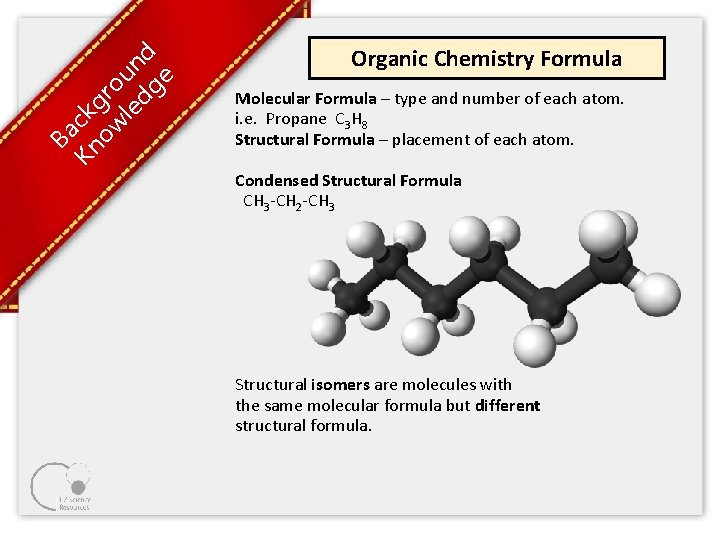
Ba Kn ck ow gro le un dg d e Organic Chemistry Formula Molecular Formula – type and number of each atom. i. e. Propane C 3 H 8 Structural Formula – placement of each atom. Condensed Structural Formula CH 3 CH 2 CH 3 Structural isomers are molecules with the same molecular formula but different structural formula.
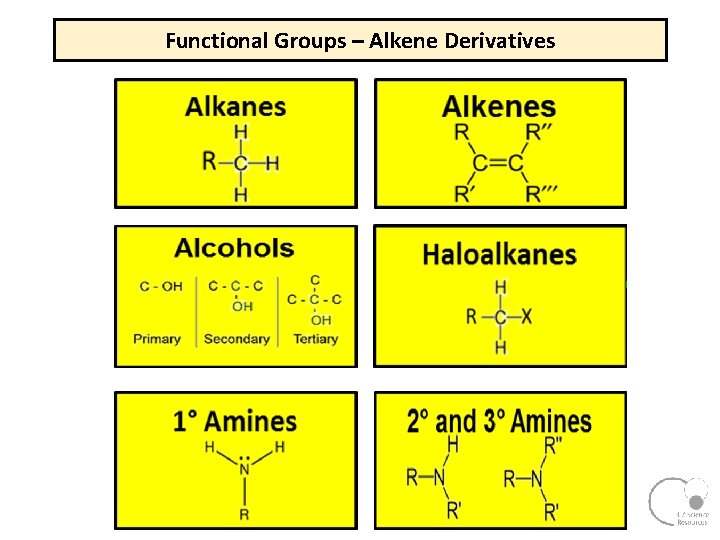
Functional Groups – Alkene Derivatives
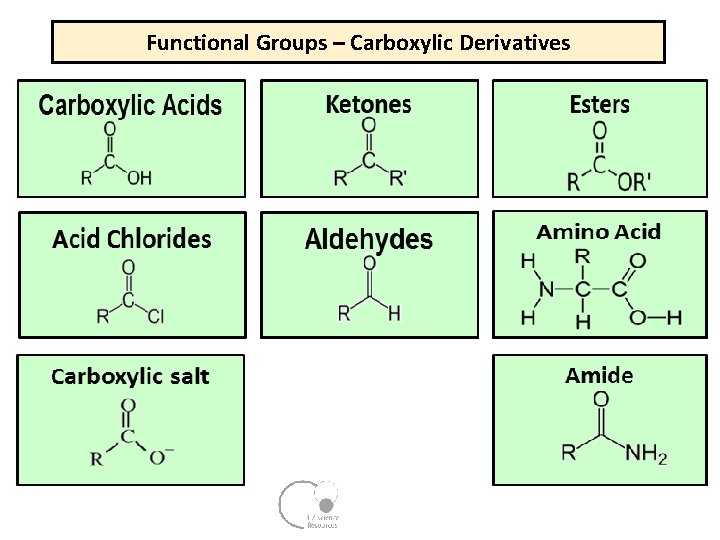
Functional Groups – Carboxylic Derivatives
Ba Kn ck ow gro le un dg d e Alkanes generic formula Cn. H 2 n+2 Compounds that contain only carbon and hydrogen are known as hydrocarbons. Those that contain as many hydrogen atoms as possible are said to be saturated. The saturated hydrocarbons are also known as alkanes. Straight-chain hydrocarbons, in which the carbon atoms form a chain that runs from one end of the molecule to the other . i. e. butane Alkanes also form branched structures. The smallest hydrocarbon in which a branch can occur has four carbon atoms. This compound has the same formula as butane (C 4 H 10), but a different structure. Compounds with the same formula and different
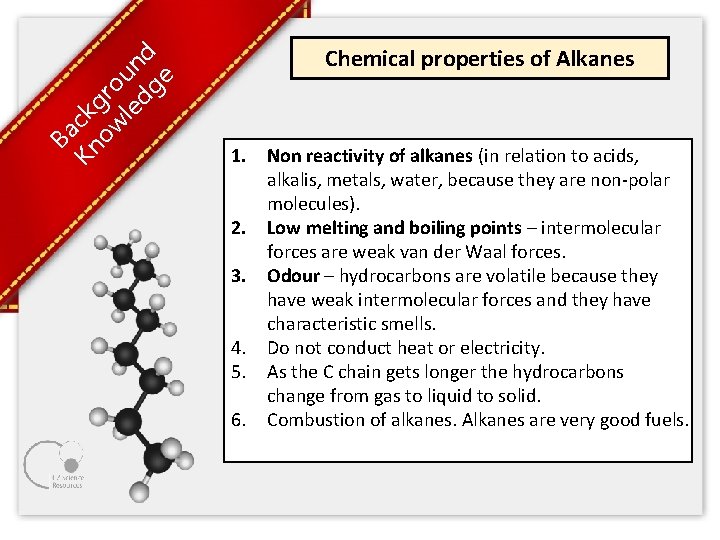
Ba Kn ck ow gro le un dg d e Chemical properties of Alkanes 1. Non reactivity of alkanes (in relation to acids, alkalis, metals, water, because they are non polar molecules). 2. Low melting and boiling points – intermolecular forces are weak van der Waal forces. 3. Odour – hydrocarbons are volatile because they have weak intermolecular forces and they have characteristic smells. 4. Do not conduct heat or electricity. 5. As the C chain gets longer the hydrocarbons change from gas to liquid to solid. 6. Combustion of alkanes. Alkanes are very good fuels.
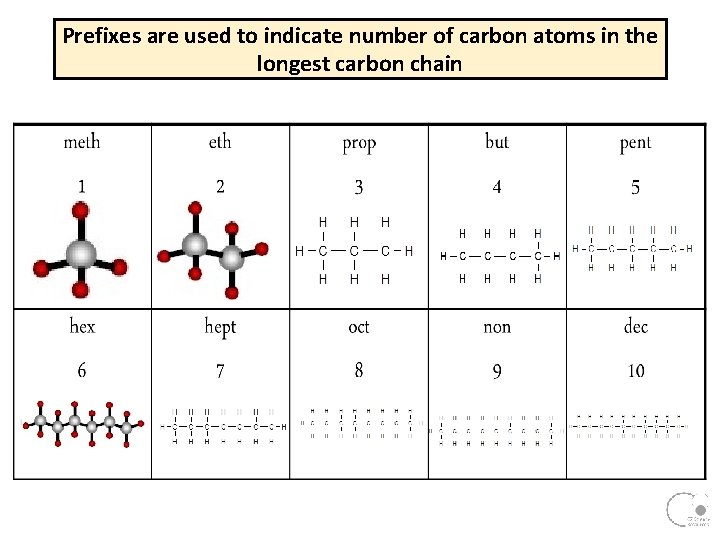
Prefixes are used to indicate number of carbon atoms in the longest carbon chain
Naming Alkanes Write name as – 1. Identify the longest C chain 2. Identify any branches 3. Number the C atoms in longest chain 4. so branches are on the lowest numbers 5. Write the name 1. Location of branch 2. Name of branch 3. Prefix of long chain 4. ane
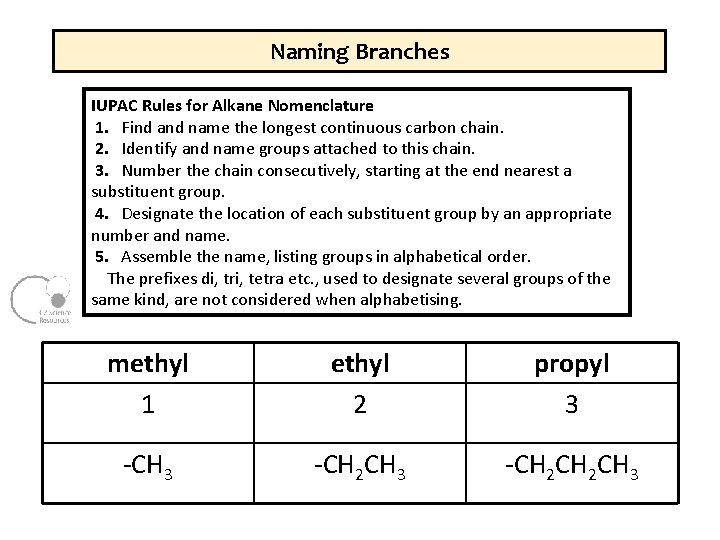
Naming Branches IUPAC Rules for Alkane Nomenclature 1. Find and name the longest continuous carbon chain. 2. Identify and name groups attached to this chain. 3. Number the chain consecutively, starting at the end nearest a substituent group. 4. Designate the location of each substituent group by an appropriate number and name. 5. Assemble the name, listing groups in alphabetical order. The prefixes di, tri, tetra etc. , used to designate several groups of the same kind, are not considered when alphabetising. methyl 1 ethyl 2 propyl 3 CH 2 CH 3
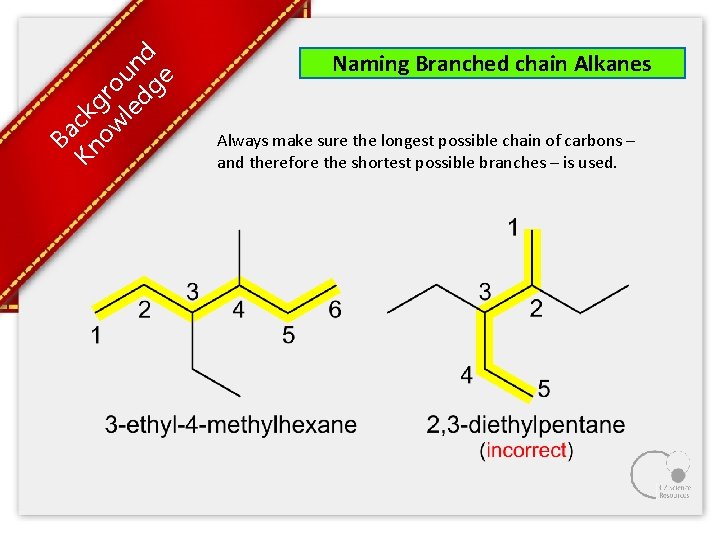
Ba Kn ck ow gro le un dg d e Naming Branched chain Alkanes Always make sure the longest possible chain of carbons – and therefore the shortest possible branches – is used.
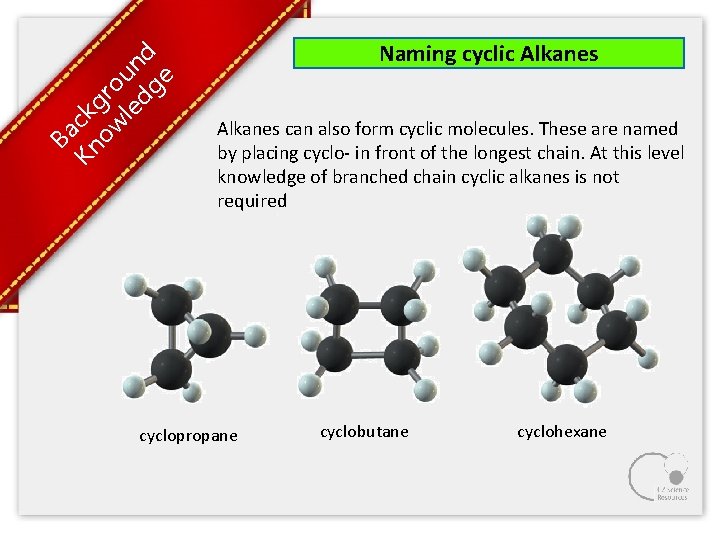
Ba Kn ck ow gro le un dg d e Naming cyclic Alkanes can also form cyclic molecules. These are named by placing cyclo in front of the longest chain. At this level knowledge of branched chain cyclic alkanes is not required cyclopropane cyclobutane cyclohexane
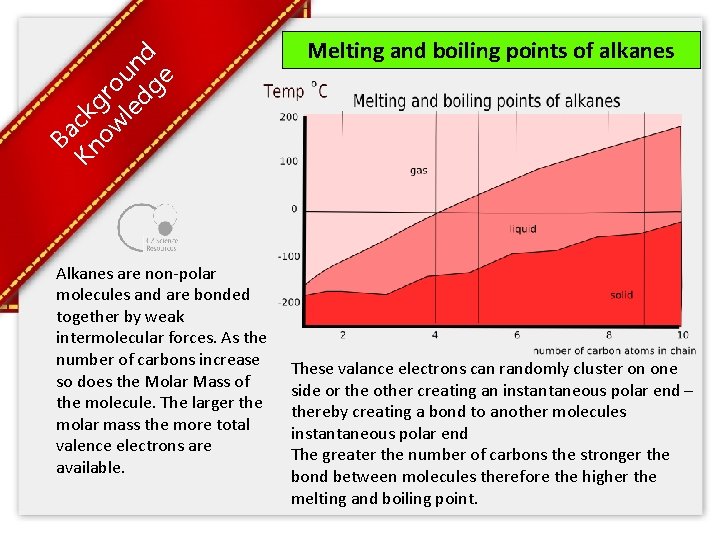
Ba Kn ck ow gro le un dg d e Alkanes are non polar molecules and are bonded together by weak intermolecular forces. As the number of carbons increase so does the Molar Mass of the molecule. The larger the molar mass the more total valence electrons are available. Melting and boiling points of alkanes These valance electrons can randomly cluster on one side or the other creating an instantaneous polar end – thereby creating a bond to another molecules instantaneous polar end The greater the number of carbons the stronger the bond between molecules therefore the higher the melting and boiling point.
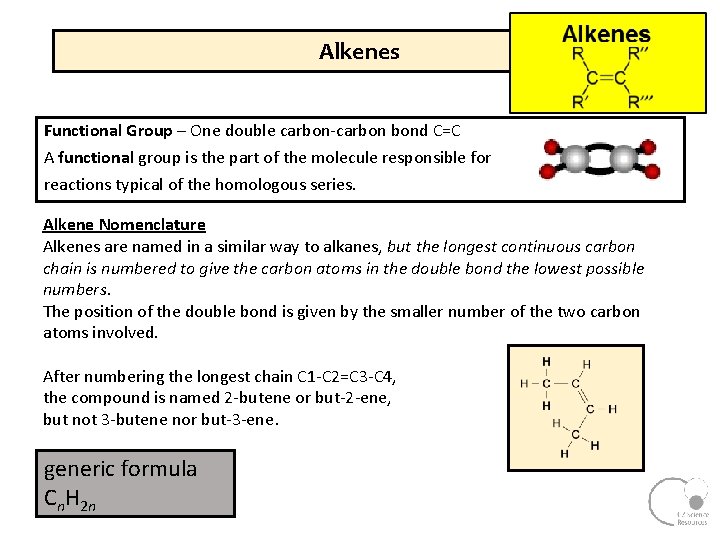
Alkenes Functional Group – One double carbon bond C=C A functional group is the part of the molecule responsible for reactions typical of the homologous series. Alkene Nomenclature Alkenes are named in a similar way to alkanes, but the longest continuous carbon chain is numbered to give the carbon atoms in the double bond the lowest possible numbers. The position of the double bond is given by the smaller number of the two carbon atoms involved. After numbering the longest chain C 1 C 2=C 3 C 4, the compound is named 2 butene or but 2 ene, but not 3 butene nor but 3 ene. generic formula Cn. H 2 n
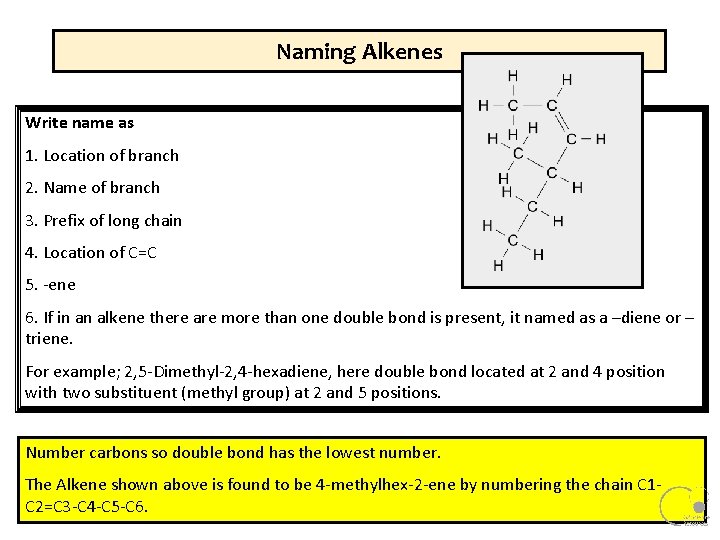
Naming Alkenes Write name as 1. Location of branch 2. Name of branch 3. Prefix of long chain 4. Location of C=C 5. ene 6. If in an alkene there are more than one double bond is present, it named as a –diene or – triene. For example; 2, 5 Dimethyl 2, 4 hexadiene, here double bond located at 2 and 4 position with two substituent (methyl group) at 2 and 5 positions. Number carbons so double bond has the lowest number. The Alkene shown above is found to be 4 methylhex 2 ene by numbering the chain C 1 C 2=C 3 C 4 C 5 C 6.
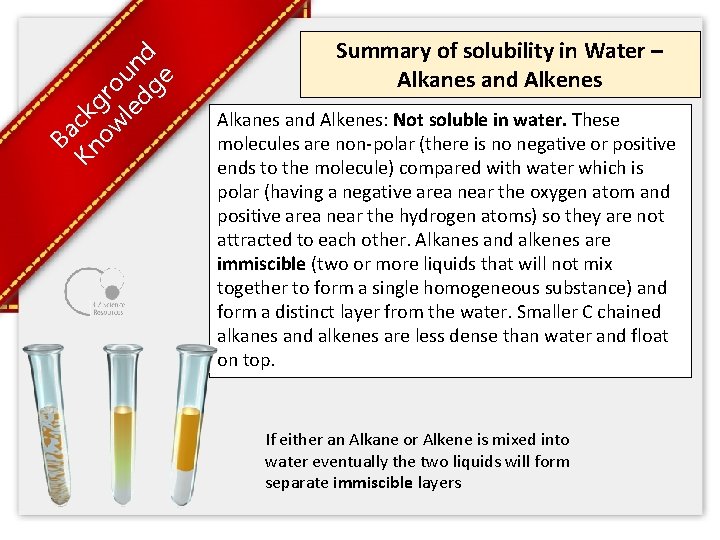
Ba Kn ck ow gro le un dg d e Summary of solubility in Water – Alkanes and Alkenes: Not soluble in water. These molecules are non polar (there is no negative or positive ends to the molecule) compared with water which is polar (having a negative area near the oxygen atom and positive area near the hydrogen atoms) so they are not attracted to each other. Alkanes and alkenes are immiscible (two or more liquids that will not mix together to form a single homogeneous substance) and form a distinct layer from the water. Smaller C chained alkanes and alkenes are less dense than water and float on top. If either an Alkane or Alkene is mixed into water eventually the two liquids will form separate immiscible layers
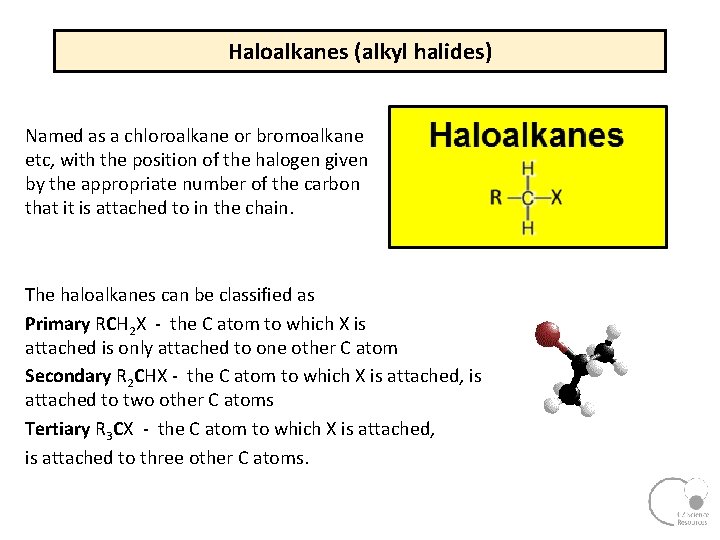
Haloalkanes (alkyl halides) Named as a chloroalkane or bromoalkane etc, with the position of the halogen given by the appropriate number of the carbon that it is attached to in the chain. The haloalkanes can be classified as Primary RCH 2 X the C atom to which X is attached is only attached to one other C atom Secondary R 2 CHX the C atom to which X is attached, is attached to two other C atoms Tertiary R 3 CX the C atom to which X is attached, is attached to three other C atoms.
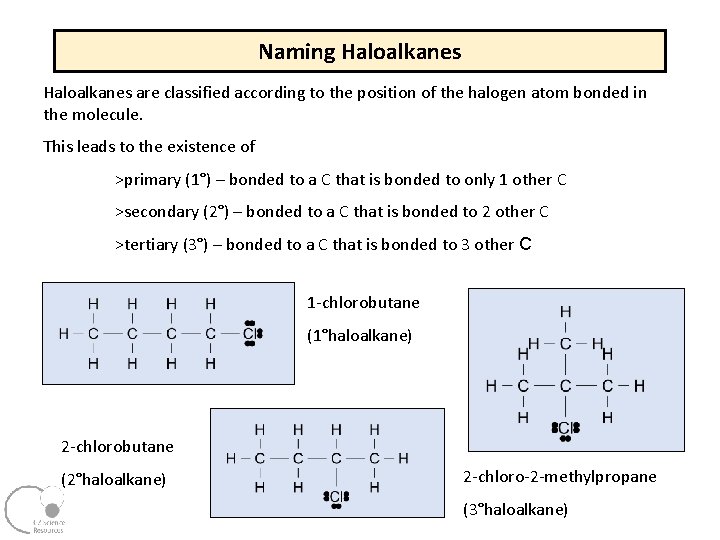
Naming Haloalkanes are classified according to the position of the halogen atom bonded in the molecule. This leads to the existence of >primary (1°) – bonded to a C that is bonded to only 1 other C >secondary (2°) – bonded to a C that is bonded to 2 other C >tertiary (3°) – bonded to a C that is bonded to 3 other C 1 chlorobutane (1°haloalkane) 2 chlorobutane (2°haloalkane) 2 chloro 2 methylpropane (3°haloalkane)
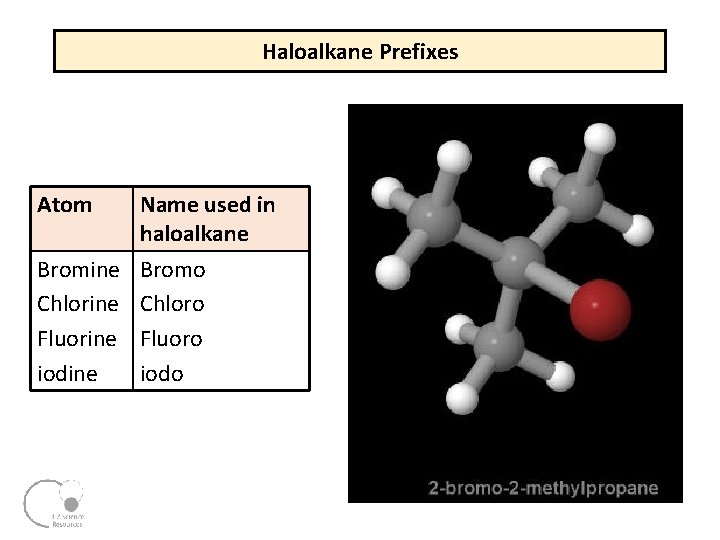
Haloalkane Prefixes Atom Name used in haloalkane Bromine Chlorine Fluorine iodine Bromo Chloro Fluoro iodo
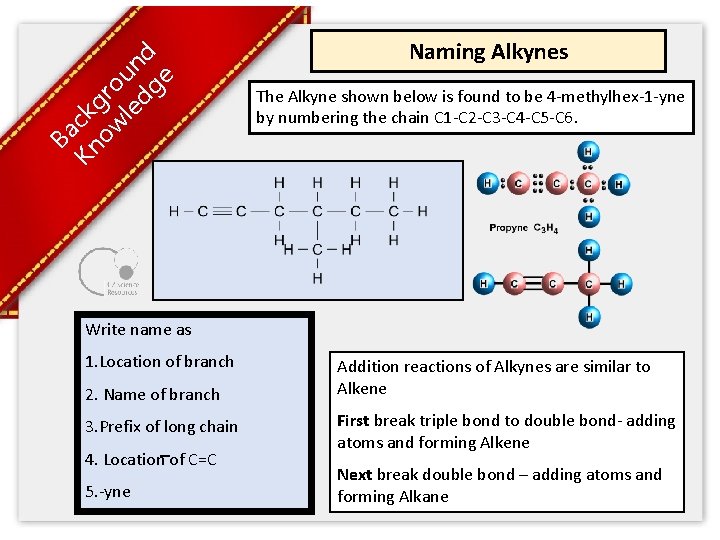
Ba Kn ck ow gro le un dg d e Naming Alkynes The Alkyne shown below is found to be 4 methylhex 1 yne by numbering the chain C 1 C 2 C 3 C 4 C 5 C 6. Write name as 1. Location of branch 2. Name of branch 3. Prefix of long chain _ 4. Location of C=C 5. yne Addition reactions of Alkynes are similar to Alkene First break triple bond to double bond adding atoms and forming Alkene Next break double bond – adding atoms and forming Alkane
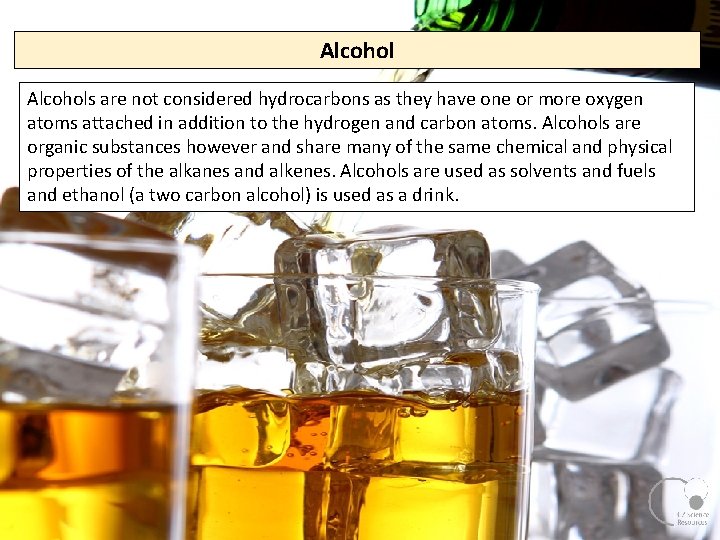
Alcohols are not considered hydrocarbons as they have one or more oxygen atoms attached in addition to the hydrogen and carbon atoms. Alcohols are organic substances however and share many of the same chemical and physical properties of the alkanes and alkenes. Alcohols are used as solvents and fuels and ethanol (a two carbon alcohol) is used as a drink.
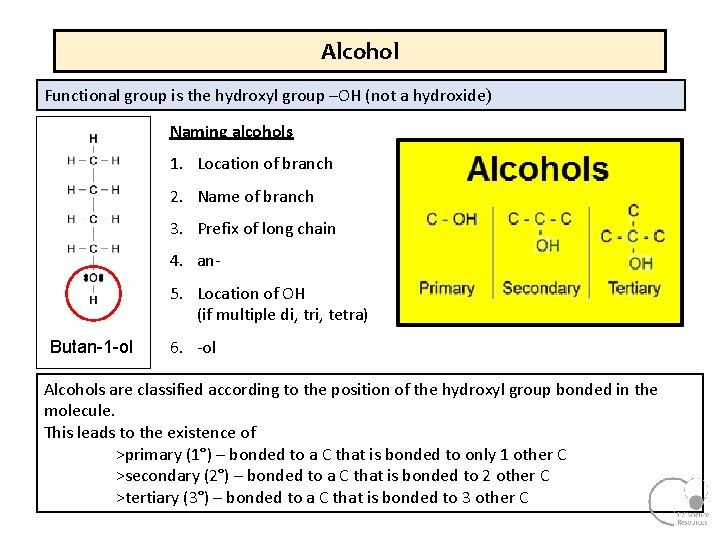
Alcohol Functional group is the hydroxyl group –OH (not a hydroxide) Naming alcohols 1. Location of branch 2. Name of branch 3. Prefix of long chain 4. an 5. Location of OH (if multiple di, tri, tetra) Butan-1 -ol 6. ol Alcohols are classified according to the position of the hydroxyl group bonded in the molecule. This leads to the existence of >primary (1°) – bonded to a C that is bonded to only 1 other C >secondary (2°) – bonded to a C that is bonded to 2 other C >tertiary (3°) – bonded to a C that is bonded to 3 other C
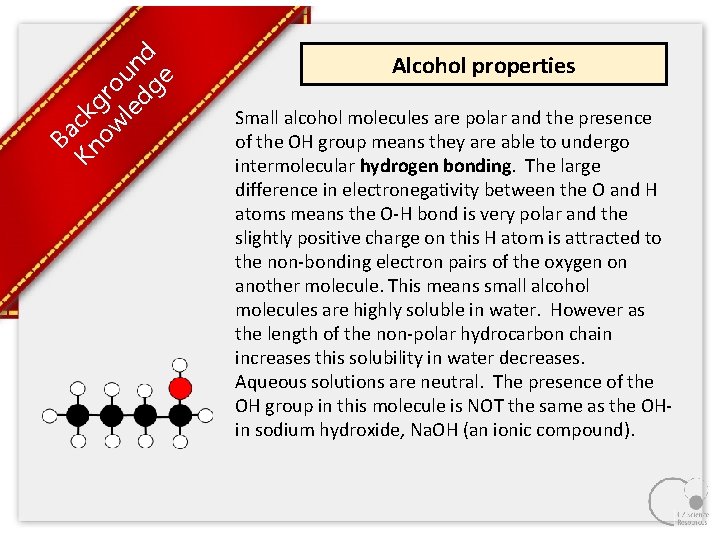
Ba Kn ck ow gro le un dg d e Alcohol properties Small alcohol molecules are polar and the presence of the OH group means they are able to undergo intermolecular hydrogen bonding. The large difference in electronegativity between the O and H atoms means the O H bond is very polar and the slightly positive charge on this H atom is attracted to the non bonding electron pairs of the oxygen on another molecule. This means small alcohol molecules are highly soluble in water. However as the length of the non polar hydrocarbon chain increases this solubility in water decreases. Aqueous solutions are neutral. The presence of the OH group in this molecule is NOT the same as the OH in sodium hydroxide, Na. OH (an ionic compound).
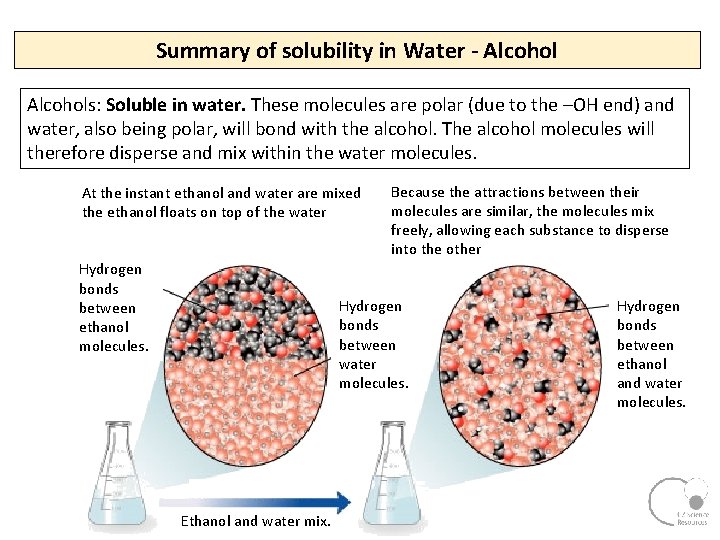
Summary of solubility in Water - Alcohols: Soluble in water. These molecules are polar (due to the –OH end) and water, also being polar, will bond with the alcohol. The alcohol molecules will therefore disperse and mix within the water molecules. At the instant ethanol and water are mixed the ethanol floats on top of the water Hydrogen bonds between ethanol molecules. Because the attractions between their molecules are similar, the molecules mix freely, allowing each substance to disperse into the other Hydrogen bonds between water molecules. Ethanol and water mix. Hydrogen bonds between ethanol and water molecules.
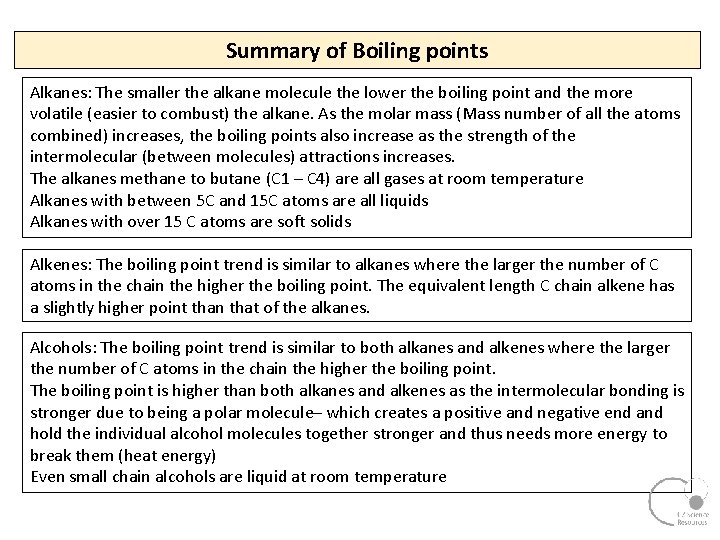
Summary of Boiling points Alkanes: The smaller the alkane molecule the lower the boiling point and the more volatile (easier to combust) the alkane. As the molar mass (Mass number of all the atoms combined) increases, the boiling points also increase as the strength of the intermolecular (between molecules) attractions increases. The alkanes methane to butane (C 1 – C 4) are all gases at room temperature Alkanes with between 5 C and 15 C atoms are all liquids Alkanes with over 15 C atoms are soft solids Alkenes: The boiling point trend is similar to alkanes where the larger the number of C atoms in the chain the higher the boiling point. The equivalent length C chain alkene has a slightly higher point than that of the alkanes. Alcohols: The boiling point trend is similar to both alkanes and alkenes where the larger the number of C atoms in the chain the higher the boiling point. The boiling point is higher than both alkanes and alkenes as the intermolecular bonding is stronger due to being a polar molecule– which creates a positive and negative end and hold the individual alcohol molecules together stronger and thus needs more energy to break them (heat energy) Even small chain alcohols are liquid at room temperature
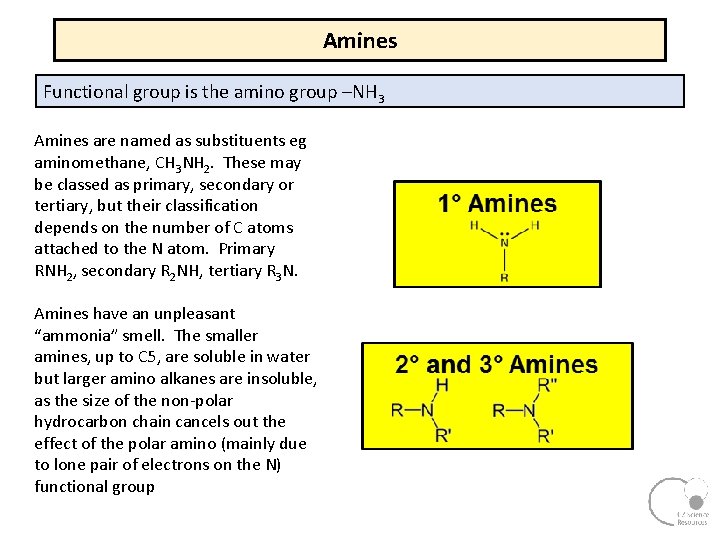
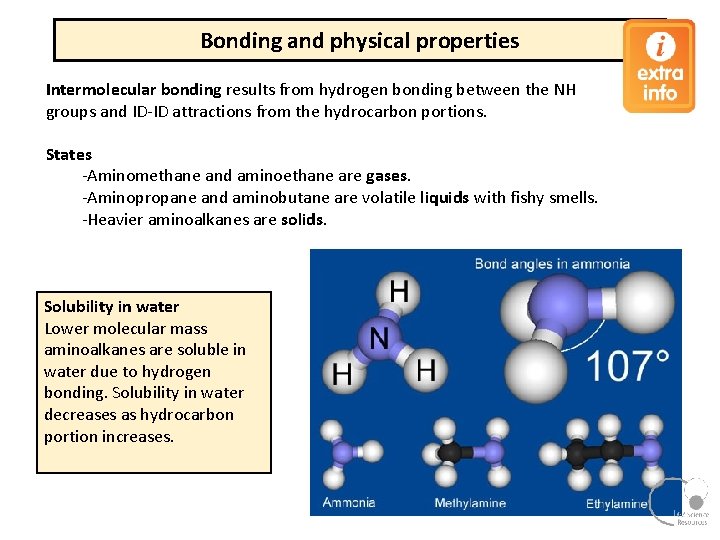
Amines Functional group is the amino group –NH 3 Amines are named as substituents eg aminomethane, CH 3 NH 2. These may be classed as primary, secondary or tertiary, but their classification depends on the number of C atoms attached to the N atom. Primary RNH 2, secondary R 2 NH, tertiary R 3 N. Amines have an unpleasant “ammonia” smell. The smaller amines, up to C 5, are soluble in water but larger amino alkanes are insoluble, as the size of the non polar hydrocarbon chain cancels out the effect of the polar amino (mainly due to lone pair of electrons on the N) functional group
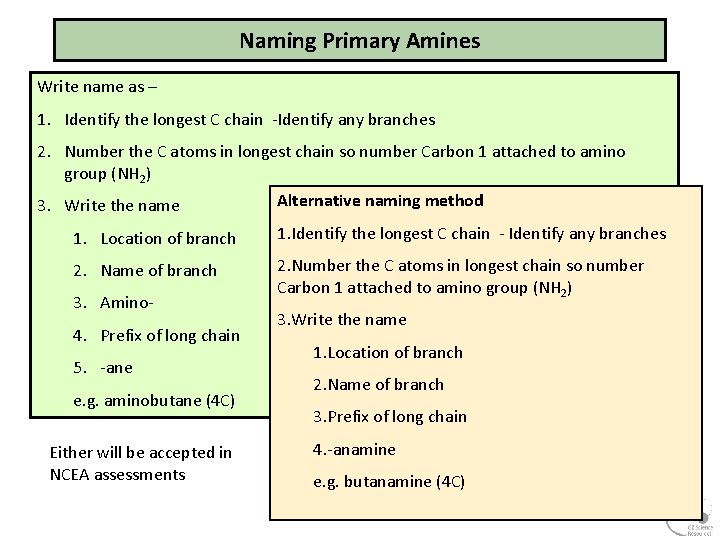
Naming Primary Amines Write name as – 1. Identify the longest C chain Identify any branches 2. Number the C atoms in longest chain so number Carbon 1 attached to amino group (NH 2) Alternative naming method 3. Write the name 1. Location of branch 1. Identify the longest C chain Identify any branches 2. Name of branch 2. Number the C atoms in longest chain so number Carbon 1 attached to amino group (NH 2) 3. Amino 4. Prefix of long chain 5. ane e. g. aminobutane (4 C) Either will be accepted in NCEA assessments 3. Write the name 1. Location of branch 2. Name of branch 3. Prefix of long chain 4. anamine e. g. butanamine (4 C)
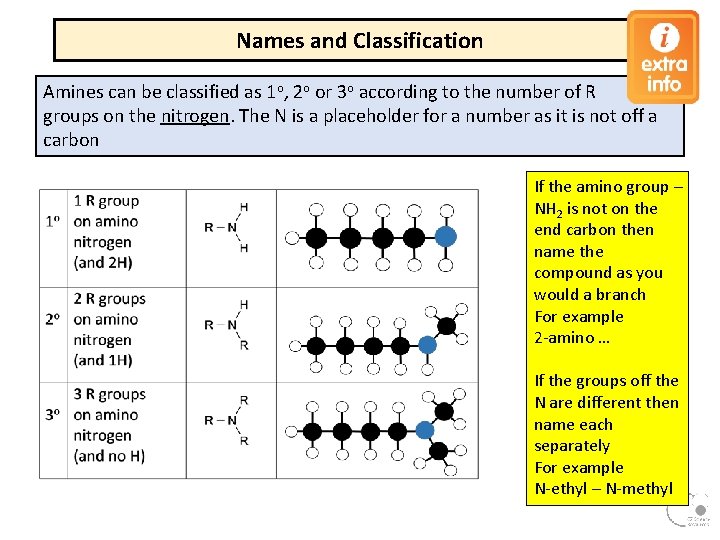
Names and Classification Amines can be classified as 1 o, 2 o or 3 o according to the number of R groups on the nitrogen. The N is a placeholder for a number as it is not off a carbon If the amino group – NH 2 is not on the end carbon then name the compound as you would a branch For example 2 amino … If the groups off the N are different then name each separately For example N ethyl – N methyl
Bonding and physical properties Intermolecular bonding results from hydrogen bonding between the NH groups and ID ID attractions from the hydrocarbon portions. States Aminomethane and aminoethane are gases. Aminopropane and aminobutane are volatile liquids with fishy smells. Heavier aminoalkanes are solids. Solubility in water Lower molecular mass aminoalkanes are soluble in water due to hydrogen bonding. Solubility in water decreases as hydrocarbon portion increases.
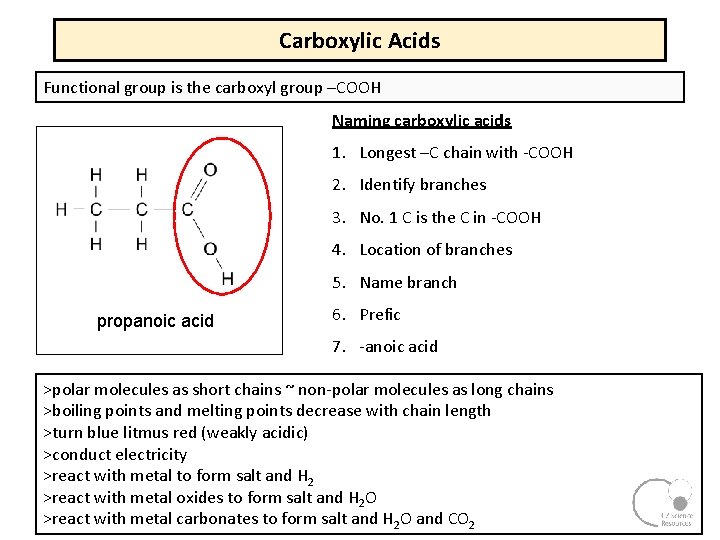
Carboxylic Acids Functional group is the carboxyl group –COOH Naming carboxylic acids 1. Longest –C chain with COOH 2. Identify branches 3. No. 1 C is the C in COOH 4. Location of branches 5. Name branch propanoic acid 6. Prefic 7. anoic acid >polar molecules as short chains ~ non polar molecules as long chains >boiling points and melting points decrease with chain length >turn blue litmus red (weakly acidic) >conduct electricity >react with metal to form salt and H 2 >react with metal oxides to form salt and H 2 O >react with metal carbonates to form salt and H 2 O and CO 2
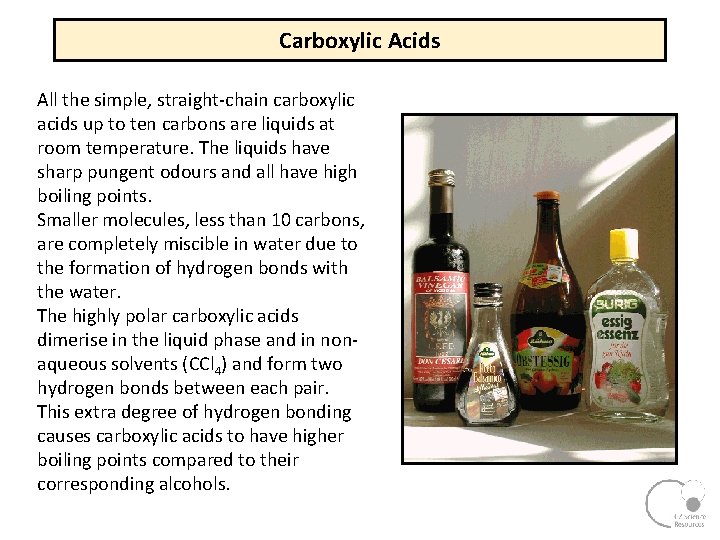
Carboxylic Acids All the simple, straight chain carboxylic acids up to ten carbons are liquids at room temperature. The liquids have sharp pungent odours and all have high boiling points. Smaller molecules, less than 10 carbons, are completely miscible in water due to the formation of hydrogen bonds with the water. The highly polar carboxylic acids dimerise in the liquid phase and in non aqueous solvents (CCl 4) and form two hydrogen bonds between each pair. This extra degree of hydrogen bonding causes carboxylic acids to have higher boiling points compared to their corresponding alcohols.
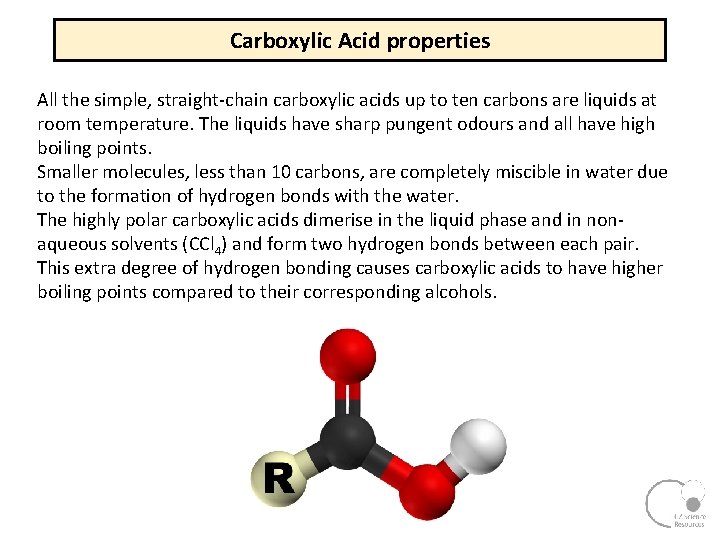
Carboxylic Acid properties All the simple, straight chain carboxylic acids up to ten carbons are liquids at room temperature. The liquids have sharp pungent odours and all have high boiling points. Smaller molecules, less than 10 carbons, are completely miscible in water due to the formation of hydrogen bonds with the water. The highly polar carboxylic acids dimerise in the liquid phase and in non aqueous solvents (CCl 4) and form two hydrogen bonds between each pair. This extra degree of hydrogen bonding causes carboxylic acids to have higher boiling points compared to their corresponding alcohols.
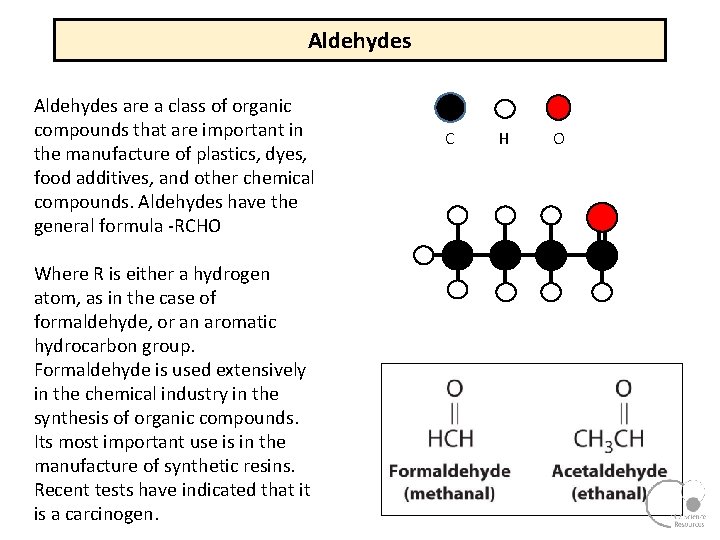
Aldehydes are a class of organic compounds that are important in the manufacture of plastics, dyes, food additives, and other chemical compounds. Aldehydes have the general formula RCHO Where R is either a hydrogen atom, as in the case of formaldehyde, or an aromatic hydrocarbon group. Formaldehyde is used extensively in the chemical industry in the synthesis of organic compounds. Its most important use is in the manufacture of synthetic resins. Recent tests have indicated that it is a carcinogen. C H O
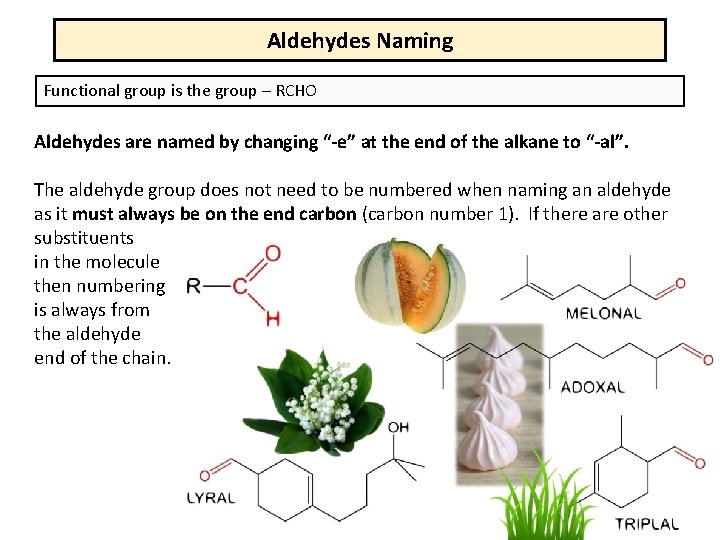
Aldehydes Naming Functional group is the group – RCHO Aldehydes are named by changing “-e” at the end of the alkane to “-al”. The aldehyde group does not need to be numbered when naming an aldehyde as it must always be on the end carbon (carbon number 1). If there are other substituents in the molecule then numbering is always from the aldehyde end of the chain.
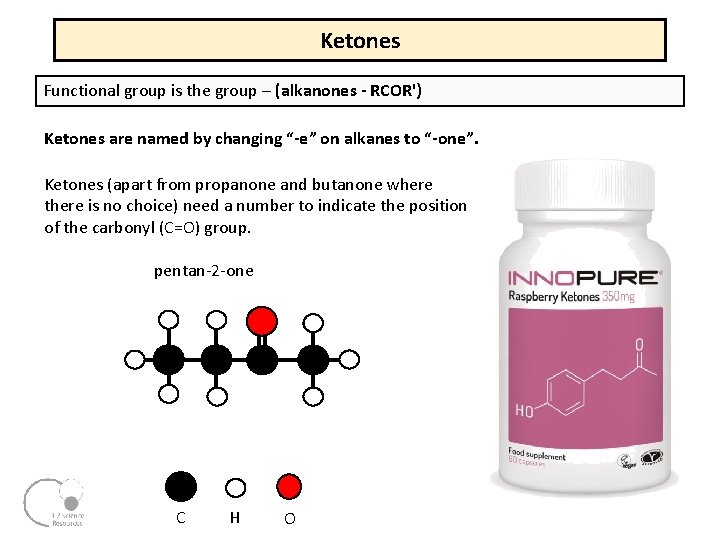
Ketones Functional group is the group – (alkanones - RCOR') Ketones are named by changing “-e” on alkanes to “-one”. Ketones (apart from propanone and butanone where there is no choice) need a number to indicate the position of the carbonyl (C=O) group. pentan 2 one C H O
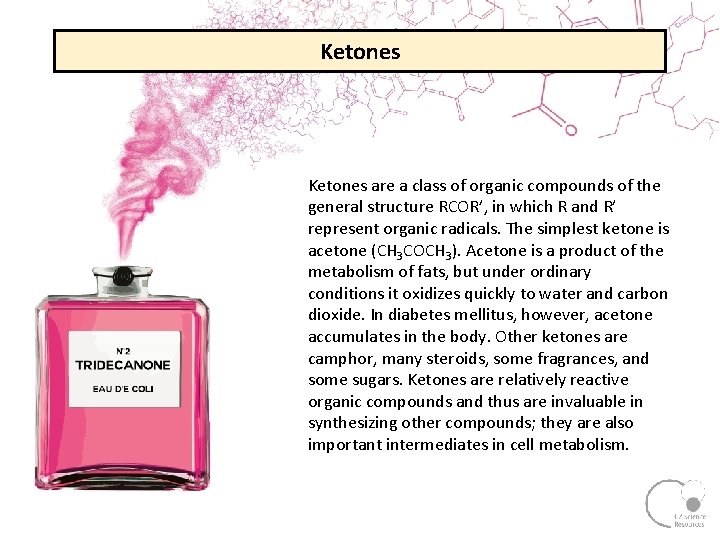
Ketones are a class of organic compounds of the general structure RCOR’, in which R and R’ represent organic radicals. The simplest ketone is acetone (CH 3 COCH 3). Acetone is a product of the metabolism of fats, but under ordinary conditions it oxidizes quickly to water and carbon dioxide. In diabetes mellitus, however, acetone accumulates in the body. Other ketones are camphor, many steroids, some fragrances, and some sugars. Ketones are relatively reactive organic compounds and thus are invaluable in synthesizing other compounds; they are also important intermediates in cell metabolism.
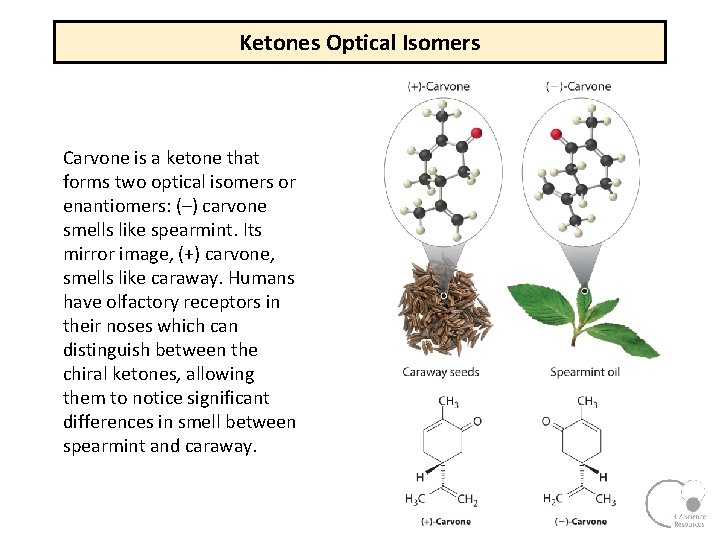
Ketones Optical Isomers Carvone is a ketone that forms two optical isomers or enantiomers: (–) carvone smells like spearmint. Its mirror image, (+) carvone, smells like caraway. Humans have olfactory receptors in their noses which can distinguish between the chiral ketones, allowing them to notice significant differences in smell between spearmint and caraway.
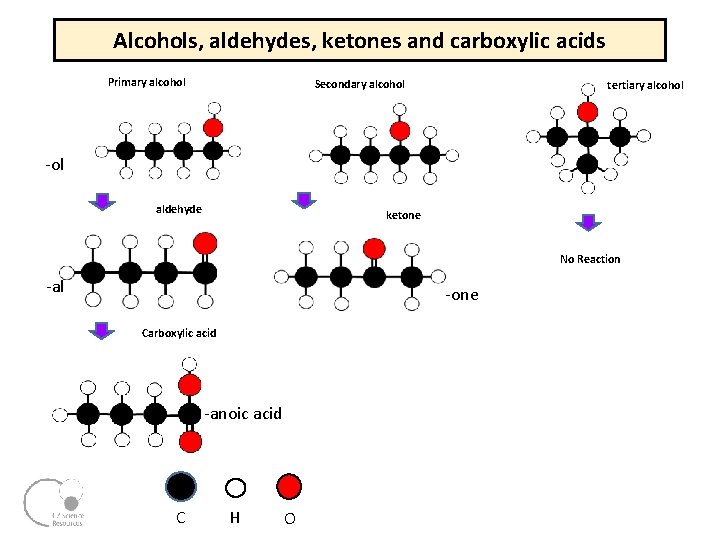
Alcohols, aldehydes, ketones and carboxylic acids Primary alcohol Secondary alcohol tertiary alcohol ol aldehyde ketone No Reaction al one Carboxylic acid anoic acid C H O
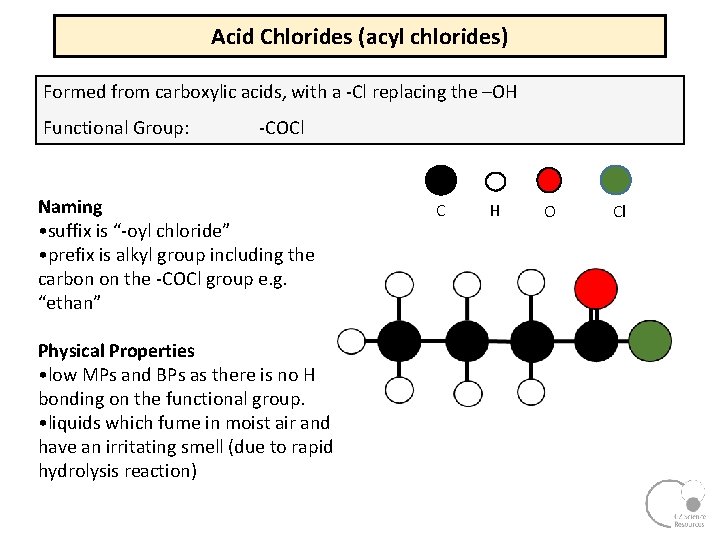
Acid Chlorides (acyl chlorides) Formed from carboxylic acids, with a Cl replacing the –OH Functional Group: COCl Naming • suffix is “ oyl chloride” • prefix is alkyl group including the carbon on the COCl group e. g. “ethan” Physical Properties • low MPs and BPs as there is no H bonding on the functional group. • liquids which fume in moist air and have an irritating smell (due to rapid hydrolysis reaction) C H O Cl
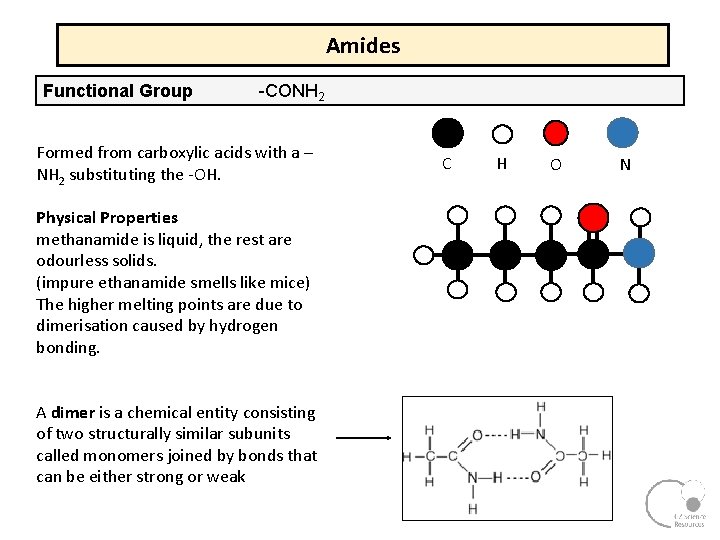
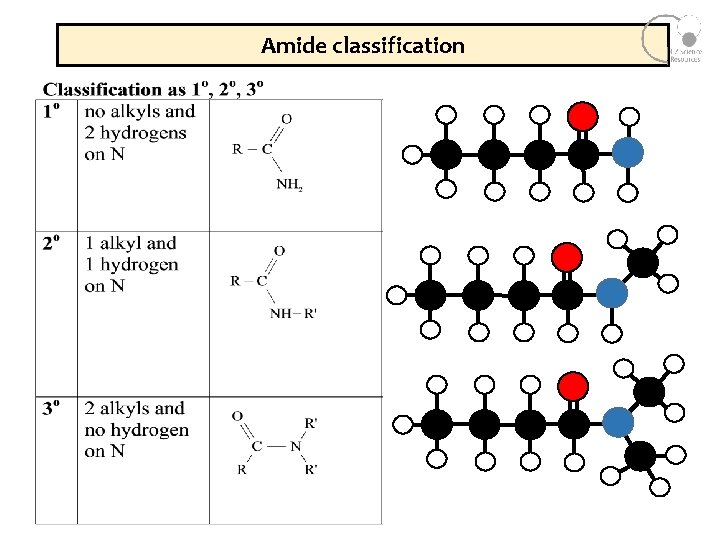
Amides Functional Group -CONH 2 Formed from carboxylic acids with a – NH 2 substituting the OH. Physical Properties methanamide is liquid, the rest are odourless solids. (impure ethanamide smells like mice) The higher melting points are due to dimerisation caused by hydrogen bonding. A dimer is a chemical entity consisting of two structurally similar subunits called monomers joined by bonds that can be either strong or weak C H O N
Amide classification
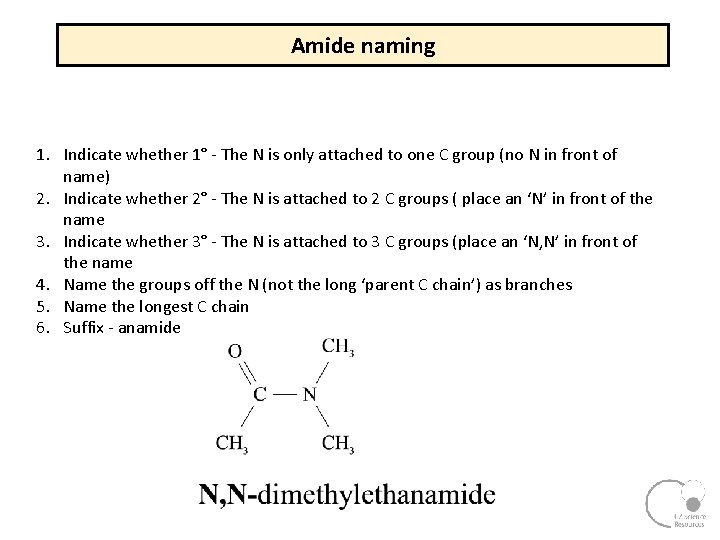
Amide naming 1. Indicate whether 1° The N is only attached to one C group (no N in front of name) 2. Indicate whether 2° The N is attached to 2 C groups ( place an ‘N’ in front of the name 3. Indicate whether 3° The N is attached to 3 C groups (place an ‘N, N’ in front of the name 4. Name the groups off the N (not the long ‘parent C chain’) as branches 5. Name the longest C chain 6. Suffix anamide
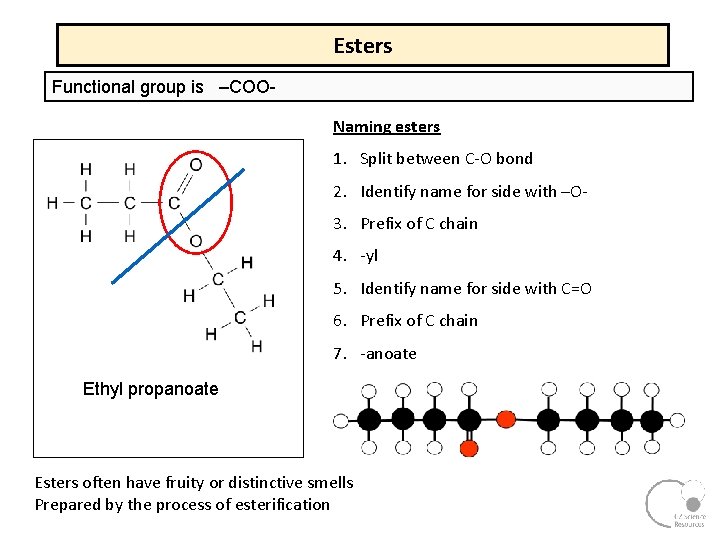
Esters Functional group is –COO- Naming esters 1. Split between C O bond 2. Identify name for side with –O 3. Prefix of C chain 4. yl 5. Identify name for side with C=O 6. Prefix of C chain 7. anoate Ethyl propanoate Esters often have fruity or distinctive smells Prepared by the process of esterification
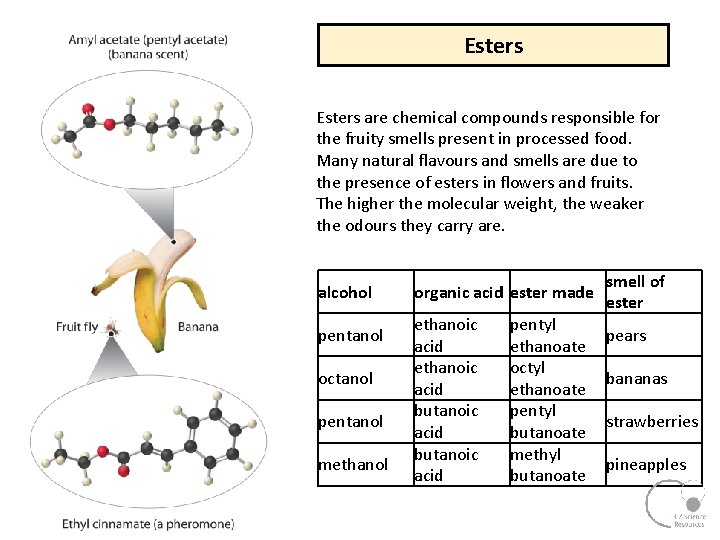
Esters are chemical compounds responsible for the fruity smells present in processed food. Many natural flavours and smells are due to the presence of esters in flowers and fruits. The higher the molecular weight, the weaker the odours they carry are. alcohol pentanol octanol pentanol methanol organic acid ester made ethanoic acid butanoic acid pentyl ethanoate octyl ethanoate pentyl butanoate methyl butanoate smell of ester pears bananas strawberries pineapples
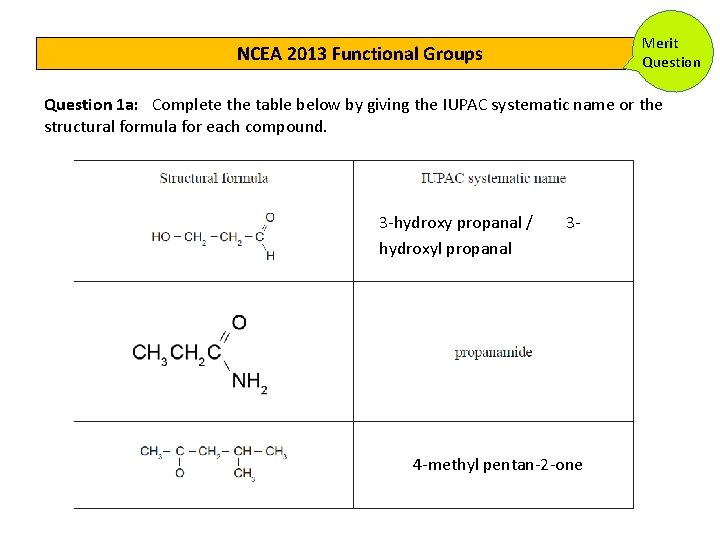
NCEA 2013 Functional Groups Merit Question 1 a: Complete the table below by giving the IUPAC systematic name or the structural formula for each compound. 3 hydroxy propanal / 3 hydroxyl propanal 4 methyl pentan 2 one
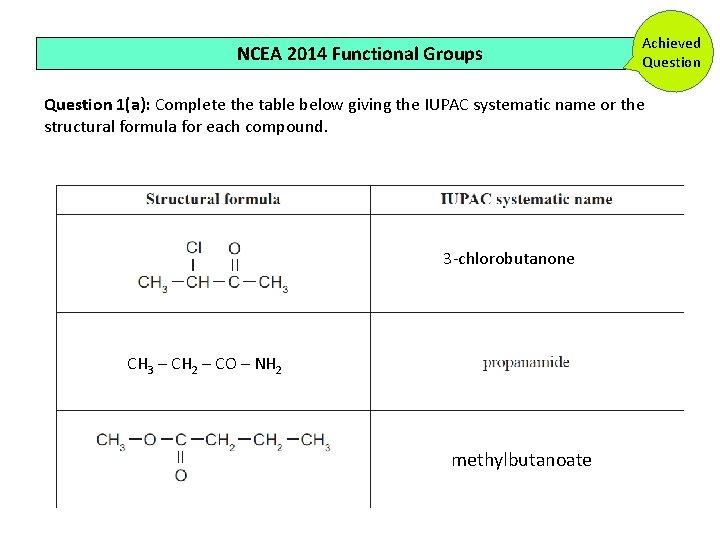
NCEA 2014 Functional Groups Achieved Question 1(a): Complete the table below giving the IUPAC systematic name or the structural formula for each compound. 3 chlorobutanone CH 3 – CH 2 – CO – NH 2 methylbutanoate
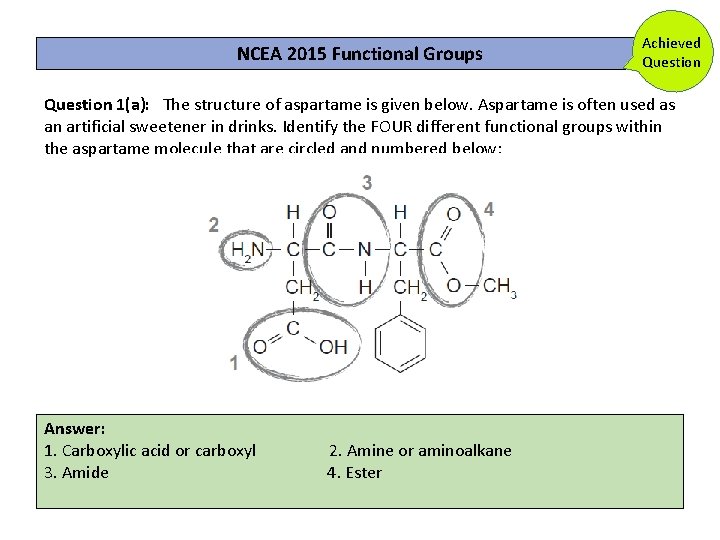
NCEA 2015 Functional Groups Achieved Question 1(a): The structure of aspartame is given below. Aspartame is often used as an artificial sweetener in drinks. Identify the FOUR different functional groups within the aspartame molecule that are circled and numbered below: Answer: 1. Carboxylic acid or carboxyl 2. Amine or aminoalkane 3. Amide 4. Ester
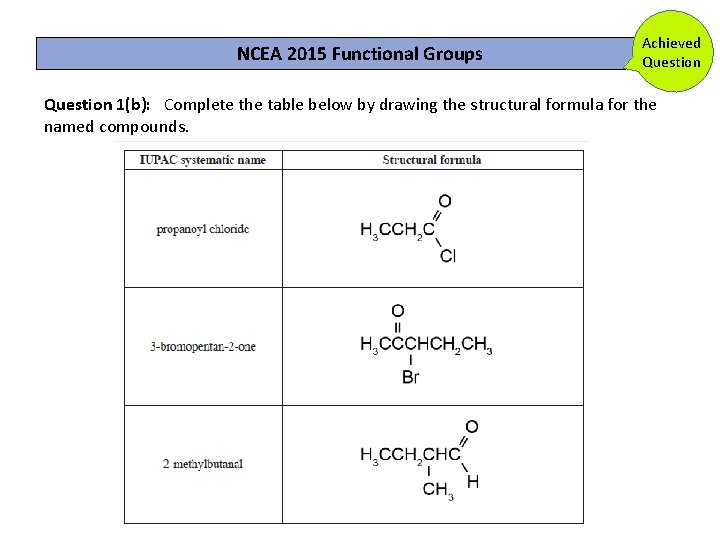
NCEA 2015 Functional Groups Achieved Question 1(b): Complete the table below by drawing the structural formula for the named compounds.
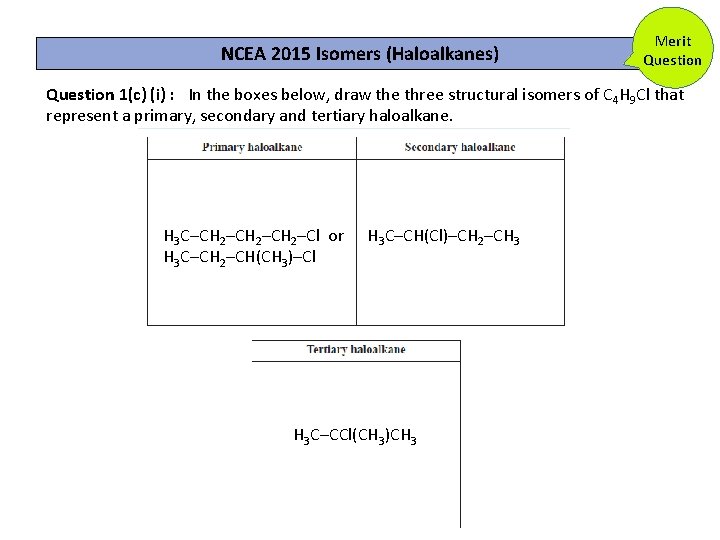
NCEA 2015 Isomers (Haloalkanes) Merit Question 1(c) (i) : In the boxes below, draw the three structural isomers of C 4 H 9 Cl that represent a primary, secondary and tertiary haloalkane. H 3 C–CH 2–CH 2–Cl or H 3 C–CH(Cl)–CH 2–CH 3 H 3 C–CH 2–CH(CH 3)–Cl H 3 C–CCl(CH 3)CH 3
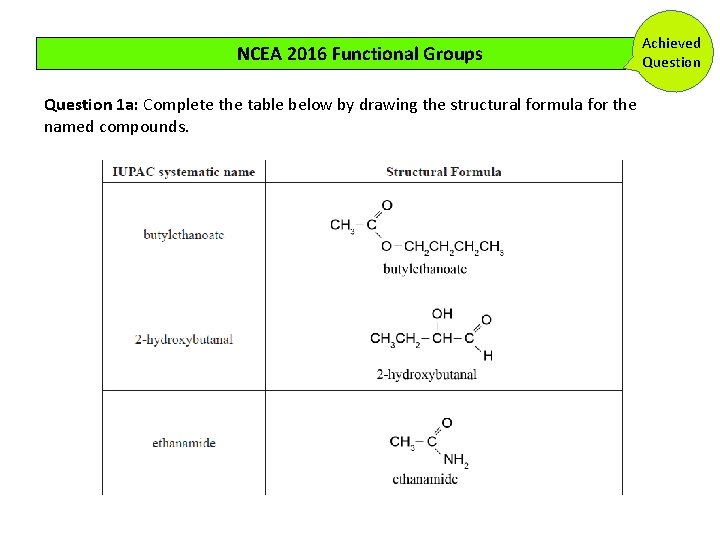
NCEA 2016 Functional Groups Question 1 a: Complete the table below by drawing the structural formula for the named compounds. Achieved Question
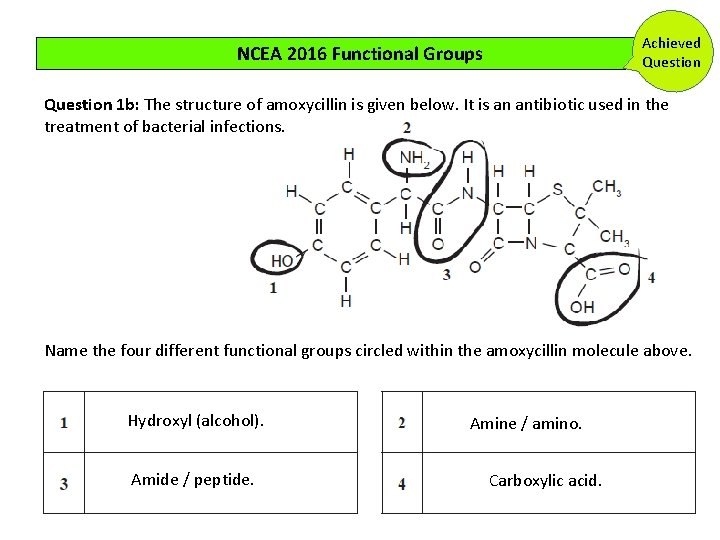
Achieved Question NCEA 2016 Functional Groups Question 1 b: The structure of amoxycillin is given below. It is an antibiotic used in the treatment of bacterial infections. Name the four different functional groups circled within the amoxycillin molecule above. Hydroxyl (alcohol). Amide / peptide. Amine / amino. Carboxylic acid.
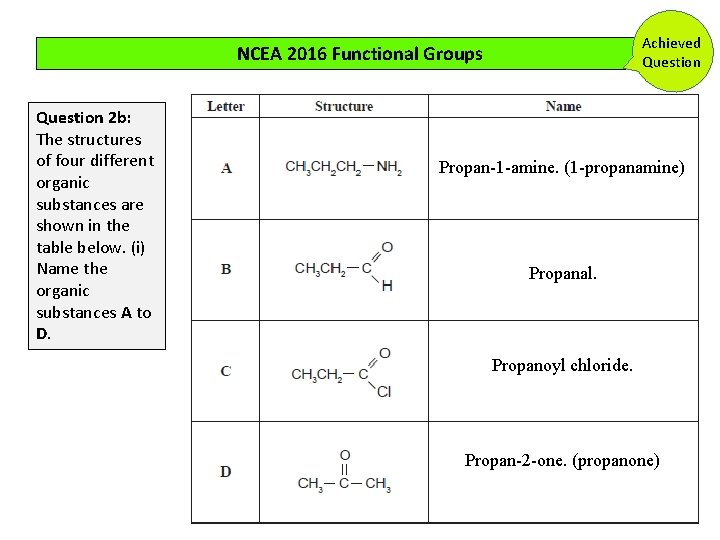
Achieved Question NCEA 2016 Functional Groups Question 2 b: The structures of four different organic substances are shown in the table below. (i) Name the organic substances A to D. Propan-1 -amine. (1 -propanamine) Propanal. Propanoyl chloride. Propan-2 -one. (propanone)
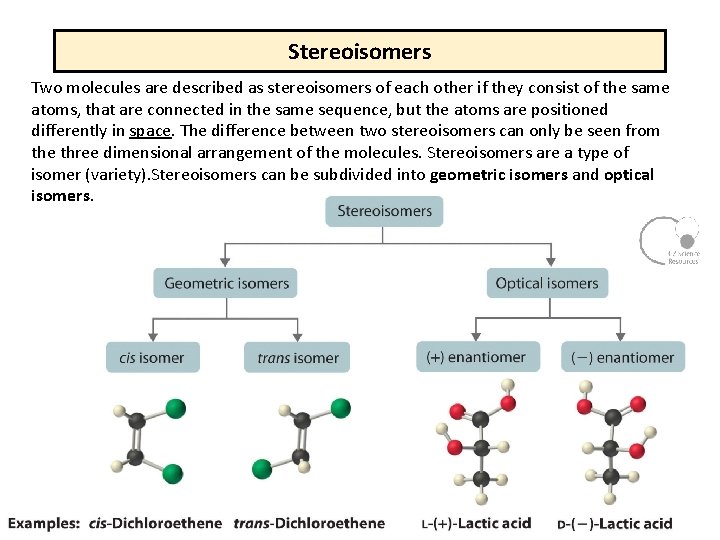
Stereoisomers Two molecules are described as stereoisomers of each other if they consist of the same atoms, that are connected in the same sequence, but the atoms are positioned differently in space. The difference between two stereoisomers can only be seen from the three dimensional arrangement of the molecules. Stereoisomers are a type of isomer (variety). Stereoisomers can be subdivided into geometric isomers and optical isomers.
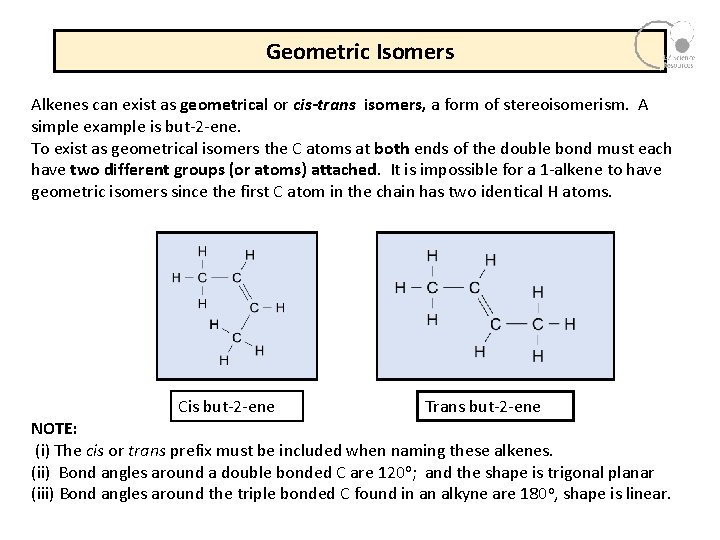
Geometric Isomers Alkenes can exist as geometrical or cis-trans isomers, a form of stereoisomerism. A simple example is but 2 ene. To exist as geometrical isomers the C atoms at both ends of the double bond must each have two different groups (or atoms) attached. It is impossible for a 1 alkene to have geometric isomers since the first C atom in the chain has two identical H atoms. Cis but 2 ene Trans but 2 ene NOTE: (i) The cis or trans prefix must be included when naming these alkenes. (ii) Bond angles around a double bonded C are 120 o; and the shape is trigonal planar (iii) Bond angles around the triple bonded C found in an alkyne are 180 o, shape is linear.
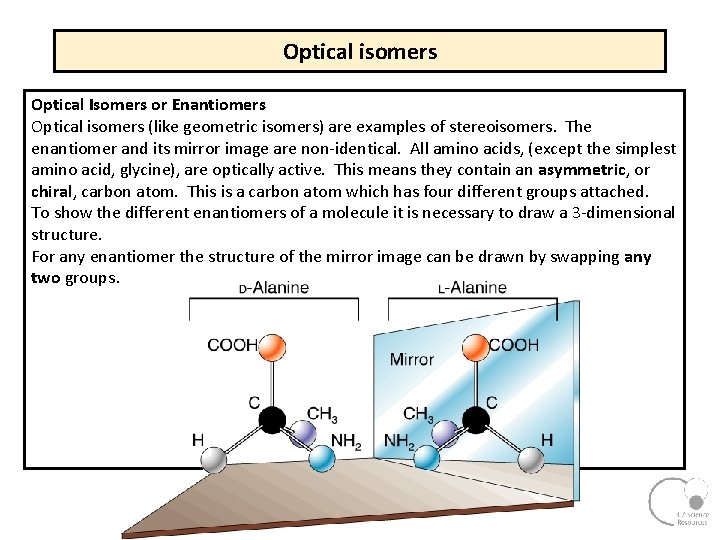
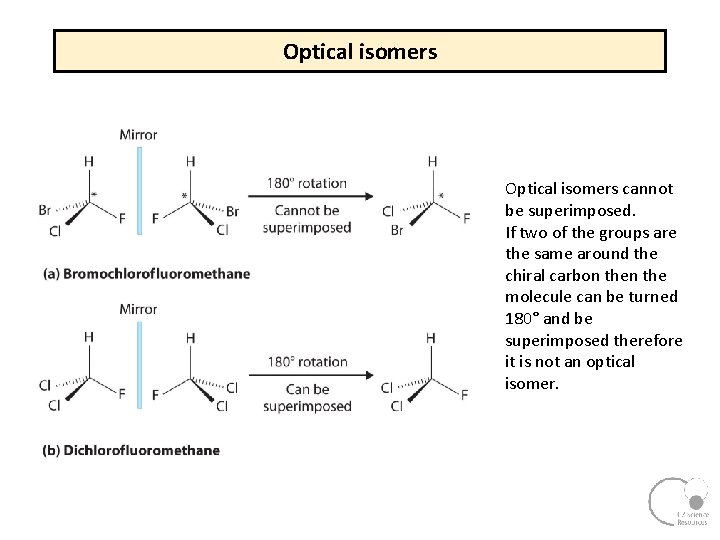
Optical isomers Optical Isomers or Enantiomers Optical isomers (like geometric isomers) are examples of stereoisomers. The enantiomer and its mirror image are non identical. All amino acids, (except the simplest amino acid, glycine), are optically active. This means they contain an asymmetric, or chiral, carbon atom. This is a carbon atom which has four different groups attached. To show the different enantiomers of a molecule it is necessary to draw a 3 dimensional structure. For any enantiomer the structure of the mirror image can be drawn by swapping any two groups.
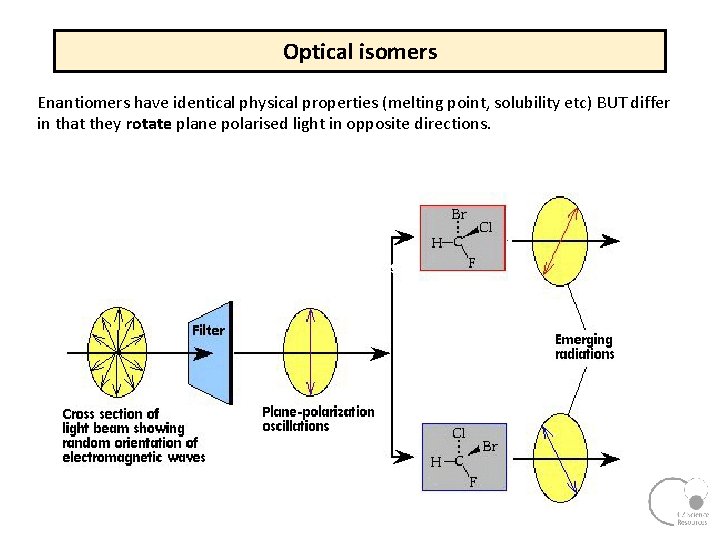
Optical isomers Enantiomers have identical physical properties (melting point, solubility etc) BUT differ in that they rotate plane polarised light in opposite directions.
Optical isomers cannot be superimposed. If two of the groups are the same around the chiral carbon the molecule can be turned 180° and be superimposed therefore it is not an optical isomer.
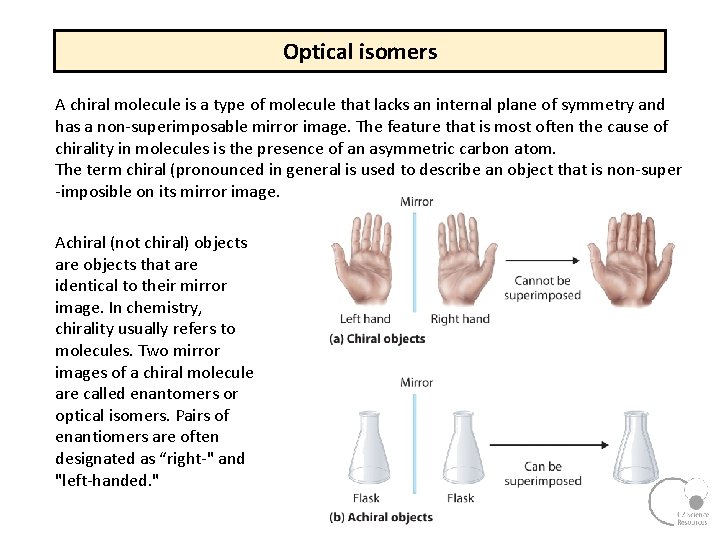
Optical isomers A chiral molecule is a type of molecule that lacks an internal plane of symmetry and has a non superimposable mirror image. The feature that is most often the cause of chirality in molecules is the presence of an asymmetric carbon atom. The term chiral (pronounced in general is used to describe an object that is non super imposible on its mirror image. Achiral (not chiral) objects are objects that are identical to their mirror image. In chemistry, chirality usually refers to molecules. Two mirror images of a chiral molecule are called enantomers or optical isomers. Pairs of enantiomers are often designated as “right " and "left handed. "
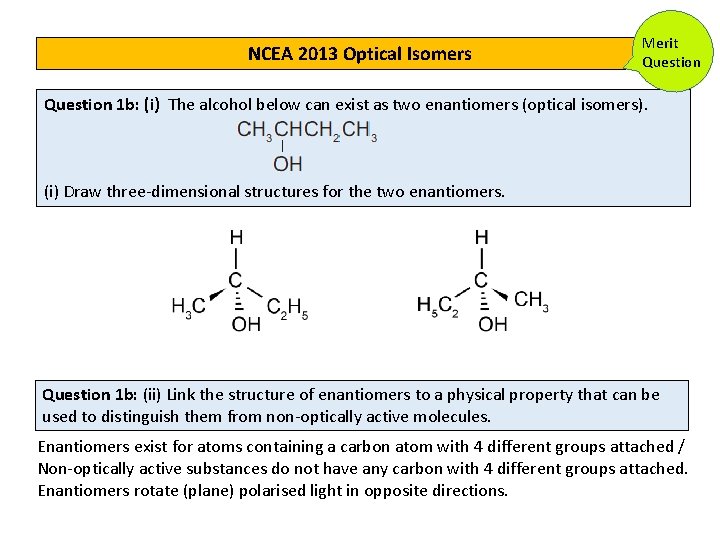
NCEA 2013 Optical Isomers Merit Question 1 b: (i) The alcohol below can exist as two enantiomers (optical isomers). (i) Draw three dimensional structures for the two enantiomers. Question 1 b: (ii) Link the structure of enantiomers to a physical property that can be used to distinguish them from non optically active molecules. Enantiomers exist for atoms containing a carbon atom with 4 different groups attached / Non optically active substances do not have any carbon with 4 different groups attached. Enantiomers rotate (plane) polarised light in opposite directions.
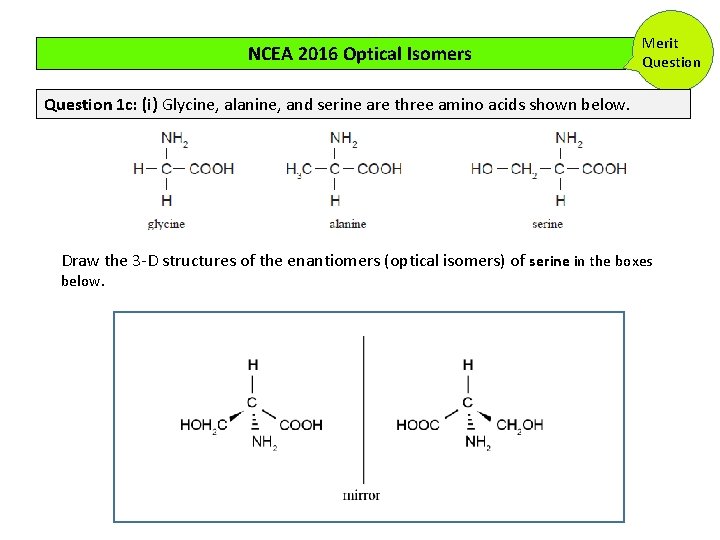
NCEA 2016 Optical Isomers Merit Question 1 c: (i) Glycine, alanine, and serine are three amino acids shown below. Draw the 3 D structures of the enantiomers (optical isomers) of serine in the boxes below.
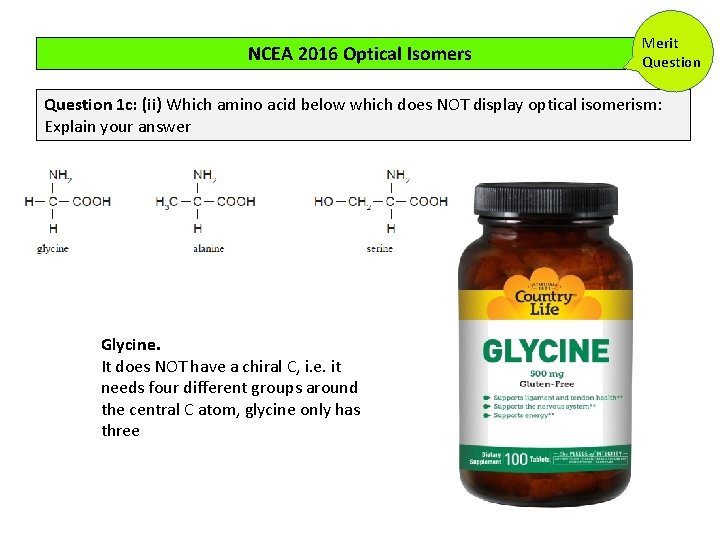
NCEA 2016 Optical Isomers Merit Question 1 c: (ii) Which amino acid below which does NOT display optical isomerism: Explain your answer Glycine. It does NOT have a chiral C, i. e. it needs four different groups around the central C atom, glycine only has three
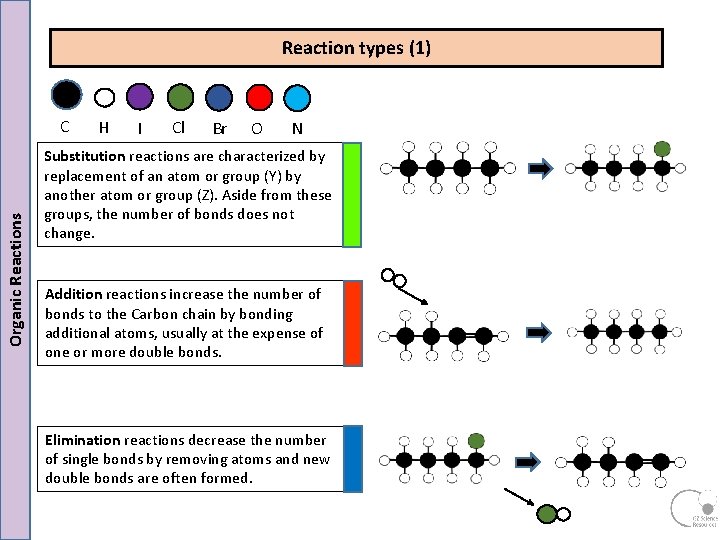
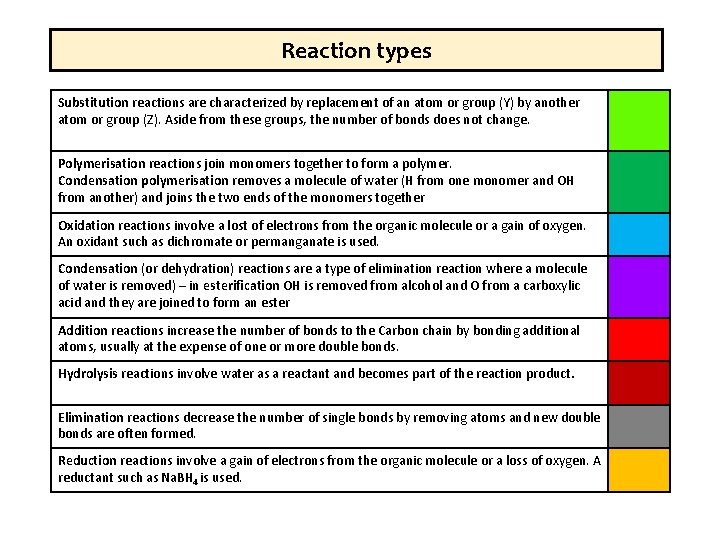
Reaction types (1) Organic Reactions C H I Cl Br O N Substitution reactions are characterized by replacement of an atom or group (Y) by another atom or group (Z). Aside from these groups, the number of bonds does not change. Addition reactions increase the number of bonds to the Carbon chain by bonding additional atoms, usually at the expense of one or more double bonds. Elimination reactions decrease the number of single bonds by removing atoms and new double bonds are often formed.
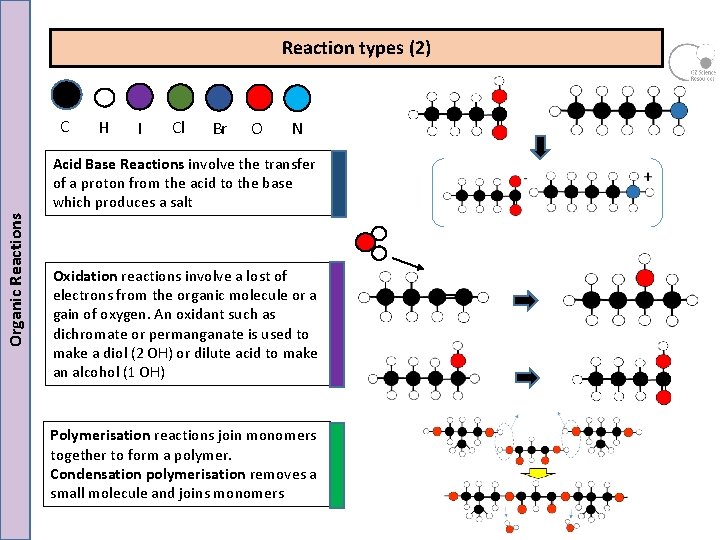
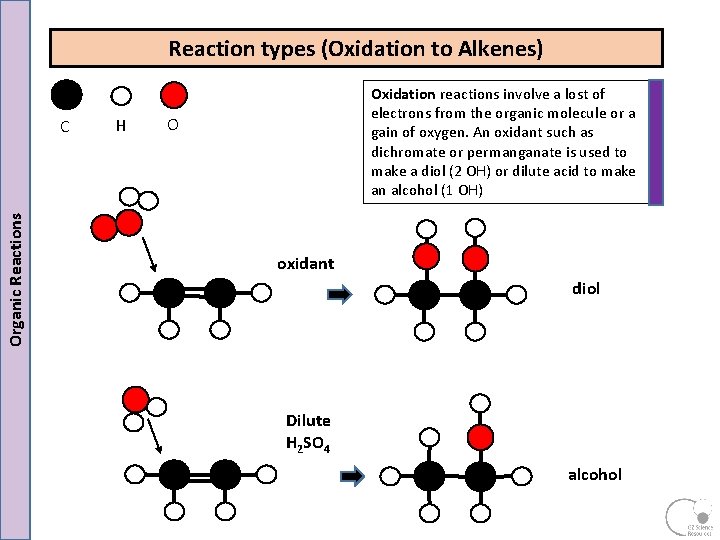
Reaction types (2) C H I Cl Br O N Organic Reactions Acid Base Reactions involve the transfer of a proton from the acid to the base which produces a salt Oxidation reactions involve a lost of electrons from the organic molecule or a gain of oxygen. An oxidant such as dichromate or permanganate is used to make a diol (2 OH) or dilute acid to make an alcohol (1 OH) Polymerisation reactions join monomers together to form a polymer. Condensation polymerisation removes a small molecule and joins monomers
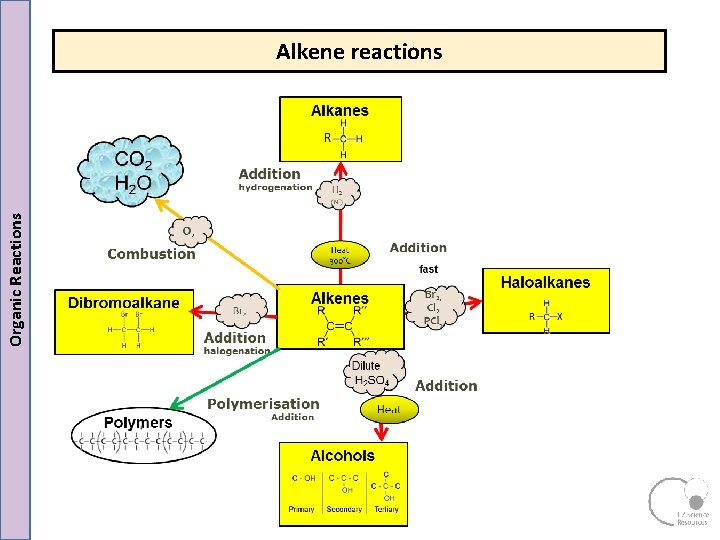
Organic Reactions Alkene reactions
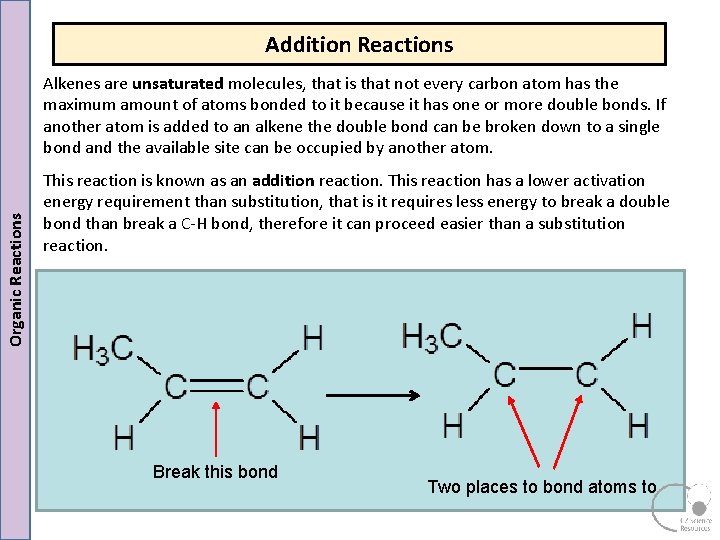
Addition Reactions Organic Reactions Alkenes are unsaturated molecules, that is that not every carbon atom has the maximum amount of atoms bonded to it because it has one or more double bonds. If another atom is added to an alkene the double bond can be broken down to a single bond and the available site can be occupied by another atom. This reaction is known as an addition reaction. This reaction has a lower activation energy requirement than substitution, that is it requires less energy to break a double bond than break a C H bond, therefore it can proceed easier than a substitution reaction. Break this bond Two places to bond atoms to
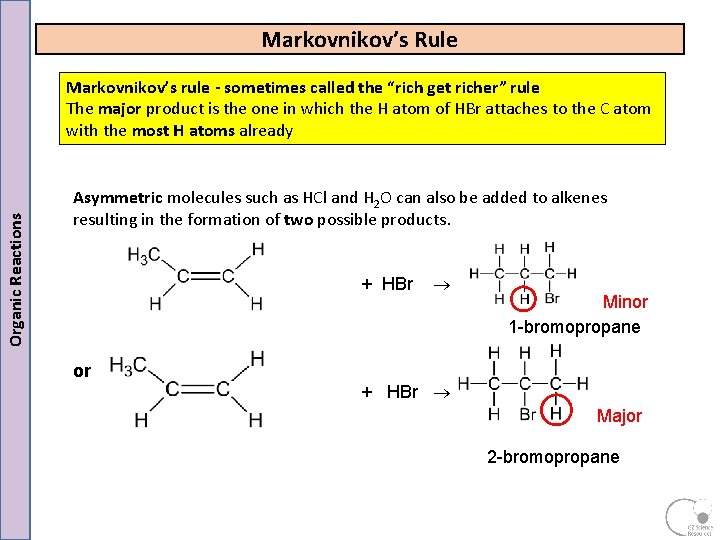
Markovnikov’s Rule Organic Reactions Markovnikov’s rule - sometimes called the “rich get richer” rule The major product is the one in which the H atom of HBr attaches to the C atom with the most H atoms already Asymmetric molecules such as HCl and H 2 O can also be added to alkenes resulting in the formation of two possible products. + HBr + HBr Minor 1 -bromopropane or Major 2 -bromopropane
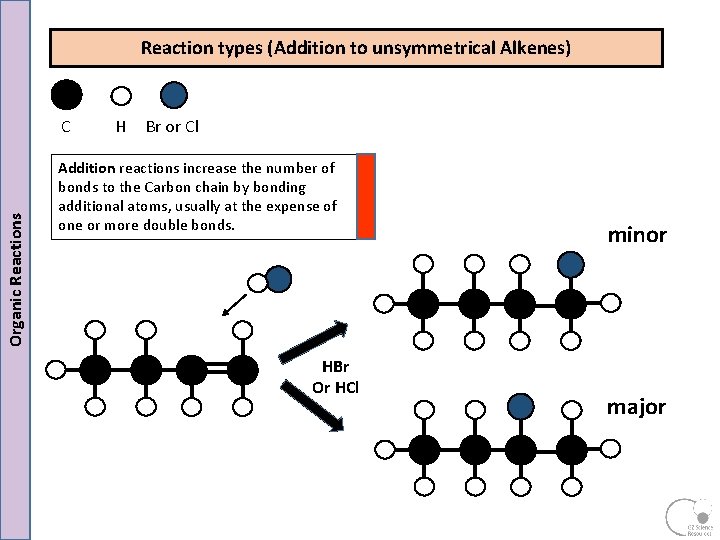
Reaction types (Addition to unsymmetrical Alkenes) Organic Reactions C H Br or Cl Addition reactions increase the number of bonds to the Carbon chain by bonding additional atoms, usually at the expense of one or more double bonds. HBr Or HCl minor major
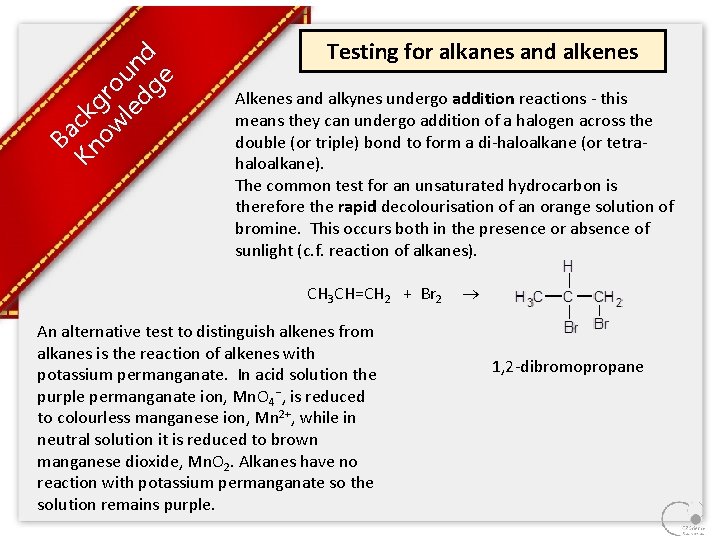
Ba Kn ck ow gro le un dg d e Testing for alkanes and alkenes Alkenes and alkynes undergo addition reactions this means they can undergo addition of a halogen across the double (or triple) bond to form a di haloalkane (or tetra haloalkane). The common test for an unsaturated hydrocarbon is therefore the rapid decolourisation of an orange solution of bromine. This occurs both in the presence or absence of sunlight (c. f. reaction of alkanes). CH 3 CH=CH 2 + Br 2 An alternative test to distinguish alkenes from alkanes is the reaction of alkenes with potassium permanganate. In acid solution the purple permanganate ion, Mn. O 4 , is reduced to colourless manganese ion, Mn 2+, while in neutral solution it is reduced to brown manganese dioxide, Mn. O 2. Alkanes have no reaction with potassium permanganate so the solution remains purple. 1, 2 dibromopropane
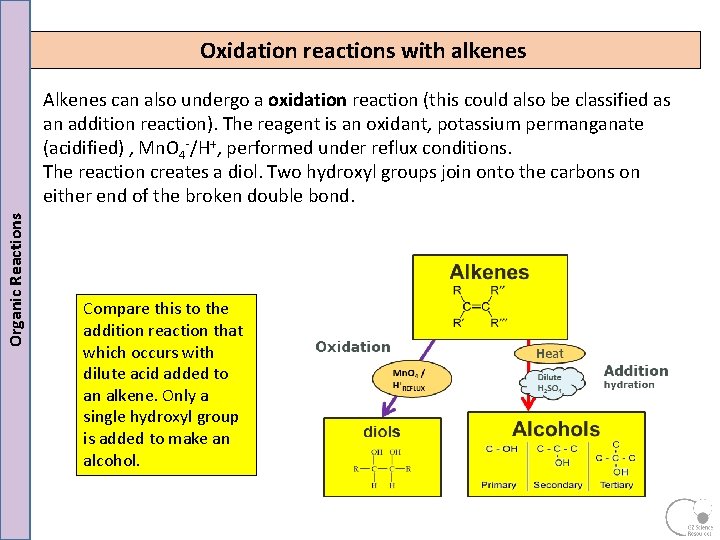
Oxidation reactions with alkenes Organic Reactions Alkenes can also undergo a oxidation reaction (this could also be classified as an addition reaction). The reagent is an oxidant, potassium permanganate (acidified) , Mn. O 4 /H+, performed under reflux conditions. The reaction creates a diol. Two hydroxyl groups join onto the carbons on either end of the broken double bond. Compare this to the addition reaction that which occurs with dilute acid added to an alkene. Only a single hydroxyl group is added to make an alcohol.
Reaction types (Oxidation to Alkenes) Organic Reactions C H Oxidation reactions involve a lost of electrons from the organic molecule or a gain of oxygen. An oxidant such as dichromate or permanganate is used to make a diol (2 OH) or dilute acid to make an alcohol (1 OH) O oxidant diol Dilute H 2 SO 4 alcohol
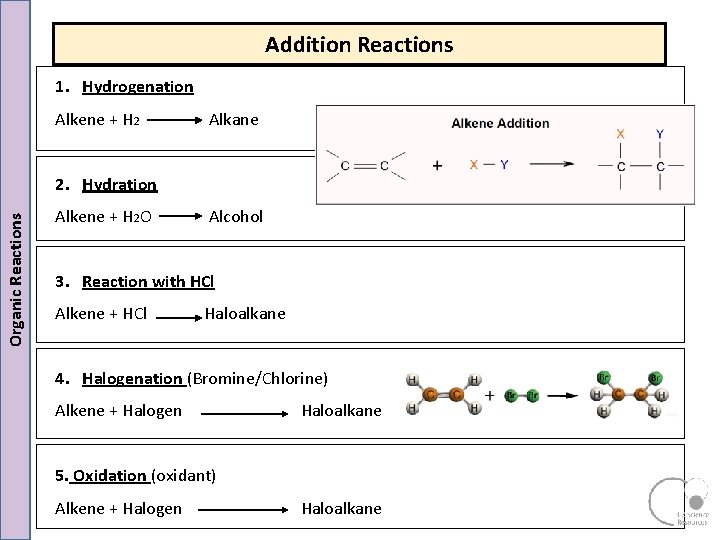
Addition Reactions 1. Hydrogenation Alkene + H 2 Alkane Organic Reactions 2. Hydration Alkene + H 2 O Alcohol 3. Reaction with HCl Alkene + HCl Haloalkane 4. Halogenation (Bromine/Chlorine) Alkene + Halogen Haloalkane 5. Oxidation (oxidant) Alkene + Halogen Haloalkane
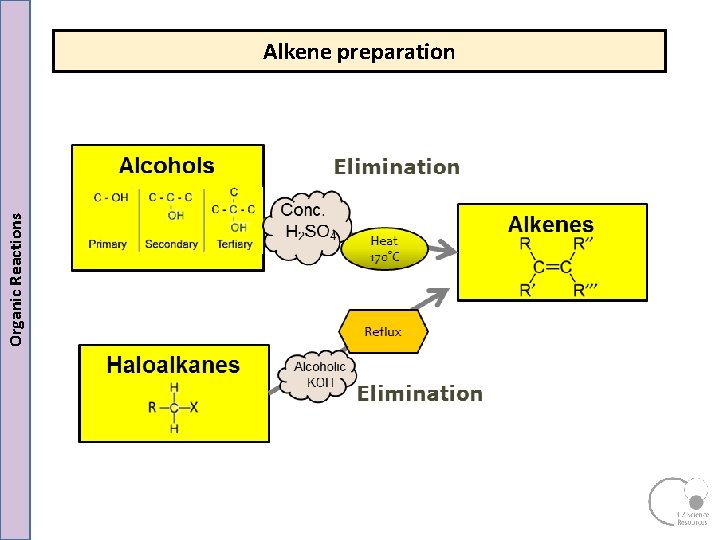
Organic Reactions Alkene preparation
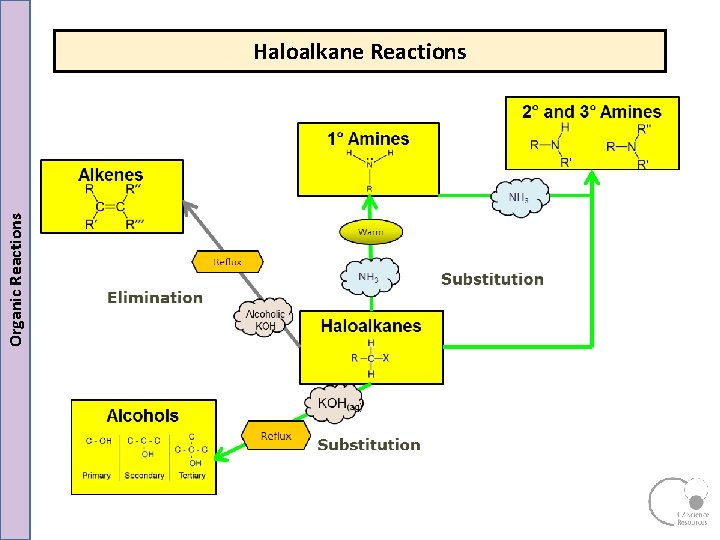
Organic Reactions Haloalkane Reactions
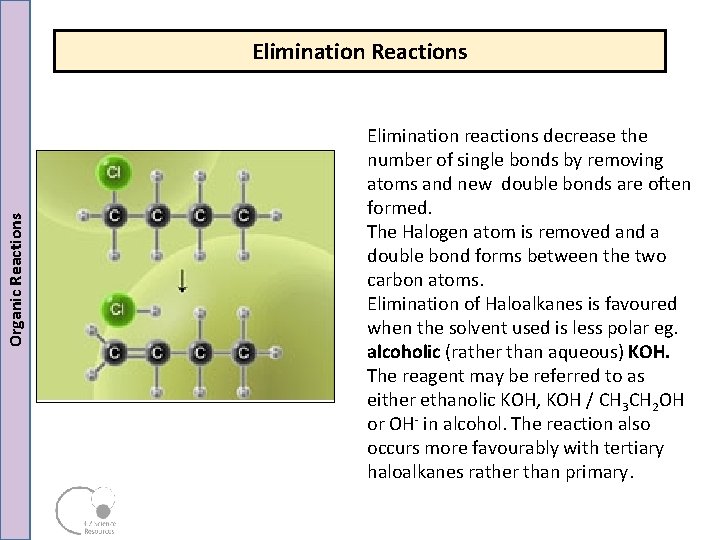
Organic Reactions Elimination reactions decrease the number of single bonds by removing atoms and new double bonds are often formed. The Halogen atom is removed and a double bond forms between the two carbon atoms. Elimination of Haloalkanes is favoured when the solvent used is less polar eg. alcoholic (rather than aqueous) KOH. The reagent may be referred to as either ethanolic KOH, KOH / CH 3 CH 2 OH or OH in alcohol. The reaction also occurs more favourably with tertiary haloalkanes rather than primary.
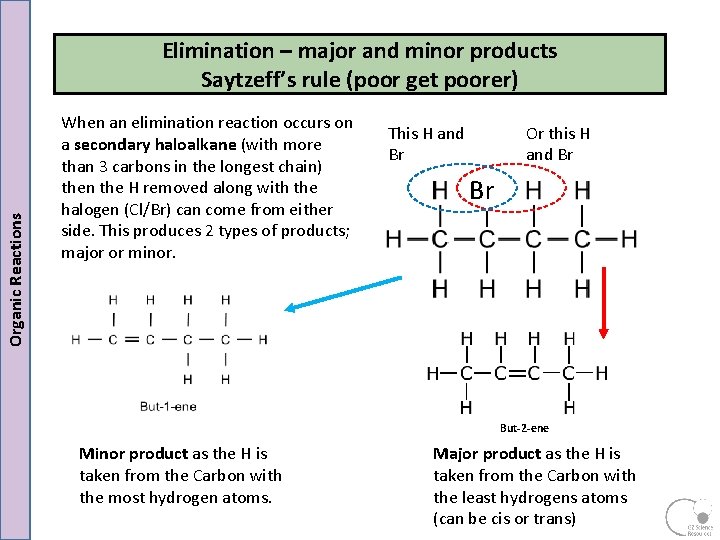
Organic Reactions Elimination – major and minor products Saytzeff’s rule (poor get poorer) When an elimination reaction occurs on a secondary haloalkane (with more than 3 carbons in the longest chain) then the H removed along with the halogen (Cl/Br) can come from either side. This produces 2 types of products; major or minor. Or this H and Br This H and Br Br But-2 -ene Minor product as the H is taken from the Carbon with the most hydrogen atoms. Major product as the H is taken from the Carbon with the least hydrogens atoms (can be cis or trans)
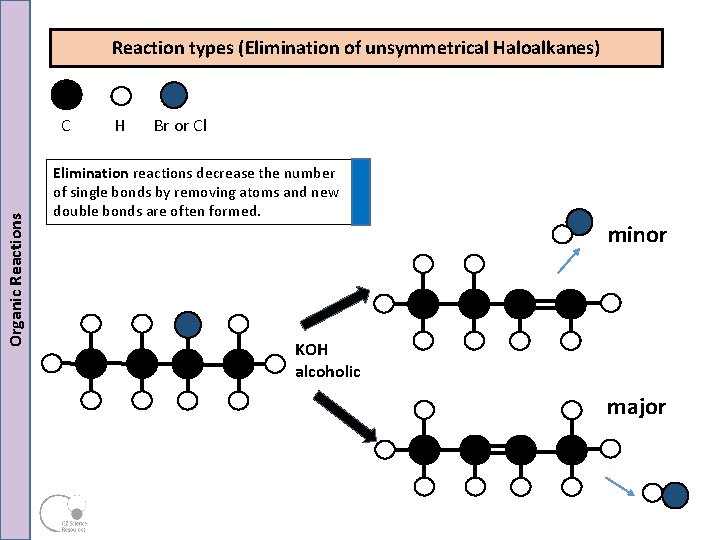
Reaction types (Elimination of unsymmetrical Haloalkanes) Organic Reactions C H Br or Cl Elimination reactions decrease the number of single bonds by removing atoms and new double bonds are often formed. minor KOH alcoholic major
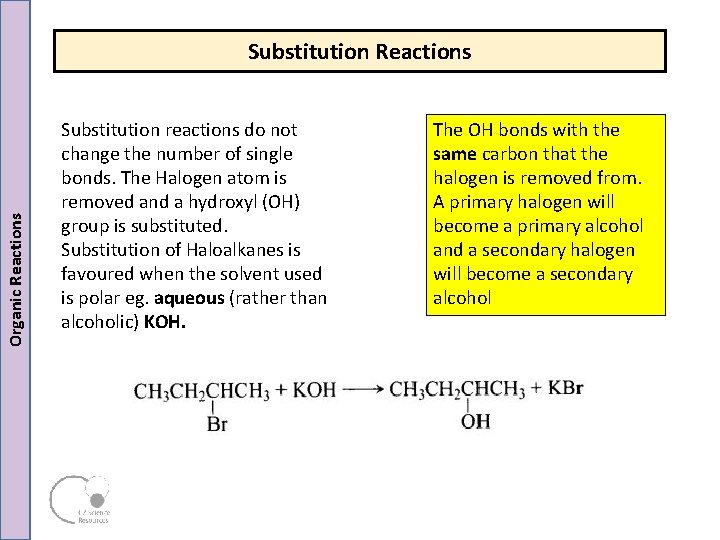
Organic Reactions Substitution reactions do not change the number of single bonds. The Halogen atom is removed and a hydroxyl (OH) group is substituted. Substitution of Haloalkanes is favoured when the solvent used is polar eg. aqueous (rather than alcoholic) KOH. The OH bonds with the same carbon that the halogen is removed from. A primary halogen will become a primary alcohol and a secondary halogen will become a secondary alcohol
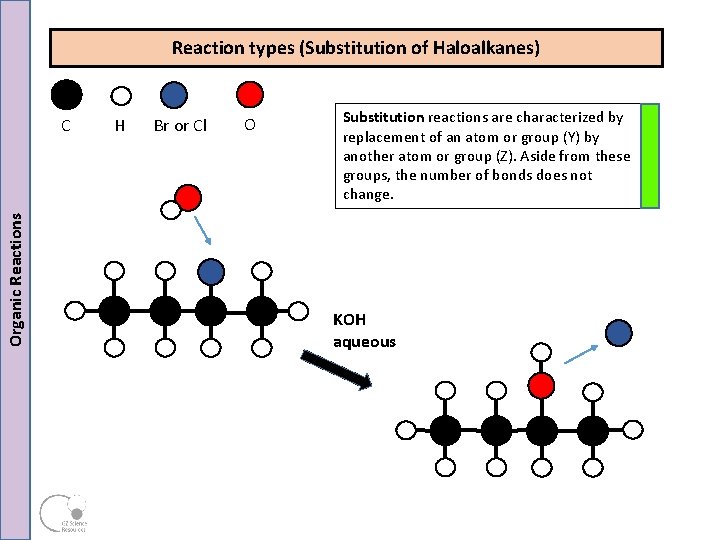
Reaction types (Substitution of Haloalkanes) Organic Reactions C H Br or Cl O Substitution reactions are characterized by replacement of an atom or group (Y) by another atom or group (Z). Aside from these groups, the number of bonds does not change. KOH aqueous
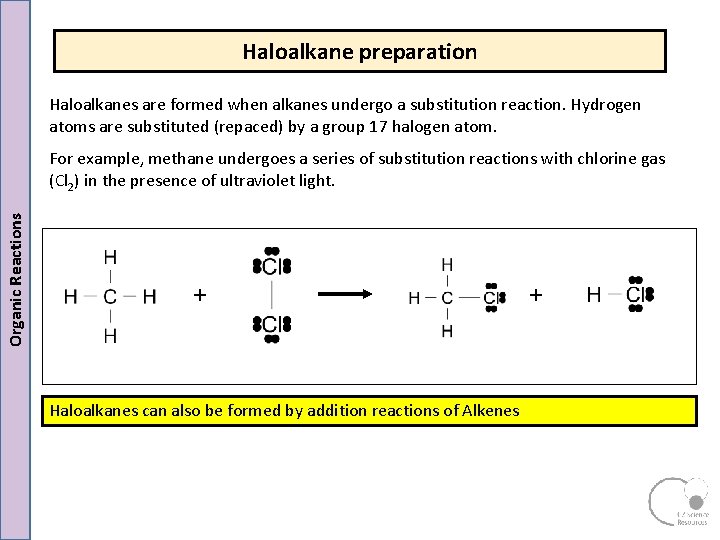
Haloalkane preparation Haloalkanes are formed when alkanes undergo a substitution reaction. Hydrogen atoms are substituted (repaced) by a group 17 halogen atom. Organic Reactions For example, methane undergoes a series of substitution reactions with chlorine gas (Cl 2) in the presence of ultraviolet light. + Haloalkanes can also be formed by addition reactions of Alkenes +
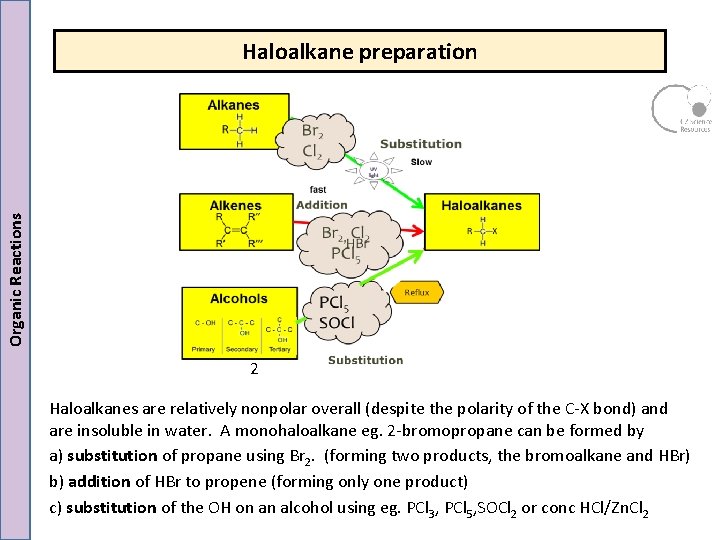
Organic Reactions Haloalkane preparation 2 Haloalkanes are relatively nonpolar overall (despite the polarity of the C X bond) and are insoluble in water. A monohaloalkane eg. 2 bromopropane can be formed by a) substitution of propane using Br 2. (forming two products, the bromoalkane and HBr) b) addition of HBr to propene (forming only one product) c) substitution of the OH on an alcohol using eg. PCl 3, PCl 5, SOCl 2 or conc HCl/Zn. Cl 2
Organic Reactions Alcohol reactions 2
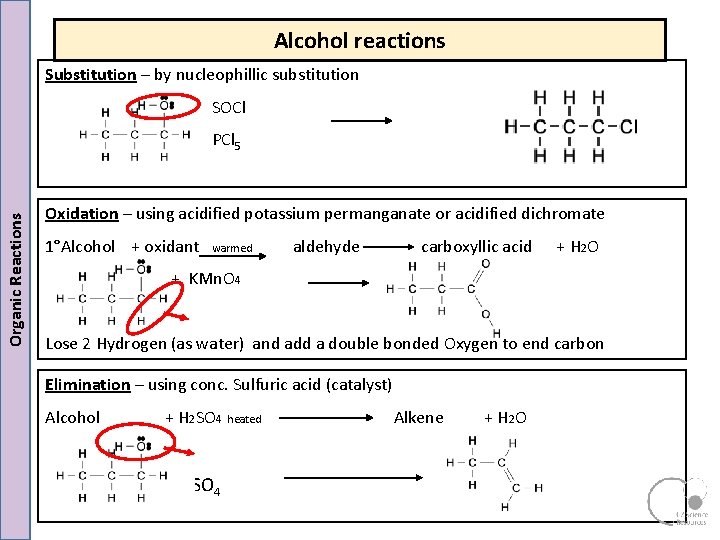
Alcohol reactions Substitution – by nucleophillic substitution SOCl Organic Reactions PCl 5 Oxidation – using acidified potassium permanganate or acidified dichromate 1°Alcohol + oxidant warmed aldehyde carboxyllic acid + H 2 O + KMn. O 4 Lose 2 Hydrogen (as water) and add a double bonded Oxygen to end carbon Elimination – using conc. Sulfuric acid (catalyst) Alcohol + H 2 SO 4 heated Alkene + H 2 O +H 2 SO 4
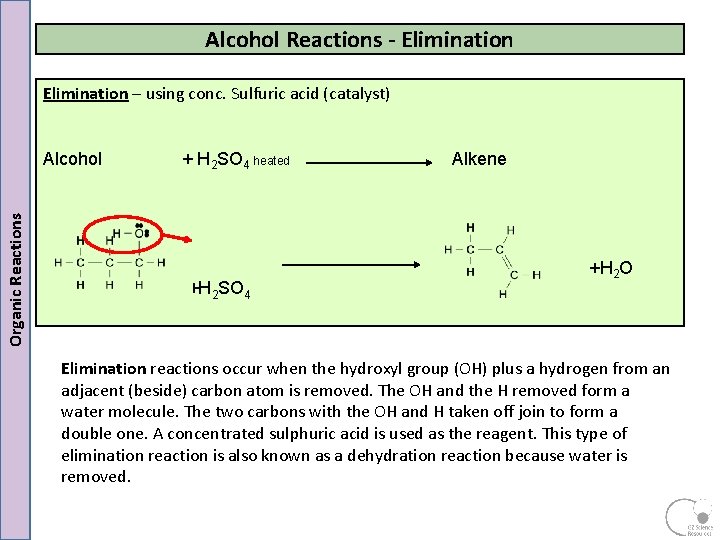
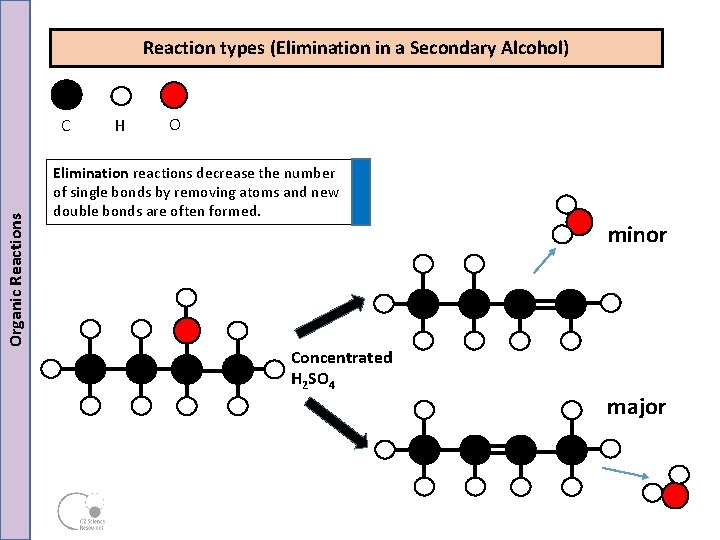
Alcohol Reactions - Elimination – using conc. Sulfuric acid (catalyst) Organic Reactions Alcohol + H 2 SO 4 heated Alkene +H 2 SO 4 +H 2 O Elimination reactions occur when the hydroxyl group (OH) plus a hydrogen from an adjacent (beside) carbon atom is removed. The OH and the H removed form a water molecule. The two carbons with the OH and H taken off join to form a double one. A concentrated sulphuric acid is used as the reagent. This type of elimination reaction is also known as a dehydration reaction because water is removed.
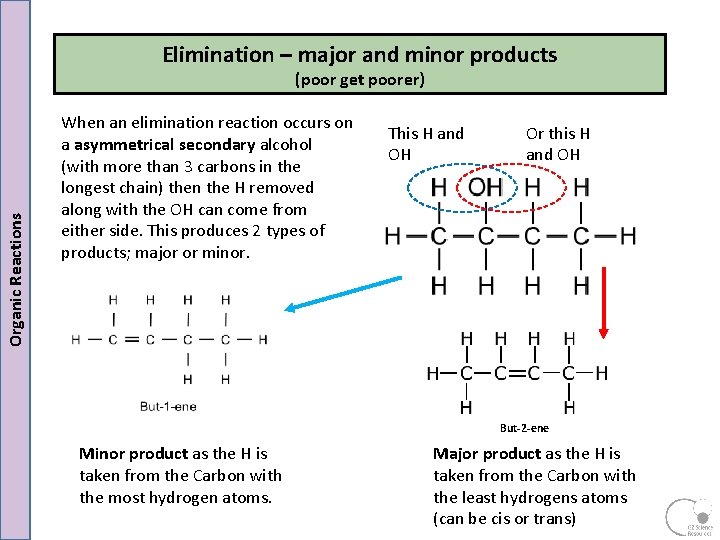
Elimination – major and minor products Organic Reactions (poor get poorer) When an elimination reaction occurs on a asymmetrical secondary alcohol (with more than 3 carbons in the longest chain) then the H removed along with the OH can come from either side. This produces 2 types of products; major or minor. This H and OH Or this H and OH But-2 -ene Minor product as the H is taken from the Carbon with the most hydrogen atoms. Major product as the H is taken from the Carbon with the least hydrogens atoms (can be cis or trans)
Reaction types (Elimination in a Secondary Alcohol) Organic Reactions C H O Elimination reactions decrease the number of single bonds by removing atoms and new double bonds are often formed. Concentrated H 2 SO 4 minor major
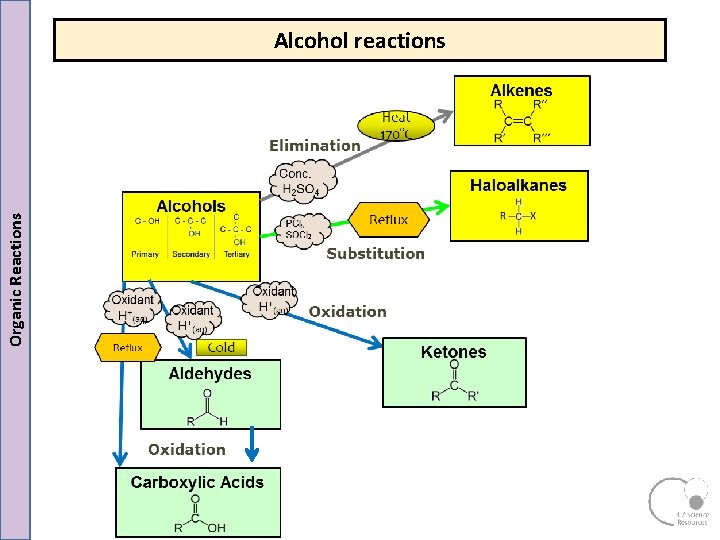
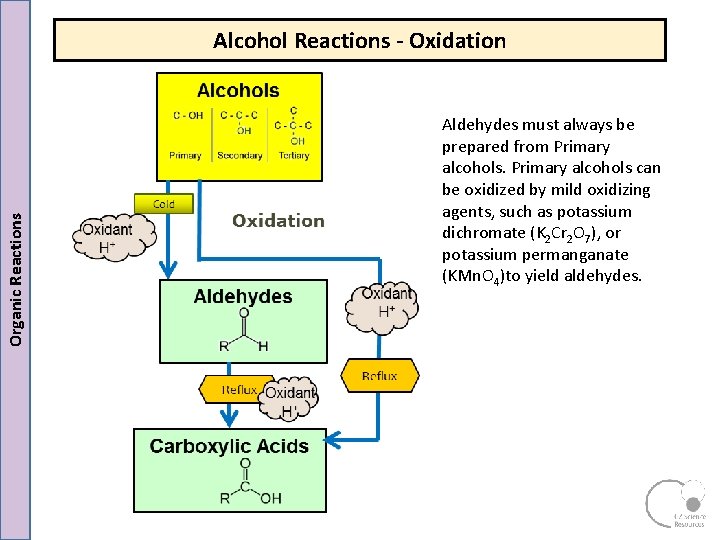
Organic Reactions Alcohol Reactions - Oxidation Aldehydes must always be prepared from Primary alcohols can be oxidized by mild oxidizing agents, such as potassium dichromate (K 2 Cr 2 O 7), or potassium permanganate (KMn. O 4)to yield aldehydes.
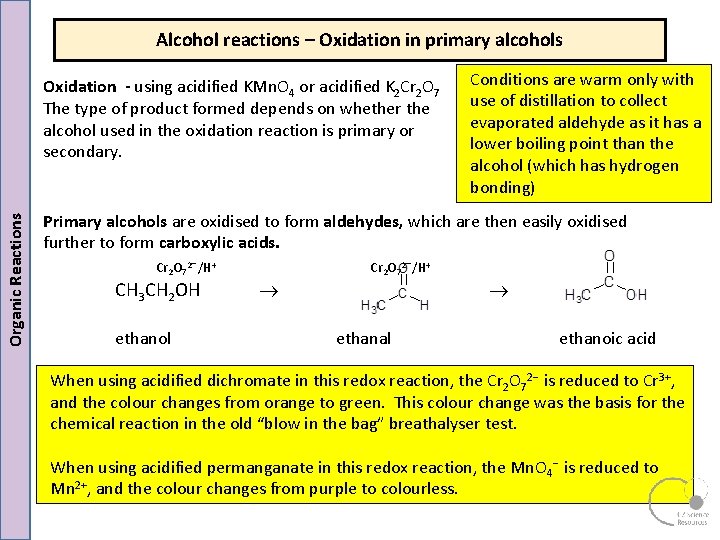
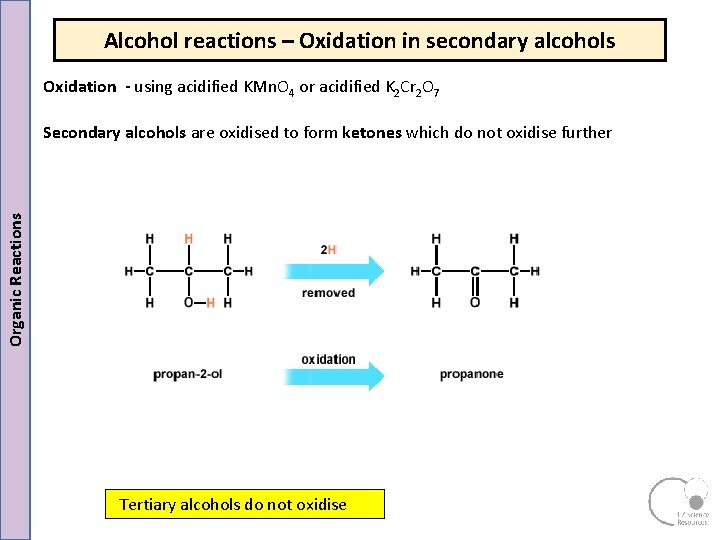
Alcohol reactions – Oxidation in primary alcohols Organic Reactions Oxidation - using acidified KMn. O 4 or acidified K 2 Cr 2 O 7 The type of product formed depends on whether the alcohol used in the oxidation reaction is primary or secondary. Conditions are warm only with use of distillation to collect evaporated aldehyde as it has a lower boiling point than the alcohol (which has hydrogen bonding) Primary alcohols are oxidised to form aldehydes, which are then easily oxidised further to form carboxylic acids. Cr 2 O 72 /H+ Cr 2 O 72 /H+ CH 3 CH 2 OH ethanol ethanal ethanoic acid When using acidified dichromate in this redox reaction, the Cr 2 O 72 is reduced to Cr 3+, and the colour changes from orange to green. This colour change was the basis for the chemical reaction in the old “blow in the bag” breathalyser test. When using acidified permanganate in this redox reaction, the Mn. O 4 is reduced to Mn 2+, and the colour changes from purple to colourless.
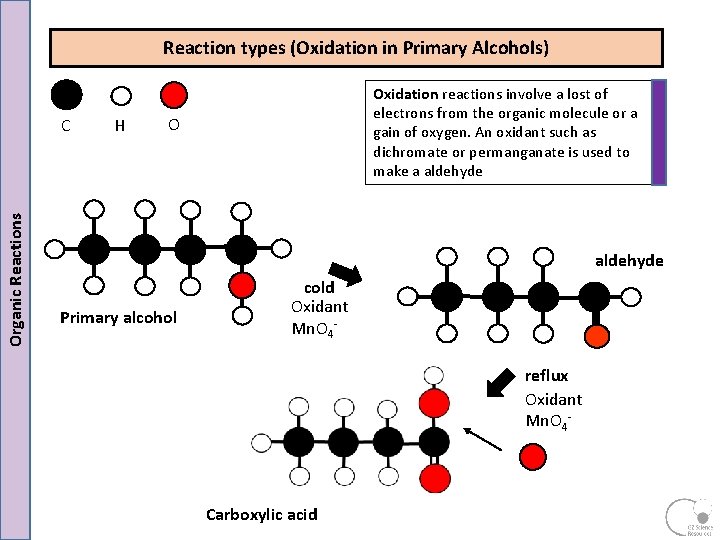
Reaction types (Oxidation in Primary Alcohols) Organic Reactions C H Oxidation reactions involve a lost of electrons from the organic molecule or a gain of oxygen. An oxidant such as dichromate or permanganate is used to make a aldehyde O aldehyde Primary alcohol cold Oxidant Mn. O 4 reflux Oxidant Mn. O 4 Carboxylic acid
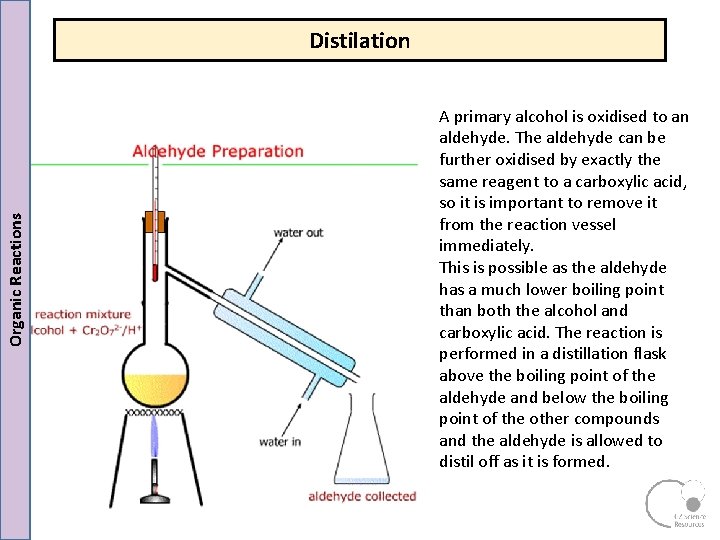
Organic Reactions Distilation A primary alcohol is oxidised to an aldehyde. The aldehyde can be further oxidised by exactly the same reagent to a carboxylic acid, so it is important to remove it from the reaction vessel immediately. This is possible as the aldehyde has a much lower boiling point than both the alcohol and carboxylic acid. The reaction is performed in a distillation flask above the boiling point of the aldehyde and below the boiling point of the other compounds and the aldehyde is allowed to distil off as it is formed.
Alcohol reactions – Oxidation in secondary alcohols Oxidation - using acidified KMn. O 4 or acidified K 2 Cr 2 O 7 Organic Reactions Secondary alcohols are oxidised to form ketones which do not oxidise further Tertiary alcohols do not oxidise
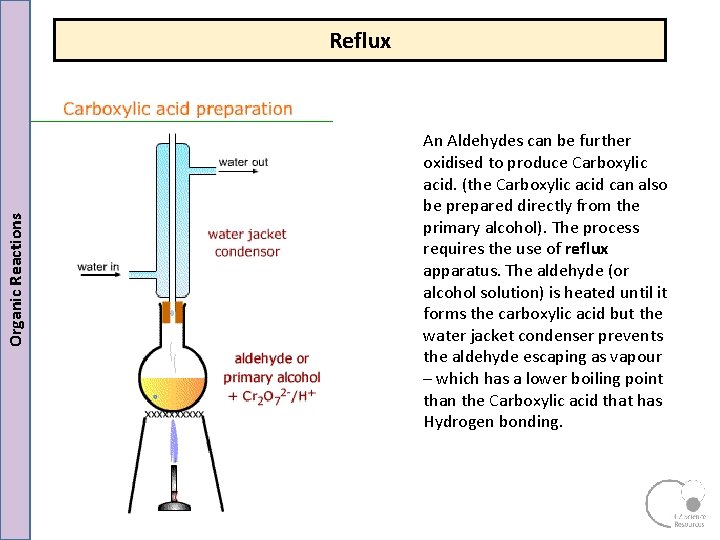
Organic Reactions Reflux An Aldehydes can be further oxidised to produce Carboxylic acid. (the Carboxylic acid can also be prepared directly from the primary alcohol). The process requires the use of reflux apparatus. The aldehyde (or alcohol solution) is heated until it forms the carboxylic acid but the water jacket condenser prevents the aldehyde escaping as vapour – which has a lower boiling point than the Carboxylic acid that has Hydrogen bonding.
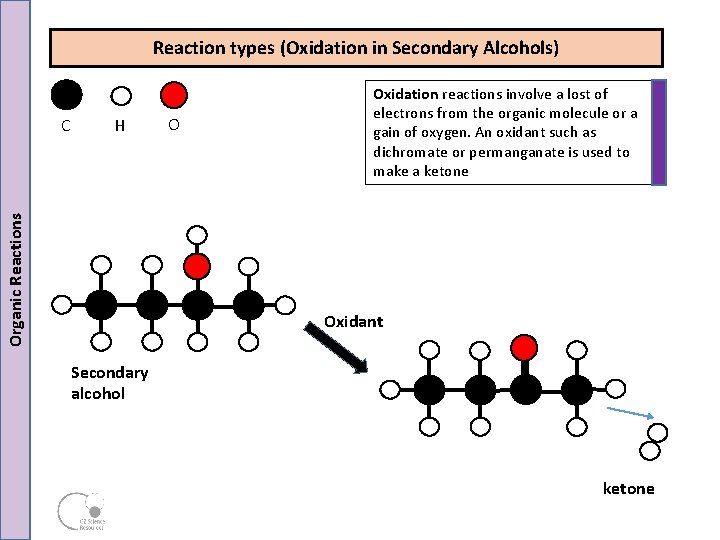
Reaction types (Oxidation in Secondary Alcohols) H Organic Reactions C O Oxidation reactions involve a lost of electrons from the organic molecule or a gain of oxygen. An oxidant such as dichromate or permanganate is used to make a ketone Oxidant Secondary alcohol ketone
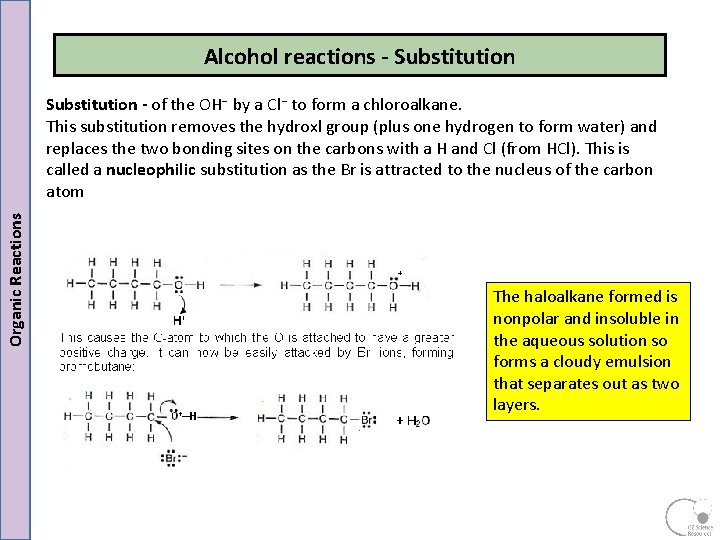
Alcohol reactions - Substitution Organic Reactions Substitution - of the OH by a Cl to form a chloroalkane. This substitution removes the hydroxl group (plus one hydrogen to form water) and replaces the two bonding sites on the carbons with a H and Cl (from HCl). This is called a nucleophilic substitution as the Br is attracted to the nucleus of the carbon atom The haloalkane formed is nonpolar and insoluble in the aqueous solution so forms a cloudy emulsion that separates out as two layers.
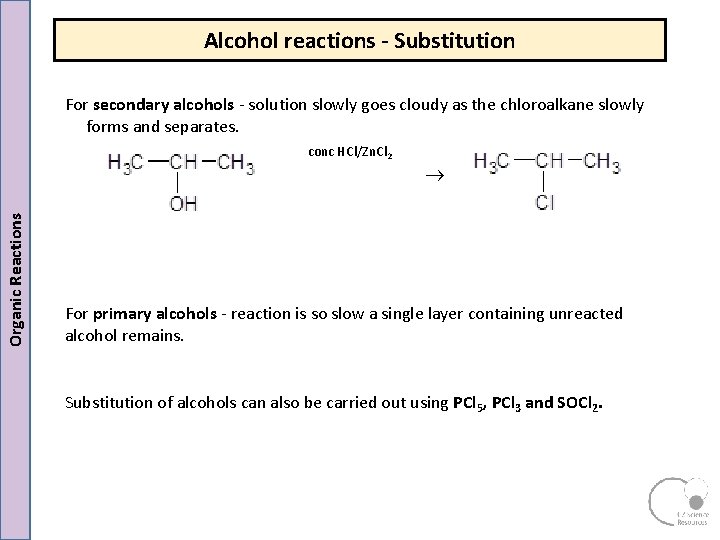
Alcohol reactions - Substitution Organic Reactions For secondary alcohols solution slowly goes cloudy as the chloroalkane slowly forms and separates. conc HCl/Zn. Cl 2 For primary alcohols reaction is so slow a single layer containing unreacted alcohol remains. Substitution of alcohols can also be carried out using PCl 5, PCl 3 and SOCl 2.
Lucas’ Reagent and substitution Organic Tests Lucas' reagent is a solution of zinc chloride in concentrated HCl, used to classify alcohols of low molecular weight. The reaction is a substitution in which the chlorine replaces the hydroxyl (OH) group. The reagent dissolves the alcohol, removing the OH group, forming a carbocation. The speed of this reaction is proportional to the energy required to form the carbocation, so tertiary alcohols react quickly, while smaller, less substituted, alcohols react more slowly. The cloudiness observed is caused by the carbocation immediately reacting with the chloride ion creating an insoluble chloroalkane. We can use these to identify whether an alcohol is primary, secondary or tertiary The time taken for turbidity to appear is a measure of the reactivity of the class of alcohol with Lucas reagent, and this is used to differentiate between the three classes of alcohols: * no visible reaction: primary alcohol * solution turns cloudy in 3 5 minutes: secondary alcohol * solution turns cloudy immediately: tertiary alcohol
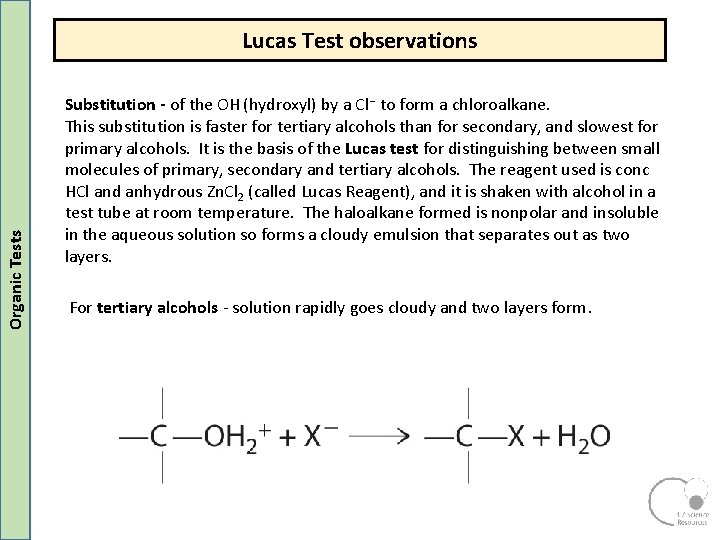
Organic Tests Lucas Test observations Substitution - of the OH (hydroxyl) by a Cl to form a chloroalkane. This substitution is faster for tertiary alcohols than for secondary, and slowest for primary alcohols. It is the basis of the Lucas test for distinguishing between small molecules of primary, secondary and tertiary alcohols. The reagent used is conc HCl and anhydrous Zn. Cl 2 (called Lucas Reagent), and it is shaken with alcohol in a test tube at room temperature. The haloalkane formed is nonpolar and insoluble in the aqueous solution so forms a cloudy emulsion that separates out as two layers. For tertiary alcohols solution rapidly goes cloudy and two layers form.
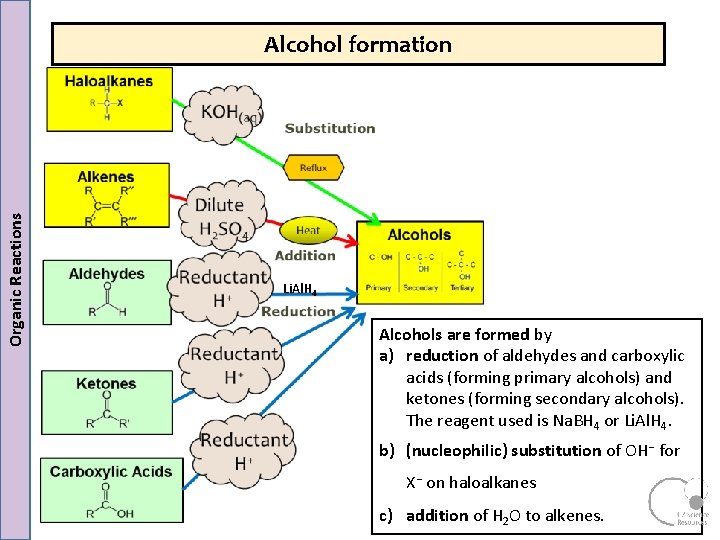
Organic Reactions Alcohol formation Li. Al. H 4 Alcohols are formed by a) reduction of aldehydes and carboxylic acids (forming primary alcohols) and ketones (forming secondary alcohols). The reagent used is Na. BH 4 or Li. Al. H 4. b) (nucleophilic) substitution of OH for X on haloalkanes c) addition of H 2 O to alkenes.
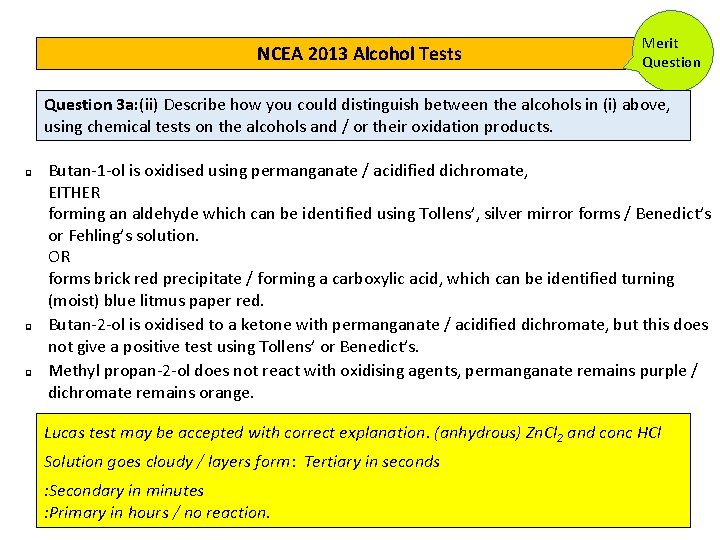
NCEA 2013 Alcohol Tests Merit Question 3 a: (ii) Describe how you could distinguish between the alcohols in (i) above, using chemical tests on the alcohols and / or their oxidation products. q q q Butan 1 ol is oxidised using permanganate / acidified dichromate, EITHER forming an aldehyde which can be identified using Tollens’, silver mirror forms / Benedict’s or Fehling’s solution. OR forms brick red precipitate / forming a carboxylic acid, which can be identified turning (moist) blue litmus paper red. Butan 2 ol is oxidised to a ketone with permanganate / acidified dichromate, but this does not give a positive test using Tollens’ or Benedict’s. Methyl propan 2 ol does not react with oxidising agents, permanganate remains purple / dichromate remains orange. Lucas test may be accepted with correct explanation. (anhydrous) Zn. Cl 2 and conc HCl Solution goes cloudy / layers form: Tertiary in seconds : Secondary in minutes : Primary in hours / no reaction.
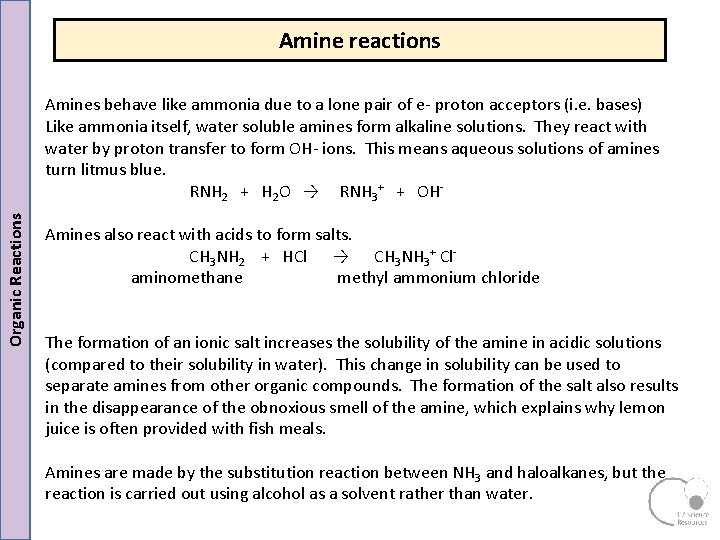
Amine reactions Organic Reactions Amines behave like ammonia due to a lone pair of e proton acceptors (i. e. bases) Like ammonia itself, water soluble amines form alkaline solutions. They react with water by proton transfer to form OH ions. This means aqueous solutions of amines turn litmus blue. RNH 2 + H 2 O → RNH 3+ + OH Amines also react with acids to form salts. CH 3 NH 2 + HCl → CH 3 NH 3+ Cl aminomethane methyl ammonium chloride The formation of an ionic salt increases the solubility of the amine in acidic solutions (compared to their solubility in water). This change in solubility can be used to separate amines from other organic compounds. The formation of the salt also results in the disappearance of the obnoxious smell of the amine, which explains why lemon juice is often provided with fish meals. Amines are made by the substitution reaction between NH 3 and haloalkanes, but the reaction is carried out using alcohol as a solvent rather than water.
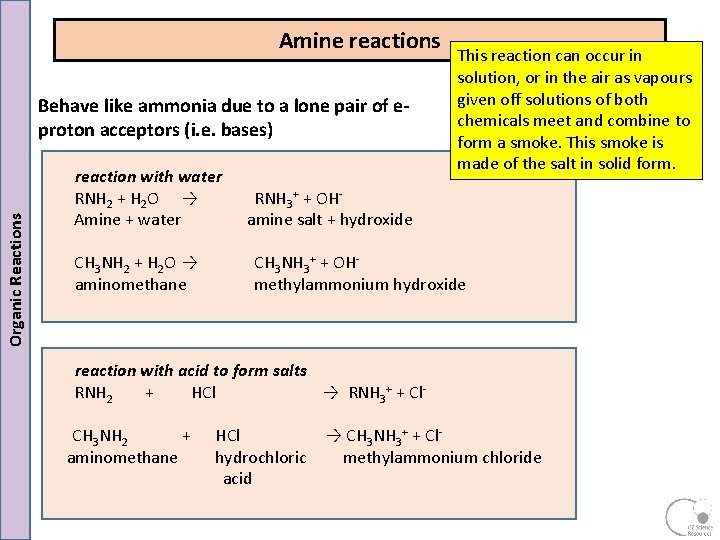
Amine reactions Organic Reactions Behave like ammonia due to a lone pair of e- proton acceptors (i. e. bases) This reaction can occur in solution, or in the air as vapours given off solutions of both chemicals meet and combine to form a smoke. This smoke is made of the salt in solid form. reaction with water RNH 2 + H 2 O → RNH 3+ + OH Amine + water amine salt + hydroxide CH 3 NH 2 + H 2 O → CH 3 NH 3+ + OH aminomethane methylammonium hydroxide reaction with acid to form salts RNH 2 + HCl → RNH 3+ + Cl CH 3 NH 2 + HCl → CH 3 NH 3+ + Cl aminomethane hydrochloric methylammonium chloride acid
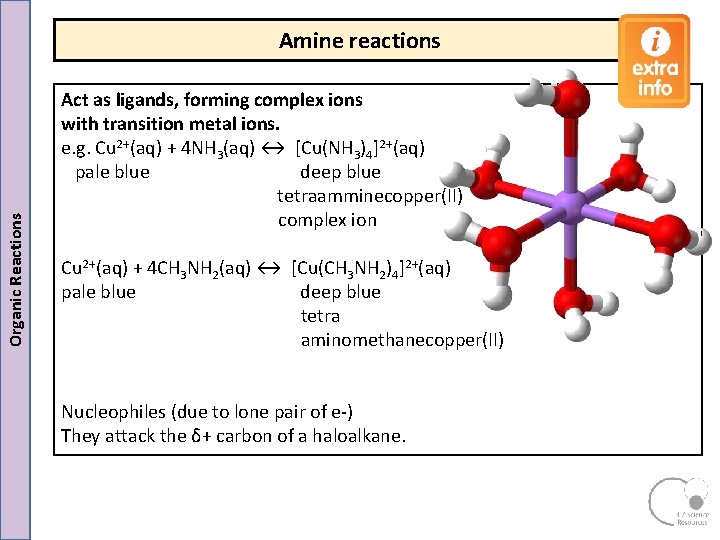
Organic Reactions Amine reactions Act as ligands, forming complex ions with transition metal ions. e. g. Cu 2+(aq) + 4 NH 3(aq) ↔ [Cu(NH 3)4]2+(aq) pale blue deep blue tetraamminecopper(II) complex ion Cu 2+(aq) + 4 CH 3 NH 2(aq) ↔ [Cu(CH 3 NH 2)4]2+(aq) pale blue deep blue tetra aminomethanecopper(II) Nucleophiles (due to lone pair of e ) They attack the δ+ carbon of a haloalkane.
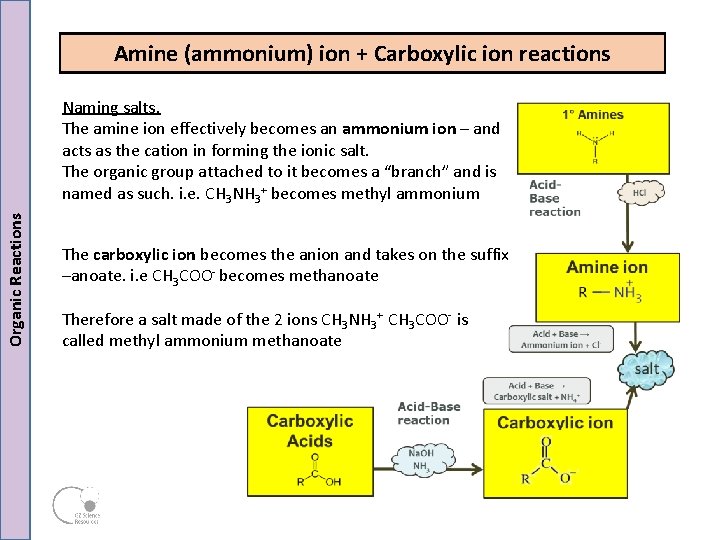
Amine (ammonium) ion + Carboxylic ion reactions Organic Reactions Naming salts. The amine ion effectively becomes an ammonium ion – and acts as the cation in forming the ionic salt. The organic group attached to it becomes a “branch” and is named as such. i. e. CH 3 NH 3+ becomes methyl ammonium The carboxylic ion becomes the anion and takes on the suffix –anoate. i. e CH 3 COO becomes methanoate Therefore a salt made of the 2 ions CH 3 NH 3+ CH 3 COO is called methyl ammonium methanoate
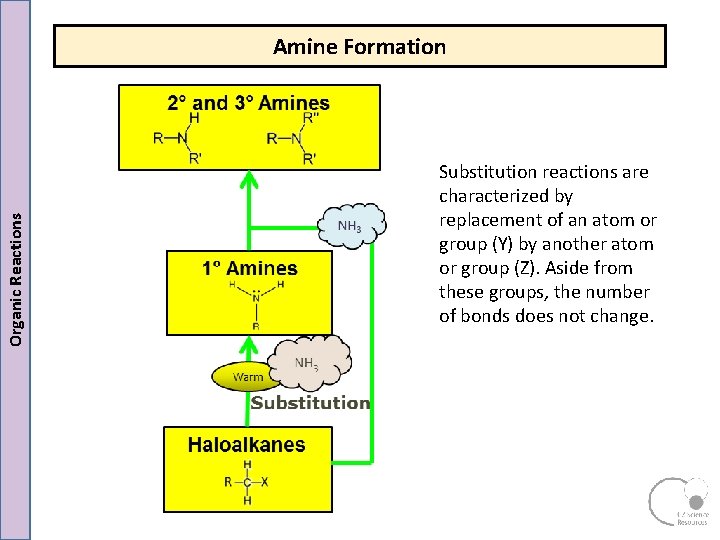
Organic Reactions Amine Formation Substitution reactions are characterized by replacement of an atom or group (Y) by another atom or group (Z). Aside from these groups, the number of bonds does not change.
2 Organic Reactions
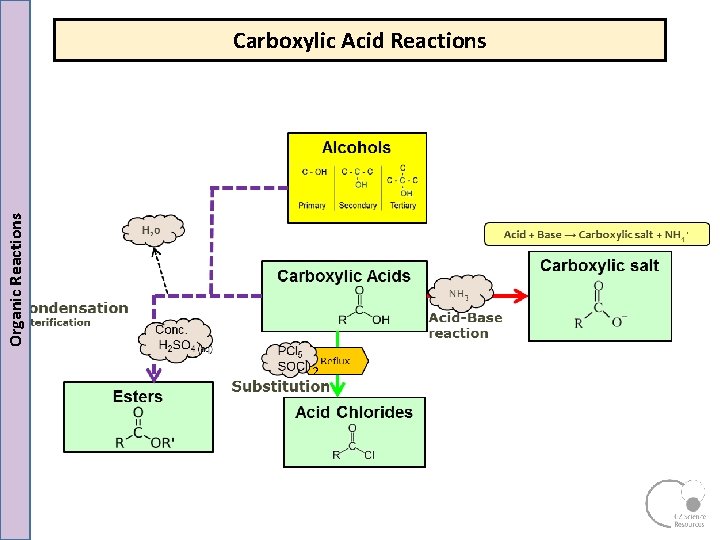
Organic Reactions Carboxylic Acid Reactions 2
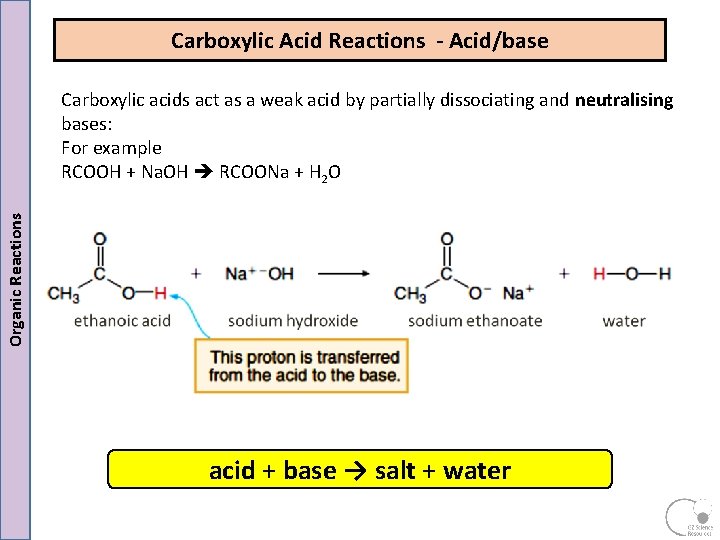
Carboxylic Acid Reactions - Acid/base Organic Reactions Carboxylic acids act as a weak acid by partially dissociating and neutralising bases: For example RCOOH + Na. OH RCOONa + H 2 O acid + base → salt + water
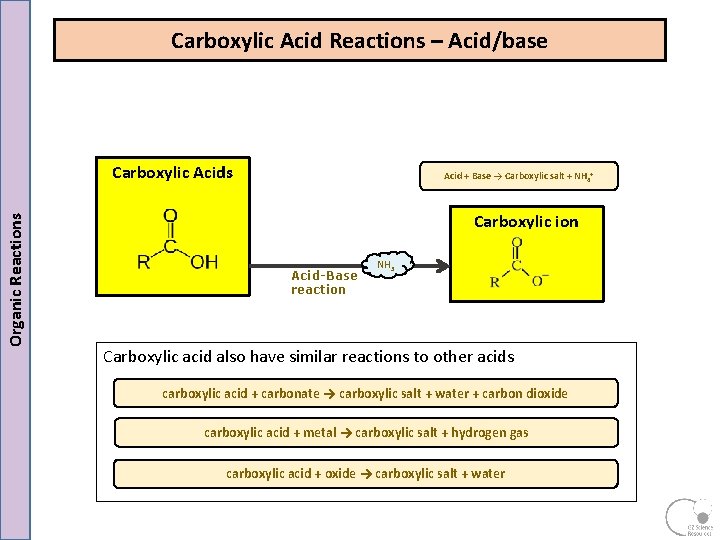
Carboxylic Acid Reactions – Acid/base Organic Reactions Carboxylic Acids Acid + Base → Carboxylic salt + NH 4+ Carboxylic ion Acid-Base reaction NH 3 Carboxylic acid also have similar reactions to other acids carboxylic acid + carbonate → carboxylic salt + water + carbon dioxide carboxylic acid + metal → carboxylic salt + hydrogen gas carboxylic acid + oxide → carboxylic salt + water
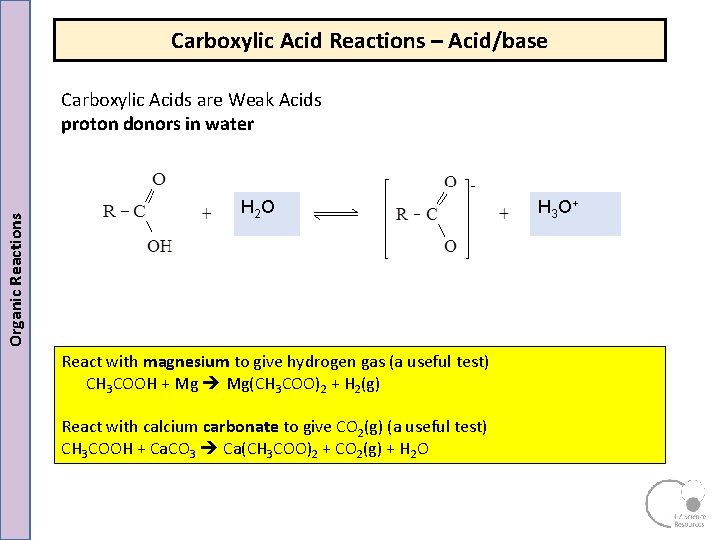
Carboxylic Acid Reactions – Acid/base Organic Reactions Carboxylic Acids are Weak Acids proton donors in water H 2 O React with magnesium to give hydrogen gas (a useful test) CH 3 COOH + Mg Mg(CH 3 COO)2 + H 2(g) React with calcium carbonate to give CO 2(g) (a useful test) CH 3 COOH + Ca. CO 3 Ca(CH 3 COO)2 + CO 2(g) + H 2 O H 3 O +
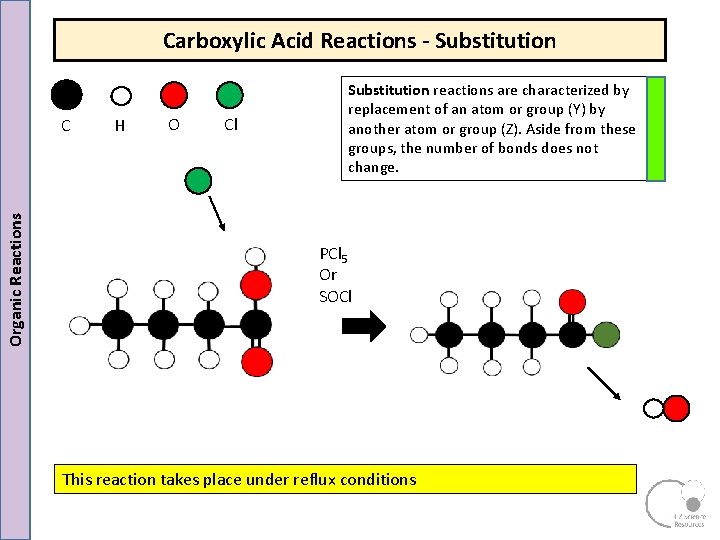
Carboxylic Acid Reactions - Substitution Organic Reactions C H O Cl Substitution reactions are characterized by replacement of an atom or group (Y) by another atom or group (Z). Aside from these groups, the number of bonds does not change. PCl 5 Or SOCl This reaction takes place under reflux conditions
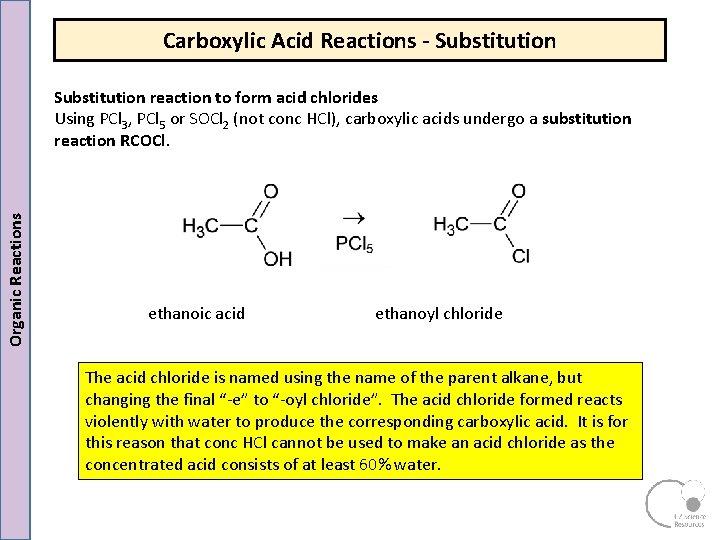
Carboxylic Acid Reactions - Substitution Organic Reactions Substitution reaction to form acid chlorides Using PCl 3, PCl 5 or SOCl 2 (not conc HCl), carboxylic acids undergo a substitution reaction RCOCl. ethanoic acid ethanoyl chloride The acid chloride is named using the name of the parent alkane, but changing the final “ e” to “ oyl chloride”. The acid chloride formed reacts violently with water to produce the corresponding carboxylic acid. It is for this reason that conc HCl cannot be used to make an acid chloride as the concentrated acid consists of at least 60% water.
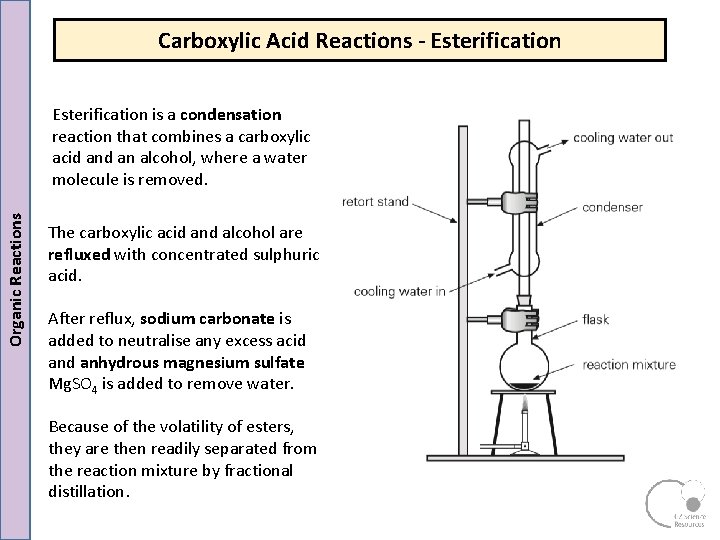
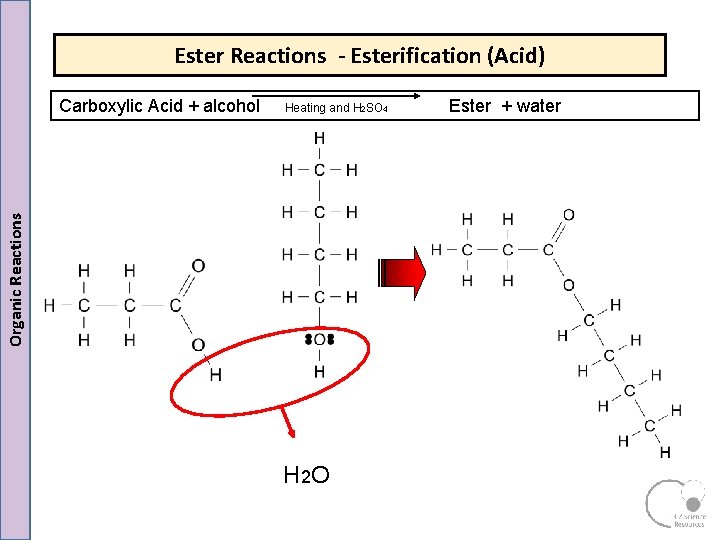
Carboxylic Acid Reactions - Esterification Organic Reactions Esterification is a condensation reaction that combines a carboxylic acid an alcohol, where a water molecule is removed. The carboxylic acid and alcohol are refluxed with concentrated sulphuric acid. After reflux, sodium carbonate is added to neutralise any excess acid anhydrous magnesium sulfate Mg. SO 4 is added to remove water. Because of the volatility of esters, they are then readily separated from the reaction mixture by fractional distillation.
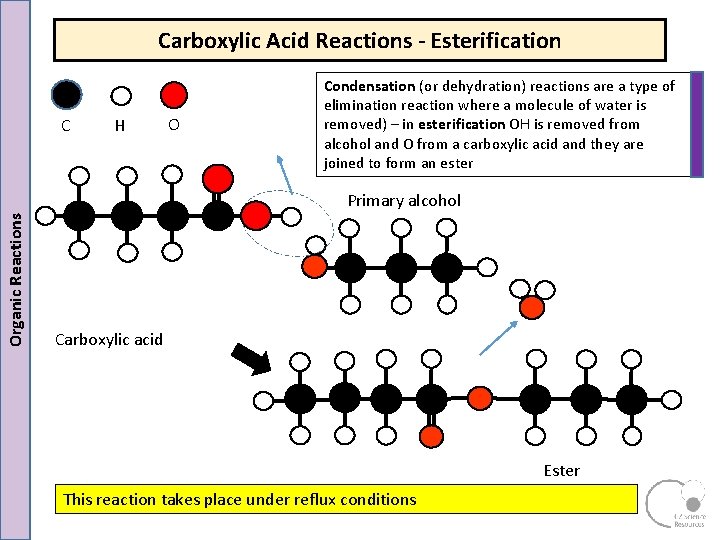
Carboxylic Acid Reactions - Esterification C H O Condensation (or dehydration) reactions are a type of elimination reaction where a molecule of water is removed) – in esterification OH is removed from alcohol and O from a carboxylic acid and they are joined to form an ester Organic Reactions Primary alcohol Carboxylic acid Ester This reaction takes place under reflux conditions
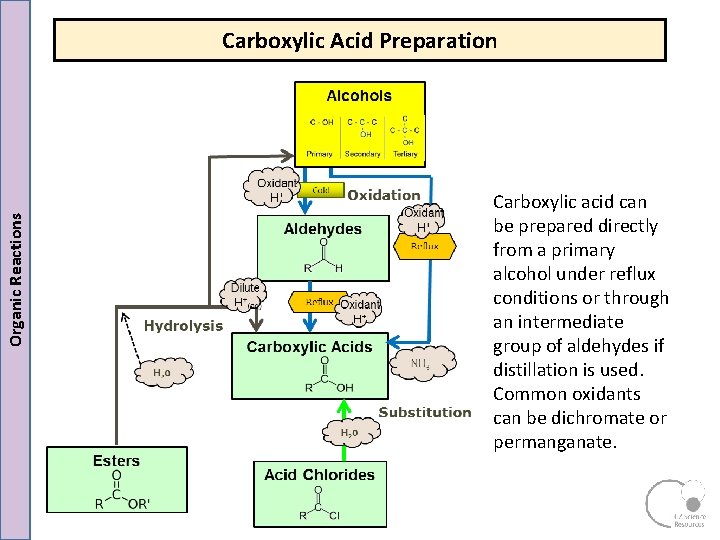
Organic Reactions Carboxylic Acid Preparation Carboxylic acid can be prepared directly from a primary alcohol under reflux conditions or through an intermediate group of aldehydes if distillation is used. Common oxidants can be dichromate or permanganate.
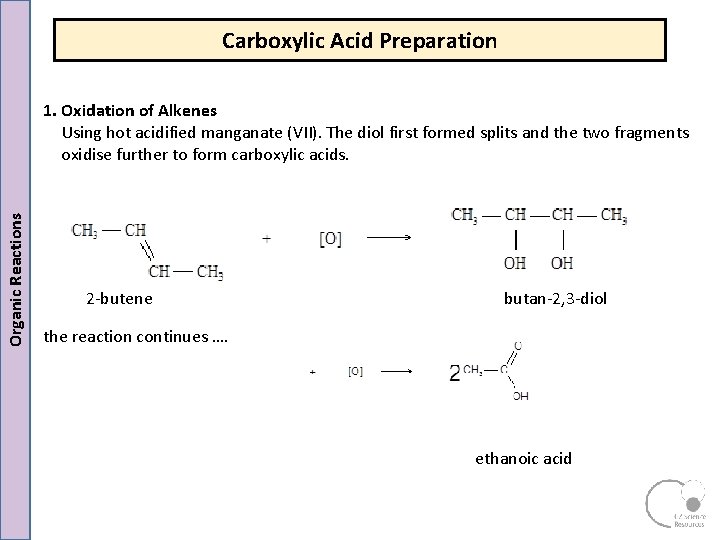
Carboxylic Acid Preparation Organic Reactions 1. Oxidation of Alkenes Using hot acidified manganate (VII). The diol first formed splits and the two fragments oxidise further to form carboxylic acids. 2 butene butan 2, 3 diol the reaction continues …. ethanoic acid
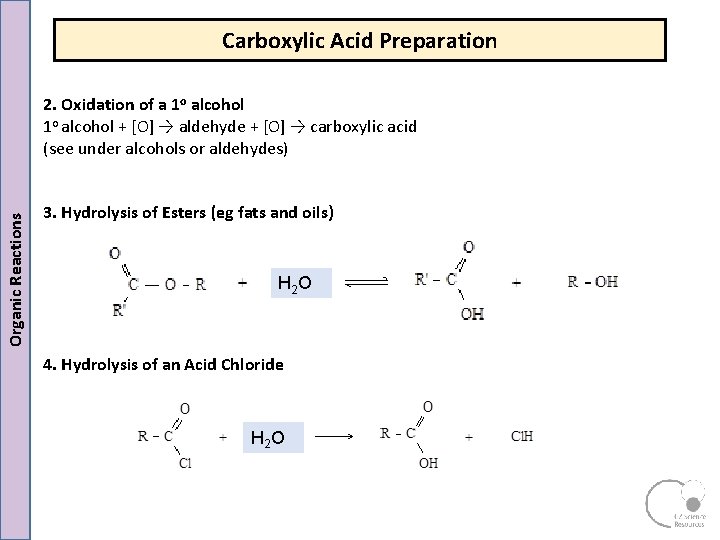
Carboxylic Acid Preparation Organic Reactions 2. Oxidation of a 1 o alcohol + [O] → aldehyde + [O] → carboxylic acid (see under alcohols or aldehydes) 3. Hydrolysis of Esters (eg fats and oils) H 2 O 4. Hydrolysis of an Acid Chloride H 2 O
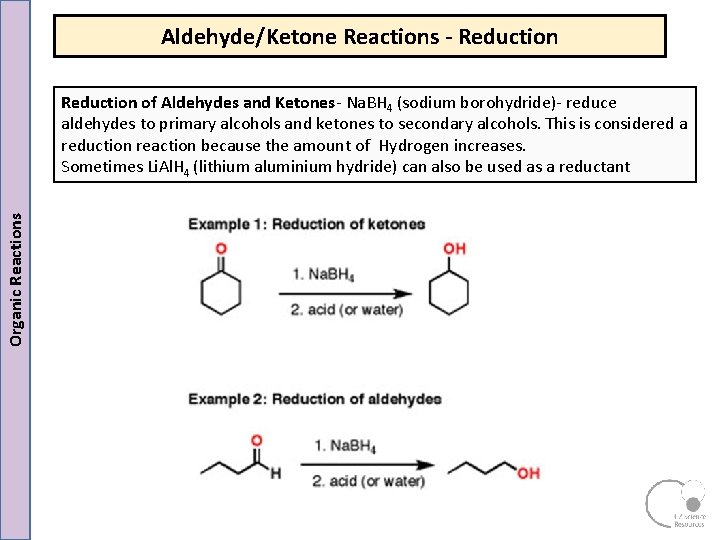
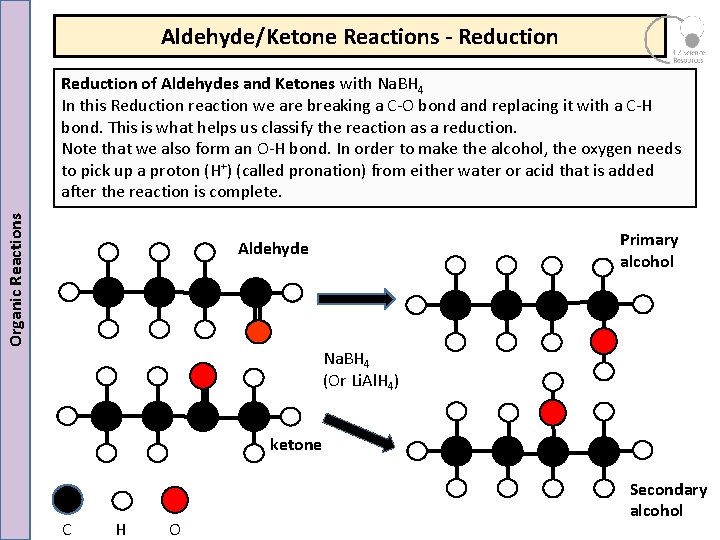
Aldehyde/Ketone Reactions - Reduction Organic Reactions Reduction of Aldehydes and Ketones Na. BH 4 (sodium borohydride) reduce aldehydes to primary alcohols and ketones to secondary alcohols. This is considered a reduction reaction because the amount of Hydrogen increases. Sometimes Li. Al. H 4 (lithium aluminium hydride) can also be used as a reductant
Aldehyde/Ketone Reactions - Reduction Organic Reactions Reduction of Aldehydes and Ketones with Na. BH 4 In this Reduction reaction we are breaking a C O bond and replacing it with a C H bond. This is what helps us classify the reaction as a reduction. Note that we also form an O H bond. In order to make the alcohol, the oxygen needs to pick up a proton (H+) (called pronation) from either water or acid that is added after the reaction is complete. Primary alcohol Aldehyde Na. BH 4 (Or Li. Al. H 4) ketone C H O Secondary alcohol
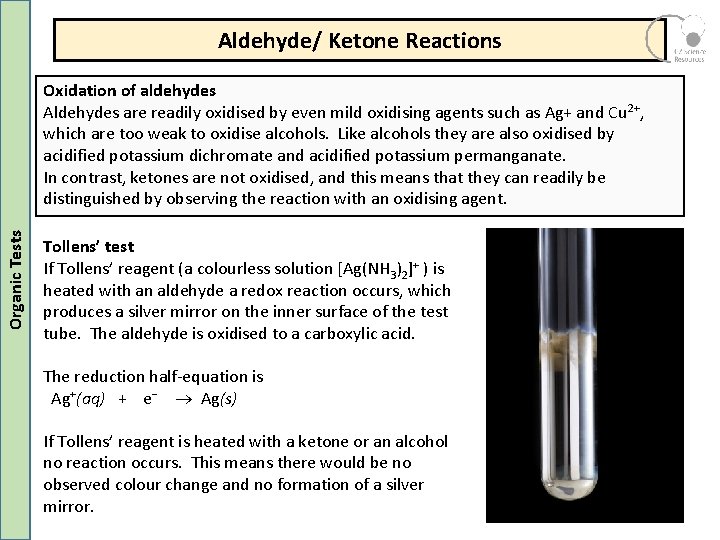
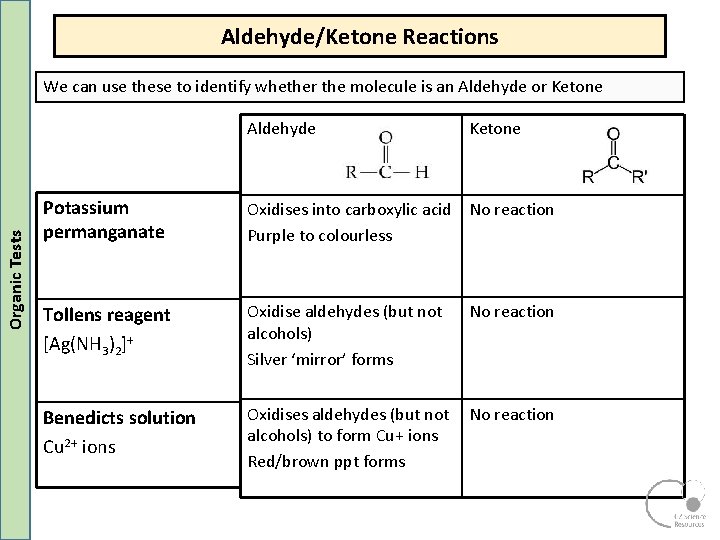
Aldehyde/ Ketone Reactions Organic Tests Oxidation of aldehydes Aldehydes are readily oxidised by even mild oxidising agents such as Ag+ and Cu 2+, which are too weak to oxidise alcohols. Like alcohols they are also oxidised by acidified potassium dichromate and acidified potassium permanganate. In contrast, ketones are not oxidised, and this means that they can readily be distinguished by observing the reaction with an oxidising agent. Tollens’ test If Tollens’ reagent (a colourless solution [Ag(NH 3)2]+ ) is heated with an aldehyde a redox reaction occurs, which produces a silver mirror on the inner surface of the test tube. The aldehyde is oxidised to a carboxylic acid. The reduction half equation is Ag+(aq) + e Ag(s) If Tollens’ reagent is heated with a ketone or an alcohol no reaction occurs. This means there would be no observed colour change and no formation of a silver mirror.
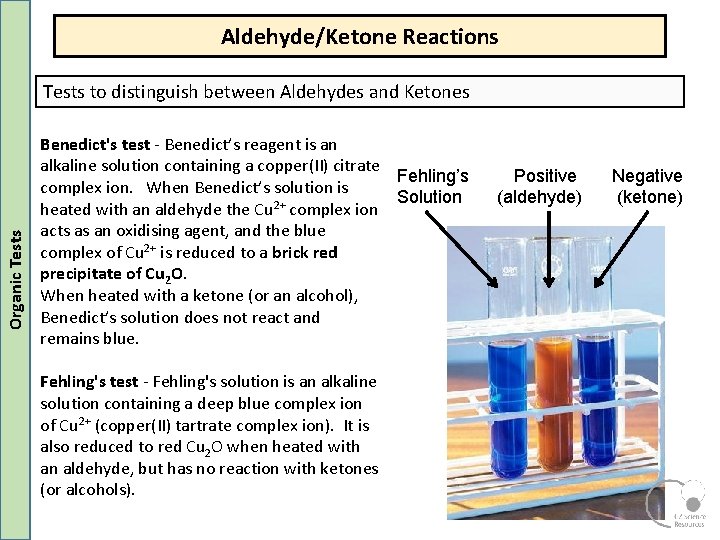
Aldehyde/Ketone Reactions Organic Tests to distinguish between Aldehydes and Ketones Benedict's test Benedict’s reagent is an alkaline solution containing a copper(II) citrate Fehling’s Positive Negative complex ion. When Benedict’s solution is Solution (aldehyde) (ketone) heated with an aldehyde the Cu 2+ complex ion acts as an oxidising agent, and the blue complex of Cu 2+ is reduced to a brick red precipitate of Cu 2 O. When heated with a ketone (or an alcohol), Benedict’s solution does not react and remains blue. Fehling's test Fehling's solution is an alkaline solution containing a deep blue complex ion of Cu 2+ (copper(II) tartrate complex ion). It is also reduced to red Cu 2 O when heated with an aldehyde, but has no reaction with ketones (or alcohols).
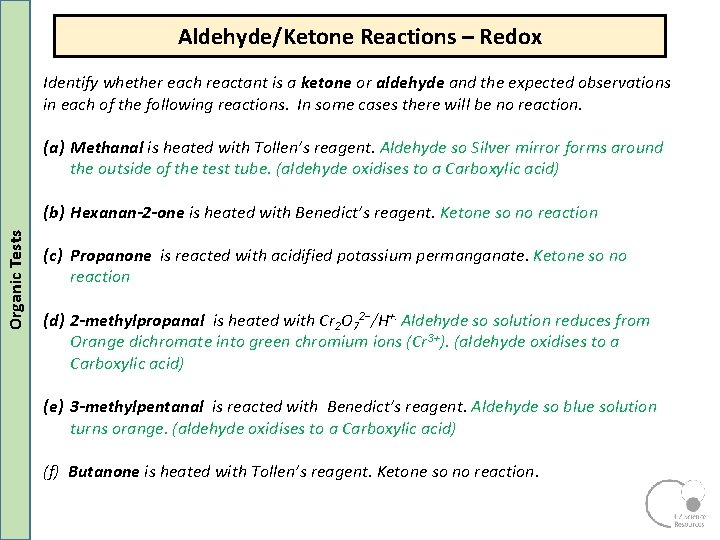
Aldehyde/Ketone Reactions – Redox Identify whether each reactant is a ketone or aldehyde and the expected observations in each of the following reactions. In some cases there will be no reaction. (a) Methanal is heated with Tollen’s reagent. Aldehyde so Silver mirror forms around the outside of the test tube. (aldehyde oxidises to a Carboxylic acid) Organic Tests (b) Hexanan-2 -one is heated with Benedict’s reagent. Ketone so no reaction (c) Propanone is reacted with acidified potassium permanganate. Ketone so no reaction (d) 2 -methylpropanal is heated with Cr 2 O 72 /H+. Aldehyde so solution reduces from Orange dichromate into green chromium ions (Cr 3+). (aldehyde oxidises to a Carboxylic acid) (e) 3 -methylpentanal is reacted with Benedict’s reagent. Aldehyde so blue solution turns orange. (aldehyde oxidises to a Carboxylic acid) (f) Butanone is heated with Tollen’s reagent. Ketone so no reaction.
Aldehyde/Ketone Reactions We can use these to identify whether the molecule is an Aldehyde or Ketone Organic Tests Aldehyde Ketone Potassium permanganate Oxidises into carboxylic acid No reaction Purple to colourless Tollens reagent [Ag(NH 3)2]+ Oxidise aldehydes (but not alcohols) Silver ‘mirror’ forms Benedicts solution Cu 2+ ions Oxidises aldehydes (but not No reaction alcohols) to form Cu+ ions Red/brown ppt forms No reaction
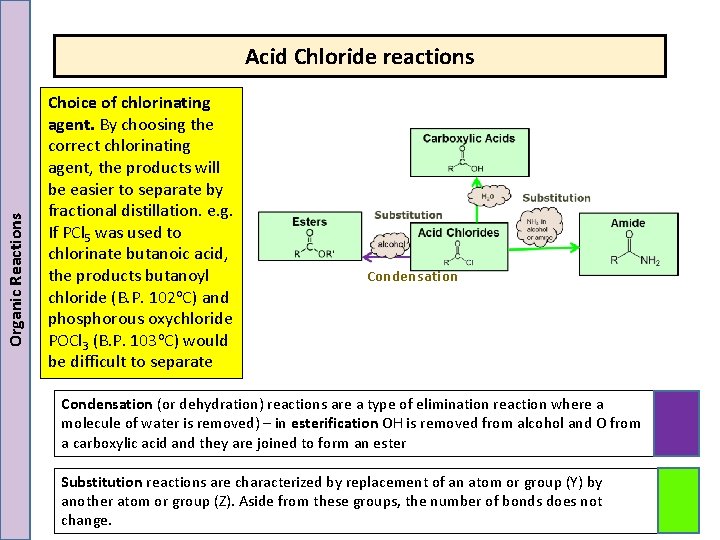
Organic Reactions Acid Chloride reactions Choice of chlorinating agent. By choosing the correct chlorinating agent, the products will be easier to separate by fractional distillation. e. g. If PCl 5 was used to chlorinate butanoic acid, the products butanoyl chloride (B. P. 102 o. C) and phosphorous oxychloride POCl 3 (B. P. 103 o. C) would be difficult to separate Condensation (or dehydration) reactions are a type of elimination reaction where a molecule of water is removed) – in esterification OH is removed from alcohol and O from a carboxylic acid and they are joined to form an ester Substitution reactions are characterized by replacement of an atom or group (Y) by another atom or group (Z). Aside from these groups, the number of bonds does not change.
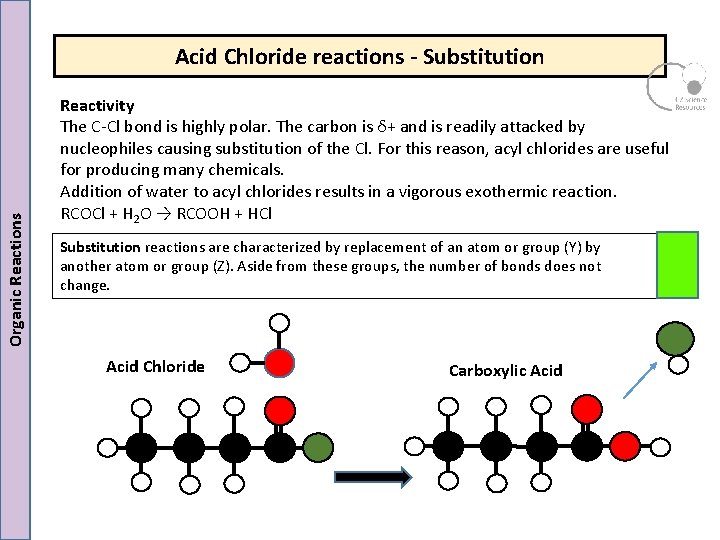
Organic Reactions Acid Chloride reactions - Substitution Reactivity The C Cl bond is highly polar. The carbon is δ+ and is readily attacked by nucleophiles causing substitution of the Cl. For this reason, acyl chlorides are useful for producing many chemicals. Addition of water to acyl chlorides results in a vigorous exothermic reaction. RCOCl + H 2 O → RCOOH + HCl Substitution reactions are characterized by replacement of an atom or group (Y) by another atom or group (Z). Aside from these groups, the number of bonds does not change. Acid Chloride Carboxylic Acid
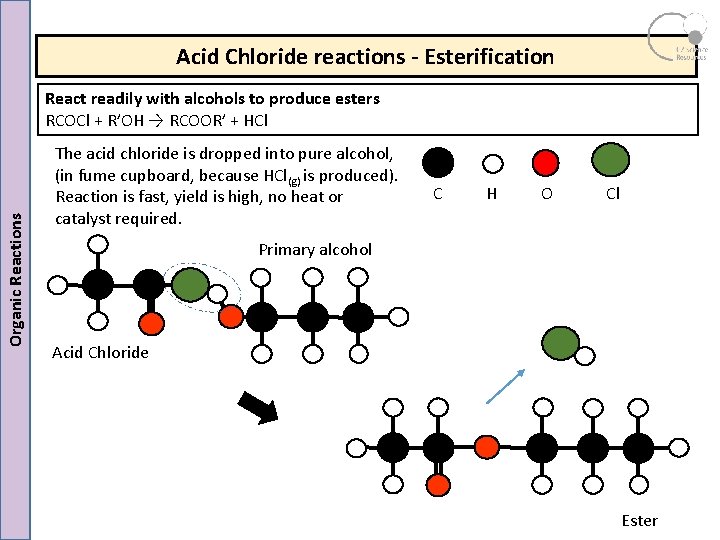
Acid Chloride reactions - Esterification Organic Reactions React readily with alcohols to produce esters RCOCl + R’OH → RCOOR’ + HCl The acid chloride is dropped into pure alcohol, (in fume cupboard, because HCl(g) is produced). Reaction is fast, yield is high, no heat or catalyst required. C H O Cl Primary alcohol Acid Chloride Ester
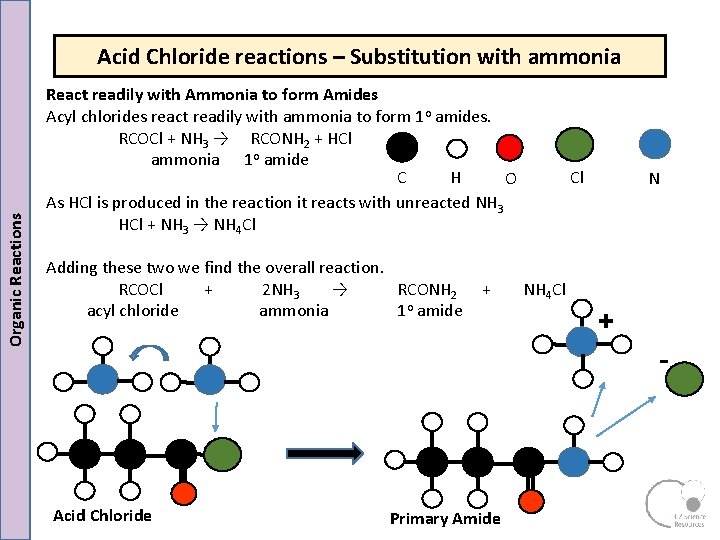
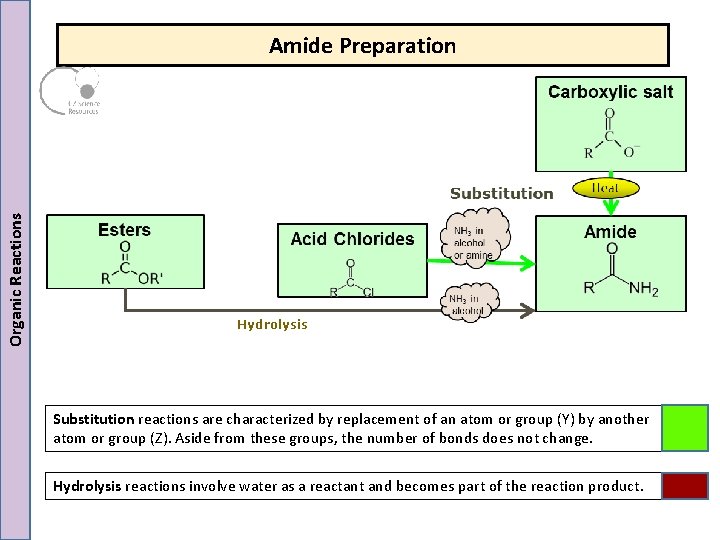
Organic Reactions Acid Chloride reactions – Substitution with ammonia React readily with Ammonia to form Amides Acyl chlorides react readily with ammonia to form 1 o amides. RCOCl + NH 3 → RCONH 2 + HCl ammonia 1 o amide C H Cl O As HCl is produced in the reaction it reacts with unreacted NH 3 HCl + NH 3 → NH 4 Cl Adding these two we find the overall reaction. RCOCl + 2 NH 3 → RCONH 2 + NH 4 Cl acyl chloride ammonia 1 o amide Acid Chloride Primary Amide N + -
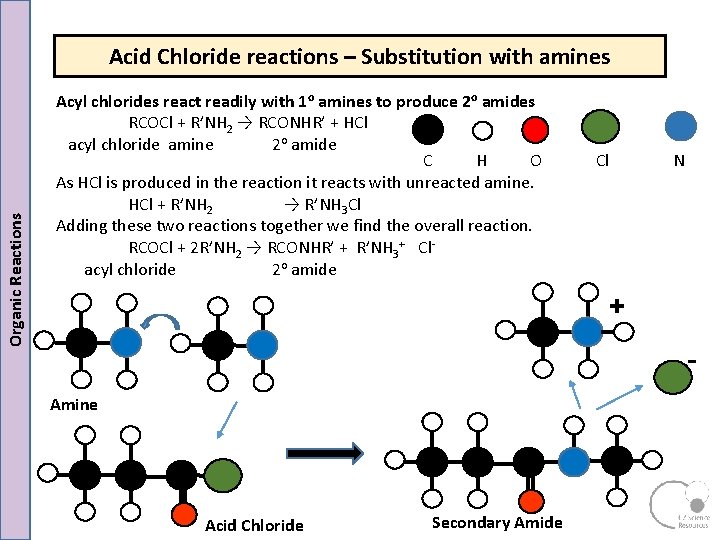
Organic Reactions Acid Chloride reactions – Substitution with amines Acyl chlorides react readily with 1 o amines to produce 2 o amides RCOCl + R’NH 2 → RCONHR’ + HCl acyl chloride amine 2 o amide C H O As HCl is produced in the reaction it reacts with unreacted amine. HCl + R’NH 2 → R’NH 3 Cl Adding these two reactions together we find the overall reaction. RCOCl + 2 R’NH 2 → RCONHR’ + R’NH 3+ Cl acyl chloride 2 o amide Cl N + Amine Acid Chloride Secondary Amide
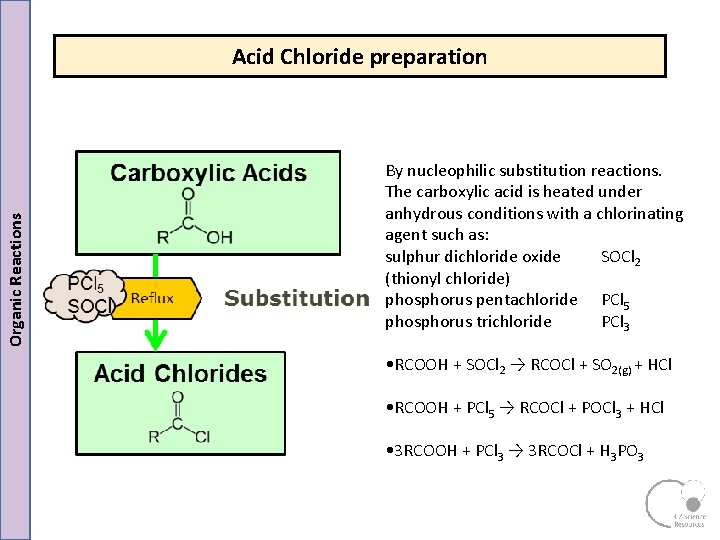
Organic Reactions Acid Chloride preparation By nucleophilic substitution reactions. The carboxylic acid is heated under anhydrous conditions with a chlorinating agent such as: sulphur dichloride oxide SOCl 2 (thionyl chloride) phosphorus pentachloride PCl 5 phosphorus trichloride PCl 3 • RCOOH + SOCl 2 → RCOCl + SO 2(g) + HCl • RCOOH + PCl 5 → RCOCl + POCl 3 + HCl • 3 RCOOH + PCl 3 → 3 RCOCl + H 3 PO 3
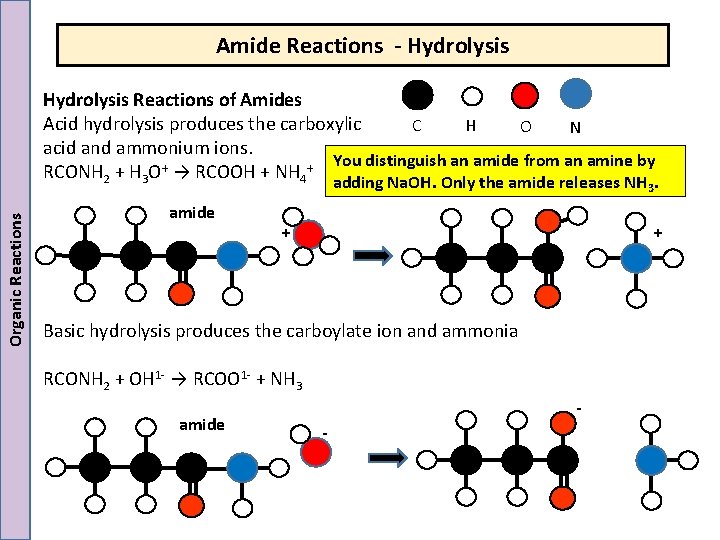
Amide Reactions - Hydrolysis Reactions of Amides Acid hydrolysis produces the carboxylic C H O N acid and ammonium ions. You distinguish an amide from an amine by RCONH 2 + H 3 O+ → RCOOH + NH 4+ adding Na. OH. Only the amide releases NH. Organic Reactions 3 amide + + Basic hydrolysis produces the carboylate ion and ammonia RCONH 2 + OH 1 → RCOO 1 + NH 3 amide -
Organic Reactions Amide Preparation Hydrolysis Substitution reactions are characterized by replacement of an atom or group (Y) by another atom or group (Z). Aside from these groups, the number of bonds does not change. Hydrolysis reactions involve water as a reactant and becomes part of the reaction product.
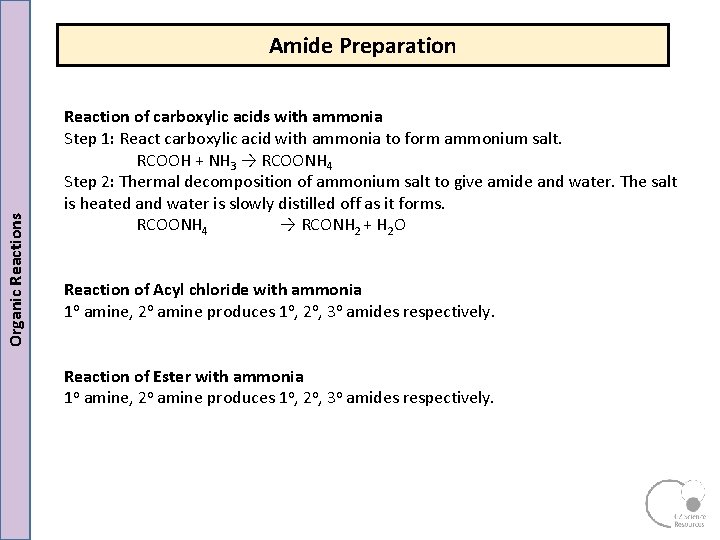
Organic Reactions Amide Preparation Reaction of carboxylic acids with ammonia Step 1: React carboxylic acid with ammonia to form ammonium salt. RCOOH + NH 3 → RCOONH 4 Step 2: Thermal decomposition of ammonium salt to give amide and water. The salt is heated and water is slowly distilled off as it forms. RCOONH 4 → RCONH 2 + H 2 O Reaction of Acyl chloride with ammonia 1 o amine, 2 o amine produces 1 o, 2 o, 3 o amides respectively. Reaction of Ester with ammonia 1 o amine, 2 o amine produces 1 o, 2 o, 3 o amides respectively.
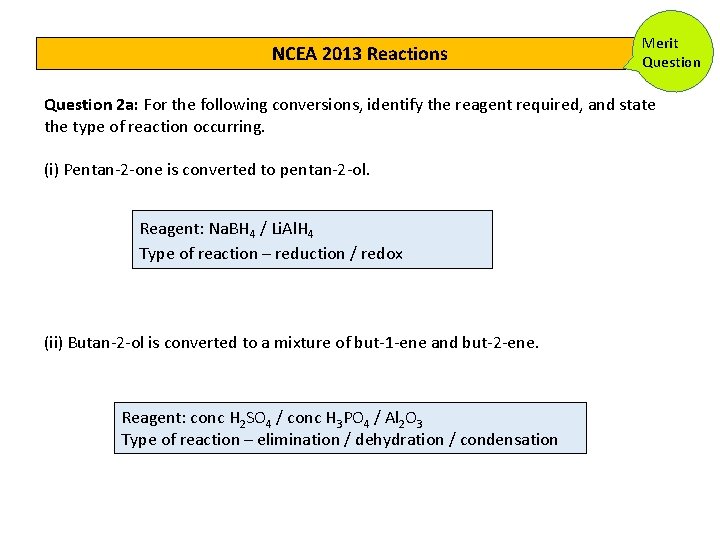
NCEA 2013 Reactions Merit Question 2 a: For the following conversions, identify the reagent required, and state the type of reaction occurring. (i) Pentan 2 one is converted to pentan 2 ol. Reagent: Na. BH 4 / Li. Al. H 4 Type of reaction – reduction / redox (ii) Butan 2 ol is converted to a mixture of but 1 ene and but 2 ene. Reagent: conc H 2 SO 4 / conc H 3 PO 4 / Al 2 O 3 Type of reaction – elimination / dehydration / condensation
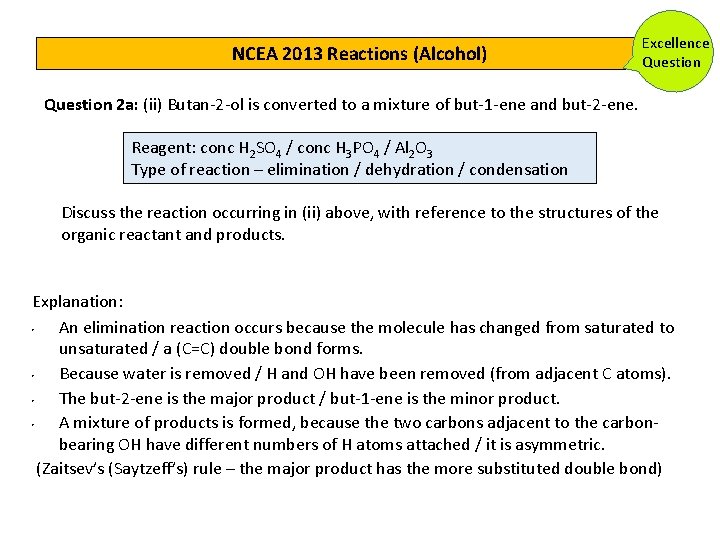
NCEA 2013 Reactions (Alcohol) Excellence Question 2 a: (ii) Butan 2 ol is converted to a mixture of but 1 ene and but 2 ene. Reagent: conc H 2 SO 4 / conc H 3 PO 4 / Al 2 O 3 Type of reaction – elimination / dehydration / condensation Discuss the reaction occurring in (ii) above, with reference to the structures of the organic reactant and products. Explanation: • An elimination reaction occurs because the molecule has changed from saturated to unsaturated / a (C=C) double bond forms. • Because water is removed / H and OH have been removed (from adjacent C atoms). • The but 2 ene is the major product / but 1 ene is the minor product. • A mixture of products is formed, because the two carbons adjacent to the carbon bearing OH have different numbers of H atoms attached / it is asymmetric. (Zaitsev’s (Saytzeff’s) rule – the major product has the more substituted double bond)
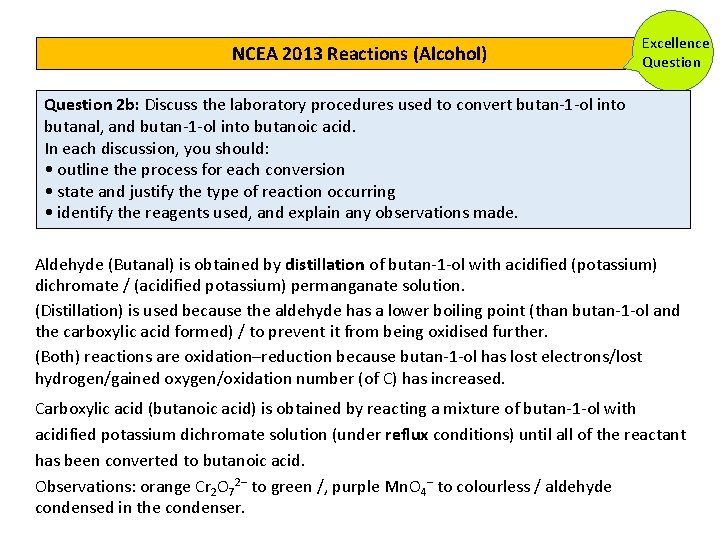
NCEA 2013 Reactions (Alcohol) Excellence Question 2 b: Discuss the laboratory procedures used to convert butan 1 ol into butanal, and butan 1 ol into butanoic acid. In each discussion, you should: • outline the process for each conversion • state and justify the type of reaction occurring • identify the reagents used, and explain any observations made. Aldehyde (Butanal) is obtained by distillation of butan 1 ol with acidified (potassium) dichromate / (acidified potassium) permanganate solution. (Distillation) is used because the aldehyde has a lower boiling point (than butan 1 ol and the carboxylic acid formed) / to prevent it from being oxidised further. (Both) reactions are oxidation–reduction because butan 1 ol has lost electrons/lost hydrogen/gained oxygen/oxidation number (of C) has increased. Carboxylic acid (butanoic acid) is obtained by reacting a mixture of butan 1 ol with acidified potassium dichromate solution (under reflux conditions) until all of the reactant has been converted to butanoic acid. Observations: orange Cr 2 O 72– to green /, purple Mn. O 4– to colourless / aldehyde condensed in the condenser.
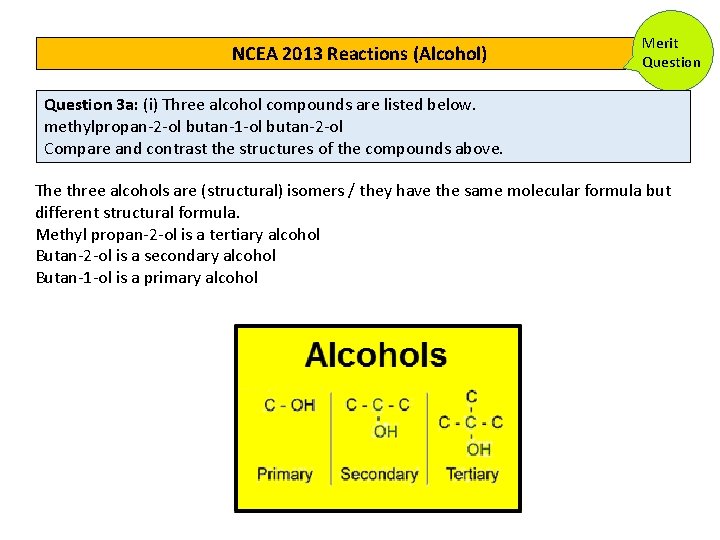
NCEA 2013 Reactions (Alcohol) Merit Question 3 a: (i) Three alcohol compounds are listed below. methylpropan 2 ol butan 1 ol butan 2 ol Compare and contrast the structures of the compounds above. The three alcohols are (structural) isomers / they have the same molecular formula but different structural formula. Methyl propan 2 ol is a tertiary alcohol Butan 2 ol is a secondary alcohol Butan 1 ol is a primary alcohol
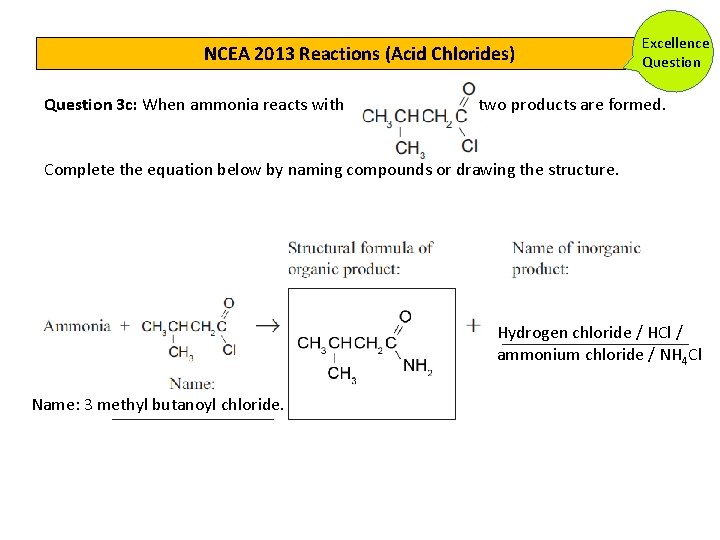
NCEA 2013 Reactions (Acid Chlorides) Excellence Question 3 c: When ammonia reacts with two products are formed. Complete the equation below by naming compounds or drawing the structure. Hydrogen chloride / HCl / ammonium chloride / NH 4 Cl Name: 3 methyl butanoyl chloride.
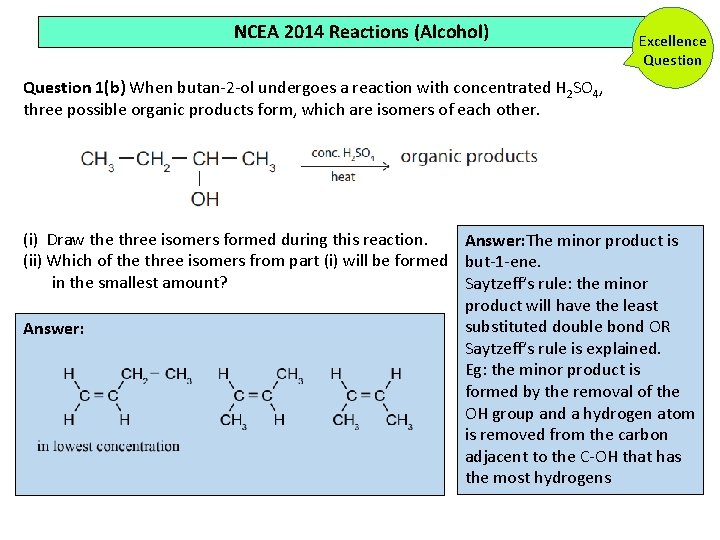
NCEA 2014 Reactions (Alcohol) Excellence Question 1(b) When butan 2 ol undergoes a reaction with concentrated H 2 SO 4, three possible organic products form, which are isomers of each other. (i) Draw the three isomers formed during this reaction. Answer: The minor product is (ii) Which of the three isomers from part (i) will be formed but 1 ene. in the smallest amount? Saytzeff’s rule: the minor product will have the least substituted double bond OR Answer: Saytzeff’s rule is explained. Eg: the minor product is formed by the removal of the OH group and a hydrogen atom is removed from the carbon adjacent to the C OH that has the most hydrogens
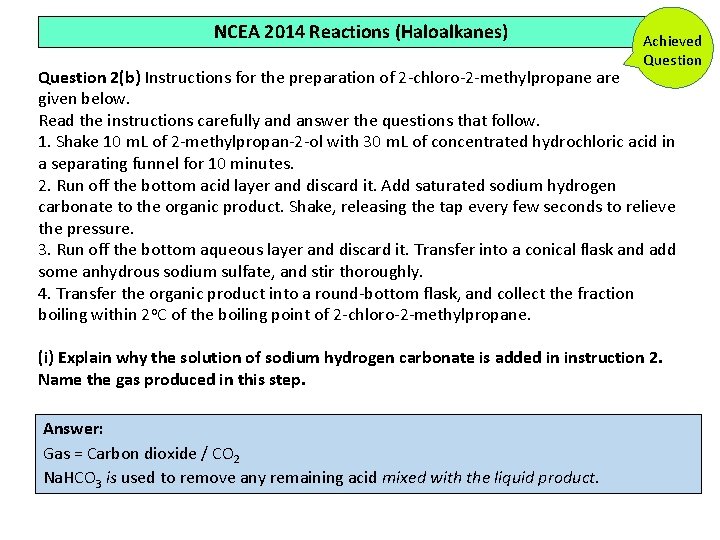
NCEA 2014 Reactions (Haloalkanes) Achieved Question 2(b) Instructions for the preparation of 2 chloro 2 methylpropane are given below. Read the instructions carefully and answer the questions that follow. 1. Shake 10 m. L of 2 methylpropan 2 ol with 30 m. L of concentrated hydrochloric acid in a separating funnel for 10 minutes. 2. Run off the bottom acid layer and discard it. Add saturated sodium hydrogen carbonate to the organic product. Shake, releasing the tap every few seconds to relieve the pressure. 3. Run off the bottom aqueous layer and discard it. Transfer into a conical flask and add some anhydrous sodium sulfate, and stir thoroughly. 4. Transfer the organic product into a round bottom flask, and collect the fraction boiling within 2 o. C of the boiling point of 2 chloro 2 methylpropane. (i) Explain why the solution of sodium hydrogen carbonate is added in instruction 2. Name the gas produced in this step. Answer: Gas = Carbon dioxide / CO 2 Na. HCO 3 is used to remove any remaining acid mixed with the liquid product.
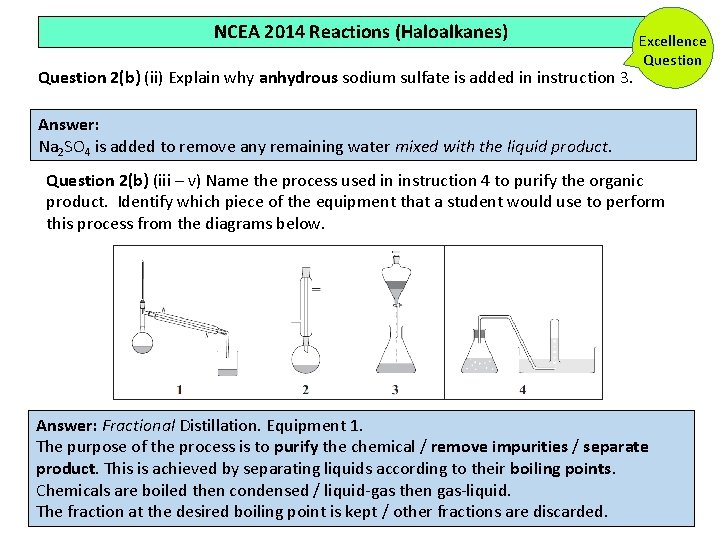
NCEA 2014 Reactions (Haloalkanes) Question 2(b) (ii) Explain why anhydrous sodium sulfate is added in instruction 3. Excellence Question Answer: Na 2 SO 4 is added to remove any remaining water mixed with the liquid product. Question 2(b) (iii – v) Name the process used in instruction 4 to purify the organic product. Identify which piece of the equipment that a student would use to perform this process from the diagrams below. Answer: Fractional Distillation. Equipment 1. The purpose of the process is to purify the chemical / remove impurities / separate product. This is achieved by separating liquids according to their boiling points. Chemicals are boiled then condensed / liquid gas then gas liquid. The fraction at the desired boiling point is kept / other fractions are discarded.
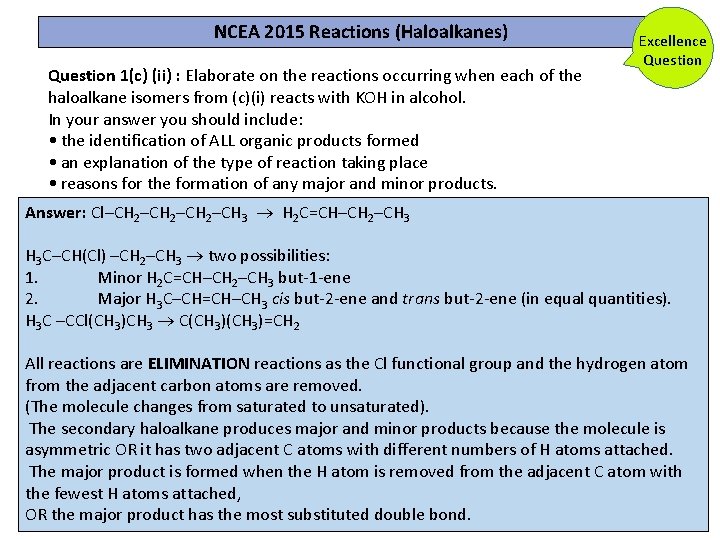
NCEA 2015 Reactions (Haloalkanes) Excellence Question 1(c) (ii) : Elaborate on the reactions occurring when each of the haloalkane isomers from (c)(i) reacts with KOH in alcohol. In your answer you should include: • the identification of ALL organic products formed • an explanation of the type of reaction taking place • reasons for the formation of any major and minor products. Answer: Cl–CH 2–CH 3 H 2 C=CH–CH 2–CH 3 H 3 C–CH(Cl) –CH 2–CH 3 two possibilities: 1. Minor H 2 C=CH–CH 2–CH 3 but 1 ene 2. Major H 3 C–CH=CH–CH 3 cis but 2 ene and trans but 2 ene (in equal quantities). H 3 C –CCl(CH 3)CH 3 C(CH 3)=CH 2 All reactions are ELIMINATION reactions as the Cl functional group and the hydrogen atom from the adjacent carbon atoms are removed. (The molecule changes from saturated to unsaturated). The secondary haloalkane produces major and minor products because the molecule is asymmetric OR it has two adjacent C atoms with different numbers of H atoms attached. The major product is formed when the H atom is removed from the adjacent C atom with the fewest H atoms attached, OR the major product has the most substituted double bond.
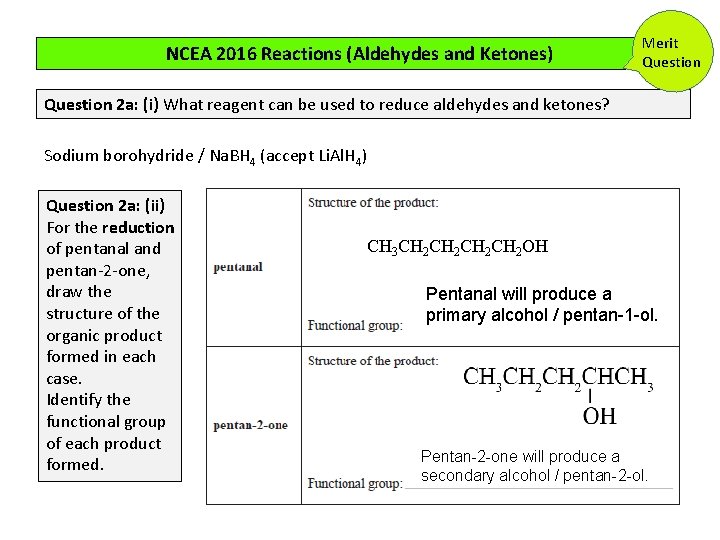
NCEA 2016 Reactions (Aldehydes and Ketones) Merit Question 2 a: (i) What reagent can be used to reduce aldehydes and ketones? Sodium borohydride / Na. BH 4 (accept Li. Al. H 4) Question 2 a: (ii) For the reduction of pentanal and pentan 2 one, draw the structure of the organic product formed in each case. Identify the functional group of each product formed. CH 3 CH 2 CH 2 OH Pentanal will produce a primary alcohol / pentan-1 -ol. Pentan-2 -one will produce a secondary alcohol / pentan-2 -ol.
Ester Reactions - Esterification (Acid) Organic Reactions Carboxylic Acid + alcohol Ester + water Heating and H 2 SO 4 H 2 O
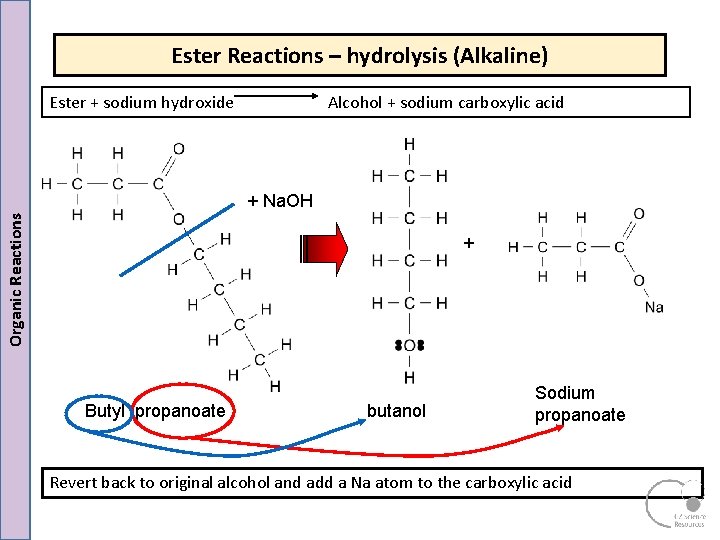
Ester Reactions – hydrolysis (Alkaline) Ester + sodium hydroxide Alcohol + sodium carboxylic acid Organic Reactions + Na. OH + Butyl propanoate butanol Sodium propanoate Revert back to original alcohol and add a Na atom to the carboxylic acid
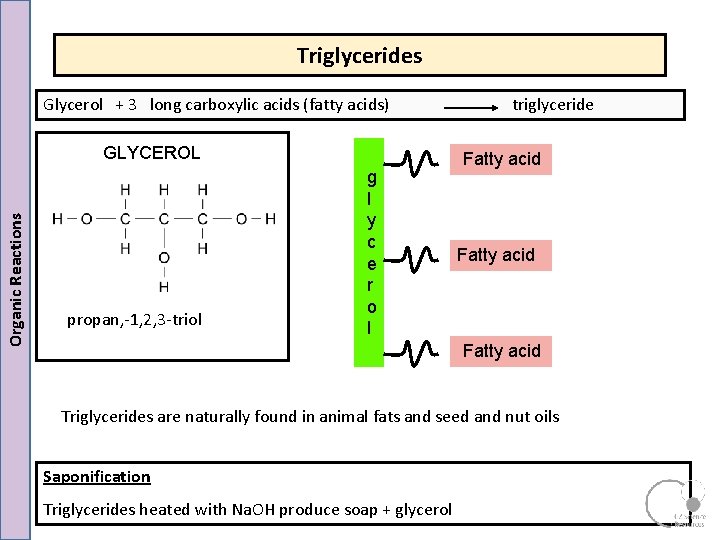
Triglycerides Glycerol + 3 long carboxylic acids (fatty acids) triglyceride Organic Reactions GLYCEROL propan, 1, 2, 3 triol g l y c e r o l Fatty acid Triglycerides are naturally found in animal fats and seed and nut oils Saponification Triglycerides heated with Na. OH produce soap + glycerol
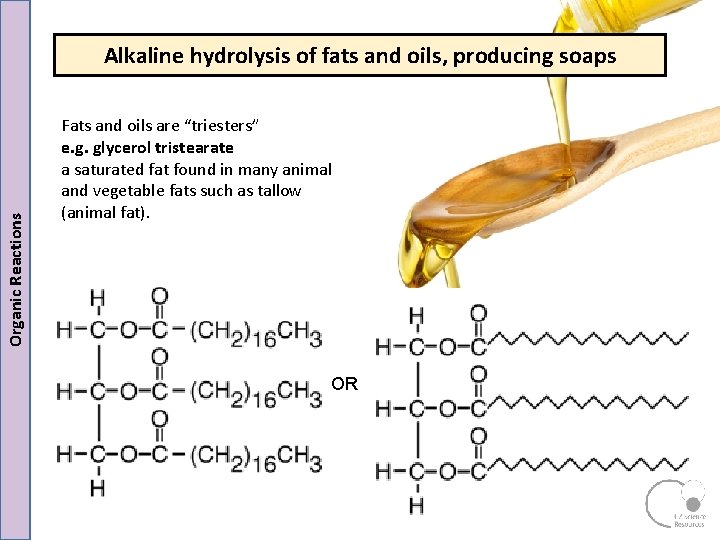
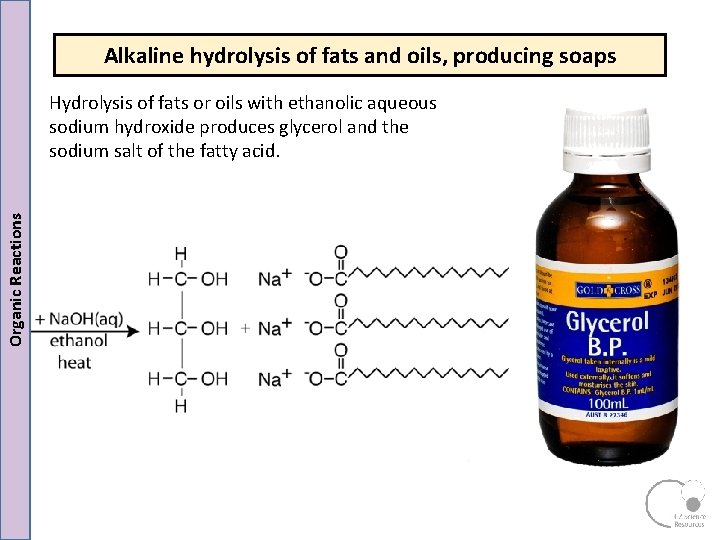
Organic Reactions Alkaline hydrolysis of fats and oils, producing soaps Fats and oils are “triesters” e. g. glycerol tristearate a saturated fat found in many animal and vegetable fats such as tallow (animal fat). OR
Alkaline hydrolysis of fats and oils, producing soaps Organic Reactions Hydrolysis of fats or oils with ethanolic aqueous sodium hydroxide produces glycerol and the sodium salt of the fatty acid.
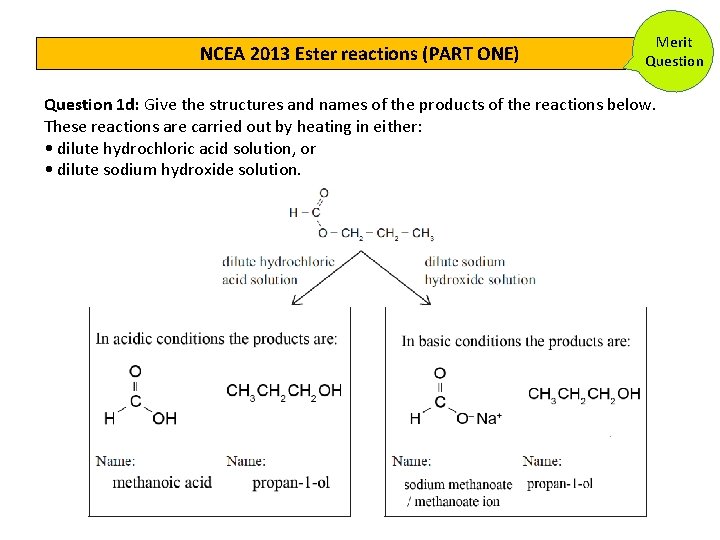
NCEA 2013 Ester reactions (PART ONE) Merit Question 1 d: Give the structures and names of the products of the reactions below. These reactions are carried out by heating in either: • dilute hydrochloric acid solution, or • dilute sodium hydroxide solution.
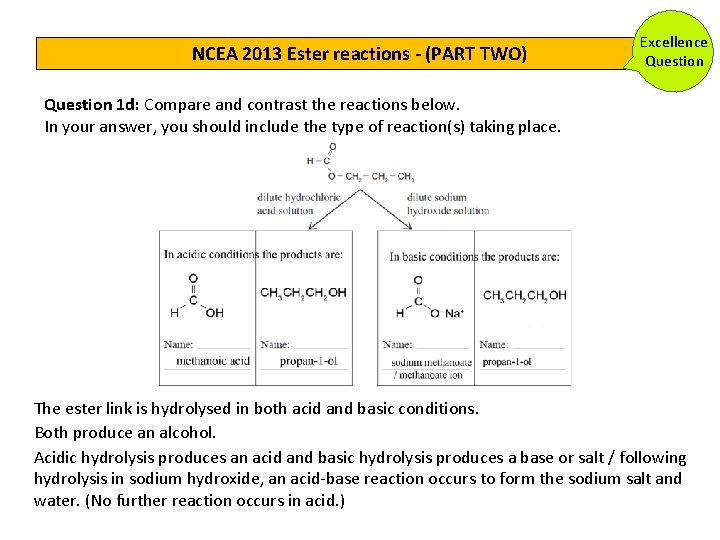
NCEA 2013 Ester reactions - (PART TWO) Excellence Question 1 d: Compare and contrast the reactions below. In your answer, you should include the type of reaction(s) taking place. The ester link is hydrolysed in both acid and basic conditions. Both produce an alcohol. Acidic hydrolysis produces an acid and basic hydrolysis produces a base or salt / following hydrolysis in sodium hydroxide, an acid base reaction occurs to form the sodium salt and water. (No further reaction occurs in acid. )
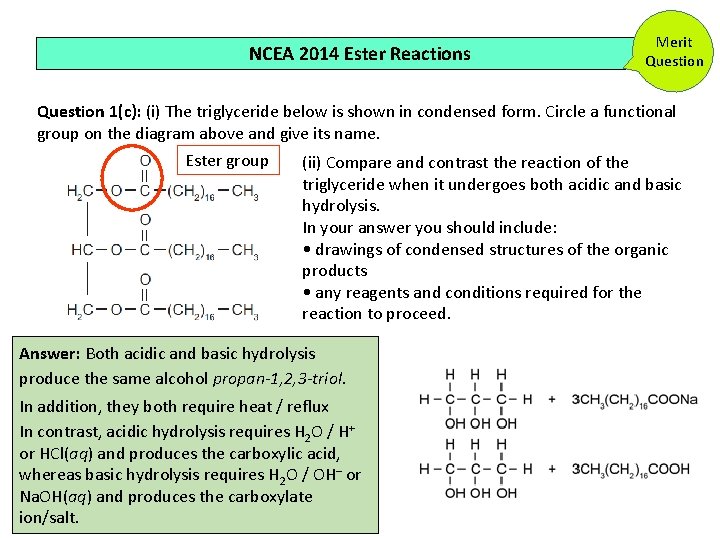
NCEA 2014 Ester Reactions Merit Question 1(c): (i) The triglyceride below is shown in condensed form. Circle a functional group on the diagram above and give its name. Ester group (ii) Compare and contrast the reaction of the triglyceride when it undergoes both acidic and basic hydrolysis. In your answer you should include: • drawings of condensed structures of the organic products • any reagents and conditions required for the reaction to proceed. Answer: Both acidic and basic hydrolysis produce the same alcohol propan-1, 2, 3 -triol. In addition, they both require heat / reflux In contrast, acidic hydrolysis requires H 2 O / H+ or HCl(aq) and produces the carboxylic acid, whereas basic hydrolysis requires H 2 O / OH– or Na. OH(aq) and produces the carboxylate ion/salt.
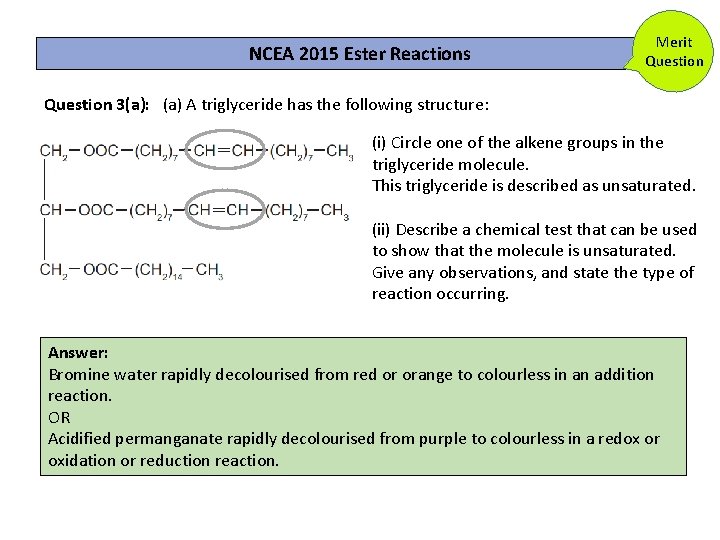
NCEA 2015 Ester Reactions Merit Question 3(a): (a) A triglyceride has the following structure: (i) Circle one of the alkene groups in the triglyceride molecule. This triglyceride is described as unsaturated. (ii) Describe a chemical test that can be used to show that the molecule is unsaturated. Give any observations, and state the type of reaction occurring. Answer: Bromine water rapidly decolourised from red or orange to colourless in an addition reaction. OR Acidified permanganate rapidly decolourised from purple to colourless in a redox or oxidation or reduction reaction.
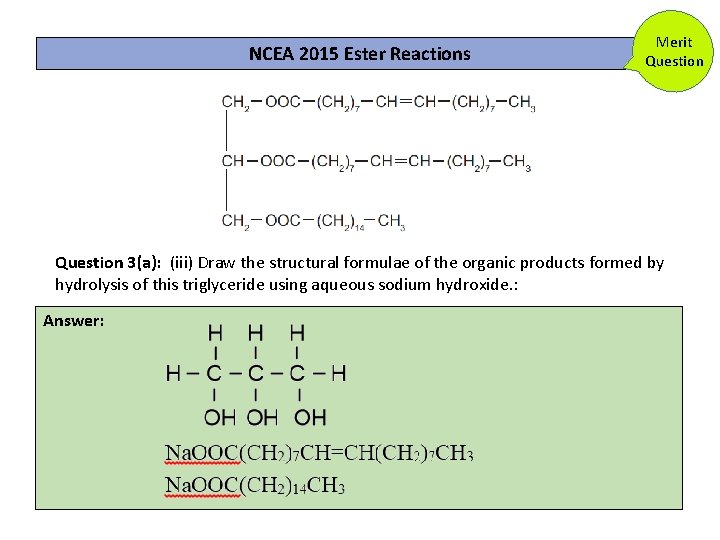
NCEA 2015 Ester Reactions Merit Question 3(a): (iii) Draw the structural formulae of the organic products formed by hydrolysis of this triglyceride using aqueous sodium hydroxide. : Answer:
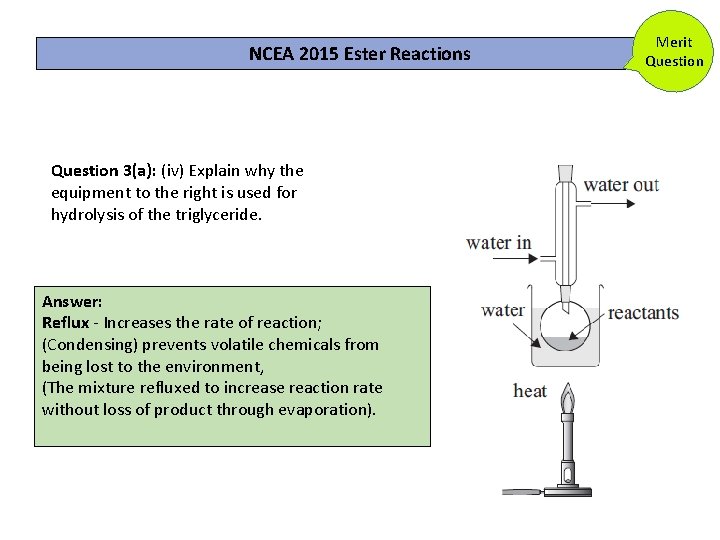
NCEA 2015 Ester Reactions Question 3(a): (iv) Explain why the equipment to the right is used for hydrolysis of the triglyceride. Answer: Reflux Increases the rate of reaction; (Condensing) prevents volatile chemicals from being lost to the environment, (The mixture refluxed to increase reaction rate without loss of product through evaporation). Merit Question
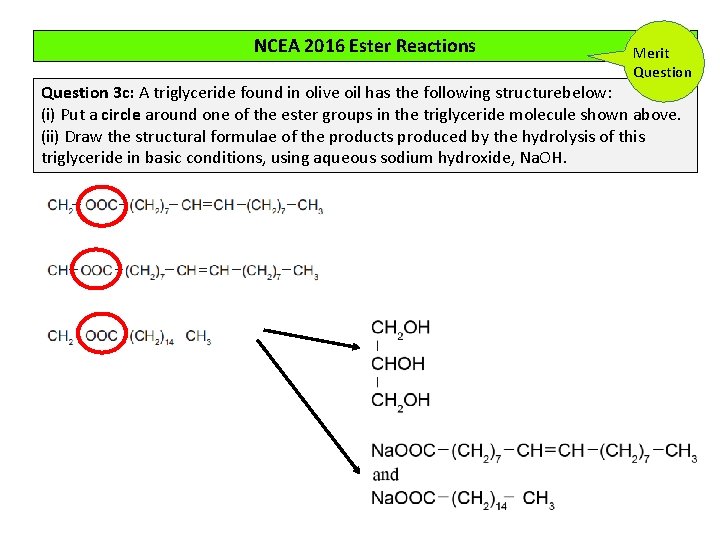
NCEA 2016 Ester Reactions Merit Question 3 c: A triglyceride found in olive oil has the following structurebelow: (i) Put a circle around one of the ester groups in the triglyceride molecule shown above. (ii) Draw the structural formulae of the products produced by the hydrolysis of this triglyceride in basic conditions, using aqueous sodium hydroxide, Na. OH.
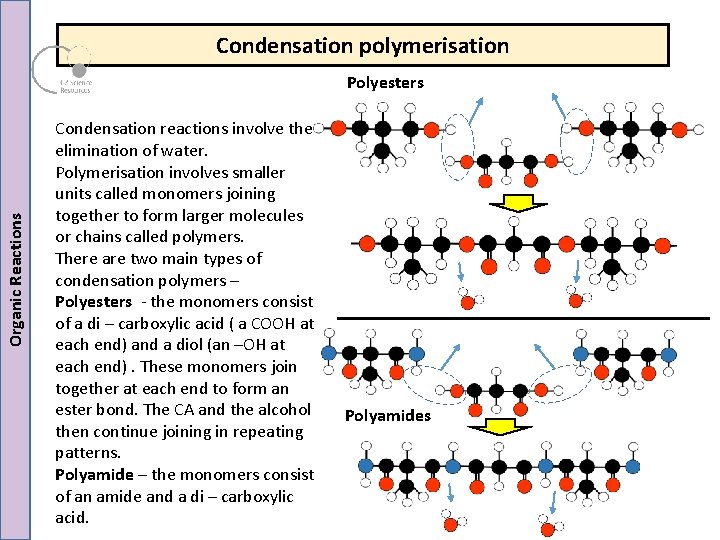
Condensation polymerisation Organic Reactions Polyesters Condensation reactions involve the elimination of water. Polymerisation involves smaller units called monomers joining together to form larger molecules or chains called polymers. There are two main types of condensation polymers – Polyesters the monomers consist of a di – carboxylic acid ( a COOH at each end) and a diol (an –OH at each end). These monomers join together at each end to form an ester bond. The CA and the alcohol then continue joining in repeating patterns. Polyamide – the monomers consist of an amide and a di – carboxylic acid. Polyamides
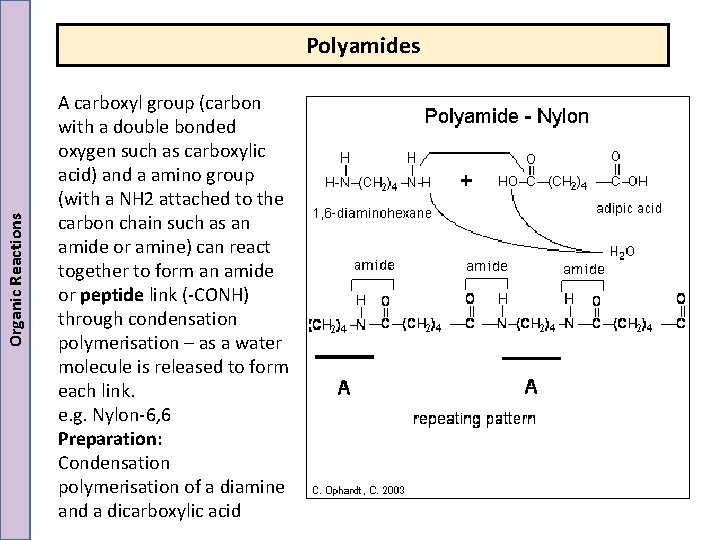
Organic Reactions Polyamides A carboxyl group (carbon with a double bonded oxygen such as carboxylic acid) and a amino group (with a NH 2 attached to the carbon chain such as an amide or amine) can react together to form an amide or peptide link ( CONH) through condensation polymerisation – as a water molecule is released to form each link. e. g. Nylon 6, 6 Preparation: Condensation polymerisation of a diamine and a dicarboxylic acid
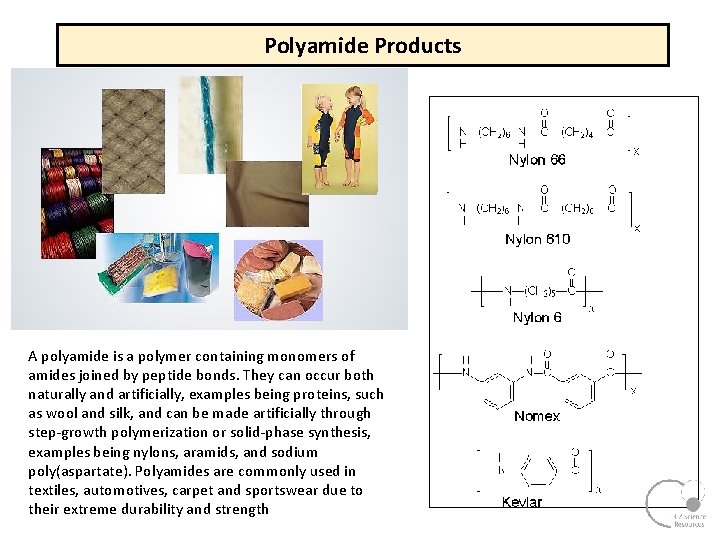
Polyamide Products A polyamide is a polymer containing monomers of amides joined by peptide bonds. They can occur both naturally and artificially, examples being proteins, such as wool and silk, and can be made artificially through step growth polymerization or solid phase synthesis, examples being nylons, aramids, and sodium poly(aspartate). Polyamides are commonly used in textiles, automotives, carpet and sportswear due to their extreme durability and strength
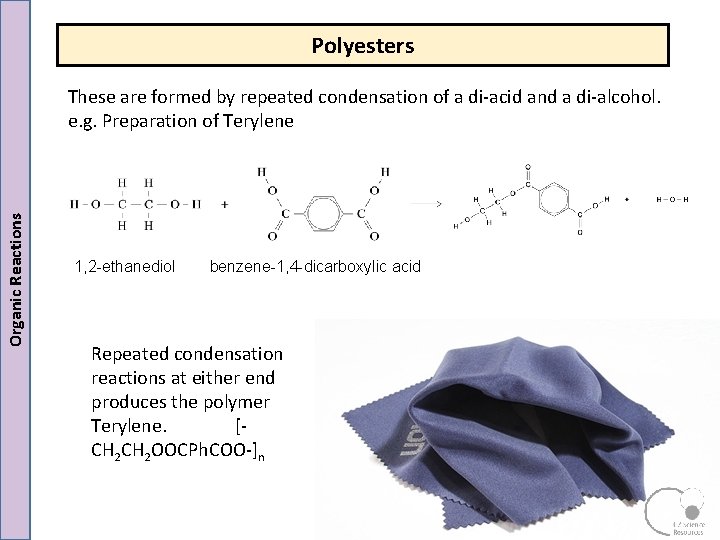
Polyesters Organic Reactions These are formed by repeated condensation of a di acid and a di alcohol. e. g. Preparation of Terylene 1, 2 -ethanediol benzene-1, 4 -dicarboxylic acid Repeated condensation reactions at either end produces the polymer Terylene. [ CH 2 OOCPh. COO ]n
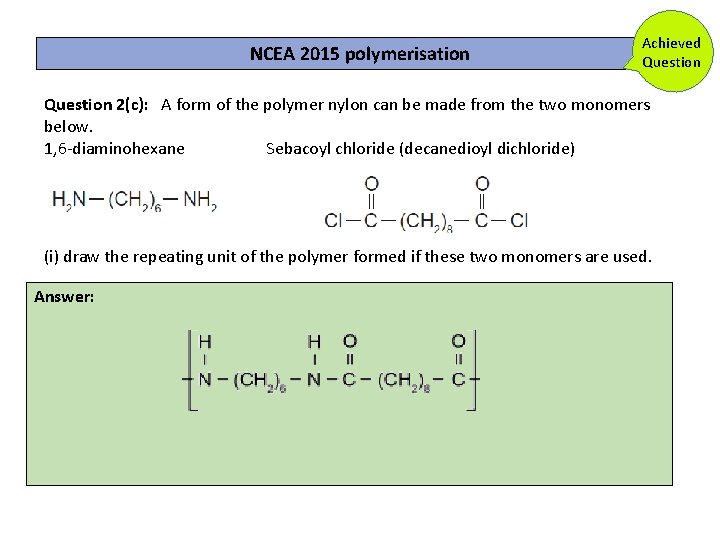
NCEA 2015 polymerisation Achieved Question 2(c): A form of the polymer nylon can be made from the two monomers below. 1, 6 diaminohexane Sebacoyl chloride (decanedioyl dichloride) (i) draw the repeating unit of the polymer formed if these two monomers are used. Answer:
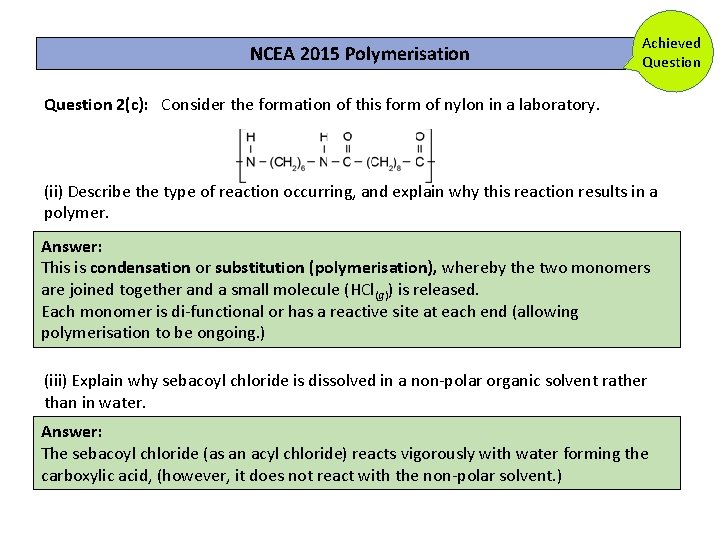
NCEA 2015 Polymerisation Achieved Question 2(c): Consider the formation of this form of nylon in a laboratory. (ii) Describe the type of reaction occurring, and explain why this reaction results in a polymer. Answer: This is condensation or substitution (polymerisation), whereby the two monomers are joined together and a small molecule (HCl(g)) is released. Each monomer is di functional or has a reactive site at each end (allowing polymerisation to be ongoing. ) (iii) Explain why sebacoyl chloride is dissolved in a non polar organic solvent rather than in water. Answer: The sebacoyl chloride (as an acyl chloride) reacts vigorously with water forming the carboxylic acid, (however, it does not react with the non polar solvent. )
NCEA 2015 Polymerisation Question 2(c): (iv) Elaborate on the reaction that will occur if a dilute aqueous solution of acid is mixed with the newly formed polymer. Answer: Dilute acid will cause hydrolysis of the amide linkage. The products formed would be (di)ammonium salt or +H 3 N(CH 2)6 NH 3+ and the (di)oic acid. HOOC(CH 2)8 COOH (Names not required) Excellence Question
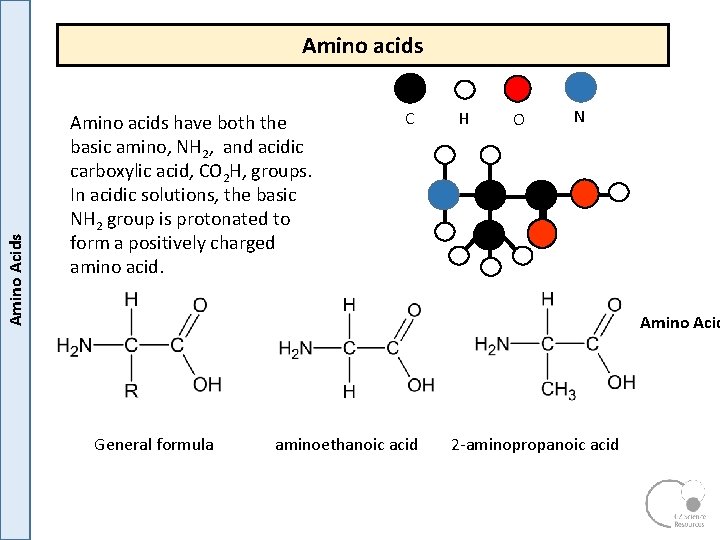
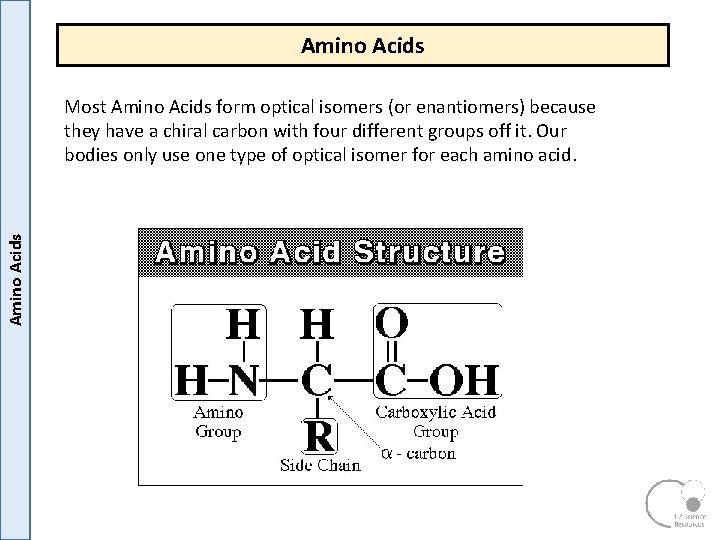
Amino Acids Amino acids have both the basic amino, NH 2, and acidic carboxylic acid, CO 2 H, groups. In acidic solutions, the basic NH 2 group is protonated to form a positively charged amino acid. C H O N Amino Acid General formula aminoethanoic acid 2 aminopropanoic acid
Amino Acids Most Amino Acids form optical isomers (or enantiomers) because they have a chiral carbon with four different groups off it. Our bodies only use one type of optical isomer for each amino acid.
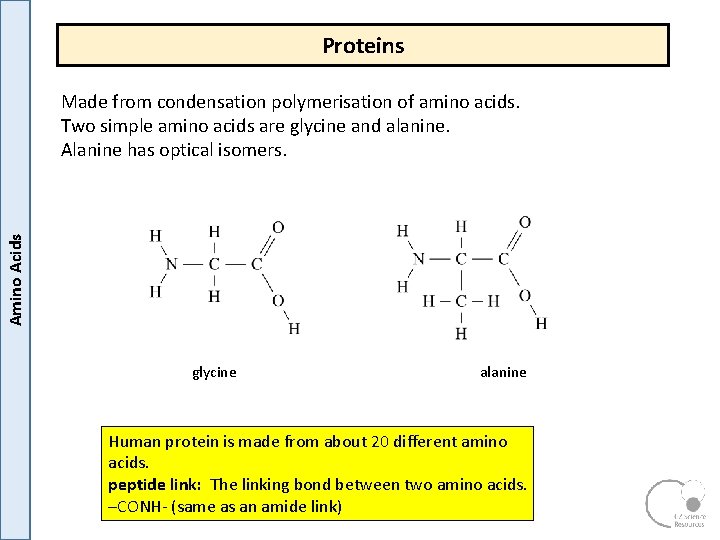
Proteins Amino Acids Made from condensation polymerisation of amino acids. Two simple amino acids are glycine and alanine. Alanine has optical isomers. glycine alanine Human protein is made from about 20 different amino acids. peptide link: The linking bond between two amino acids. –CONH (same as an amide link)
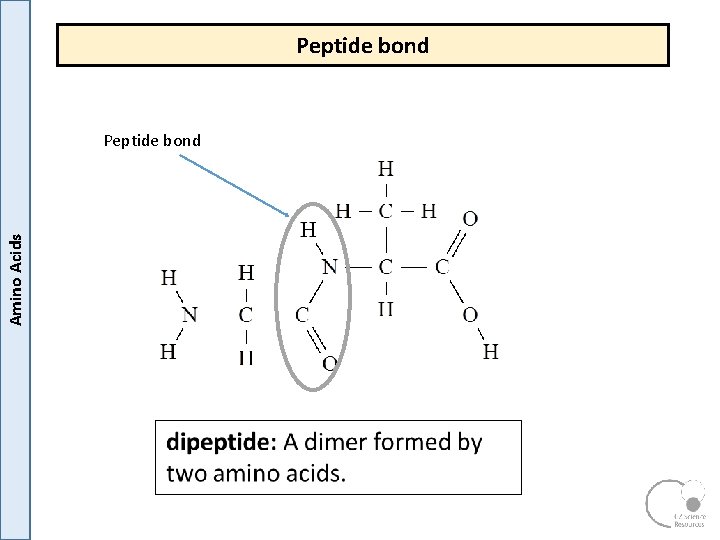
Peptide bond Amino Acids Peptide bond
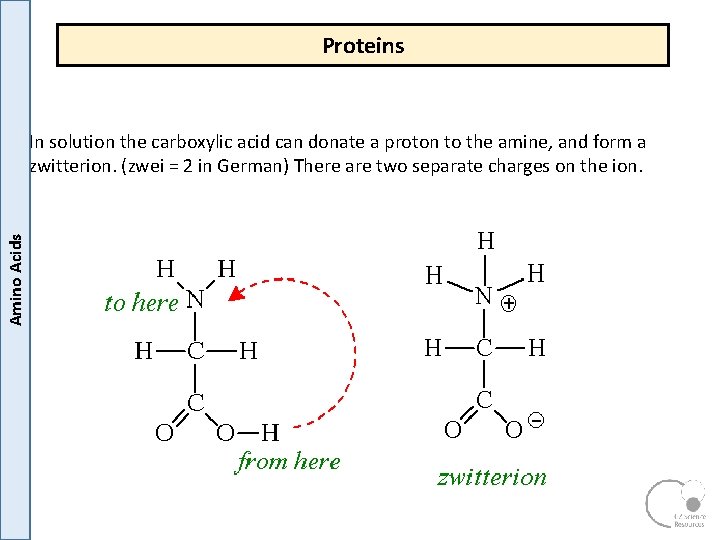
Proteins Amino Acids In solution the carboxylic acid can donate a proton to the amine, and form a zwitterion. (zwei = 2 in German) There are two separate charges on the ion.
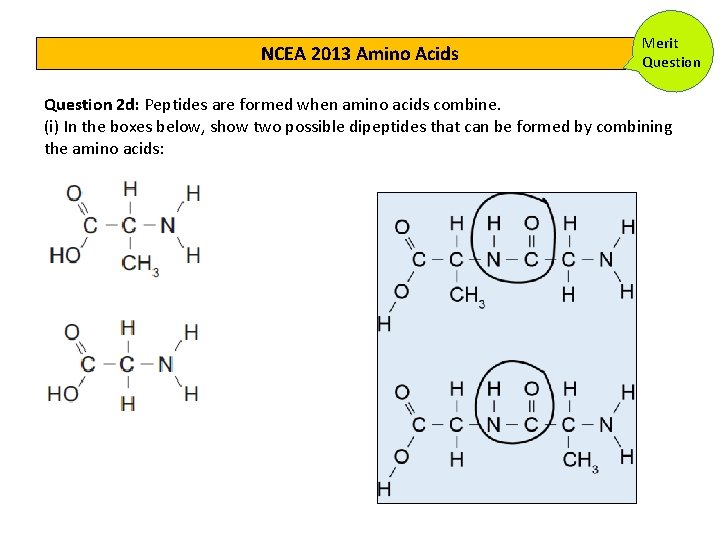
NCEA 2013 Amino Acids Merit Question 2 d: Peptides are formed when amino acids combine. (i) In the boxes below, show two possible dipeptides that can be formed by combining the amino acids:
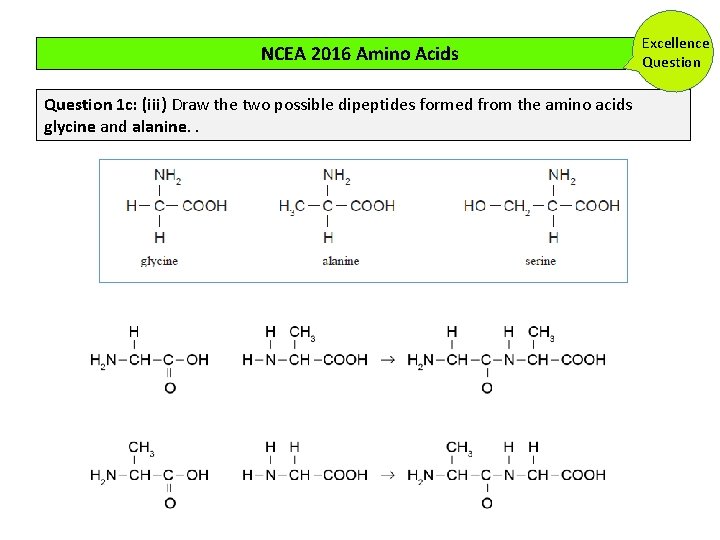
NCEA 2016 Amino Acids Question 1 c: (iii) Draw the two possible dipeptides formed from the amino acids glycine and alanine. . Excellence Question
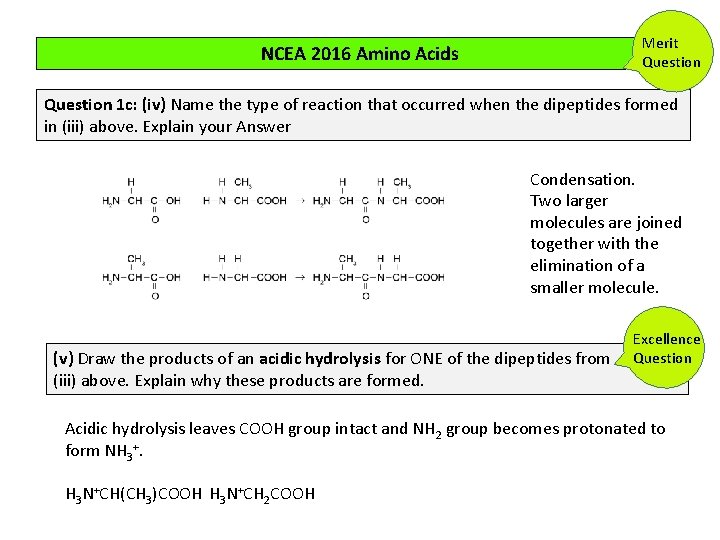
Merit Question NCEA 2016 Amino Acids Question 1 c: (iv) Name the type of reaction that occurred when the dipeptides formed in (iii) above. Explain your Answer Condensation. Two larger molecules are joined together with the elimination of a smaller molecule. (v) Draw the products of an acidic hydrolysis for ONE of the dipeptides from (iii) above. Explain why these products are formed. Excellence Question Acidic hydrolysis leaves COOH group intact and NH 2 group becomes protonated to form NH 3+. H 3 N+CH(CH 3)COOH H 3 N+CH 2 COOH
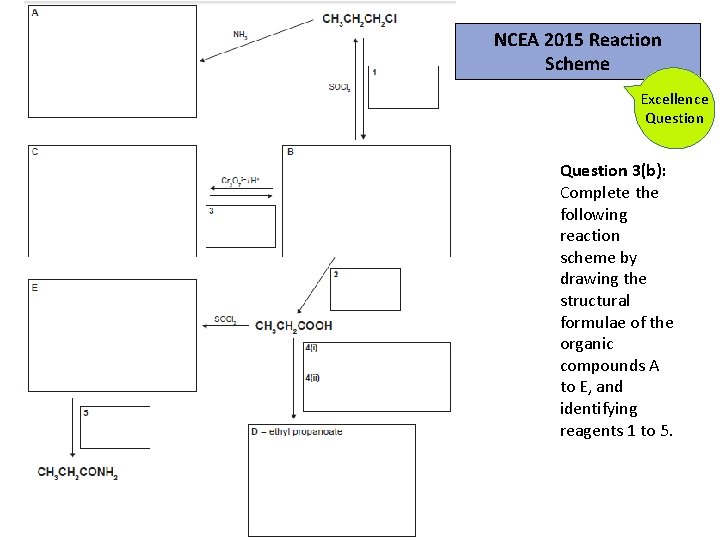
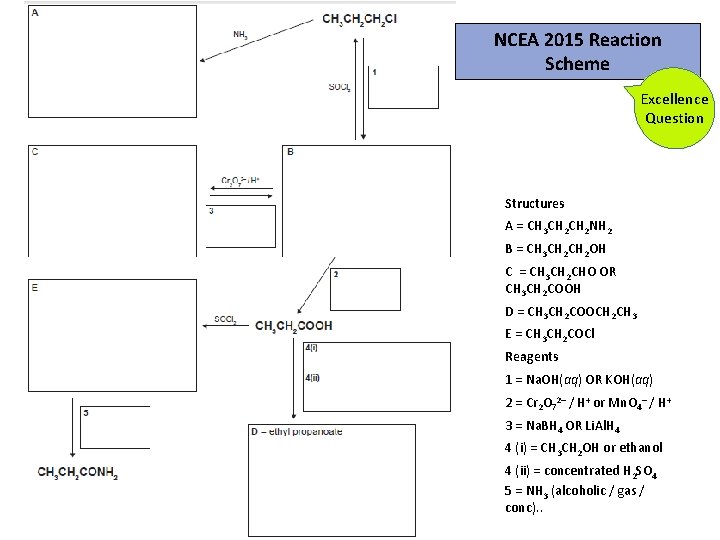
NCEA 2015 Reaction Scheme Excellence Question 3(b): Complete the following reaction scheme by drawing the structural formulae of the organic compounds A to E, and identifying reagents 1 to 5.
NCEA 2015 Reaction Scheme Excellence Question Structures A = CH 3 CH 2 NH 2 B = CH 3 CH 2 OH C = CH 3 CH 2 CHO OR CH 3 CH 2 COOH D = CH 3 CH 2 COOCH 2 CH 3 E = CH 3 CH 2 COCl Reagents 1 = Na. OH(aq) OR KOH(aq) 2 = Cr 2 O 72– / H+ or Mn. O 4– / H+ 3 = Na. BH 4 OR Li. Al. H 4 4 (i) = CH 3 CH 2 OH or ethanol 4 (ii) = concentrated H 2 SO 4 5 = NH 3 (alcoholic / gas / conc). .
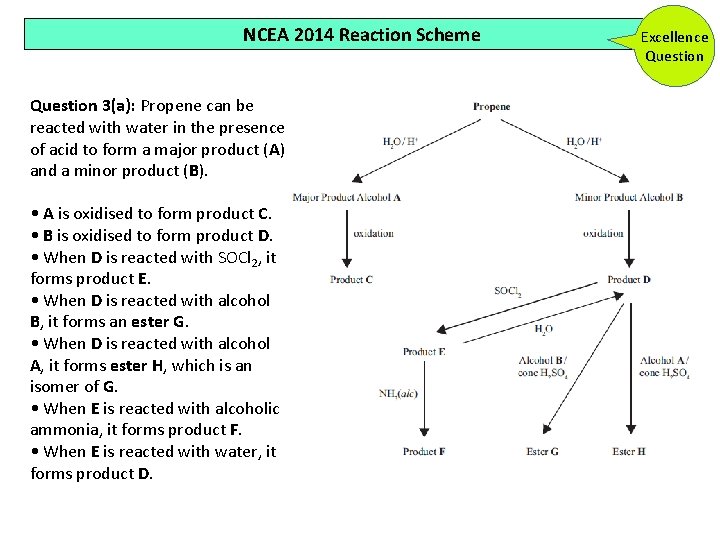
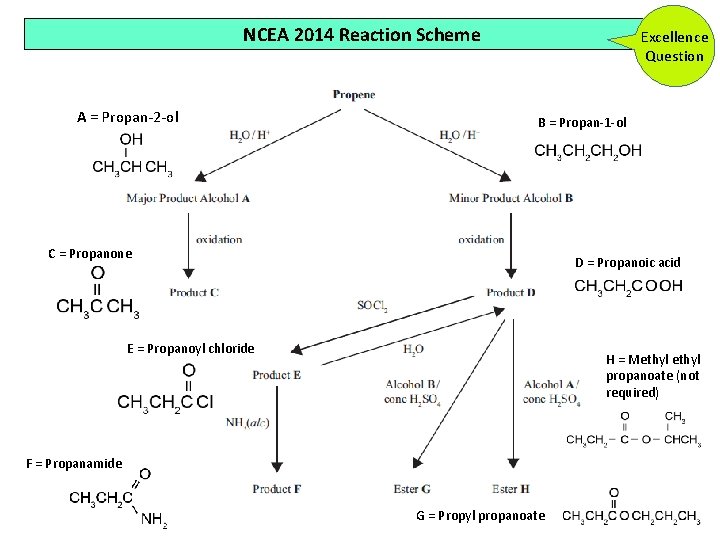
NCEA 2014 Reaction Scheme Question 3(a): Propene can be reacted with water in the presence of acid to form a major product (A) and a minor product (B). • A is oxidised to form product C. • B is oxidised to form product D. • When D is reacted with SOCl 2, it forms product E. • When D is reacted with alcohol B, it forms an ester G. • When D is reacted with alcohol A, it forms ester H, which is an isomer of G. • When E is reacted with alcoholic ammonia, it forms product F. • When E is reacted with water, it forms product D. Excellence Question
NCEA 2014 Reaction Scheme A = Propan 2 ol Excellence Question B = Propan 1 ol C = Propanone D = Propanoic acid E = Propanoyl chloride H = Methyl propanoate (not required) F = Propanamide G = Propyl propanoate
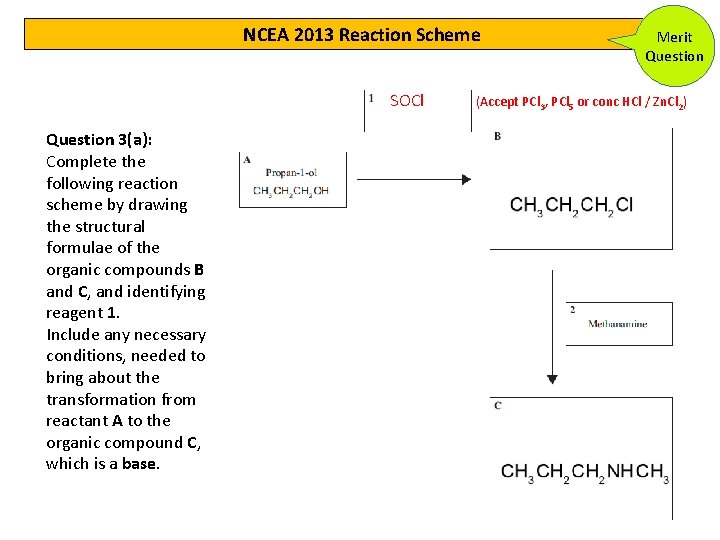
NCEA 2013 Reaction Scheme Merit Question SOCl (Accept PCl 3, PCl 5 or conc HCl / Zn. Cl 2) Question 3(a): Complete the following reaction scheme by drawing the structural formulae of the organic compounds B and C, and identifying reagent 1. Include any necessary conditions, needed to bring about the transformation from reactant A to the organic compound C, which is a base.
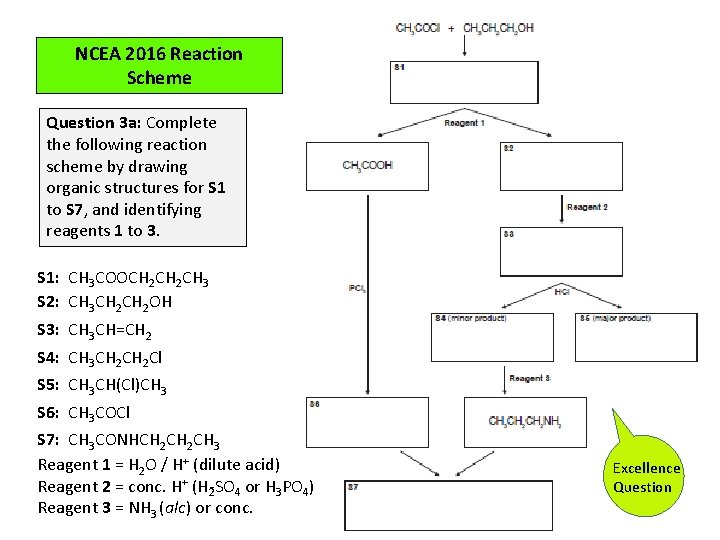
NCEA 2016 Reaction Scheme Question 3 a: Complete the following reaction scheme by drawing organic structures for S 1 to S 7, and identifying reagents 1 to 3. S 1: CH 3 COOCH 2 CH 3 S 2: CH 3 CH 2 OH S 3: CH 3 CH=CH 2 S 4: CH 3 CH 2 Cl S 5: CH 3 CH(Cl)CH 3 S 6: CH 3 COCl S 7: CH 3 CONHCH 2 CH 3 Reagent 1 = H 2 O / H+ (dilute acid) Reagent 2 = conc. H+ (H 2 SO 4 or H 3 PO 4) Reagent 3 = NH 3 (alc) or conc. Excellence Question
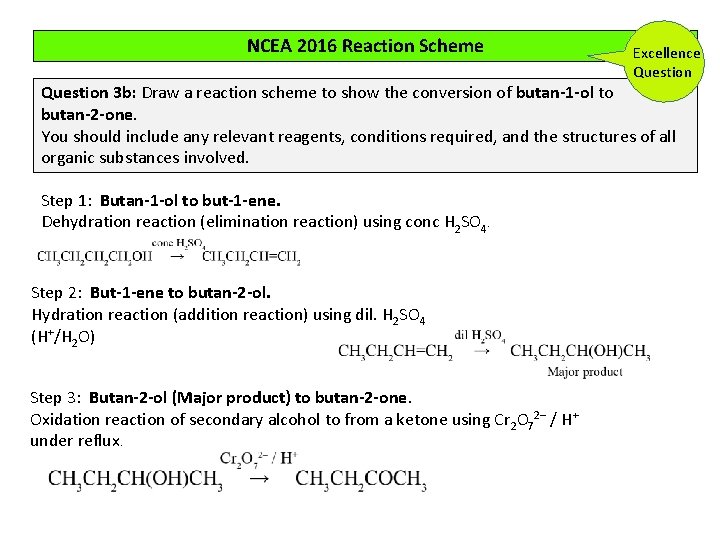
NCEA 2016 Reaction Scheme Excellence Question 3 b: Draw a reaction scheme to show the conversion of butan-1 -ol to butan-2 -one. You should include any relevant reagents, conditions required, and the structures of all organic substances involved. Step 1: Butan-1 -ol to but-1 -ene. Dehydration reaction (elimination reaction) using conc H 2 SO 4. Step 2: But-1 -ene to butan-2 -ol. Hydration reaction (addition reaction) using dil. H 2 SO 4 (H+/H 2 O) Step 3: Butan-2 -ol (Major product) to butan-2 -one. Oxidation reaction of secondary alcohol to from a ketone using Cr 2 O 72– / H+ under reflux.
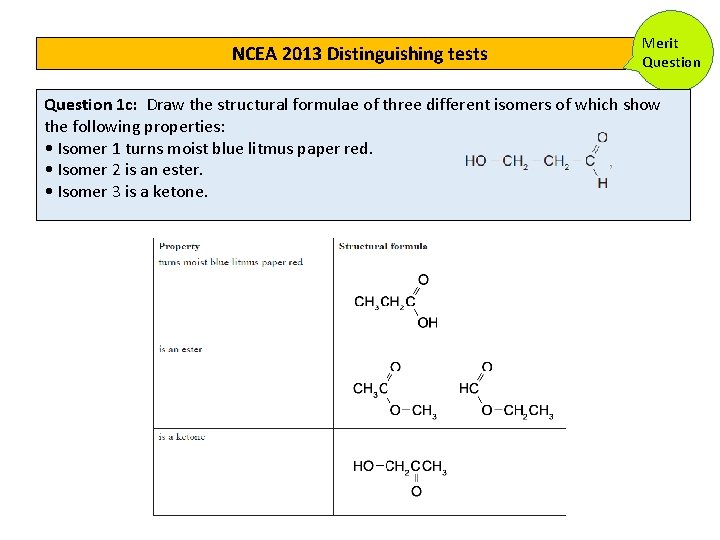
NCEA 2013 Distinguishing tests Merit Question 1 c: Draw the structural formulae of three different isomers of which show the following properties: • Isomer 1 turns moist blue litmus paper red. • Isomer 2 is an ester. • Isomer 3 is a ketone.
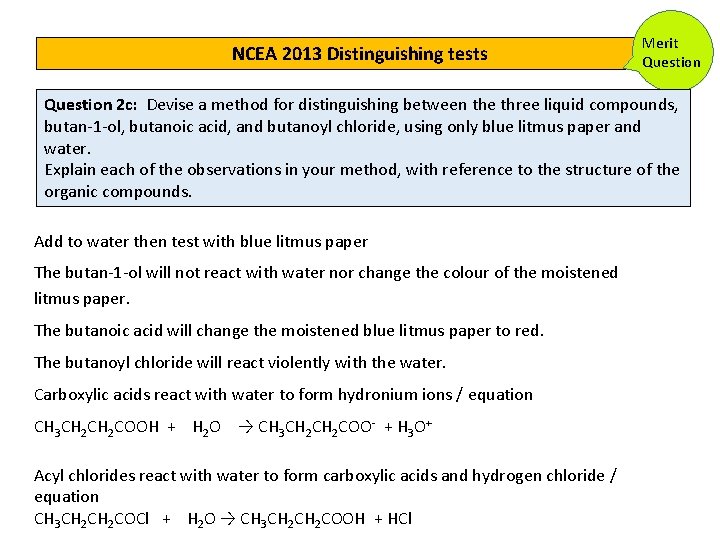
NCEA 2013 Distinguishing tests Merit Question 2 c: Devise a method for distinguishing between the three liquid compounds, butan 1 ol, butanoic acid, and butanoyl chloride, using only blue litmus paper and water. Explain each of the observations in your method, with reference to the structure of the organic compounds. Add to water then test with blue litmus paper The butan 1 ol will not react with water nor change the colour of the moistened litmus paper. The butanoic acid will change the moistened blue litmus paper to red. The butanoyl chloride will react violently with the water. Carboxylic acids react with water to form hydronium ions / equation CH 3 CH 2 COOH + H 2 O → CH 3 CH 2 COO + H 3 O+ Acyl chlorides react with water to form carboxylic acids and hydrogen chloride / equation CH 3 CH 2 COCl + H 2 O → CH 3 CH 2 COOH + HCl
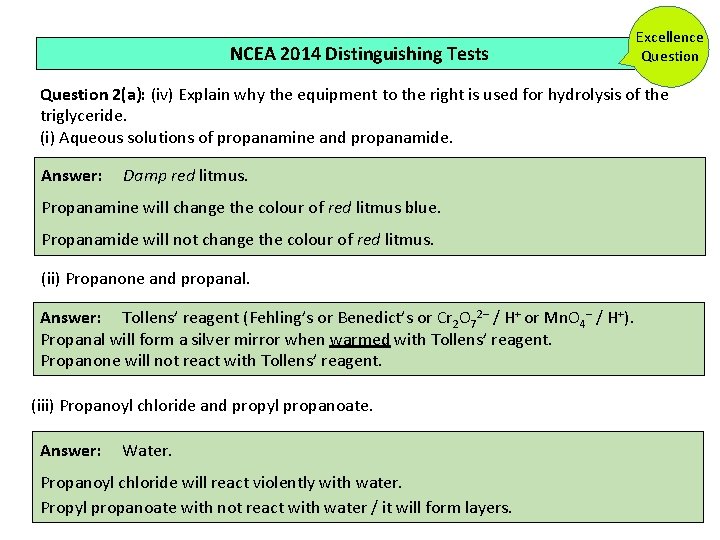
NCEA 2014 Distinguishing Tests Excellence Question 2(a): (iv) Explain why the equipment to the right is used for hydrolysis of the triglyceride. (i) Aqueous solutions of propanamine and propanamide. Answer: Damp red litmus. Propanamine will change the colour of red litmus blue. Propanamide will not change the colour of red litmus. (ii) Propanone and propanal. Answer: Tollens’ reagent (Fehling’s or Benedict’s or Cr 2 O 72– / H+ or Mn. O 4– / H+). Propanal will form a silver mirror when warmed with Tollens’ reagent. Propanone will not react with Tollens’ reagent. (iii) Propanoyl chloride and propyl propanoate. Answer: Water. Propanoyl chloride will react violently with water. Propyl propanoate with not react with water / it will form layers.
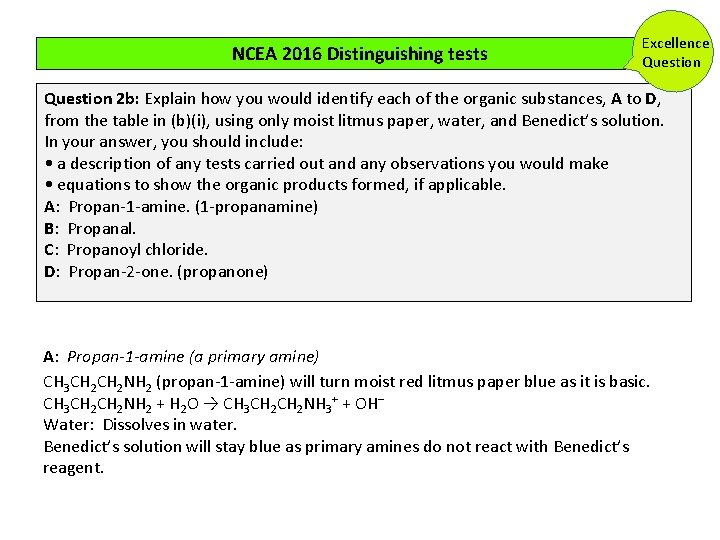
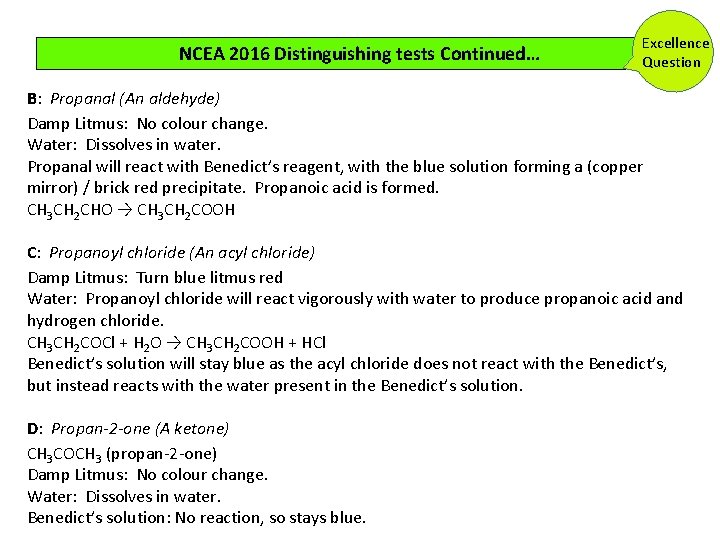
NCEA 2016 Distinguishing tests Excellence Question 2 b: Explain how you would identify each of the organic substances, A to D, from the table in (b)(i), using only moist litmus paper, water, and Benedict’s solution. In your answer, you should include: • a description of any tests carried out and any observations you would make • equations to show the organic products formed, if applicable. A: Propan 1 amine. (1 propanamine) B: Propanal. C: Propanoyl chloride. D: Propan 2 one. (propanone) A: Propan-1 -amine (a primary amine) CH 3 CH 2 NH 2 (propan 1 amine) will turn moist red litmus paper blue as it is basic. CH 3 CH 2 NH 2 + H 2 O → CH 3 CH 2 NH 3+ + OH– Water: Dissolves in water. Benedict’s solution will stay blue as primary amines do not react with Benedict’s reagent.
NCEA 2016 Distinguishing tests Continued… Excellence Question B: Propanal (An aldehyde) Damp Litmus: No colour change. Water: Dissolves in water. Propanal will react with Benedict’s reagent, with the blue solution forming a (copper mirror) / brick red precipitate. Propanoic acid is formed. CH 3 CH 2 CHO → CH 3 CH 2 COOH C: Propanoyl chloride (An acyl chloride) Damp Litmus: Turn blue litmus red Water: Propanoyl chloride will react vigorously with water to produce propanoic acid and hydrogen chloride. CH 3 CH 2 COCl + H 2 O → CH 3 CH 2 COOH + HCl Benedict’s solution will stay blue as the acyl chloride does not react with the Benedict’s, but instead reacts with the water present in the Benedict’s solution. D: Propan-2 -one (A ketone) CH 3 COCH 3 (propan 2 one) Damp Litmus: No colour change. Water: Dissolves in water. Benedict’s solution: No reaction, so stays blue.
Reaction types Substitution reactions are characterized by replacement of an atom or group (Y) by another atom or group (Z). Aside from these groups, the number of bonds does not change. Polymerisation reactions join monomers together to form a polymer. Condensation polymerisation removes a molecule of water (H from one monomer and OH from another) and joins the two ends of the monomers together Oxidation reactions involve a lost of electrons from the organic molecule or a gain of oxygen. An oxidant such as dichromate or permanganate is used. Condensation (or dehydration) reactions are a type of elimination reaction where a molecule of water is removed) – in esterification OH is removed from alcohol and O from a carboxylic acid and they are joined to form an ester Addition reactions increase the number of bonds to the Carbon chain by bonding additional atoms, usually at the expense of one or more double bonds. Hydrolysis reactions involve water as a reactant and becomes part of the reaction product. Elimination reactions decrease the number of single bonds by removing atoms and new double bonds are often formed. Reduction reactions involve a gain of electrons from the organic molecule or a loss of oxygen. A reductant such as Na. BH 4 is used.