
2017 OTLA Webinar Sexual Assault Cases Overcoming Significant
2017 OTLA Webinar Sexual Assault Cases: Overcoming Significant Client Credibility Issues Loretta Merritt March 27, 2017 TORKIN MANES LLP
EVERYBODY LIES • Each of us is deceived in some way 10 to 200 times/day • Strangers lie to one another approximately 3 times within the first 10 minutes of meeting • Men lie about themselves 10 times more often than do women 2 Webinar Support 905 639 6852
REASONS PEOPLE LIE • To benefit another • To avoid conflict • To appear better (self-promotion) • To protect self • To benefit self • To harm another (malicious intent) 3 Webinar Support 905 639 6852
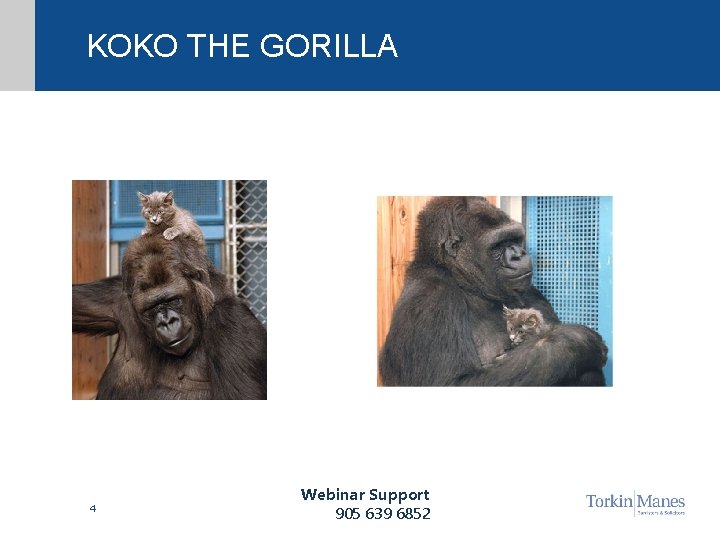
KOKO THE GORILLA 4 Webinar Support 905 639 6852
LYING AND LIE DETECTION • Most people think they are good at detecting lies but are poor liars • Research shows the opposite 5 Webinar Support 905 639 6852
THE RESEARCH STUDIES • Video tapes shown to police, psychiatrist, federal judges, secret service agents, polygraphers, college students • Only secret service agents scored above chance (64%) • Canadian Federal Parole Officers (40. 4%) • Police Officers only able to detect lying at level of chance • Forensic psychologists and psychiatrists (46. 7%) 6 Webinar Support 905 639 6852
ERRONEOUS BELIEFS • There is a single sign of deception • Nervousness, gaze aversion, fidgeting are reliable signs of deception • Particularly a problem with cross-cultural fact finding 7 Webinar Support 905 639 6852
PORTER ET AL (1999) • When telling lies, people tend to: § Provide too much detail § Repeat information § Claim that the memory is extremely vivid/exaggerate § Rarely admit to not remembering § Use more word pauses § Speak more slowly § Engage in more eye contact 8 Webinar Support 905 639 6852
OTHER DECEPTION INDICATORS? • Blink rate • Speech prompting gestures • Body language • Face hiding • First person singular 9 Webinar Support 905 639 6852
FACTORS THAT AFFECT MEMORY • Age • Ability to understand events • Delay / passage of time • Reminders or cues • Opportunity to recall and review events 10 Webinar Support 905 639 6852
MEMORY OF TRAUMATIC EVENTS • Difficulty recalling all details • Age and nature of the abuse are factors • Gaps • Order of events • Context and time perspective 11 Webinar Support 905 639 6852
MEMORY OF TRAUMATIC EVENTS (Continued) • Flashbacks • Peripheral details • Attending to detail and encoding • Dates • Disassociation • Emotion 12 Webinar Support 905 639 6852
CHILDHOOD SEXUAL ABUSE • Key components remain clear • Peripheral details may be wrong • Dates and times • Degree of trauma • Sensory memory • Inability to distinguish between particular incidents of abuse 13 Webinar Support 905 639 6852
ASSESSING MEMORY • Suggestive techniques • Consistency of central events vs. peripheral information • Individual’s tendency for suggestibility or disassociation • Corroboration • Alcohol and drug 14 Webinar Support 905 639 6852
ASSESSING CREDIBILITY • Demeanor § Unreliable § Coaching § Likely to backfire § Come across as programmed 15 Webinar Support 905 639 6852
ASSESSING CREDIBILITY (Continued) • Prior Findings of Credibility § Criminal record (Evidence Act) § Type of offense § Guilty plea or trial? § Lies under oath § Prior finings of credibility 16 Webinar Support 905 639 6852
ASSESSING CREDIBILITY (Continued) • Prior inconsistent statements § Therapy or other medical records § Police statements § Criminal Injuries Compensation Board applications or hearing evidence § Prior statements to family, friends, clergy, etc. (verbal or written) 17 Webinar Support 905 639 6852
THE DISCLOSURE PROCESS • Silence • Denial • Evolving story 18 Webinar Support 905 639 6852
OTHER VICTIMS • Evidence of bad character generally not admissible • Exception, similar fact evidence 19 Webinar Support 905 639 6852
CORROBORATIVE EVIDENCE • Prior consistent statement (oath helping vs. refuting the defense of recent fabrication) • Other corroboration • The surrounding story • Unusual markings 20 Webinar Support 905 639 6852
HOW TO DEAL WITH POTENTIAL CREDIBILITY PROBLEMS • The initial call/meeting § Do not expect the full details § First call – basics, I. D. perpetrator, type and number of assaults § First meeting - a bit more information. If institutional case, how perpetrator and child met § In writing – get the full story 21 Webinar Support 905 639 6852
HOW TO DEAL WITH POTENTIAL CREDIBILITY PROBLEMS (Continued) • Pleadings § Be general § Leave room to expand § Motions for particulars 22 Webinar Support 905 639 6852
HOW TO DEAL WITH POTENTIAL CREDIBILITY PROBLEMS (Continued) • Jury or Non-Jury? § Factors to consider § Government defendants 23 Webinar Support 905 639 6852
HOW TO DEAL WITH POTENTIAL CREDIBILITY PROBLEMS (Continued) • Affidavit of Documents § Obtain all records (everyone they told who could have possibly put it in writing) § Send records to Plaintiff well in advance of discovery and point out areas where they will be questioned § When doing records review and summary, make note of any place where they tell the story (verbatim) § If changing story, do a disclosure chronology 24 Webinar Support 905 639 6852
HOW TO DEAL WITH POTENTIAL CREDIBILITY PROBLEMS (Continued) • Examination for Discovery § Hear the explanations before the Discovery § Disclose all abuse § Think about impact § Don’t get sucked into format (1 st incident, 2 nd incident, etc. ) § Review claim and records § Core issues vs. everything else (“the dog died”) § How to deal with anger 25 Webinar Support 905 639 6852
HOW TO DEAL WITH POTENTIAL CREDIBILITY PROBLEMS (Continued) • Expert Assessments/Evidence § Tell the client about the validity indicators § Tell the client to tell the full story § Make sure Plaintiff’s experts see everything before they see the client including Discovery transcripts § Communications with experts covered by litigation privilege (Moore v. Getahun, 2015 ONCA 55 (Can. LII)) § Memory expert § Ghomeshi case 26 Webinar Support 905 639 6852
HOW TO DEAL WITH POTENTIAL CREDIBILITY PROBLEMS (Continued) • Preparation for Trial § Need to review every version of the story ever told § Need to review all records (medical, police, criminal transcripts, discoveries, CIBC, etc. ) § Discuss inconsistencies § The bad evidence must come out in the opening and/or Examination in Chief 27 Webinar Support 905 639 6852
CASE STUDY: JESSIE IMESON • The defense position • The opening statement • The examination in chief • The records § Our corroborating evidence vs. theirs – Linked. In profile • Defence theory • Group home defendant / “expert” • The closing 28 Webinar Support 905 639 6852
Loretta Merritt Phone 416 777 5404 Email lmerritt@torkinmanes. com Torkin Manes LLP 151 Yonge Street, Suite 1500 Toronto, ON M 5 C 2 W 7 www. torkinmanes. com
- Slides: 29