
2017 Mathematics and Science Partnership Program Grant Enhancing
- Slides: 14
2017 Mathematics and Science Partnership Program Grant: Enhancing Content Knowledge and Pedagogical Skills of K-5 Educators in the Next Generation Science Standards Dr. Simone Palmer Rhode Island Department of Education
Mathematics and Science Partnerships (MSP) Program: • Authorized by Title II, Part B, of NCLB; 2017 -18 last year of MSP • Intended to increase academic achievement of students in mathematics and science by enhancing content knowledge and teaching skills of classroom teachers • Partnerships must be among high-need LEA(s) (Local Education Agency) and institution of higher education (IHE) • For more information, see US Department of Education’s MSP site. http: //www. ed. gov/programs/mathsci/index. html
Goals of the K-5 Science Instructional Coaching Grant 1. Increase educator science content knowledge; 2. Deepen educator understanding of conceptual and pedagogical shifts associated with NGSS 3 -dimensional model of science learning 3. Train educators how to design instructional units aligned with a set of grade-level NGSS Performance Expectations (PEs); 4. Enhance educator adeptness with instructional strategies that support student science learning resulting in increased student ability to apply Science and Engineering practices as tools to learn content (Disciplinary Core Ideas) and interdisciplinary concepts (Crosscutting Concepts); and 5. Reinforce educator confidence in their capacity to assess children’s progress toward a set of NGSS performance expectations. 6. To develop a cadre of teacher leaders, comprised of exemplary K-5 educators who will assist in facilitation and sustainability of project.
Requirements for Eligible Partnerships • must include a science department (including a science education department) of an IHE and a high-need LEA; NOTE: IHE can be local or from out-of-state • may also include other IHE, LEA, business, and community partners. • must focus on development of science content and instructional practices grounded in NGSS. • shared responsibility and accountability among partnership members for project implementation and outcomes. • must designate a project director to serve as point of primary contact for LEA(s). • must be active and well-defined in all aspects of grant, including planning, delivery, and evaluation of professional development.
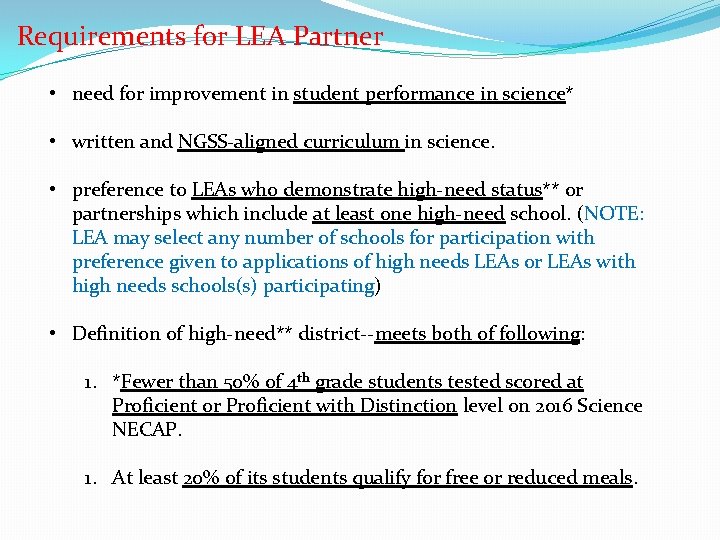
Requirements for LEA Partner • need for improvement in student performance in science* • written and NGSS-aligned curriculum in science. • preference to LEAs who demonstrate high-need status** or partnerships which include at least one high-need school. (NOTE: LEA may select any number of schools for participation with preference given to applications of high needs LEAs or LEAs with high needs schools(s) participating) • Definition of high-need** district--meets both of following: 1. *Fewer than 50% of 4 th grade students tested scored at Proficient or Proficient with Distinction level on 2016 Science NECAP. 1. At least 20% of its students qualify for free or reduced meals.
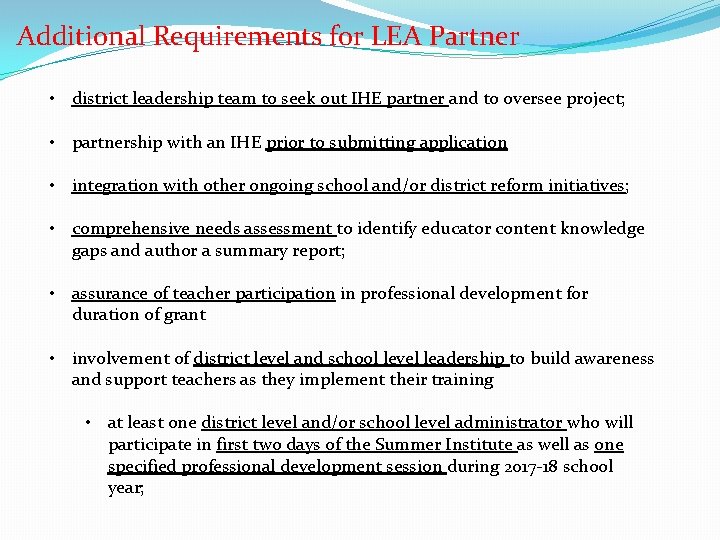
Additional Requirements for LEA Partner • district leadership team to seek out IHE partner and to oversee project; • partnership with an IHE prior to submitting application • integration with other ongoing school and/or district reform initiatives; • comprehensive needs assessment to identify educator content knowledge gaps and author a summary report; • assurance of teacher participation in professional development for duration of grant • involvement of district level and school level leadership to build awareness and support teachers as they implement their training • at least one district level and/or school level administrator who will participate in first two days of the Summer Institute as well as one specified professional development session during 2017 -18 school year;
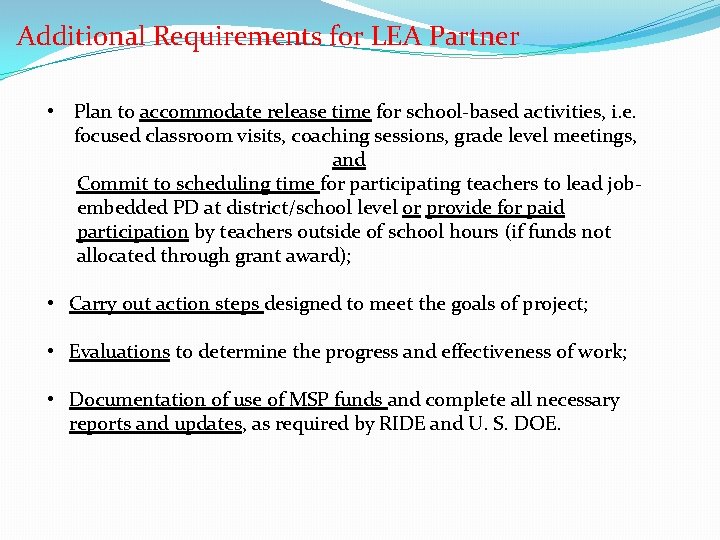
Additional Requirements for LEA Partner • Plan to accommodate release time for school-based activities, i. e. focused classroom visits, coaching sessions, grade level meetings, and Commit to scheduling time for participating teachers to lead jobembedded PD at district/school level or provide for paid participation by teachers outside of school hours (if funds not allocated through grant award); • Carry out action steps designed to meet the goals of project; • Evaluations to determine the progress and effectiveness of work; • Documentation of use of MSP funds and complete all necessary reports and updates, as required by RIDE and U. S. DOE.
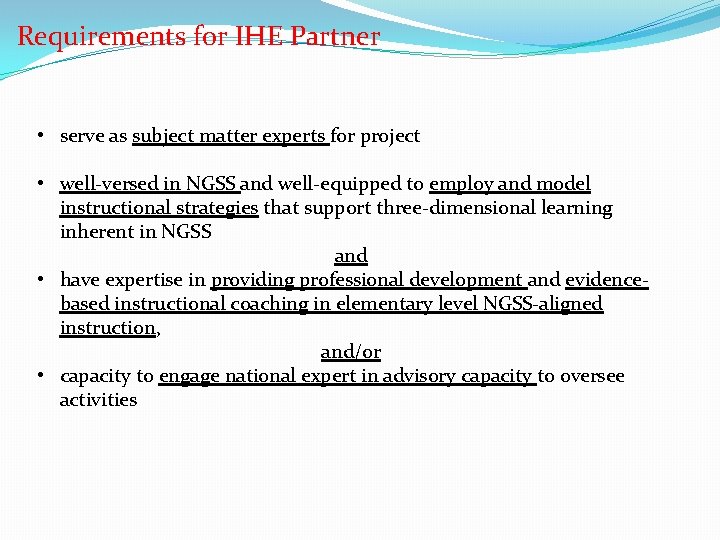
Requirements for IHE Partner • serve as subject matter experts for project • well-versed in NGSS and well-equipped to employ and model instructional strategies that support three-dimensional learning inherent in NGSS and • have expertise in providing professional development and evidencebased instructional coaching in elementary level NGSS-aligned instruction, and/or • capacity to engage national expert in advisory capacity to oversee activities
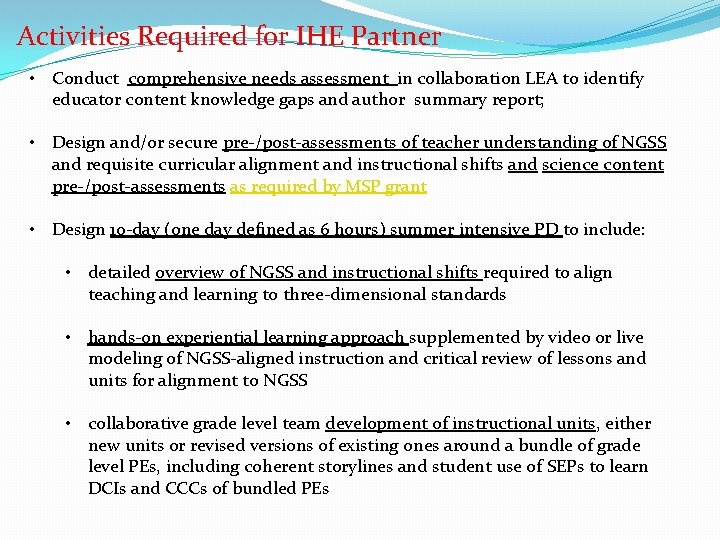
Activities Required for IHE Partner • Conduct comprehensive needs assessment in collaboration LEA to identify educator content knowledge gaps and author summary report; • Design and/or secure pre-/post-assessments of teacher understanding of NGSS and requisite curricular alignment and instructional shifts and science content pre-/post-assessments as required by MSP grant • Design 10 -day (one day defined as 6 hours) summer intensive PD to include: • detailed overview of NGSS and instructional shifts required to align teaching and learning to three-dimensional standards • hands-on experiential learning approach supplemented by video or live modeling of NGSS-aligned instruction and critical review of lessons and units for alignment to NGSS • collaborative grade level team development of instructional units, either new units or revised versions of existing ones around a bundle of grade level PEs, including coherent storylines and student use of SEPs to learn DCIs and CCCs of bundled PEs
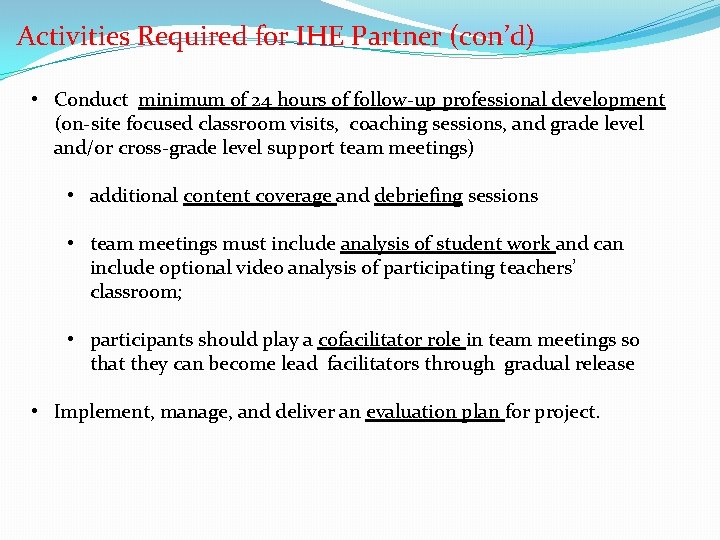
Activities Required for IHE Partner (con’d) • Conduct minimum of 24 hours of follow-up professional development (on-site focused classroom visits, coaching sessions, and grade level and/or cross-grade level support team meetings) • additional content coverage and debriefing sessions • team meetings must include analysis of student work and can include optional video analysis of participating teachers’ classroom; • participants should play a cofacilitator role in team meetings so that they can become lead facilitators through gradual release • Implement, manage, and deliver an evaluation plan for project.
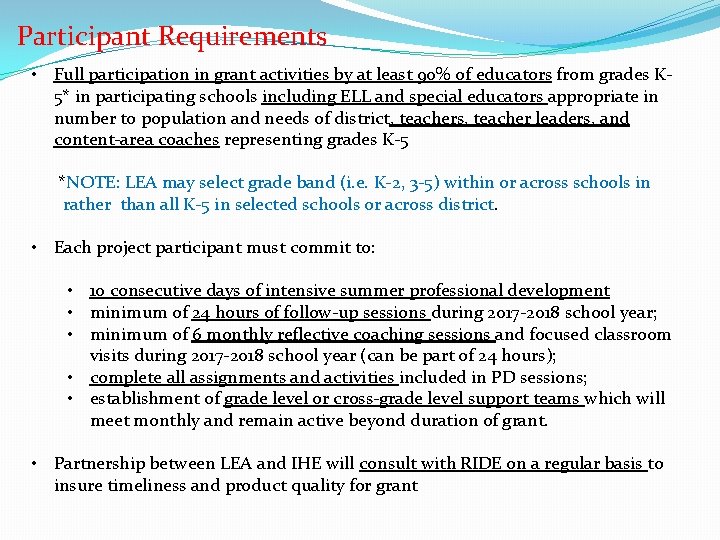
Participant Requirements • Full participation in grant activities by at least 90% of educators from grades K 5* in participating schools including ELL and special educators appropriate in number to population and needs of district, teachers, teacher leaders, and content-area coaches representing grades K-5 *NOTE: LEA may select grade band (i. e. K-2, 3 -5) within or across schools in rather than all K-5 in selected schools or across district. • Each project participant must commit to: • 10 consecutive days of intensive summer professional development • minimum of 24 hours of follow-up sessions during 2017 -2018 school year; • minimum of 6 monthly reflective coaching sessions and focused classroom visits during 2017 -2018 school year (can be part of 24 hours); • complete all assignments and activities included in PD sessions; • establishment of grade level or cross-grade level support teams which will meet monthly and remain active beyond duration of grant. • Partnership between LEA and IHE will consult with RIDE on a regular basis to insure timeliness and product quality for grant
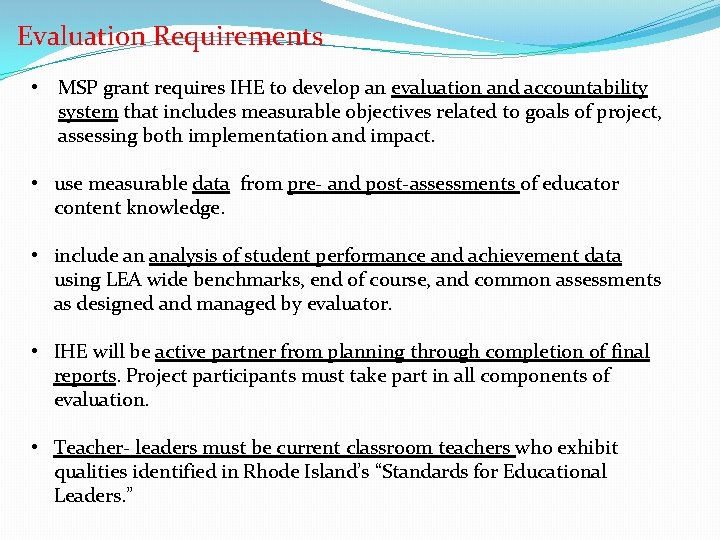
Evaluation Requirements • MSP grant requires IHE to develop an evaluation and accountability system that includes measurable objectives related to goals of project, assessing both implementation and impact. • use measurable data from pre- and post-assessments of educator content knowledge. • include an analysis of student performance and achievement data using LEA wide benchmarks, end of course, and common assessments as designed and managed by evaluator. • IHE will be active partner from planning through completion of final reports. Project participants must take part in all components of evaluation. • Teacher- leaders must be current classroom teachers who exhibit qualities identified in Rhode Island’s “Standards for Educational Leaders. ”
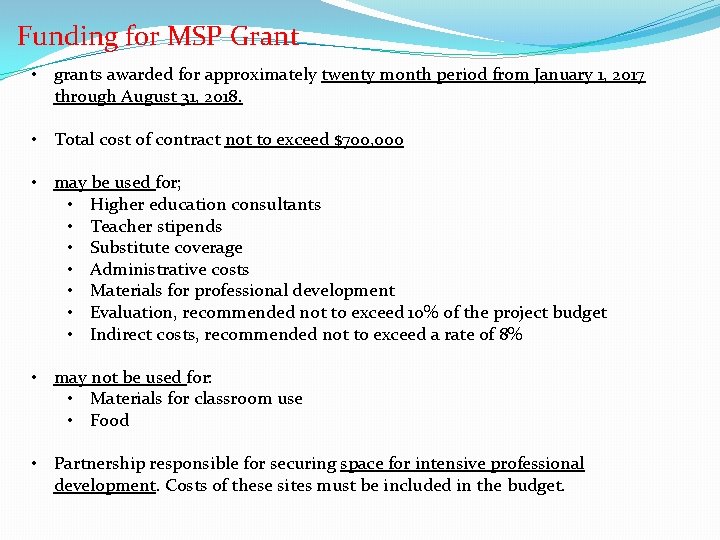
Funding for MSP Grant • grants awarded for approximately twenty month period from January 1, 2017 through August 31, 2018. • Total cost of contract not to exceed $700, 000 • may be used for; • Higher education consultants • Teacher stipends • Substitute coverage • Administrative costs • Materials for professional development • Evaluation, recommended not to exceed 10% of the project budget • Indirect costs, recommended not to exceed a rate of 8% • may not be used for: • Materials for classroom use • Food • Partnership responsible for securing space for intensive professional development. Costs of these sites must be included in the budget.
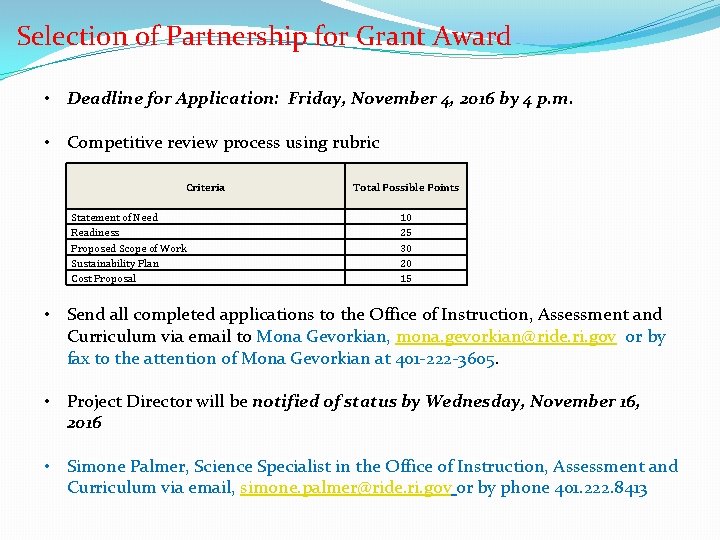
Selection of Partnership for Grant Award • Deadline for Application: Friday, November 4, 2016 by 4 p. m. • Competitive review process using rubric Criteria Statement of Need Readiness Proposed Scope of Work Sustainability Plan Cost Proposal Total Possible Points 10 25 30 20 15 • Send all completed applications to the Office of Instruction, Assessment and Curriculum via email to Mona Gevorkian, mona. gevorkian@ride. ri. gov or by fax to the attention of Mona Gevorkian at 401 -222 -3605. • Project Director will be notified of status by Wednesday, November 16, 2016 • Simone Palmer, Science Specialist in the Office of Instruction, Assessment and Curriculum via email, simone. palmer@ride. ri. gov or by phone 401. 222. 8413