
2017 Benefits Presentation Steve Mc Cauley Director of

2017 Benefits Presentation Steve Mc. Cauley, Director of Benefits
2016: In Review • Major Changes o Blended out-of-pocket maximum (medical/Rx) o Urgent care and emergency copays removed (EPO and PPO) • Focus Group Outcomes o Positives • Good value and coverage • #1 recruitment/retention tool o Negatives • Didn’t like blended out-of-pocket maximum • What Employees Value in Benefits Plan o Consistency o Choices o Cost
2017: ALEX Preview • ALEX guides you through important benefits, health care, and wellness decisions • Access ALEX 24/7; whenever is convenient for you • ALEX keeps you actively engaged • ALEX will walk through all your benefits decisions and provides advice that fits your individual needs • https: //www. youtube. com/watch? v=IL R 9 a. QCMx. Iw
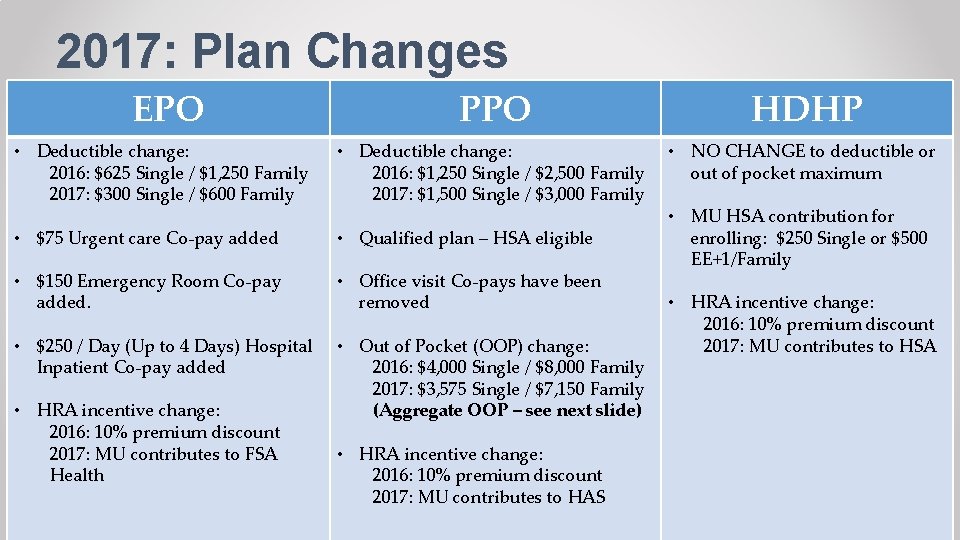
2017: Plan Changes EPO PPO HDHP • Deductible change: 2016: $625 Single / $1, 250 Family 2017: $300 Single / $600 Family • Deductible change: 2016: $1, 250 Single / $2, 500 Family 2017: $1, 500 Single / $3, 000 Family • NO CHANGE to deductible or out of pocket maximum • $75 Urgent care Co-pay added • Qualified plan – HSA eligible • $150 Emergency Room Co-pay added. • Office visit Co-pays have been removed • $250 / Day (Up to 4 Days) Hospital Inpatient Co-pay added • Out of Pocket (OOP) change: 2016: $4, 000 Single / $8, 000 Family 2017: $3, 575 Single / $7, 150 Family (Aggregate OOP – see next slide) • HRA incentive change: 2016: 10% premium discount 2017: MU contributes to FSA Health • HRA incentive change: 2016: 10% premium discount 2017: MU contributes to HAS • MU HSA contribution for enrolling: $250 Single or $500 EE+1/Family • HRA incentive change: 2016: 10% premium discount 2017: MU contributes to HSA
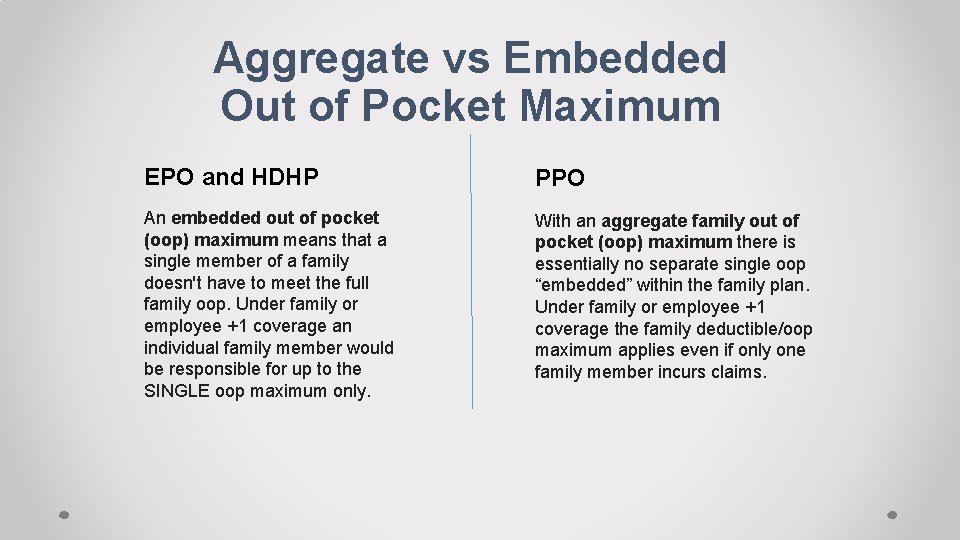
Aggregate vs Embedded Out of Pocket Maximum EPO and HDHP PPO An embedded out of pocket (oop) maximum means that a single member of a family doesn't have to meet the full family oop. Under family or employee +1 coverage an individual family member would be responsible for up to the SINGLE oop maximum only. With an aggregate family out of pocket (oop) maximum there is essentially no separate single oop “embedded” within the family plan. Under family or employee +1 coverage the family deductible/oop maximum applies even if only one family member incurs claims.
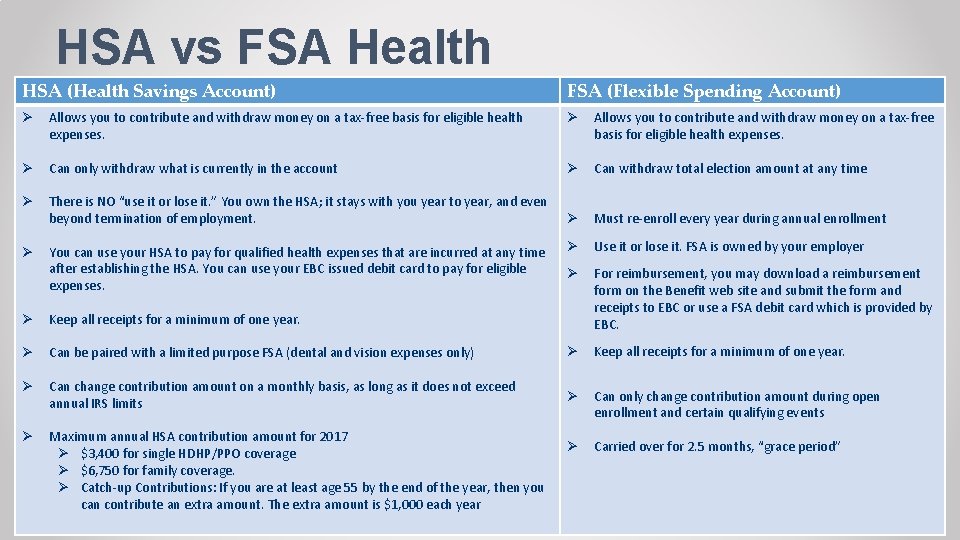
HSA vs FSA Health HSA (Health Savings Account) FSA (Flexible Spending Account) Allows you to contribute and withdraw money on a tax-free basis for eligible health expenses. Can only withdraw what is currently in the account Can withdraw total election amount at any time There is NO “use it or lose it. ” You own the HSA; it stays with you year to year, and even beyond termination of employment. Must re-enroll every year during annual enrollment Use it or lose it. FSA is owned by your employer For reimbursement, you may download a reimbursement form on the Benefit web site and submit the form and receipts to EBC or use a FSA debit card which is provided by EBC. You can use your HSA to pay for qualified health expenses that are incurred at any time after establishing the HSA. You can use your EBC issued debit card to pay for eligible expenses. Keep all receipts for a minimum of one year. Can be paired with a limited purpose FSA (dental and vision expenses only) Keep all receipts for a minimum of one year. Can change contribution amount on a monthly basis, as long as it does not exceed annual IRS limits Can only change contribution amount during open enrollment and certain qualifying events Maximum annual HSA contribution amount for 2017 $3, 400 for single HDHP/PPO coverage $6, 750 for family coverage. Catch-up Contributions: If you are at least age 55 by the end of the year, then you can contribute an extra amount. The extra amount is $1, 000 each year Carried over for 2. 5 months, “grace period”
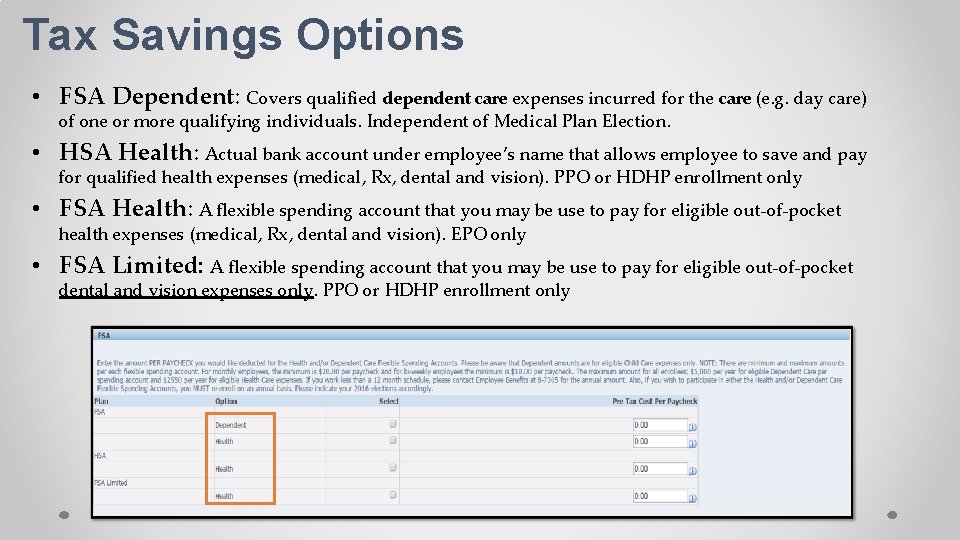
Tax Savings Options • FSA Dependent: Covers qualified dependent care expenses incurred for the care (e. g. day care) of one or more qualifying individuals. Independent of Medical Plan Election. • HSA Health: Actual bank account under employee’s name that allows employee to save and pay for qualified health expenses (medical, Rx, dental and vision). PPO or HDHP enrollment only • FSA Health: A flexible spending account that you may be use to pay for eligible out-of-pocket health expenses (medical, Rx, dental and vision). EPO only • FSA Limited: A flexible spending account that you may be use to pay for eligible out-of-pocket dental and vision expenses only. PPO or HDHP enrollment only
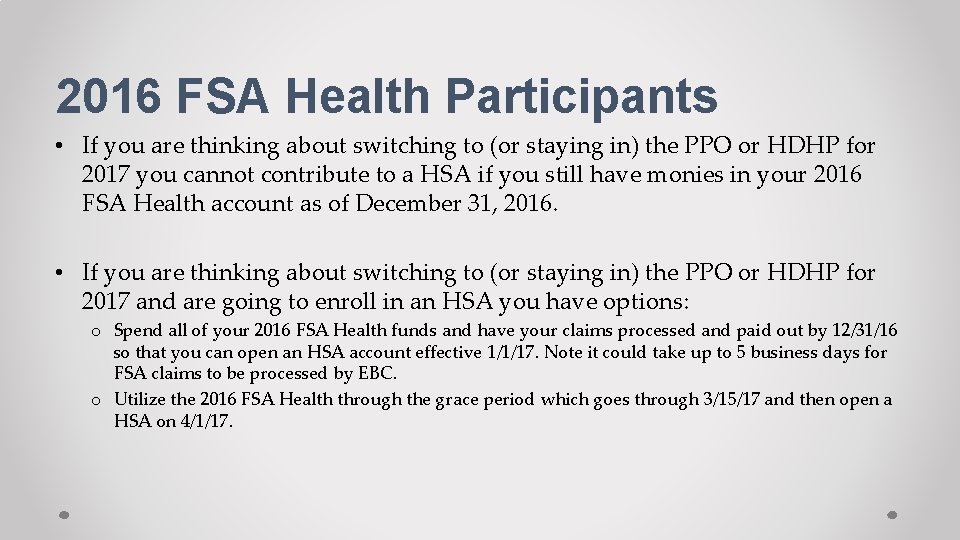
2016 FSA Health Participants • If you are thinking about switching to (or staying in) the PPO or HDHP for 2017 you cannot contribute to a HSA if you still have monies in your 2016 FSA Health account as of December 31, 2016. • If you are thinking about switching to (or staying in) the PPO or HDHP for 2017 and are going to enroll in an HSA you have options: o Spend all of your 2016 FSA Health funds and have your claims processed and paid out by 12/31/16 so that you can open an HSA account effective 1/1/17. Note it could take up to 5 business days for FSA claims to be processed by EBC. o Utilize the 2016 FSA Health through the grace period which goes through 3/15/17 and then open a HSA on 4/1/17.
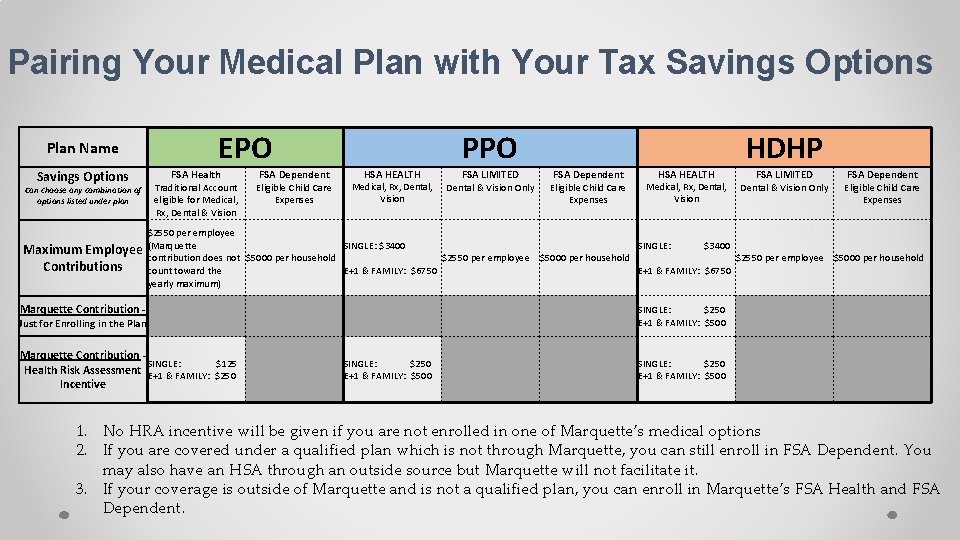
Pairing Your Medical Plan with Your Tax Savings Options Plan Name Savings Options Can choose any combination of options listed under plan Maximum Employee Contributions EPO FSA Health Traditional Account eligible for Medical, Rx, Dental & Vision FSA Dependent Eligible Child Care Expenses PPO HSA HEALTH Medical, Rx, Dental, Vision FSA LIMITED Dental & Vision Only HDHP FSA Dependent Eligible Child Care Expenses HSA HEALTH Medical, Rx, Dental, Vision FSA LIMITED Dental & Vision Only FSA Dependent Eligible Child Care Expenses $2550 per employee SINGLE: $3400 (Marquette contribution does not $5000 per household $2550 per employee $5000 per household count toward the E+1 & FAMILY: $6750 yearly maximum) Marquette Contribution - SINGLE: $250 E+1 & FAMILY: $500 Just for Enrolling in the Plan Marquette Contribution SINGLE: $125 Health Risk Assessment E+1 & FAMILY: $250 Incentive SINGLE: $250 E+1 & FAMILY: $500 1. No HRA incentive will be given if you are not enrolled in one of Marquette’s medical options 2. If you are covered under a qualified plan which is not through Marquette, you can still enroll in FSA Dependent. You may also have an HSA through an outside source but Marquette will not facilitate it. 3. If your coverage is outside of Marquette and is not a qualified plan, you can enroll in Marquette’s FSA Health and FSA Dependent.
- Slides: 9