
2016 Maintenance Innovation Challenge Dynamic Test RequirementCode Architecture
- Slides: 1
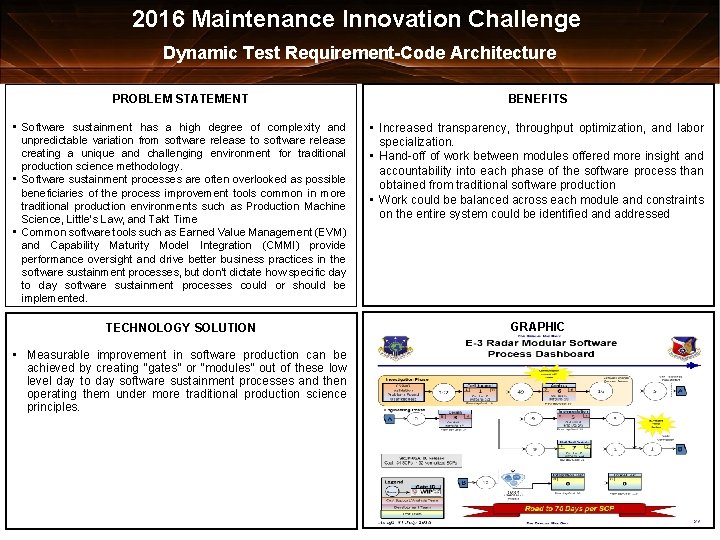
2016 Maintenance Innovation Challenge Dynamic Test Requirement-Code Architecture PROBLEM STATEMENT BENEFITS • Software sustainment has a high degree of complexity and unpredictable variation from software release to software release creating a unique and challenging environment for traditional production science methodology. • Software sustainment processes are often overlooked as possible beneficiaries of the process improvement tools common in more traditional production environments such as Production Machine Science, Little’s Law, and Takt Time • Common software tools such as Earned Value Management (EVM) and Capability Maturity Model Integration (CMMI) provide performance oversight and drive better business practices in the software sustainment processes, but don’t dictate how specific day to day software sustainment processes could or should be implemented. • Increased transparency, throughput optimization, and labor specialization. • Hand-off of work between modules offered more insight and accountability into each phase of the software process than obtained from traditional software production • Work could be balanced across each module and constraints on the entire system could be identified and addressed TECHNOLOGY SOLUTION GRAPHIC • Measurable improvement in software production can be achieved by creating “gates” or “modules” out of these low level day to day software sustainment processes and then operating them under more traditional production science principles.