
2016 by Pearson Education Inc Chapter 14 Empirical

© 2016 by Pearson Education, Inc.
Chapter 14 Empirical Reasoning THINK CRITICALLY, FACIONE & GITTENS © 2016 by Pearson Education, Inc.
Learning Outcomes • Explain empirical reasoning and how it works as a self-corrective process • Apply empirical reasoning correctly • Describe the uses, benefits, and risks of empirical reasoning THINK CRITICALLY, FACIONE & GITTENS © 2016 by Pearson Education, Inc.
Chapter Opening Video THINK CRITICALLY, FACIONE & GITTENS © 2016 by Pearson Education, Inc.
Recognizing Empirical Reasoning • Characteristics of empirical reasoning • Hypotheses, conditions, and measurable manifestations THINK CRITICALLY, FACIONE & GITTENS © 2016 by Pearson Education, Inc.
Characteristics of Empirical Reasoning • Empirical reasoning – Inductive – Self-corrective – Open to scrutiny and independent verification THINK CRITICALLY, FACIONE & GITTENS © 2016 by Pearson Education, Inc.
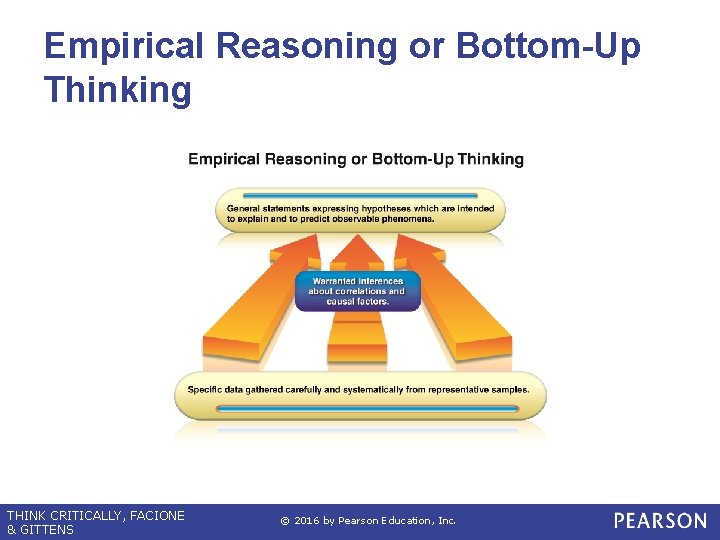
Empirical Reasoning or Bottom-Up Thinking THINK CRITICALLY, FACIONE & GITTENS © 2016 by Pearson Education, Inc.
Hypotheses, Conditions, and Measurable Manifestations • Hypothesis can be expressed as a supposition or a general statement • Null hypothesis: Two phenomena are entirely unrelated except by random chance • Empirical reasoning arguments describe states of affairs created experimentally or measured in natural settings THINK CRITICALLY, FACIONE & GITTENS © 2016 by Pearson Education, Inc.
Conducting an Investigation Scientifically • Steps in the process - An extended example • Evaluating empirical reasoning THINK CRITICALLY, FACIONE & GITTENS © 2016 by Pearson Education, Inc.
Steps in the Process - An Extended Example • • Identify a problem of significance Form a hypothesis Review the scientific literature Identify all factors related to the hypothesis and the phenomenon of interest THINK CRITICALLY, FACIONE & GITTENS © 2016 by Pearson Education, Inc.
Steps in the Process - An Extended Example • Make each factor measurable • Ensure that the experimental conditions can be met THINK CRITICALLY, FACIONE & GITTENS © 2016 by Pearson Education, Inc.
Steps in the Process - An Extended Example • Design a procedure • Run a pilot study • Conduct the study/experiment and gather the data • Conduct appropriate analyses of the data • Interpret the findings and discuss their significance THINK CRITICALLY, FACIONE & GITTENS © 2016 by Pearson Education, Inc.
Steps in the Process - An Extended Example • Critique the findings • Publish the research • Design a follow up study THINK CRITICALLY, FACIONE & GITTENS © 2016 by Pearson Education, Inc.
Evaluating Empirical Reasoning • Tests to determine the worthiness of an argument – Truthfulness of the premises – Test for logical strength – Test of relevancy and test of non-circularity – Peer review THINK CRITICALLY, FACIONE & GITTENS © 2016 by Pearson Education, Inc.
Benefits and Risks Associated with Empirical Reasoning • Used when an individual wants to explain, predict or control what happens – Accurate predictions enable people to anticipate what is likely to happen under certain conditions • Can be complicated, errors can occur – Confirmatory findings support a hypothesis THINK CRITICALLY, FACIONE & GITTENS © 2016 by Pearson Education, Inc.
Benefits and Risks Associated with Empirical Reasoning • Group endeavors - Empirical investigation, and the application of critical thinking skills and habits of mind to scientific inquiry • Empirical reasoning self-monitors and selfcorrects through independent inquiry THINK CRITICALLY, FACIONE & GITTENS © 2016 by Pearson Education, Inc.
Discussion Question • “Science is a way to keep from fooling ourselves -- and each other” - Anne Druyan, Executive Producer, & Steven Soter, Astrophysicist – What are they referring to? Give an example THINK CRITICALLY, FACIONE & GITTENS © 2016 by Pearson Education, Inc.
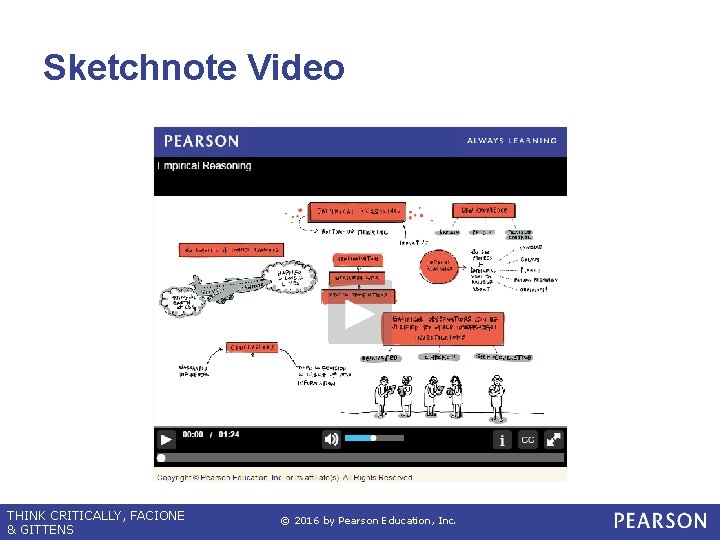
Sketchnote Video THINK CRITICALLY, FACIONE & GITTENS © 2016 by Pearson Education, Inc.
- Slides: 18