
20153486 Changju Lee Visual System Neural Network Lab
20153486 Changju Lee Visual System Neural Network Lab. Department of Bio and Brain Engineering

Content • Introduction - Neural oscillation & Neural synchronization - Schizophrenia (SCZ) • Result - Neural oscillation in SCZ - Neurobiology of abnormal oscillations - Neurodevelopmental hypothesis of SCZ • Conclusion
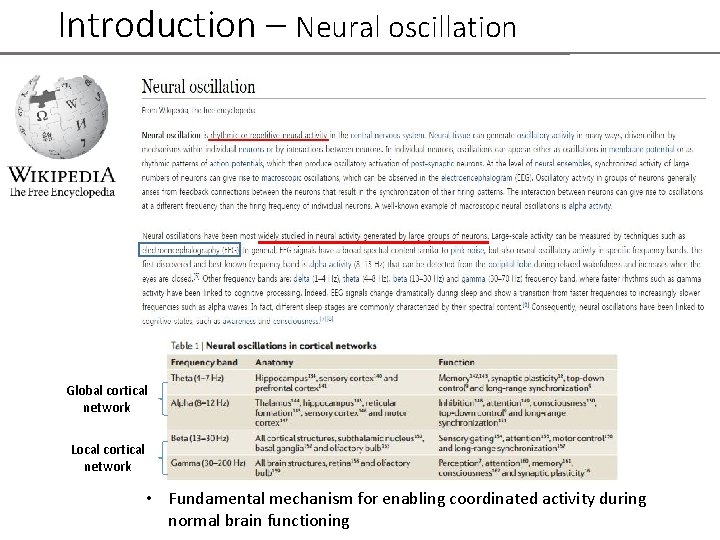
Introduction – Neural oscillation Global cortical network Local cortical network • Fundamental mechanism for enabling coordinated activity during normal brain functioning
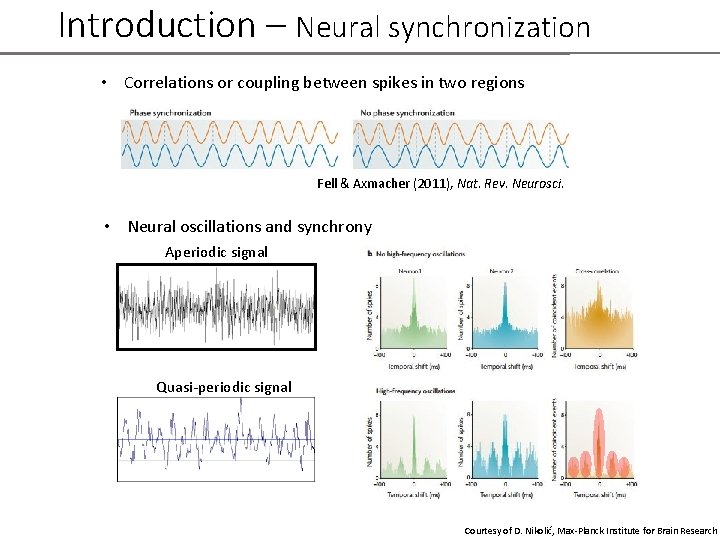
Introduction – Neural synchronization • Correlations or coupling between spikes in two regions Fell & Axmacher (2011), Nat. Rev. Neurosci. • Neural oscillations and synchrony Aperiodic signal Quasi-periodic signal Courtesy of D. Nikolić, Max-Planck Institute for Brain Research
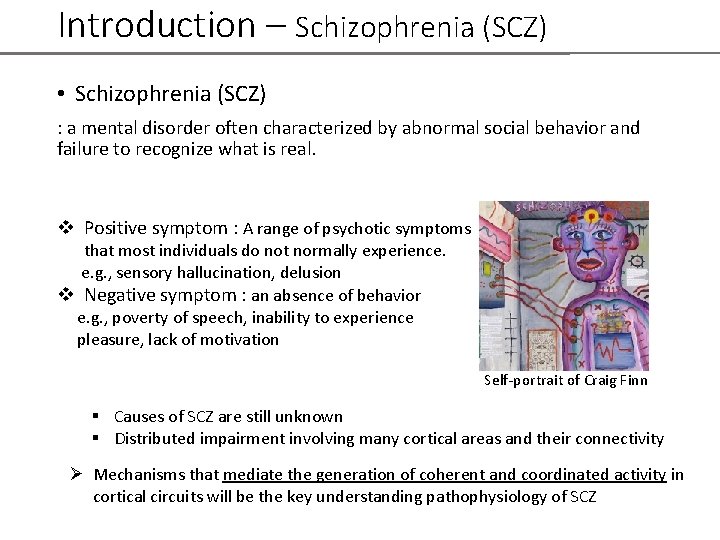
Introduction – Schizophrenia (SCZ) • Schizophrenia (SCZ) : a mental disorder often characterized by abnormal social behavior and failure to recognize what is real. v Positive symptom : A range of psychotic symptoms that most individuals do not normally experience. e. g. , sensory hallucination, delusion v Negative symptom : an absence of behavior e. g. , poverty of speech, inability to experience pleasure, lack of motivation Self-portrait of Craig Finn § Causes of SCZ are still unknown § Distributed impairment involving many cortical areas and their connectivity Ø Mechanisms that mediate the generation of coherent and coordinated activity in cortical circuits will be the key understanding pathophysiology of SCZ
In this review article, Ø Role of dysfunctional neural oscillations in SCZ with EEG and MEG Ø Possible neurobiological causes of impaired oscillations of SCZ Ø Neurodevelopmental hypothesis and oscillations of SCZ
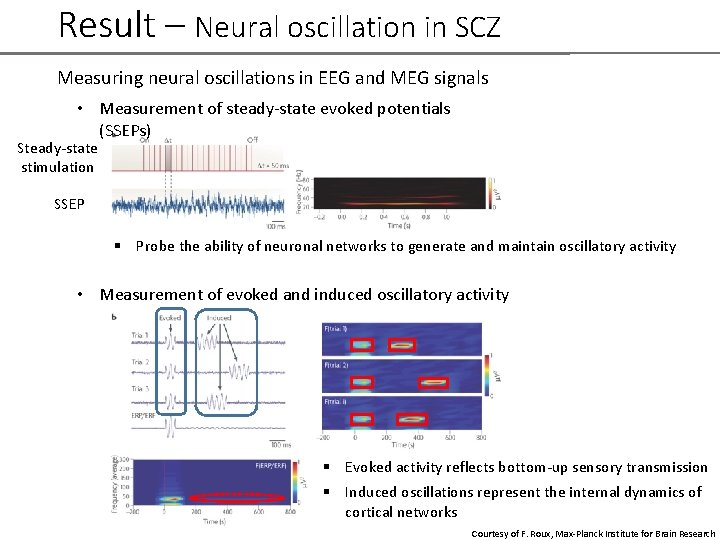
Result – Neural oscillation in SCZ Measuring neural oscillations in EEG and MEG signals • Measurement of steady-state evoked potentials (SSEPs) Steady-state stimulation SSEP § Probe the ability of neuronal networks to generate and maintain oscillatory activity • Measurement of evoked and induced oscillatory activity § Evoked activity reflects bottom-up sensory transmission § Induced oscillations represent the internal dynamics of cortical networks Courtesy of F. Roux, Max-Planck Institute for Brain Research
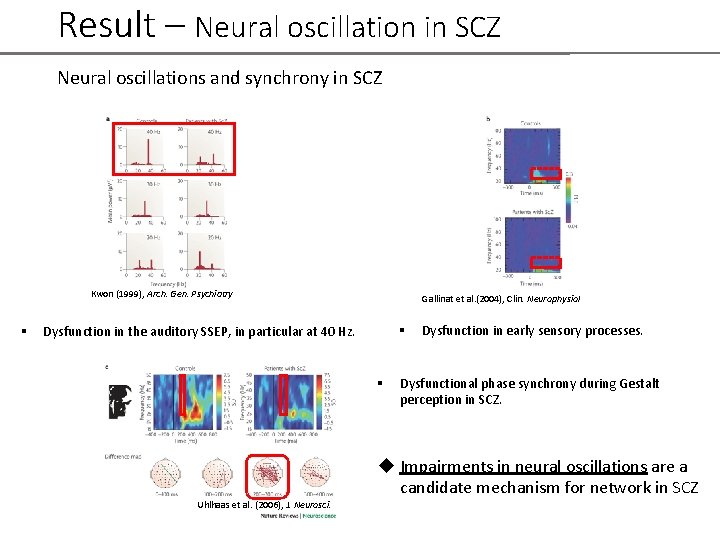
Result – Neural oscillation in SCZ Neural oscillations and synchrony in SCZ Kwon (1999), Arch. Gen. Psychiatry § Gallinat et al. (2004), Clin. Neurophysiol Dysfunction in the auditory SSEP, in particular at 40 Hz. § § Dysfunction in early sensory processes. Dysfunctional phase synchrony during Gestalt perception in SCZ. u Impairments in neural oscillations are a candidate mechanism for network in SCZ Uhlhaas et al. (2006), J. Neurosci.
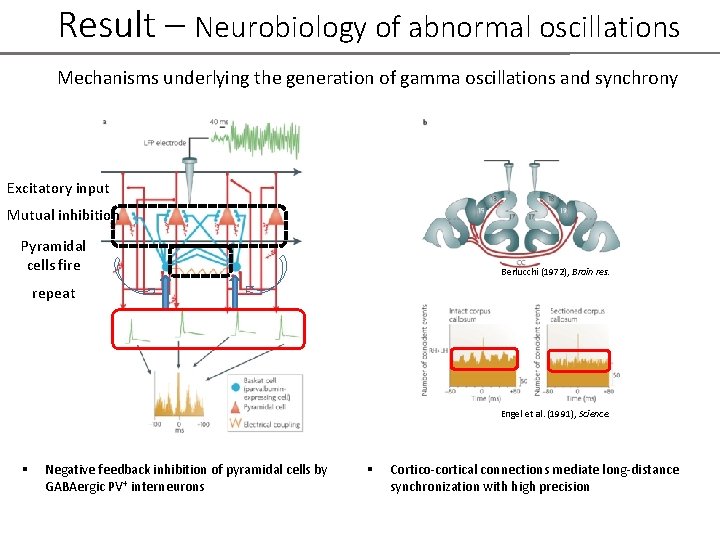
Result – Neurobiology of abnormal oscillations Mechanisms underlying the generation of gamma oscillations and synchrony Excitatory input Mutual inhibition Pyramidal cells fire Berlucchi (1972), Brain res. repeat Engel et al. (1991), Science. § Negative feedback inhibition of pyramidal cells by GABAergic PV+ interneurons § Cortico-cortical connections mediate long-distance synchronization with high precision
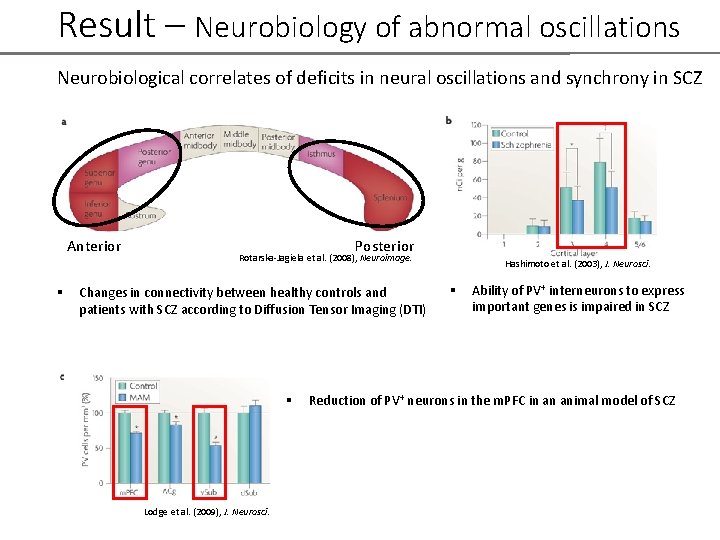
Result – Neurobiology of abnormal oscillations Neurobiological correlates of deficits in neural oscillations and synchrony in SCZ Anterior § Posterior Rotarska-Jagiela et al. (2008), Neuroimage. Changes in connectivity between healthy controls and patients with SCZ according to Diffusion Tensor Imaging (DTI) § Lodge et al. (2009), J. Neurosci. Hashimoto et al. (2003), J. Neurosci. § Ability of PV+ interneurons to express important genes is impaired in SCZ Reduction of PV+ neurons in the m. PFC in an animal model of SCZ
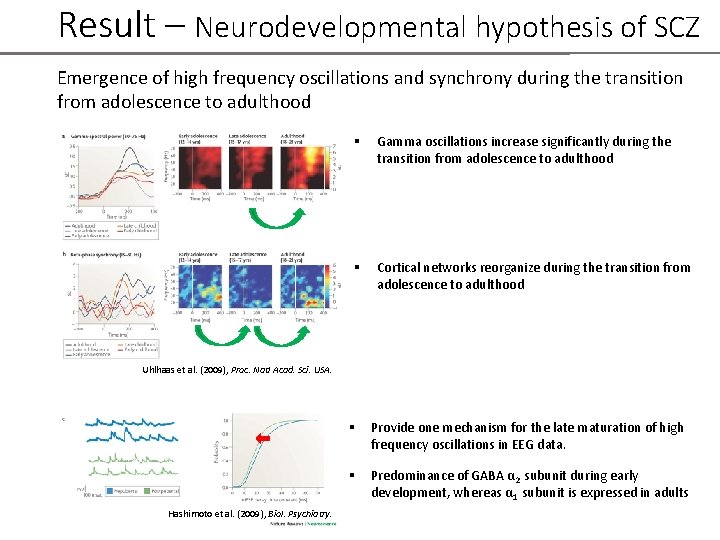
Result – Neurodevelopmental hypothesis of SCZ Emergence of high frequency oscillations and synchrony during the transition from adolescence to adulthood § Gamma oscillations increase significantly during the transition from adolescence to adulthood § Cortical networks reorganize during the transition from adolescence to adulthood Uhlhaas et al. (2009), Proc. Natl Acad. Sci. USA. Hashimoto et al. (2009), Biol. Psychiatry. § Provide one mechanism for the late maturation of high frequency oscillations in EEG data. § Predominance of GABA α 2 subunit during early development, whereas α 1 subunit is expressed in adults
Conclusion ü Abnormalities in the synchronized oscillatory activity of neurons may have a central role in the pathophysiology of SCZ ü PV+ interneurons generate gamma oscillation synchrony in local neural networks, and corpus callosum transmits Interhemispheric information with high precision ü SCZ is characterized by abnormal brain maturation at several stages of development, and typically manifests during late adolescence and early adulthood

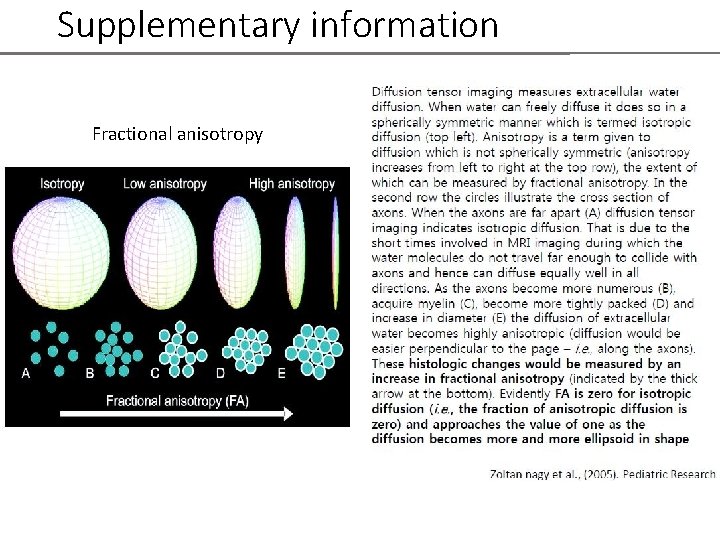
Supplementary information Fractional anisotropy
- Slides: 14