
2015 RADIATION SAFETY REFRESHER TRAINING FOR GRU USERS

- Slides: 31
2015 RADIATION SAFETY REFRESHER TRAINING FOR GRU USERS OF RADIOACTIVE MATERIAL Radiation Safety Office Environmental Health and Safety Division
Course Content • Radiation Safety • Radiation Dose Limits and Dosimetry • Postings for Laboratories Using Radioactive Materials • Laboratory Surveys • Other Topics Radiation Safety Office
Radiation Safety Office
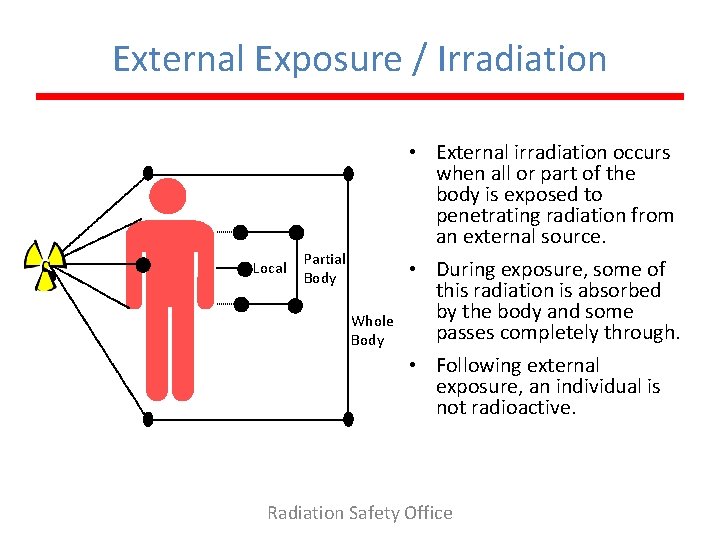
External Exposure / Irradiation s · ·Local Partial Body · · Whole Body • External irradiation occurs when all or part of the body is exposed to penetrating radiation from an external source. • During exposure, some of this radiation is absorbed by the body and some passes completely through. • Following external exposure, an individual is not radioactive. Radiation Safety Office
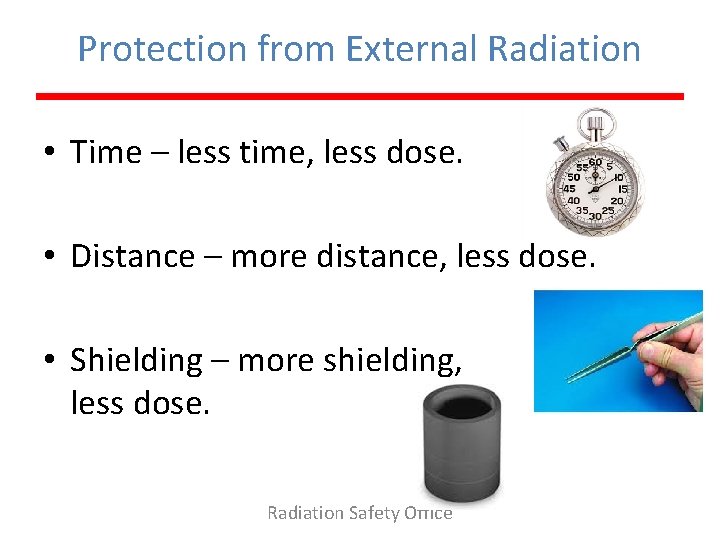
Protection from External Radiation • Time – less time, less dose. • Distance – more distance, less dose. • Shielding – more shielding, less dose. Radiation Safety Office
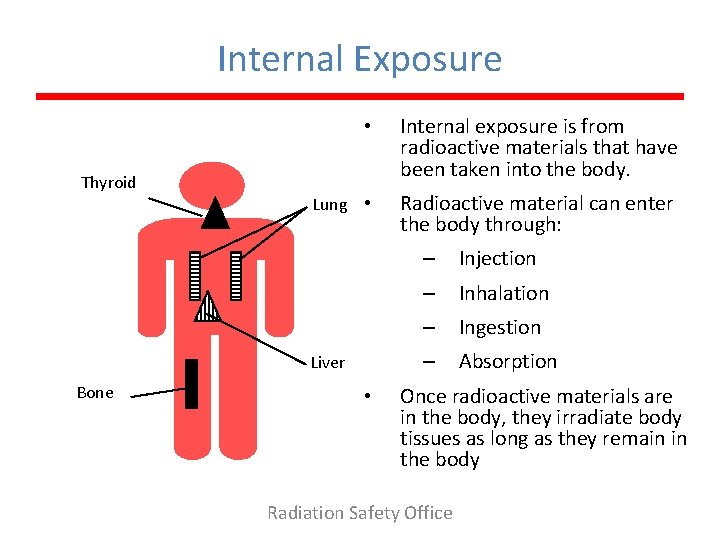
Internal Exposure Thyroid Lung • Internal exposure is from radioactive materials that have been taken into the body. • Radioactive material can enter the body through: Liver Bone • – Injection – Inhalation – Ingestion – Absorption Once radioactive materials are in the body, they irradiate body tissues as long as they remain in the body Radiation Safety Office
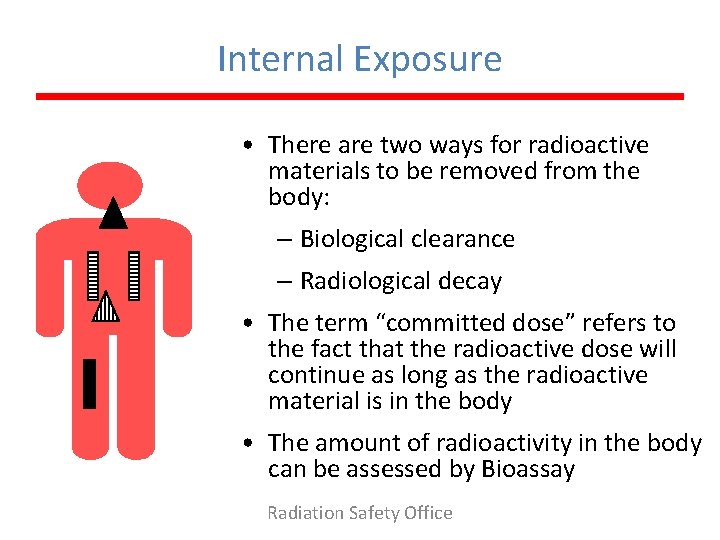
Internal Exposure • There are two ways for radioactive materials to be removed from the body: – Biological clearance – Radiological decay • The term “committed dose” refers to the fact that the radioactive dose will continue as long as the radioactive material is in the body • The amount of radioactivity in the body can be assessed by Bioassay Radiation Safety Office
Radiation Dose Limits and Dosimetry Radiation Safety Office
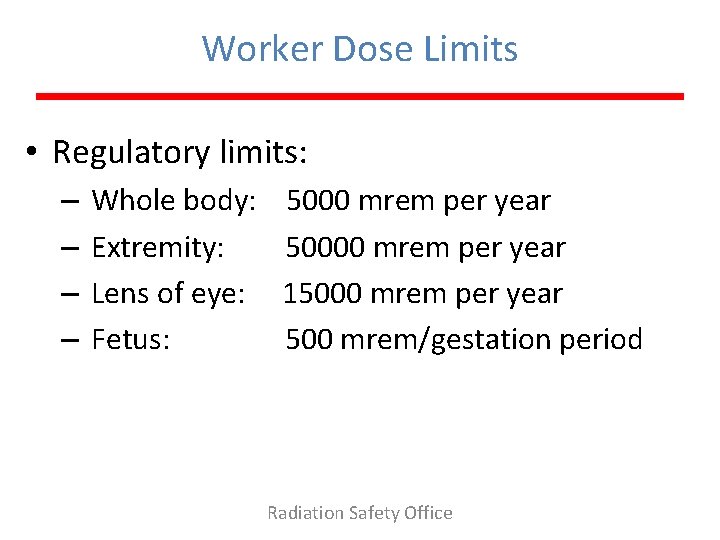
Worker Dose Limits • Regulatory limits: – – Whole body: Extremity: Lens of eye: Fetus: 5000 mrem per year 50000 mrem per year 15000 mrem per year 500 mrem/gestation period Radiation Safety Office
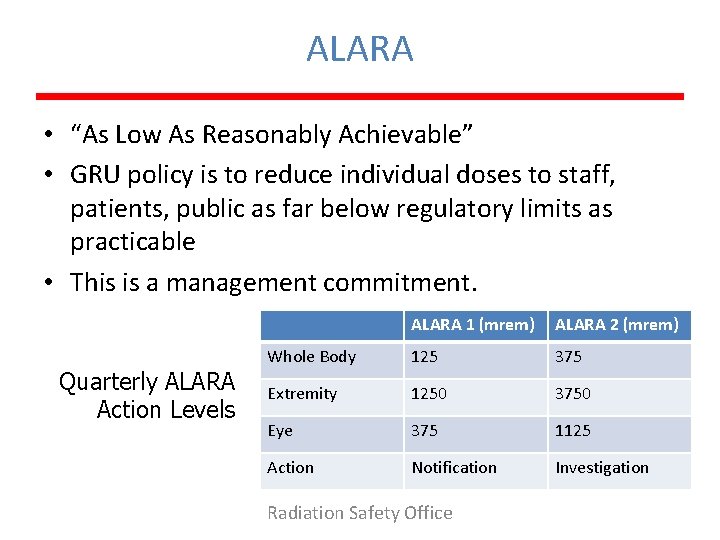
ALARA • “As Low As Reasonably Achievable” • GRU policy is to reduce individual doses to staff, patients, public as far below regulatory limits as practicable • This is a management commitment. Quarterly ALARA Action Levels ALARA 1 (mrem) ALARA 2 (mrem) Whole Body 125 375 Extremity 1250 3750 Eye 375 1125 Action Notification Investigation Radiation Safety Office
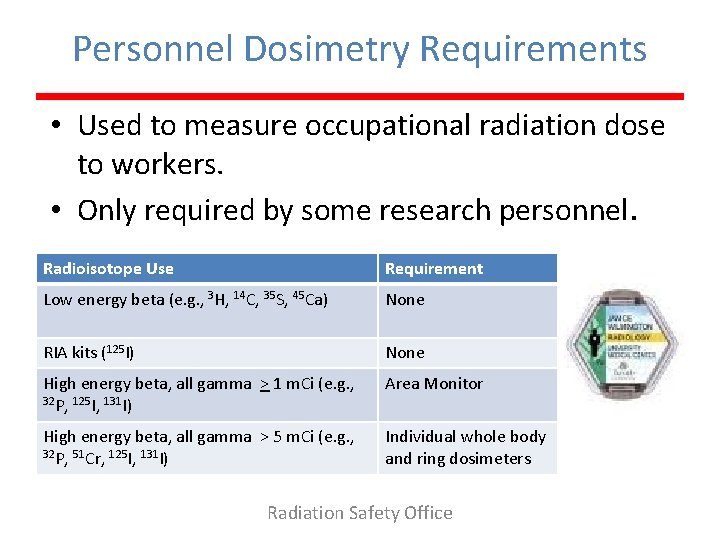
Personnel Dosimetry Requirements • Used to measure occupational radiation dose to workers. • Only required by some research personnel. Radioisotope Use Requirement Low energy beta (e. g. , 3 H, 14 C, 35 S, 45 Ca) None RIA kits (125 I) None High energy beta, all gamma > 1 m. Ci (e. g. , 32 P, 125 I, 131 I) Area Monitor High energy beta, all gamma > 5 m. Ci (e. g. , 32 P, 51 Cr, 125 I, 131 I) Individual whole body and ring dosimeters Radiation Safety Office
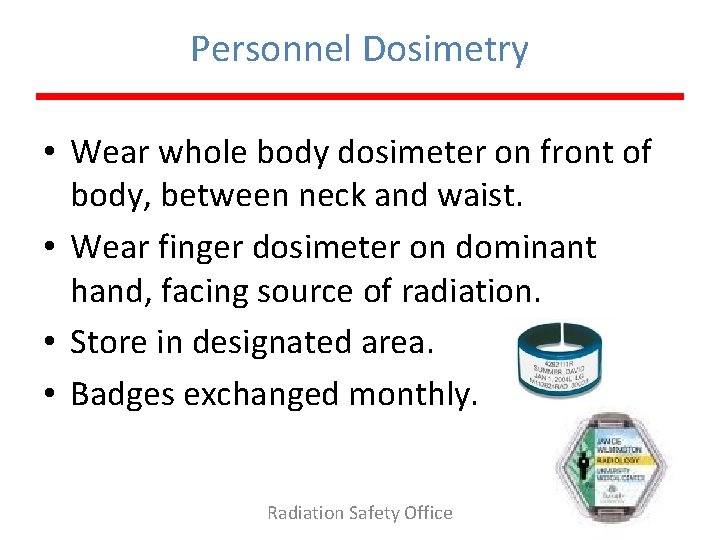
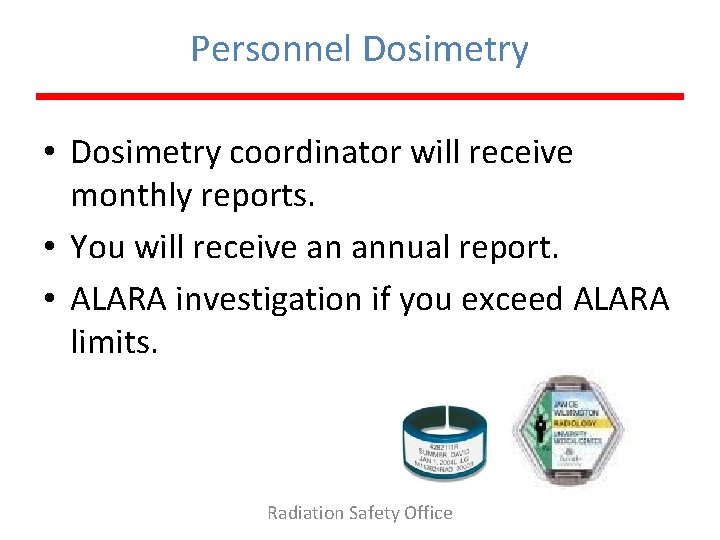
Personnel Dosimetry • Wear whole body dosimeter on front of body, between neck and waist. • Wear finger dosimeter on dominant hand, facing source of radiation. • Store in designated area. • Badges exchanged monthly. Radiation Safety Office
Personnel Dosimetry • Dosimetry coordinator will receive monthly reports. • You will receive an annual report. • ALARA investigation if you exceed ALARA limits. Radiation Safety Office
Pregnant Radiation Workers • May declare pregnancy (voluntary). • For declared pregnant rad workers: – Dose history review. – 500 mrem limit (to protect fetus). – Fetal monitoring badge. – Possible work limitations. – Monthly review by the Radiation Safety Office
Postings for Laboratories Using Radioactive Materials Radiation Safety Office
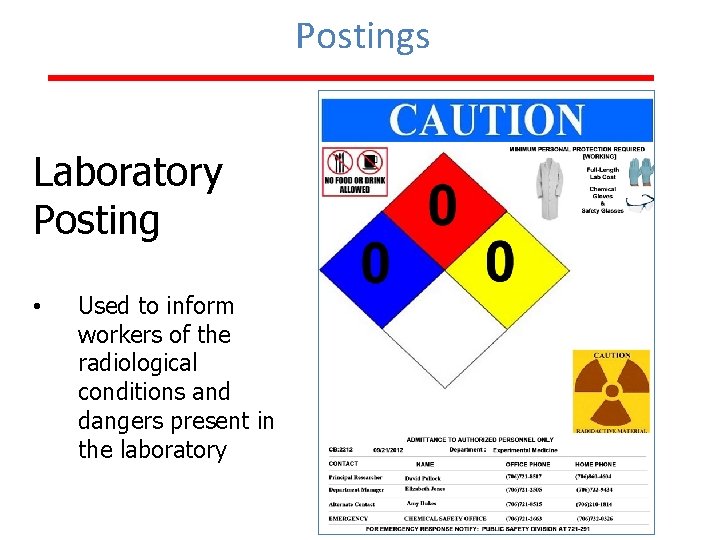
Postings Laboratory Posting • Used to inform workers of the radiological conditions and dangers present in the laboratory
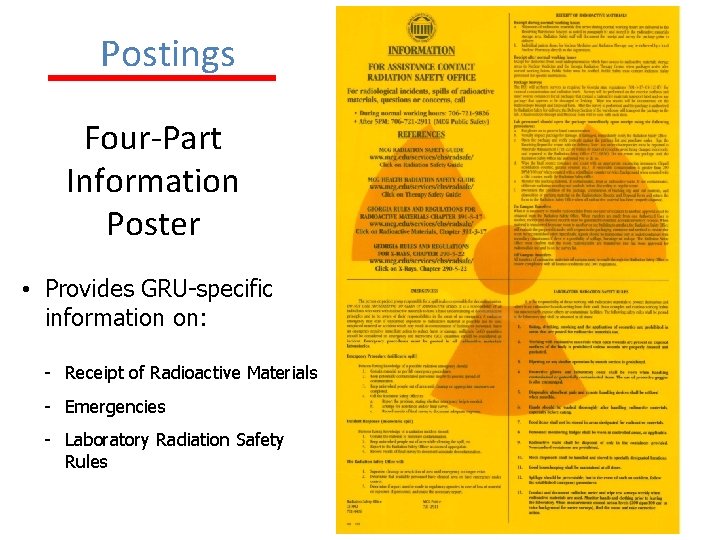
Postings Four-Part Information Poster • Provides GRU-specific information on: - Receipt of Radioactive Materials - Emergencies - Laboratory Radiation Safety Rules
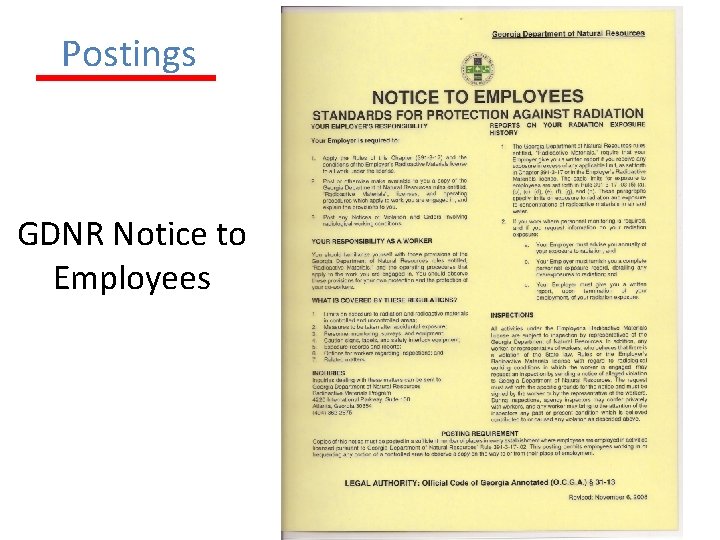
Postings GDNR Notice to Employees
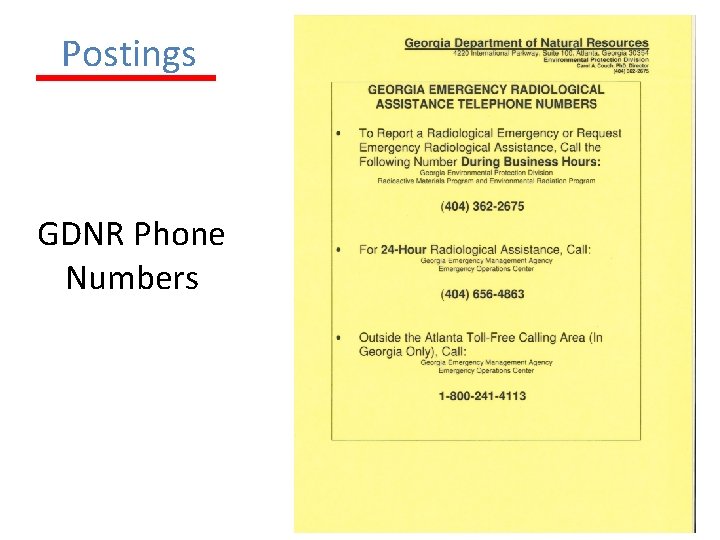
Postings GDNR Phone Numbers
Laboratory Surveys Radiation Safety Office
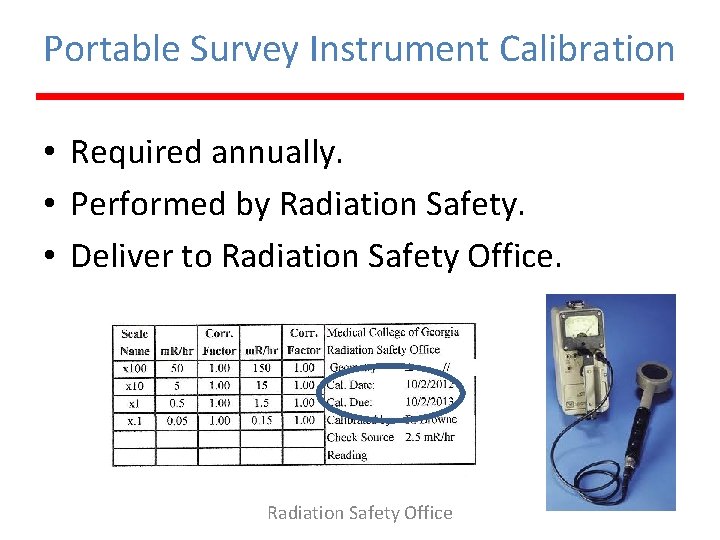
Portable Survey Instrument Calibration • Required annually. • Performed by Radiation Safety. • Deliver to Radiation Safety Office
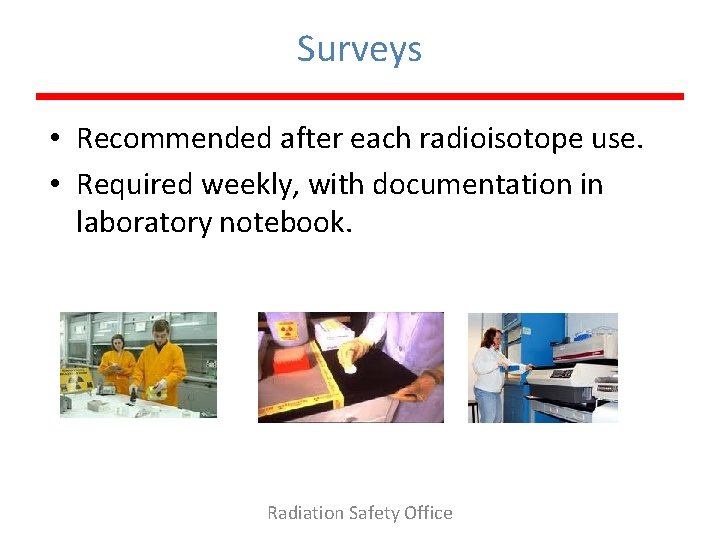
Surveys • Recommended after each radioisotope use. • Required weekly, with documentation in laboratory notebook. Radiation Safety Office
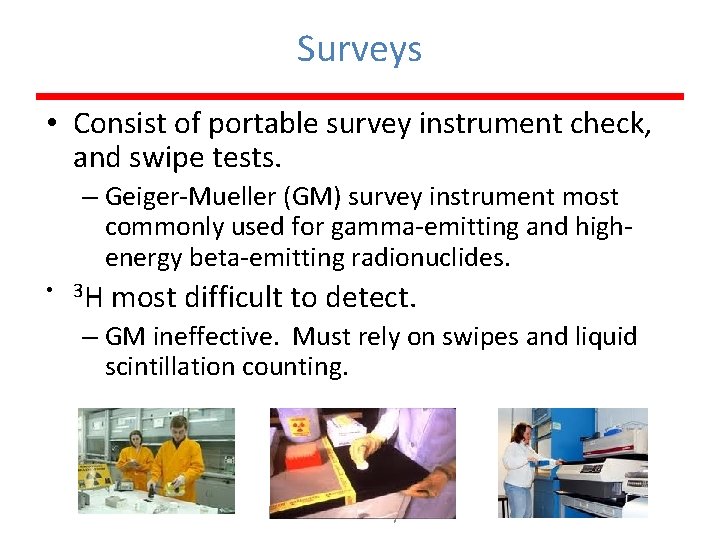
Surveys • Consist of portable survey instrument check, and swipe tests. – Geiger-Mueller (GM) survey instrument most commonly used for gamma-emitting and highenergy beta-emitting radionuclides. • 3 H most difficult to detect. – GM ineffective. Must rely on swipes and liquid scintillation counting. Radiation Safety Office
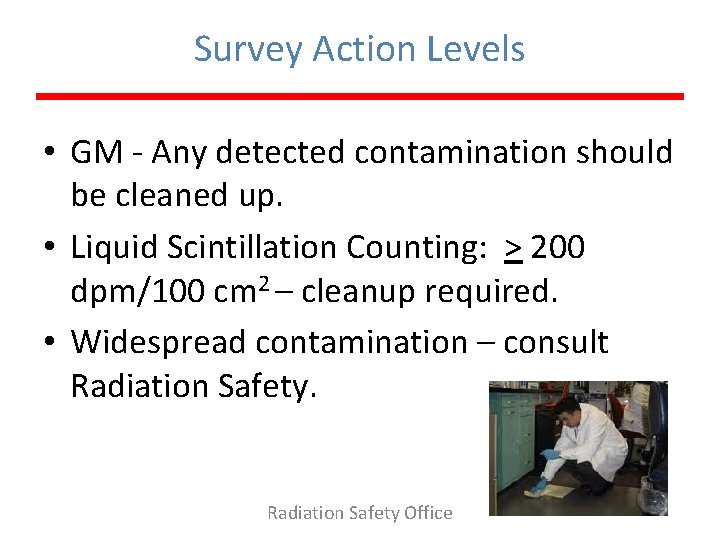
Survey Action Levels • GM - Any detected contamination should be cleaned up. • Liquid Scintillation Counting: > 200 dpm/100 cm 2 – cleanup required. • Widespread contamination – consult Radiation Safety Office
Other Topics Radiation Safety Office
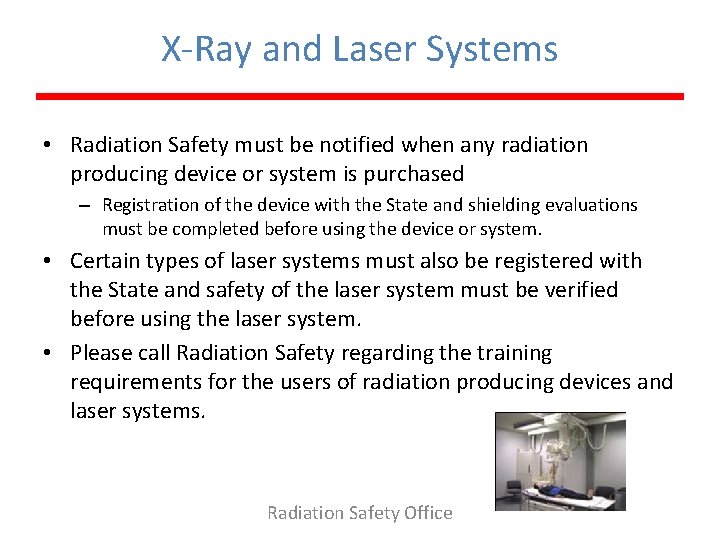
X-Ray and Laser Systems • Radiation Safety must be notified when any radiation producing device or system is purchased – Registration of the device with the State and shielding evaluations must be completed before using the device or system. • Certain types of laser systems must also be registered with the State and safety of the laser system must be verified before using the laser system. • Please call Radiation Safety regarding the training requirements for the users of radiation producing devices and laser systems. Radiation Safety Office
Emergencies • Lost or stolen radioactive material. • Major radioactive spills. • Contact Radiation Safety 706 -721 -9826 (706 -664 -8607 after hours), and Public Safety 706 -721 -2911 • In case of injury, medical treatment takes priority over contamination concerns. Radiation Safety Office
Reporting Non-compliances Report radiation and radioactive material non-compliances to the Radiation Safety Officer (706) 721 -9826 or (706) 664 -8607 after hours. Radiation Safety Office
License Location • The GRU Radioactive Material Licenses issued by the State of Georgia are maintained by the Radiation Safety Office • These documents are available for examination by GRU employees • Please call ahead (706 -721 -9826) to arrange a viewing of these documents Radiation Safety Office
Radiation Safety Office • Additional information or assistance. • CI Building. • http: //www. gru. edu/services/ehs/radsafe/ • (706) 721 -9826 normal business hours. • (706) 664 -8607 after hours. Radiation Safety Office
Please complete and submit the Quiz