
2015 National Disaster Life Support Foundation Inc All
- Slides: 34
© 2015 National Disaster Life Support Foundation, Inc. All rights reserved. BDLS® v. 3. 2
Session 4 – Lesson Eight Biologic Disasters © 2015 National Disaster Life Support Foundation, Inc. All rights reserved. BDLS® v. 3. 2
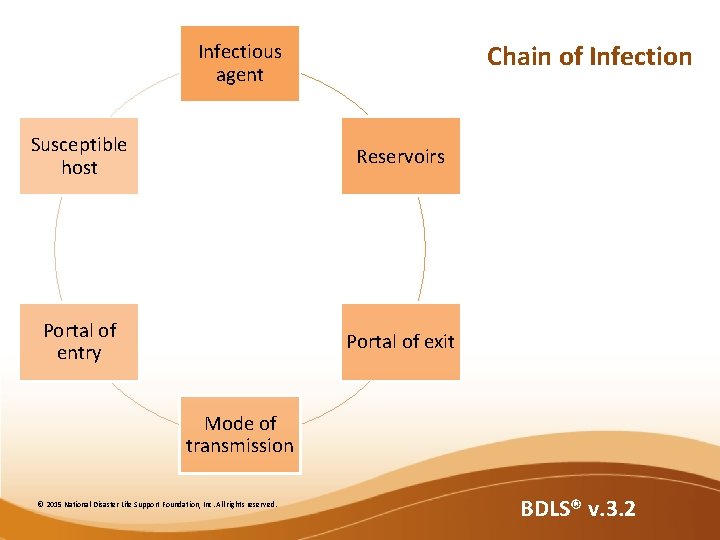
Objectives § Describe six key factors that compose the “chain of infection” § Identify clinical and epidemiologic clues suggestive of a biologic disaster § Discuss actions that can be taken to protect the health, safety, and security of responders and affected populations in a biologic disaster § Describe essential infection control strategies to prevent the spread of biologic agents § Discuss appropriate clinical management guidance for CDC category A biologic agents © 2015 National Disaster Life Support Foundation, Inc. All rights reserved. BDLS® v. 3. 2
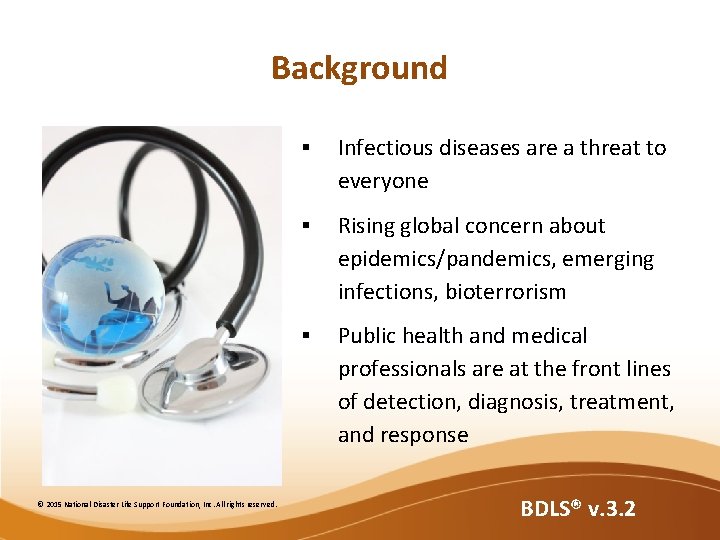
Background © 2015 National Disaster Life Support Foundation, Inc. All rights reserved. § Infectious diseases are a threat to everyone § Rising global concern about epidemics/pandemics, emerging infections, bioterrorism § Public health and medical professionals are at the front lines of detection, diagnosis, treatment, and response BDLS® v. 3. 2
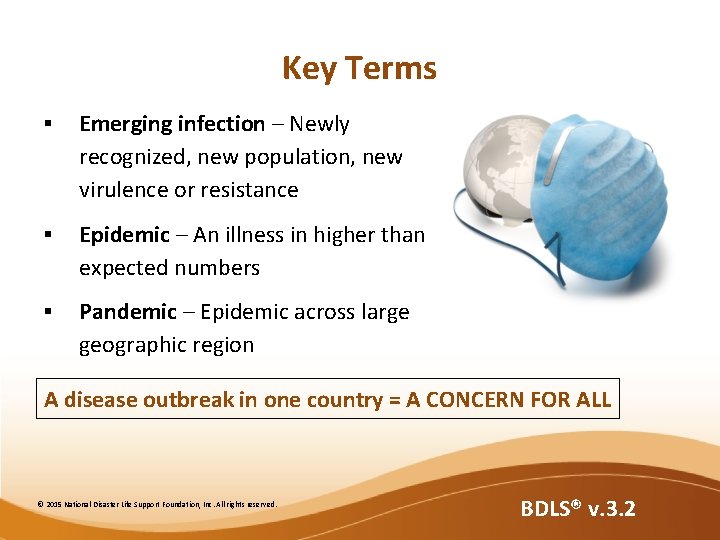
Key Terms § Emerging infection – Newly recognized, new population, new virulence or resistance § Epidemic – An illness in higher than expected numbers § Pandemic – Epidemic across large geographic region A disease outbreak in one country = A CONCERN FOR ALL © 2015 National Disaster Life Support Foundation, Inc. All rights reserved. BDLS® v. 3. 2
Chain of Infection Infectious agent Susceptible host Reservoirs Portal of entry Portal of exit Mode of transmission © 2015 National Disaster Life Support Foundation, Inc. All rights reserved. BDLS® v. 3. 2
Bioterrorism/Biowarfare § Both involve use of a biologic agent or product to cause harm – § A matter of scale Difficult to detect research, production, transportation of BT agents A criminal act that requires Public Health + Law Enforcement/military © 2015 National Disaster Life Support Foundation, Inc. All rights reserved. BDLS® v. 3. 2
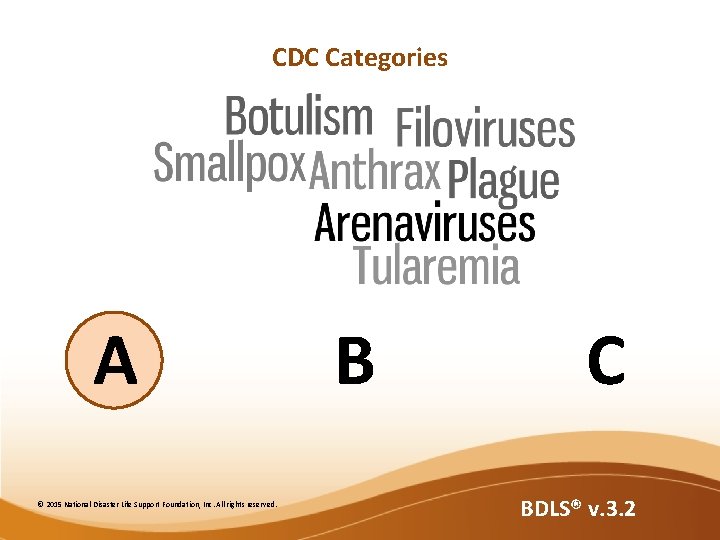
CDC Categories A © 2015 National Disaster Life Support Foundation, Inc. All rights reserved. B C BDLS® v. 3. 2
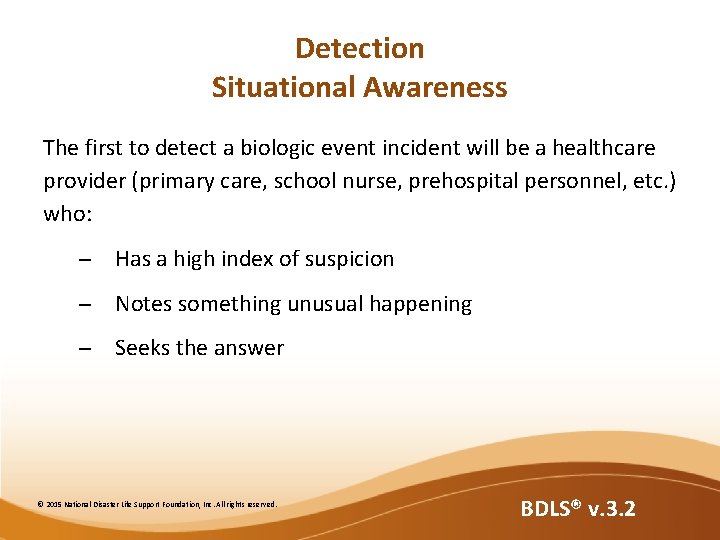
Detection Situational Awareness The first to detect a biologic event incident will be a healthcare provider (primary care, school nurse, prehospital personnel, etc. ) who: – Has a high index of suspicion – Notes something unusual happening – Seeks the answer © 2015 National Disaster Life Support Foundation, Inc. All rights reserved. BDLS® v. 3. 2
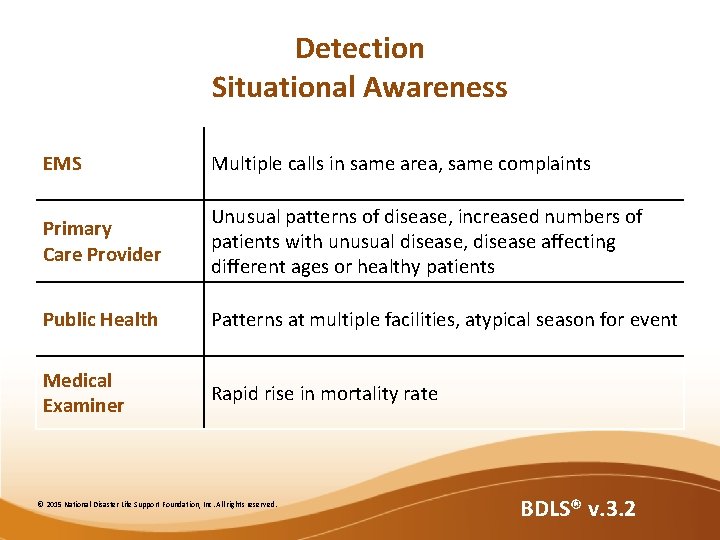
Detection Situational Awareness EMS Multiple calls in same area, same complaints Primary Care Provider Unusual patterns of disease, increased numbers of patients with unusual disease, disease affecting different ages or healthy patients Public Health Patterns at multiple facilities, atypical season for event Medical Examiner Rapid rise in mortality rate © 2015 National Disaster Life Support Foundation, Inc. All rights reserved. BDLS® v. 3. 2
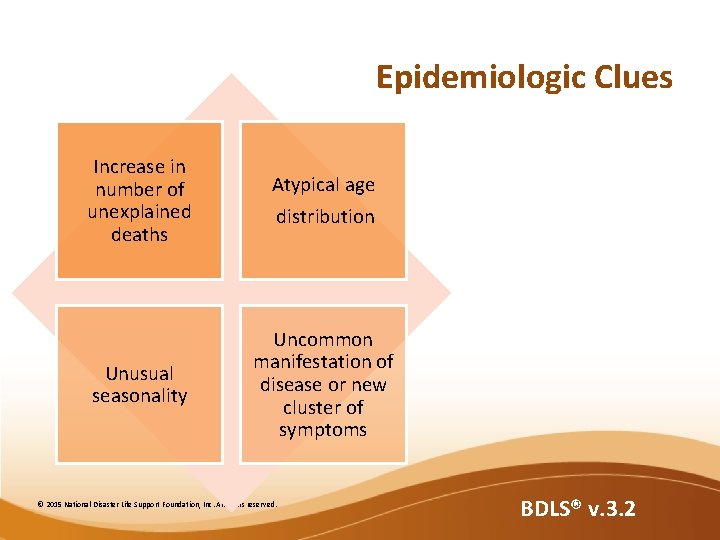
Epidemiologic Clues Increase in number of unexplained deaths Unusual seasonality Atypical age distribution Uncommon manifestation of disease or new cluster of symptoms © 2015 National Disaster Life Support Foundation, Inc. All rights reserved. BDLS® v. 3. 2
Detection Bioterrorism Agents § Victims initially may present with subtle symptoms or those resembling normal disease, such as flu-like symptoms § Few tests available for quick diagnosis © 2015 National Disaster Life Support Foundation, Inc. All rights reserved. BDLS® v. 3. 2
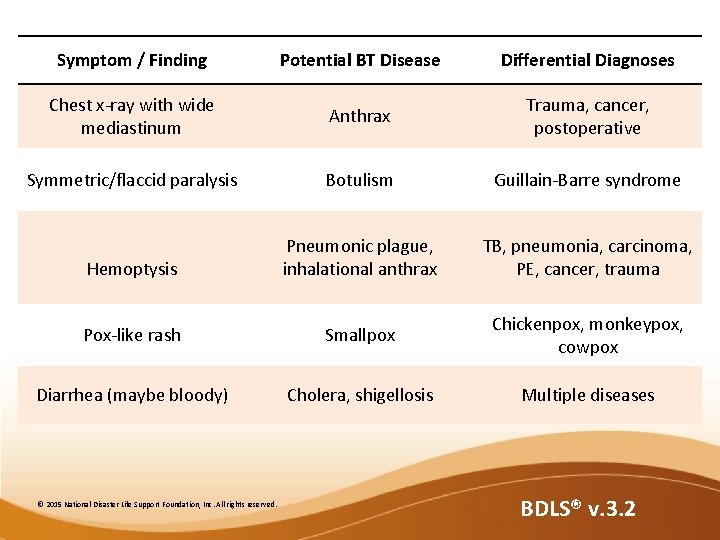
Symptom / Finding Potential BT Disease Differential Diagnoses Chest x-ray with wide mediastinum Anthrax Trauma, cancer, postoperative Symmetric/flaccid paralysis Botulism Guillain-Barre syndrome Hemoptysis Pneumonic plague, inhalational anthrax TB, pneumonia, carcinoma, PE, cancer, trauma Pox-like rash Smallpox Chickenpox, monkeypox, cowpox Diarrhea (maybe bloody) Cholera, shigellosis Multiple diseases © 2015 National Disaster Life Support Foundation, Inc. All rights reserved. BDLS® v. 3. 2
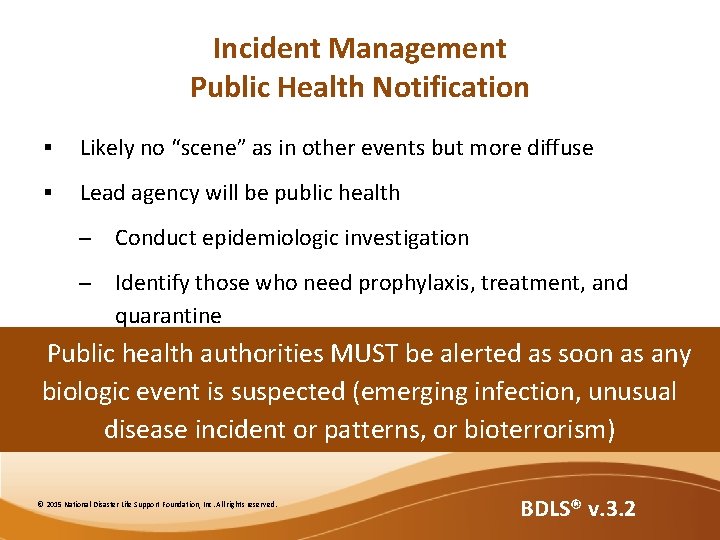
Incident Management Public Health Notification § Likely no “scene” as in other events but more diffuse § Lead agency will be public health – Conduct epidemiologic investigation – Identify those who need prophylaxis, treatment, and quarantine Public health authorities MUST be alerted as soon as any biologic event is suspected (emerging infection, unusual disease incident or patterns, or bioterrorism) © 2015 National Disaster Life Support Foundation, Inc. All rights reserved. BDLS® v. 3. 2
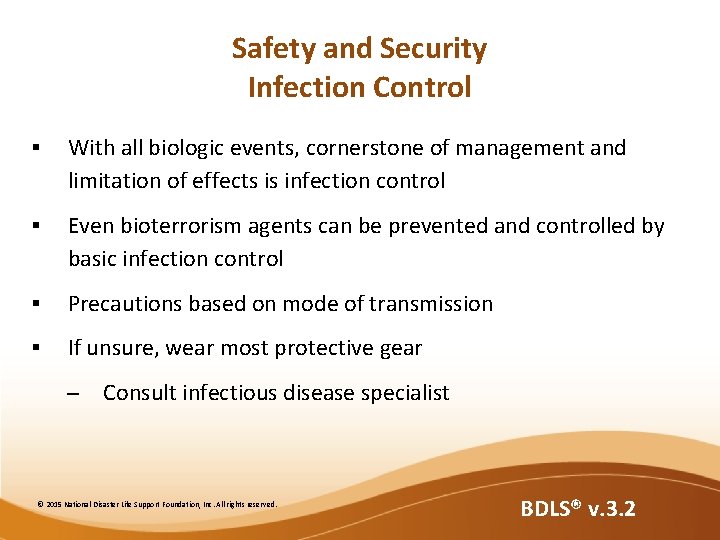
Safety and Security Infection Control § With all biologic events, cornerstone of management and limitation of effects is infection control § Even bioterrorism agents can be prevented and controlled by basic infection control § Precautions based on mode of transmission § If unsure, wear most protective gear – Consult infectious disease specialist © 2015 National Disaster Life Support Foundation, Inc. All rights reserved. BDLS® v. 3. 2
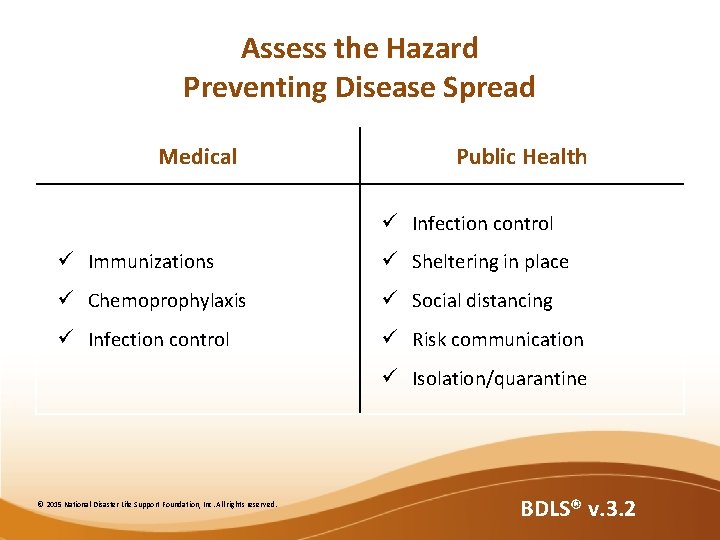
Assess the Hazard Preventing Disease Spread Medical Public Health ü Infection control ü Immunizations ü Sheltering in place ü Chemoprophylaxis ü Social distancing ü Infection control ü Risk communication ü Isolation/quarantine © 2015 National Disaster Life Support Foundation, Inc. All rights reserved. BDLS® v. 3. 2
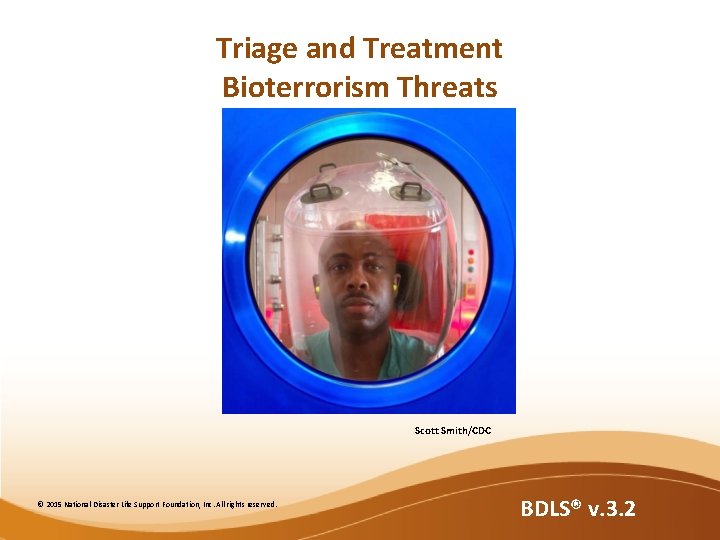
Triage and Treatment Bioterrorism Threats Scott Smith/CDC © 2015 National Disaster Life Support Foundation, Inc. All rights reserved. BDLS® v. 3. 2
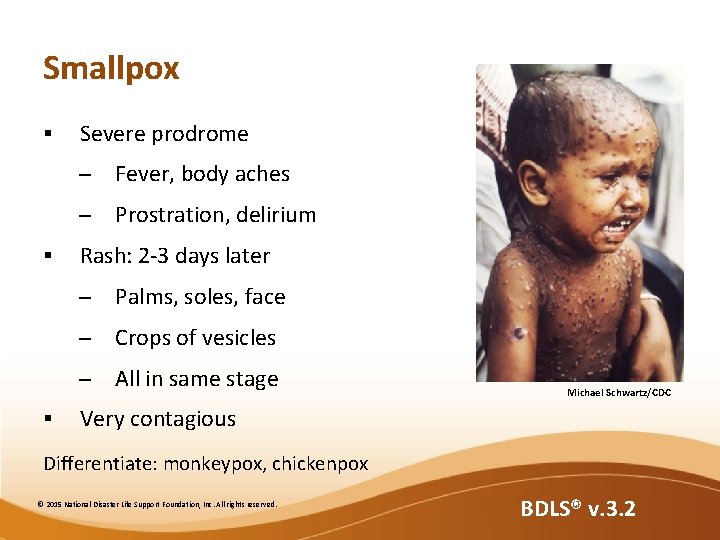
Smallpox § § § Severe prodrome – Fever, body aches – Prostration, delirium Rash: 2 -3 days later – Palms, soles, face – Crops of vesicles – All in same stage Michael Schwartz/CDC Very contagious Differentiate: monkeypox, chickenpox © 2015 National Disaster Life Support Foundation, Inc. All rights reserved. BDLS® v. 3. 2
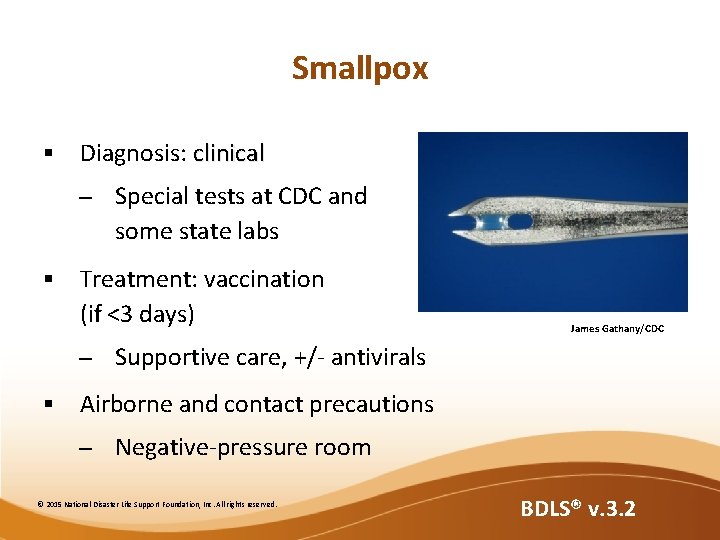
Smallpox § Diagnosis: clinical – § Treatment: vaccination (if <3 days) – § Special tests at CDC and some state labs James Gathany/CDC Supportive care, +/- antivirals Airborne and contact precautions – Negative-pressure room © 2015 National Disaster Life Support Foundation, Inc. All rights reserved. BDLS® v. 3. 2
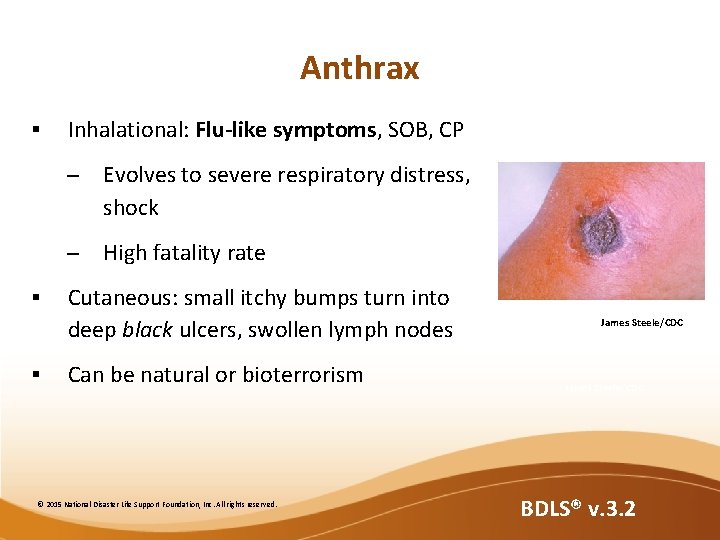
Anthrax § § § Inhalational: Flu-like symptoms, SOB, CP – Evolves to severe respiratory distress, shock – High fatality rate Cutaneous: small itchy bumps turn into deep black ulcers, swollen lymph nodes Can be natural or bioterrorism © 2015 National Disaster Life Support Foundation, Inc. All rights reserved. James Steele/CDC BDLS® v. 3. 2
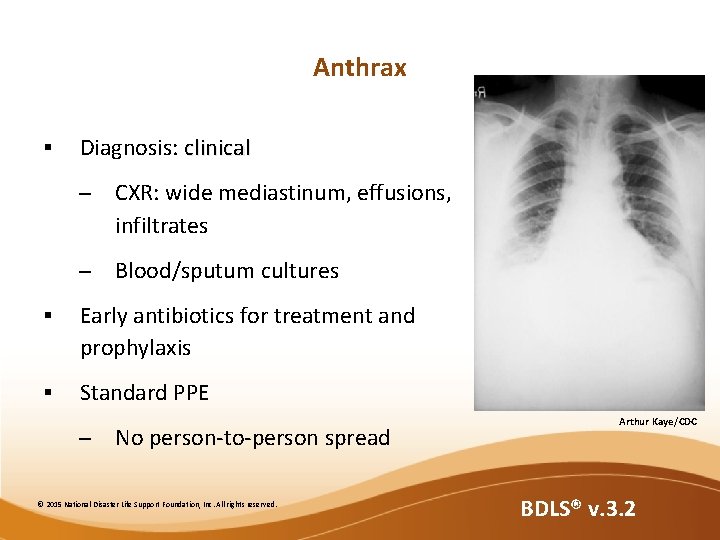
Anthrax § Diagnosis: clinical – CXR: wide mediastinum, effusions, infiltrates – Blood/sputum cultures § Early antibiotics for treatment and prophylaxis § Standard PPE – No person-to-person spread © 2015 National Disaster Life Support Foundation, Inc. All rights reserved. Arthur Kaye/CDC BDLS® v. 3. 2
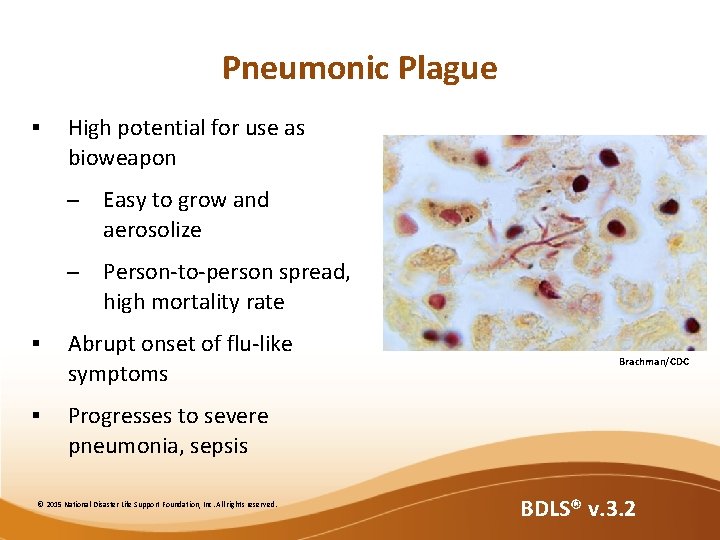
Pneumonic Plague § High potential for use as bioweapon – Easy to grow and aerosolize – Person-to-person spread, high mortality rate § Abrupt onset of flu-like symptoms § Progresses to severe pneumonia, sepsis © 2015 National Disaster Life Support Foundation, Inc. All rights reserved. Brachman/CDC BDLS® v. 3. 2
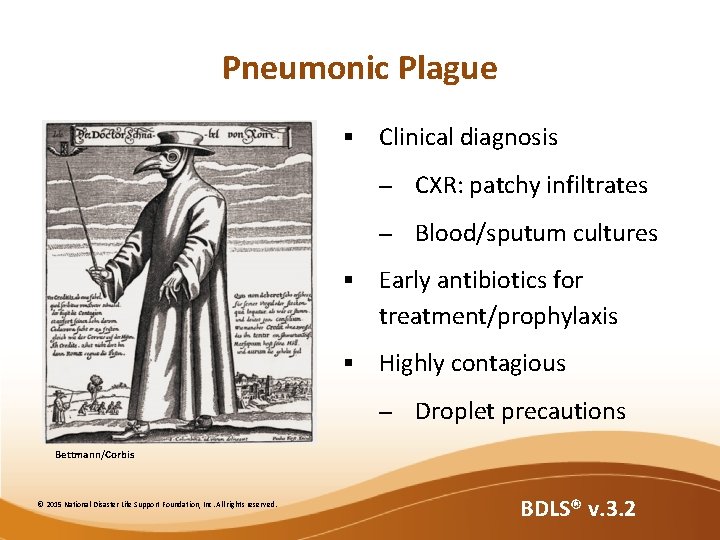
Pneumonic Plague § Clinical diagnosis – CXR: patchy infiltrates – Blood/sputum cultures § Early antibiotics for treatment/prophylaxis § Highly contagious – Droplet precautions Bettmann/Corbis © 2015 National Disaster Life Support Foundation, Inc. All rights reserved. BDLS® v. 3. 2
Botulism § § Gradual onset of symptoms – Facial paralysis – Difficulty speaking and swallowing – Blurry vision Progresses to muscle weakness, diaphragm paralysis © 2015 National Disaster Life Support Foundation, Inc. All rights reserved. BDLS® v. 3. 2
Botulism § Diagnosis: clinical – § Must stay on ventilator until toxin wears off – § Weeks to months Antitoxin available – § Confirmed by toxin assay Limited supply for episodic single cases Standard PPE – Not contagious © 2015 National Disaster Life Support Foundation, Inc. All rights reserved. BDLS® v. 3. 2
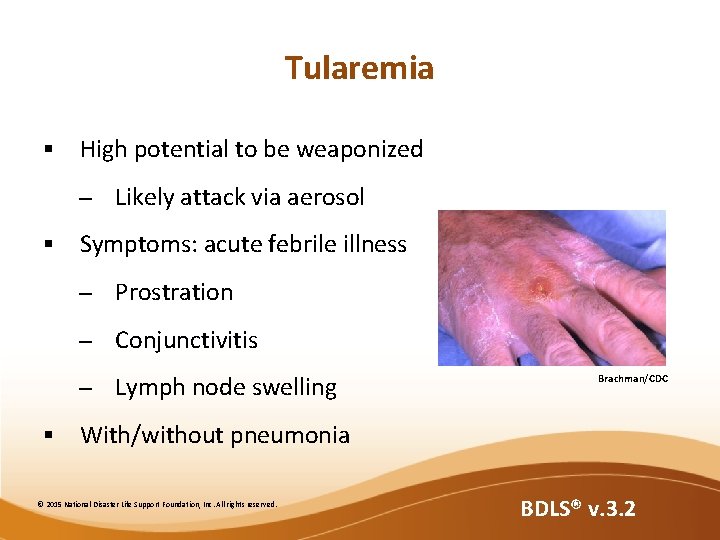
Tularemia § High potential to be weaponized – § § Likely attack via aerosol Symptoms: acute febrile illness – Prostration – Conjunctivitis – Lymph node swelling Brachman/CDC With/without pneumonia © 2015 National Disaster Life Support Foundation, Inc. All rights reserved. BDLS® v. 3. 2
Tularemia § Diagnosis: CLINICAL – Gram stain, cultures, antibody tests – 80% CXR with pneumonia § Treatment/prophylaxis with antibiotics § Standard PPE – Not contagious © 2015 National Disaster Life Support Foundation, Inc. All rights reserved. BDLS® v. 3. 2
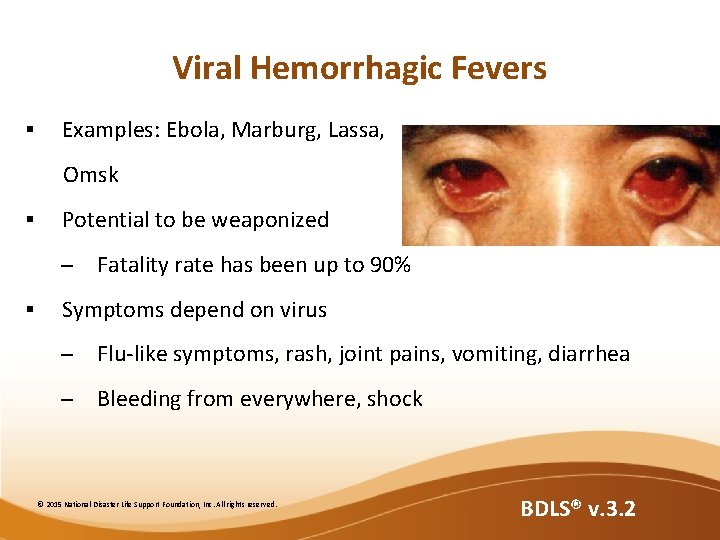
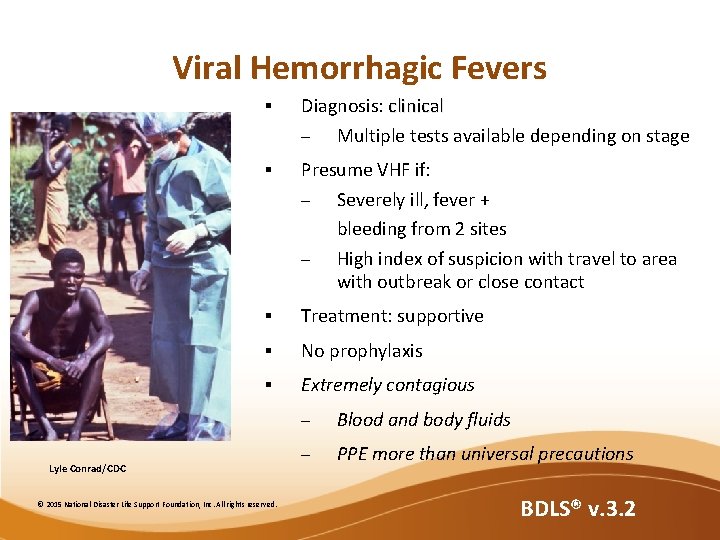
Viral Hemorrhagic Fevers § Examples: Ebola, Marburg, Lassa, Omsk § Potential to be weaponized – § Fatality rate has been up to 90% Symptoms depend on virus – Flu-like symptoms, rash, joint pains, vomiting, diarrhea – Bleeding from everywhere, shock © 2015 National Disaster Life Support Foundation, Inc. All rights reserved. BDLS® v. 3. 2
Viral Hemorrhagic Fevers § Diagnosis: clinical – Multiple tests available depending on stage § Presume VHF if: – Severely ill, fever + bleeding from 2 sites – High index of suspicion with travel to area with outbreak or close contact § Treatment: supportive § No prophylaxis § Extremely contagious Lyle Conrad/CDC © 2015 National Disaster Life Support Foundation, Inc. All rights reserved. – Blood and body fluids – PPE more than universal precautions BDLS® v. 3. 2
Triage and Treatment Summary § Recognition is key – any pattern outside norm § Different ages, severity, populations, symptoms, etc § Early on, most have flulike symptoms § Diagnosis clinical – requires high index of suspicion § Largely supportive treatment, some respond to antibiotics or vaccines § Responder safety and infection control paramount © 2015 National Disaster Life Support Foundation, Inc. All rights reserved. BDLS® v. 3. 2
Issues to Consider § § Vaccination, Chemoprophylaxis, and Treatment Medications – How many doses are available? – How easy is it to mass vaccinate? – Can you accomplish vaccination in time? Provider safety/infection control – Do you have enough PPE for multiple patients? – Is PPE worn 100% of the time? – How will you ensure compliance with prophylaxis? © 2015 National Disaster Life Support Foundation, Inc. All rights reserved. BDLS® v. 3. 2
Evacuation and Recovery • Evacuation – Issues with moving patients and protecting transporting staff – Issues with using public transportation to seek medical care – Issues with identifying receiving facilities capable and willing to accept patients © 2015 National Disaster Life Support Foundation, Inc. All rights reserved. • Recovery – Stop the reemergence of disease – Address stigma for both survivors and treatment facilities – Healthcare can be hardest hit sector for casualties BDLS® v. 3. 2
Lesson Summary § Biologic disasters require observation for both clinical and epidemiologic clues § There is increasing global concern about the possibility of bioterrorism § Medical and public health professionals play a key role in preparedness, early identification, and intervention © 2015 National Disaster Life Support Foundation, Inc. All rights reserved. BDLS® v. 3. 2
Questions? © 2015 National Disaster Life Support Foundation, Inc. All rights reserved. BDLS® v. 3. 2