
2015 International Energy Conservation Code Overview and Compliance
- Slides: 45
2015 International Energy Conservation Code Overview and Compliance Requirements 2016 COAA-MD/DC Fall Workshop Wednesday, October 5, 2016 10: 30 AM - 3: 30 PM Morgan State University Martha Shrader, LEED AP, BD+C Sustainability Manager University of Maryland College Park Facilities Management Design and Construction Technical Support 301 -405 -0575 shrader@umd. edu
2015 International Energy Conservation Code Learning Objectives • 2015 IECC Overview • 2015 IECC Compliance Paths (Commercial Code) • Documentation/Inspection Requirements (Commercial Code) • Beyond code – LEED, High Performance Building Program, campus goals
2015 International Energy Conservation Code Learning Objectives • 2015 IECC Overview • 2015 IECC Compliance Paths (Commercial Code) • Documentation/Inspection Requirements (Commercial Code) • Beyond code – LEED, High Performance Building Program, campus goals
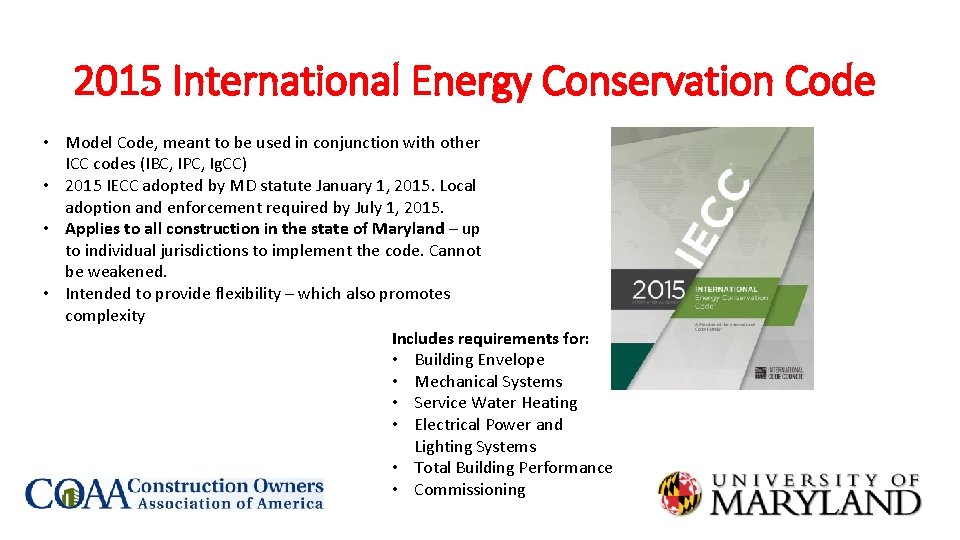
2015 International Energy Conservation Code • Model Code, meant to be used in conjunction with other ICC codes (IBC, IPC, Ig. CC) • 2015 IECC adopted by MD statute January 1, 2015. Local adoption and enforcement required by July 1, 2015. • Applies to all construction in the state of Maryland – up to individual jurisdictions to implement the code. Cannot be weakened. • Intended to provide flexibility – which also promotes complexity Includes requirements for: • Building Envelope • Mechanical Systems • Service Water Heating • Electrical Power and Lighting Systems • Total Building Performance • Commissioning
IECC Definitions • Addition: an extension or increase in the conditioned space floor area or height of a building or structure C 502. 1 General. Additions to an existing building, building system or portion thereof shall conform to the provisions of this code as those provisions relate to new construction without requiring the unaltered portion of the existing building or building system to comply with this code. • Repair: the reconstruction or renewal of any part of an existing building for the purpose of its maintenance or to correct damage Section 501. 3 Maintenance. Buildings and structures, and parts thereof, shall be maintained in a safe and sanitary condition. Devices and systems that are required by this code shall be maintained in conformance to the code edition under which it was installed…
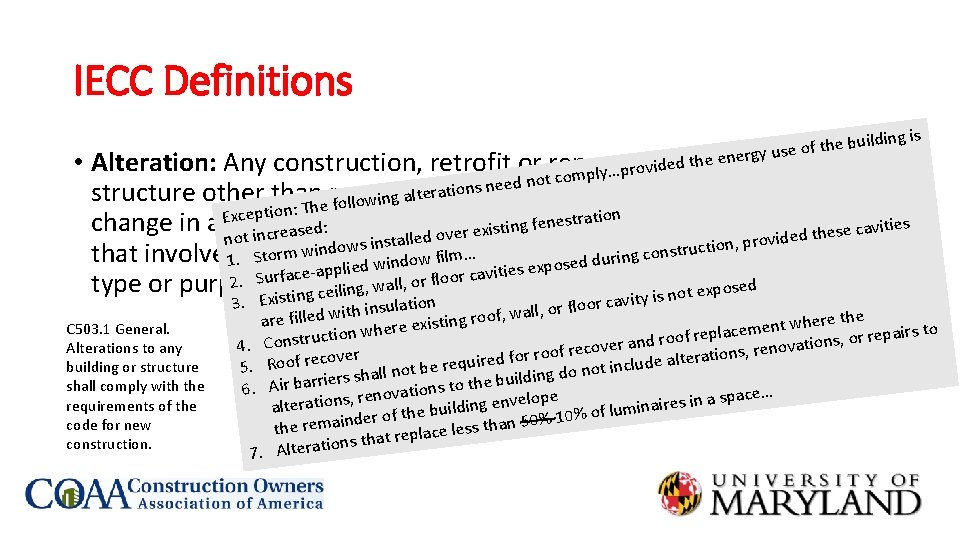
IECC Definitions is uilding b e h t f o e gy us the ener d e • Alteration: Any construction, retrofit or renovation to an existing id v o r p omply… c t o n d e e rations n e lt structure other than repair or addition that requires a permit. Also, a a g in w o he foll xception: T E nestration e f ies g change in a building, electrical, gas, mechanical or plumbing system it v in : t a d is c e x e s s a e e r h e c not in rovided t p nstalled ov , i n s io w t o c d u r in t that involves an extension, addition, or change to the arrangement, ing cons r u 1. Storm w plied window film… d d e s o p vities ex a c r rface-ap o u S lo f r. 2 type or purpose of the original installation that requires a permit. posed ing, wall, o x il e e t c o g n s in t i y is vit Ex or ca lation lo u f s r n o i , h ll it a w w ere the are filled h ting roof, is w x t e n e e r m e e h n w airs to plac p e io e t r f c r r o u r o o t , s r s n d n o n 4. C enovatio ecover a r r , f s o n o r io r t e r a v o r o f e c clude alt required n e i 5. Roof re t b t o o n n o ll d a iers sh uilding 6. Air barr , renovations to the b pace… pe s lo s a e n n v i io n s t e e a r g ir e a in alt of lumin the build % f 0 o r 1 e % d 0 in 5 a ess than the rem l e c la p e r t ns tha 7. Alteratio 3. C 503. 1 General. Alterations to any building or structure shall comply with the requirements of the code for new construction.
IECC Definitions • Residential Building: includes detached one- and twofamily dwellings and multiple single-family dwellings (townhouses) as well as group R-2, R-3 and R-4 buildings three stories or less in height above the grade plane • Commercial Building: all buildings not included in the definition of “residential building”
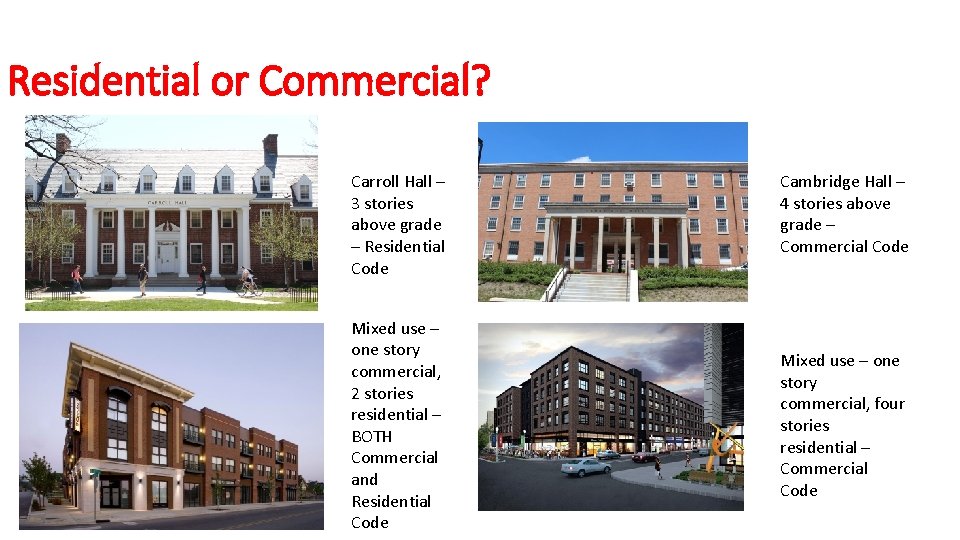
Residential or Commercial? Carroll Hall – 3 stories above grade – Residential Code Mixed use – one story commercial, 2 stories residential – BOTH Commercial and Residential Code Cambridge Hall – 4 stories above grade – Commercial Code Mixed use – one story commercial, four stories residential – Commercial Code
2015 International Energy Conservation Code Learning Objectives • 2015 IECC Overview • 2015 IECC Compliance Paths (Commercial Code) • Documentation/Inspection Requirements (Commercial Code) • Beyond code – LEED, High Performance Building Program, campus goals
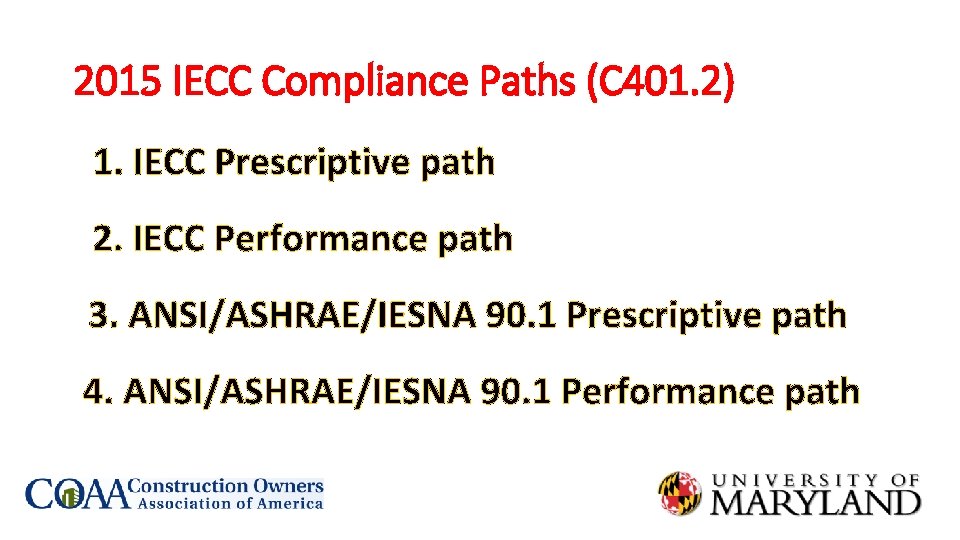
2015 IECC Compliance Paths (C 401. 2) 1. IECC Prescriptive path 2. IECC Performance path 3. ANSI/ASHRAE/IESNA 90. 1 Prescriptive path 4. ANSI/ASHRAE/IESNA 90. 1 Performance path
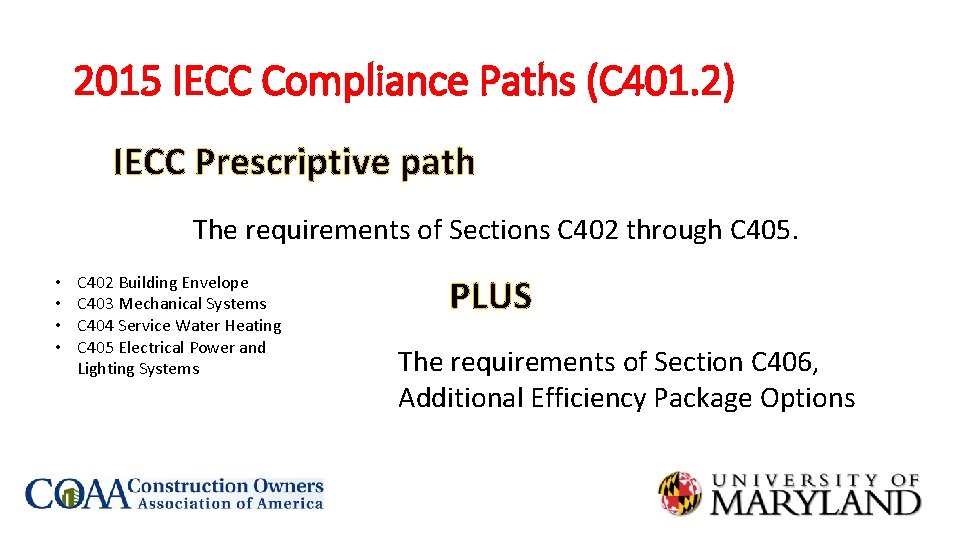
2015 IECC Compliance Paths (C 401. 2) IECC Prescriptive path The requirements of Sections C 402 through C 405. • • C 402 Building Envelope C 403 Mechanical Systems C 404 Service Water Heating C 405 Electrical Power and Lighting Systems PLUS The requirements of Section C 406, Additional Efficiency Package Options
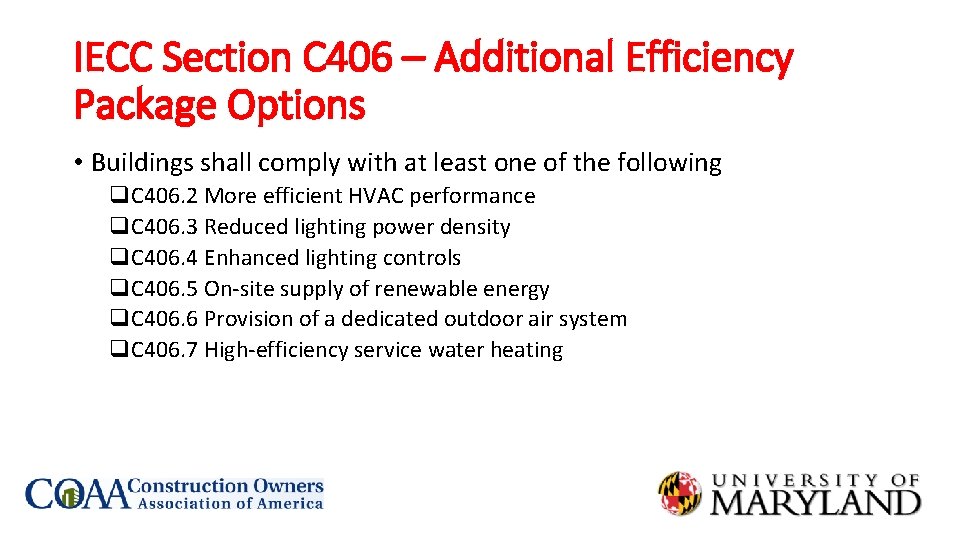
IECC Section C 406 – Additional Efficiency Package Options • Buildings shall comply with at least one of the following q. C 406. 2 More efficient HVAC performance q. C 406. 3 Reduced lighting power density q. C 406. 4 Enhanced lighting controls q. C 406. 5 On-site supply of renewable energy q. C 406. 6 Provision of a dedicated outdoor air system q. C 406. 7 High-efficiency service water heating
2015 IECC Compliance Paths (C 401. 2) IECC Performance path The requirements of Section C 407, Total Building Performance. PLUS All mandatory requirements…
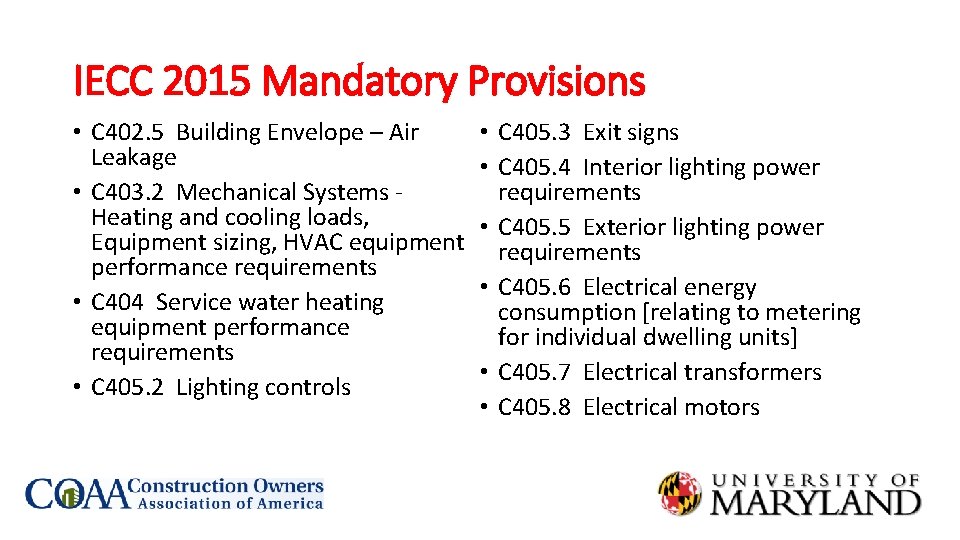
IECC 2015 Mandatory Provisions • C 402. 5 Building Envelope – Air Leakage • C 403. 2 Mechanical Systems - Heating and cooling loads, Equipment sizing, HVAC equipment performance requirements • C 404 Service water heating equipment performance requirements • C 405. 2 Lighting controls • C 405. 3 Exit signs • C 405. 4 Interior lighting power requirements • C 405. 5 Exterior lighting power requirements • C 405. 6 Electrical energy consumption [relating to metering for individual dwelling units] • C 405. 7 Electrical transformers • C 405. 8 Electrical motors
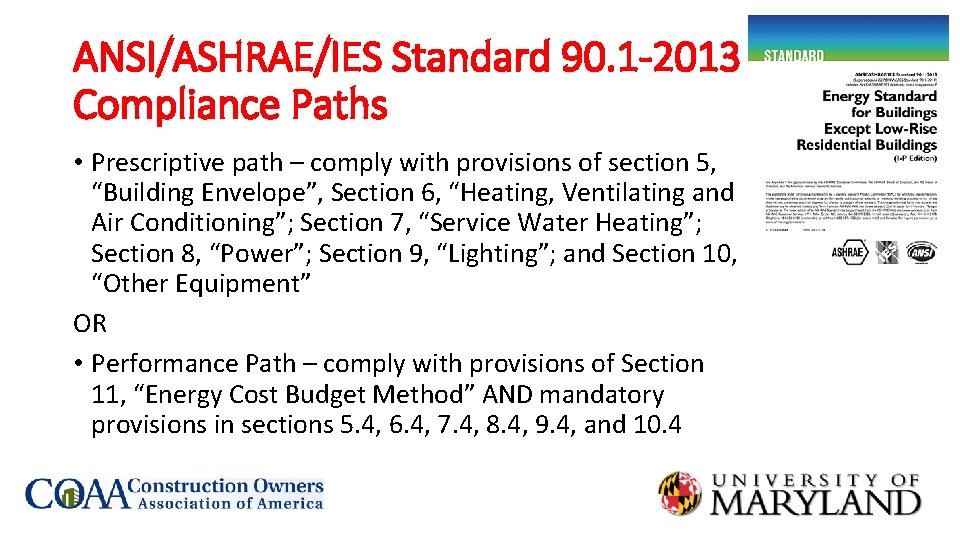
ANSI/ASHRAE/IES Standard 90. 1 -2013 Compliance Paths • Prescriptive path – comply with provisions of section 5, “Building Envelope”, Section 6, “Heating, Ventilating and Air Conditioning”; Section 7, “Service Water Heating”; Section 8, “Power”; Section 9, “Lighting”; and Section 10, “Other Equipment” OR • Performance Path – comply with provisions of Section 11, “Energy Cost Budget Method” AND mandatory provisions in sections 5. 4, 6. 4, 7. 4, 8. 4, 9. 4, and 10. 4
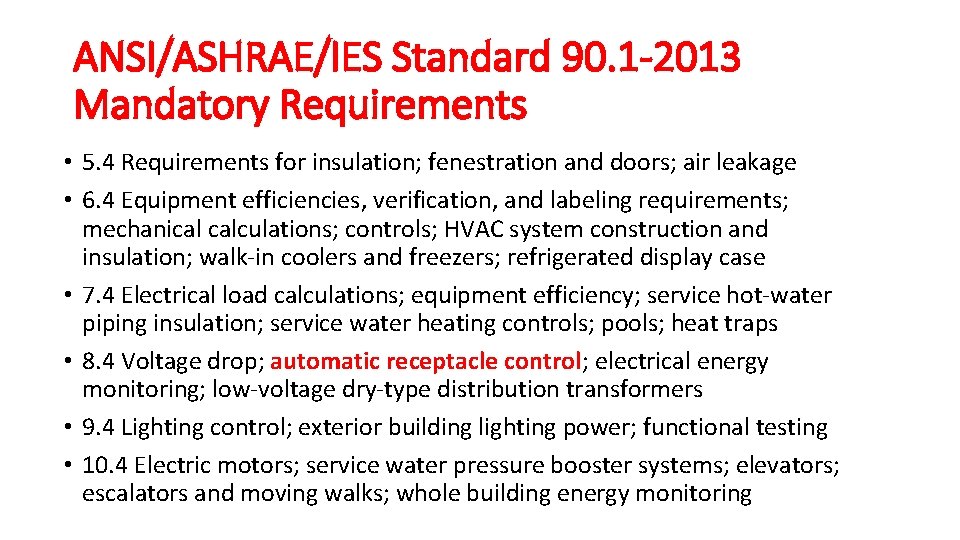
ANSI/ASHRAE/IES Standard 90. 1 -2013 Mandatory Requirements • 5. 4 Requirements for insulation; fenestration and doors; air leakage • 6. 4 Equipment efficiencies, verification, and labeling requirements; mechanical calculations; controls; HVAC system construction and insulation; walk-in coolers and freezers; refrigerated display case • 7. 4 Electrical load calculations; equipment efficiency; service hot-water piping insulation; service water heating controls; pools; heat traps • 8. 4 Voltage drop; automatic receptacle control; electrical energy monitoring; low-voltage dry-type distribution transformers • 9. 4 Lighting control; exterior building lighting power; functional testing • 10. 4 Electric motors; service water pressure booster systems; elevators; escalators and moving walks; whole building energy monitoring
2015 International Energy Conservation Code Learning Objectives • 2015 IECC Overview • 2015 IECC Compliance Paths (Commercial Code) • Documentation/Inspection Requirements (Commercial Code) • Beyond code – LEED, High Performance Building Program, campus goals
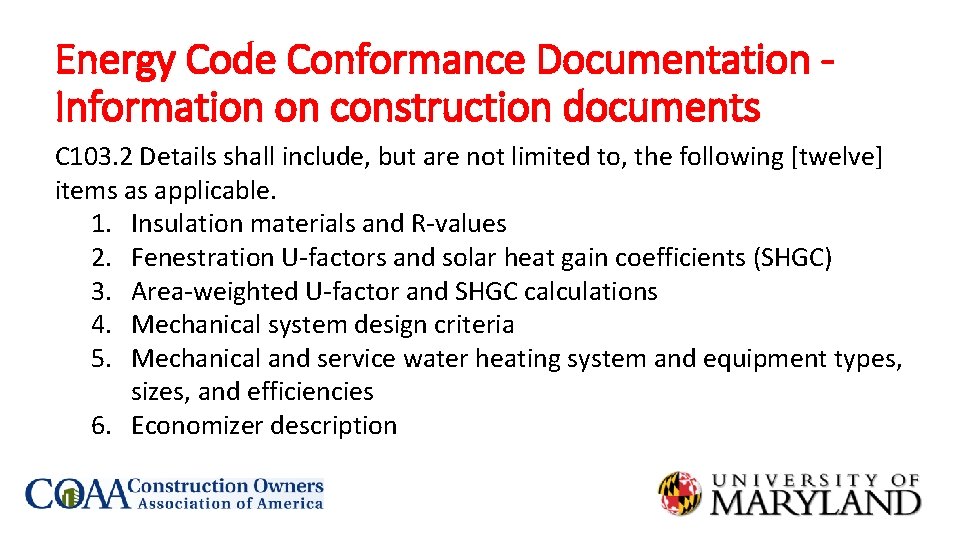
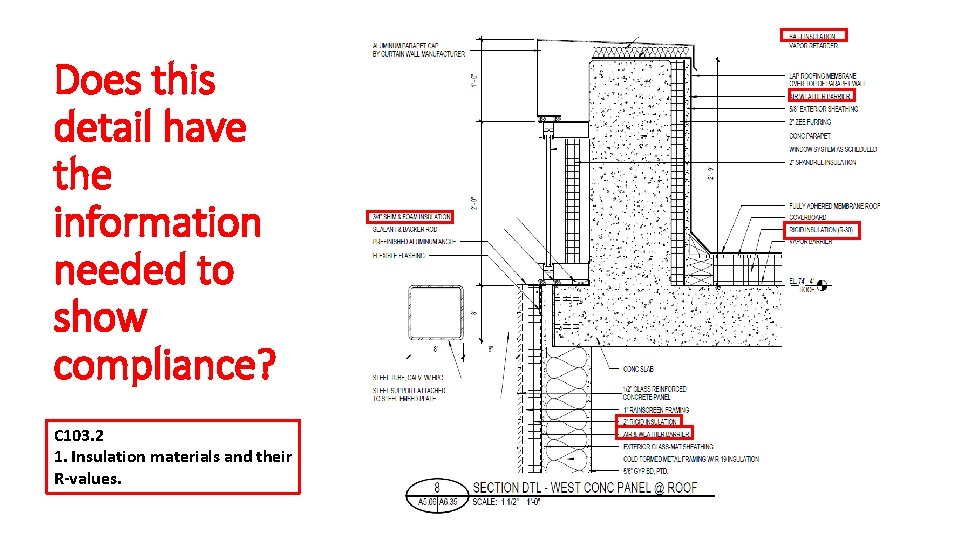
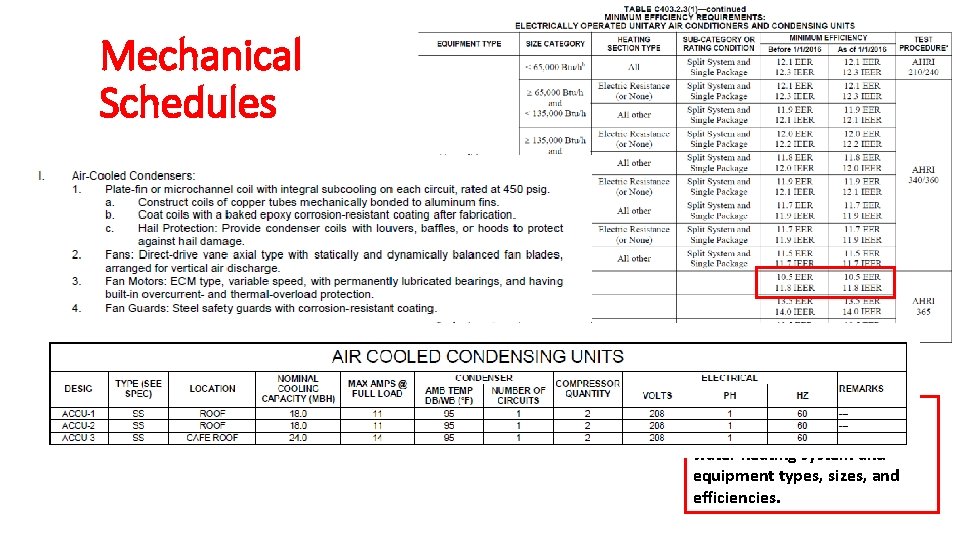
Energy Code Conformance Documentation Information on construction documents C 103. 2 Details shall include, but are not limited to, the following [twelve] items as applicable. 1. Insulation materials and R-values 2. Fenestration U-factors and solar heat gain coefficients (SHGC) 3. Area-weighted U-factor and SHGC calculations 4. Mechanical system design criteria 5. Mechanical and service water heating system and equipment types, sizes, and efficiencies 6. Economizer description
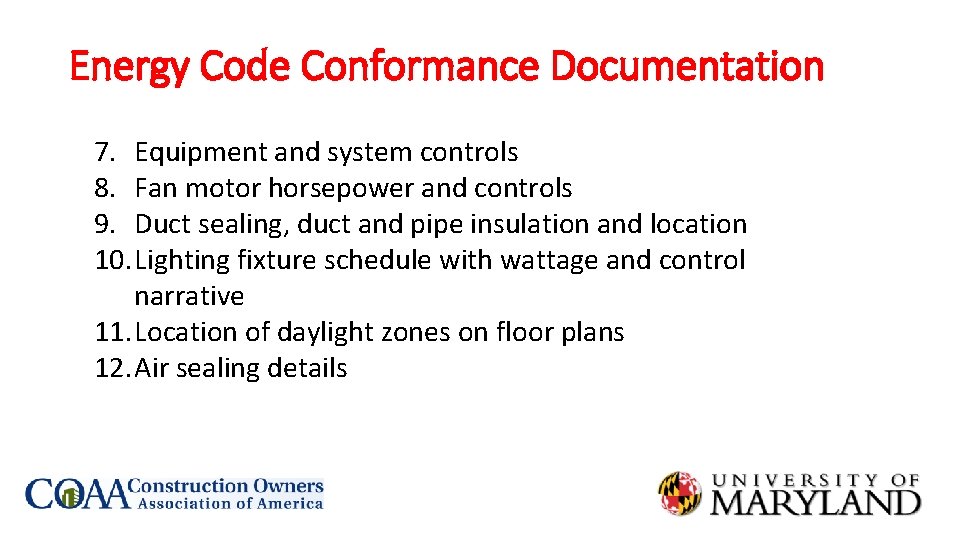
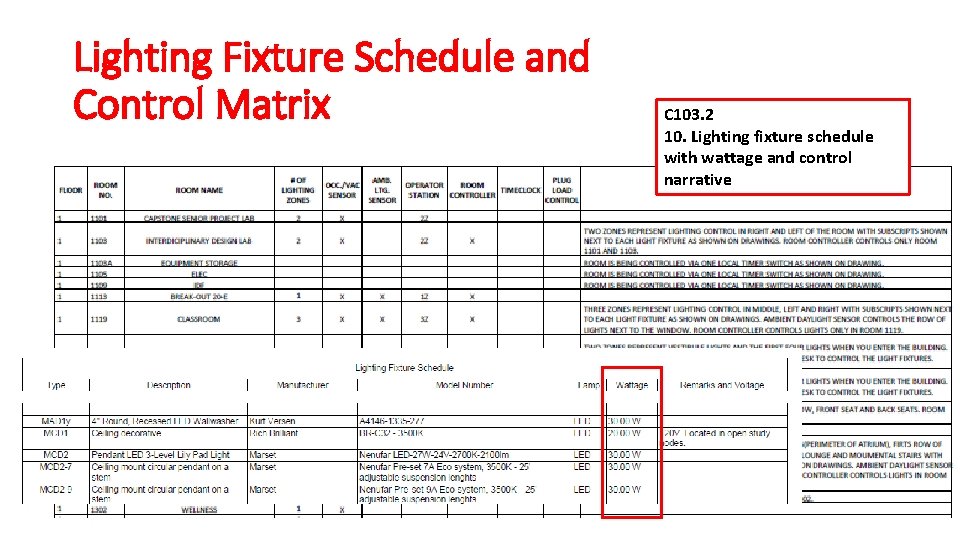
Energy Code Conformance Documentation 7. Equipment and system controls 8. Fan motor horsepower and controls 9. Duct sealing, duct and pipe insulation and location 10. Lighting fixture schedule with wattage and control narrative 11. Location of daylight zones on floor plans 12. Air sealing details
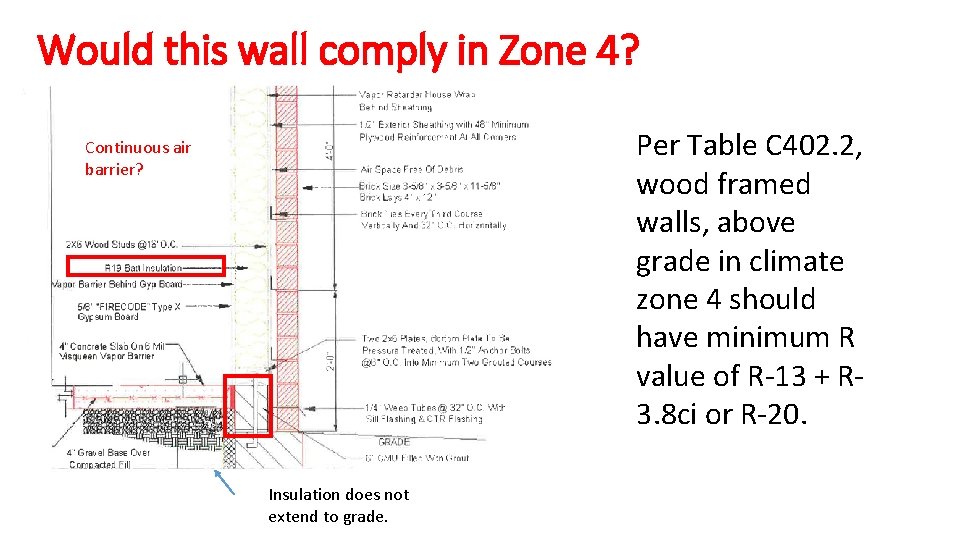
Would this wall comply in Zone 4? Per Table C 402. 2, wood framed walls, above grade in climate zone 4 should have minimum R value of R-13 + R 3. 8 ci or R-20. Continuous air barrier? Insulation does not extend to grade.
Does this detail have the information needed to show compliance? C 103. 2 1. Insulation materials and their R-values.
Lighting Fixture Schedule and Control Matrix C 103. 2 10. Lighting fixture schedule with wattage and control narrative
Mechanical Schedules C 103. 2 5. Mechanical and service water heating system and equipment types, sizes, and efficiencies.
Other Documentation (varies depending on compliance path and project type) • HVAC load calculations (IECC 403. 2. 1; ASHRAE 6. 4. 2. 1) • Daylighting calculations (IECC 2015 C 405. 2. 3; ASHRAE 90. 1 -2013 5. 7 & 9. 7) • Lighting power density calculations (IECC C 405. 4 & C 405. 5; ASHRAE 9. 2. 2. 3 &9. 4. 2)
Other Documentation (varies depending on compliance path and project type) • Documentation verifying methods and accuracy of compliance energy model software (IECC C 407. 4; ASHRAE 11. 7) • Energy model (different models will be needed for LEED and IECC 2015) • Commissioning Plan, preliminary Cx report, final Cx report (IECC C 408; ASHRAE 6. 7. 2. 4 • COMCheck Reports
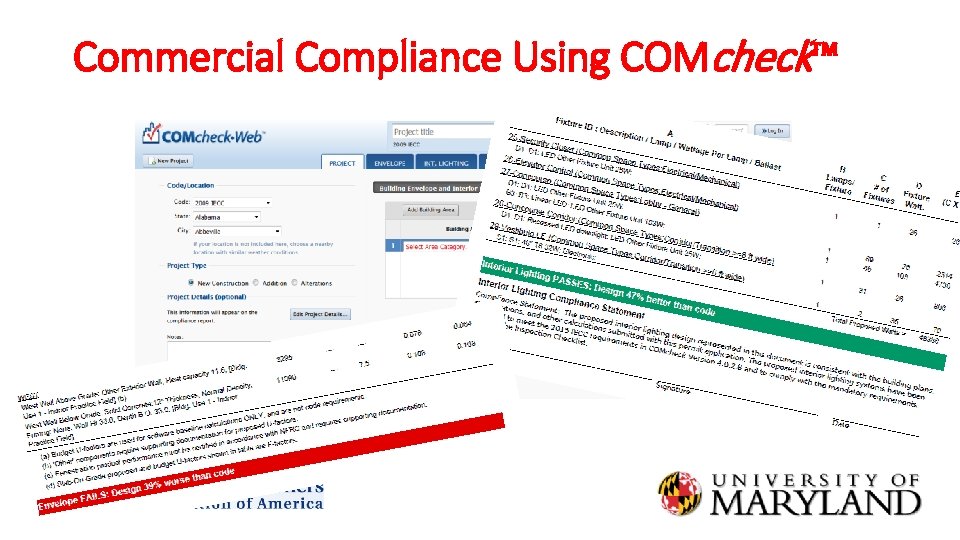
Commercial Compliance Using COMcheck™ • https: //www. energycodes. gov/comcheck • The COMcheck product group makes it easy for architects, builders, designers, and contractors to determine whether new commercial or high-rise residential buildings, additions, and alterations meet the requirements of the IECC and ASHRAE Standard 90. 1, as well as several state-specific codes. COMcheck also simplifies compliance for building officials, plan checkers, and inspectors by allowing them to quickly determine if a building project meets the code.
Commercial Compliance Using COMcheck™
Energy Code Conformance Documentation Required Inspections (C 104. 2): 1. 2. 3. 4. 5. 6. Footing and foundation Framing and rough-in Plumbing rough-in Mechanical rough-in Electrical rough-in Final inspection
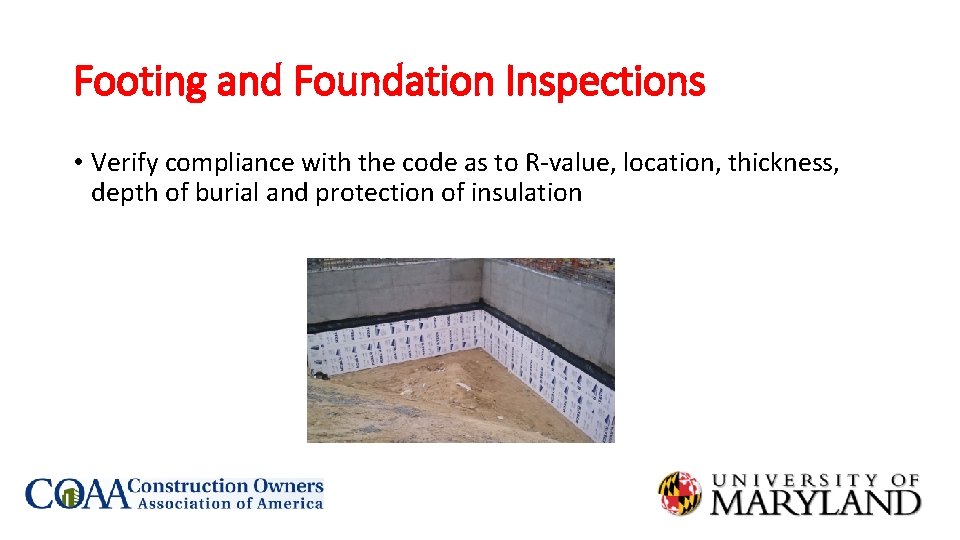
Footing and Foundation Inspections • Verify compliance with the code as to R-value, location, thickness, depth of burial and protection of insulation
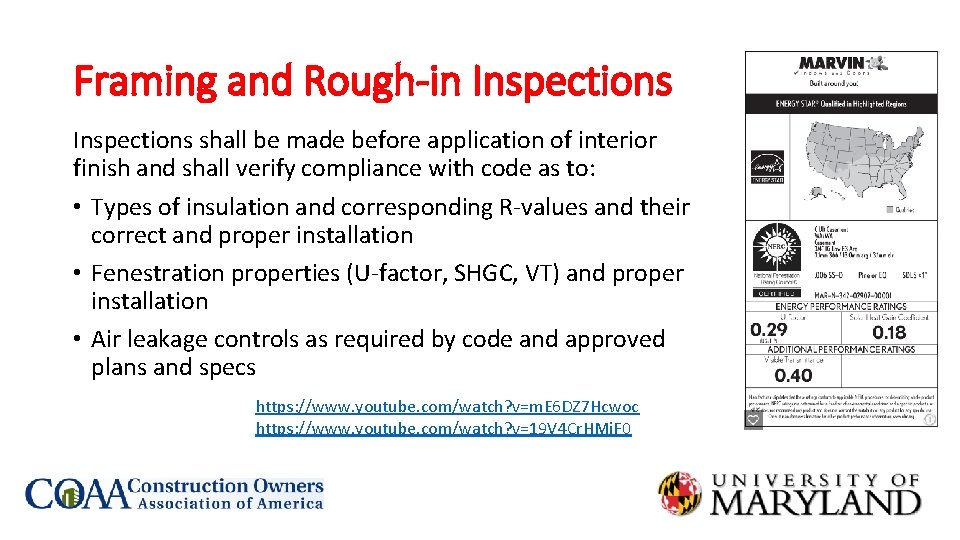
Framing and Rough-in Inspections shall be made before application of interior finish and shall verify compliance with code as to: • Types of insulation and corresponding R-values and their correct and proper installation • Fenestration properties (U-factor, SHGC, VT) and proper installation • Air leakage controls as required by code and approved plans and specs https: //www. youtube. com/watch? v=m. E 6 DZ 7 Hcwoc https: //www. youtube. com/watch? v=19 V 4 Cr. HMi. F 0
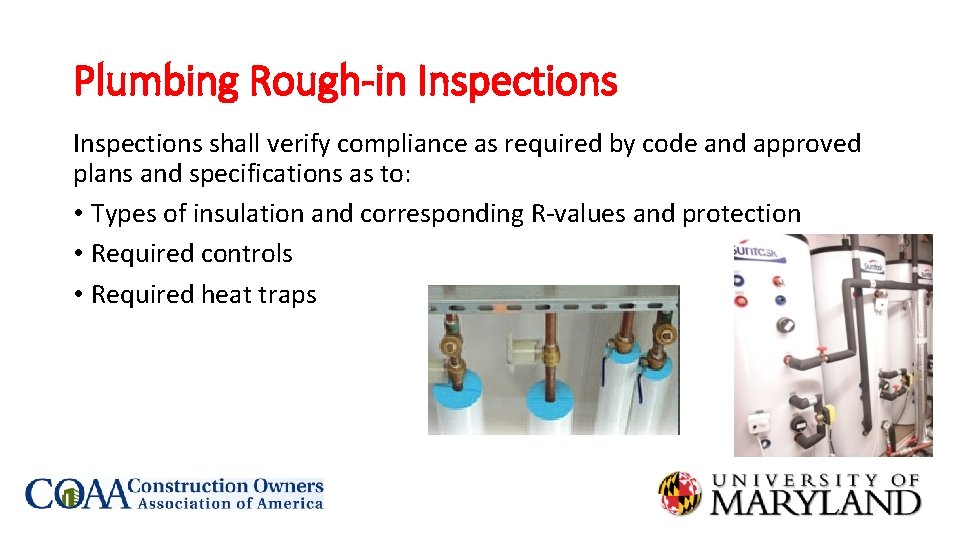
Plumbing Rough-in Inspections shall verify compliance as required by code and approved plans and specifications as to: • Types of insulation and corresponding R-values and protection • Required controls • Required heat traps
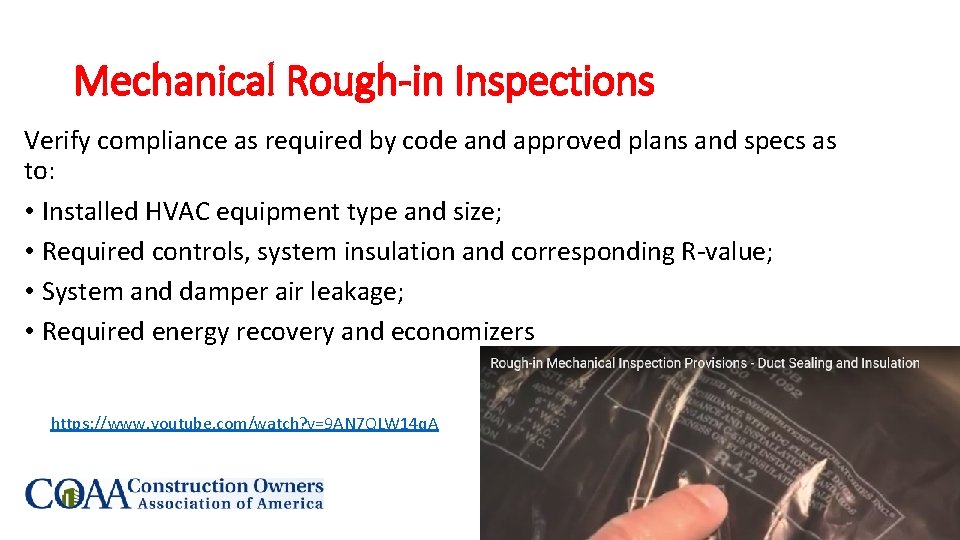
Mechanical Rough-in Inspections Verify compliance as required by code and approved plans and specs as to: • Installed HVAC equipment type and size; • Required controls, system insulation and corresponding R-value; • System and damper air leakage; • Required energy recovery and economizers https: //www. youtube. com/watch? v=9 AN 7 QLW 14 q. A
Electrical Rough-in Inspections shall verify compliance with code and approved plans and specifications as to: • Installed lighting systems, components and controls • Installation of an electric meter for each dwelling unit https: //www. youtube. com/watch? v=Btu 3_mw 3 a. Ew
Final Inspection Final inspection shall include: • Verification of the installation and properation of all required building controls, and documentation verifying activities associated with required building commissioning have been conducted and findings of non-compliance corrected. • Final inspection shall not occur until the preliminary Cx report is received.
2015 International Energy Conservation Code Learning Objectives • 2015 IECC Overview • 2015 IECC Compliance Paths (Commercial Code) • Documentation/Inspection Requirements (Commercial Code) • Beyond code – LEED, High Performance Building Program, campus goals
LEED vs. IECC Maryland base code is IECC 2015/ASHRAE 90. 1 -2013 LEED v 3 Energy Model based on ASHRAE 90. 1 -2007 (Appendix G) LEED v 4 Energy Model based on ASHRAE 90. 1 -2010 (Appendix G) Note: Section C 102. 1. 1 allows the code official to deem a project using an “above code” program (including mandatory requirements) to be in compliance with the code. Neither LEED v 3 nor LEED v 4 would be considered “above code” compared to IECC 2015.
LEED beyond IECC LEED prerequisite - whole building energy metering LEED Credits beyond code: Enhanced Commissioning Advanced energy metering Renewable Energy Production
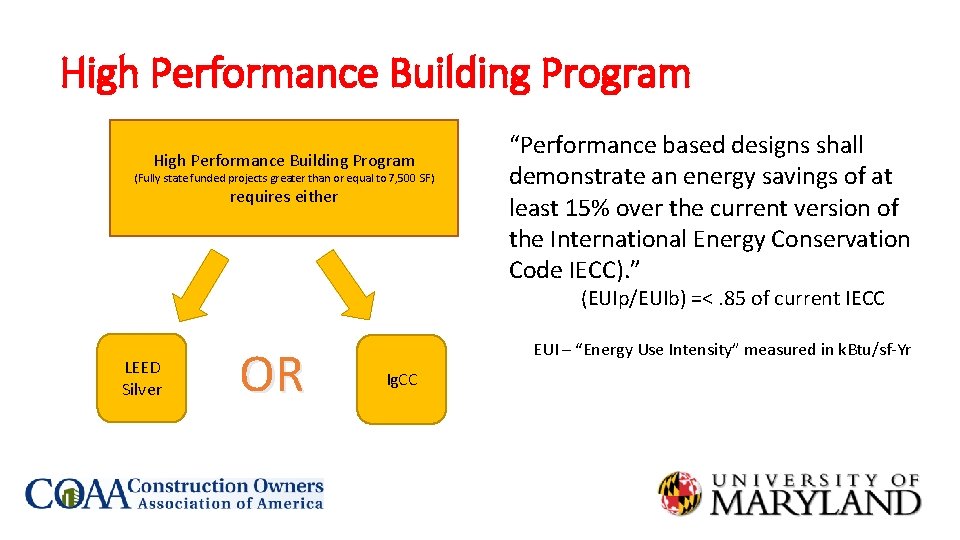
High Performance Building Program (Fully state funded projects greater than or equal to 7, 500 SF) requires either “Performance based designs shall demonstrate an energy savings of at least 15% over the current version of the International Energy Conservation Code IECC). ” (EUIp/EUIb) =<. 85 of current IECC LEED Silver OR EUI – “Energy Use Intensity” measured in k. Btu/sf-Yr Ig. CC
New University of Maryland College Park Energy Analysis Requirements - During Design • Energy modeling early in the process to inform the design • Preference for “open source” modeling software • Energy modeling reports at each design phase
New University of Maryland College Park Energy Analysis Requirements – After Occupancy • As Built energy model which incorporates any major changes that occur during construction • Review of energy usage 12 months after occupancy to identify areas where building is not performing as designed and provide recommendations for addressing issues
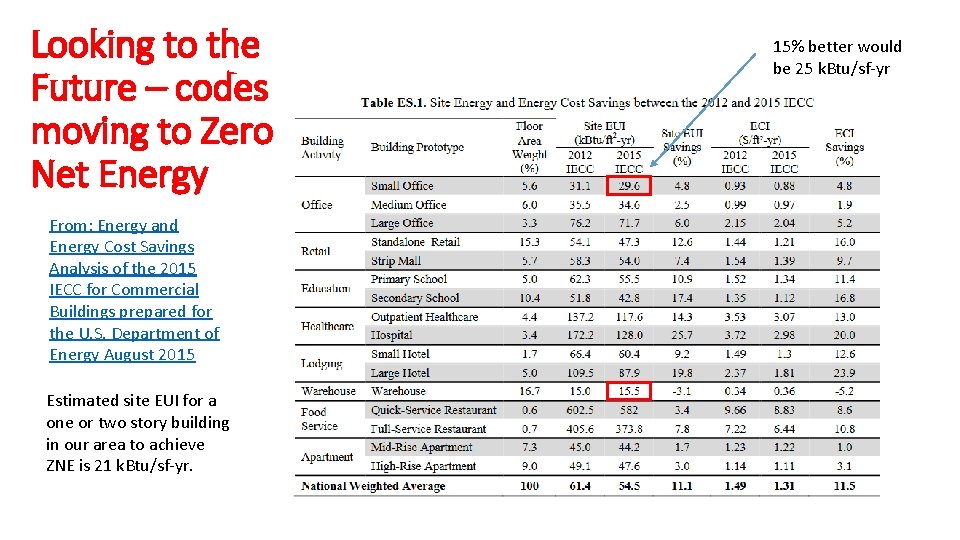
Looking to the Future – codes moving to Zero Net Energy From: Energy and Energy Cost Savings Analysis of the 2015 IECC for Commercial Buildings prepared for the U. S. Department of Energy August 2015 Estimated site EUI for a one or two story building in our area to achieve ZNE is 21 k. Btu/sf-yr. 15% better would be 25 k. Btu/sf-yr
Challenges • Gaps in documentation – daylighting calculations, mechanical equipment efficiency requirements, insulation information often missing • No industry standard - documentation there but “hidden” – sometimes on drawings, sometimes in specs, sometimes in different drawings or specs than we expect, sometimes in a separate calculation submission • Narrative explaining calculations and confirming code compliance is unclear or missing
Challenges • Multiple energy models are required for different phases of design • LEED and IECC require different modeling baselines and methodologies • Keeping up with technological “advances” • Post-occupancy • • Energy model not indicative of actual building energy use Building systems too complicated to manage properly Building users by-pass energy saving systems Preventive maintenance
Recap • All projects in Maryland must follow the 2015 International Energy Conservation Code – new construction, renovations, additions, alterations, equipment replacements (for Washington, DC and VA – 2012 IECC) • Four compliance paths meet the requirements of the IECC – 2015 IECC Prescriptive Path, 2015 IECC Performance Path, ASHRAE 90. 1 -2013 Prescriptive Path, ASHRAE 90. 1 -2013 Performance Path. Choose one - no mixing and matching! • Construction documents must include energy code information to confirm compliance. • Mandatory inspections must be documented during construction. • There may be additional requirements from the jurisdiction and/or owner.
2015 International Energy Conservation Code Overview and Compliance Requirements Code Questions? Contact the Energy Code Coach – sponsored by Maryland Energy Administration (301) 899 -0017 energycodecoach@newportpartnersllc. com Check out the resource and training sections at Energy. Codes. gov.