
2015 CPR First Aid Revisions e m o
- Slides: 28
2015 CPR & First Aid Revisions ! e m o c Wel
Agenda ① Purpose ② Background to revisions ③ Literature revisions: CPR & First Aid ④ Summary
Purpose • To introduce the 2015 CPR & First Aid guidelines to Lifesaving Instructors/Examiners and lifeguards through revised content changes in the Society’s literature.
Background to changes Every 5 years • • • Medical experts review the research in CPR and First Aid. New treatment recommendations are released worldwide (Oct. 2015). Training agencies meet to ensure consensus of guidelines. Transition to new guidelines • • Lifesaving Society has released the new guidelines and updated its instructor and candidate resources. Changes to be adopted no later than December 31, 2016.
Literature revisions • You can identify changes to literature: the front cover reads “With the 2015 guidelines” on cover of affected Award Guides, Canadian Lifesaving Manual, Canadian First Aid Manual, Canadian CPR-HCP Manual. • To view a complete list of changes view/download the 2015 Summary of Changes in Lifesaving Society Literature from the Society’s website. • There a variety of “tweaks” and some new information. The important thing to know is that there is no change to the resuscitation standards for drowning victims and your existing training is still effective in saving lives. • There are no major changes to Must Sees in the First Aid Award Guide, Bronze Medals Award Guide or National Lifeguard Award Guide.
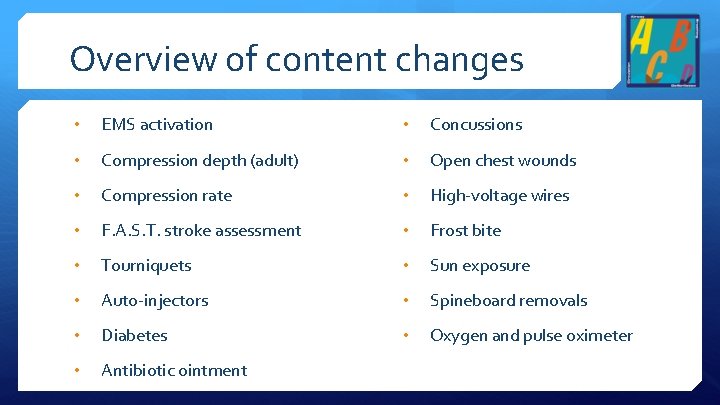
Overview of content changes • EMS activation • Concussions • Compression depth (adult) • Open chest wounds • Compression rate • High-voltage wires • F. A. S. T. stroke assessment • Frost bite • Tourniquets • Sun exposure • Auto-injectors • Spineboard removals • Diabetes • Oxygen and pulse oximeter • Antibiotic ointment
Overview content: get ready • While reviewing this presentation, reference the following: v Canadian First Aid Manual, revised October 2016 v Canadian Lifesaving Manual, revised October 2016 v First Aid Award Guide, revised October 2016
EMS activation • The use of mobile technologies for quick activation of EMS including using bystanders to call and using speaker mode to communicate with EMS dispatchers. • Revised literature: v Canadian First Aid Manual: in EMS (pg. 8) and in Action, ABC Priorities (pg. 22). v Canadian Lifesaving Manual: in revised procedures for one- and two-rescuer CPR (pg. 7 -13 and 7 -17).
Compression depth: adult victim • An upper limit on depth of compressions for an adult victim. Rescuers should compress the chest at least 5 cm but not more than 6 cm. • Revised literature: v Canadian First Aid Manual: in DEPTH HOW FAR TO PUSH DOWN THE BREASTBONE (Pg. 27). v Canadian Lifesaving Manual: in revised procedures for one- and two- rescuer CPR (pg. 7 -13 and 7 -17).
Compression rate • “Push hard, Push fast” remains valid for effective CPR. In the 2015 Guidelines “Fast” means 100 to 120 compressions per minute. The Guidelines suggest rescuers aim for 30 compressions in 15 to 18 sec. • Revised literature: v Canadian First Aid Manual: this new range is reflected in THREE TIPS FOR GOOD, EFFECTIVE CPR and in Counting (p. 28). v Canadian Lifesaving Manual: this change is captured in Compression Rate (p. 7 -14) and Three tips for good effective CPR (p. 7 -15).
F. A. S. T. stroke assessment • The 2015 Guidelines suggest first aiders can use the acronym “F. A. S. T. ”(Face. Arms. Speech. Time) to help assess a suspected stroke victim • Revised literature: v Canadian First Aid Manual: reference to F. A. S. T is introduced in a sidebar to Stroke (p. 35). v Canadian Lifesaving Manual: reference to F. A. S. T is introduced in a sidebar to Stroke (p. 8 -8).
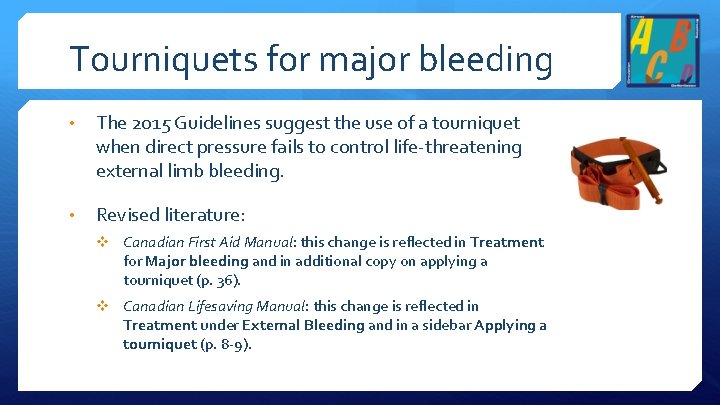
Tourniquets for major bleeding • The 2015 Guidelines suggest the use of a tourniquet when direct pressure fails to control life-threatening external limb bleeding. • Revised literature: v Canadian First Aid Manual: this change is reflected in Treatment for Major bleeding and in additional copy on applying a tourniquet (p. 36). v Canadian Lifesaving Manual: this change is reflected in Treatment under External Bleeding and in a sidebar Applying a tourniquet (p. 8 -9).
Tourniquets for major bleeding • The updated First Aid Award Guide includes a new Note to Circulatory emergencies: external bleeding (EFA, Item 11 c, p. 22) about the use of tourniquets: v “Use of tourniquets is not required for this item. However, candidates should understand the purpose of a tourniquet (e. g. , apply when direct pressure fails to stop life-threatening external limb bleeding). ”
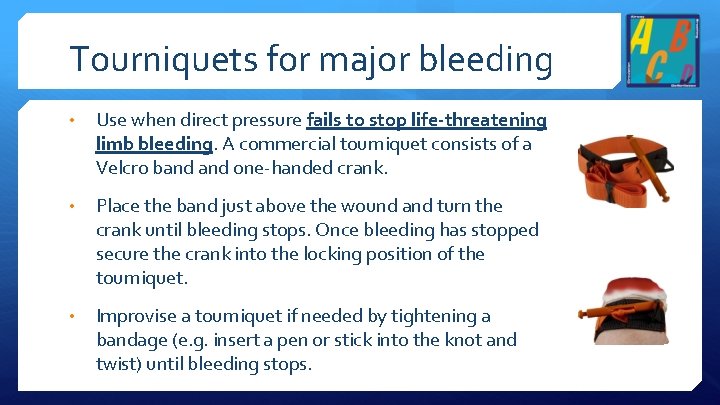
Tourniquets for major bleeding • Use when direct pressure fails to stop life-threatening limb bleeding. A commercial tourniquet consists of a Velcro band one-handed crank. • Place the band just above the wound and turn the crank until bleeding stops. Once bleeding has stopped secure the crank into the locking position of the tourniquet. • Improvise a tourniquet if needed by tightening a bandage (e. g. insert a pen or stick into the knot and twist) until bleeding stops.
Auto-injectors • The 2015 Guidelines recommend a second dose of epinephrine be administered after 5 minutes if the signs and symptoms do not improve after the initial dose. • Revised literature: v Canadian First Aid Manual: this recommendation is included under Treatment in Severe allergies (Anaphylaxis) on p. 45. Copy related to Twinject auto-injectors is removed because this device is no longer manufactured. v Canadian Lifesaving Manual: this recommendation is included under Treatment (p. 8 -3).
Diabetes • The 2015 Guidelines suggest the preferred first aid treatment option is to provide glucose tablets to an individual suffering hypoglycemia. Hard candy like Mentos, Skittles, or Jelly beans are a second choice. Last choice would be orange or other fructose juice drinks. • Revised literature: v Canadian First Aid Manual: this recommendation is included under Treatment for Diabetes (p. 46). v Canadian Lifesaving Manual: this recommendation is included under Treatment for Diabetic Emergencies (p. 8 -18).
Antibiotic ointment • The 2015 Guidelines recommend the use of antibiotic ointment to help promote healing of minor wounds. • Revised literature: v Canadian First Aid Manual (Wounds, p. 49) includes the use of antibiotic ointment on superficial wounds to promote healing for those who have no sensitivity to antibiotics such as penicillin. v Canadian Lifesaving Manual: as above in External Bleeding, p. 8 -9.
Concussions • The 2015 Guidelines recognize the difficulty first aiders have in recognizing concussions – a specific and common type of head injury. The Guidelines talk about the mechanism of injury, how to recognize a concussion, and the importance of removing the victim from activity to see early medical help. • Revised literature: v The updated Canadian First Aid Manual contains a Concussion sidebar to Head Injuries (p. 52). Signs and symptoms and Treatment are both updated. v The Canadian Lifesaving Manual presents information on Concussions in a sidebar to Head Injuries (p. 8 -11).
Open chest wound • The 2015 Guidelines recommend that leaving an open chest wound exposed is preferable to taping the wound with plastic because of the life-threatening adverse effects this may have. A non-adhering and permeable dressing that allows liquids or gasses to pass through is preferred. • Revised literature: v Canadian First Aid Manual: Treatment under Open chest wound (p. 63). v Canadian Lifesaving Manual: Open chest wounds sidebar to Chest wounds (p. 8 -13).
High-voltage wires • The Canadian First Aid Manual (under Treatment in Electrical burns, p. 69) stresses that first aiders should never attempt to move or remove high-voltage wires and power lines. • The Canadian Lifesaving Manual illustration (p. 6 -2) showing a rescuer removing a live wire with a branch is removed and a sidebar (p. 6 -3) advises rescuer to never attempt to move or remove high-voltage wires and power lines.
Frostbite • The 2015 Guidelines recommendations on treatment for rewarming body parts suffering frostbite: warm water immersion for 20 -30 min. and avoidance of chemical warmers. • Revised literature: v Canadian First Aid Manual: Treatment under Frostbite (p. 76). v Canadian Lifesaving Manual: Treatment under Frostbite (p. 8 -23).
Sun exposure • In 2016, the Canadian Cancer Society updated its sun protection recommendations which should be of special interest to all lifeguards working in outdoor settings. v The Cancer Society’s higher minimum sunscreen recommendation (SPF 30) is updated in Alert, under The Sun (p. 24).
Spineboard removals (Lifeguards) • The 2015 Guidelines acknowledge a lack of evidence to support the benefits of spinal immobilization and the use of immobilization devices by first aiders. In a water rescue, a spineboard is mainly an extraction device for a breathing victim with a suspected spinal injury. However, when the need for CPR is indicated, use of a spineboard should never delay victim removal and the immediate commencement of CPR, life-over-limb. • Revised literature: v Canadian First Aid Manual: this is reflected in Circulation (p. 58) and in Use of spineboards (p. 59). v Canadian Lifesaving Manual: this is reflected in a new sidebar on (p. 5 -19) and in EMS transport and spineboards (p. 5 -22). v In Alert, this principle is reflected under Management of Spinal Injuries (p. 53).
Spineboard removals (Lifeguards) • Canadian Lifesaving Manual: ABC’s v If the victim is found in the water and is not breathing, start with 2 rescue breaths. Remove the victim promptly to the pool deck or beach, and start CPR. If several rescuers and a spineboard are available quickly but carefully place the victim on a spineboard, and remove him or her immediately. Start CPR. (NEW sidebar) Spineboard removals should not delay CPR. When the need for CPR is indicated, use of a spineboard should never delay victim removal and immediate commencement of CPR. (p. 5 -19). • Canadian Lifesaving Manual: EMS transport and spineboards v (NEW sidebar) Spineboards are used to remove a suspected spinal-injured victim from the water. EMS may decide to remove the spineboard when preparing to transport the victim (p. 5 -22).
Oxygen (Airway Mgt. Award) • The 2015 Guidelines caution oxygen supplementation may be contraindicated for some victims who do not warrant its use. • Revised literature: v Canadian First Aid Manual, under Oxygen Administration (p. 84), recommends use of oxygen for drowning victims, decompression sickness, carbon monoxide poisoning, respiratory arrest, and for victims with a pulse oximetry reading of less than 94%. Pulse Oximetry addressed on p. 88. v Alert: removal of reference to no danger in receiving high concentrations of oxygen for a short period (Oxygen, p. 83). v First Aid Award Guide: in Notes to Airway Management: Oxygen supplementation (Airway Management, Item 5, p. 62), “Victims are assessed with a pulse oximeter unless they have suffered a drowning incident, decompression sickness (SCUBA incident), carbon monoxide poisoning, or are in respiratory arrest. ”
Pulse oximeter (Airway Mgt. Award) • Measures blood oxygen saturation expressed as Sp. O 2 • If oxygen levels are lower than 94% Sp. O 2 provide supplemental oxygen and monitor levels. • Use oxygen for drowning victims, decompression sickness, carbon monoxide poisoning, respiratory arrest, and for victims with a pulse oximetry reading of less than 94%. • Accurate readings maybe difficult if: v nail polish on a finger tips v bright lights v excessive movement v carbon monoxide poisoning
Summary: • EMS activation • Concussions • Compression depth (adult) • Open chest wounds • Compression rate • High-voltage wires • F. A. S. T. stroke assessment • Frost bite • Tourniquets • Sun exposure • Auto-injectors • Spineboard removals • Diabetes • Oxygen and pulse oximeter • Antibiotic ointment
2015 CPR & First Aid Revisions