
2015 Cold Blob Update and Simulation Jennifer Mecking
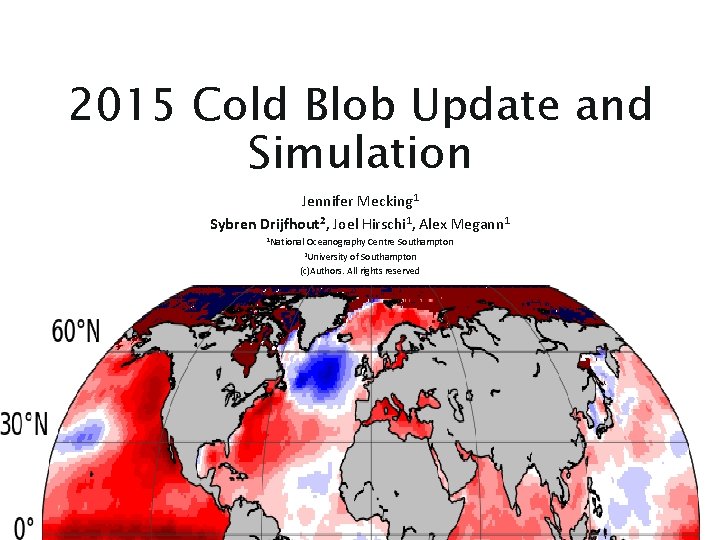
2015 Cold Blob Update and Simulation Jennifer Mecking 1 Sybren Drijfhout 2, Joel Hirschi 1, Alex Megann 1 1 National Oceanography Centre Southampton of Southampton (c)Authors. All rights reserved 2 University

Motivation
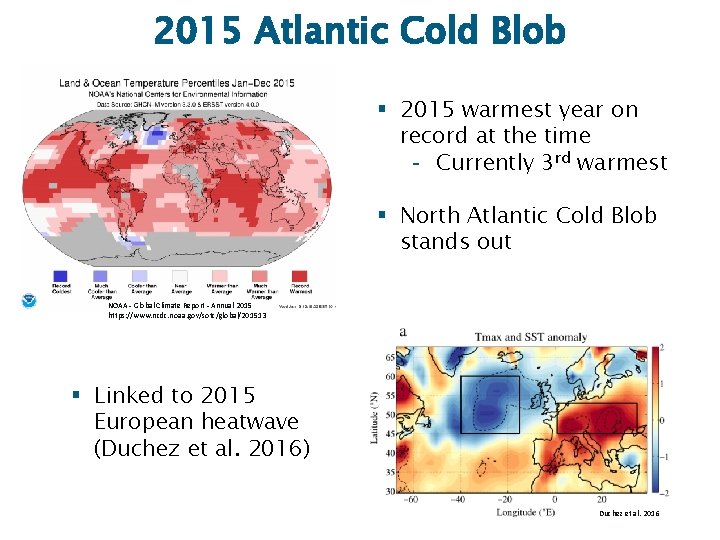
2015 Atlantic Cold Blob § 2015 warmest year on record at the time - Currently 3 rd warmest § North Atlantic Cold Blob stands out NOAA – Global Climate Report – Annual 2015 https: //www. ncdc. noaa. gov/sotc/global/201513 § Linked to 2015 European heatwave (Duchez et al. 2016) Duchez et al. 2016
Cold Blob Region Current Conditions
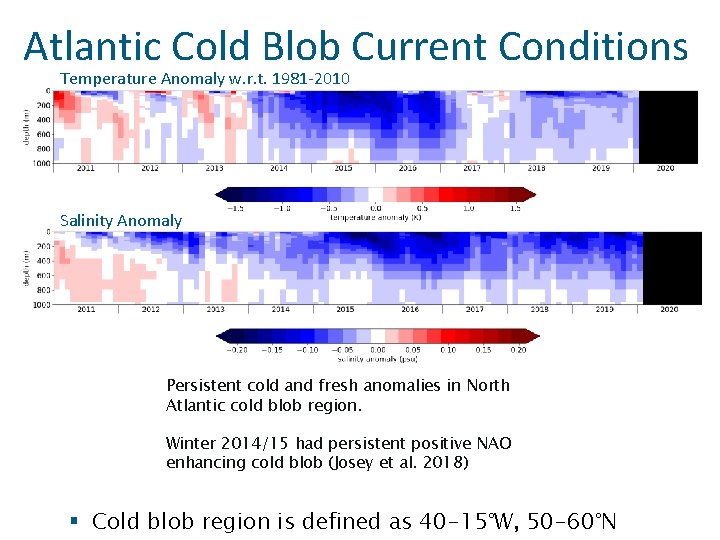
Atlantic Cold Blob Current Conditions Temperature Anomaly w. r. t. 1981 -2010 Salinity Anomaly Persistent cold and fresh anomalies in North Atlantic cold blob region. Winter 2014/15 had persistent positive NAO enhancing cold blob (Josey et al. 2018) § Cold blob region is defined as 40 -15°W, 50 -60°N
Simulating 2015 Cold Blob
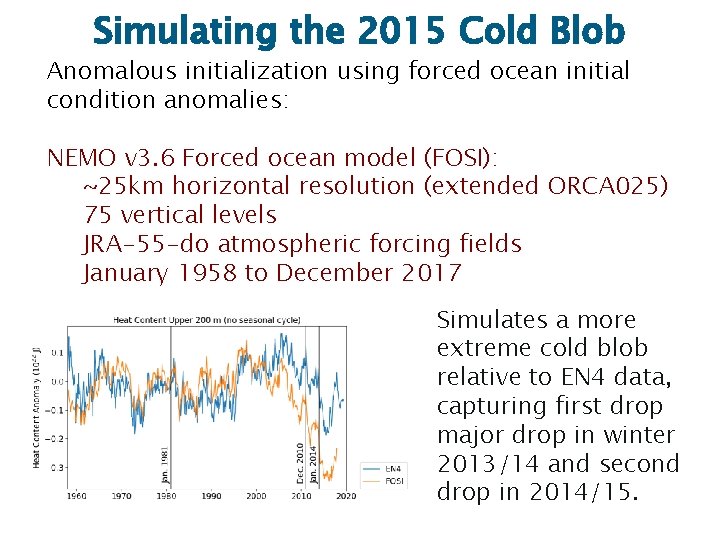
Simulating the 2015 Cold Blob Anomalous initialization using forced ocean initial condition anomalies: NEMO v 3. 6 Forced ocean model (FOSI): ~25 km horizontal resolution (extended ORCA 025) 75 vertical levels JRA-55 -do atmospheric forcing fields January 1958 to December 2017 Simulates a more extreme cold blob relative to EN 4 data, capturing first drop major drop in winter 2013/14 and second drop in 2014/15.
Simulating the 2015 Cold Blob Anomalous initialization using forced ocean initial condition anomalies: Had. GEM 3 -GC 3. 1 coupled model: Same ocean/sea ice as forced ocean ~60 km atmospheric horizontal resolution 85 vertical levels Climatology from last 200 years of present-day control simulation Initialized Experiments (EXPn): Coupled model initialized with anomalous 3 D temperature and salinity on November 1 st, 2014 from FOSI simulation and added to the present-day control climatology. Experiments are run for 5 years 5 ensemble members (i. e. n = 1, 2, 3, 4, 5)
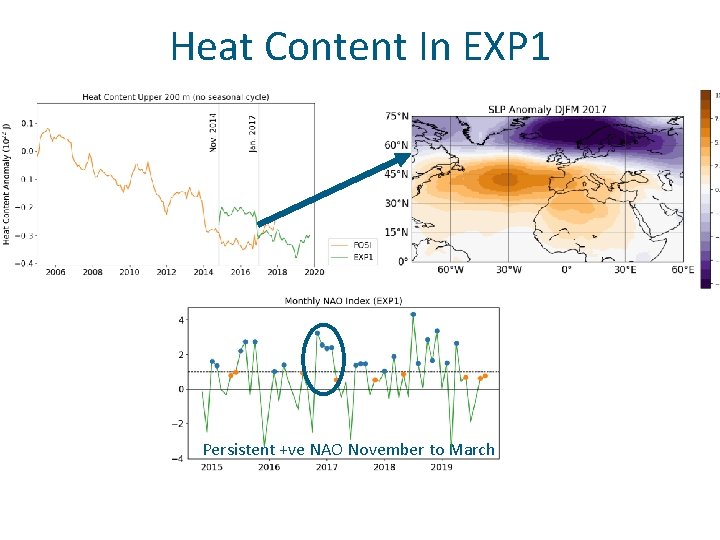
Heat Content In EXP 1 Persistent +ve NAO November to March
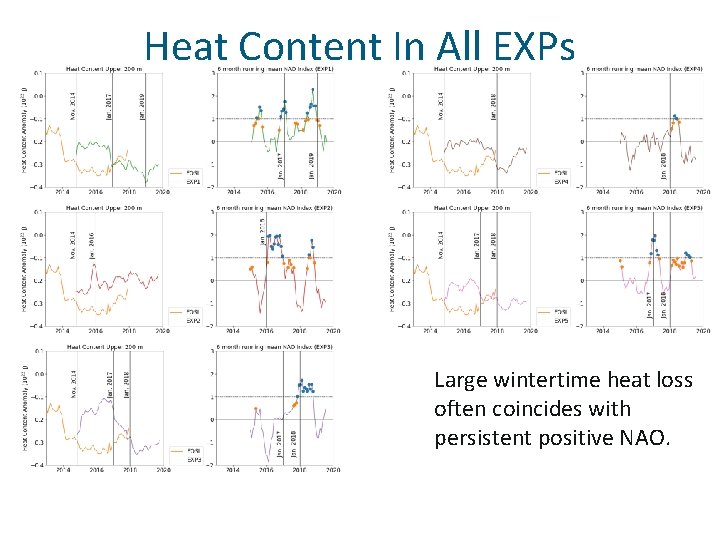
Heat Content In All EXPs Large wintertime heat loss often coincides with persistent positive NAO.
Conclusions • Cold (and fresh) anomalies in N. Atlantic eastern SPG still ongoing, suggesting the 2015 conditions could be more common in the future. • An anomalous initialized coupled simulation is able to capture the 2015 cold blob. However, the timing is delayed by 2 -3 years. • There is often a persistent positive NAO prior to the cold blob as was observed in winter of 2014/15. The Blue-Action project has received funding from the European Union’s Horizon 2020 research and innovation programme under grant agreement No 727852
- Slides: 11