
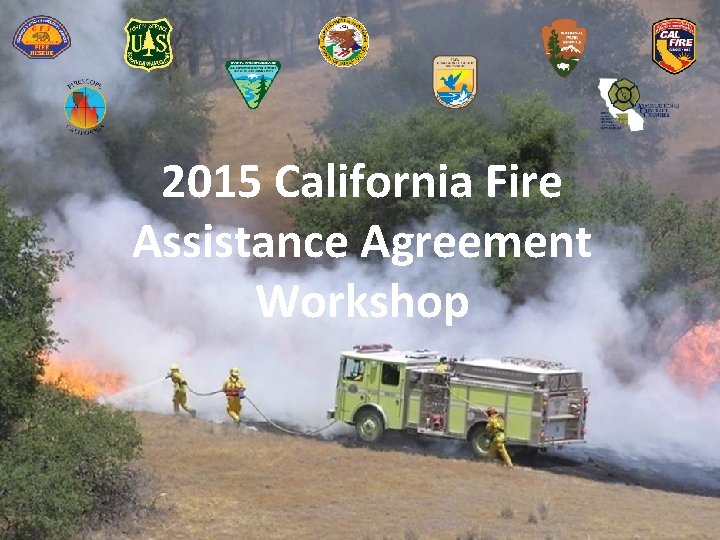
2015 California Fire Assistance Agreement Workshop Introduction Welcome
- Slides: 69
2015 California Fire Assistance Agreement Workshop
Introduction Ø Welcome � Introduction of Cadre Members Ø What is the CFAA and why do we need it? Ø How did we get here? � CFAA Committee � Negotiation Process
Purpose Ø Provide an understanding of expectations on the different Memorandum Of Understanding (MOU’s), Memorandum of Agreement (MOA’s), Governing Body Resolution (GBR’s) or equivalent language, etc. Ø Assist local government fire agencies in developing accurates per the type of classification held. Ø Support successful implementation of existing language and changes for 2015.
Agenda Ø CFAA Intent Ø No 12 -Hour Free Period for DOI Agencies Ø Actual Administrative Rate Due Date Ø MOU/MOA/GBR or equivalent � � Due Dates Above straight time above a BC Review Process Supplemental Personnel exclusion
Agenda (cont. ) Ø Suppression, Non-Suppression and Supplemental Personnel definitions Ø 2015 Rate Letter � Ø Base Rates/Formula New OES F-42 Ø DOD and Tribal Fire Departments Ø Reimbursement of fractional hours
Agenda (cont. ) Ø SAM Registration Ø Rental Vehicle Use Ø Exhibit G: Out-of-State assignments - travel, per diem and misc. approved reimbursement process Ø Exhibit H: In-State assignments – travel, per diem and misc. approved reimbursement process 6
Agenda (cont. ) Ø Actual Administrative Rate Calculation Ø Average Actual Rate Calculation • Suppression & Non Suppression Ø Establishing Supplemental Personnel Rates 7
The CFAA Ø Intent : “It is the intent of the signatories to the CFAA to compensate California Fire and Rescue Mutual Aid System Agencies for the cost of assisting the State of California and the Federal Fire Agencies. The rates, methodologies, and formulas in the agreement are intended to provide for such costs. The compensation shall be consistent with the California Fire and Rescue Mutual Aid System Agency’s normal internal business practices and any existing memorandum of understanding (MOU)/memorandum of agreement (MOA) or governing body resolution, or equivalent which supports those business practices. ” (pg. A-1) 8
Overview and Changes Ø 12 Hour Free Period Exception: � Department of Interior Agencies will reimburse from initial time of dispatch. � There will be NO 12 hour free period for order and requests from BLM, NPS, FWS and BIA. � USFS and CAL FIRE will still require a 12 hour free period. 9
Overview and Changes Ø Actual Administrative Rate Due Date: � Local government fire agencies who prefer to develop an actual administrative rate, are required to develop and submit a new rate by July 1, of each year. � Failure to submit each year before this date, will default your agency to the base administrative rate set annually each year by the committee (The rate is 10%). 10
Overview and Changes ØDefinitions for personnel hours �PORTAL TO PORTAL shall mean the time of initial dispatch from home base to the time of return to home base. �ACTUAL HOURS WORKED shall mean the time/hours actually worked on the incident. 11
Overview and Changes Ø Memorandum of Understanding (MOU), Memorandum of Agreement (MOA), Governing Body Resolution (GBR) or Equivalent: • Any agency seeking reimbursement for personnel for more than actual hours worked on an incident (PORTAL TO PORTAL) must file an MOU/MOA/GBR or equivalent with Cal OES. The MOU/MOA/GBR or equivalent shall indicate how personnel will be compensated. 12
Overview and Changes Ø Memorandum of Understanding (MOU), Memorandum of Agreement (MOA), Governing Body Resolution (GBR) or Equivalent (cont. ): � Due to Cal OES by May 31, 2015. � If an F-42 is submitted and the above documentation is not on file with Cal OES, the local agency has the option to have Cal OES hold the F-42 for processing for up to 90 days to allow for the agency seeking reimbursement to submit the necessary documentation. � Upon verification that an MOU/MOA/GBR or equivalent is not on file, Cal OES will notify the local agency in writing. 13
Overview and Changes Ø Memorandum of Understanding (MOU), Memorandum of Agreement (MOA), Governing Body Resolution (GBR) or Equivalent (cont. ): . � If the local agency does not submit an MOU/MOA/GBR or equivalent within the allowable 90 days, the F-42 will be processed, and the local agency will be paid for ACTUAL HOURS worked. � This option of providing an MOU/MOA/GBR or equivalent to Cal OES will sunset December 31, 2015, and in no way changes the terms of the 2015 CFAA. 14
Overview and Changes Ø Memorandum of Understanding (MOU), Memorandum of Agreement (MOA), Governing Body Resolution (GBR) or Equivalent for Chief Officers: � Personnel above the Battalion Chief level that have an MOU/MOA/GBR or equivalent that indicates they are to be paid above straight time must have the associated document on file at the time of dispatch to receive full reimbursement for associated personnel cost. 15
Overview and Changes Ø Memorandum of Understanding (MOU), Memorandum of Agreement (MOA), Governing Body Resolution (GBR) or Equivalent (cont. ): � Any MOU/MOA/GBR or equivalent is subject to review by the Committee. � Local government will be formally notified by Cal OES of the determination. � If your agency submits an MOU/MOA/GBR, only the full complete MOU /MOA/GBR will be accepted. No partial documents will be reviewed. 16
Overview and Changes ØMemorandum of Understanding (MOU), Memorandum of Agreement (MOA), Governing Body Resolution (GBR) or Equivalent (cont. ): � When submitting a numerous page document for review, it’s important to point out and identify the type of language the document is intended to cover and where the language is located. 17
Overview and Changes Ø Memorandum of Understanding (MOU), Memorandum of Agreement (MOA), Governing Body Resolution (GBR) or Equivalent exclusion: � Any agency seeking reimbursement for its Supplemental Personnel will accept rates as outlined in NWCG#2004 -2009, Attachment D, which states that Supplemental Personnel will be reimbursed using General Schedule tables with locality pay applied for actual hours worked. 18
Overview and Changes Ø Documentation: � All required documentation for rates and hours shall be based on actual costs to the responding agency, and not contingent upon reimbursement from the State of California or Federal Fire Agencies at a rate that exceeds what the agency will pay its personnel. 19
Overview and Changes Ø Definition for Suppression and Non- Suppression Personnel: � Suppression Personnel shall mean personnel who routinely respond to emergencies. � Non Suppression Personnel shall mean personnel who occupy a civilian position within a fire agency. 20
Overview and Changes Ø Definition for Supplemental Personnel: � Supplemental Personnel shall mean overhead tied to a local fire department/agency generally by agreement who are mobilized primarily for response to incidents/wildland fires outside of their district or mutual aid zone. They are not a permanent part of the local fire organization and are not required to attend scheduled trainings, meetings, etc. of the department staff. 21
Overview and Changes Ø 2015 Rate Letter and Salary Survey: � On January 01, 2015, the annual rate letter was published. � Actual Average and Supplemental rates have to be on file at the time of dispatch. � You may submit rates at any time there is a change or update(s) to your MOU/MOA/GBR or equivalent. 22
Overview and Changes Ø Base Rates: � A standard reimbursement formula and base rates have been established for any agency who is NOT seeking reimbursement for rates higher than what has been set forth by the Committee. 23
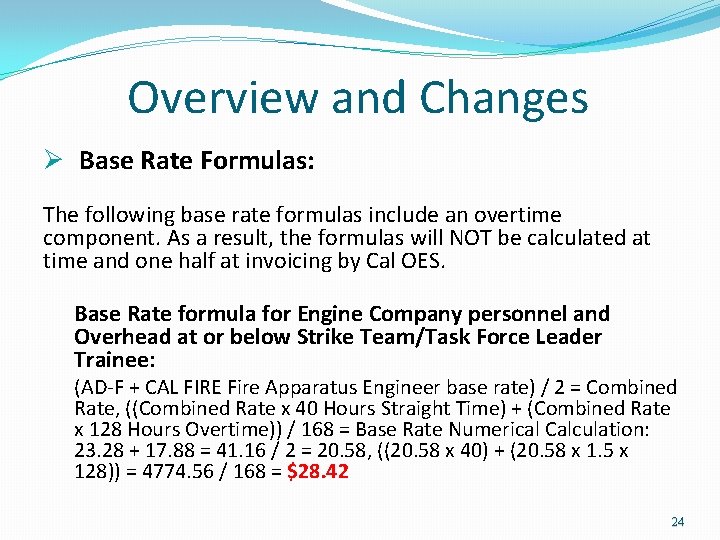
Overview and Changes Ø Base Rate Formulas: The following base rate formulas include an overtime component. As a result, the formulas will NOT be calculated at time and one half at invoicing by Cal OES. Base Rate formula for Engine Company personnel and Overhead at or below Strike Team/Task Force Leader Trainee: (AD-F + CAL FIRE Fire Apparatus Engineer base rate) / 2 = Combined Rate, ((Combined Rate x 40 Hours Straight Time) + (Combined Rate x 128 Hours Overtime)) / 168 = Base Rate Numerical Calculation: 23. 28 + 17. 88 = 41. 16 / 2 = 20. 58, ((20. 58 x 40) + (20. 58 x 1. 5 x 128)) = 4774. 56 / 168 = $28. 42 24
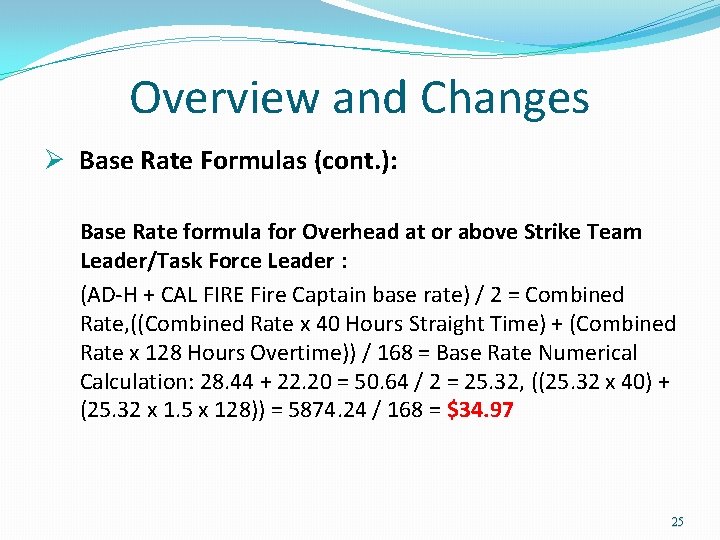
Overview and Changes Ø Base Rate Formulas (cont. ): Base Rate formula for Overhead at or above Strike Team Leader/Task Force Leader : (AD-H + CAL FIRE Fire Captain base rate) / 2 = Combined Rate, ((Combined Rate x 40 Hours Straight Time) + (Combined Rate x 128 Hours Overtime)) / 168 = Base Rate Numerical Calculation: 28. 44 + 22. 20 = 50. 64 / 2 = 25. 32, ((25. 32 x 40) + (25. 32 x 1. 5 x 128)) = 5874. 24 / 168 = $34. 97 25
Overview and Changes Ø Rate Letter Link 26
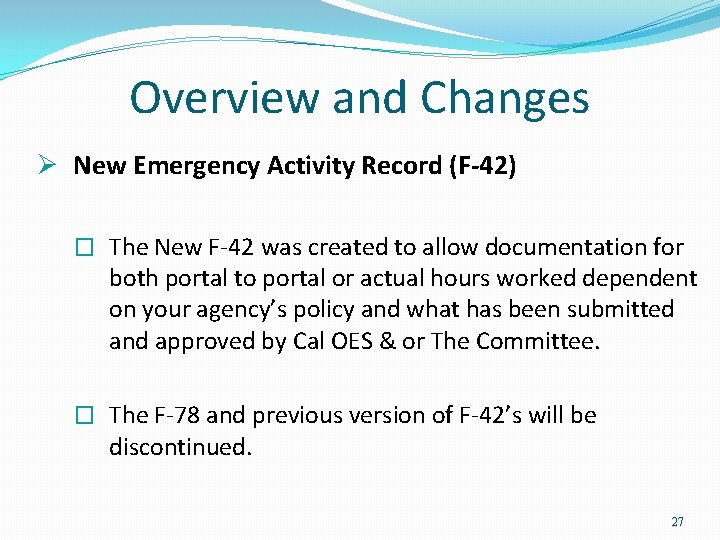
Overview and Changes Ø New Emergency Activity Record (F-42) � The New F-42 was created to allow documentation for both portal to portal or actual hours worked dependent on your agency’s policy and what has been submitted and approved by Cal OES & or The Committee. � The F-78 and previous version of F-42’s will be discontinued. 27
Overview and Changes Ø New Emergency Activity Record (F-42): � Link to sample F-42 28
Overview and Changes Ø Federal/Department of Defense/Tribal Fire Departments: � Reimbursement of Federal, DOD, and Tribal Fire Departments that respond to Federal Fire Agency fires are governed by other federal agreements. In these cases Cal OES will not produce or process reimbursement invoices for DOD and Tribal Fire Departments. � Federal and DOD Fire Departments responding under this Agreement will invoice the supported Federal Fire Agency directly in accordance with existing federal and local agreements. 29
Overview and Changes Ø Tribal Fire Departments: � Tribal Fire Departments responding under this Agreement will invoice the BIA directly in accordance with existing federal or local Agreements. � Tribal Fire Departments that have a compacted or contracted wildland fire program from BIA will respond through the Federal Dispatching System and not through the California Fire and Rescue Mutual Aid System. 30
Overview and Changes Ø Tribal Fire Department exception: � HOWEVER, BIA and Cal OES have mutually agreed to informally allow tribal fire departments that would prefer Cal OES to process and generate invoices on behalf of their department to submit a request to both organizations requesting this process be documented for further billings/reimbursement. 31
Overview and Changes Ø Reimbursement for fractional hours: � In the previous agreement, reimbursement for fractional hours was taken to the next whole hour. Reimbursement for fractional hours will now be taken to the next quarter hour. 32
Overview and Changes Ø System for Award Management (SAM): � There is NO fee to register (www. sam. gov). � Once your agency has registered, your agency is required to review and validate annually. � Your agency will receive an email at 60, 30, and 15 days prior to expiration. 33
Overview and Changes Ø System for Award Management (SAM) (cont. ): � If the Administrator of your agency leaves the agency without providing the log in and password to a new administrator, a notarized letter must be submitted to SAM to grant access to the new Administrator. � The Administrator can add a second contact within the registration (recommended) so that if one leaves the dept. there is still someone that can access the account (and that person can then add a new second contact). 34
Overview and Changes Ø Rental Vehicles: � The use and reimbursement of rental vehicles requires authorization either at the time of the initial request in ROSS, or documented by written approval at the incident. 35
Overview and Changes Ø Rental Vehicles (cont. ): � Authorized Rental Vehicles: The dispatch/mobilization centers for the requesting State of California or Federal Fire Agencies may make arrangements for procuring rental vehicles, or may direct the California Fire and Rescue Mutual Aid System Agency to make their own arrangements. � Rental vehicles from an airport are discouraged and the use of economy cars is encouraged. 36
Overview and Changes Ø Rental Vehicles (cont. ): � Authorized Rental Vehicles on the resource order do not need additional incident approval. The cost of the rental vehicle, if incurred by the local agency, and fuel purchased to operate the rental vehicle must be submitted on the “travel expense claim reimbursement log” with attached receipts and the ROSS order validating the approval. 37
Overview and Changes Ø Exhibit G – Federal Interstate Agreement: � Procedures and reimbursement provisions of personnel and local government-owned emergency apparatus ordered for use on Federal incidents outside the State of California. � Reimbursement of personnel, emergency apparatus, and support equipment will be consistent with Exhibit A Reimbursement Policy and Procedures with the following exceptions: 38
Overview and Changes Ø Exhibit G – Federal Interstate Agreement (cont. ): �Travel costs for lodging and per diem for personnel shall be reimbursed at the rates and methods established within Exhibit H, limited to the California State Standard Per Diem Rates in effect at the time of the response. �Lodging expense will follow the “all counties/cities located in California” up to 90. 00 per night, plus tax. 39
Overview and Changes Ø Exhibit G – Federal Interstate Agreement (cont. ): � Exceptions will be handled case by case with formal documented written approval. � The rates and methods established by the U. S. General Services Administration (GSA) will no longer be used. 40
Overview and Changes Ø Exhibit H – In-State Travel and Incident Related Expenses: � Identifies allowable costs and the process for submitting such cost. � Primarily pertains to cost associated with fuel, food, vehicle and lodging. 41
Overview and Changes Ø Exhibit H – In-State Travel and Incident Related Expenses (cont. ): � At no time will the California Fire and Rescue Mutual Aid System Agencies seek reimbursement for travel expenses such as fuel, food, and lodging responding to, during or returning from a State of California or Federal Fire Agency incident unless formally documented and approved in writing at the incident. The reimbursement of meals to and from the incident will be subject to the California state standard per diem and lodging rates specified in Exhibit H. 42
Overview and Changes Ø Exhibit H – In-State Travel and Incident Related Expenses (cont. ): � Travel arrangements and reimbursement including travel for relieving personnel and backfill will only be made from the fire dept/agency location or residence whichever is closest to the incident or reporting location. � In order for agencies to be eligible for reimbursement of expenses related to the incident, the approval MUST be formally documented with an associated Supply (S) #. 43
Overview and Changes Ø Exhibit H – In-State Travel and Incident Related Expenses (cont. ): Exhibit H 44
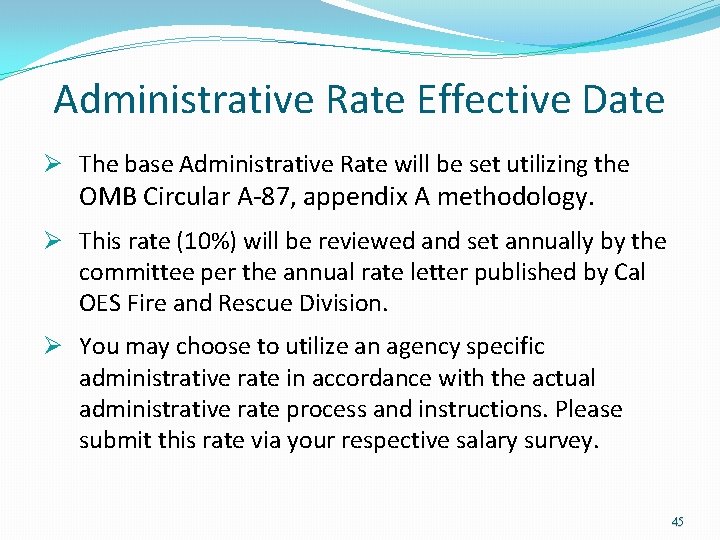
Administrative Rate Effective Date Ø The base Administrative Rate will be set utilizing the OMB Circular A-87, appendix A methodology. Ø This rate (10%) will be reviewed and set annually by the committee per the annual rate letter published by Cal OES Fire and Rescue Division. Ø You may choose to utilize an agency specific administrative rate in accordance with the actual administrative rate process and instructions. Please submit this rate via your respective salary survey. 45
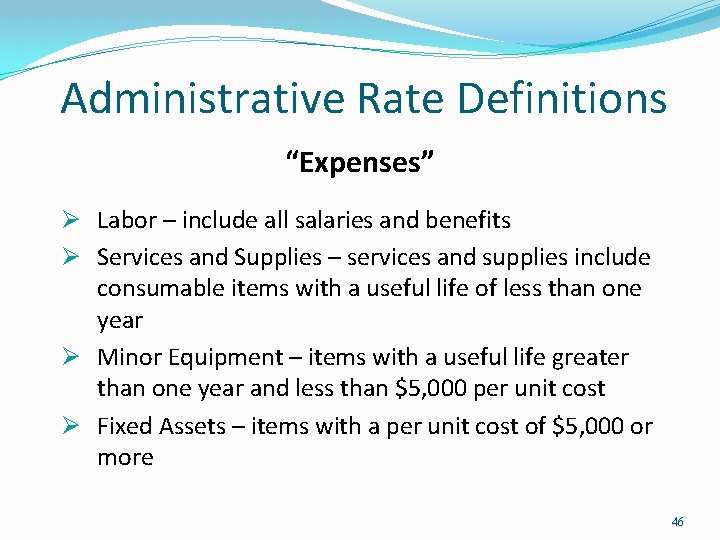
Administrative Rate Definitions “Expenses” Ø Labor – include all salaries and benefits Ø Services and Supplies – services and supplies include consumable items with a useful life of less than one year Ø Minor Equipment – items with a useful life greater than one year and less than $5, 000 per unit cost Ø Fixed Assets – items with a per unit cost of $5, 000 or more 46
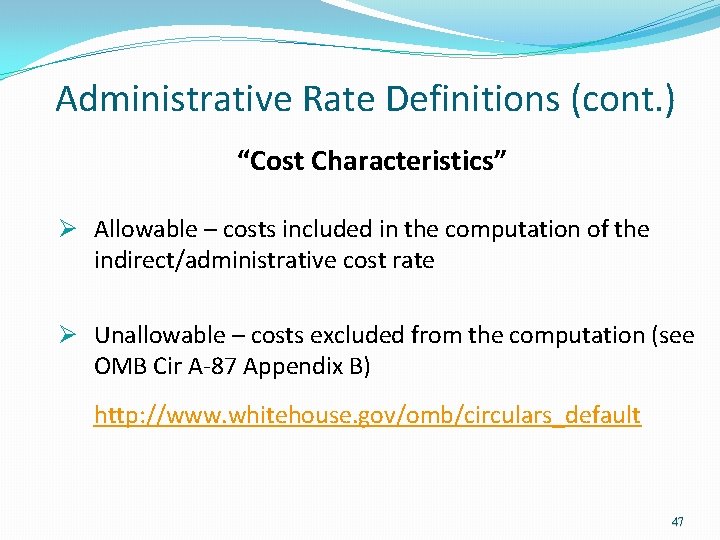
Administrative Rate Definitions (cont. ) “Cost Characteristics” Ø Allowable – costs included in the computation of the indirect/administrative cost rate Ø Unallowable – costs excluded from the computation (see OMB Cir A-87 Appendix B) http: //www. whitehouse. gov/omb/circulars_default 47
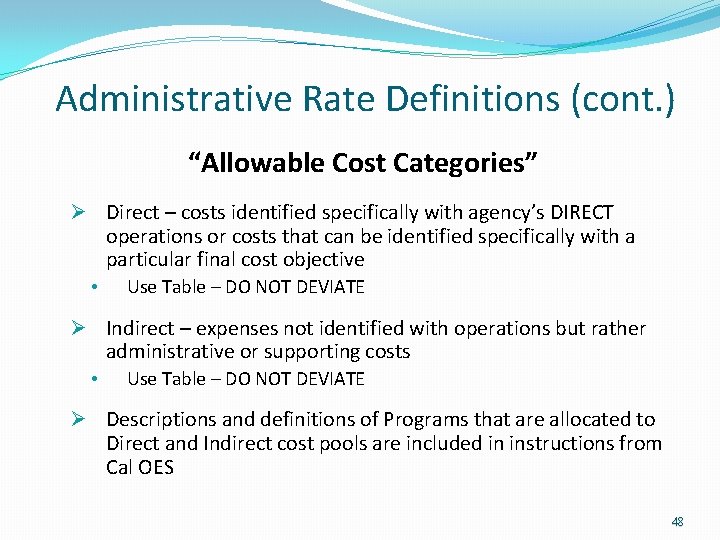
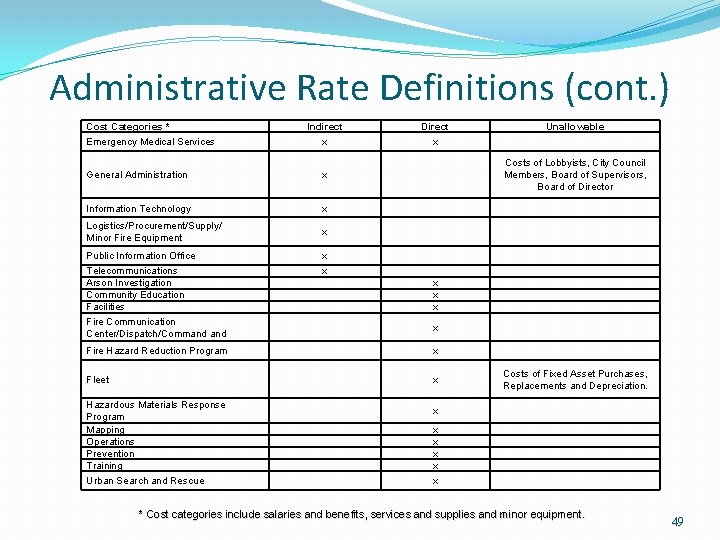
Administrative Rate Definitions (cont. ) “Allowable Cost Categories” Ø Direct – costs identified specifically with agency’s DIRECT operations or costs that can be identified specifically with a particular final cost objective • Use Table – DO NOT DEVIATE Ø Indirect – expenses not identified with operations but rather administrative or supporting costs • Use Table – DO NOT DEVIATE Ø Descriptions and definitions of Programs that are allocated to Direct and Indirect cost pools are included in instructions from Cal OES 48
Administrative Rate Definitions (cont. ) Cost Categories * Indirect Direct Emergency Medical Services x x General Administration x Information Technology x Logistics/Procurement/Supply/ Minor Fire Equipment x Public Information Office x Telecommunications Arson Investigation Community Education Facilities Fire Communication Center/Dispatch/Command x Costs of Lobbyists, City Council Members, Board of Supervisors, Board of Director x x Fire Hazard Reduction Program x Fleet x Hazardous Materials Response Program Mapping Operations Prevention Training Urban Search and Rescue Unallowable Costs of Fixed Asset Purchases, Replacements and Depreciation. x x x * Cost categories include salaries and benefits, services and supplies and minor equipment. 49
Administrative Rate Calculations Ø USE TEMPLATE PROVIDED Ø “Actual Administrative Rate Calculation Sheet” Ø Insert prior year actual departmental indirect and direct costs into Template (referred to as “prior actual”). Ø Not all categories of direct and indirect costs will follow your normal practice; however, this was an equitable, reasonable, and defendable approach and shall not be changed. 50
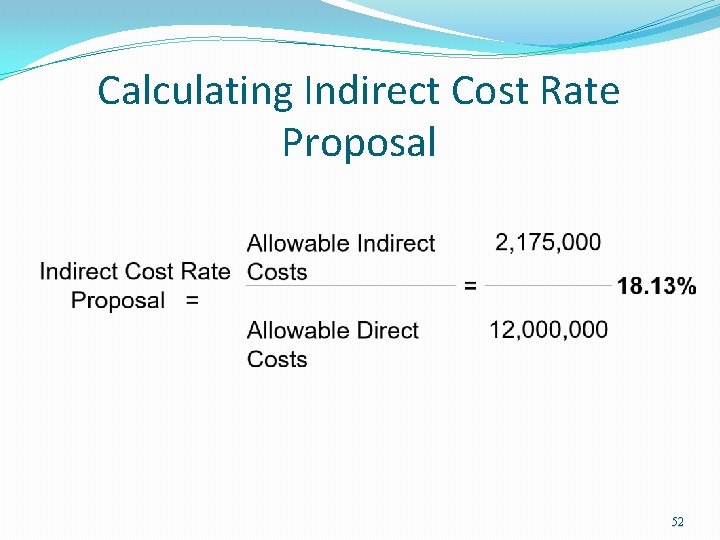
Administrative Rate Calculations (cont. ) Ø Divide the sum of the allowable indirect costs into the allowable direct costs to generate indirect/administrative percentage Ø Indirect costs/direct costs = indirect cost rate % 51
Calculating Indirect Cost Rate Proposal 52
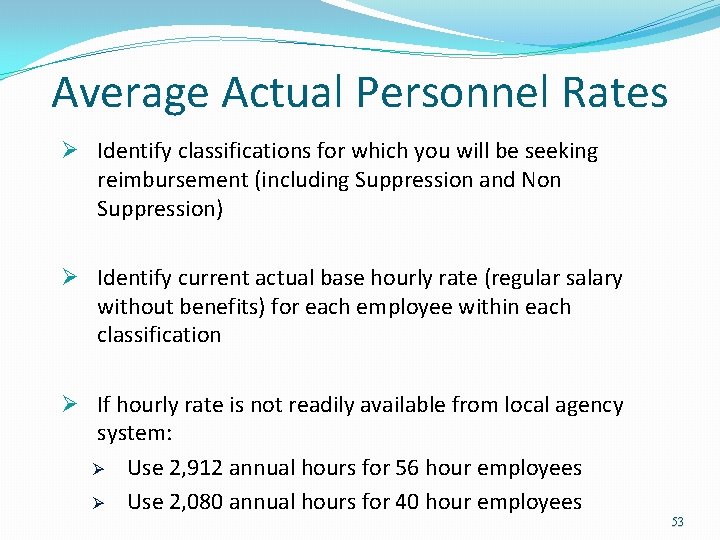
Average Actual Personnel Rates Ø Identify classifications for which you will be seeking reimbursement (including Suppression and Non Suppression) Ø Identify current actual base hourly rate (regular salary without benefits) for each employee within each classification Ø If hourly rate is not readily available from local agency system: Ø Use 2, 912 annual hours for 56 hour employees Ø Use 2, 080 annual hours for 40 hour employees 53
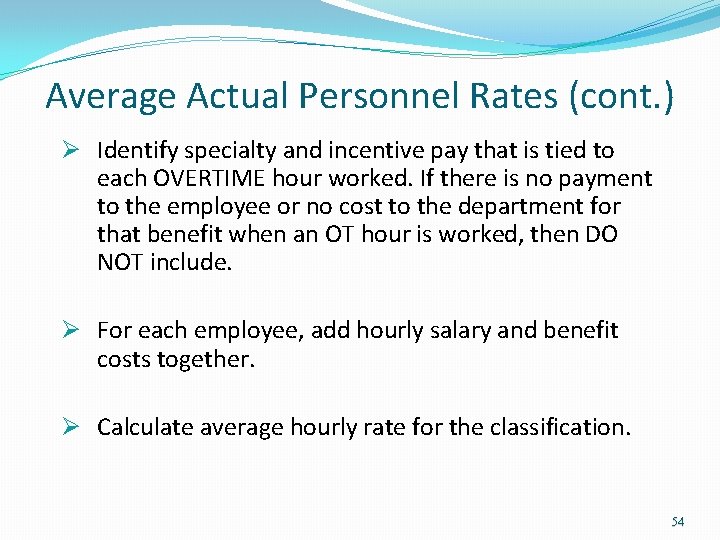
Average Actual Personnel Rates (cont. ) Ø Identify specialty and incentive pay that is tied to each OVERTIME hour worked. If there is no payment to the employee or no cost to the department for that benefit when an OT hour is worked, then DO NOT include. Ø For each employee, add hourly salary and benefit costs together. Ø Calculate average hourly rate for the classification. 54
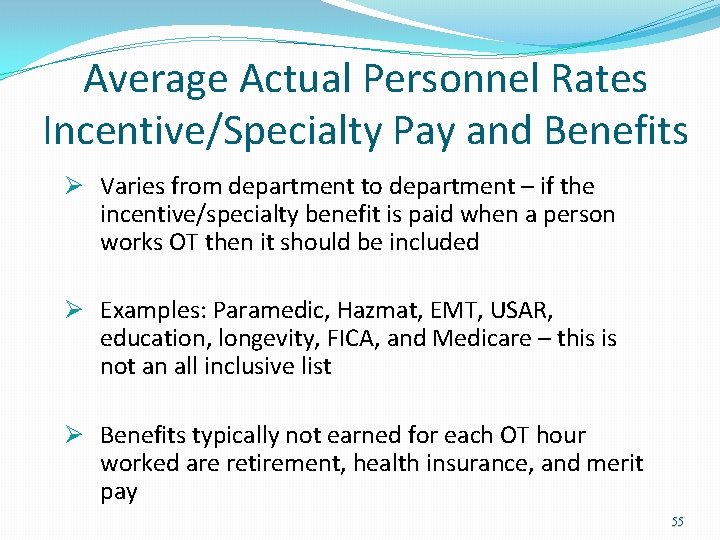
Average Actual Personnel Rates Incentive/Specialty Pay and Benefits Ø Varies from department to department – if the incentive/specialty benefit is paid when a person works OT then it should be included Ø Examples: Paramedic, Hazmat, EMT, USAR, education, longevity, FICA, and Medicare – this is not an all inclusive list Ø Benefits typically not earned for each OT hour worked are retirement, health insurance, and merit pay 55
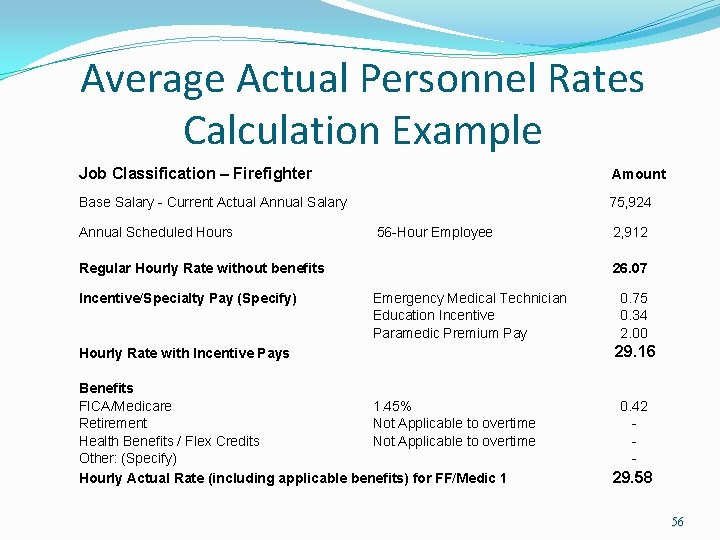
Average Actual Personnel Rates Calculation Example Job Classification – Firefighter Amount Base Salary - Current Actual Annual Salary 75, 924 Annual Scheduled Hours 56 -Hour Employee Regular Hourly Rate without benefits Incentive/Specialty Pay (Specify) 2, 912 26. 07 Emergency Medical Technician Education Incentive Paramedic Premium Pay Hourly Rate with Incentive Pays. Benefits FICA/Medicare 1. 45% Retirement Not Applicable to overtime Health Benefits / Flex Credits Not Applicable to overtime Other: (Specify) Hourly Actual Rate (including applicable benefits) for FF/Medic 1 0. 75 0. 34 2. 00 29. 16 0. 42 - 29. 58 56
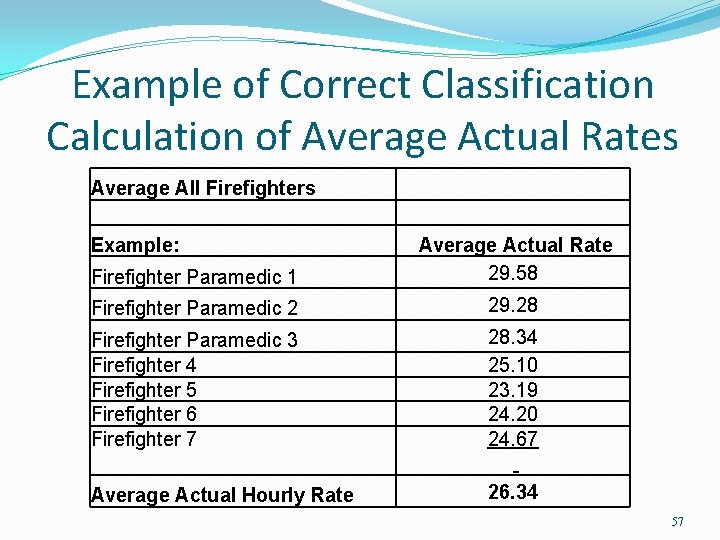
Example of Correct Classification Calculation of Average Actual Rates Average All Firefighters. Example: Firefighter Paramedic 1 Average Actual Rate 29. 58 Firefighter Paramedic 2 29. 28 Firefighter Paramedic 3 Firefighter 4 Firefighter 5 Firefighter 6 Firefighter 7 28. 34 25. 10 23. 19 24. 20 24. 67 Average Actual Hourly Rate 26. 34 57
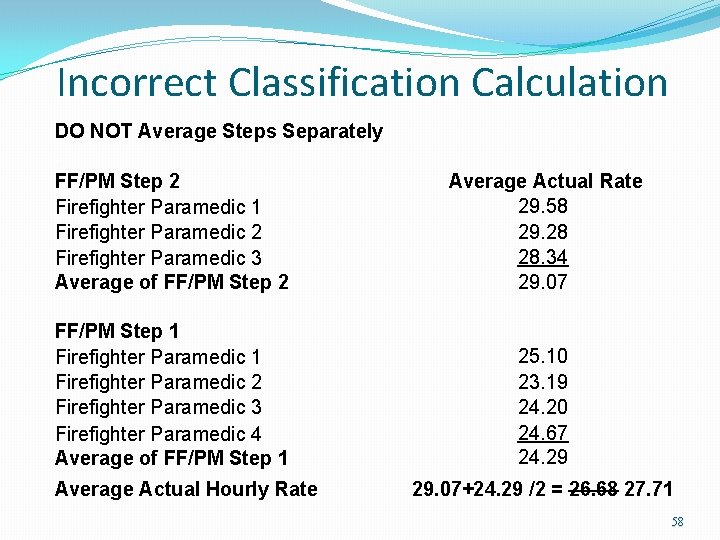
Incorrect Classification Calculation DO NOT Average Steps Separately. FF/PM Step 2 Firefighter Paramedic 1 Firefighter Paramedic 2 Firefighter Paramedic 3 Average of FF/PM Step 2 FF/PM Step 1 Firefighter Paramedic 2 Firefighter Paramedic 3 Firefighter Paramedic 4 Average of FF/PM Step 1 Average Actual Hourly Rate Average Actual Rate 29. 58 29. 28 28. 34 29. 07 25. 10 23. 19 24. 20 24. 67 24. 29 29. 07+24. 29 /2 = 26. 68 27. 71 58
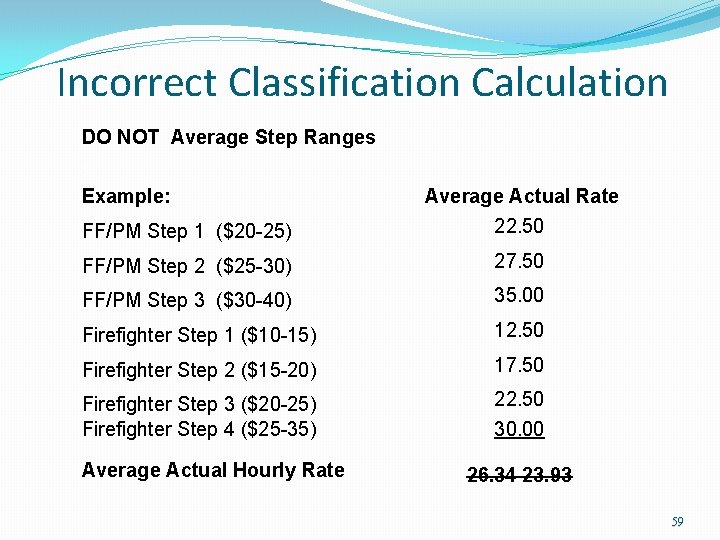
Incorrect Classification Calculation DO NOT Average Step Ranges. Example: FF/PM Step 1 ($20 -25) Average Actual Rate 22. 50 FF/PM Step 2 ($25 -30) 27. 50 FF/PM Step 3 ($30 -40) 35. 00 Firefighter Step 1 ($10 -15) 12. 50 Firefighter Step 2 ($15 -20) 17. 50 Firefighter Step 3 ($20 -25) Firefighter Step 4 ($25 -35) 22. 50 30. 00 Average Actual Hourly Rate 26. 34 23. 93 59
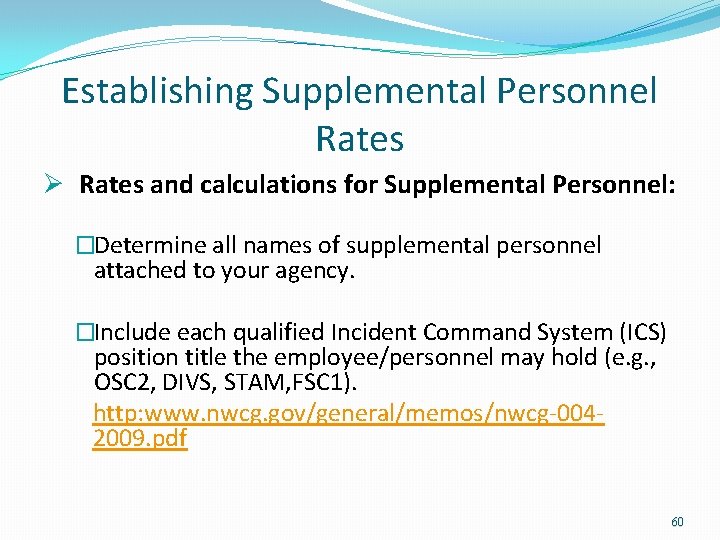
Establishing Supplemental Personnel Rates Ø Rates and calculations for Supplemental Personnel: �Determine all names of supplemental personnel attached to your agency. �Include each qualified Incident Command System (ICS) position title the employee/personnel may hold (e. g. , OSC 2, DIVS, STAM, FSC 1). http: www. nwcg. gov/general/memos/nwcg-0042009. pdf 60
Establishing Supplemental Personnel Rates (cont. ) Ø Rates and calculations for Supplemental Personnel: � Go to website http: //www. opm. gov/policy-data- oversight/pay-leave/salaries-wages/2015/generalschedule/. � Indicated the GS pay rate at step 5 for each position held. If the locality pay applies to the location under your agency, use the appropriate GS locality pay rate associated with your fire agency and NOT your residence. 61
Establishing Supplemental Personnel Rates (cont. ) Ø Rates and calculations for Supplemental Personnel (cont. ): � Supplemental employee’s will submit for reimbursement for the ICS position the incident ordered and requested and NOT the highest ICS position held. 62
Salary Survey(s) Ø Salary Survey’s Link to Salary Survey (Suppression) Link to Salary Survey (Non Suppression) Attach A Link to Salary Survey (Supplemental) Attach B 63
Deadlines/Timelines Ø Critical Deadline Matrix Ø CFAA Reimbursement Timelines 64
Resources and References Ø California Fire Assistance Agreement (CFAA) and related documents: http: //www. caloes. ca. gov/Fire. Rescue. Site/Pages/Reimburseme nt. aspx Ø Cal OES Fire website http: //www. caloes. ca. gov/Cal-OES-Divisions/Fire-Rescue Ø FEMA website (equipment rates): http: //www. fema. gov/government/grant/pa/eqrates. shtm 65
Questions / Help? 66
Contacts � Yolie Thomas, Assistant Director, Incident Administration ythomas@fs. fed. us 707 -562 -8835 – United States Forest Service, Region 5 � Anjulie White, Administrative Officer anjulie. white@bia. ca. gov 916 -978 -6146 – Bureau of Indian Affairs � Ann. Marie Carlson, Program Analyst acarlson@blm. gov 916 -978 -4446 – Bureau of Land Management 67
Contacts � Lori Lopez, Emergency Services Coordinator lori. lopez@caloes. ca. gov – Local Gov’t Rep 916 -845 -8722 – Cal OES Fire and Rescue Division � Michelle Lawrence, Emergency Response Billing Office Manager michelle. lawrence@fire. ca. gov 916 -653 -5335 – CAL FIRE � Mike Rosales, Deputy Chief, State and Federal Programs mike. rosales@fire. ca. gov 916 -653 -8362 – CAL FIRE 68
CFAA Local Government Representatives � Richard H. Webb, Fire Chief rich. webb@lindafire. org – 530 -743 -1553 Local Government Rep North/Volunteers Linda Fire Protection District � Mark Lorenzen, Fire Chief Mark. lorenzen@ventura. org – 805 -389 -9704 Local Government Rep South Ventura County Fire Department � Vacant Local Government Rep Volunteers 69