
2014October23 Toward Understanding Tacticity in Radical Vinyl Polymerization
2014/October/23 Toward Understanding Tacticity in Radical Vinyl Polymerization in PCP Nanochannels PCP細孔内ラジカルビニル重合反応生成物の 立体規則性の理解に向けて Masayoshi Takayanagi Graduate School of Information Science, Nagoya University 1
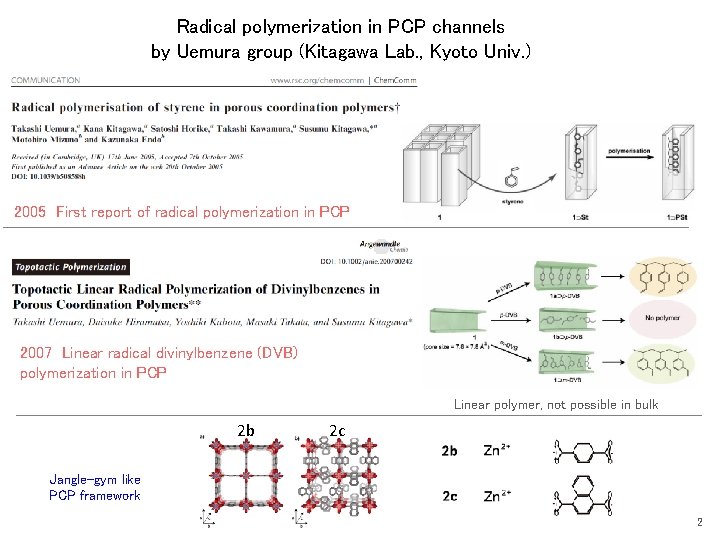
Radical polymerization in PCP channels by Uemura group (Kitagawa Lab. , Kyoto Univ. ) 2005 First report of radical polymerization in PCP 2007 Linear radical divinylbenzene (DVB) polymerization in PCP Linear polymer, not possible in bulk 2 b 2 c Jangle-gym like PCP framework 2
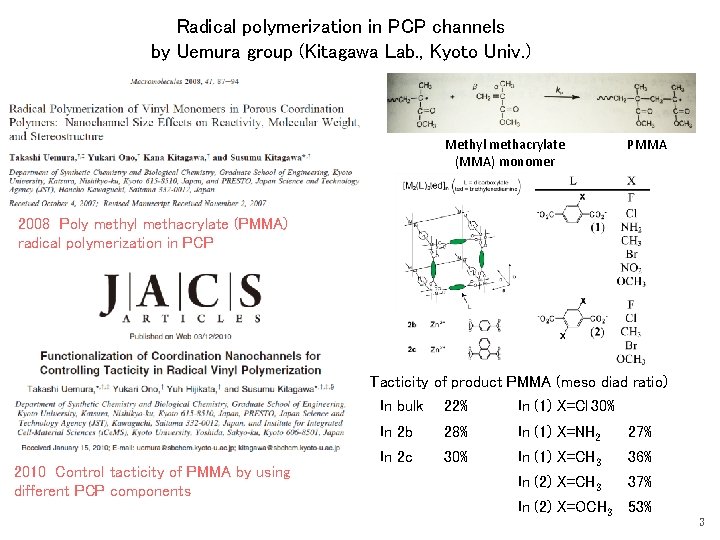
Radical polymerization in PCP channels by Uemura group (Kitagawa Lab. , Kyoto Univ. ) Methyl methacrylate (MMA) monomer PMMA 2008 Poly methyl methacrylate (PMMA) radical polymerization in PCP Tacticity of product PMMA (meso diad ratio) 2010 Control tacticity of PMMA by using different PCP components In bulk 22% In (1) X=Cl 30% In 2 b 28% In (1) X=NH 2 27% In 2 c 30% In (1) X=CH 3 36% In (2) X=CH 3 37% In (2) X=OCH 3 53% 3

Tacticity Meso diad (m) Isotactic triad (mm) Isotactic polymer Racemo diad (r) Heterotactic triad (mr, rm) Syndiotactic triad (rr) Syndiotactic polymer 4

Initiation reaction of MMA radical polymerization by AIBNによるMMAラジカル重合の開始反応 Thermal decomposition at 40 -80 ℃ AIBN MMA monomer 5
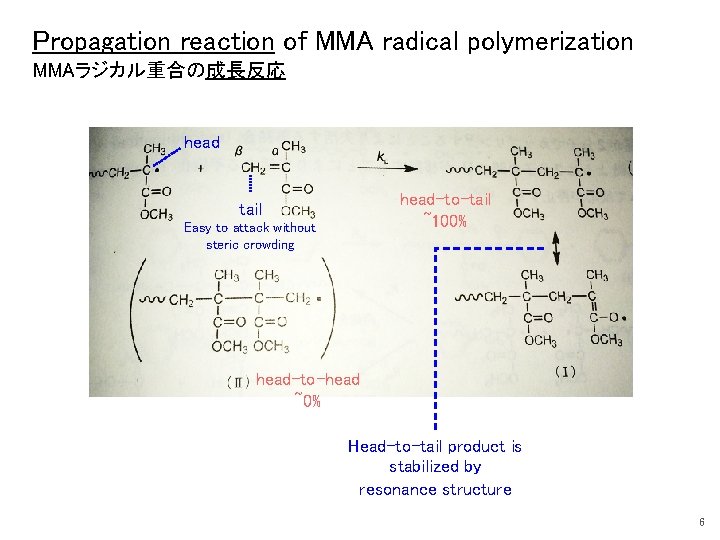
Propagation reaction of MMA radical polymerization MMAラジカル重合の成長反応 head-to-tail ~100% tail Easy to attack without steric crowding head-to-head ~0% Head-to-tail product is stabilized by resonance structure 6
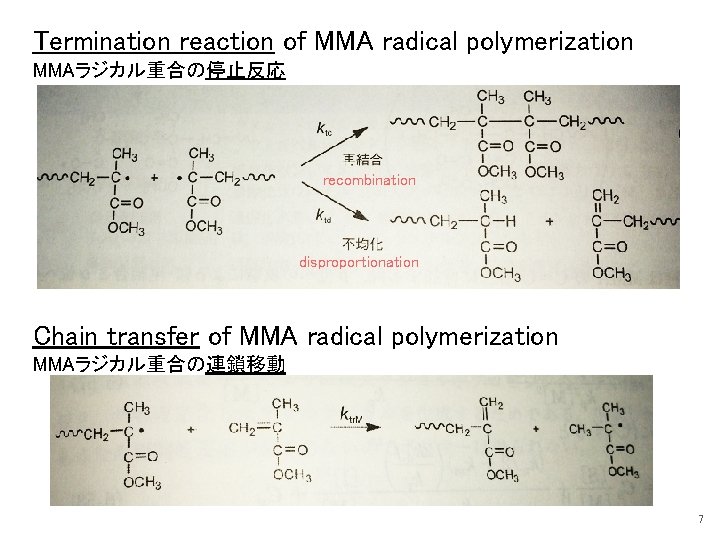
Termination reaction of MMA radical polymerization MMAラジカル重合の停止反応 recombination disproportionation Chain transfer of MMA radical polymerization MMAラジカル重合の連鎖移動 7
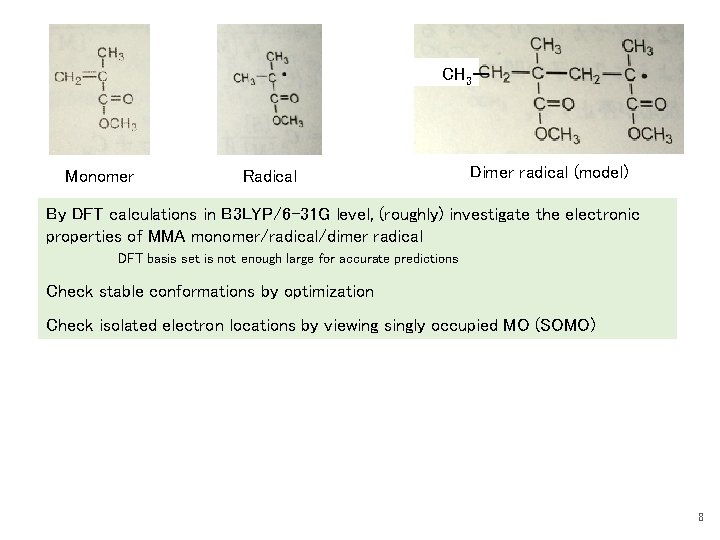
CH 3ー Monomer Radical Dimer radical (model) By DFT calculations in B 3 LYP/6 -31 G level, (roughly) investigate the electronic properties of MMA monomer/radical/dimer radical DFT basis set is not enough large for accurate predictions Check stable conformations by optimization Check isolated electron locations by viewing singly occupied MO (SOMO) 8
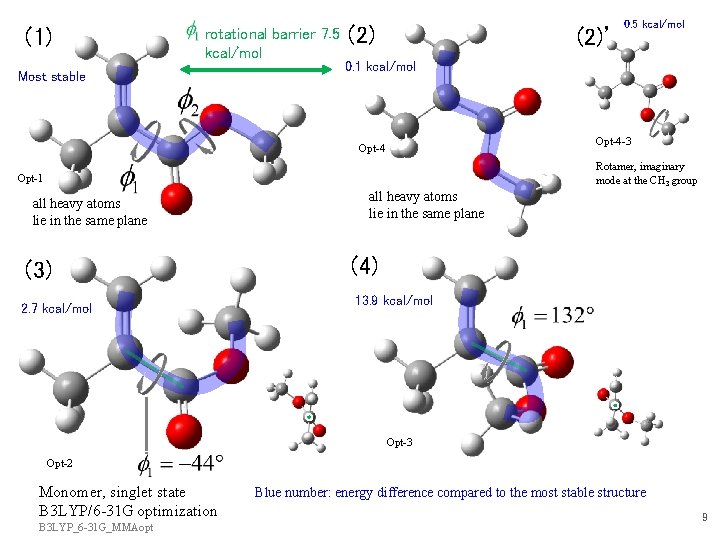
(1) rotational barrier 7. 5 kcal/mol Most stable (2)’ 0. 5 kcal/mol 0. 1 kcal/mol Opt-4 -3 Opt-4 Rotamer, imaginary mode at the CH 3 group Opt-1 all heavy atoms lie in the same plane (3) 2. 7 kcal/mol all heavy atoms lie in the same plane (4) 13. 9 kcal/mol Opt-3 Opt-2 Monomer, singlet state B 3 LYP/6 -31 G optimization B 3 LYP_6 -31 G_MMAopt Blue number: energy difference compared to the most stable structure 9
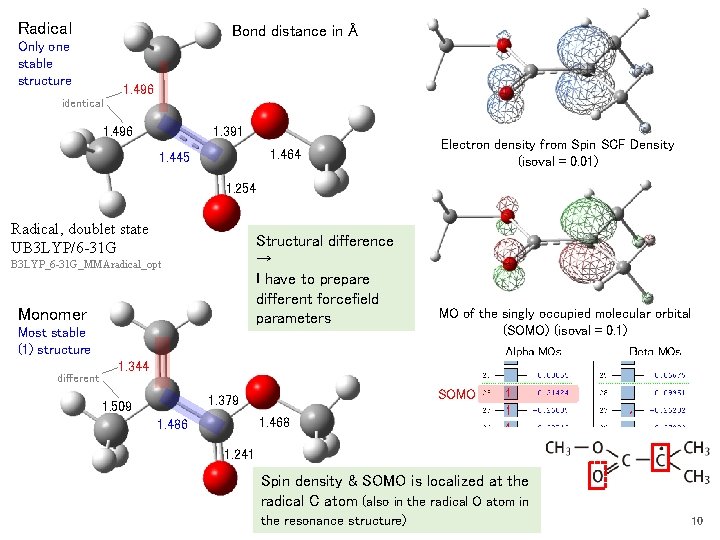
Radical Bond distance in Å Only one stable structure 1. 496 identical 1. 391 1. 496 1. 464 1. 445 Electron density from Spin SCF Density (isoval = 0. 01) 1. 254 Radical, doublet state UB 3 LYP/6 -31 G Structural difference → I have to prepare different forcefield parameters B 3 LYP_6 -31 G_MMAradical_opt Monomer Most stable (1) structure different MO of the singly occupied molecular orbital (SOMO) (isoval = 0. 1) 1. 344 SOMO 1. 379 1. 509 1. 468 1. 486 1. 241 Spin density & SOMO is localized at the radical C atom (also in the radical O atom in the resonance structure) 10
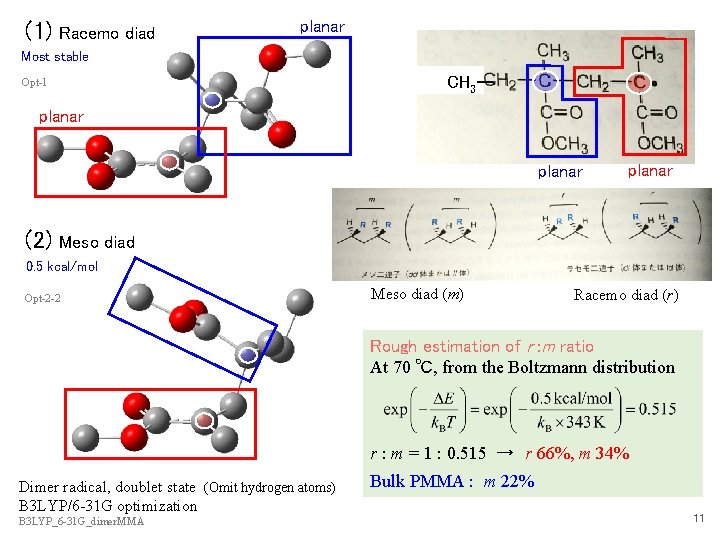
(1) Racemo diad planar Most stable CH 3ー Opt-1 planar (2) planar Meso diad 0. 5 kcal/mol Opt-2 -2 Meso diad (m) Racemo diad (r) Rough estimation of r : m ratio At 70 ℃, from the Boltzmann distribution r : m = 1 : 0. 515 → r 66%, m 34% Dimer radical, doublet state (Omit hydrogen atoms) B 3 LYP/6 -31 G optimization B 3 LYP_6 -31 G_dimer. MMA Bulk PMMA : m 22% 11
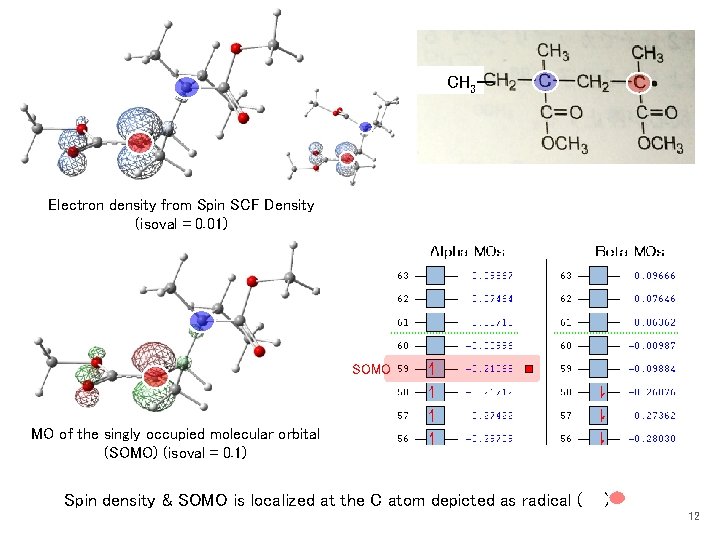
CH 3ー Electron density from Spin SCF Density (isoval = 0. 01) SOMO MO of the singly occupied molecular orbital (SOMO) (isoval = 0. 1) Spin density & SOMO is localized at the C atom depicted as radical ( ) 12
- Slides: 12