
20140913 Evolution of interstellar dust and extinction curve
- Slides: 11
2014/09/13 高赤方偏移クェーサー母銀河の 星間ダスト進化と減光曲線 (Evolution of interstellar dust and extinction curve in the host galaxies of high-z quasars) 野沢 貴也 (Takaya Nozawa) 国立天文台 (NAOJ) 共同研究者 浅野 良輔、竹内 努 (名古屋大学)、平下 博之 (ASIAA) Reference: Nozawa, Asano, Hirashita, Takeuchi (2014, submitted to MNRAS Letter)
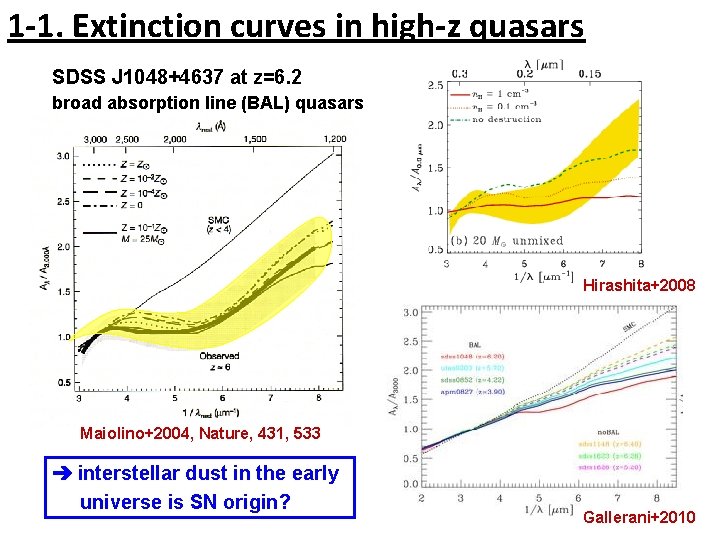
1 -1. Extinction curves in high-z quasars SDSS J 1048+4637 at z=6. 2 broad absorption line (BAL) quasars Hirashita+2008 Maiolino+2004, Nature, 431, 533 ➔ interstellar dust in the early universe is SN origin? Gallerani+2010
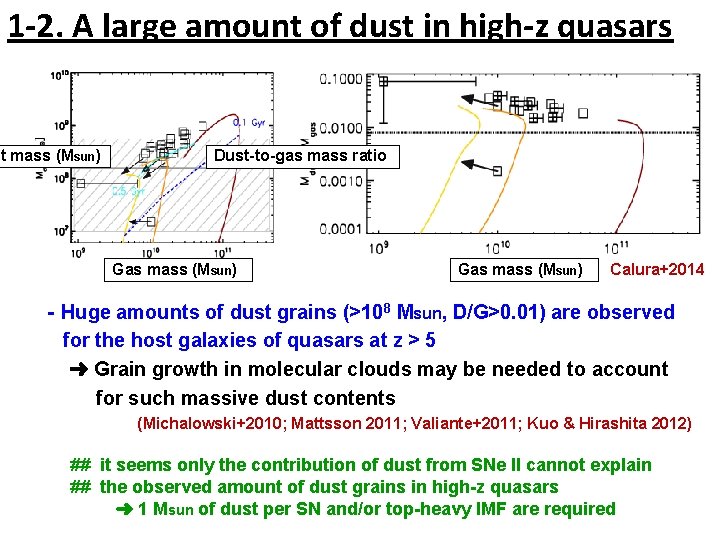
1 -2. A large amount of dust in high-z quasars st mass (Msun) Dust-to-gas mass ratio Gas mass (Msun) Calura+2014 ‐Huge amounts of dust grains (>108 Msun, D/G>0. 01) are observed for the host galaxies of quasars at z > 5 ➜ Grain growth in molecular clouds may be needed to account for such massive dust contents (Michalowski+2010; Mattsson 2011; Valiante+2011; Kuo & Hirashita 2012) ## it seems only the contribution of dust from SNe II cannot explain ## the observed amount of dust grains in high-z quasars ➜ 1 Msun of dust per SN and/or top-heavy IMF are required
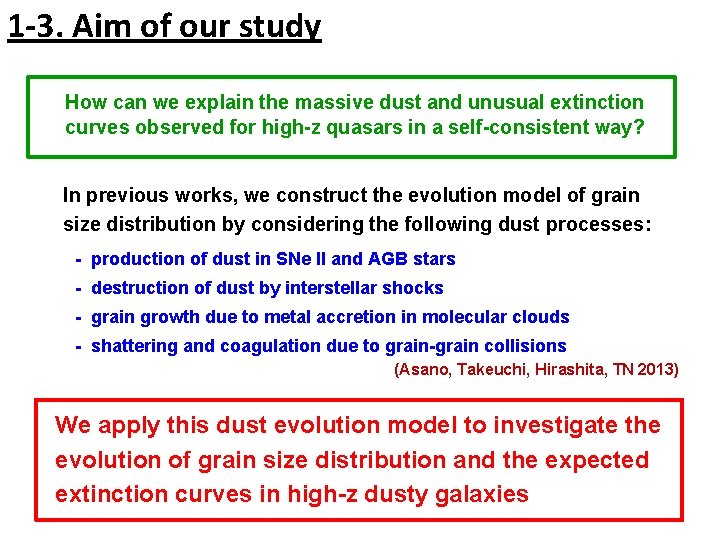
1 -3. Aim of our study How can we explain the massive dust and unusual extinction curves observed for high-z quasars in a self-consistent way? In previous works, we construct the evolution model of grain size distribution by considering the following dust processes: - production of dust in SNe II and AGB stars - destruction of dust by interstellar shocks - grain growth due to metal accretion in molecular clouds - shattering and coagulation due to grain-grain collisions (Asano, Takeuchi, Hirashita, TN 2013) We apply this dust evolution model to investigate the evolution of grain size distribution and the expected extinction curves in high-z dusty galaxies
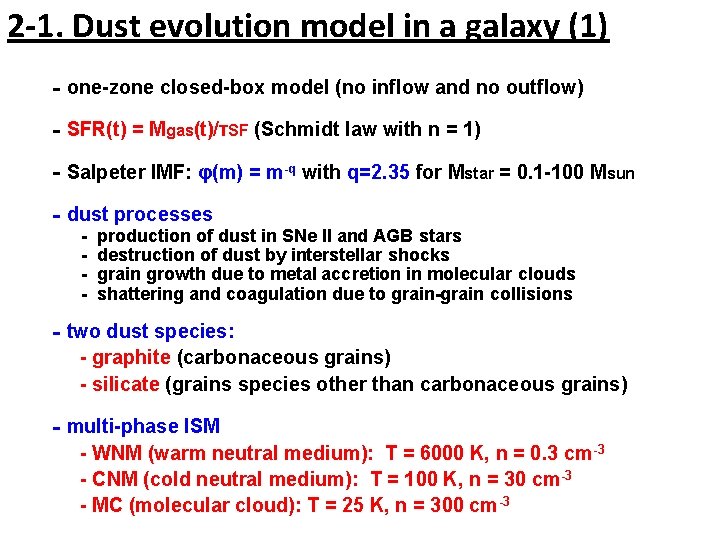
2 -1. Dust evolution model in a galaxy (1) ‐one-zone closed-box model (no inflow and no outflow) ‐SFR(t) = Mgas(t)/τSF (Schmidt law with n = 1) ‐Salpeter IMF: φ(m) = m-q with q=2. 35 for Mstar = 0. 1 -100 Msun ‐dust processes - production of dust in SNe II and AGB stars destruction of dust by interstellar shocks grain growth due to metal accretion in molecular clouds shattering and coagulation due to grain-grain collisions ‐two dust species: - graphite (carbonaceous grains) - silicate (grains species other than carbonaceous grains) ‐multi-phase ISM - WNM (warm neutral medium): T = 6000 K, n = 0. 3 cm-3 - CNM (cold neutral medium): T = 100 K, n = 30 cm-3 - MC (molecular cloud): T = 25 K, n = 300 cm-3
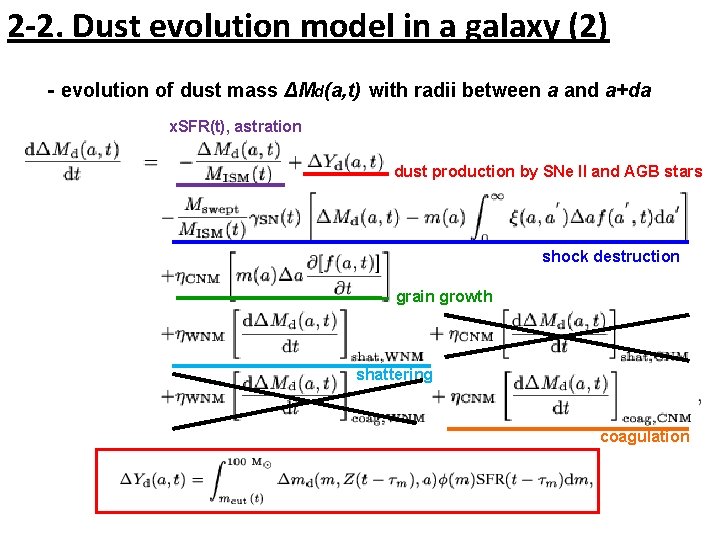
2 -2. Dust evolution model in a galaxy (2) ‐evolution of dust mass ΔMd(a, t) with radii between a and a+da x. SFR(t), astration dust production by SNe II and AGB stars shock destruction grain growth shattering coagulation
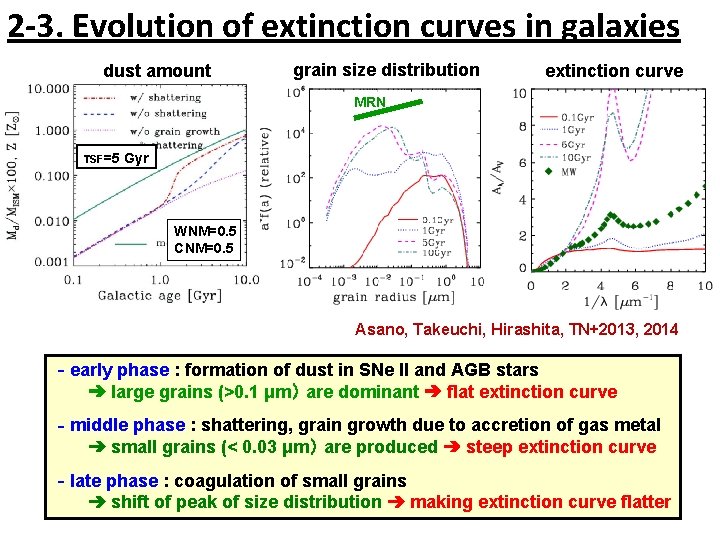
2 -3. Evolution of extinction curves in galaxies grain size distribution dust amount extinction curve MRN τSF=5 Gyr WNM=0. 5 CNM=0. 5 Asano, Takeuchi, Hirashita, TN+2013, 2014 ‐early phase : formation of dust in SNe II and AGB stars ➔ large grains (>0. 1 μm) are dominant ➔ flat extinction curve Asano+12 ‐middle phase : shattering, grain growth due to accretion of gas metal ➔ small grains (< 0. 03 μm) are produced ➔ steep extinction curve ‐late phase : coagulation of small grains ➔ shift of peak of size distribution ➔ making extinction curve flatter
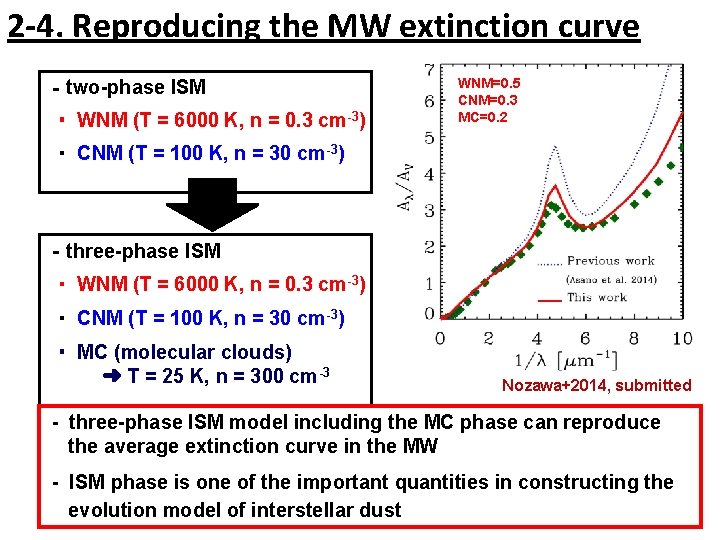
2 -4. Reproducing the MW extinction curve ‐two-phase ISM ・ WNM (T = 6000 K, n = 0. 3 cm-3) WNM=0. 5 CNM=0. 3 MC=0. 2 ・ CNM (T = 100 K, n = 30 cm-3) ‐three-phase ISM ・ WNM (T = 6000 K, n = 0. 3 cm-3) ・ CNM (T = 100 K, n = 30 cm-3) ・ MC (molecular clouds) ➜ T = 25 K, n = 300 cm-3 Nozawa+2014, submitted - three-phase ISM model including the MC phase can reproduce the average extinction curve in the MW - ISM phase is one of the important quantities in constructing the evolution model of interstellar dust
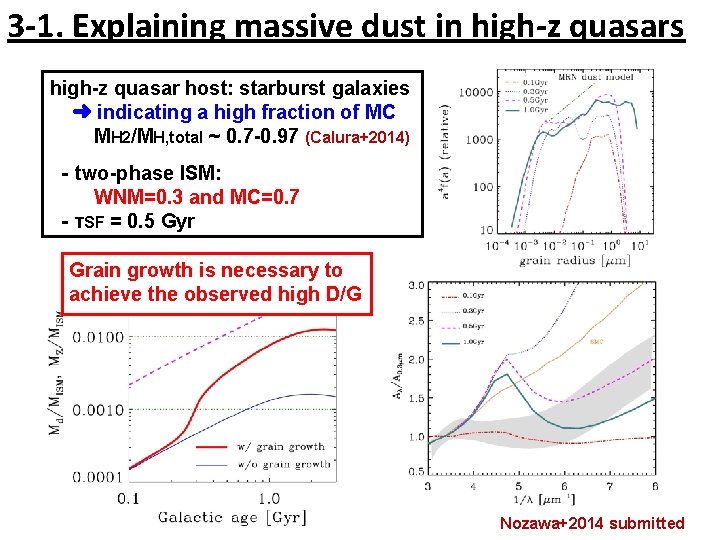
3 -1. Explaining massive dust in high-z quasars high-z quasar host: starburst galaxies ➜ indicating a high fraction of MC MH 2/MH, total ~ 0. 7 -0. 97 (Calura+2014) ‐two-phase ISM: WNM=0. 3 and MC=0. 7 ‐τSF = 0. 5 Gyr Grain growth is necessary to achieve the observed high D/G Nozawa+2014 submitted
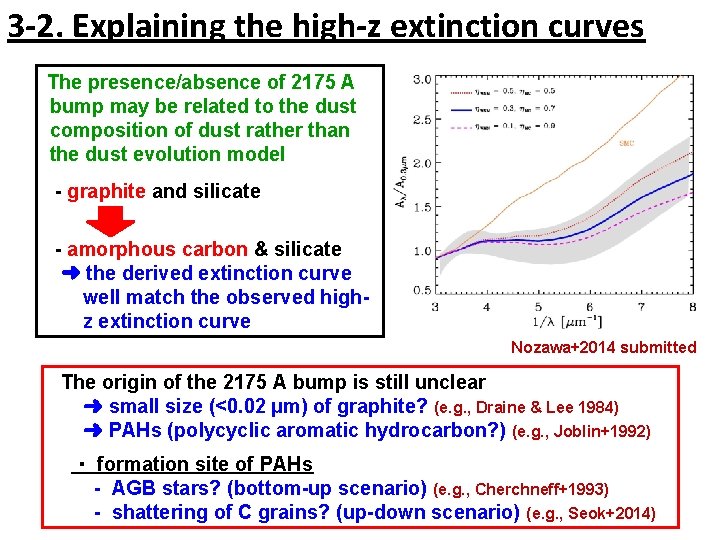
3 -2. Explaining the high-z extinction curves The presence/absence of 2175 A bump may be related to the dust composition of dust rather than the dust evolution model - graphite and silicate - amorphous carbon & silicate ➜ the derived extinction curve well match the observed highz extinction curve Nozawa+2014 submitted The origin of the 2175 A bump is still unclear ➜ small size (<0. 02 µm) of graphite? (e. g. , Draine & Lee 1984) ➜ PAHs (polycyclic aromatic hydrocarbon? ) (e. g. , Joblin+1992) ・ formation site of PAHs - AGB stars? (bottom-up scenario) (e. g. , Cherchneff+1993) - shattering of C grains? (up-down scenario) (e. g. , Seok+2014)
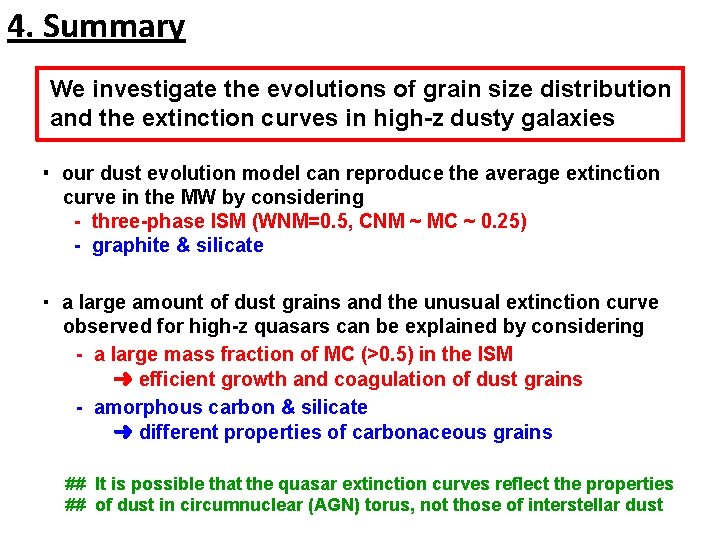
4. Summary We investigate the evolutions of grain size distribution and the extinction curves in high-z dusty galaxies ・ our dust evolution model can reproduce the average extinction curve in the MW by considering - three-phase ISM (WNM=0. 5, CNM ~ MC ~ 0. 25) - graphite & silicate ・ a large amount of dust grains and the unusual extinction curve observed for high-z quasars can be explained by considering - a large mass fraction of MC (>0. 5) in the ISM ➜ efficient growth and coagulation of dust grains - amorphous carbon & silicate ➜ different properties of carbonaceous grains ## It is possible that the quasar extinction curves reflect the properties ## of dust in circumnuclear (AGN) torus, not those of interstellar dust